Electric Wall Heater Installation and Setup Costs
By Housey · Last reviewed 6th of May 2026
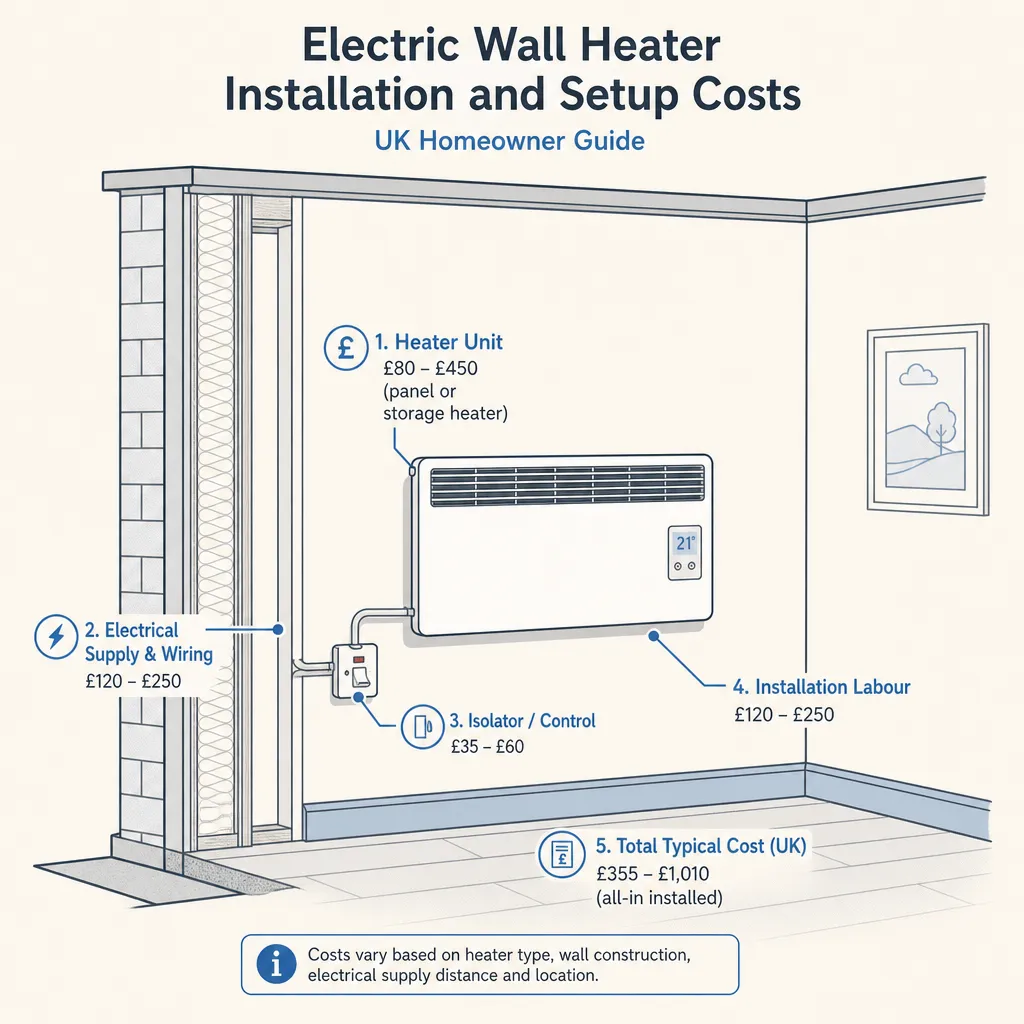
Electric Wall Heater Installation and Setup Costs
Electric wall heaters are among the most flexible heating solutions available to UK homeowners, particularly for rooms that sit outside a central heating zone or where a gas supply is unavailable. Questions about installation costs most often arise when someone is converting a garage, heating a garden room, adding warmth to a loft conversion, or replacing an ageing storage heater in an all-electric property. Getting accurate cost information upfront helps you budget correctly and avoids unexpected extras on the day of installation.
Key points
- Fixed electric wall heaters must be installed by a Part P-registered electrician under Building Regulations Part P in England and Wales; a registered competent person self-certifies the work and issues a completion certificate.
- Panel heaters (the most common choice) typically cost £150–£350 to install, excluding the unit itself; storage heaters usually cost £300–£600 to install.
- If a new dedicated spur or circuit is required, expect to add £100–£250 to the total cost.
- Storage heaters are most cost-effective when paired with an Economy 7 or Economy 10 electricity tariff, which offers cheaper overnight charging rates.
- Bathroom heater installations must comply with BS 7671 IP rating zone requirements; not all heater types are permitted in Zones 1 and 2.
Indicative UK costs, last reviewed 2026-05-06. Quotes vary by location, property type, and contractor.
Types of electric wall heater and what they cost
The term 'electric wall heater' covers several technologies with different running costs, comfort profiles, and installation requirements. The table below outlines the main options available to UK homeowners.
Heater type | Typical unit price | Typical installation cost | Best suited to | Key consideration |
|---|---|---|---|---|
Panel heater (convector) | £50–£300 | £150–£300 | Bedrooms, offices, extensions | Most common type; hardwired or plug-in models available |
Storage heater | £200–£600 | £300–£600 | Homes on Economy 7 or Economy 10 tariff | Charges overnight; modern models have improved charge controls |
Infrared radiant heater | £100–£400 | £150–£300 | Conservatories, spot heating, draughty or high-ceilinged rooms | Heats objects rather than air; efficient for occasional use |
Fan convector heater | £80–£250 | £150–£250 | Larger rooms requiring rapid warmth | Noisier than panel options; useful where fast heat-up matters |
Electric towel rail | £80–£250 | £150–£250 | Bathrooms | Must meet BS 7671 IP rating requirements for the installation zone |
Indicative UK costs, last reviewed 2026-05-06. Installation costs assume a connection to an existing nearby circuit or spur point and exclude the unit price.
What affects the total installation cost
Several factors can move the final price significantly above the base range.
New spur or dedicated circuit: If the electrician needs to run a new cable from the consumer unit to the heater location, expect to add £100–£250 depending on the distance and whether the consumer unit has spare capacity.
Consumer unit age and condition: Older fuse boards — particularly those with rewirable fuses rather than modern circuit breakers and residual current devices (RCDs) — may need replacing before additional circuits can be added safely. A full consumer unit replacement costs approximately £400–£900 and is a separate job from the heater installation.
Number of units installed: Installing two or three heaters in a single visit is usually more cost-effective per unit than separate visits, as the electrician's call-out charge is spread across the work.
Property type and access: Running cables through solid masonry walls or concrete ceilings takes longer than in a timber-framed extension or stud partition. Difficult access increases labour time and therefore cost.
Smart controls and thermostats: Many modern panel heaters include built-in smart controls, but if you want a separate programmable room thermostat wired in, agree this in advance as it adds to the labour and materials cost.
Location: London and South East day rates for electricians are typically 10–20% higher than the UK average. Rural areas may also carry a travel surcharge on top of the installation fee.
Do you need a Part P-registered electrician?
In England and Wales, Building Regulations Part P requires that fixed electrical installation work in dwellings — including hardwiring a wall heater to a dedicated spur or a new circuit — is either carried out by a registered competent person or formally notified to building control.
Using a Part P-registered electrician (registered with a competent person scheme such as NICEIC, NAPIT, or ELECSA) means they self-certify the work and issue a completion certificate at the end. This is the route most homeowners take. If the work is carried out by someone who is not registered, you or they must notify building control and pay a notification fee — typically £150–£300 — in addition to the installation cost.
Plug-in wall heaters that connect via a standard 13A plug and socket are not classified as fixed electrical installation and do not require Part P notification. However, they are less practical for primary room heating at higher wattages.
In Scotland, electrical installation work is notifiable under the Building (Scotland) Regulations 2004 and must be carried out by a registered electrician or formally notified to the relevant local authority building standards department.
Which electric wall heater should you choose?
Use this decision tree to narrow down the right option for your situation.
- Choose a panel heater if you want the most straightforward installation, the room is used intermittently, and you are on a standard single-rate electricity tariff.
- Choose a storage heater if your property already uses storage heaters, you are on or can switch to an Economy 7 or Economy 10 tariff, and you want to take advantage of cheaper overnight electricity rates.
- Choose an infrared heater if the room is draughty, has a high ceiling, or is used only occasionally — such as a conservatory or occasional home office — where heating the air would be wasteful.
- Choose an electric towel rail for bathrooms, but confirm the IP rating is suitable for the installation zone before purchasing the unit.
- Ask a registered electrician if you are unsure which circuit can accommodate the additional load, if your consumer unit is more than 25 years old, or if you are installing heaters across multiple rooms at once.
What to ask before accepting a quote
Before agreeing to any installation, use these questions to compare quotes and check credentials.
- Is the electrician registered with NICEIC, NAPIT, ELECSA, or another government-approved competent person scheme?
- Does the quote include the Part P completion certificate (self-certification)?
- Is the cost of the heater unit included, or is this a labour-only price?
- Will a new spur or circuit be required, and if so, is the cost of this included in the quote?
- Has the electrician confirmed that the consumer unit has capacity for the additional electrical load?
- Is VAT included in the quoted price?
- What guarantee is offered on the installation work, separate from the manufacturer's product warranty?
- What happens if unforeseen issues arise — for example, if the cable route is more complex than anticipated or the consumer unit needs upgrading?
When to get professional help
Any hardwired electric wall heater installation should involve a qualified, registered electrician — this is not a grey area under Building Regulations. You should also seek professional advice before proceeding if:
- Your consumer unit has rewirable fuses or is more than 25–30 years old.
- You are installing multiple heaters and are uncertain whether existing circuits can handle the combined load.
- The heater is going into a bathroom, where IP rating rules must be followed carefully.
- You are replacing storage heaters with a different heating type and want to review your electricity tariff at the same time.
- The property is a listed building or in a conservation area, where any external cable routing or visible works may require additional consent from the local planning authority.
How Housey can help
Housey helps UK homeowners find and compare qualified local tradespeople, including Part P-registered electricians. If you are planning an electric wall heater installation and want to request quotes from vetted providers in your area, Housey can connect you with relevant professionals so you can compare credentials and prices before committing.
Frequently asked questions
Does installing a plug-in electric wall heater require an electrician?
No — plug-in heaters connecting via a standard 13A socket do not require Part P notification or a registered electrician. However, the socket must be in good condition and the circuit must not be overloaded. If you have any doubt about the socket or circuit capacity, ask a registered electrician to check before use.
How long does electric wall heater installation take?
A single hardwired panel heater installation usually takes 2–4 hours if a spur point already exists nearby. If new cable needs to be run from the consumer unit, allow 4–8 hours. Installing multiple heaters in one visit is more time-efficient than separate visits, and often more cost-effective per unit.
Can electric wall heaters be installed in bathrooms?
Yes, but with restrictions. Electric heaters in bathrooms must have an appropriate IP (ingress protection) rating for their installation zone, as defined by BS 7671. Towel rails and panel heaters designed for bathrooms are available, but they must be installed by a qualified electrician who can confirm compliance with the relevant zone requirements.
Are storage heaters worth installing in 2026?
Modern storage heaters with advanced charge control and automatic weather compensation are significantly more controllable than older models. They are most cost-effective on Economy 7 or Economy 10 tariffs. Whether they are appropriate depends on your available tariff options, the property's insulation level, and how each room is used. An energy adviser or heating engineer can help you compare options before committing.
Is VAT charged on electric wall heater installation?
In most cases, yes — installation by a VAT-registered electrician is subject to 20% VAT. Certain energy-saving measures may qualify for a reduced or zero VAT rate, but electric resistance heaters generally do not qualify. Always confirm the VAT position with your installer before agreeing to the quote.
Sources and further reading
- Competent person schemes — GOV.UK
- Electric heating guidance — Energy Saving Trust
- BS 7671 Requirements for Electrical Installations (IET Wiring Regulations) — IET
- Energy price cap and tariff information — Ofgem
Useful next reads
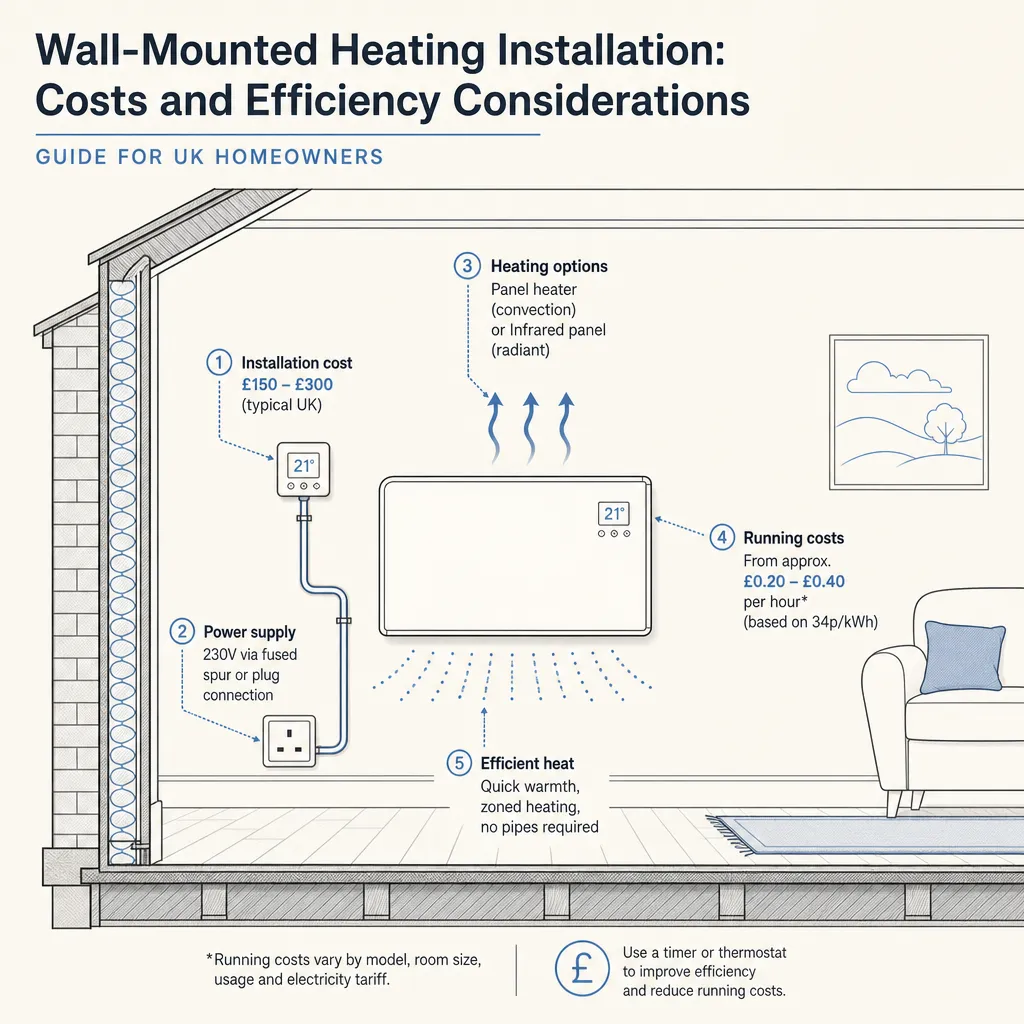 Energy & Retrofit
Wall-Mounted Heating Installation: Costs and Efficiency Considerations
Wall-mounted electric heaters fall into three main types: convection panel heaters, infrared panels, and electric wall radiators.
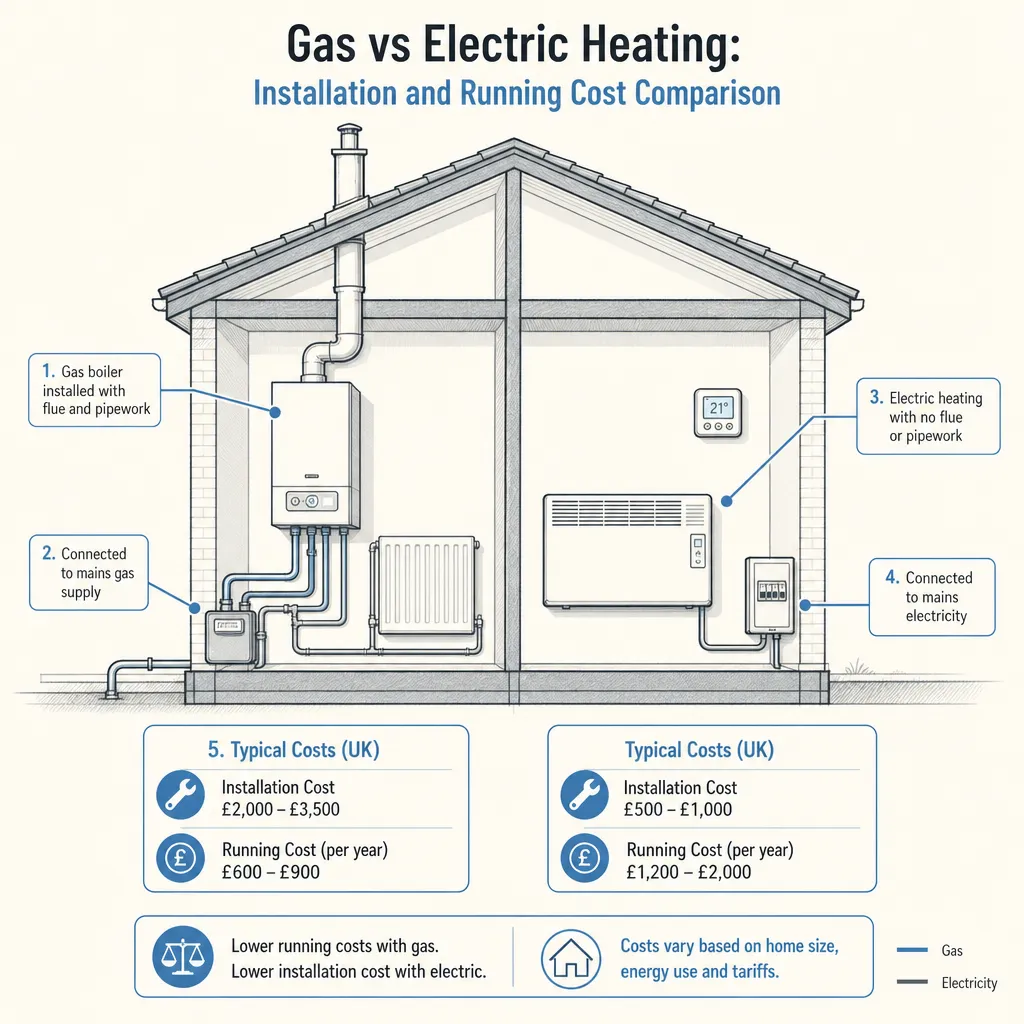 Energy & Retrofit
Gas vs Electric Heating: Installation and Running Cost Comparison
Gas central heating usually has lower running costs per kWh than direct electric heating in the UK, though heat pumps can change that equation.
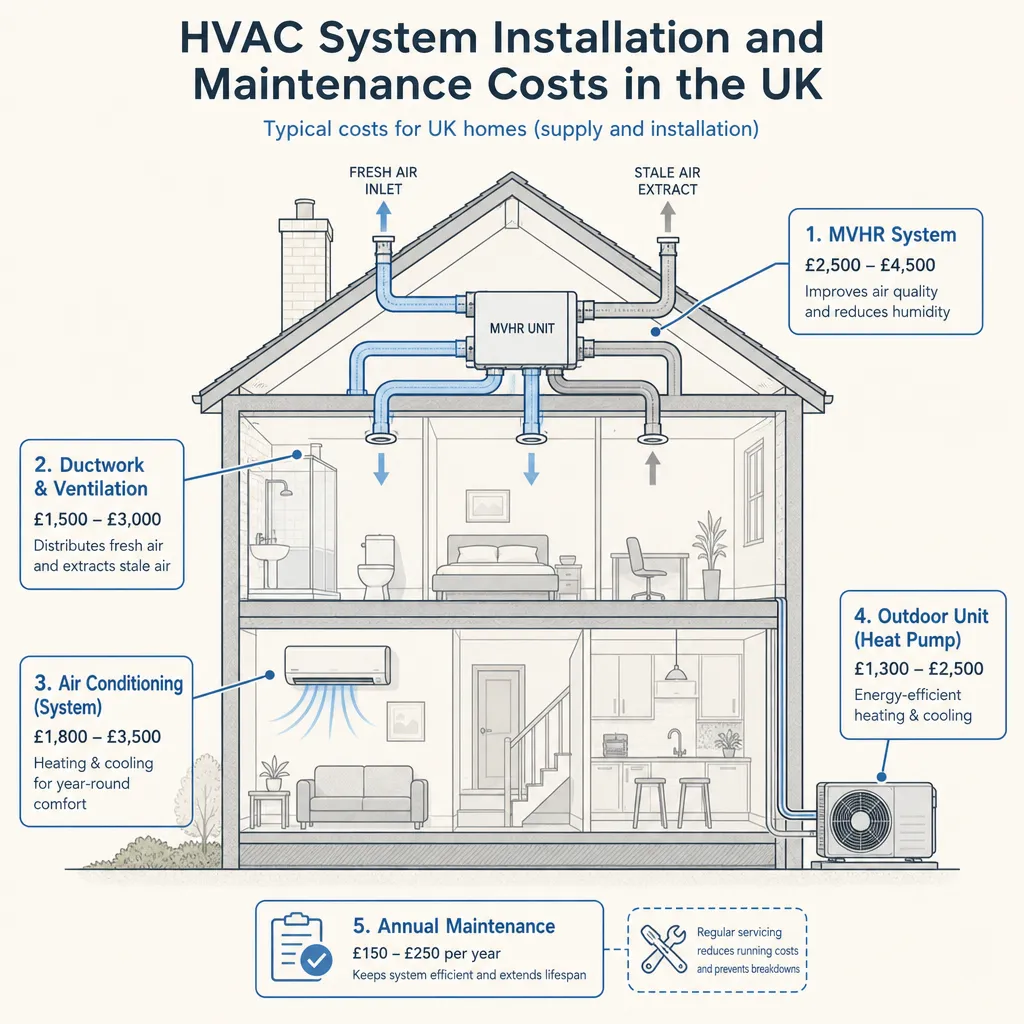 Energy & Retrofit
HVAC System Installation and Maintenance Costs in the UK
HVAC costs in UK homes vary by system type.
 Energy & Retrofit
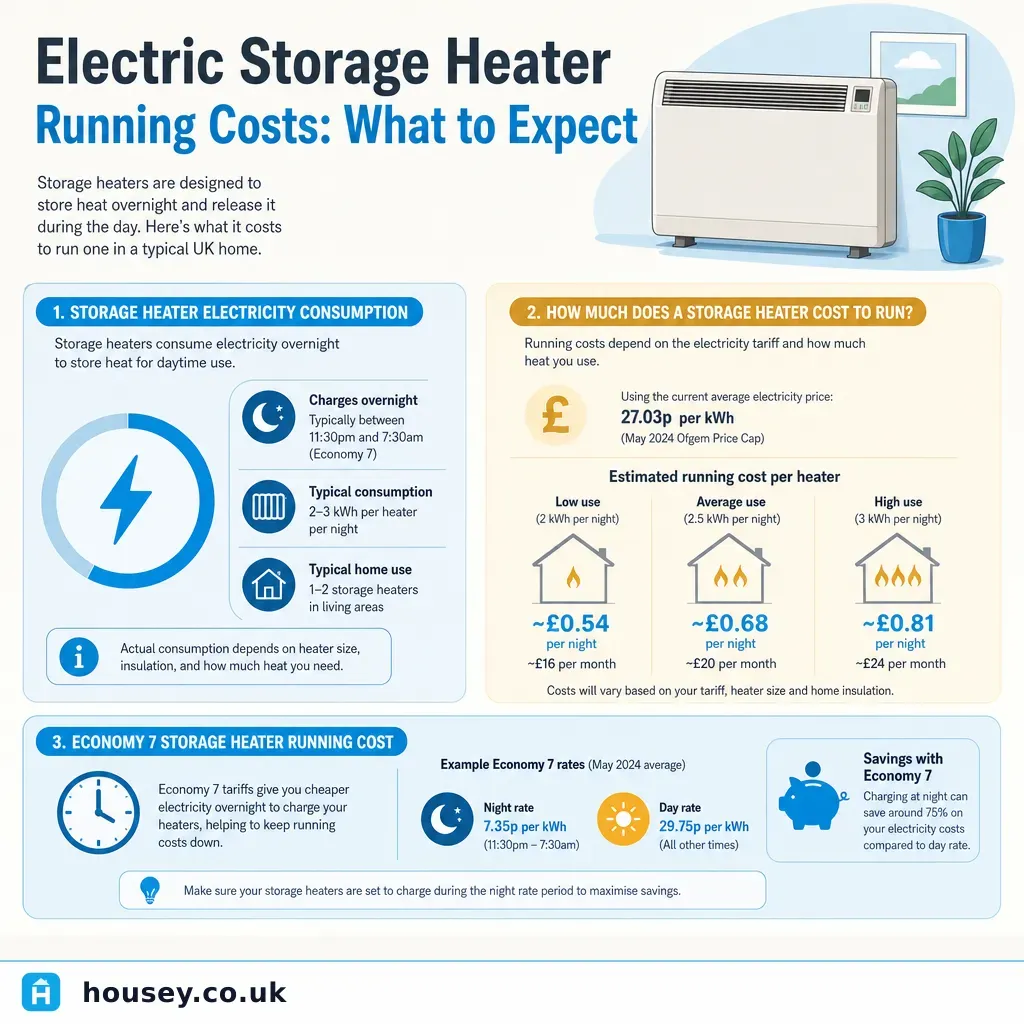
Electric Storage Heater Running Costs: What to Expect
Electric storage heaters typically cost £84–£572 per heater per year to run, depending on size and off-peak tariff rate.
 Energy & Retrofit
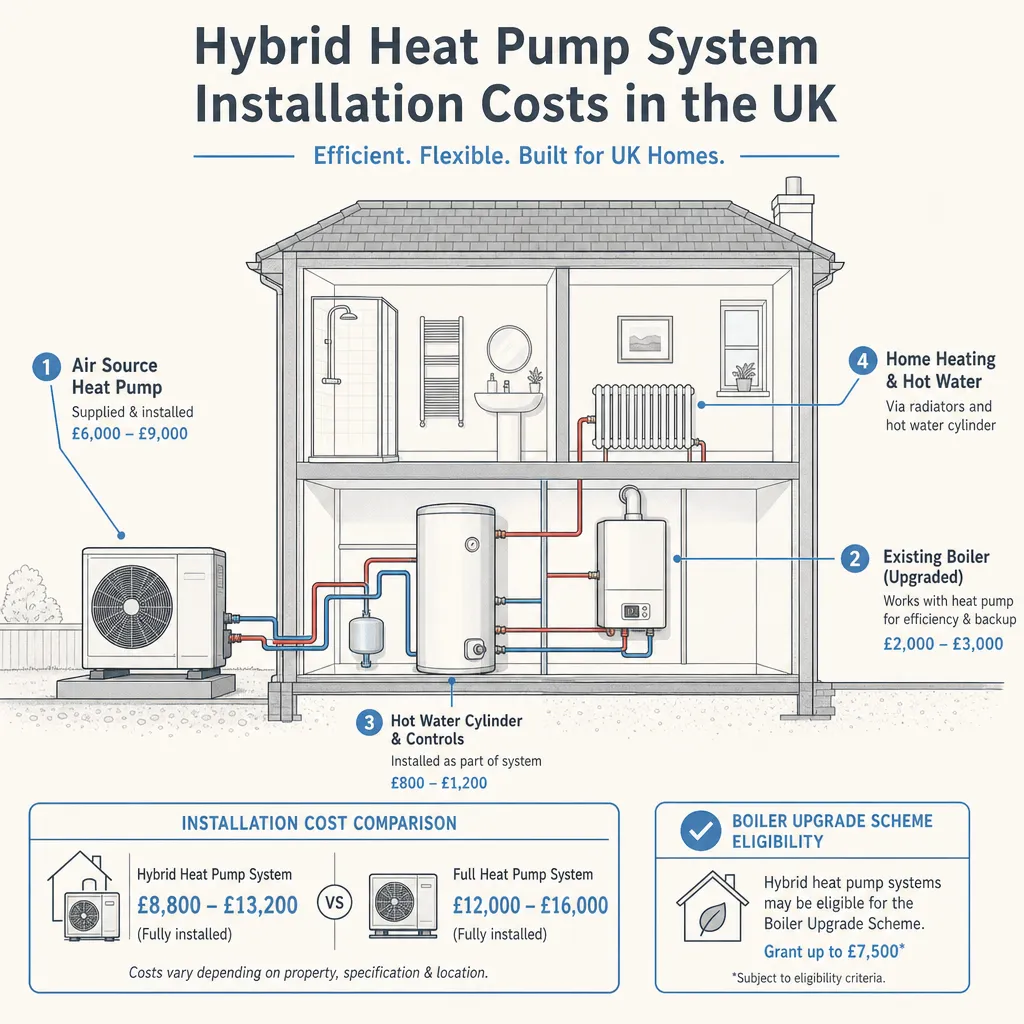
Hybrid Heat Pump System Installation Costs in the UK
A hybrid heat pump — pairing an air source heat pump with an existing gas boiler — typically costs £4,000–£10,000 installed in the UK before any grant deductions.