Electric Vehicles as Backup Power: V2H Technology and Viability in the UK
By Housey · Last reviewed 11th of May 2026
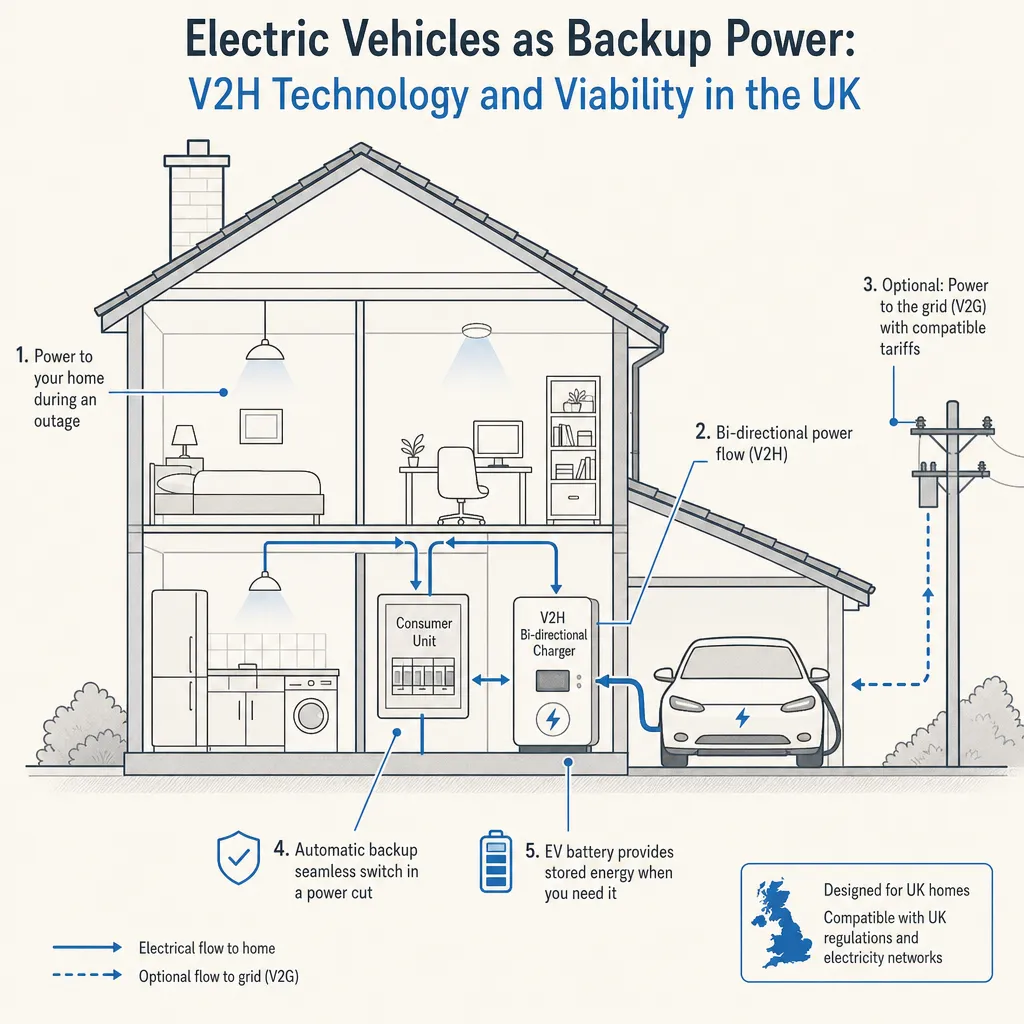
Electric Vehicles as Backup Power: V2H Technology and Viability in the UK
Vehicle-to-Home (V2H) technology is attracting growing interest among UK homeowners as electric vehicles become mainstream and energy resilience moves up the agenda following recent periods of grid volatility and high electricity prices. The idea — using the large battery already installed in an EV to supply electricity to your home during a grid outage, or to discharge cheap overnight charge during expensive peak evening hours — is technically sound and commercially available, but the UK rollout is still at an early stage. A limited number of compatible vehicles and chargers are on the market, and the regulatory process for connecting bidirectional equipment to the grid adds a step that many homeowners do not anticipate. Understanding what V2H requires, what it can and cannot do, and how it differs from Vehicle-to-Grid and standalone home battery storage will help you decide whether to invest now or plan for it in your next EV or charger purchase.
Key points
- Vehicle-to-Home (V2H) discharges EV battery power to the home only; Vehicle-to-Grid (V2G) additionally exports power to the national grid — the two require different charger specifications and grid connection approvals.
- V2H requires a bidirectional charger (sometimes called a bi-di charger), a compatible EV with a supported connector type, and in most cases a G99 or G100 grid connection notification approved by your Distribution Network Operator (DNO).
- As of May 2026, the most established UK-compatible V2H combination is the Nissan Leaf (CHAdeMO port) with the Nissan EV Power Station charger; broader CCS bidirectional support is being rolled out across the industry.
- A typical 40–80 kWh EV battery can supply an average UK household (consuming roughly 8–10 kWh per day) for four to ten days with careful load management.
- Smart EV tariffs such as Octopus Intelligent and OVO Drive + Save can reduce charging costs significantly; V2H adds a further layer of value by allowing discharge during expensive peak-rate evening hours.
How V2H works
A standard EV charger is unidirectional — electricity flows from the grid to the vehicle's battery only. A bidirectional charger reverses this flow under controlled conditions, drawing power from the EV battery and converting it to AC electricity for the home's consumer unit.
In a V2H setup the typical sequence is:
- The EV charges overnight, usually on a cheap off-peak tariff.
- During the day, or during a grid outage, the bidirectional charger draws power from the EV battery.
- An automatic transfer switch (ATS) or a home energy management system (HEMS) manages the switchover between grid supply and EV power, preventing backfeed to the street network.
- The vehicle's battery management system (BMS) communicates with the charger to prevent over-discharge below the owner-configured minimum reserve (typically 20–30%).
V2H does not require a separate home battery — though the two can be combined for greater resilience. The key dependency is that the car must be parked, connected, and sufficiently charged for the system to function.
V2H, V2G, and home battery storage: which suits you?
Technology | How it works | Best for | Key requirement | Typical installed cost (indicative, 2026-05-11) |
|---|---|---|---|---|
V2H (Vehicle-to-Home) | EV battery → home circuit only | Backup power, peak-shifting, households with a compatible EV | Bidirectional charger + compatible EV | £3,000–£6,000 |
V2G (Vehicle-to-Grid) | EV battery → home + grid export | Energy arbitrage, DNO flexibility contracts, export income | V2G-certified charger + DNO agreement + smart meter | £4,000–£8,000+ |
Home battery storage | Dedicated battery unit, independent of vehicle | Always-available backup, solar self-consumption | Battery unit + hybrid inverter | £5,000–£12,000 installed |
Smart EV charging only | Cheap overnight charging, no discharge | Reducing EV running costs with no other change | Smart charger + compatible tariff | £750–£1,500 installed |
Indicative UK costs, last reviewed 2026-05-11. Prices vary by installer, property configuration, and DNO requirements.
Which EVs support V2H in the UK?
As of May 2026, bidirectional charging support in the UK market is limited but expanding:
- Nissan Leaf (2013–present, CHAdeMO port) — the most established V2H-compatible vehicle in the UK; works with the Nissan EV Power Station charger.
- Nissan Ariya — supports bidirectional charging; check the specific trim and market variant.
- Mitsubishi Outlander PHEV — limited V2H support with a compatible charger; smaller battery capacity than pure EVs.
- Volkswagen ID. series (CCS) — CCS bidirectional charging being progressively rolled out in European markets; confirm UK market availability before purchasing equipment.
- Most current Tesla models — do not support V2H or V2G as of mid-2026; Tesla's own Powerwall home battery is a separate product.
The CCS connector standard is expected to enable bidirectional charging across a much wider range of vehicles from 2025–2027. If you are choosing an EV within the next 12 months and V2H is a priority, check bidirectional capability in the manufacturer's UK specification before purchasing.
Decision tree: is V2H viable for you right now?
- Proceed with V2H installation if you already own a Nissan Leaf (CHAdeMO) or another confirmed UK-compatible bidirectional EV, your DNO serves an area where G99/G100 connections are routinely approved for domestic installations, and backup power or peak-shifting is a clear priority.
- Plan for V2H compatibility if you are choosing a new EV within 12 months — research bidirectional support before purchasing and ask your electrician to position the charger cabling and consumer unit connections for future bidirectional upgrade.
- Consider a dedicated home battery instead if backup power is the primary goal and your current EV is not V2H-compatible — a system from a battery storage installer provides the same resilience without dependence on the car being present and charged.
- Start with a smart EV charger if V2H is interesting but upfront cost is a constraint — a well-positioned smart installation from a qualified EV charger installer can often be upgraded to bidirectional capability later if the wiring and consumer unit position are correctly planned.
- Consult your DNO early if you are in an area with known network constraints — grid connection approval timelines vary by region and network operator.
Installation requirements and regulations
V2H installation in the UK involves several regulatory steps that are distinct from a standard EV charger installation:
- Electrical installation: must be carried out by a qualified electrician registered under a Part P competent person scheme (NICEIC, NAPIT, or similar). Consumer unit work and bidirectional wiring must be correctly specified for reverse current flow.
- DNO notification: under Engineering Recommendation G99 (for installations above 3.68 kVA single-phase) or G100 (for newer smart generation equipment), you must notify and receive approval from your Distribution Network Operator before connecting V2H or V2G equipment. Your installer should manage this process — confirm it is in scope before signing a contract.
- Planning permission: most domestic EV charger installations are permitted development under Part 2 of the Town and Country Planning (General Permitted Development) (England) Order 2015. A bidirectional charger for domestic use is unlikely to need a planning application unless the property is listed or in a Conservation Area.
- Grant schemes: the Electric Vehicle Homecharge Scheme (EVHS) grant for homeowners ended in 2022, though it remains available for flat owners and renters. Check current GOV.UK guidance for any successor schemes applicable to bidirectional equipment.
Homeowner checklist: before commissioning V2H
When to get professional help
V2H installation should always be carried out by a qualified, registered electrician — this is not a DIY project. Key professional touchpoints include a NICEIC or NAPIT-registered electrician for all consumer unit and charger installation work, your installer for managing DNO G99/G100 notification (confirm this is in scope), and an independent energy consultant if you are weighing V2H against home battery storage or a full solar-plus-storage system.
Red flags: any installer who does not mention DNO notification as part of the process; claims that V2H works with any EV without checking the specific model's UK specification; or cannot provide their NICEIC or NAPIT registration number on request.
How Housey can help
Housey connects you with accredited EV charger installers who can advise on bidirectional-ready installations and V2H compatibility for your specific vehicle, and with battery storage installers if a standalone home battery better suits your resilience goals. Compare quotes and find specialists who understand the DNO notification process and can manage it as part of the installation scope.
Frequently asked questions
Which electric cars support V2H charging in the UK?
As of May 2026, the most established V2H-compatible vehicle in the UK is the Nissan Leaf (CHAdeMO port), used with the Nissan EV Power Station charger. The Nissan Ariya also supports bidirectional charging. Broader CCS bidirectional support is in development across several manufacturers; always check your specific model's UK specification before purchasing V2H equipment, as compatibility varies by market and model year.
How much backup power can an EV provide for a UK home?
A 40 kWh EV battery can supply a typical UK household consuming 8–10 kWh per day for roughly four to five days with careful load management, avoiding high-demand appliances such as electric showers and ovens. An 80 kWh battery extends this to eight to ten days. Most V2H systems allow the owner to set a minimum charge reserve so the vehicle remains driveable throughout.
Do I need DNO approval for a V2H charger?
Yes. Connecting a bidirectional charger to the domestic grid requires notification to your Distribution Network Operator under G99 or G100 regulations, depending on the system's output rating. Your installer should manage this process as part of the installation scope — confirm it is included before signing a contract. Installing a bidirectional charger without DNO approval is non-compliant and may affect your buildings insurance.
Is V2H the same as having a home battery storage system?
No. V2H uses your EV's existing battery as a temporary power source, meaning available energy depends on whether the car is parked, charged, and connected. A dedicated home battery such as a GivEnergy or Powerwall unit is always available regardless of vehicle presence. For maximum energy resilience, some homeowners combine V2H with a separate home battery, though this significantly increases total system cost.
What does a V2H installation cost in the UK?
A bidirectional charger and full installation typically costs £3,000–£6,000 depending on the charger model chosen, the amount of consumer unit work required, and the complexity of the DNO notification process. These are indicative UK costs, last reviewed 2026-05-11. Always get at least three quotes from NICEIC or NAPIT-registered installers who have specific V2H installation experience.
Sources and further reading
- Government grants for low-emission vehicles — GOV.UK
- Energy Networks Association: G99 and G100 connection standards — Energy Networks Association
- Find a registered electrician — NICEIC
- Smart EV charging and vehicle-to-grid — Energy Saving Trust
- Ofgem: smart metering and vehicle-to-grid — Ofgem
- Bidirectional charging in the UK — Zap-Map
Useful next reads
 Energy & Retrofit
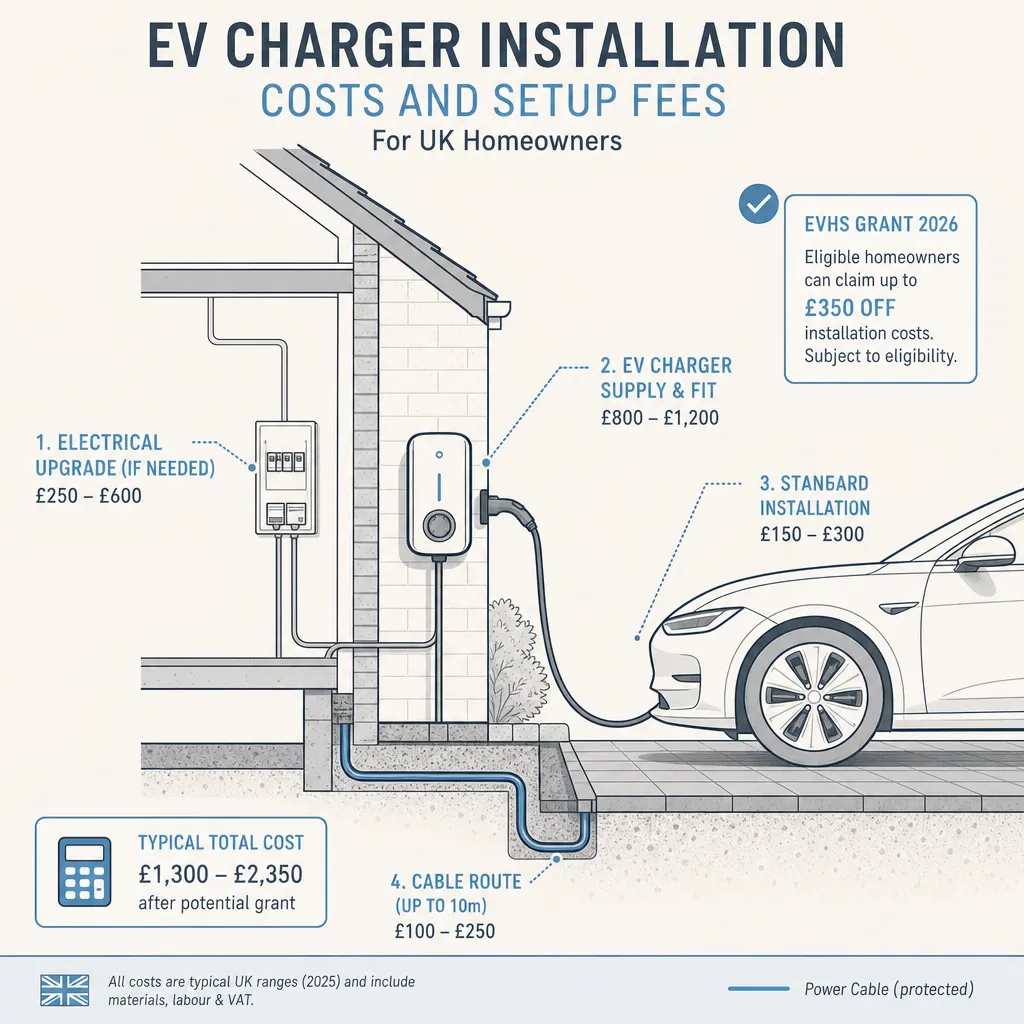
EV Charger Installation Costs and Setup Fees
A home EV charger typically costs £700–£1,200 installed in the UK, including unit and labour.
 Energy & Retrofit
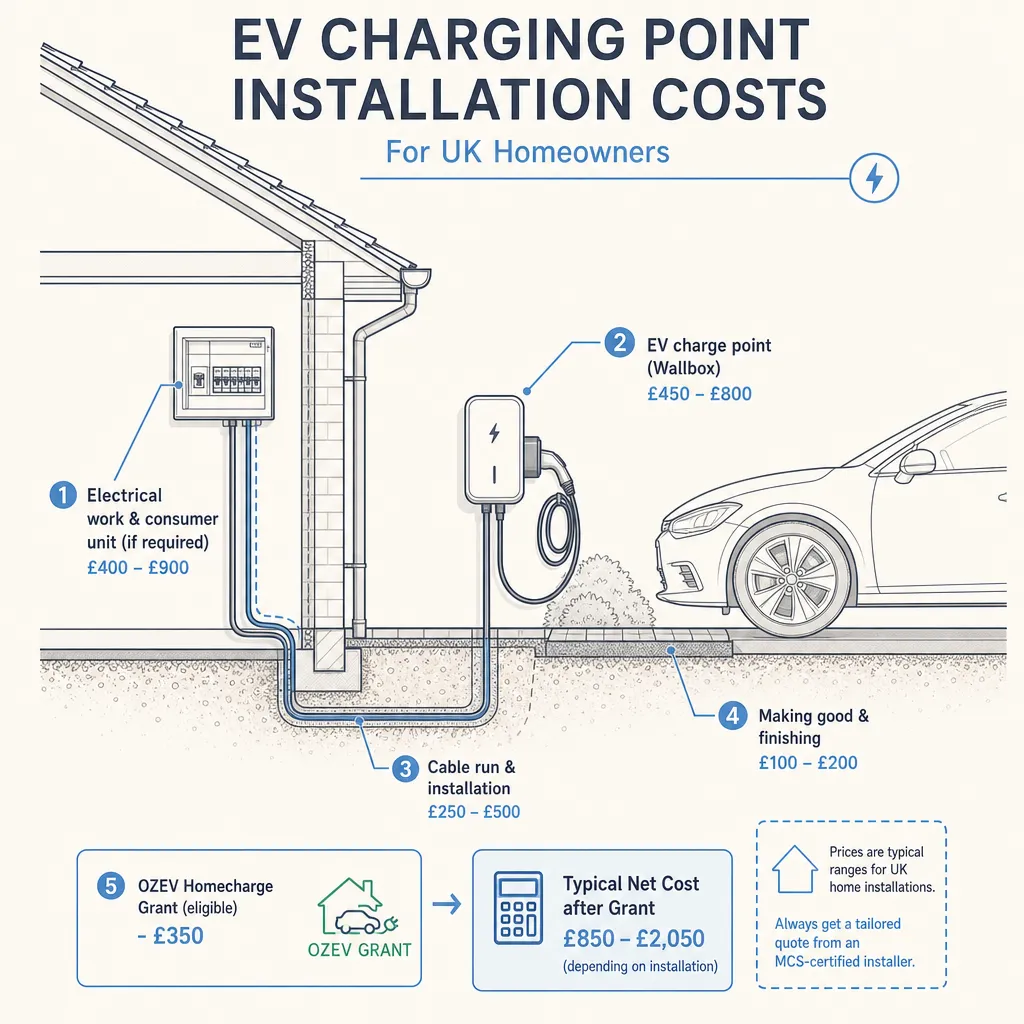
EV Charging Point Installation Costs
A home EV charging point in the UK typically costs £800 to £1,200 for a 7 kW smart wallbox including installation.
 Energy & Retrofit
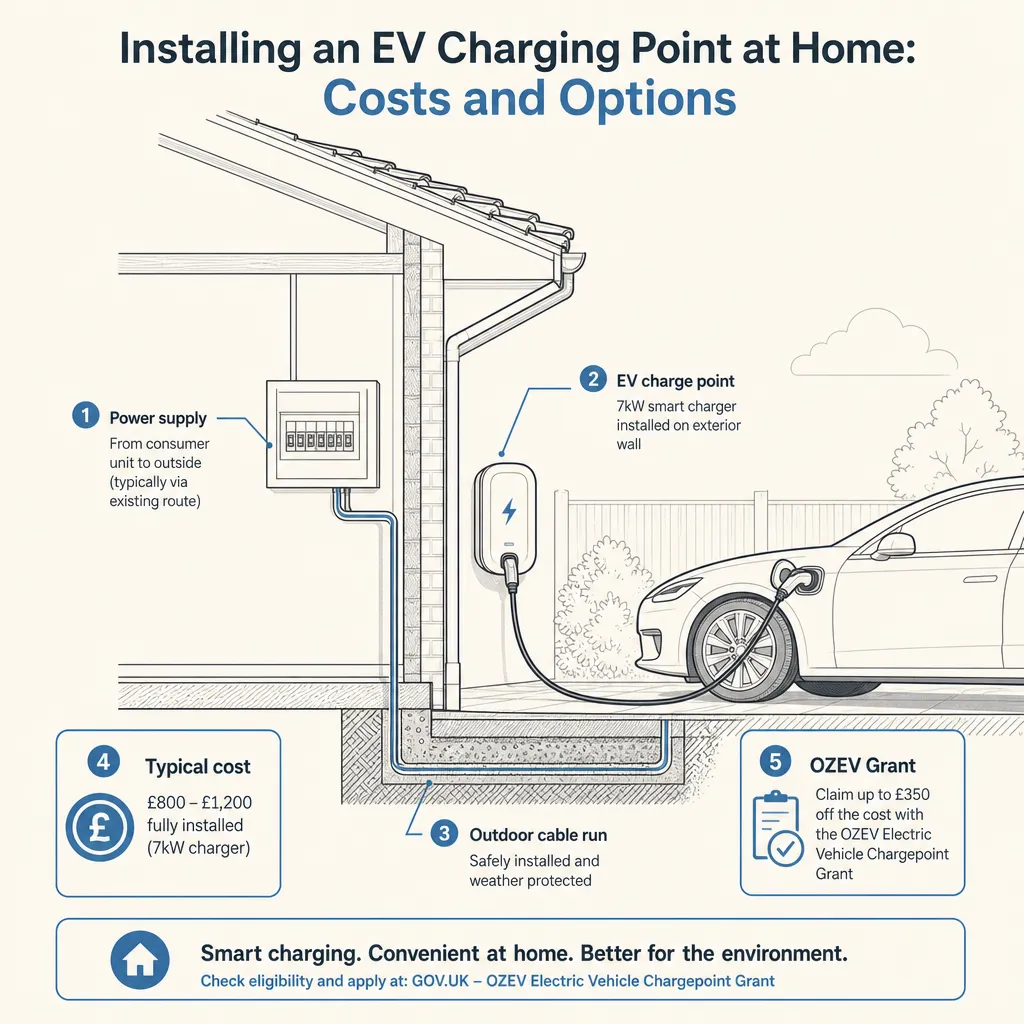
Installing an EV Charging Point at Home: Costs and Options
Installing a home EV charging point in the UK typically costs £300–£800 after the OZEV Electric Vehicle Chargepoint Grant of up to £350.
 Energy & Retrofit
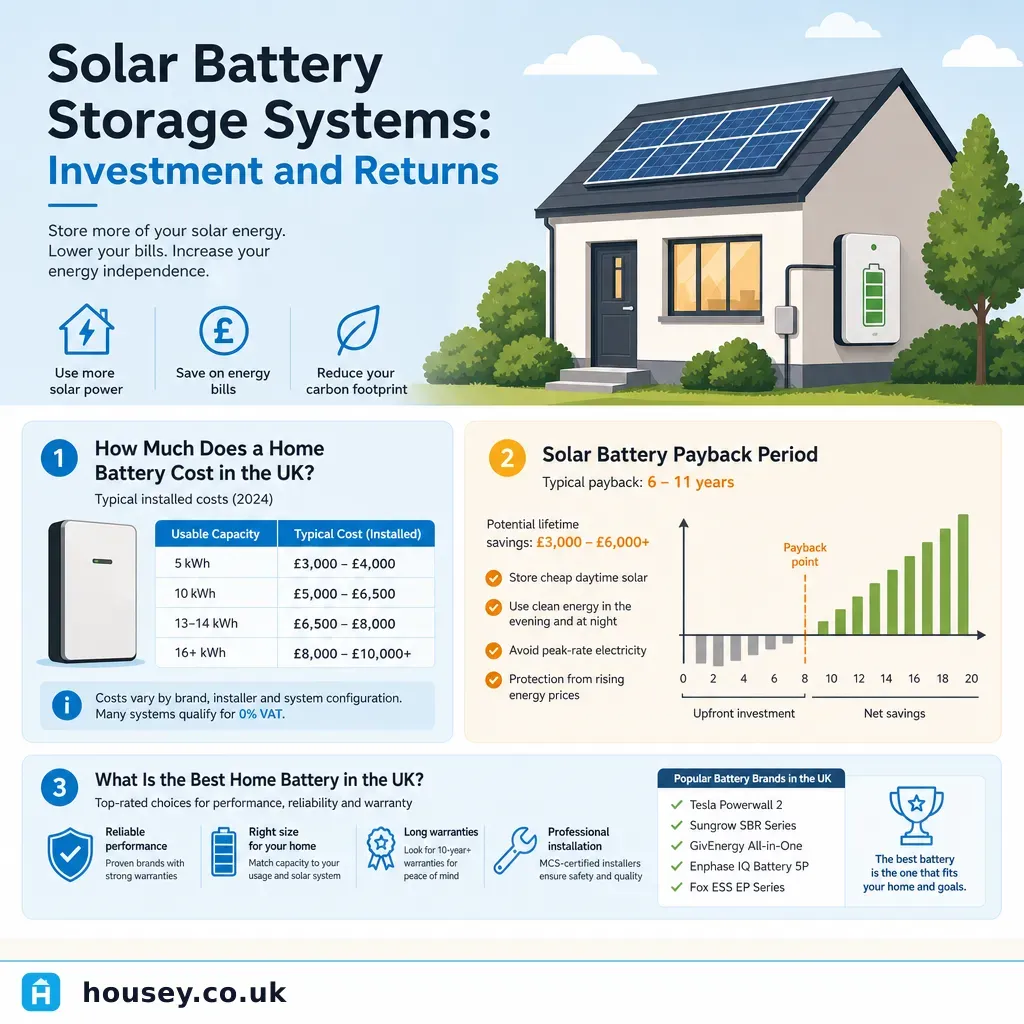
Solar Battery Storage Systems: Investment and Returns
A home battery storage system stores surplus solar energy for use in the evening, reducing grid electricity imports.
 Energy & Retrofit
Maximising Energy Efficiency: Smart Tips for UK Homes
Improving energy efficiency in a UK home typically starts with draught-proofing and loft insulation — the measures with the fastest payback — before moving to wall insulation, heating system upgrades, and low-carbon technologies such as heat pumps or solar panels.