EV Charger Installation Costs and Setup Fees
By Housey · Last reviewed 6th of May 2026
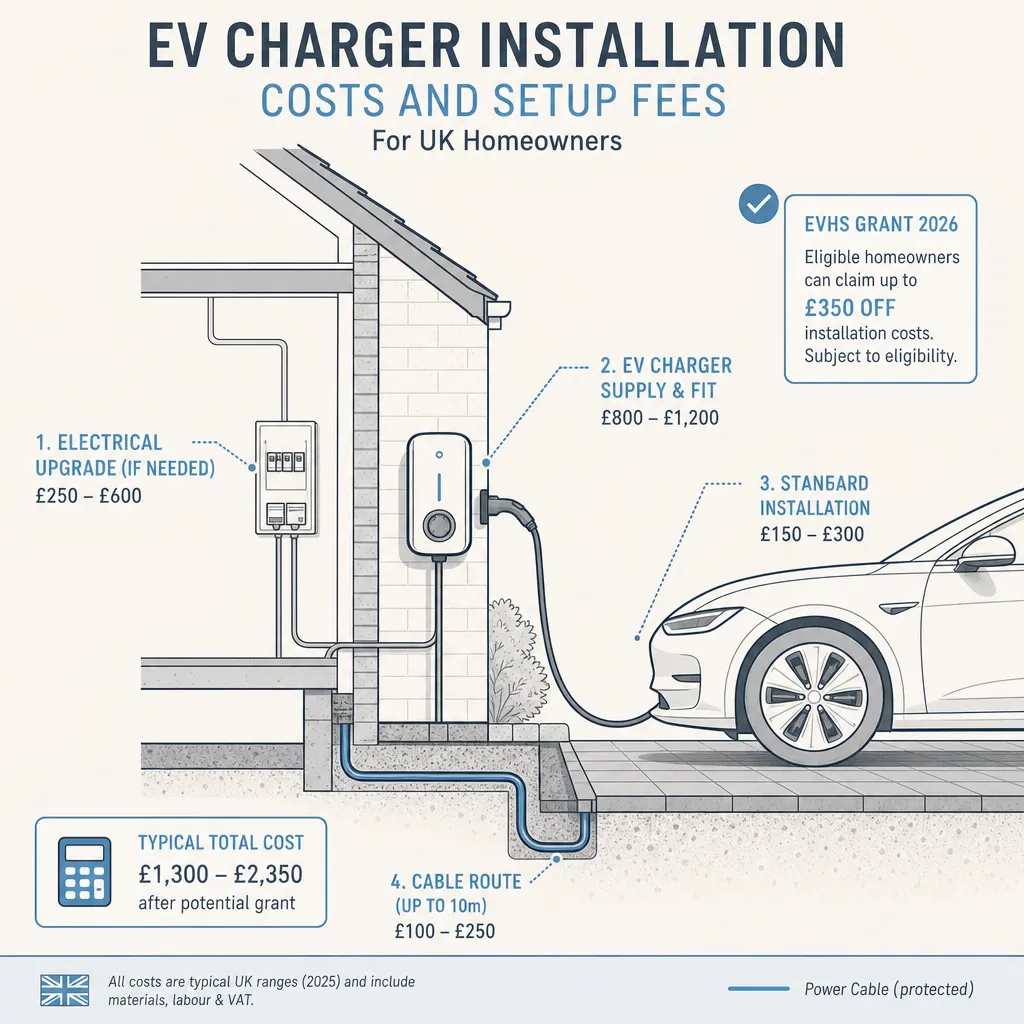
EV Charger Installation Costs and Setup Fees
Most homeowners start thinking about a home charging point as soon as they order or take delivery of an electric vehicle — and the costs involved are often less straightforward than manufacturers' brochures suggest. The price depends on where your consumer unit is located, how far the cable needs to run, and what condition your existing electrical setup is in. Understanding the real cost breakdown helps you request meaningful quotes rather than being surprised once an installer visits.
Key points
- All new domestic EV chargepoints must be smart chargers under the Electric Vehicles (Smart Charge Points) Regulations 2021 — installations that do not comply are not eligible for OZEV grants.
- The Electric Vehicle Homecharge Scheme (EVHS) offers up to £350 (capped at 75% of the installed cost) for eligible renters and flat or apartment owners — homeowners of detached, semi-detached, or terraced houses lost access to this grant in April 2022.
- A typical 7kW home chargepoint installation costs £700–£1,200 all-in, though this rises if your consumer unit needs upgrading or the cable run is long (indicative UK costs, last reviewed 2026-05-06).
- Your chargepoint must be connected to a dedicated circuit from the consumer unit; sharing a ring main is not acceptable and does not meet the Regulations.
- Planning permission is not usually required for a home EV charger under Class A, Part 2, Schedule 2 of the Town and Country Planning (General Permitted Development) (England) Order 2015, though listed buildings and some conservation areas may be exceptions.
What affects EV charger installation cost?
Several factors shape how much you will actually pay once an OZEV-authorised installer surveys your property.
Cable run length The installer runs a dedicated cable from your consumer unit to the charger location — typically on an outside wall, in a garage, or on a driveway. A short run of 5–10 metres is considerably cheaper than a 25–30 metre run through a garage or below a path, where additional containment and labour add to the bill.
Consumer unit condition If your consumer unit is old, lacks spare capacity, or needs replacing to accommodate a new dedicated circuit, expect additional costs of £300–£700 or more. An installer should assess this during a pre-install survey before confirming a final price.
Charger type and brand A 7kW single-phase charger is the standard domestic recommendation and the most common install. Popular OZEV-approved brands include Ohme, Andersen, Wallbox, Pod Point, and myenergi Zappi. Unit prices vary by brand and feature set; smart features such as solar integration and time-of-use tariff scheduling affect the unit cost.
Groundwork or ducting Running cables underground to a detached garage or across a courtyard may require groundwork, adding significantly to the total cost depending on surface type and distance.
Tethered vs untethered Tethered units have a cable permanently attached; untethered units have a socket that accepts any compatible Type 2 cable. Tethered units suit households with one EV type and offer daily convenience; untethered suits mixed fleets or households expecting to change vehicles.
Typical EV charger installation costs in the UK
The table below gives indicative price ranges for common domestic scenarios. Always compare multiple quotes — prices vary by installer and region.
Scenario | Approximate installed cost |
|---|---|
Standard 7kW unit, short cable run, modern consumer unit with spare capacity | £700–£900 |
7kW unit, cable run of 15–25 m, consumer unit has capacity | £900–£1,200 |
7kW unit plus consumer unit upgrade required | £1,200–£1,800 |
7kW unit plus underground cable run to detached garage | £1,400–£2,500+ |
Premium-brand charger (e.g. Andersen A2) with longer or complex install | £2,000–£3,000+ |
Indicative UK costs, last reviewed 2026-05-06. Prices exclude VAT unless stated. VAT on domestic EV charger installations is currently 5% under HMRC's reduced rate for energy-saving materials.
EVHS grant: who qualifies in 2026?
The Electric Vehicle Homecharge Scheme (EVHS) is administered by the Office for Zero Emission Vehicles (OZEV). It provides a grant of up to £350, or 75% of the total installed cost (whichever is lower), towards a qualifying home chargepoint.
Eligible applicants:
- Flat or apartment owners (owner-occupier or shared ownership)
- Tenants in rented accommodation (house or flat)
- Property must have usable off-street parking
- Applicant must own, lease, or have on order a qualifying electric or plug-in hybrid vehicle
Not eligible:
- Owner-occupiers of detached, semi-detached, or terraced houses (grant access closed April 2022)
- Properties without off-street parking
The grant is claimed by your OZEV-authorised installer on your behalf — you do not apply separately. The installer submits the claim and your invoice reflects the reduced amount.
Check the current GOV.UK EVHS guidance before assuming eligibility, as scheme rules are subject to change.
Which charger setup is right for you?
- Choose a standard 7kW tethered home charger if you have one EV, park consistently in the same spot, and want the most convenient daily setup.
- Choose a 7kW untethered charger if you have more than one EV with different connector types, or want flexibility with charging cables.
- Consider a solar-integrated smart charger (such as the myenergi Zappi) if you have or plan to install solar panels and want to charge from surplus generation during the day.
- Ask your installer about load management if you also run a heat pump, electric oven, or other high-draw appliances — simultaneous use can strain a standard domestic supply.
- Check with your Distribution Network Operator (DNO) before installing if your property has an older single-phase 60A supply, as a 7kW charger can represent a significant additional load.
- Speak to your managing agent or freeholder before instructing an installer if you live in a leasehold flat — consent is usually required for any external installation.
What to ask before accepting a quote
- Is the installer OZEV-authorised? (Required for EVHS grant eligibility and a recommended minimum quality indicator.)
- Will a pre-install survey be carried out before a final price is confirmed?
- Is a consumer unit assessment included in the scope of work?
- What charger model is quoted, and is it on the current OZEV approved product list?
- How long is the cable run, and how will it be routed and protected?
- What warranty covers the unit and the installation workmanship?
- Is VAT at 5% correctly applied in the quoted price?
- Does the installation include notification under Part P of the Building Regulations, where required, and which party is responsible for this?
- What assumptions is the quote based on — and what could change the final price?
When to get professional help
EV charger installation always requires a qualified electrician; this is not DIY work. Seek independent electrical advice before instructing an installer if:
- Your consumer unit is more than 15 years old or uses rewirable fuses.
- Your property has aluminium wiring, present in some 1960s–1970s homes.
- You are a leaseholder and need freeholder or managing agent consent before the work can proceed.
- You are renting and need written landlord permission for both the installation and any EVHS grant claim.
- You want to combine EV charging with solar panels, battery storage, or a heat pump on the same supply — this may require a more detailed electrical design assessment.
How Housey can help
Finding a qualified, OZEV-authorised installer is straightforward when you can compare quotes from vetted professionals. Housey connects you with EV charger installers who carry out pre-install surveys, advise on grant eligibility, and provide itemised quotes so you can compare like-for-like before committing to any work.
Frequently asked questions
Do I need planning permission for a home EV charger?
Usually not. Home EV chargers are generally covered by permitted development rights in England under Class A, Part 2, Schedule 2 of the Town and Country Planning (General Permitted Development) Order 2015. Listed buildings and properties in designated areas such as conservation areas or National Parks may require consent. Always check with your local planning authority if in doubt.
How long does EV charger installation take?
A straightforward installation typically takes two to four hours. More complex installs — consumer unit upgrades, underground cable runs, or long cable routes through a property — may take a full day or require a return visit. Your installer should provide a realistic timeframe after completing the pre-install survey.
Can I charge my EV using a standard three-pin plug at home?
Yes, using a Mode 2 cable supplied with most EVs, but it is slow — typically six to ten miles of range per hour from a 13A socket. A 7kW home chargepoint adds around 25–30 miles per hour of charge and is safer and faster for regular overnight use. Long-term daily charging from a domestic socket is not recommended without professional assessment of the socket and circuit.
Is VAT charged at the full rate on EV charger installation?
Domestic EV charger installations currently attract VAT at 5% rather than 20%, qualifying under HMRC's reduced rate for energy-saving materials. Always confirm with your installer that the quoted price reflects the correct VAT rate before accepting, as errors in VAT treatment do occur.
What if my flat's freeholder won't agree to an EV charger installation?
Freeholder consent is usually required for physical alterations in leasehold properties. Raise the matter formally in writing, referencing the EVHS grant if you are eligible. If consent is unreasonably withheld, you may have recourse under the terms of your lease or through the First-tier Tribunal (Property Chamber). Consider seeking legal advice if the freeholder refuses without a substantive reason.
Sources and further reading
- Electric Vehicle Homecharge Scheme — GOV.UK / OZEV
- Electric Vehicles (Smart Charge Points) Regulations 2021 — legislation.gov.uk
- Office for Zero Emission Vehicles — GOV.UK
- Charging your electric vehicle at home — Energy Saving Trust
- VAT on energy-saving materials and heating equipment (Notice 708/6) — HMRC
Useful next reads
 Energy & Retrofit
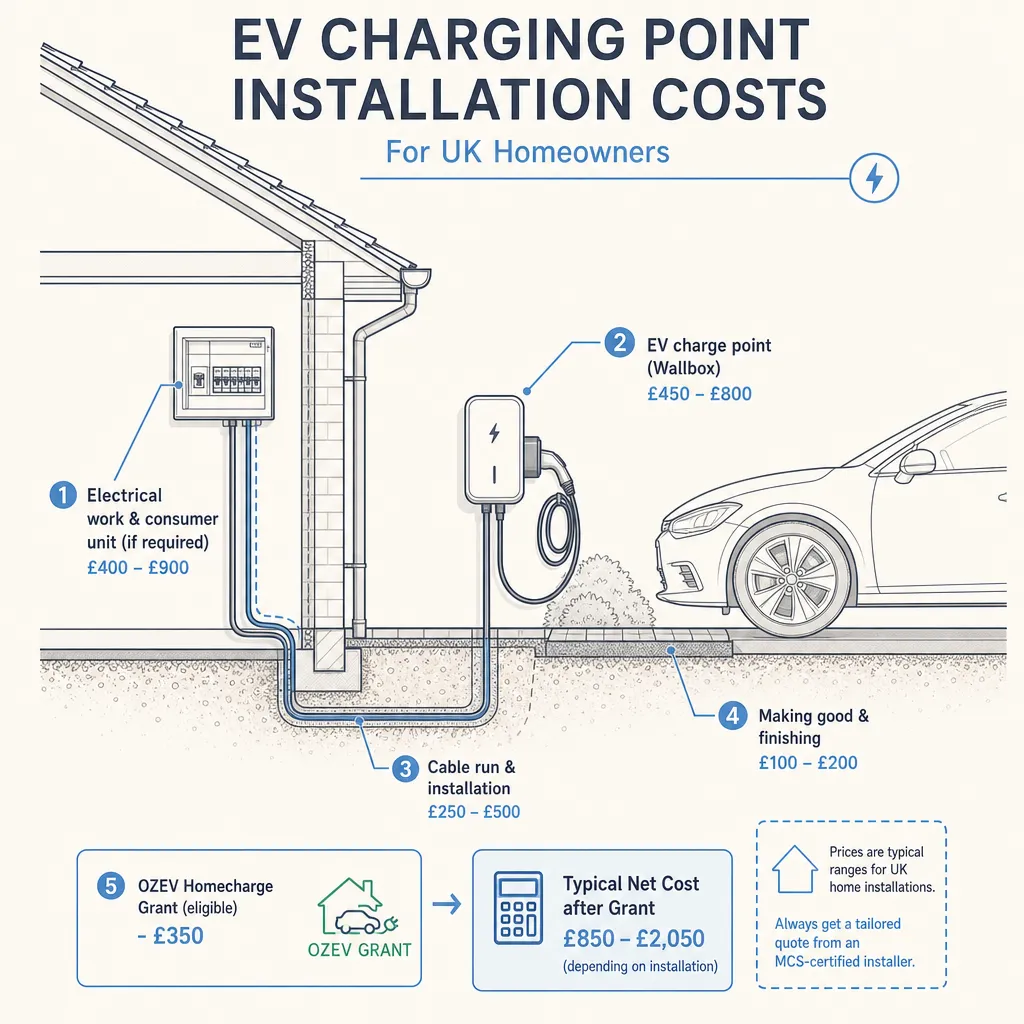
EV Charging Point Installation Costs
A home EV charging point in the UK typically costs £800 to £1,200 for a 7 kW smart wallbox including installation.
 Energy & Retrofit
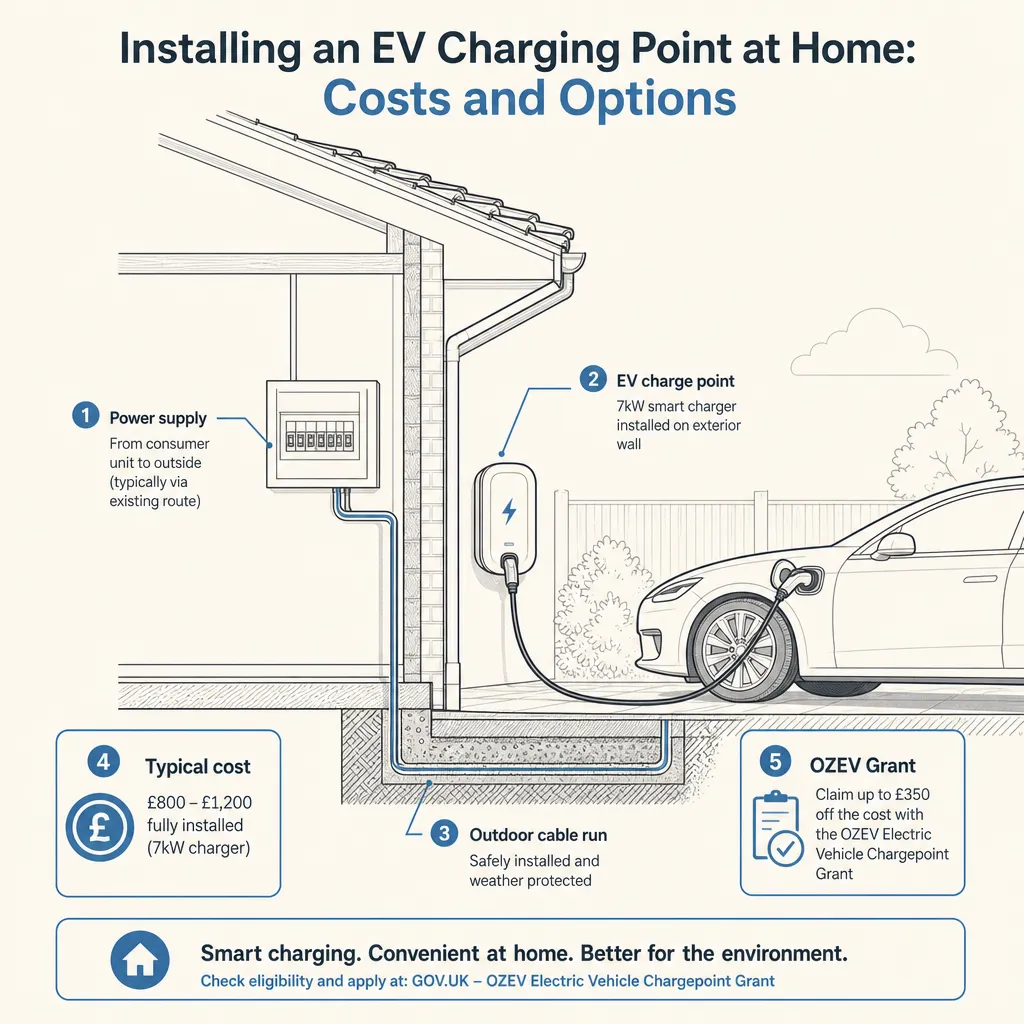
Installing an EV Charging Point at Home: Costs and Options
Installing a home EV charging point in the UK typically costs £300–£800 after the OZEV Electric Vehicle Chargepoint Grant of up to £350.
 Energy & Retrofit
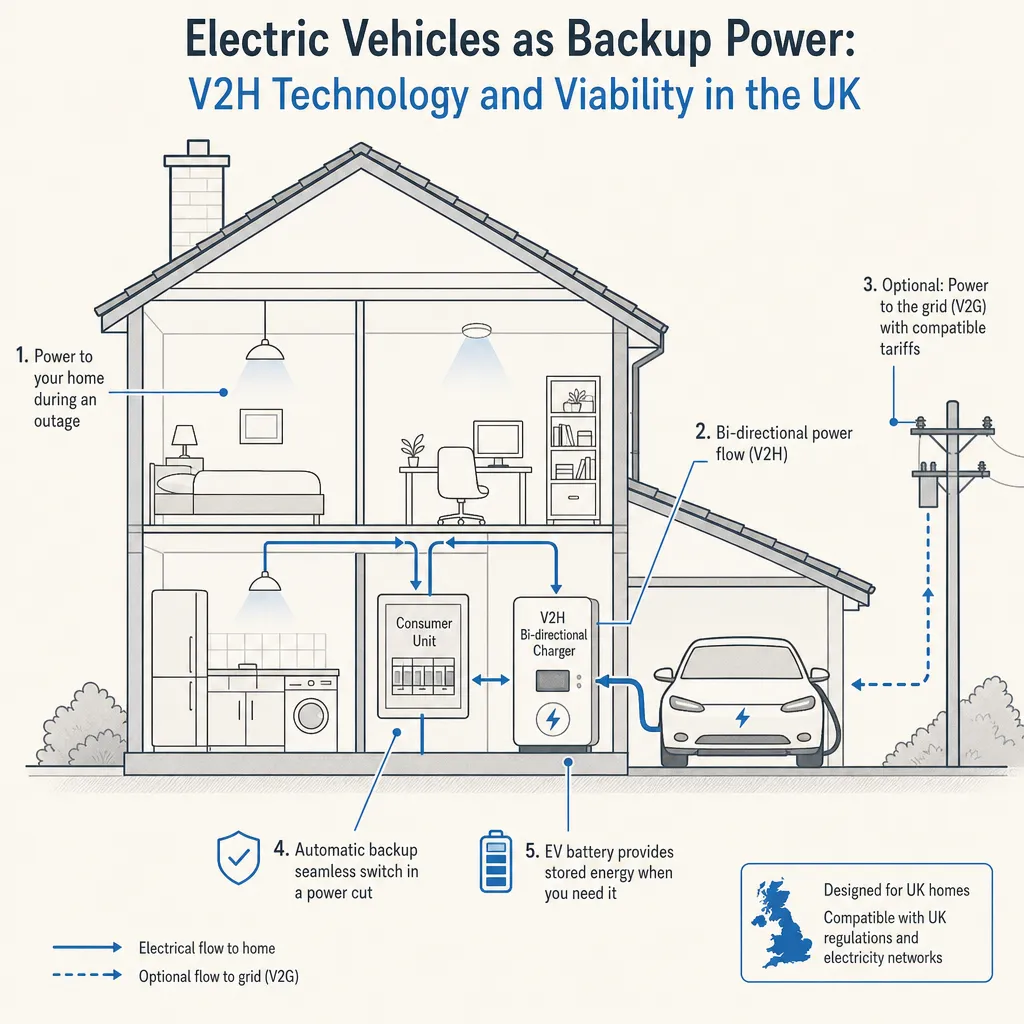
Electric Vehicles as Backup Power: V2H Technology and Viability in the UK
Vehicle-to-Home (V2H) technology uses your electric vehicle's battery to supply electricity to your home, either as backup power during grid outages or to shift cheap overnight charging into daytime use.
 Energy & Retrofit
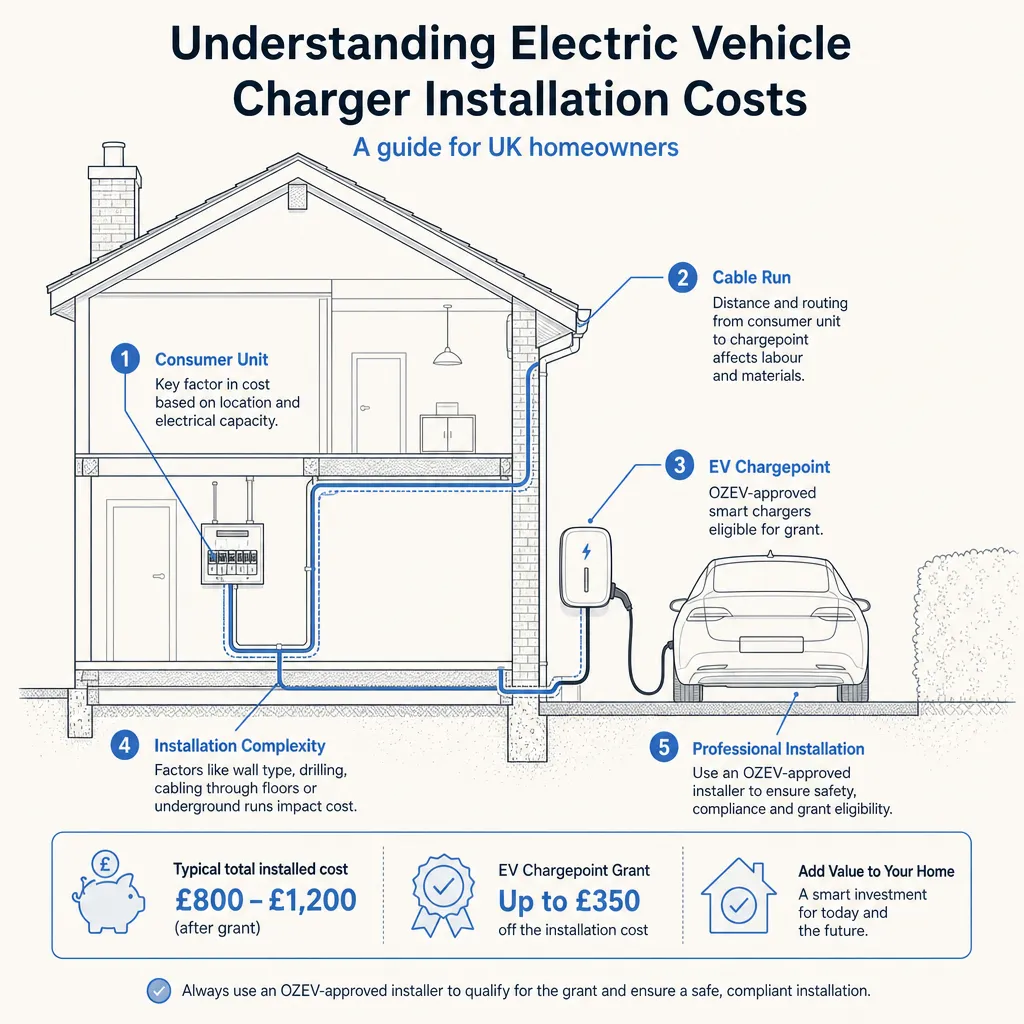
Understanding Electric Vehicle Charger Installation Costs
Installing a home EV wallbox charger in the UK typically costs £800–£1,200 for a 7kW unit, including an OZEV-approved installer's labour.
 Energy & Retrofit
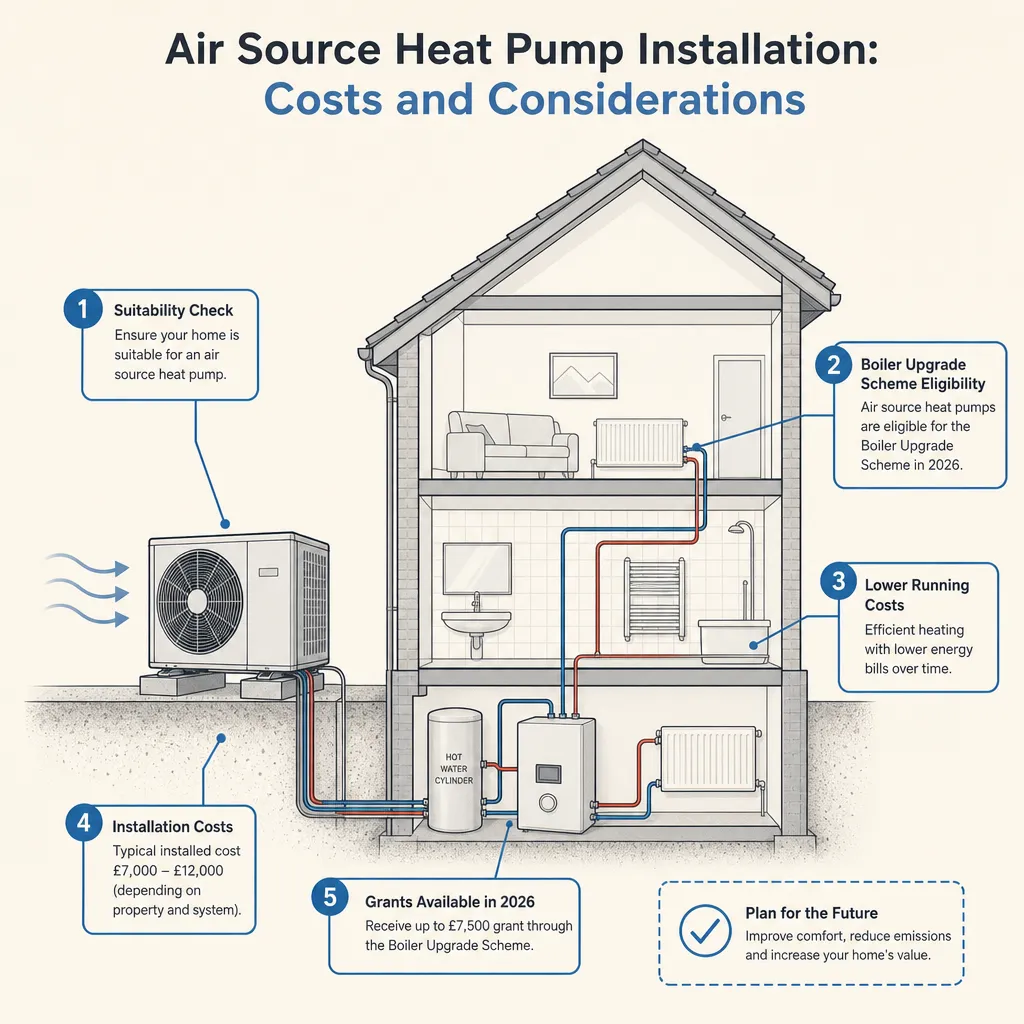
Air Source Heat Pump Installation: Costs and Considerations
Air source heat pump installation in the UK typically costs £8,000–£15,000 before the £7,500 Boiler Upgrade Scheme grant, available through MCS-certified installers in England and Wales.