Installing an EV Charging Point at Home: Costs and Options
By Housey · Last reviewed 10th of May 2026
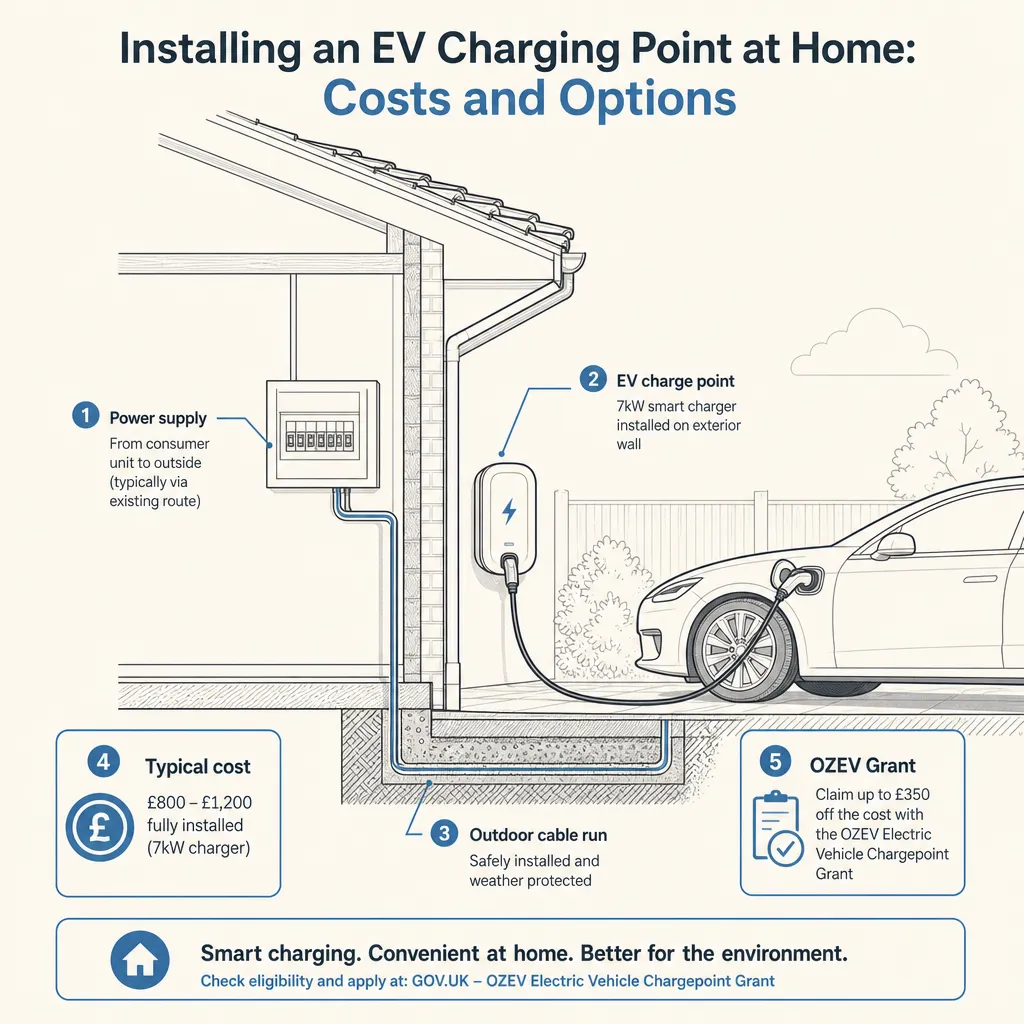
Installing an EV Charging Point at Home: Costs and Options
The rapid growth in electric vehicle ownership across the UK has made home charging a practical priority for many drivers — particularly as public charging infrastructure, while improving, remains patchy outside urban centres. Deciding which type of charger suits your property, whether you qualify for a government grant, and what the installation process involves are questions that arise as soon as an EV arrives on the driveway.
Key points
- The OZEV Electric Vehicle Chargepoint Grant (EVCG) offers eligible homeowners and renters up to £350 off the cost of a home charger installation — check GOV.UK for current eligibility, as terms are updated periodically.
- All new home EV charger installations must use a smart charger capable of off-peak scheduling, as required by the Electric Vehicles (Smart Charge Points) Regulations 2021, effective June 2022.
- Home EV chargers must be installed by an OZEV-approved installer; DIY installation is not permitted for grant-eligible units and may void product warranties.
- A 7 kW (32A single-phase) smart wallbox is the standard home charger, adding approximately 25–30 miles of range per hour — most home charging is done overnight.
- Three-phase supply (required for 22 kW charging) is uncommon in UK domestic properties; most homes have single-phase supply only.
Home EV charger types compared
Charger type | Power output | Range added per hour | Best for | Notes |
|---|---|---|---|---|
3-pin plug adaptor (Mode 2) | ~2.3 kW | ~8 miles | Emergency or very occasional use | Not suitable for regular daily charging |
7 kW smart wallbox (Mode 3) | 7 kW | ~25–30 miles | Most home installations | Standard OZEV grant-eligible option |
22 kW smart wallbox (Mode 3) | 22 kW | ~75–90 miles | Homes with confirmed three-phase supply | Rare in UK domestic; supply upgrade often needed |
Which charger should you choose?
- Choose a 7 kW smart wallbox if your property has a standard single-phase electricity supply and you park at home most evenings — this covers the needs of the vast majority of UK homeowners.
- Choose a 22 kW unit only if your property has confirmed three-phase supply and your vehicle supports on-board AC charging above 7.4 kW — ask an OZEV-approved installer to verify your supply before ordering.
- Avoid relying on a 3-pin plug adaptor for regular daily charging — slow charge rates and potential heat build-up on domestic sockets create long-term risks, and this approach is not grant-eligible.
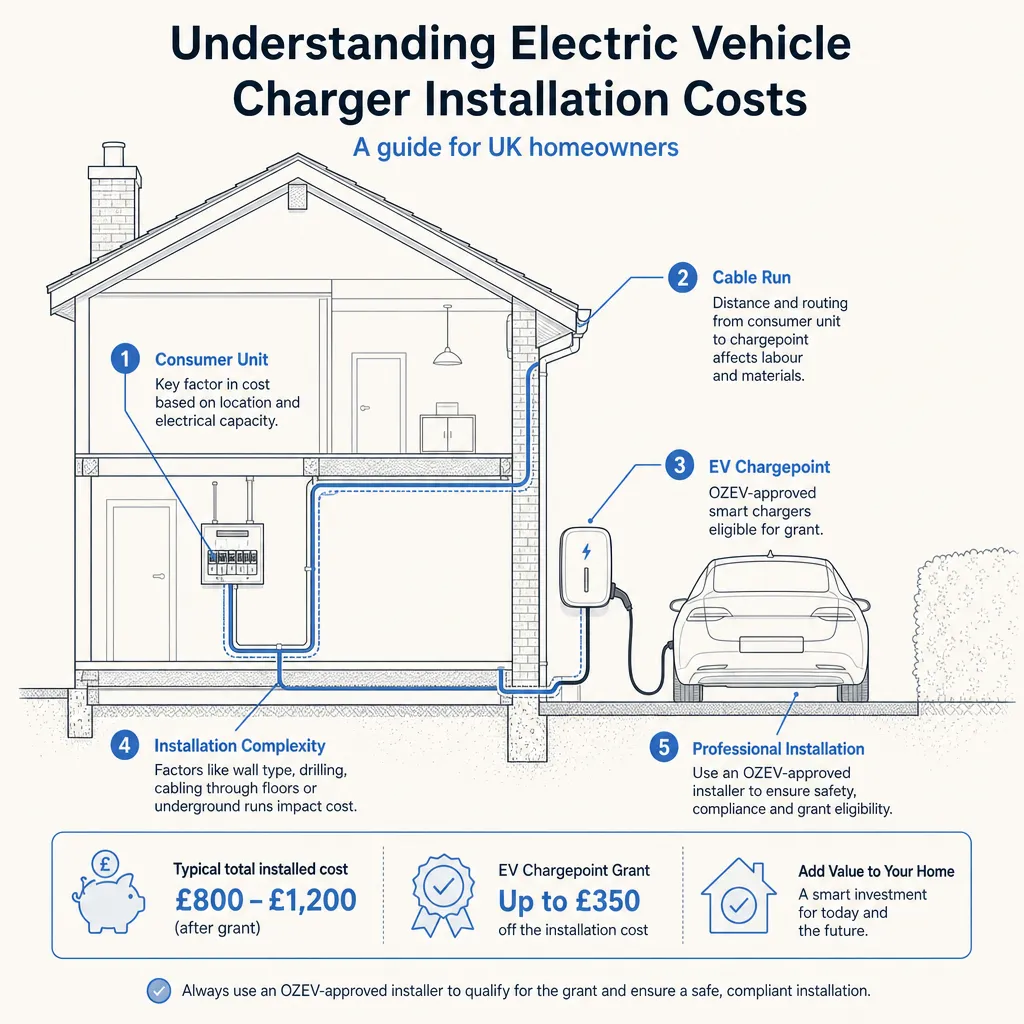
- Ask an OZEV-approved installer if your consumer unit is older than 25 years, your parking is some distance from the property, or you are deciding between a tethered (cable fixed to unit) and untethered (socket only) configuration.
What does home EV charger installation cost?
Cost element | Indicative range |
|---|---|
7 kW smart wallbox unit (hardware only) | £300–£700 |
Standard installation (under 10 m cable run, modern consumer unit) | £200–£400 |
Longer cable run or groundworks | £400–£1,000+ additional |
OZEV Electric Vehicle Chargepoint Grant | Up to £350 off |
Typical total after grant (standard installation) | £300–£800 |
Indicative UK costs, last reviewed 2026-05-10. VAT at 5% applies to EV charger installation in domestic properties. Always obtain at least three quotes from OZEV-approved installers before committing.
Without the grant, total installed costs typically range from £800 to £1,500 or more depending on complexity.
The OZEV Electric Vehicle Chargepoint Grant
The EVCG (previously known as the OLEV grant) is administered by the Office for Zero Emission Vehicles. As of May 2026, it provides up to £350 off installation costs for homeowners with dedicated off-street parking, renters with landlord permission, and — under different conditions — flat owners and residents of multi-unit properties.
Key points:
- The charger must be purchased and installed by an OZEV-approved installer who applies the grant discount directly to your invoice — you do not claim it back separately.
- Smart charger capability is mandatory; basic non-smart units do not qualify.
- Grant terms and eligibility criteria are subject to government review. Always check the current GOV.UK OZEV guidance before instructing an installer.
What to ask before accepting a quote
- Is the installer OZEV-approved, and will they manage the grant application on my behalf?
- Which smart charger brands and models are included in the quote?
- Is the full cable run included, and what happens if it needs to be longer than estimated?
- Will the consumer unit need upgrading, and is that cost included?
- What are the options for tethered versus untethered cable configuration?
- Is the smart charging app and any connectivity included, and are there ongoing subscription costs?
- Is VAT at 5% included in the quoted price?
- What warranty covers the unit hardware and the installation workmanship?
Do I need planning permission?
In most cases, no. Installing a wall-mounted or post-mounted EV charging point on a house in England is generally treated as permitted development. However:
- Listed buildings: Check with your local planning authority before installation.
- Conservation areas: Chargers visible from a public highway may require permitted development rights to be confirmed.
- Flats and maisonettes: The freeholder or management company may require consent; planning permission may also be needed.
If in doubt, contact your local planning authority before instructing an installer.
When to get professional help
An OZEV-approved installer handles the electrical work as standard, but seek additional input if:
- Your consumer unit is older than 25 years or lacks an RCD (residual current device) — a consumer unit upgrade may be needed before the charger is fitted.
- The installation requires running cables through a listed building's historic fabric.
- You are installing multiple chargers for several vehicles, which may require a load management assessment.
- Your property is a leasehold flat and communal charging infrastructure requires freeholder or management company coordination.
How Housey can help
Housey connects you with OZEV-approved EV charger installers who can confirm grant eligibility, assess your consumer unit, and provide competitive quotes. Describe your property and parking setup once and compare up to four installer quotes side by side.
Frequently asked questions
Can I get a grant for a home EV charger?
Eligible homeowners and renters with off-street parking can apply for the OZEV Electric Vehicle Chargepoint Grant (EVCG), which provides up to £350 off installation costs. The grant must be applied through an OZEV-approved installer and covers smart chargers only. Grant terms change periodically — always check GOV.UK for current eligibility criteria before instructing an installer.
How long does home EV charger installation take?
In straightforward cases — a modern consumer unit, short cable run, and clear wall mounting point — installation typically takes 2–4 hours. More complex jobs involving longer cable runs, groundworks, or consumer unit work may take a full day. OZEV-approved installers generally handle the grant application paperwork at the same time as the installation.
Do I need planning permission for a home EV charger?
Generally, no — installing a home EV charging point on a house falls within permitted development in England. Planning permission may be required for listed buildings, properties in conservation areas, and flats or maisonettes. Always confirm with your local planning authority and, for leasehold properties, check your lease for any consent requirements before instructing an installer.
Can I install an EV charger if I rent?
Yes — renters may be eligible for the OZEV Electric Vehicle Chargepoint Grant if their landlord gives permission for the installation. A separate landlord grant scheme also exists for eligible landlords installing chargers at rental properties. Contact your landlord or letting agent to confirm consent before approaching an OZEV-approved installer.
Sources and further reading
- Electric Vehicle Chargepoint Grant — GOV.UK / OZEV
- Electric Vehicles (Smart Charge Points) Regulations 2021 — legislation.gov.uk
- Charging electric vehicles at home — Energy Saving Trust
- Electric vehicles and home charging — Ofgem
Useful next reads
 Energy & Retrofit
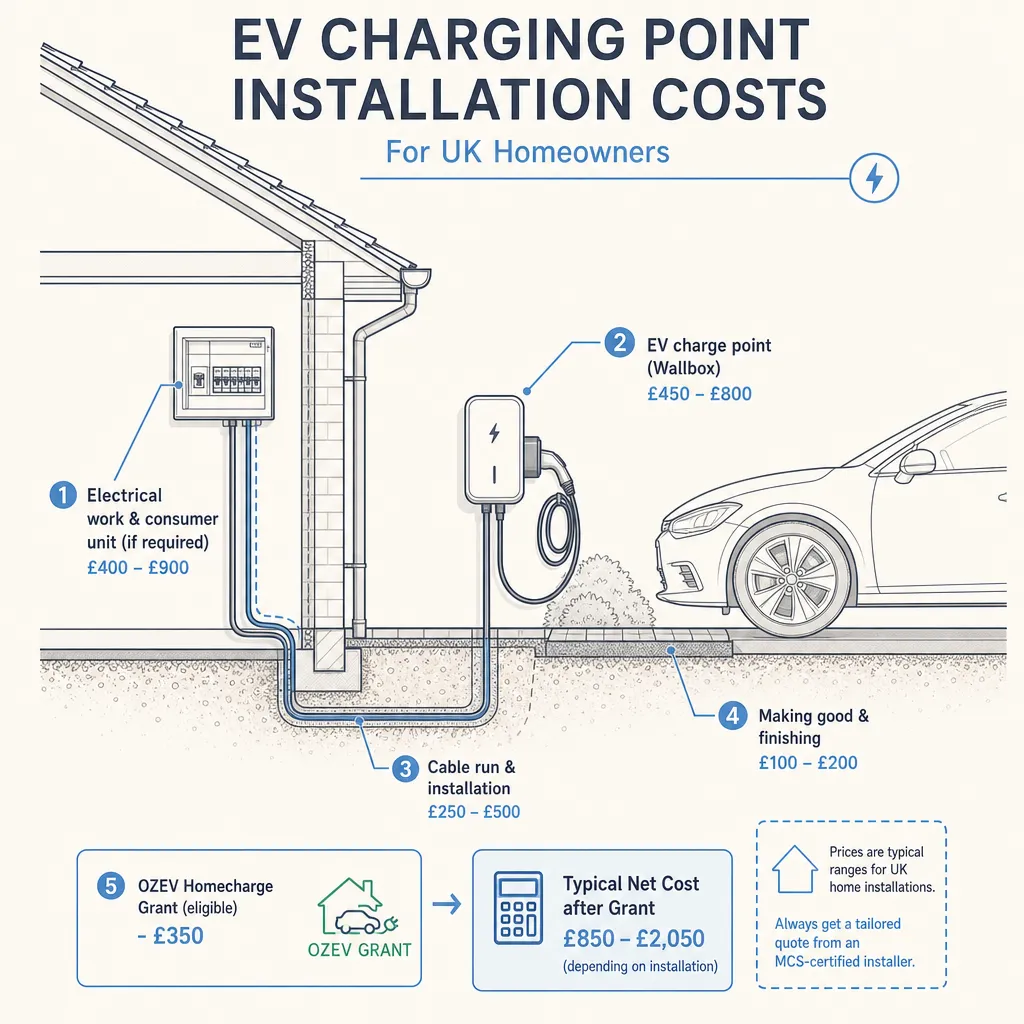
EV Charging Point Installation Costs
A home EV charging point in the UK typically costs £800 to £1,200 for a 7 kW smart wallbox including installation.
 Energy & Retrofit
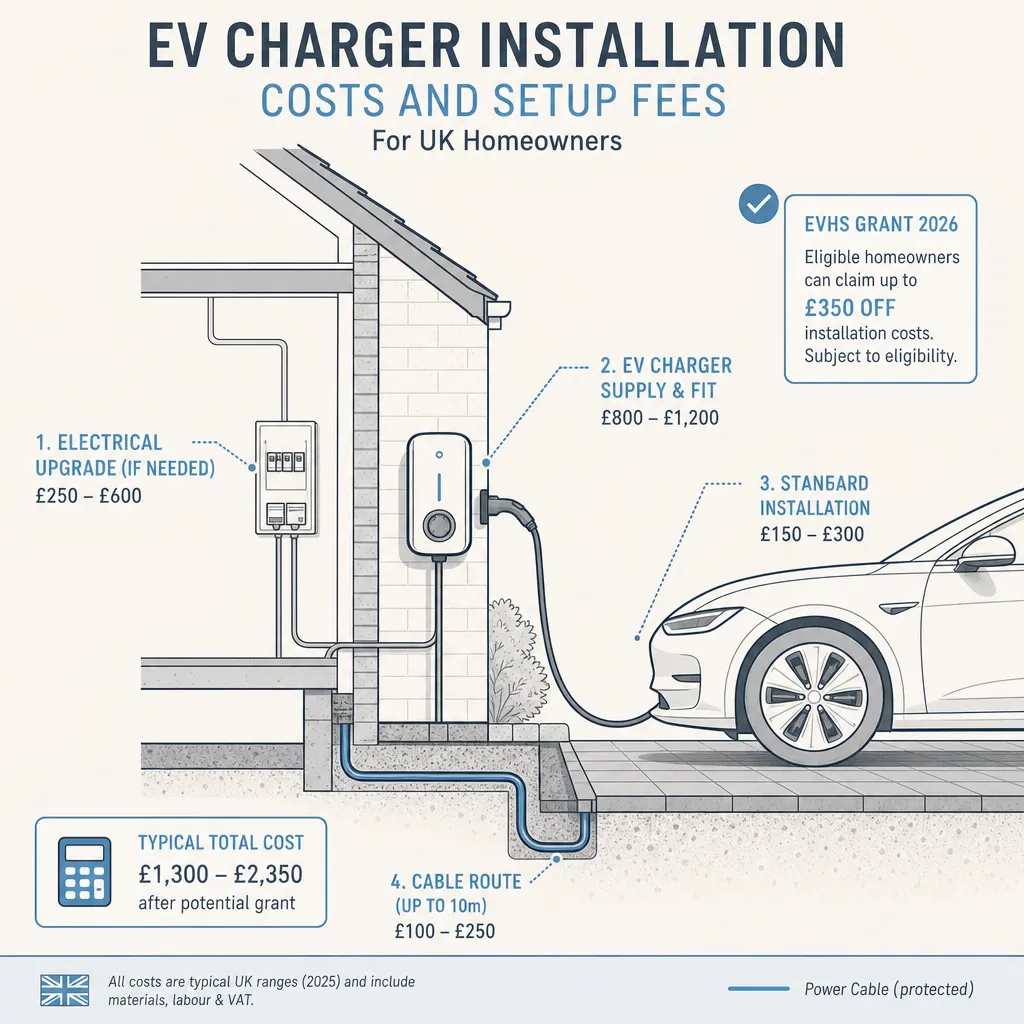
EV Charger Installation Costs and Setup Fees
A home EV charger typically costs £700–£1,200 installed in the UK, including unit and labour.
 Energy & Retrofit
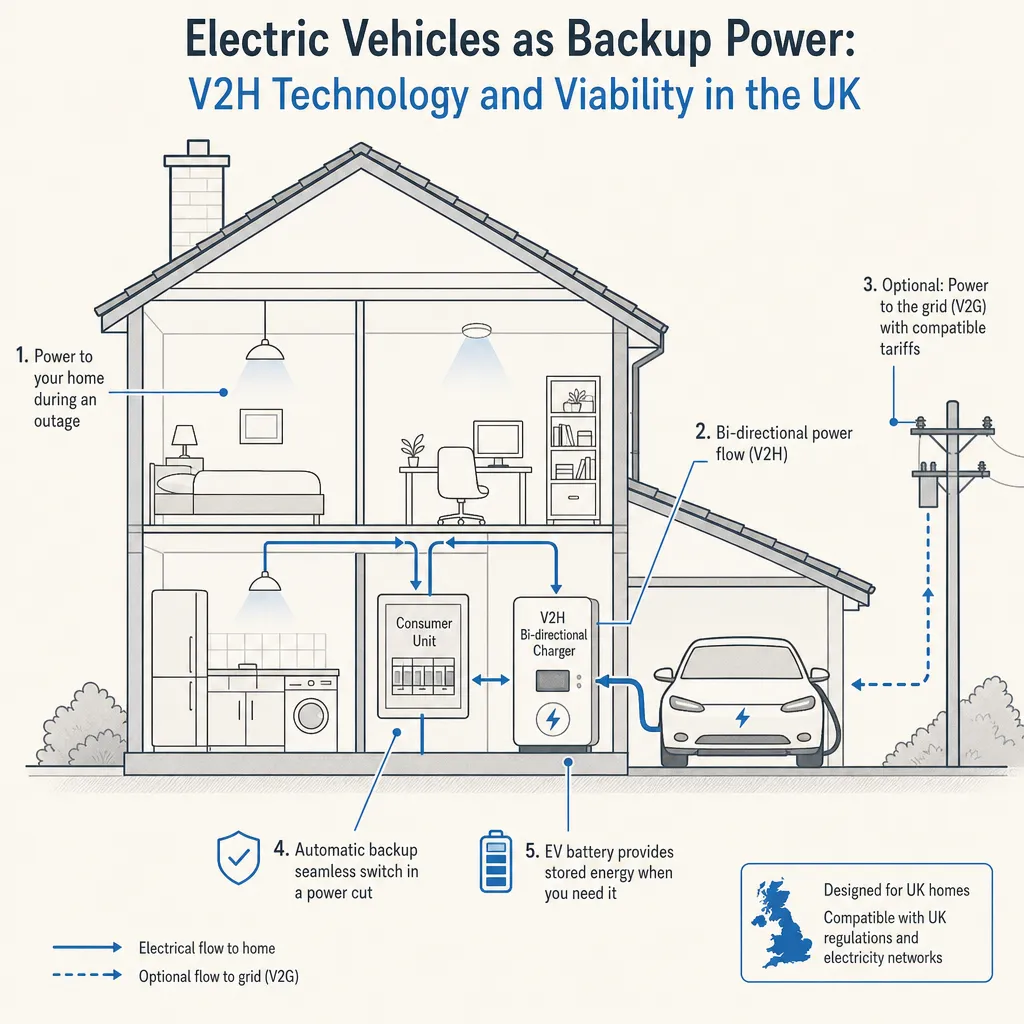
Electric Vehicles as Backup Power: V2H Technology and Viability in the UK
Vehicle-to-Home (V2H) technology uses your electric vehicle's battery to supply electricity to your home, either as backup power during grid outages or to shift cheap overnight charging into daytime use.
 Energy & Retrofit
Understanding Electric Vehicle Charger Installation Costs
Installing a home EV wallbox charger in the UK typically costs £800–£1,200 for a 7kW unit, including an OZEV-approved installer's labour.
 Energy & Retrofit
Smart Glass Windows: Technology, Applications and Investment Costs
Smart glass windows switch between transparent, tinted, or opaque states using electrical signals or heat.