Solar Battery Storage Systems: Investment and Returns
By Housey · Last reviewed 10th of May 2026
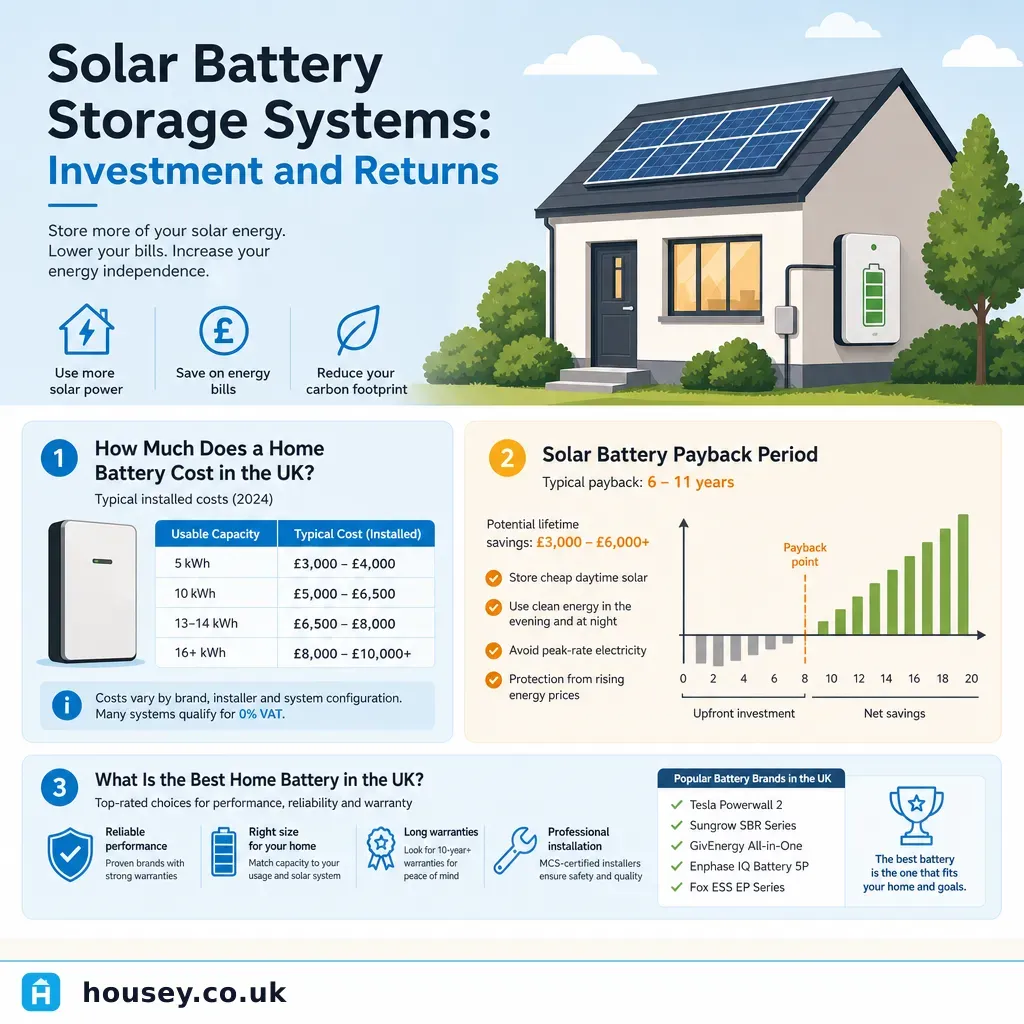
Solar Battery Storage Systems: Investment and Returns
Battery storage has become a mainstream consideration for UK solar homeowners as electricity prices remain high and Smart Export Guarantee rates stay relatively modest. The decision turns on how a battery interacts with your generation and usage pattern, what realistic payback looks like over its lifespan, and what installation involves.
Key points
- Home battery systems in the UK are most commonly lithium-ion, with usable capacities of 3–16 kWh for residential use.
- VAT on residential battery storage was cut to 0% in 2023 for installations connected to a qualifying renewable energy system under HMRC energy-saving materials rules.
- The Smart Export Guarantee (SEG) obligates larger electricity suppliers to pay for exported solar energy — rates vary from around 3p to 15p/kWh depending on the supplier.
- MCS-certified installation is required for grid-connection compliance and eligibility for government incentive schemes.
- Typical payback for a solar-plus-battery system is estimated at 8–14 years depending on capacity, tariff, and usage.
How home battery storage works
A battery charges from solar panels when generation exceeds household demand, storing energy that would otherwise be exported at a low SEG rate. You draw it down in the evening, reducing grid imports during peak tariff periods. Batteries can also charge from the grid overnight on off-peak tariffs — such as Octopus Go or Agile — and discharge during peak hours. This time-of-use (TOU) optimisation strategy can add value even without solar panels.
Battery types compared
Type | Cycle life | Depth of discharge | Relative cost | Best for |
|---|---|---|---|---|
Lithium iron phosphate (LFP) | 4,000–6,000 cycles | 80–100% | Mid–high | Most UK homes; long life and strong safety profile |
Nickel manganese cobalt (NMC) | 2,000–4,000 cycles | 80–90% | Mid | Space-constrained installs; higher energy density |
Lead-acid (AGM) | 500–1,000 cycles | 50–60% | Low | Off-grid or backup power; lower upfront cost |
For most homeowners, lithium iron phosphate (LFP) offers the best combination of cycle life, discharge depth, safety, and total cost of ownership.
Is battery storage financially worthwhile?
Returns depend on your tariff structure, SEG export rate, and daily usage profile. Indicative UK costs, last reviewed 2026-05-10: a 5 kWh system typically costs £3,500–£5,000 installed; a 10 kWh system £5,500–£8,000 or more. Quotes vary by brand, installer, and system complexity.
Worked UK property scenario: A 1970s semi-detached in the East Midlands with a 4 kWp solar array generates around 3,400 kWh/year. Without a battery, roughly 1,700 kWh is exported at 5p/kWh — around £85/year. Adding a 5 kWh LFP battery allows self-consumption of an additional 1,200–1,500 kWh at 28p/kWh, saving £336–£420 — minus around £65 of lost SEG income. Net annual gain: approximately £270–£355. At £4,000 installed, simple payback is around 11–15 years. This is illustrative only; your figures will depend on your actual tariff and usage pattern.
Smart Export Guarantee and battery storage
The SEG requires obligated suppliers to pay for surplus solar electricity exported to the grid. As of early 2026, rates ranged from approximately 3p to 15p/kWh. Installing a battery reduces exports, so SEG income falls — this must be factored into any payback calculation. Flexible SEG tariffs, where export prices vary by time of day, can make battery dispatch more complex and potentially more financially favourable. Check Ofgem's SEG guidance for current obligated supplier rates.
Decision tree: is battery storage right for you?
- Strong case if you have solar PV generating more than your daytime demand, pay a peak evening tariff, and plan to stay in the property for 10+ years.
- Consider TOU charging without solar if you are on a variable-rate tariff with cheap overnight periods.
- Weaker case if your SEG export rate is high, your electricity tariff is flat-rate, or your array is under 2 kWp.
- Seek independent advice if you are on a complex tariff arrangement, considering off-grid operation, or managing large export volumes.
MCS certification and installer accreditation
MCS-certified installation is required for grid-connected battery storage to satisfy Engineering Recommendations G98 and G99. MCS certification is also a prerequisite for most government incentive schemes. Always verify your installer's MCS certificate number on the MCS website before agreeing to any work.
When to get professional help
Battery storage installation requires a qualified and accredited electrician — not DIY work. Seek professional advice when:
- Your existing inverter may not be battery-compatible.
- You are considering a system over 10 kWh, which may involve additional grid-connection requirements.
- Your consumer unit may need upgrading before connection.
- You want an independent financial model before committing to a system.
How Housey can help
Housey connects you with MCS-certified battery storage installers and independent energy-efficiency consultants who can review your solar generation data and model your likely return. A solar survey can also check whether your existing array and roof are ready for battery integration before you commit.
Frequently asked questions
Do I need planning permission to install a home battery?
In most cases, no. Battery systems installed inside a property — in a garage or utility room, for example — are generally permitted development. An external enclosure on a listed building or in a conservation area may need consent. Check with your Local Planning Authority if you are unsure.
Can I add a battery to an existing solar PV system?
Often yes, but compatibility depends on your existing inverter. Some inverters are battery-ready; others may need replacing with a hybrid inverter. An MCS-certified installer can assess your current setup and recommend the right approach before any work is agreed.
What size battery do I need for my home?
Households using 10–15 kWh/day typically benefit from a 5–7.5 kWh battery to cover most evening and overnight demand. Larger households or those with electric vehicles may need 10–16 kWh. Oversizing rarely improves payback — match capacity to your actual daily usage pattern.
Is there any grant funding for home battery storage?
As of May 2026, there is no dedicated standalone grant for home battery storage in England. Battery systems forming part of a broader retrofit under ECO4 may attract indirect subsidy for eligible households. Check the Energy Saving Trust for current schemes and eligibility criteria.
How long do home batteries last?
Most LFP batteries are warranted for 10 years or 4,000–6,000 cycles. Real-world lifespan depends on charge and discharge frequency and operating temperature. Capacity typically degrades to around 80% of its original rating by the end of the warranty period.
Sources and further reading
- Smart Export Guarantee (SEG) — Ofgem — Ofgem
- Solar panels and battery storage — Energy Saving Trust — Energy Saving Trust
- MCS certified installer search — Microgeneration Certification Scheme
- VAT on energy-saving materials — HMRC — GOV.UK / HMRC
Useful next reads
 Energy & Retrofit
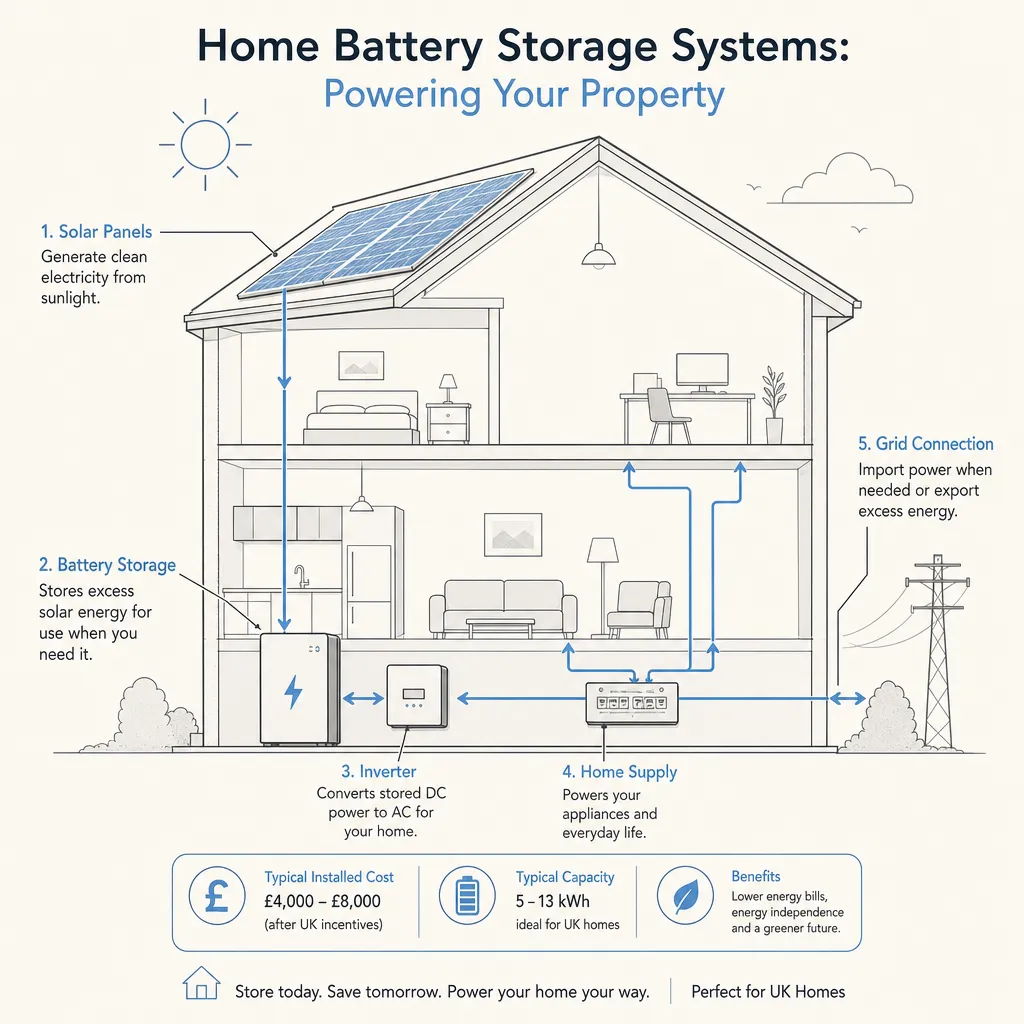
Home Battery Storage Systems: Powering Your Property
Home battery storage systems store electricity from solar panels or the grid — typically 5 to 15 kWh capacity — for use when generation is low or tariffs are high.
 Energy & Retrofit
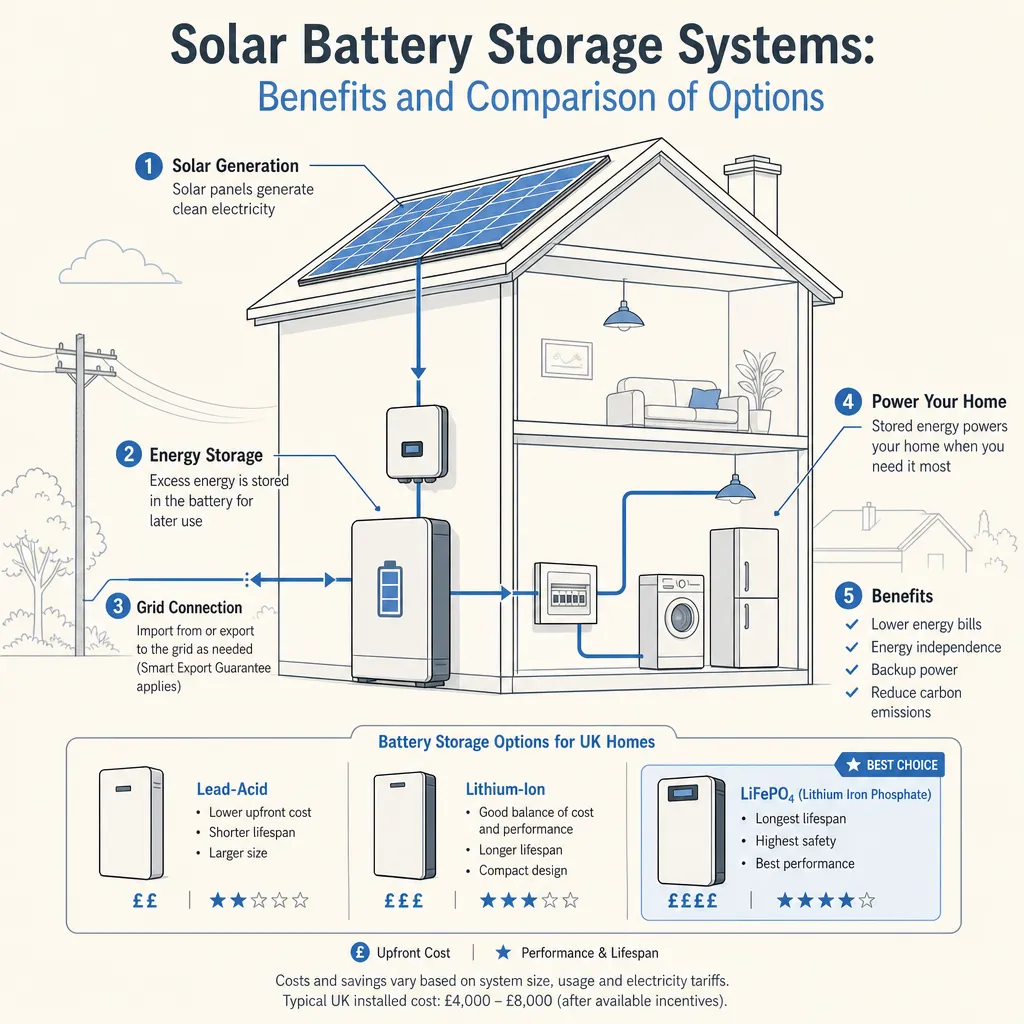
Solar Battery Storage Systems: Benefits and Comparison of Options
A solar battery storage system captures surplus electricity from your solar panels and stores it for use in the evenings, overnight, or on cloudy days.
 Energy & Retrofit
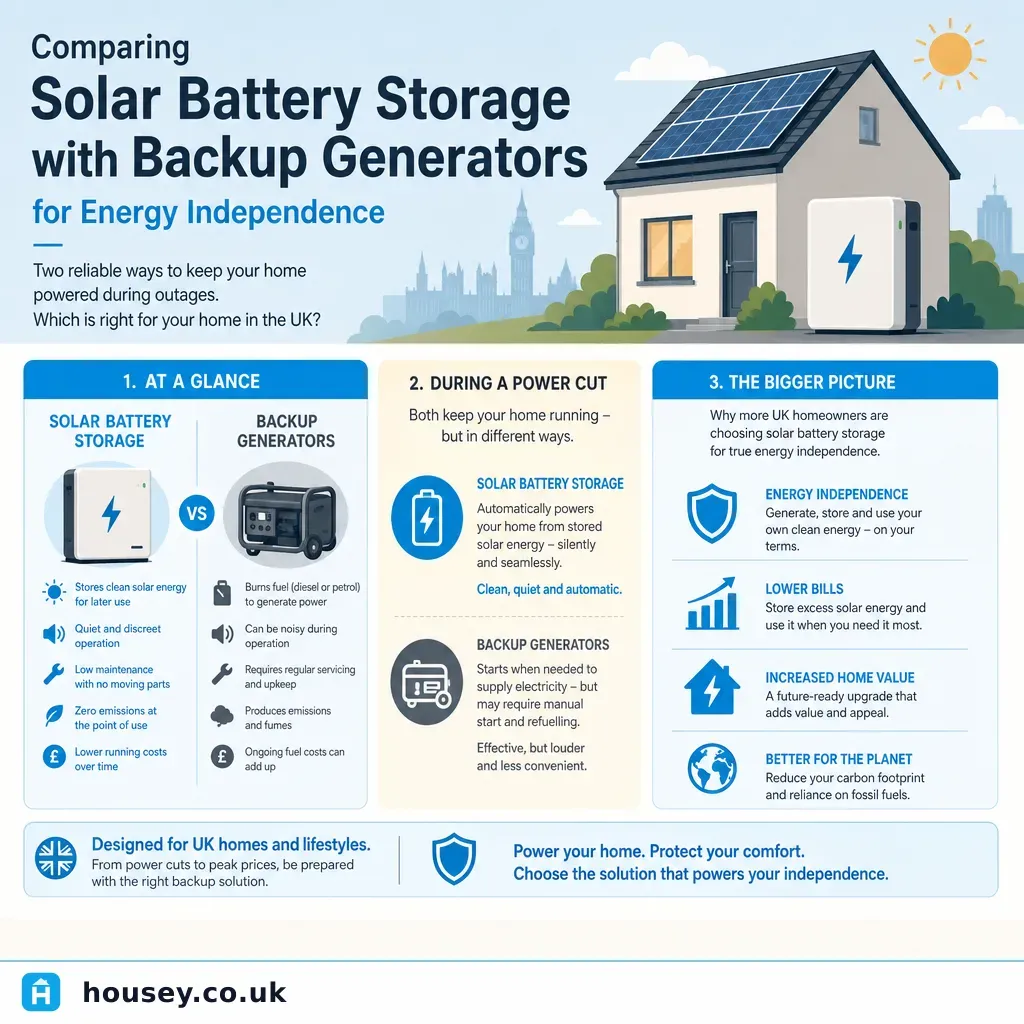
Comparing Solar Battery Storage with Backup Generators for Energy Independence
Solar battery storage and backup generators both offer energy resilience but work very differently.
 Energy & Retrofit
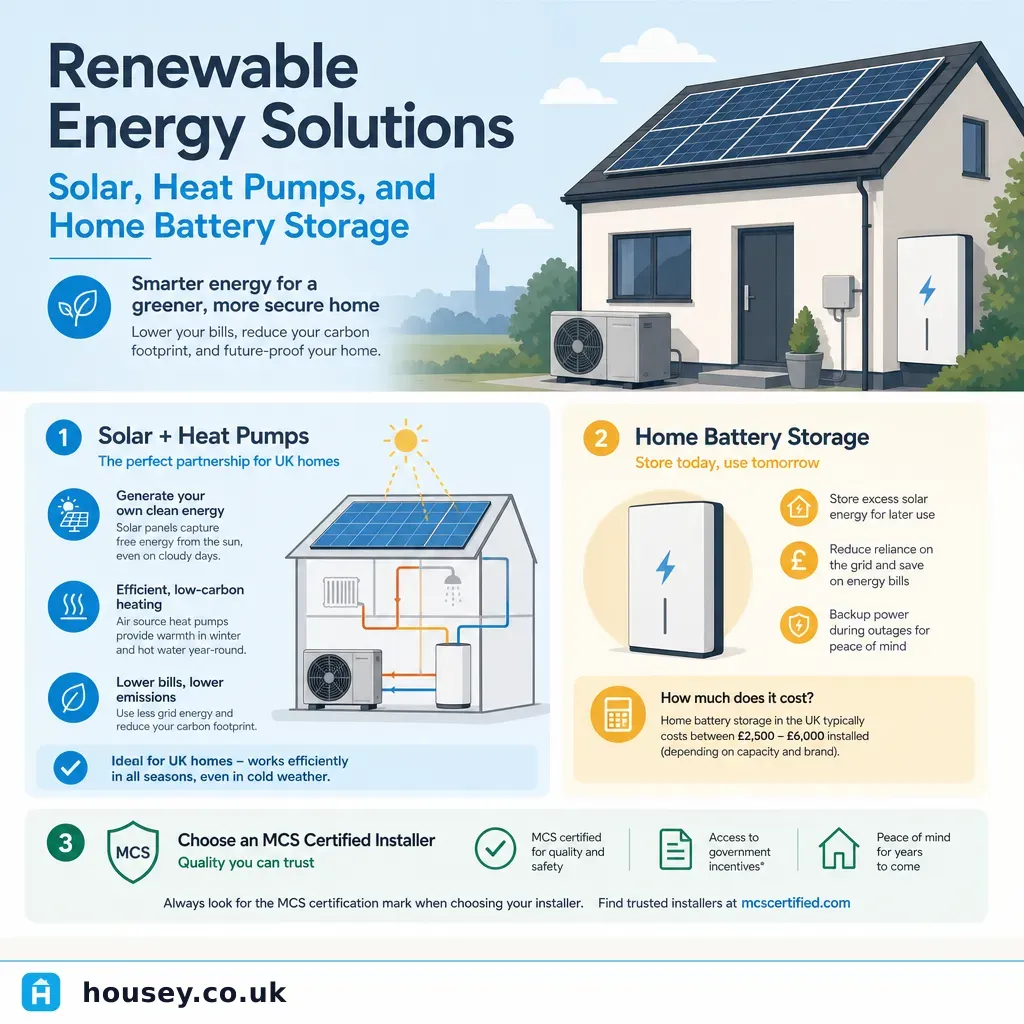
Renewable Energy Solutions: Solar, Heat Pumps, and Home Battery Storage
UK homeowners can reduce energy bills and carbon emissions by combining solar PV panels, air source heat pumps, and home battery storage.
 Energy & Retrofit
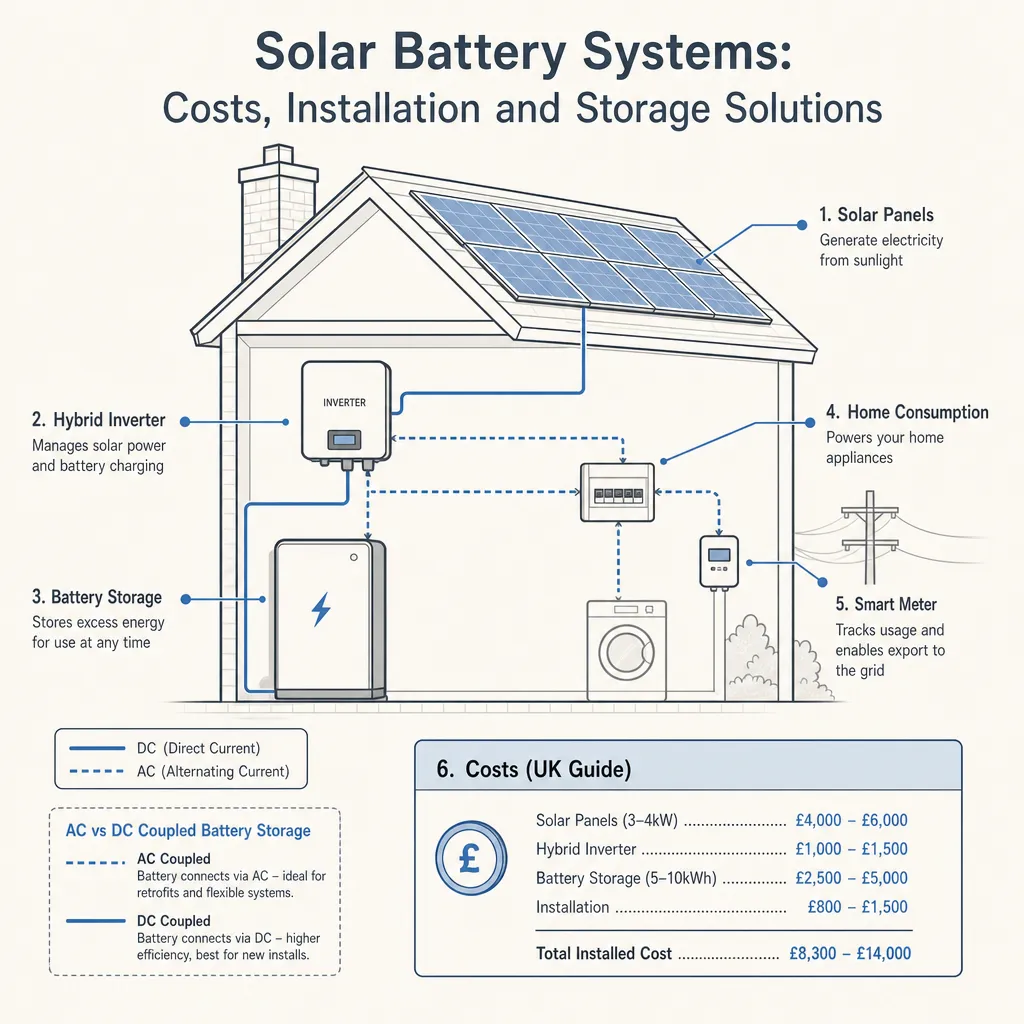
Solar Battery Systems: Costs, Installation and Storage Solutions
Solar battery systems in the UK typically cost £3,000–£8,000 installed for a 5–10 kWh system, though prices vary by brand, capacity, and coupling method.