EV Charging Point Installation Costs
By Housey · Last reviewed 11th of May 2026
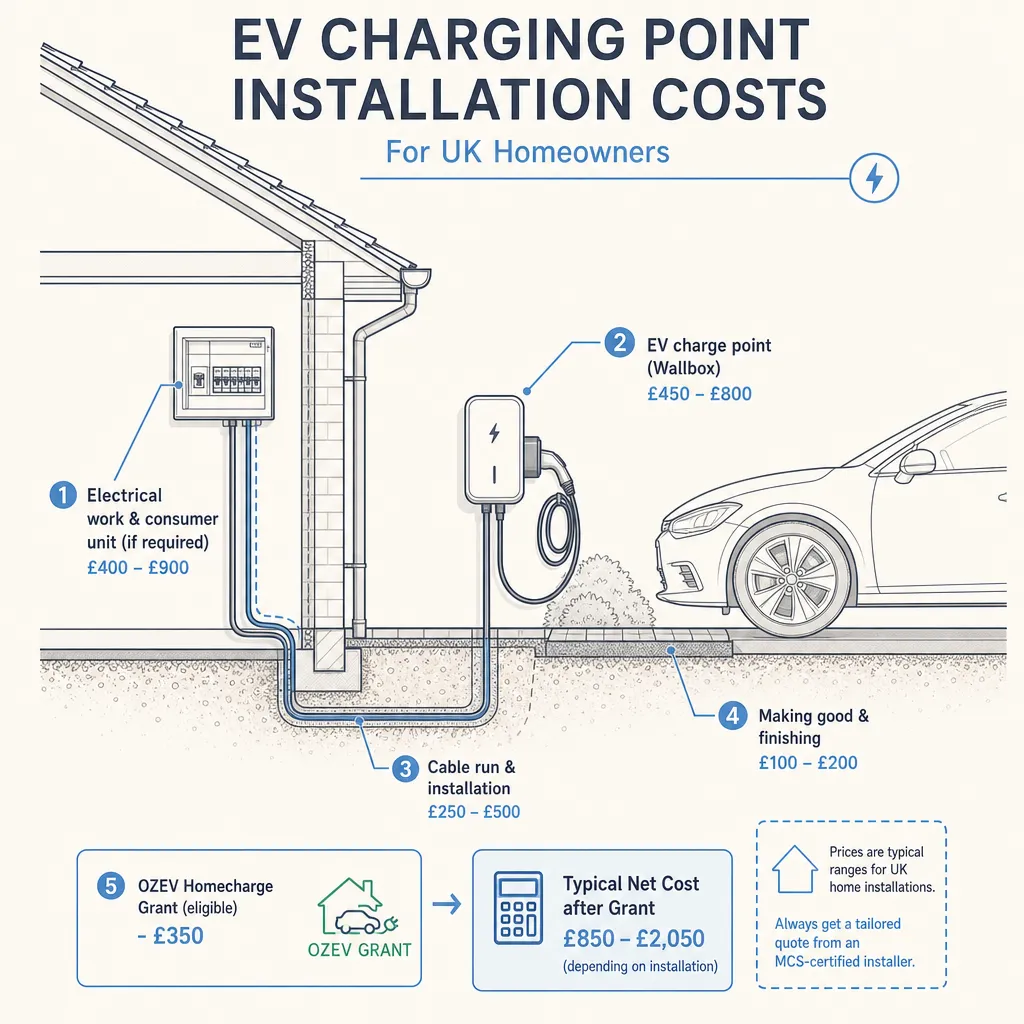
EV Charging Point Installation Costs
As electric vehicles move into the mainstream, a dedicated home charging point has become a practical priority for most UK EV owners. Charging overnight from a wallbox is faster, safer, and considerably cheaper per mile than relying on public rapid chargers — and since June 2022, UK law requires all new domestically installed chargepoints to be smart devices capable of shifting demand to off-peak hours. Whether you are buying your first EV or adding a charger before a property sale, understanding installation costs and grant eligibility will save both time and money.
Key points
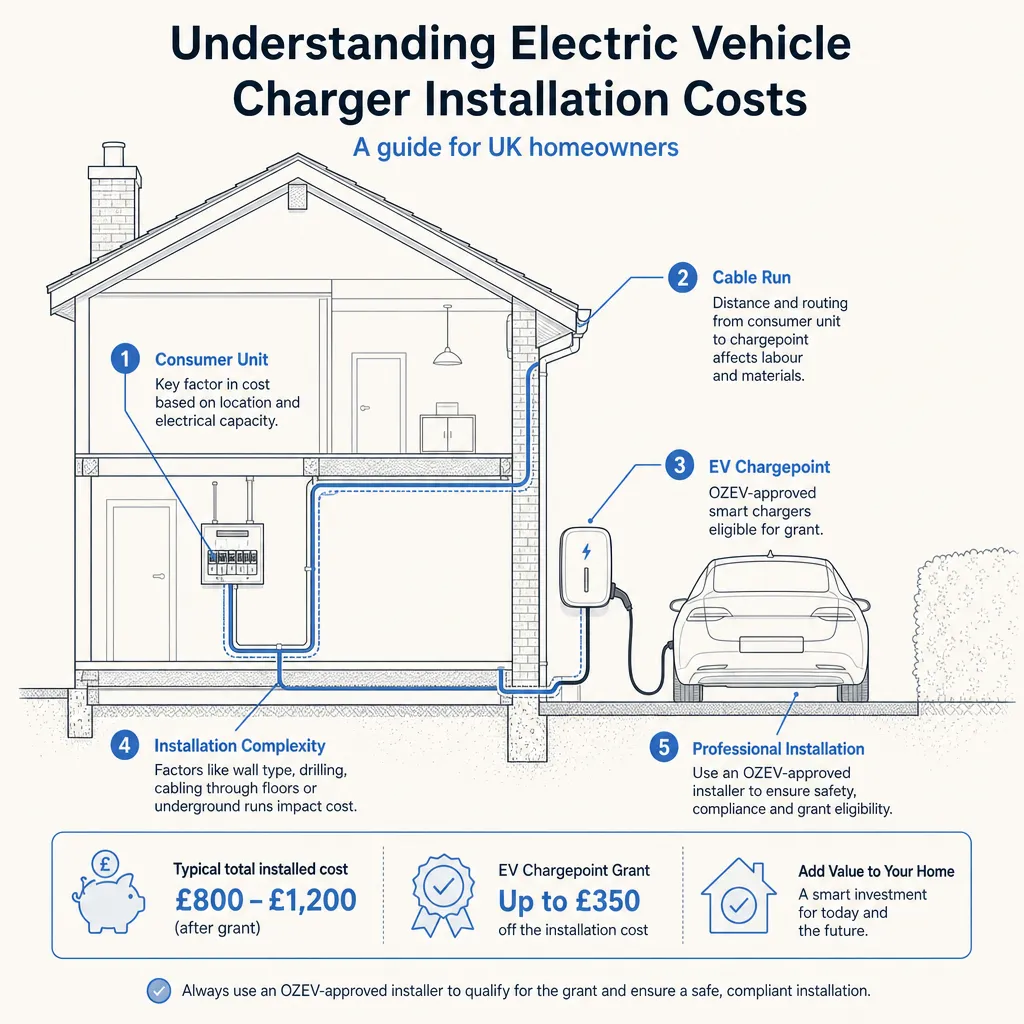
- A standard home EV charging point installation — 7 kW smart wallbox, supply, and labour — typically costs £800 to £1,200 in the UK (Indicative UK costs, last reviewed 2026-05-11).
- The Electric Vehicles (Smart Charge Points) Regulations 2021 require all new domestic EV chargepoints installed in Great Britain from 30 June 2022 to be smart chargers with pre-set off-peak charging defaults.
- The OZEV EV Chargepoint Grant of up to £350 (or 75% of costs, whichever is lower) remains available to renters, flat owners, and residential landlords — but the equivalent grant for homeowners with dedicated off-street parking ended in April 2022.
- Installation must be carried out by an OZEV-approved installer; those also registered with NAPIT or NICEIC can self-certify the electrical work under a competent persons scheme, avoiding a separate building control application.
- A 7 kW home charger typically adds 25–30 miles of range per hour for most modern EVs, compared with 8–12 miles per hour from a standard 13 A socket.
How much does home EV charger installation cost?
Total cost depends on the unit chosen, cable route length, whether consumer unit work is needed, and installer rates in your area.
Installation scenario | Indicative total cost | Notes |
|---|---|---|
Standard install, 7 kW smart wallbox | £800–£1,100 | Most common domestic scenario |
Install requiring consumer unit upgrade | £1,000–£1,600 | Older fuse boards may need replacing |
Flat or communal install, longer cable run | £1,100–£1,800+ | Depends on cable distance from meter |
22 kW three-phase unit | £1,200–£2,000+ | Requires three-phase supply; uncommon domestically |
Indicative UK costs, last reviewed 2026-05-11. Costs vary by region, installer, and property type.
Hardware for the charger unit alone typically costs £300 to £700 depending on brand and features (smart scheduling, solar integration capability, tethered or untethered socket). Labour for a standard cable run and installation is usually £300 to £500.
What types of home charger are available?
3.7 kW single-phase (slow)
Suitable for overnight charging of plug-in hybrids with smaller batteries. Less commonly specified for new installations today — a 7 kW unit is now the standard recommendation for battery-electric vehicles.
7 kW single-phase (fast)
The most common domestic choice in the UK. Adds approximately 25–30 miles per hour and will fully charge most battery-electric vehicles overnight from a standard single-phase supply, which covers the majority of UK homes.
22 kW three-phase (fast AC)
Requires a three-phase electricity supply — rare in standard UK residential properties. If your home does not already have three-phase, do not install the infrastructure solely for EV charging without professional advice on the full cost implications.
Which charger type is right for your home?
- Choose a 7 kW smart wallbox if you have a standard single-phase supply and drive a battery-electric car — this suits the majority of UK homeowners and provides ample overnight range.
- Consider a 3.7 kW unit if your vehicle is a plug-in hybrid with a small battery (under 15 kWh) and a slower overnight charge meets your daily needs.
- Ask an OZEV-approved installer to assess whether your consumer unit and supply can support a 7 kW radial circuit before purchasing any hardware.
- Check whether your property already has three-phase supply before considering a 22 kW unit — it is rare in standard UK homes and not worth installing solely for domestic EV charging.
Are grants available for home EV charger installation?
Grant | Who can apply | Amount | Status |
|---|---|---|---|
EV Chargepoint Grant (OZEV) | Renters and flat owners | Up to £350 or 75% of costs | Available — claimed via OZEV-approved installer |
Landlord EV Chargepoint Grant (OZEV) | Residential landlords | Up to £350 per socket | Available — up to £30,000 per application |
EVHS (homeowner grant) | Homeowners with off-street parking | Was up to £350 | Ended April 2022 — no longer available |
Grant availability and eligibility rules can change. Always verify current details on the GOV.UK OZEV EV Chargepoint Grant page before instructing an installer, as schemes can be paused, modified, or closed.
What happens during installation?
A standard home EV charger installation takes between three and six hours for a straightforward cable route; longer if a consumer unit upgrade is required.
- Pre-installation survey — the installer assesses the consumer unit, available supply capacity, proposed charger location, and cable route.
- Consumer unit check — confirms whether a spare MCB slot is available or whether upgrade work is needed.
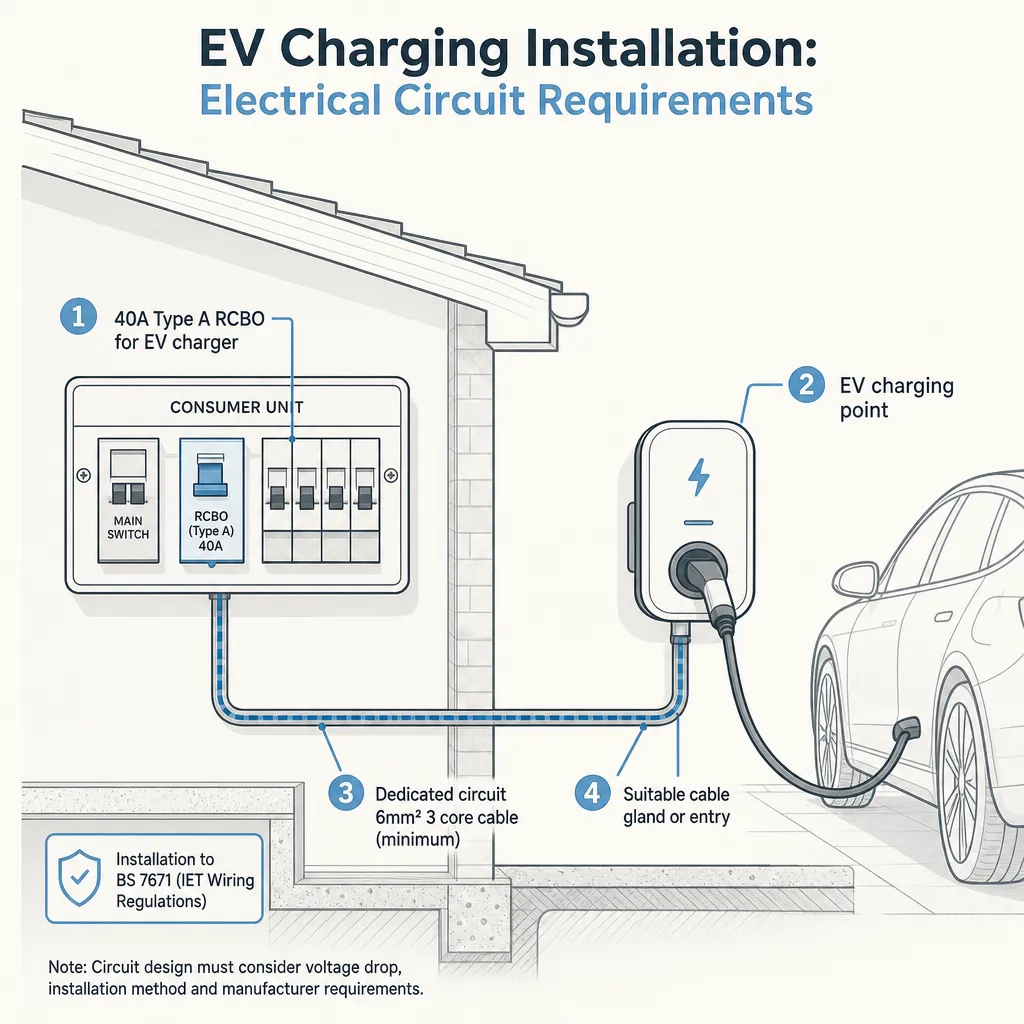
- Cable installation — a dedicated radial circuit (typically 6 mm² cable) is run from the consumer unit to the charger location, protected in conduit where surface-run.
- Charger mounting — the wallbox is fixed to the wall (garage, side wall, or external wall).
- Connection and commissioning — the unit is wired, configured for smart off-peak charging, and tested.
- Certification — the installer notifies building control or self-certifies via NAPIT or NICEIC competent persons scheme.
What to ask before accepting a quote
- Is this an OZEV-approved installation by a registered installer?
- What brand and model of unit are you supplying, and does it comply with the Smart Charge Points Regulations 2021?
- Is the consumer unit suitable as-is, or is an upgrade included or excluded from this quote?
- What is the cable route, how long is the run, and how is the cable protected?
- Is VAT included in the quoted price?
- Will you handle the OZEV grant application on my behalf if I am eligible?
- What warranty does the unit carry, and what does your installation warranty cover?
Important considerations for flats and rented properties
If you live in a leasehold flat, you may need freeholder or management company consent before installing a charger, particularly if cables pass through communal areas. Check your lease before commissioning any work.
Renters should obtain written landlord consent before proceeding. The OZEV Landlord Grant provides a financial incentive for landlords to fund installation, and eligible renters may claim their own grant towards costs. Shared communal parking may be better served by a networked multi-user chargepoint solution rather than individual home wallboxes.
When to get professional help
EV charger installation involves mains electrical work and must always be carried out by a qualified, OZEV-approved electrician. Seek additional professional input if your consumer unit is a pre-2005 fuse board or has no spare capacity, your electricity supply cable appears undersized, you want to integrate the charger with a home solar PV system or battery storage, or the property is listed or in a conservation area.
Do not attempt to install an EV charger as a DIY project. An unsafe electrical installation can cause fire, invalidate home insurance, and breach Building Regulations.
How Housey can help
Housey connects UK homeowners and renters with vetted EV charger installers who are OZEV-approved, can advise on grant eligibility, and will ensure your installation complies with the Smart Charge Points Regulations 2021. Compare quotes from local installers before committing.
Frequently asked questions
Can I use a standard three-pin socket to charge my EV?
Yes, as a temporary measure, but it is not recommended for regular overnight use. A standard 13 A socket delivers around 2.3 kW — roughly 8 to 12 miles of range per hour — compared with 25 to 30 miles per hour from a 7 kW wallbox. Standard sockets are not designed for sustained continuous current draw, increasing fire risk over time, particularly with older sockets or extension leads.
How long does EV charger installation take?
A standard 7 kW wallbox installation in a property with a suitable consumer unit typically takes three to six hours. A more complex installation — longer cable route, consumer unit replacement, or difficult access — may take a full working day. Your installer should confirm the expected duration during the pre-installation survey.
Does a home EV charger need planning permission?
In most cases, installing a home EV charger is permitted development and does not require planning permission. However, if you live in a listed building, a conservation area, or a leasehold flat with freeholder restrictions, additional consent may be required. Check with your local planning authority or freeholder if in doubt before commissioning work.
Will home charging reduce my electricity costs compared with public chargers?
Home charging is generally significantly cheaper per kWh than public rapid chargers, particularly when using an off-peak overnight tariff designed for EV drivers. Smart chargers — mandatory for all new domestic installations since June 2022 — can be configured to charge automatically during cheaper overnight periods, helping to reduce running costs further.
Sources and further reading
- EV Chargepoint Grant — GOV.UK — Office for Zero Emission Vehicles (OZEV)
- The Electric Vehicles (Smart Charge Points) Regulations 2021 — legislation.gov.uk — UK Legislation
- NAPIT Competent Persons Scheme — NAPIT
- NICEIC Approved Contractors — NICEIC
Useful next reads
 Energy & Retrofit
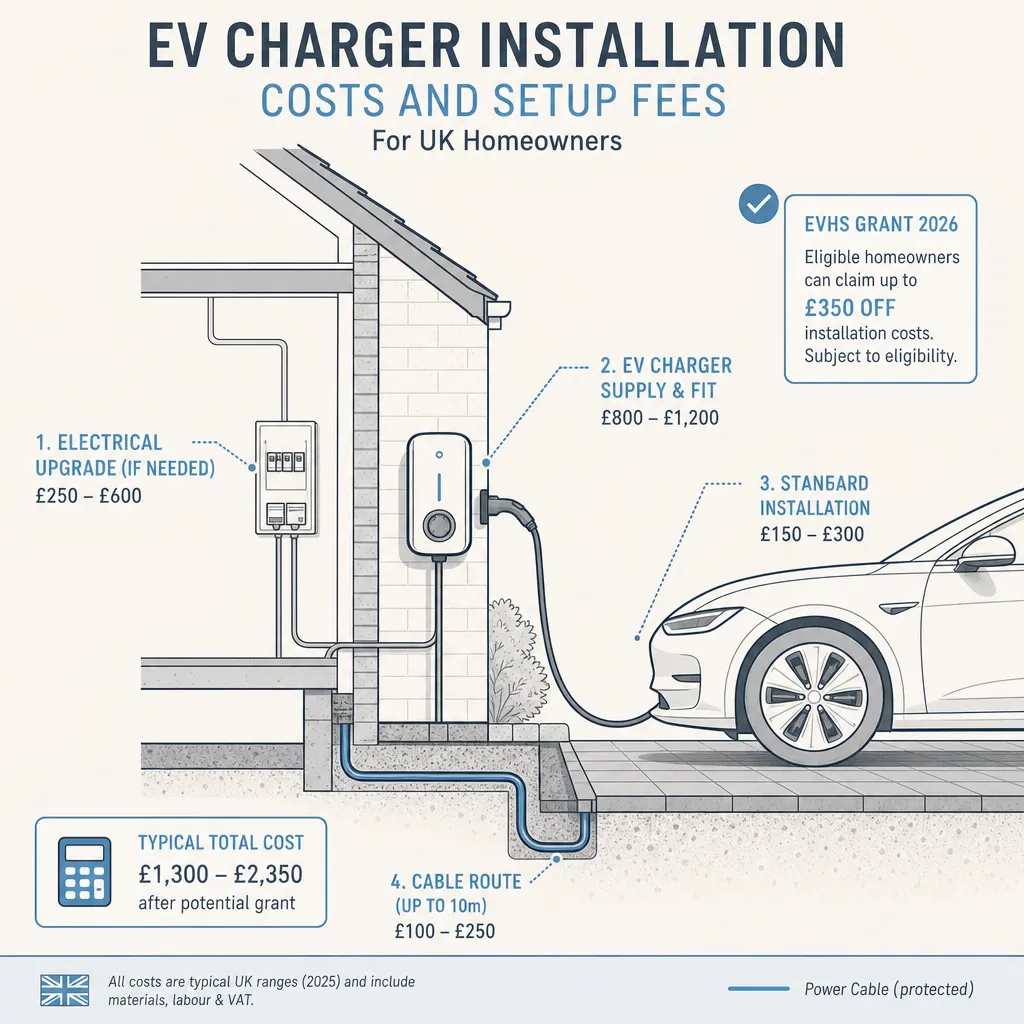
EV Charger Installation Costs and Setup Fees
A home EV charger typically costs £700–£1,200 installed in the UK, including unit and labour.
 Energy & Retrofit
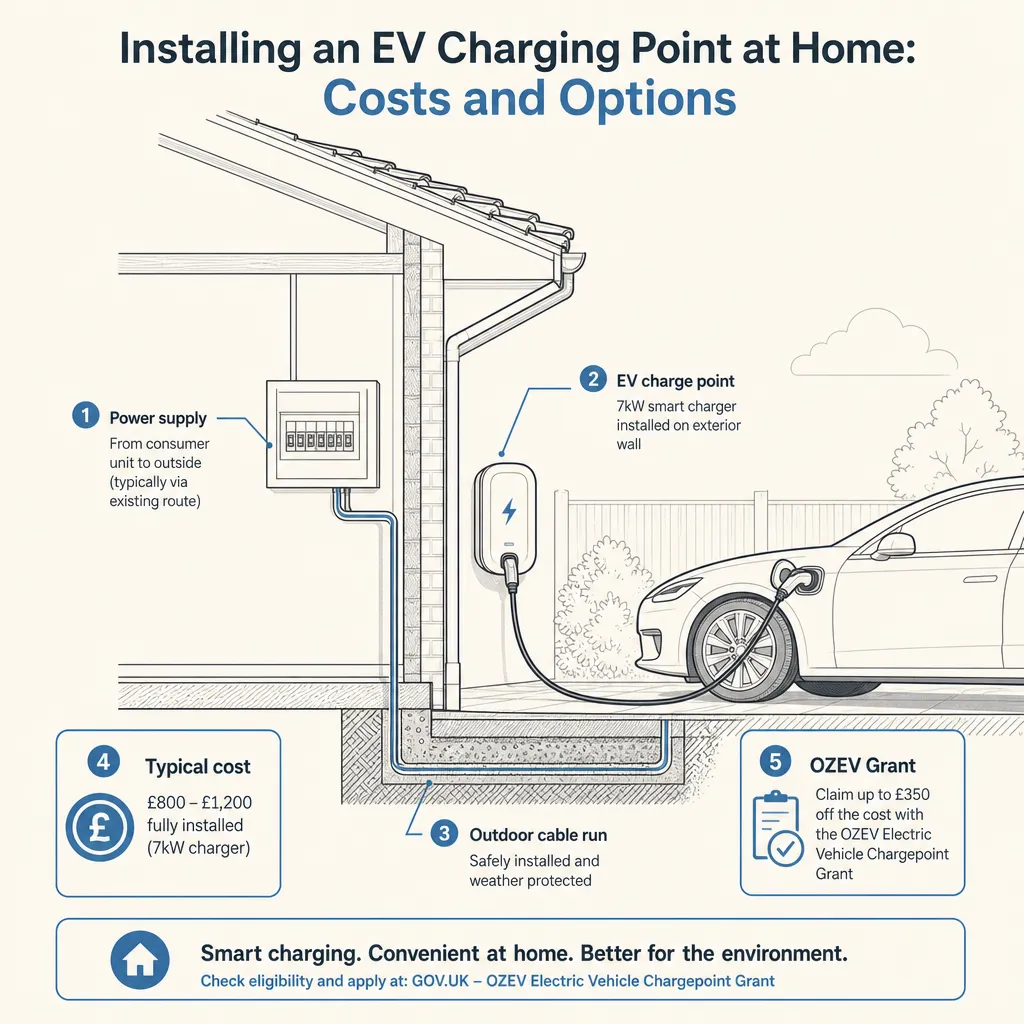
Installing an EV Charging Point at Home: Costs and Options
Installing a home EV charging point in the UK typically costs £300–£800 after the OZEV Electric Vehicle Chargepoint Grant of up to £350.
 Energy & Retrofit
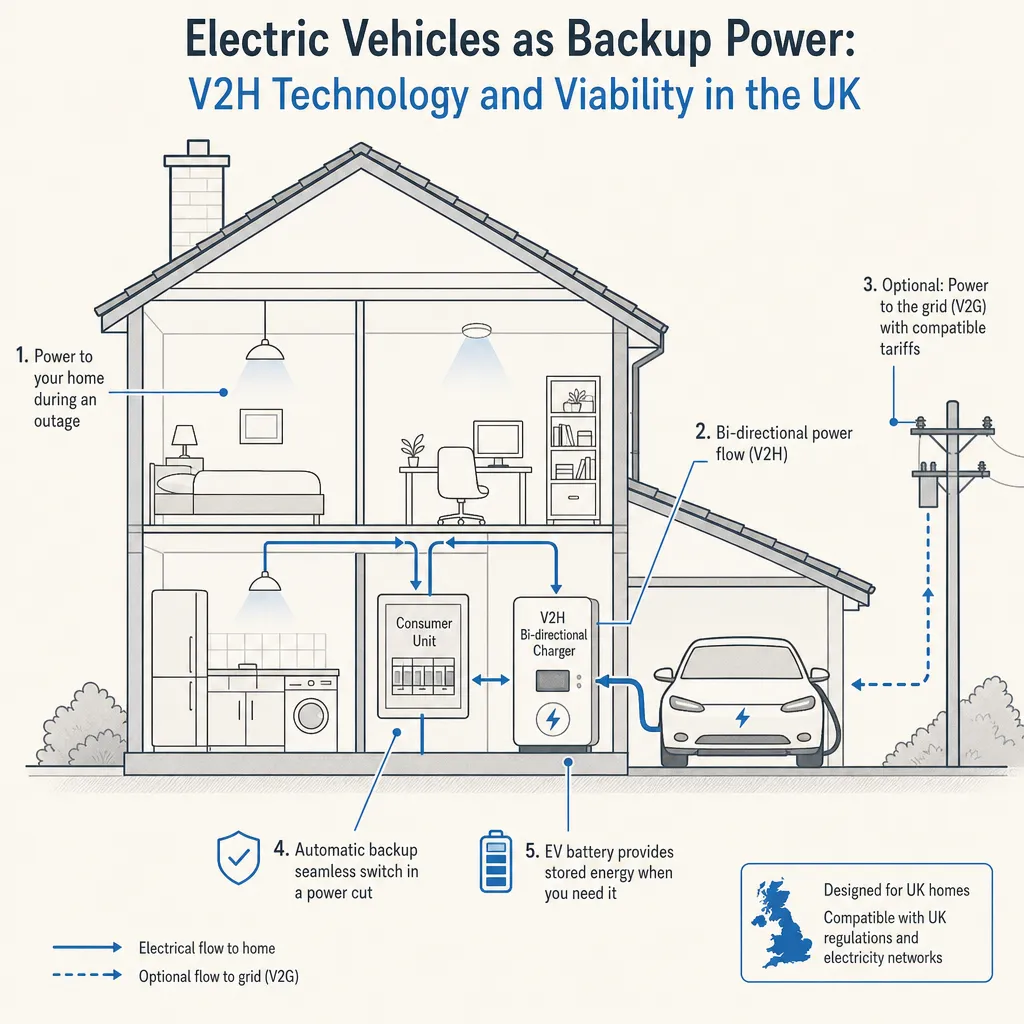
Electric Vehicles as Backup Power: V2H Technology and Viability in the UK
Vehicle-to-Home (V2H) technology uses your electric vehicle's battery to supply electricity to your home, either as backup power during grid outages or to shift cheap overnight charging into daytime use.
 Energy & Retrofit
EV Charging Installation: Electrical Circuit Requirements
A home EV charger (7 kW) requires a dedicated single-phase 32 A circuit run directly from the consumer unit, installed by a registered electrician.
 Energy & Retrofit
Understanding Electric Vehicle Charger Installation Costs
Installing a home EV wallbox charger in the UK typically costs £800–£1,200 for a 7kW unit, including an OZEV-approved installer's labour.