Wall-Mounted Heating Installation: Costs and Efficiency Considerations
By Housey · Last reviewed 11th of May 2026
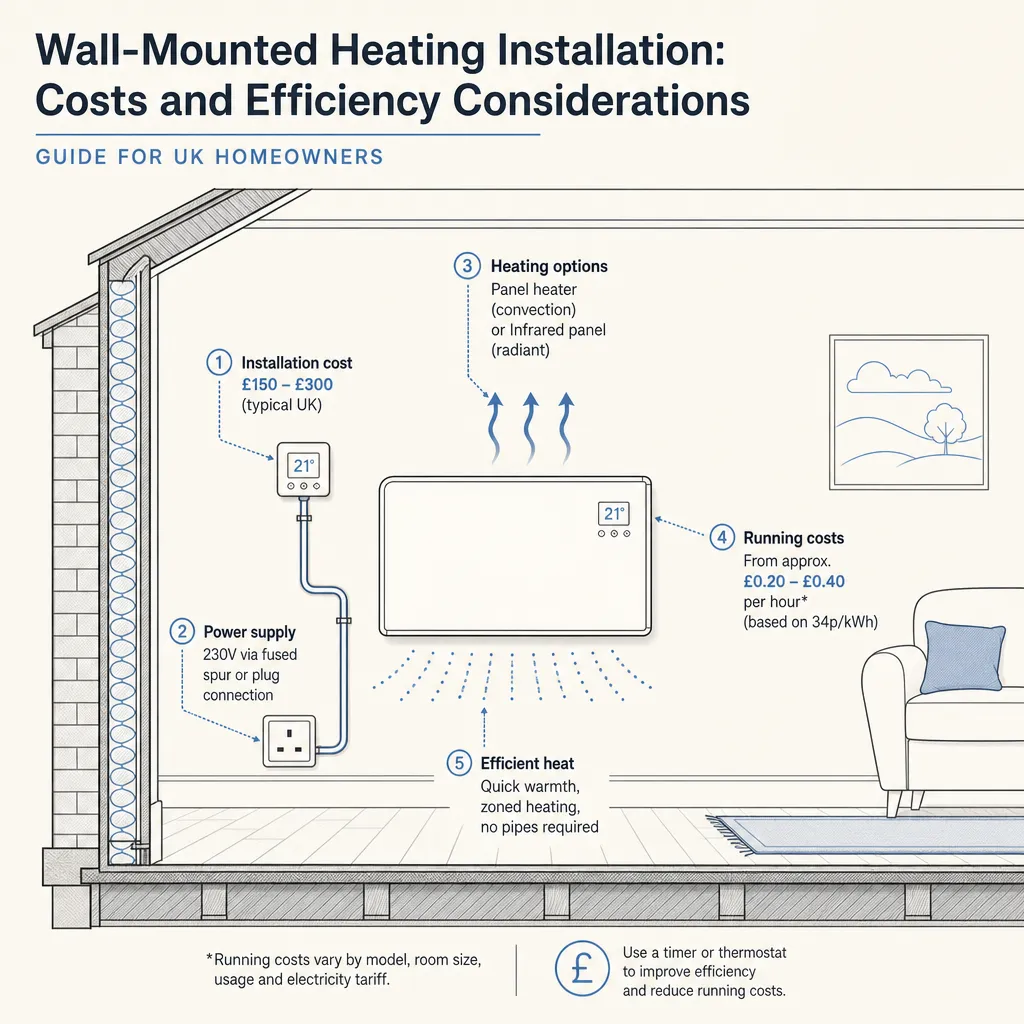
Wall-Mounted Heating Installation: Costs and Efficiency Considerations
Wall-mounted electric heaters are a common solution in rooms without central heating connections — in extensions, outbuildings, rental properties, and homes where extending a wet radiator system is impractical or uneconomic. The choice between convection panel heaters, infrared panels, and electric wall radiators affects both upfront cost and ongoing running costs, and in a period of elevated electricity prices that difference is worth understanding before you buy. This article covers the main types, indicative costs, efficiency characteristics, and what to check before specifying or instructing installation.
Key points
- Wall-mounted electric heaters do not require Gas Safe registration; any hardwired mains connection (adding a fused spur or dedicated circuit) must be carried out by a Part P-registered electrician under Building Regulations.
- Convection panel heaters typically cost £50–£300 to supply; infrared panels range from £150–£600; professional installation per unit adds approximately £100–£250 (indicative UK costs, last reviewed 2026-05-11).
- A 1.5 kW panel heater running continuously for 8 hours consumes 12 kWh; at the Ofgem Q2 2026 unit rate of approximately 24.5p/kWh this is around £2.94/day — thermostat cycling typically halves actual consumption.
- All direct electric heating converts electricity to heat at close to 100% efficiency; running costs depend on wattage, hours of use, and the electricity unit rate rather than the heater type.
- The Energy Saving Trust notes that programmable heating controls can substantially reduce energy consumption compared with uncontrolled operation; a thermostat is one of the most cost-effective additions to any electric heater.
Types of wall-mounted electric heater
Convection panel heaters
Panel heaters warm the air in a room through convection — heated air rises from the front face, circulates, and gradually raises room temperature. They are widely available, the least expensive to purchase, and straightforward to install (most connect to a standard fused spur or plug into a 13A socket for lower-wattage models).
Best for: background heating in smaller rooms, hallways, and supplementary heat in buy-to-let properties where cost is the primary concern.
Limitations: air-based heating loses warmth quickly when windows or doors are opened; can feel slow to reach comfort temperature in poorly insulated rooms.
Infrared heating panels
Infrared panels emit radiant heat absorbed directly by people, furniture, and wall surfaces rather than heating the air. Rooms often feel comfortable at a lower thermostat setting — typically 18–19°C with infrared feels equivalent to 21°C with convection. They respond quickly and suit rooms with high ceilings where warm air would otherwise stratify.
Best for: open-plan spaces with high ceilings, conservatories, rooms where doors open frequently, or where rapid warmth is needed.
Limitations: higher purchase cost; radiant heat does not spread around corners; objects must be within reasonable line-of-sight of the panel.
Electric wall-mounted radiators
These mimic wet-system radiators in form but use an electric heating element, often combined with oil or ceramic thermal mass to retain heat and reduce on/off cycling. Many include 24/7 digital programming and open-window detection.
Best for: rooms where a radiator aesthetic is preferred, or properties where extending the wet system would be too disruptive.
Limitations: higher supply cost than basic panel heaters; heavier, requiring secure fixing to appropriate wall construction.
Cost comparison
Type | Typical supply cost | Installation cost | Smart controls | Best for |
|---|---|---|---|---|
Convection panel heater | £50–£200 | £100–£200 | Often basic or none | Budget-conscious supplementary heating |
Infrared panel | £150–£600 | £150–£250 | Often included | High ceilings, open-plan, fast warmth |
Electric wall radiator | £200–£600 | £150–£300 | Usually included | Radiator aesthetic, thermal retention |
Indicative UK supply and installation costs, last reviewed 2026-05-11. Running costs for all types are approximately equal per kilowatt at full load. At Ofgem Q2 2026 unit rate of 24.5p/kWh, a 1.5 kW heater running 8 hours/day at full load costs £2.94/day maximum; thermostat cycling typically reduces actual consumption by 40–60%.
Note on heat pumps: Heat pumps achieve coefficients of performance (CoP) of 2.5–4.0, meaning 1 kWh of electricity produces 2.5–4.0 kWh of heat. For homeowners heating multiple rooms or the whole property, a heat pump may offer substantially lower running costs over a heating season, though capital and installation costs are significantly higher.
Which type should you choose?
- Choose a convection panel heater if you need low-cost, flexible supplementary heating and are comfortable with slower warm-up times.
- Choose an infrared panel if you have high ceilings, an open-plan layout, or a room where doors open frequently.
- Choose an electric wall radiator if you want heating that resembles a wet-system radiator aesthetically, or want longer heat retention after the element cycles off.
- Consider a heat pump if you are heating multiple rooms or the whole property — the running cost advantage over a full heating season can justify the higher upfront investment.
- Ask a Part P-registered electrician before purchasing if your consumer unit has limited spare capacity — adding multiple heaters may require a consumer unit upgrade, which is a separate and potentially significant cost.
- Check the wall construction before specifying infrared panels — fixing into dry-lined or dot-and-dab walls at the wrong point can be unreliable for heavier panels.
Installation: what is involved
Most wall-mounted heaters connect to a 240V supply via a fused spur — a dedicated switched connection from the ring main or a radial circuit. A Part P-registered electrician will:
- Assess available capacity on the consumer unit.
- Install a fused spur or dedicated circuit where required.
- Mount the bracket and panel per manufacturer instructions and wall fixing requirements.
- Test the circuit and issue an Electrical Installation Certificate (EIC) or Minor Electrical Installation Works Certificate as appropriate under BS 7671.
For multiple new heaters in a property, the electrician may recommend a dedicated radial circuit. All connection work must be notified to the local authority under Building Regulations Part P, or self-certified by a registered competent person (for example, NICEIC, NAPIT, or ELECSA-registered contractors).
Running cost: what to check before buying
- What is the wattage? More wattage equals more output but higher running cost. A rough sizing guide for UK homes is 60–100 W per m² depending on insulation level.
- Does it have a thermostat? A heater without a thermostat runs at full power continuously. A thermostat cycles the heater and typically halves actual energy consumption.
- Does it have a 24/7 programmer? Programming heat only for occupied hours avoids heating empty rooms.
- Is it smart-compatible? Wi-Fi control allows remote adjustment and can prevent unnecessary heating if you leave unexpectedly.
- Is VAT included in the quote? Domestic installation work is subject to standard-rate VAT; confirm whether the quote is inclusive.
When to get professional help
Any hardwired mains connection must be carried out by a registered electrician — this is a Building Regulations requirement, not merely good practice. If you are uncertain about your consumer unit's spare capacity, have an electrician assess before purchasing multiple heaters. If you are considering heating a whole property with wall-mounted electric heaters, consult an energy consultant about whole-house options first; running cost differences over a full heating season can be substantial compared with a heat pump.
How Housey can help
Housey connects homeowners with qualified local electricians and energy consultants who can advise on the right heating solution for your property, assess consumer unit capacity, and carry out fully compliant installation work. Use Housey to compare quotes from verified professionals before committing to any works.
Frequently asked questions
Do I need an electrician to install a wall-mounted heater?
If the heater plugs into a standard 13A socket, a registered electrician is not required for the connection itself, though professional mounting is still advisable. If it requires a hardwired connection via a fused spur or dedicated circuit, the work must be carried out by a Part P-registered electrician or notified to your local building control under Building Regulations. An Electrical Installation Certificate must be issued on completion.
Are electric wall heaters expensive to run?
All direct electric heaters convert electricity to heat at close to 100% efficiency, so cost depends entirely on wattage and hours of use. A 1.5 kW heater running 8 hours a day at full load consumes 12 kWh, costing approximately £2.94 at 24.5p/kWh (Ofgem Q2 2026 rate). Thermostat cycling typically reduces actual consumption by 40–60%. Indicative costs, last reviewed 2026-05-11.
Can I get a grant for wall-mounted electric heaters?
There is no specific grant for direct electric panel heaters in the UK. The Great British Insulation Scheme and ECO4 fund insulation measures rather than heating appliances, and the Boiler Upgrade Scheme funds heat pumps. Some local authority or energy supplier schemes may contribute to broader heating improvements — check directly with your energy supplier and local council for current eligibility.
How long do electric wall heaters last?
Panel heaters and infrared panels typically last 10–20 years with minimal maintenance, as they have no moving parts. Electric radiators with thermal fluid may have a similar lifespan, but the element can usually be replaced independently if it fails. Manufacturer warranties are typically 2–5 years; keep installation certificates and product documentation in case of a warranty claim.
Sources and further reading
- Approved Document P: Electrical safety in dwellings — GOV.UK
- Ofgem energy price cap — Ofgem
- Thermostats and heating controls — Energy Saving Trust
- Find a registered electrician — NICEIC
- Building regulations and electrical work — Electrical Safety First
Useful next reads
 Energy & Retrofit
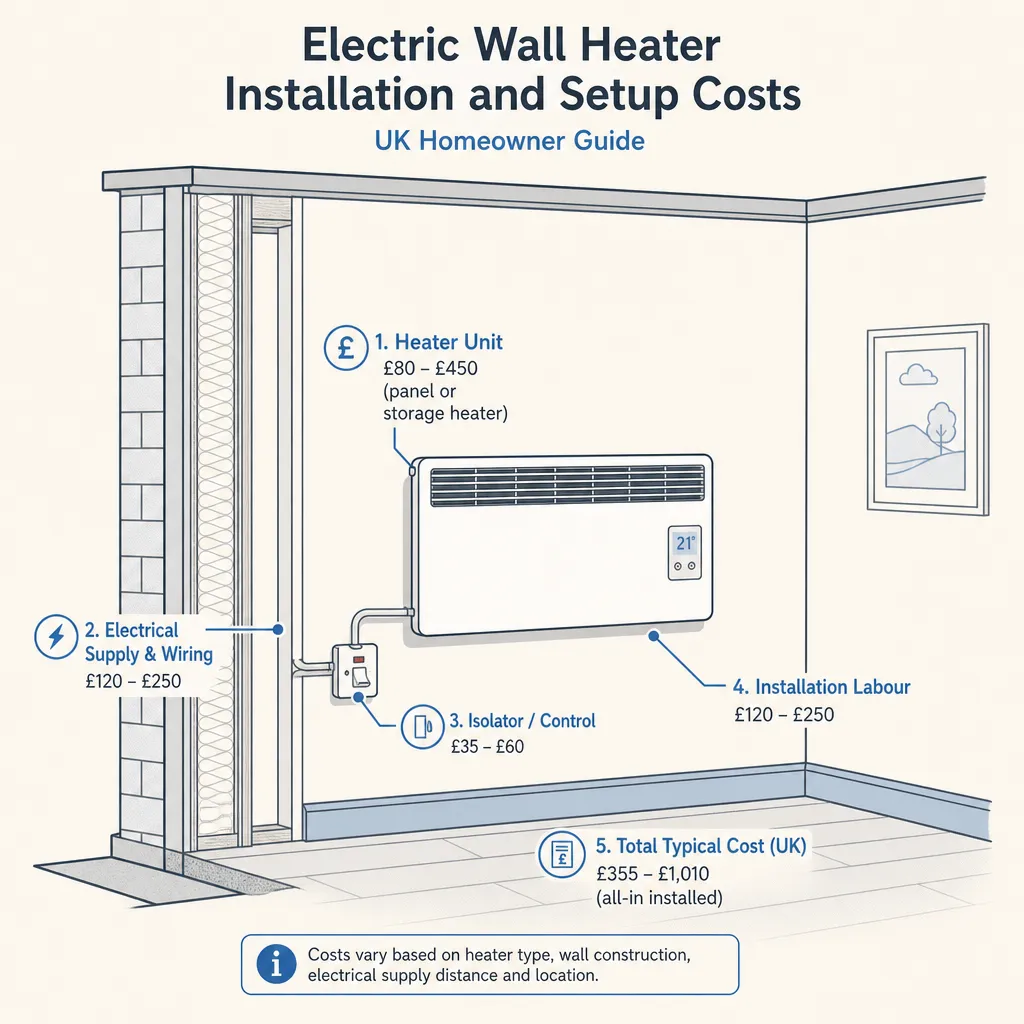
Electric Wall Heater Installation and Setup Costs
Electric wall heater installation in the UK typically costs £150–£350 per unit for a panel heater, plus £100–£250 if a new spur or circuit is needed.
 Energy & Retrofit
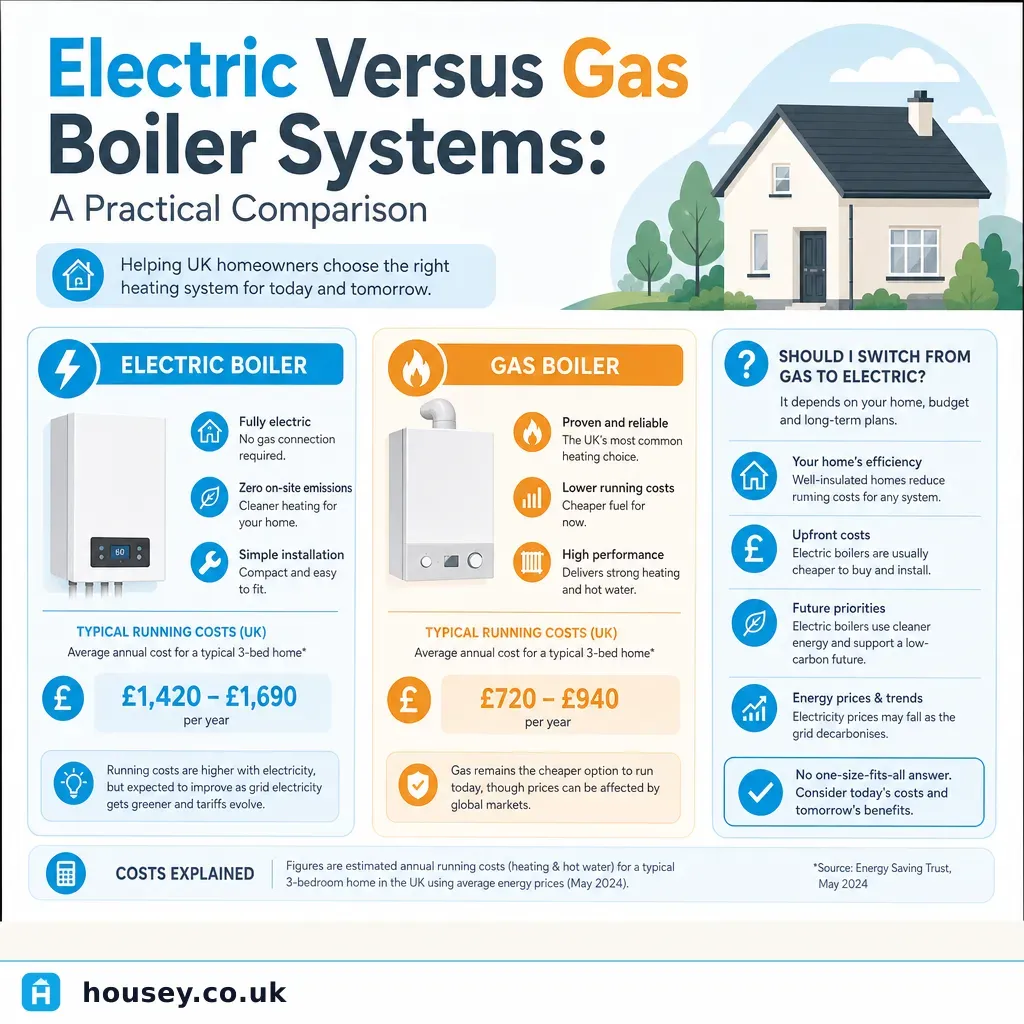
Electric Versus Gas Boiler Systems: A Practical Comparison
Electric boilers convert nearly all electricity into heat (98–99% efficiency) but electricity costs roughly 3–4 times more per kWh than gas, making running costs higher in most UK homes.
 Energy & Retrofit
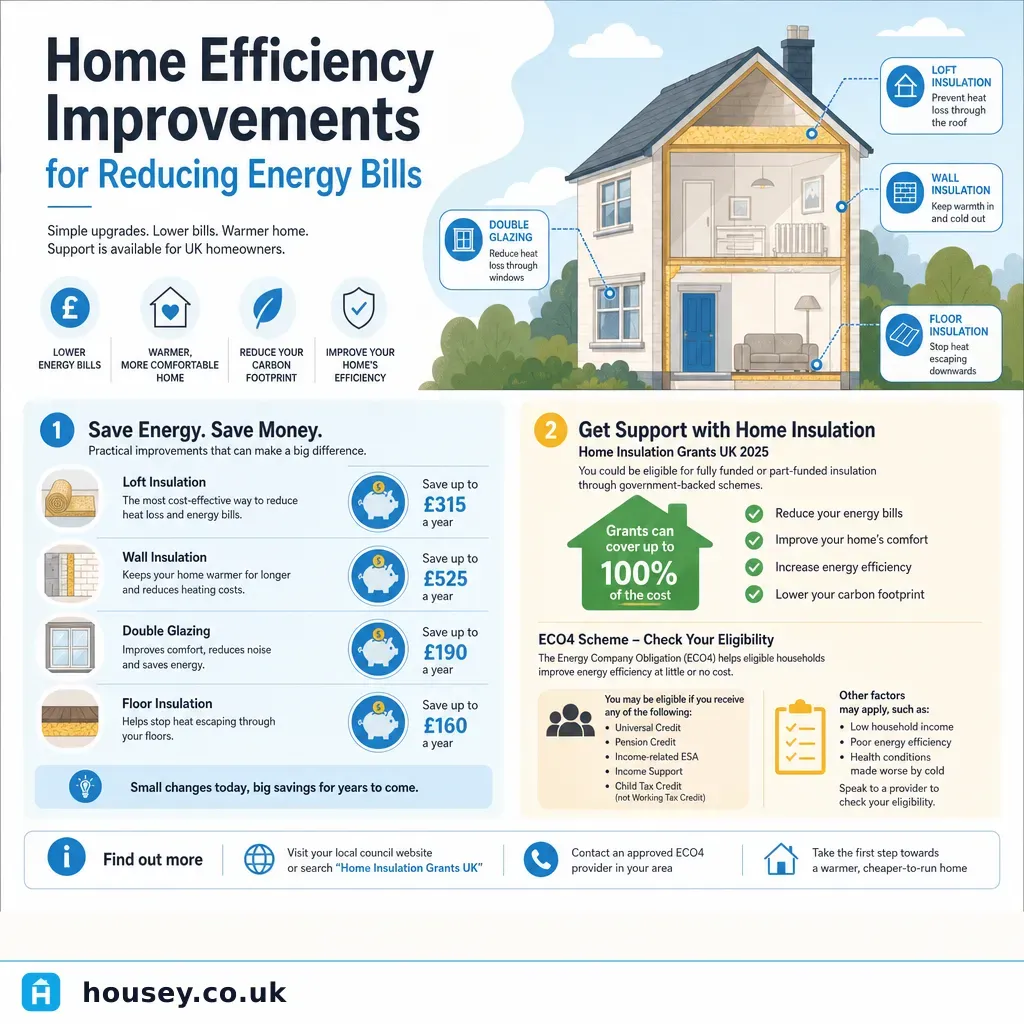
Home Efficiency Improvements for Reducing Energy Bills
The most cost-effective UK home efficiency improvements are usually loft insulation, cavity wall insulation, draught-proofing, and upgrading heating controls.
 Energy & Retrofit
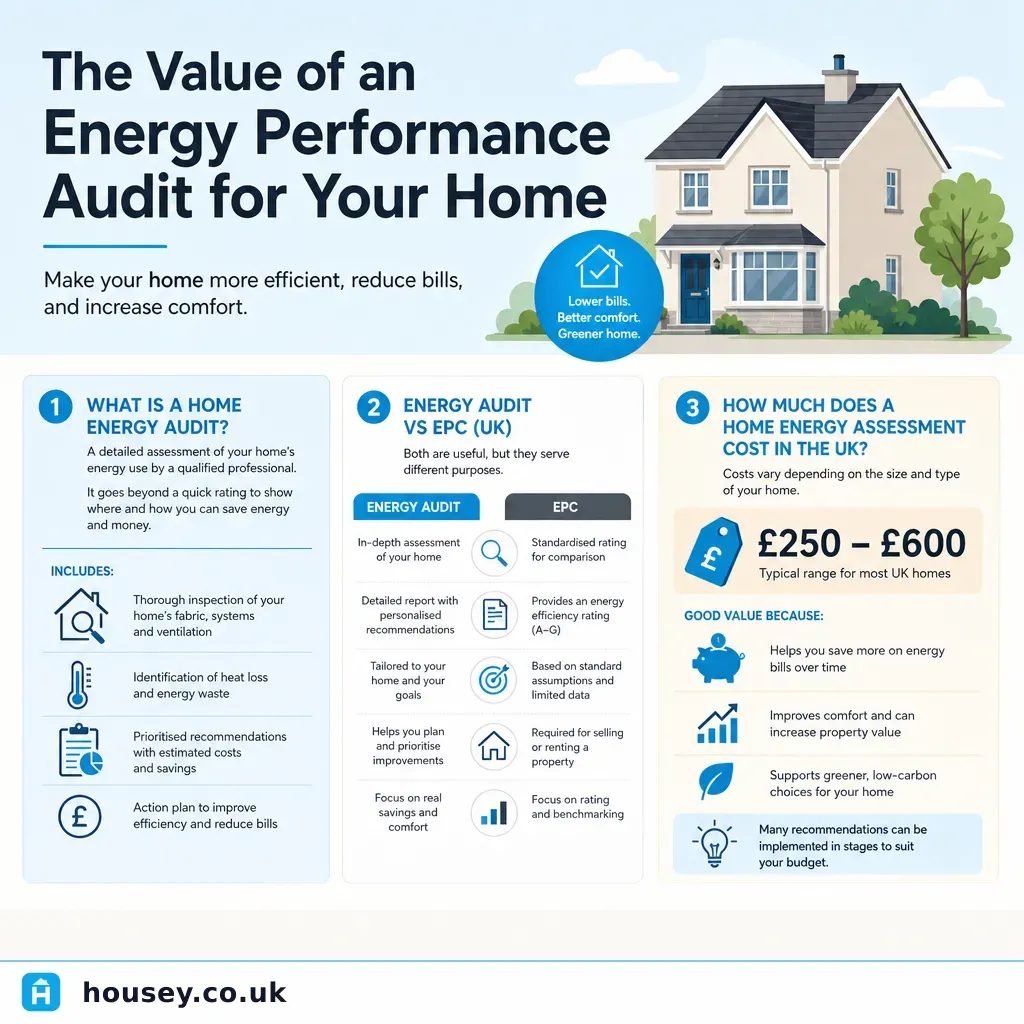
The Value of an Energy Performance Audit for Your Home
A home energy performance audit is a detailed, site-specific assessment of a property's fabric, heating, ventilation, and controls.
 Energy & Retrofit
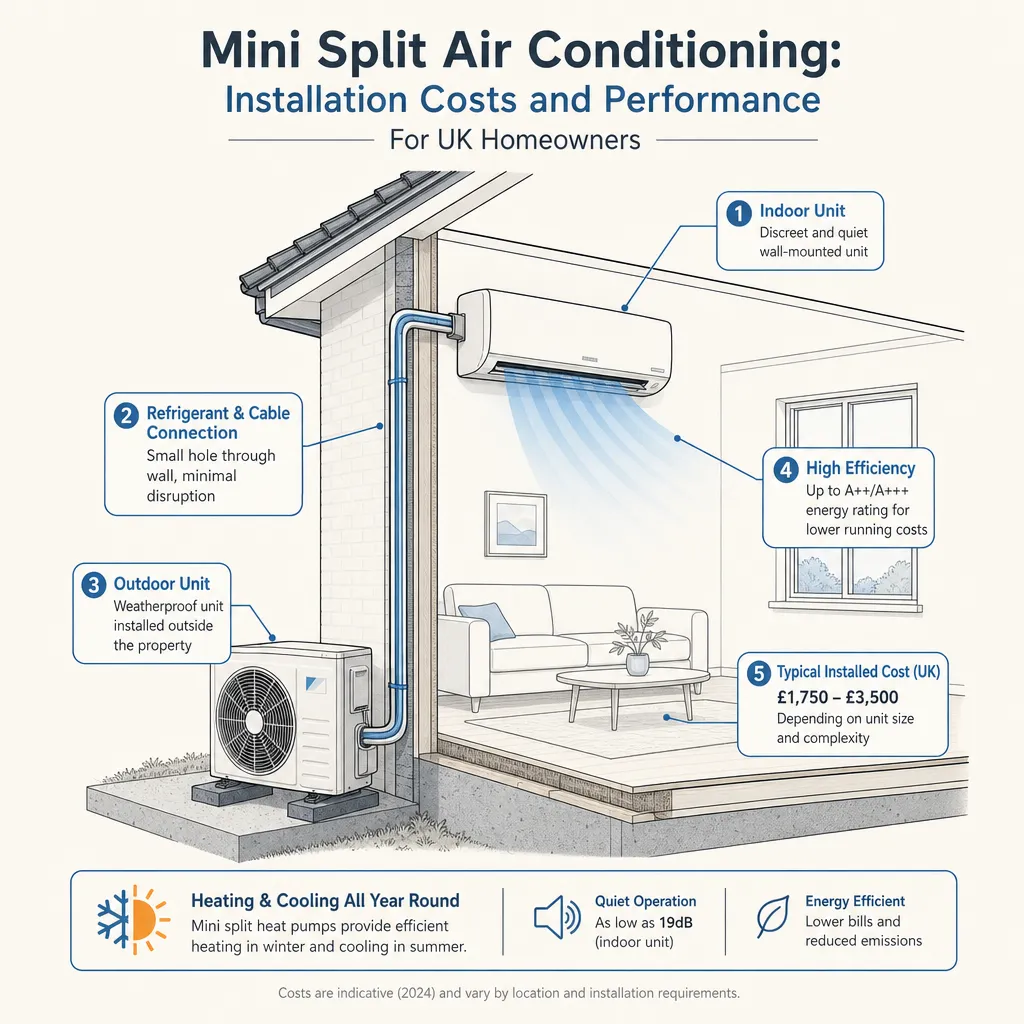
Mini Split Air Conditioning: Installation Costs and Performance
A mini-split (ductless) air conditioning unit costs roughly £1,500–£4,000 installed for a single room in the UK.