Electrical Faults Commonly Found in UK Homes: Identification and Safety
By Housey · Last reviewed 11th of May 2026
Electrical Faults Commonly Found in UK Homes: Identification and Safety
Electrical problems in UK homes can be easy to overlook, yet some of the most serious fire and electrocution hazards develop gradually in wiring that is decades old or has been modified without proper certification. With an estimated 20,000 electrical fires occurring in UK homes each year (Electrical Safety First), understanding what common faults look like, how they are formally assessed, and when to act is an important part of responsible home ownership — particularly for buyers and owners of pre-1990s properties where the original electrical installation may never have been fully updated.
Key points
- An Electrical Installation Condition Report (EICR) is the standard document for assessing electrical safety in UK homes; landlords in England must obtain one every five years under the Electrical Safety Standards in the Private Rented Sector (England) Regulations 2020.
- Wiring installed before the 1960s may use rubber-insulated conductors that become brittle and crack over time, exposing live parts — this type of installation carries a significantly elevated fire risk.
- Residual Current Devices (RCDs) disconnect a circuit within milliseconds of detecting a fault; homes without RCD protection in the consumer unit are at greater risk of electrocution and electrical fire.
- Under Part P of the Building Regulations, notifiable electrical work must be carried out by a competent person registered with an approved scheme such as NICEIC or NAPIT, or submitted to building control for approval.
- Aluminium wiring — used in some UK homes during the 1960s and 1970s — is still present in a small number of properties; it oxidises over time and can cause high-resistance connections that generate localised heat.
The most common electrical faults in UK homes
Outdated consumer units and overloaded circuits
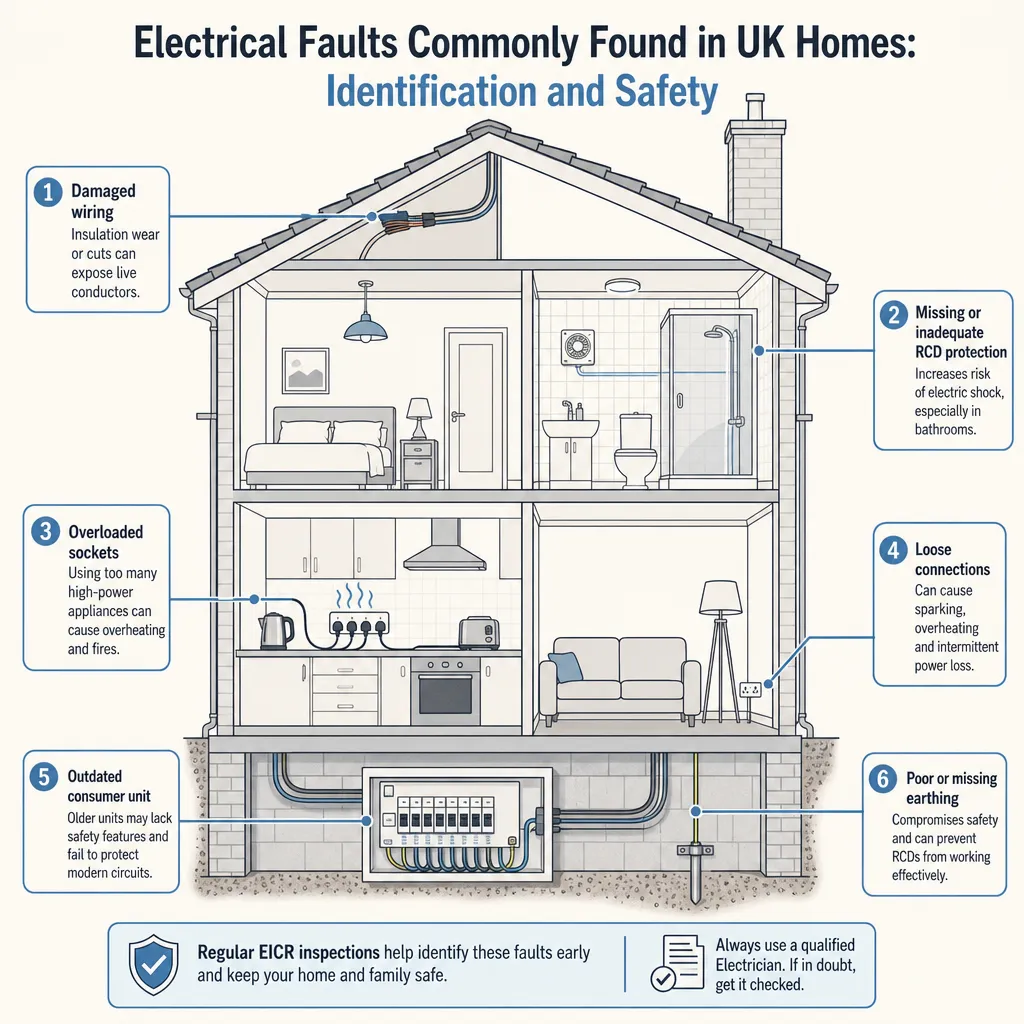
Many UK homes built before the 1990s contain consumer units (fuse boards) fitted with rewireable fuses rather than modern miniature circuit breakers (MCBs) and RCDs. These older units offer less protection against overloads, short circuits, and earth faults, and cannot disconnect a faulty circuit as rapidly. Overloaded circuits — typically caused by running multiple high-load appliances from extension leads — are a common cause of MCB trips and, in properties with rewireable fuses, a potential fire risk.
Deteriorating wiring
Wiring type | Typical era | Key risk | Recommended action |
|---|---|---|---|
Rubber-insulated | Pre-1960s | Insulation becomes brittle and cracks, exposing conductors | Urgent rewiring recommended |
Lead-sheathed, fabric-covered | Pre-1950s | Severe degradation; live conductor exposure | Urgent rewiring recommended |
Aluminium conductors | 1960s–1970s | Oxidation creates high-resistance joints that overheat | Specialist inspection; connections may need upgrading |
PVC-insulated (TRS) | 1970s–1990s | Generally sound but may have suffered poor additions | EICR to assess overall condition |
Modern PVC twin and earth | 1990s–present | Standard; check for physical damage and correct installation | Periodic EICR as recommended |
Missing or inadequate RCD protection
Residual Current Devices (RCDs) protect against electric shock by detecting fault currents and disconnecting the circuit far faster than a standard fuse or MCB. Without RCD protection — either within the consumer unit or as plug-in devices at individual sockets — socket circuits, outdoor circuits, and bathroom circuits carry elevated risk. Many consumer units installed before the early 2000s lack this protection entirely.
Faulty or incorrectly wired sockets and switches
Loose wiring connections at socket back-boxes are a common source of arcing — localised electrical sparks that generate heat and represent a fire hazard. Symptoms include sockets or light switches that feel warm to the touch, scorch marks or discolouration around faceplates, flickering lights when other appliances operate, or a burning smell from near a fitting.
DIY and unapproved electrical alterations
A significant proportion of faults identified in EICRs result from DIY electrical work or work by unregistered tradespeople that was never tested and certified. Common findings include cables run without protective conduit inside walls, incorrect cable sizes for the circuit load, missing earth bonding to metal gas and water pipes, and ring mains incorrectly extended or interrupted.
How to identify electrical problems in your home
Red flags — symptoms requiring prompt attention
- Frequent MCB trips or blown fuses, particularly on the same circuit.
- Flickering or dimming lights not explained by a failing lamp.
- Sockets or switch faceplates that are warm or show discolouration.
- A burning or acrid smell from any electrical fitting or the consumer unit.
- Buzzing, crackling, or humming from sockets, light fittings, or the consumer unit.
- A consumer unit that has no RCD protection present.
- Rubber-insulated or fabric-sheathed wiring visible in the loft, under floorboards, or at the consumer unit.
What an EICR identifies
An Electrical Installation Condition Report (EICR) is a formal inspection carried out by a qualified electrician registered with an approved scheme (NICEIC, NAPIT, ELECSA, or equivalent). The inspection covers the consumer unit and all protective devices, the condition and suitability of all wiring, earthing and bonding arrangements, all accessories (sockets, switches, and light fittings), and any non-compliant or DIY work.
Findings are classified as:
- C1 (Danger present): Immediate remedial action required.
- C2 (Potentially dangerous): Urgent remedial work needed.
- C3 (Improvement recommended): Not immediately dangerous, but should be addressed.
- FI (Further investigation): Cannot be fully assessed without additional investigation.
Any C1 or C2 classification means the installation is considered unsatisfactory and remedial work must follow.
What to ask before instructing an electrician
- Are you registered with NICEIC, NAPIT, ELECSA, or another Part P-approved scheme?
- What does the EICR scope cover — the full installation or only accessible parts?
- If remedial work is needed, will you provide a detailed written quotation before starting?
- Will the work be self-certified through your scheme or submitted to building control?
- What certification and documentation will I receive on completion?
- How long will the inspection and any remedial work take, and will power need to be interrupted?
Important limitations
Electrical faults can be invisible to the untrained eye and carry serious risks including electric shock, fire, and death. This article is for general awareness only and is not a substitute for an EICR carried out by a qualified, registered electrician. Never investigate electrical fittings by removing socket or switch faceplates, accessing the consumer unit, or touching any conductors. If you suspect immediate danger — such as a burning smell, visible sparks, or a warm consumer unit — switch off at the main isolator if it is safe to do so, and contact a qualified electrician urgently. In any emergency, call 999.
What to ask a qualified professional
Before instructing an electrician for inspection or remedial work:
- What is included in the EICR scope, and are there areas that cannot be accessed or tested?
- What is the age of the existing consumer unit, and does it meet current requirements under BS 7671?
- If the wiring is pre-1960s, what does a full rewire involve and how long would it take?
- Is the earthing and bonding to gas, water, and structural metalwork compliant with current standards?
- Which circuits currently lack RCD protection, and what would it cost to address that?
When to get professional help
Contact a qualified, registered electrician without delay if:
- Any of the red-flag symptoms listed above are present.
- The property has not had an EICR within the last five to ten years (or within five years if it is a private rental).
- You are buying a property and the seller cannot provide a recent EICR or electrical completion certificate.
- Electrical work has been carried out without formal certification.
- You are planning renovation work that will affect existing circuits or require new ones.
- Rubber-insulated or fabric-sheathed wiring is visible anywhere in the property.
How Housey can help
Housey connects homeowners with qualified, registered electricians who can carry out Electrical Installation Condition Reports (EICR) to identify faults, assess risk, and guide you through any remedial work required. Compare local professionals and request quotes with confidence.
Frequently asked questions
How often should an owner-occupied home have an EICR?
There is no legal frequency requirement for owner-occupied homes in England. The IET and NICEIC recommend an EICR every ten years or on change of occupancy. For private rental properties in England, an EICR is legally required every five years under the Electrical Safety Standards in the Private Rented Sector (England) Regulations 2020, with a copy provided to tenants before they move in.
Can I carry out my own electrical work at home?
Minor like-for-like replacements — such as changing a socket faceplate or a light fitting on an existing circuit — may be carried out by a competent householder under Part P of the Building Regulations. However, notifiable work (new circuits, work in bathrooms, or any work near the consumer unit) must be carried out by a registered electrician or submitted to building control. When in doubt, use a registered professional.
What does an EICR cost?
Indicative UK costs, last reviewed 2026-05-11. An EICR for a typical three-bedroom house costs approximately £150–£300, depending on installation size, number of circuits, and region. Properties with older or more complex wiring may cost more. Always confirm the scope of the inspection before instructing, and ask whether the quote covers the full installation or only accessible areas.
What happens if my property fails an EICR?
A failed EICR containing C1 or C2 codes means remedial work is required. C1 codes indicate immediate danger and require action before the installation is used again. The electrician should provide a written schedule of remedial works with costs. On completion, a Minor Electrical Installation Works Certificate or a new satisfactory EICR confirms the installation now meets the required standard.
Sources and further reading
- Electrical Safety First — homeowner guidance — Electrical Safety First
- Electrical Safety Standards in the Private Rented Sector (England) Regulations 2020 — GOV.UK
- NICEIC — find a registered electrician — NICEIC
- IET Wiring Regulations (BS 7671) — Institution of Engineering and Technology
- HSE: electrical safety — Health and Safety Executive
Useful next reads
 Surveys & Inspections
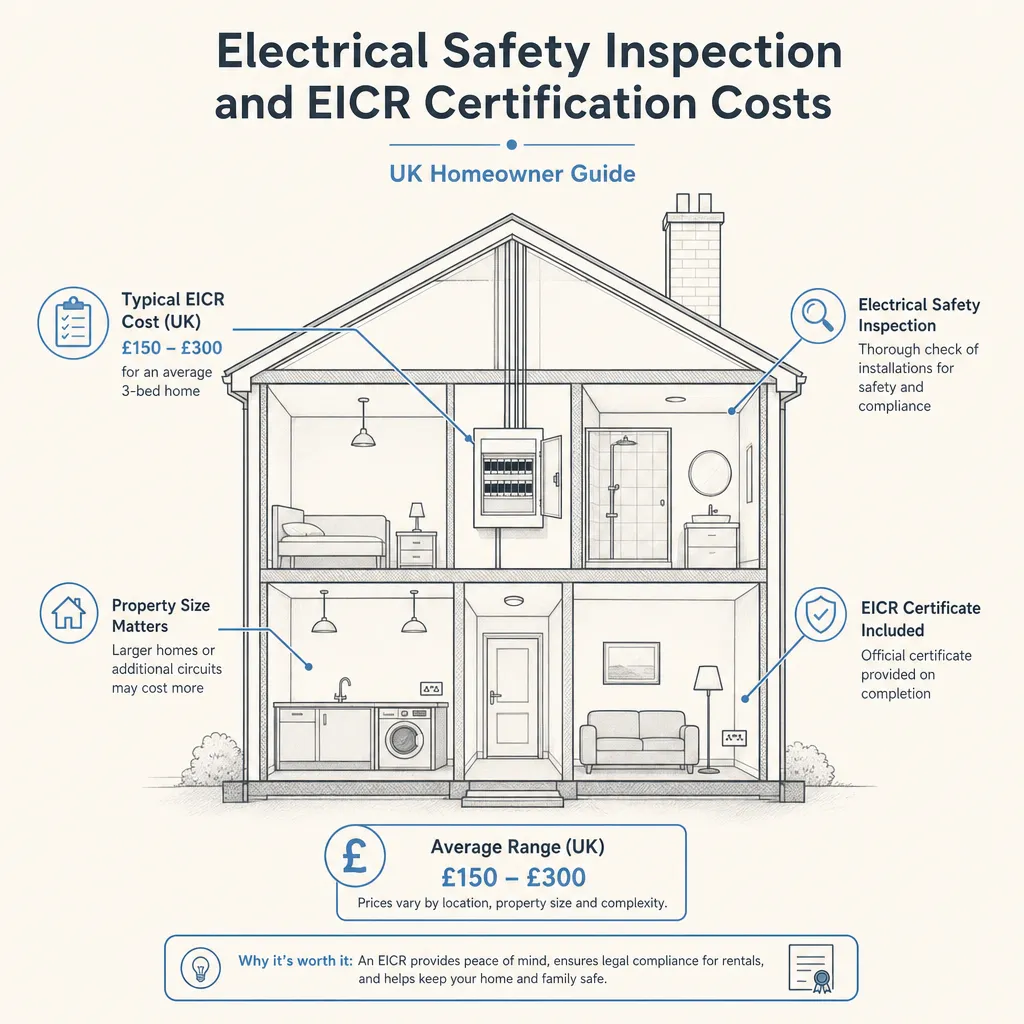
Electrical Safety Inspection and EICR Certification Costs
An Electrical Installation Condition Report (EICR) typically costs £100–£150 for a one-bedroom flat and £150–£250 for a two- to three-bedroom house in the UK.
 Surveys & Inspections
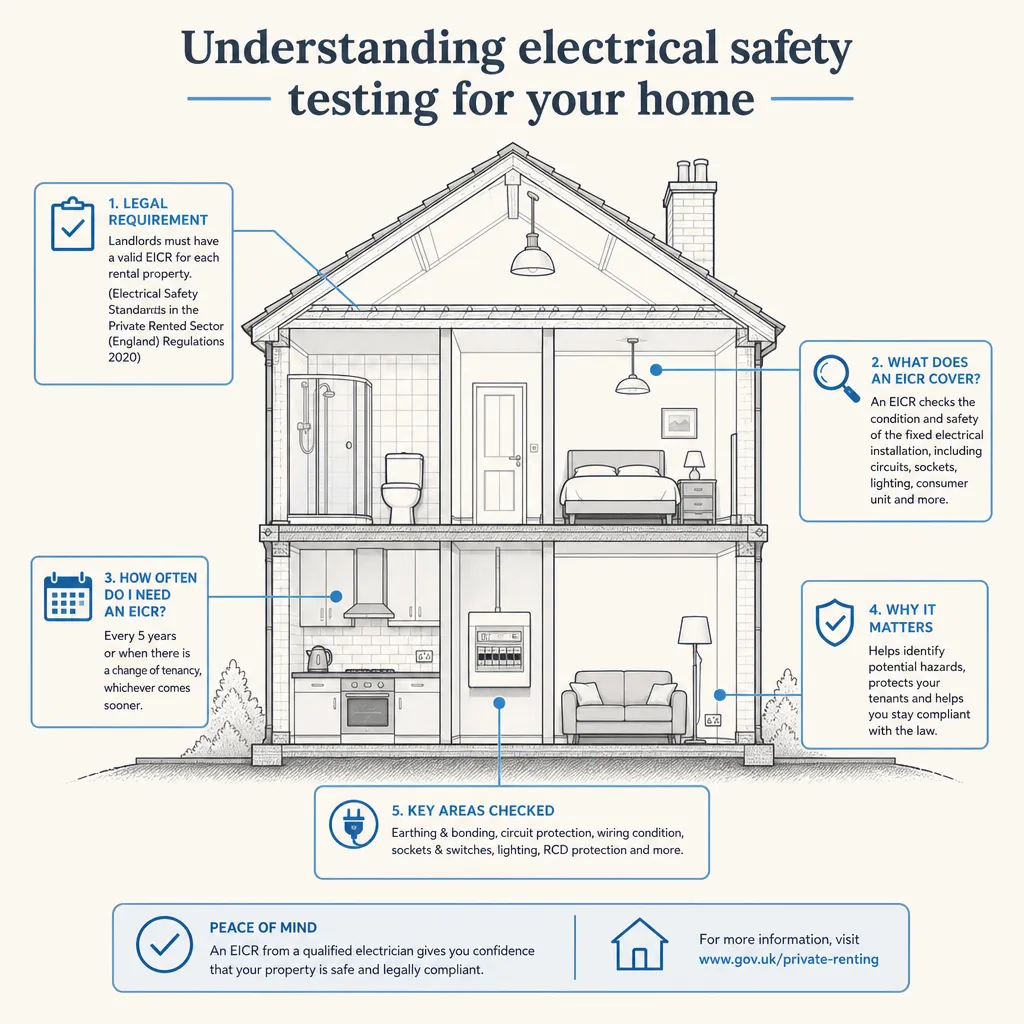
Understanding electrical safety testing for your home
An Electrical Installation Condition Report (EICR) assesses the fixed wiring, consumer unit, and electrical circuits in a property.
 Surveys & Inspections
Why Property Boundaries Matter: Surveying and Dispute Prevention
Property boundaries in England and Wales are recorded as general boundaries by HM Land Registry — not precise measurements.
 Surveys & Inspections
Safe Property Viewing Practices: Protecting Yourself During Inspections
When viewing a property in the UK, always tell someone where you are going and share the full address before you leave.
 Surveys & Inspections
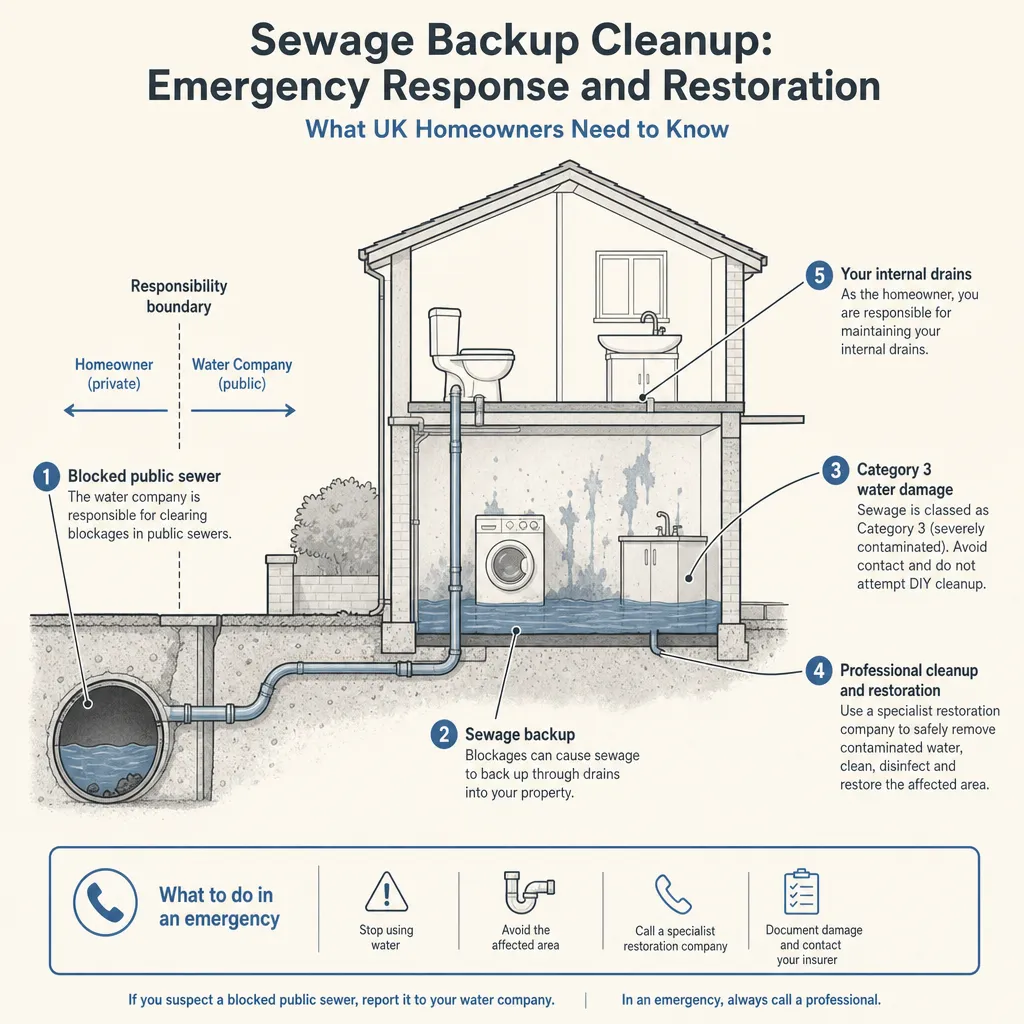
Sewage Backup Cleanup: Emergency Response and Restoration
A sewage backup should be treated as a Category 3 contamination event.