Understanding electrical safety testing for your home
By Housey · Last reviewed 19th of May 2026
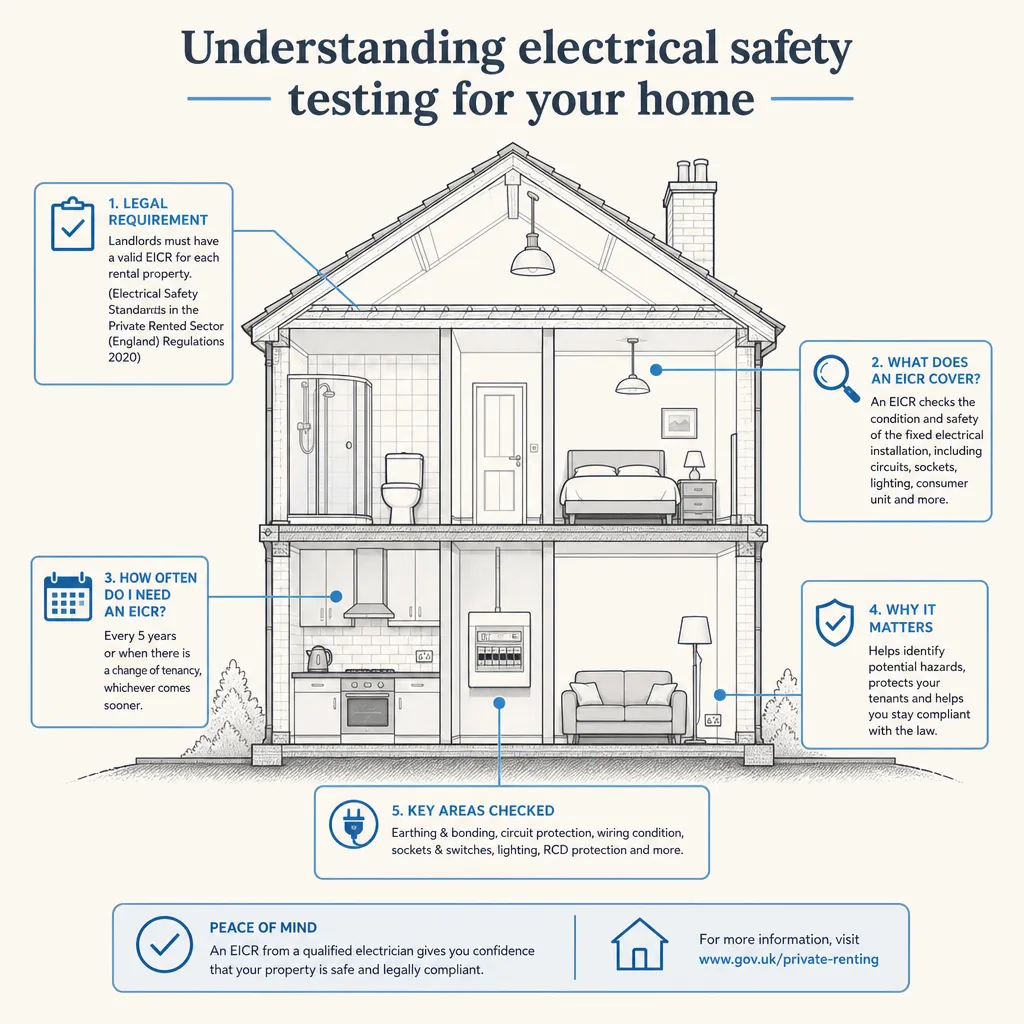
Understanding electrical safety testing for your home
An Electrical Installation Condition Report (EICR) is one of the most commonly requested safety documents in UK residential property — required by law for privately rented homes in England, expected by many mortgage lenders and insurers, and strongly recommended for any property where the electrical installation has not been formally checked in recent years. Understanding what an EICR is, when you need one, and what happens during the process helps homeowners and landlords make informed decisions about electrical safety and legal compliance.
Key points
- Since 1 April 2021, private landlords in England must have a valid EICR for every tenancy; the installation must be inspected by a qualified electrician and any C1 (danger present) or C2 (potentially dangerous) codes remediated within 28 days of receiving the report.
- The Electrical Safety Standards in the Private Rented Sector (England) Regulations 2020 set the legal framework for landlord EICR obligations in England; Scotland has separate duties under the Housing (Scotland) Act 2006 and associated regulations.
- An EICR must be carried out by a competent person — typically a registered electrician on the NICEIC, NAPIT, or ELECSA schemes, or an ECA-registered contractor.
- EICRs are graded using coded observations: C1 (immediate danger), C2 (potentially dangerous), C3 (improvement recommended), and FI (further investigation required).
- Homeowners are not legally required to hold an EICR but are strongly advised to obtain one every 10 years, or on buying a home with an unknown electrical history.
What an EICR covers
An EICR assesses the fixed electrical installation in a property — the consumer unit (fuse box), wiring, sockets, switches, light fittings, and any permanently wired equipment. It does not cover portable appliances (which fall under PAT testing) or renewable energy generation equipment unless specifically included in the scope.
The inspection typically includes:
- Visual inspection of accessible components for signs of damage, deterioration, or non-compliant installation.
- Electrical testing of circuits using specialist instruments, including insulation resistance, earth continuity, polarity, and prospective fault current measurements.
- Verification that the installation meets the current requirements of BS 7671 (the IET Wiring Regulations, 18th Edition, as amended).
- Issue of the formal EICR report with coded observations and a schedule of circuits.
EICR codes explained
Code | Meaning | Action required |
|---|---|---|
C1 — Danger present | Immediate risk of injury to persons | Remediate immediately; do not delay |
C2 — Potentially dangerous | Could become dangerous over time | Remediate within 28 days (landlords) or as soon as practicable (homeowners) |
C3 — Improvement recommended | Does not meet current standards but not dangerous | Not mandatory, but worth addressing at next rewire or major works |
FI — Further investigation | Cannot be fully assessed without additional work | Investigate before a satisfactory outcome can be issued |
A Satisfactory overall outcome means no C1 or C2 codes were found. An Unsatisfactory outcome means at least one C1 or C2 was identified; remediation is required, and a new EICR or a completion certificate for the works must follow.
Who needs an EICR and when
Private landlords (England): A valid EICR is required before a new tenancy begins if no current report exists, and must be renewed at least every five years. Local authorities can impose civil penalties of up to £30,000 for non-compliance under the 2020 Regulations.
Homeowners: There is no legal requirement, but Electrical Safety First and most registered electricians recommend an EICR every 10 years in owner-occupied properties, or at change of occupancy. Properties wired before the 1990s — particularly those with older rubber-insulated wiring, TT earthing arrangements, or no residual current device (RCD) protection — warrant earlier inspection.
Buyers: Mortgage lenders increasingly request EICR evidence for older properties. A conveyancing solicitor may flag an outdated or absent EICR as a risk to the buyer during the transaction.
Sellers: A valid, satisfactory EICR can smooth the conveyancing process and provide reassurance to prospective buyers.
Homeowner EICR checklist
Before your EICR appointment, prepare the following:
What to ask before hiring an electrician for an EICR
Before instructing an electrician, ask:
- Are you registered with NICEIC, NAPIT, ELECSA, or another competent persons scheme, and can I verify your registration online?
- Will the EICR be produced in the standard format approved by the relevant scheme?
- How long will the inspection take, and will the electricity supply need to be isolated at any point?
- If C1 or C2 codes are found, do you carry out remediation, and will you provide a separate quote before proceeding?
- Is VAT included in the quoted fee?
- Will you issue a new EICR or a completion certificate after any remedial works?
Important limitations
This article provides general information about EICRs in UK residential property. Electrical safety is a safety-critical topic and nothing here constitutes electrical advice or a substitute for a professional inspection. Requirements for private landlords vary by nation — England, Scotland, Wales, and Northern Ireland each have distinct regulatory frameworks. Always verify current obligations with a registered electrician or the relevant regulatory body for your jurisdiction.
When to get professional help
Contact a registered electrician without delay if:
- Your consumer unit contains rewireable fuses rather than circuit breakers — a sign of a very old installation.
- You notice burning smells, scorch marks around sockets or switches, flickering lights, or frequently tripping circuits.
- Your property has no RCD protection — a significant safety gap in many pre-2000 properties.
- A previous EICR has expired: over five years old for a rental, over ten years for an owner-occupied home.
- You are buying a property where no EICR history is available.
What to ask a qualified professional
Before instructing an electrician for an EICR or remediation, ask:
- What is the scope of the inspection — will you test all circuits and accessible accessories?
- If you identify C1 or C2 issues, can you provide a separate remediation quote before I commit to the work?
- Is partial rewiring likely to be needed, and how will you assess this during the inspection?
- What documentary evidence will I receive that any remedial work has been completed to BS 7671?
- Is the fee a fixed price, or could it vary if additional circuits or access issues are found?
How Housey can help
Housey connects you directly with qualified electricians offering Electrical Installation Condition Reports (EICR), making it straightforward to obtain quotes from NICEIC- or NAPIT-registered contractors and compare them in one place.
Frequently asked questions
How much does an EICR cost in the UK?
Indicative UK costs, last reviewed 2026-05-19: for a typical 2–3 bedroom house, expect to pay approximately £150–£300, though costs vary significantly by property size, number of circuits, location, and contractor. Always obtain at least two quotes and confirm what is included. Costs sourced from Electrical Safety First guidance on EICR pricing.
How long does an EICR take?
A typical 2–3 bedroom house usually takes 2–4 hours, depending on the number of circuits and accessibility. Older or larger properties with more circuits may take longer. The electrician will need to isolate circuits individually during testing, so expect some disruption to the electrical supply during the inspection.
Can a landlord use any electrician for an EICR?
No. Under the Electrical Safety Standards in the Private Rented Sector (England) Regulations 2020, the inspection must be carried out by a qualified person — in practice, a registered electrician on a competent persons scheme such as NICEIC, NAPIT, or ELECSA. Always verify registration on the scheme's public register before instructing.
What is the difference between an EICR and a PAT test?
An EICR covers the fixed electrical installation — wiring, consumer unit, sockets, and permanently wired equipment. A PAT (Portable Appliance Test) covers portable items such as kettles, lamps, and washing machines. For a rental property both may be relevant, but they are separate assessments carried out by different means.
Sources and further reading
- Electrical Safety Standards in the Private Rented Sector (England) Regulations 2020 — legislation.gov.uk
- Electrical safety in the private rented sector: guidance for landlords — GOV.UK
- EICR guidance for homeowners — Electrical Safety First
- IET Wiring Regulations BS 7671 — IET
- Find a registered electrician — NICEIC
Useful next reads
 Surveys & Inspections
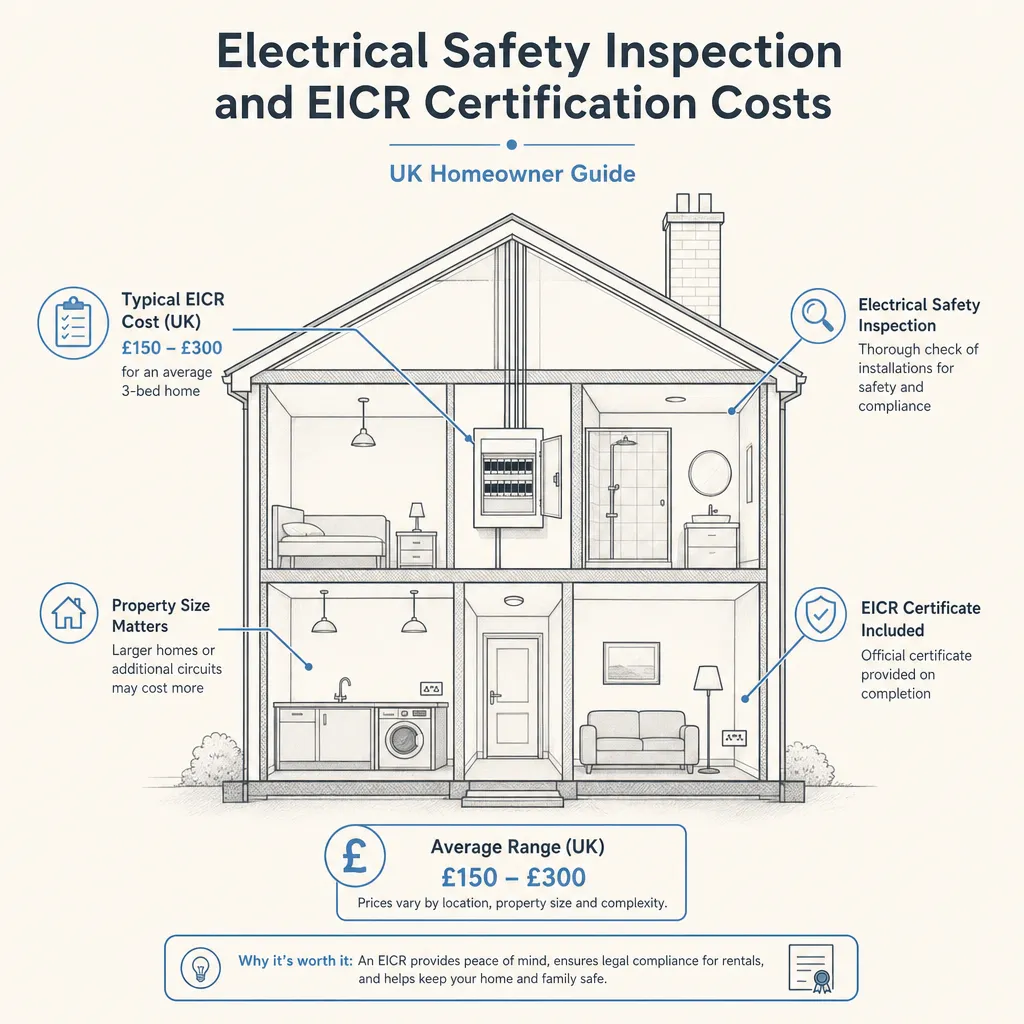
Electrical Safety Inspection and EICR Certification Costs
An Electrical Installation Condition Report (EICR) typically costs £100–£150 for a one-bedroom flat and £150–£250 for a two- to three-bedroom house in the UK.
 Surveys & Inspections
Asbestos Testing: Finding a Qualified Surveyor
Finding a qualified asbestos surveyor means choosing a company accredited by UKAS to ISO/IEC 17020, with analysts holding BOHS P402 or equivalent qualifications.
 Surveys & Inspections
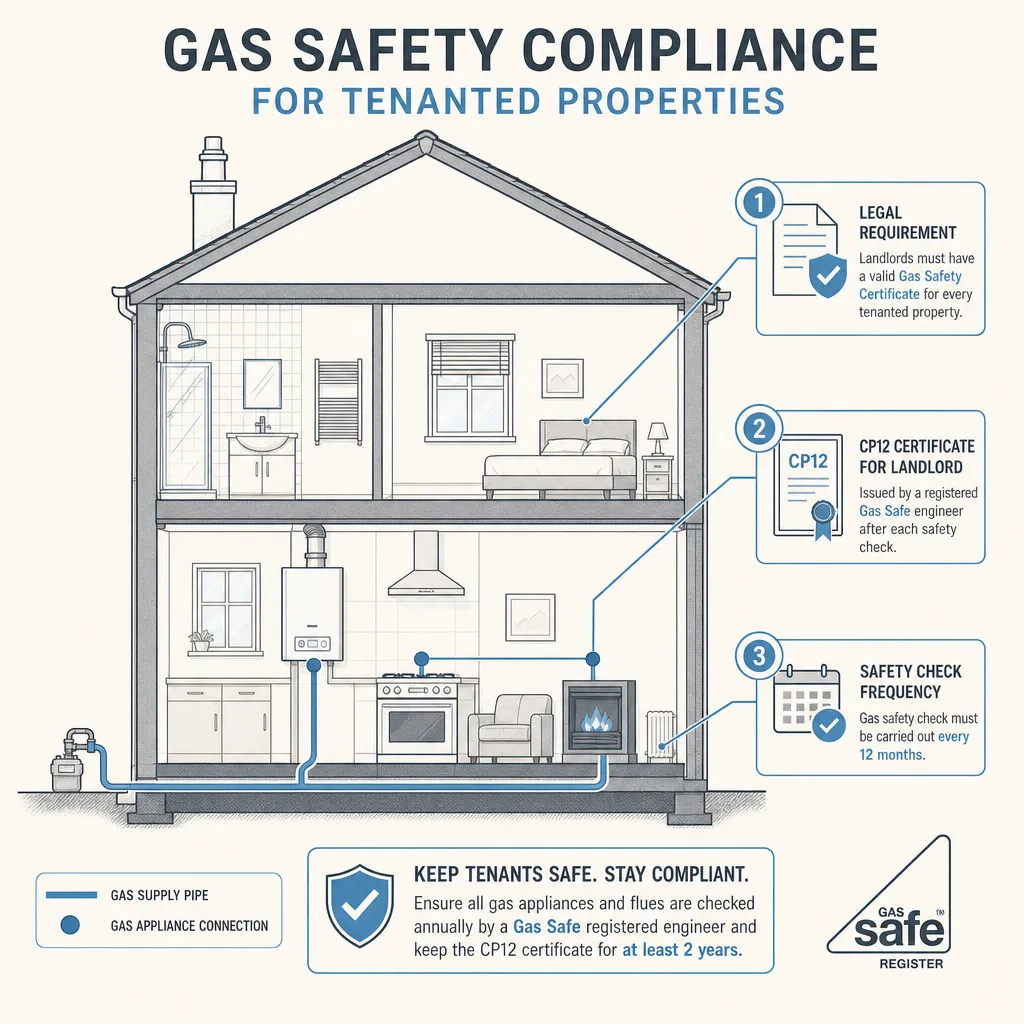
Gas Safety Compliance for Tenanted Properties
UK landlords are legally required to arrange an annual gas safety check by a Gas Safe registered engineer for every tenanted property with a gas appliance.
 Surveys & Inspections
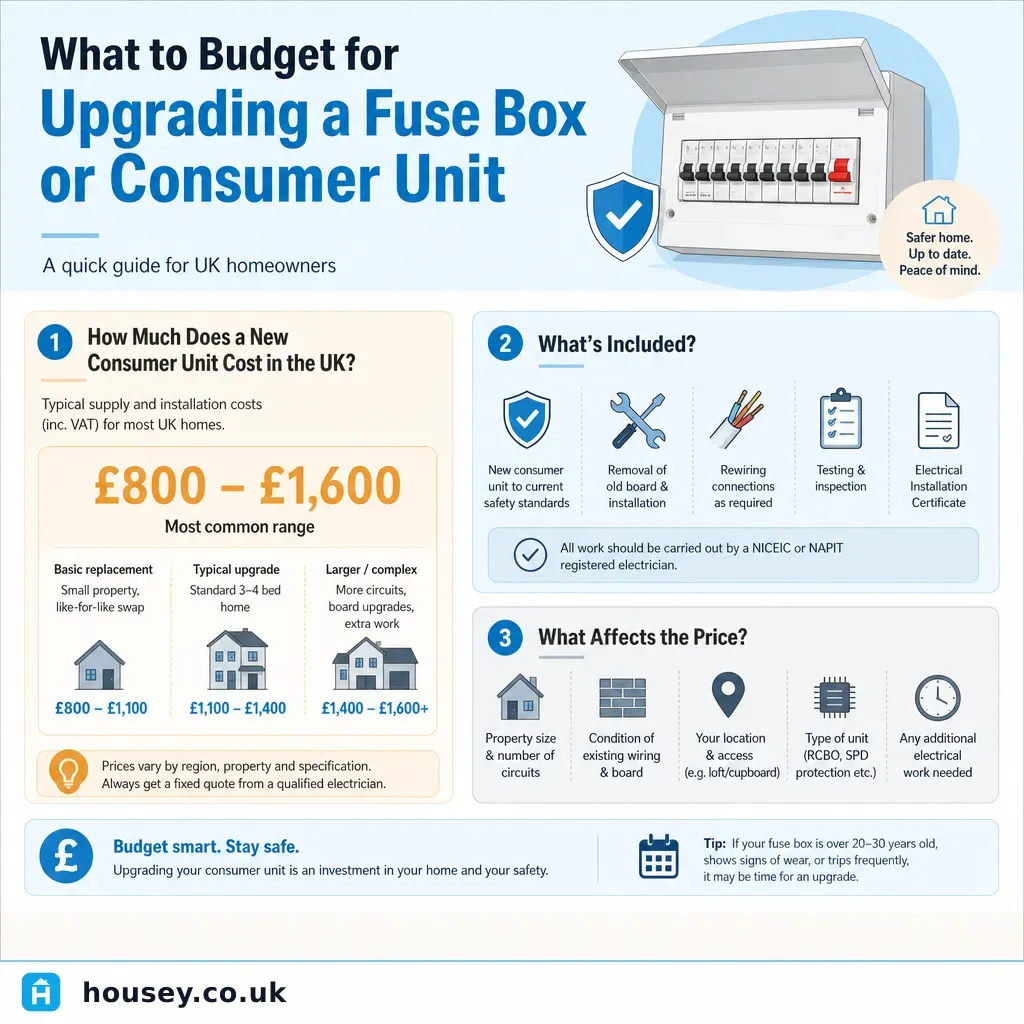
What to Budget for Upgrading a Fuse Box or Consumer Unit
Replacing a consumer unit (fuse box) in the UK typically costs £400–£900 for a straightforward installation by a Part P registered electrician.
 Surveys & Inspections
Gas Safety Certificate: What Landlords and Homeowners Need
Landlords in England, Scotland, and Wales must arrange a gas safety check every 12 months by a Gas Safe registered engineer under the Gas Safety (Installation and Use) Regulations 1998.