Electrical installation methods for cable management and wall penetrations
By Housey · Last reviewed 30th of May 2026
Electrical installation methods for cable management and wall penetrations
Questions about cable routing and wall penetrations arise most often when homeowners are planning a rewire, adding new circuits, or reviewing findings from an Electrical Installation Condition Report (EICR) that has highlighted code C2 or C3 observations about wiring methods. Understanding how cables should be installed — and why the rules exist — helps homeowners assess the quality of existing work, brief electricians effectively, and ask the right questions before authorising any notifiable work.
Key points
- BS 7671:2018+A2:2022 (the IET Wiring Regulations, 18th Edition) is the current UK wiring standard; all fixed electrical installation work must comply with it, and notifiable work must be carried out by a Part P registered electrician or notified to Building Control before it starts.
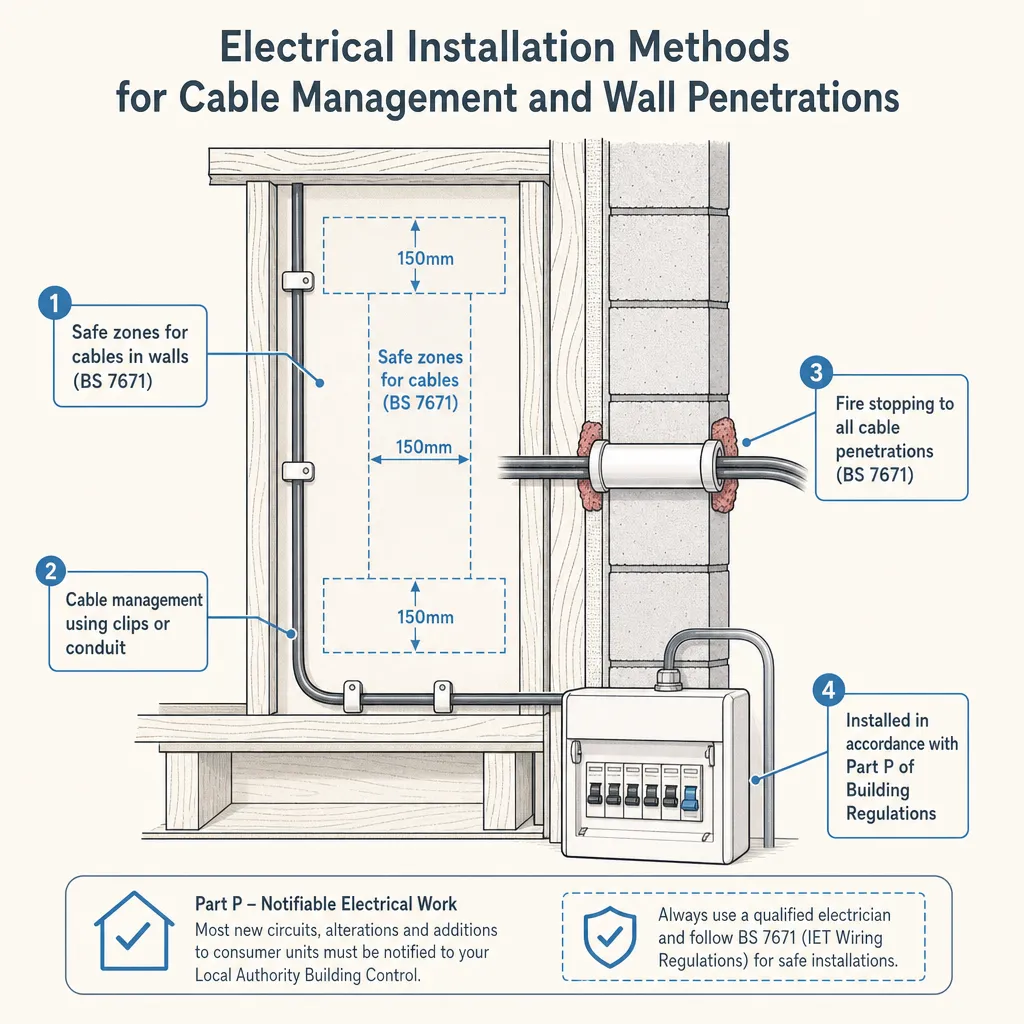
- Cables concealed in walls must be installed in defined safe zones — within 150 mm of a room corner or within 150 mm of a ceiling or floor junction — or be protected by earthed metallic conduit, or be on a circuit protected by a 30 mA RCD (BS 7671, Regulation 522.6.6).
- All penetrations through fire-compartment boundaries — party walls, floors between flats, walls separating a garage from a habitable room — must be fire-stopped with intumescent materials to maintain the compartmentation required by Building Regulations Approved Document B.
- Notifiable work under Part P includes new circuits, consumer unit replacements, and work in special locations such as bathrooms, kitchen sink zones, and swimming pool areas, regardless of apparent complexity.
- NAPIT and NICEIC are the main competent person scheme operators for domestic electrical work in England; registered members can self-certify notifiable work without a separate Building Control application.
What the regulations say about cable routing in walls
Safe zones under BS 7671
Regulation 522.6.6 of BS 7671 requires that cables installed in walls or partitions are protected against the risk of damage from fixings — nails, screws, and rawlbolts — during the life of the building. Three compliant approaches exist:
- Install cables in a safe zone — the horizontal or vertical routes within 150 mm of a room corner, or within 150 mm above or below a ceiling or floor junction. Cables in these zones are statistically less likely to be penetrated by future fixings.
- Install cables in earthed metallic conduit — provides mechanical protection regardless of position within the wall, and can provide an earth path.
- Provide 30 mA RCD protection — a 30 mA RCD protecting the circuit reduces the risk of electric shock if a cable is accidentally penetrated; this is permitted as an alternative in certain circumstances but does not prevent cable damage or associated fire risk.
Cable routing in timber-framed and stud partition walls
In timber-framed or stud partition walls, cables should pass through the centres of studs where possible, no closer than 25 mm from any face of the timber. Where cables pass through notches cut in floor joists, steel nail plates (protection plates) should be fitted over the notch to prevent accidental penetration from above. Cable installed in stud partitions containing insulating material may also be subject to derating for thermal effects.
Wall and floor penetrations: fire stopping
Every cable or conduit that passes through a fire-compartment boundary must be fire-stopped to restore the compartmentation required by Approved Document B (Fire Safety) of the Building Regulations in England.
Why fire stopping matters
Unprotected cable penetrations act as pathways that allow fire and toxic smoke to spread between compartments, potentially reducing effective escape time and undermining the protection that party walls and separating floors are designed to provide between properties.
Fire-stopping methods for cable penetrations
Method | Suitable for | Notes |
|---|---|---|
Intumescent putty or pads | Small single-cable penetrations through plasterboard or masonry | Products should carry UKCA or CE marking with a fire performance classification |
Intumescent collars | Larger openings or conduit penetrations | Expand on contact with heat to close the gap around the cable |
Proprietary cable transit systems | Multiple cables through a single pre-formed opening | Designed for specific penetration sizes; system documentation required |
Fire-rated silicone sealant or mastic | Gaps around cables in masonry blockwork | Must be applied at the specified minimum depth; fire classification must match the compartment requirement |
Fire stopping is frequently missed in domestic rewires, particularly in older properties where party walls have accumulated cable penetrations over multiple successive rewires. An EICR may note fire-stopping deficiencies, though electricians are not fire compartmentation specialists; a broader building inspection may be warranted if the issue appears widespread.
Surface cable management: conduit, trunking, and containment
Where cables are run on the surface of walls or ceilings rather than concealed, the choice of containment affects mechanical protection, appearance, and compliance with BS 7671.
Method | Typical use | Advantages | Limitations |
|---|---|---|---|
Mini-trunking (PVC) | Skirting-level or surface runs on plasterboard | Low cost, paintable, widely available | Limited mechanical protection; may need replacing on heavy redecoration |
Steel conduit | Garages, outbuildings, exposed locations | Strong mechanical protection, provides earth path | More complex installation; requires conduit bending tools for neat runs |
PVC conduit | Less-exposed surface locations | Lightweight, straightforward to install | Not appropriate where mechanical protection against impact is a requirement |
Dado trunking | Extensions, home offices, above kitchen worktops | Neat multi-compartment finish | Higher cost; requires careful circuit planning before installation |
Homeowner checklist for reviewing electrical work compliance
Use this checklist when assessing an EICR report, reviewing recent electrical work, or preparing to instruct an electrician:
Important limitations
This article provides general information about UK cable management methods, safe-zone requirements, and fire-stopping obligations under current building and electrical standards. It does not constitute an electrical inspection, EICR, or professional safety assessment of any installation. Electrical work involves hazards capable of causing electric shock, fire, and death; all notifiable work must be carried out by a competent, registered electrician. The specific requirements for any installation depend on the existing wiring condition, circuit loading calculations, special location classifications, and property type. Only a qualified electrician who has physically assessed your installation can determine what work is required.
When this becomes urgent
Contact a registered electrician without delay if:
- You notice burning smells, discolouration, or scorch marks around sockets, switches, or the consumer unit.
- A circuit trips repeatedly or a fuse blows frequently without an obvious overload cause.
- You have received a C1 (danger present) observation on an EICR — this requires immediate remedial action before the installation is used.
- You discover rubber-insulated wiring, bare copper conductors, or wiring showing visible physical deterioration.
- There are signs of water ingress near any part of the electrical installation.
- Electrical work has been carried out in the property since 2005 without a completion certificate.
What to ask a qualified professional
When instructing an electrician for a rewire, new circuits, or significant installation work, ask:
- Are you registered with a Part P competent person scheme — NAPIT, NICEIC, or equivalent — and will you self-certify this work without a separate Building Control application?
- If the work is notifiable and you are not Part P registered, has the cost of a Building Control application been included in the quote?
- Will all cables concealed in walls be installed in safe zones or protected by earthed metallic conduit, and how will this be confirmed on completion?
- Will all penetrations through fire-compartment walls and floors be fire-stopped, and what intumescent products will be used?
- Will you issue an Electrical Installation Certificate (EIC) or Minor Electrical Installation Works Certificate (MEIWC) on completion, and will a copy be left with the property?
- What level of RCD protection will each circuit receive, and will the consumer unit be upgraded as part of this work?
- For any external or outbuilding circuits: will armoured cable or suitable conduit with appropriate cable be specified?
- What assumptions is the quote based on, and what could change the price, scope, or timeline after work begins?
When to get professional help
New electrical circuits, consumer unit replacements, and work in bathrooms and kitchens are notifiable under Part P of the Building Regulations. DIY installation of notifiable work is not permitted unless a Building Control application is made before work starts. For assessment of an existing installation — whether at the point of purchase, as a periodic check, or to investigate a concern about ageing or sub-standard wiring — an EICR carried out by a Part P registered electrician provides a systematic assessment against current standards and results in a written, signed report.
How Housey can help
If you need a professional assessment of your home's wiring, Housey connects you with NICEIC- and NAPIT-registered electricians who can carry out an Electrical Installation Condition Report (EICR). An EICR gives you a clear picture of your installation's condition, identifies any C1 or C2 safety observations requiring attention, and produces a signed report suitable for peace of mind, a property sale, or landlord compliance under the Electrical Safety Standards in the Private Rented Sector (England) Regulations 2020.
Frequently asked questions
What is the difference between an Electrical Installation Certificate and an EICR?
An Electrical Installation Certificate (EIC) is issued by the electrician who installed or significantly altered a circuit, confirming the new work complied with BS 7671 at the time of installation. An Electrical Installation Condition Report (EICR) assesses an existing installation to determine whether it remains in a satisfactory condition for continued use. You should receive an EIC for any new notifiable work; an EICR is for inspecting what is already installed.
Do I need to fire-stop cable holes in a domestic property?
Yes, wherever a cable passes through a fire-compartment boundary. In a house this includes the wall or floor between a garage and the house, party walls shared with neighbours, and in blocks of flats the floor-and-ceiling assembly between dwellings. Approved Document B requires these boundaries to maintain their fire resistance, and any penetration — including small cable holes — must be sealed with an appropriate intumescent product.
Can I drill through a wall for a cable myself?
Making the physical hole is not itself notifiable electrical work, but connecting and energising a new circuit is. Before drilling, use a cable and pipe detector to locate existing services. Any penetration through a fire-compartment boundary must be fire-stopped on completion. The connection and testing of a new circuit must be carried out by a Part P registered electrician or, if you do the work yourself, notified to Building Control before starting.
What does a C2 observation on an EICR mean?
A C2 (potentially dangerous) observation means a defect requiring urgent remedial action has been found, though the installation is not immediately dangerous (that would be C1). Common C2 observations include absence of RCD protection on socket circuits, missing or incorrect earthing or bonding, and cables installed outside safe zones without adequate mechanical protection. Remedial work should be completed promptly; for private landlords it must be done within 28 days of the EICR date.
Sources and further reading
- Building Regulations Approved Document B: Fire Safety — GOV.UK
- Building Regulations Approved Document P: Electrical Safety — GOV.UK
- IET Wiring Regulations BS 7671:2018+A2:2022 — Institution of Engineering and Technology
- Electrical Safety Standards in the Private Rented Sector (England) Regulations 2020 — legislation.gov.uk
- NICEIC: Find a registered contractor — NICEIC
- Electrical Safety First: Safety in the home — Electrical Safety First
Useful next reads
 Surveys & Inspections
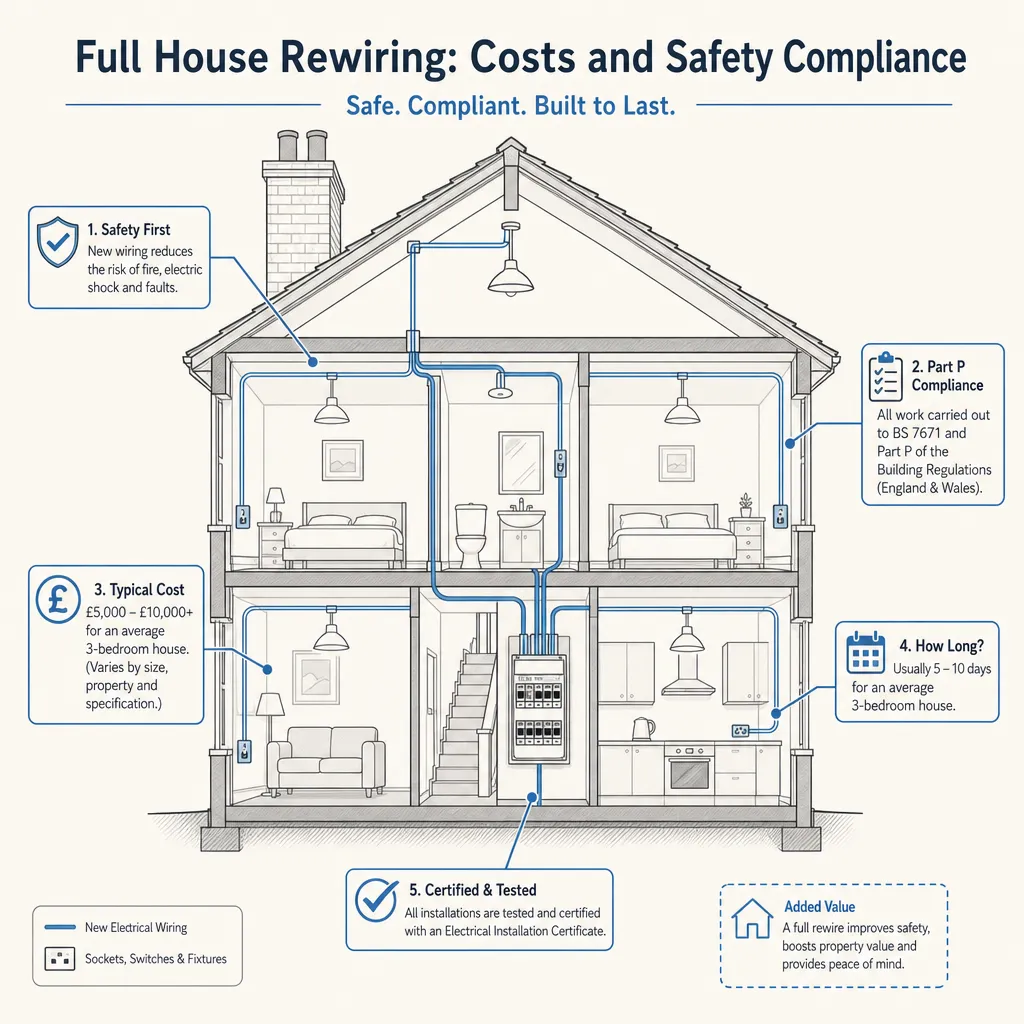
Full House Rewiring: Costs and Safety Compliance
A full house rewire in the UK typically costs £3,500–£6,000 for a three-bedroom semi and must comply with BS 7671:2018 and Building Regulations Part P.
 Surveys & Inspections
What to Budget for Upgrading a Fuse Box or Consumer Unit
Replacing a consumer unit (fuse box) in the UK typically costs £400–£900 for a straightforward installation by a Part P registered electrician.
 Surveys & Inspections
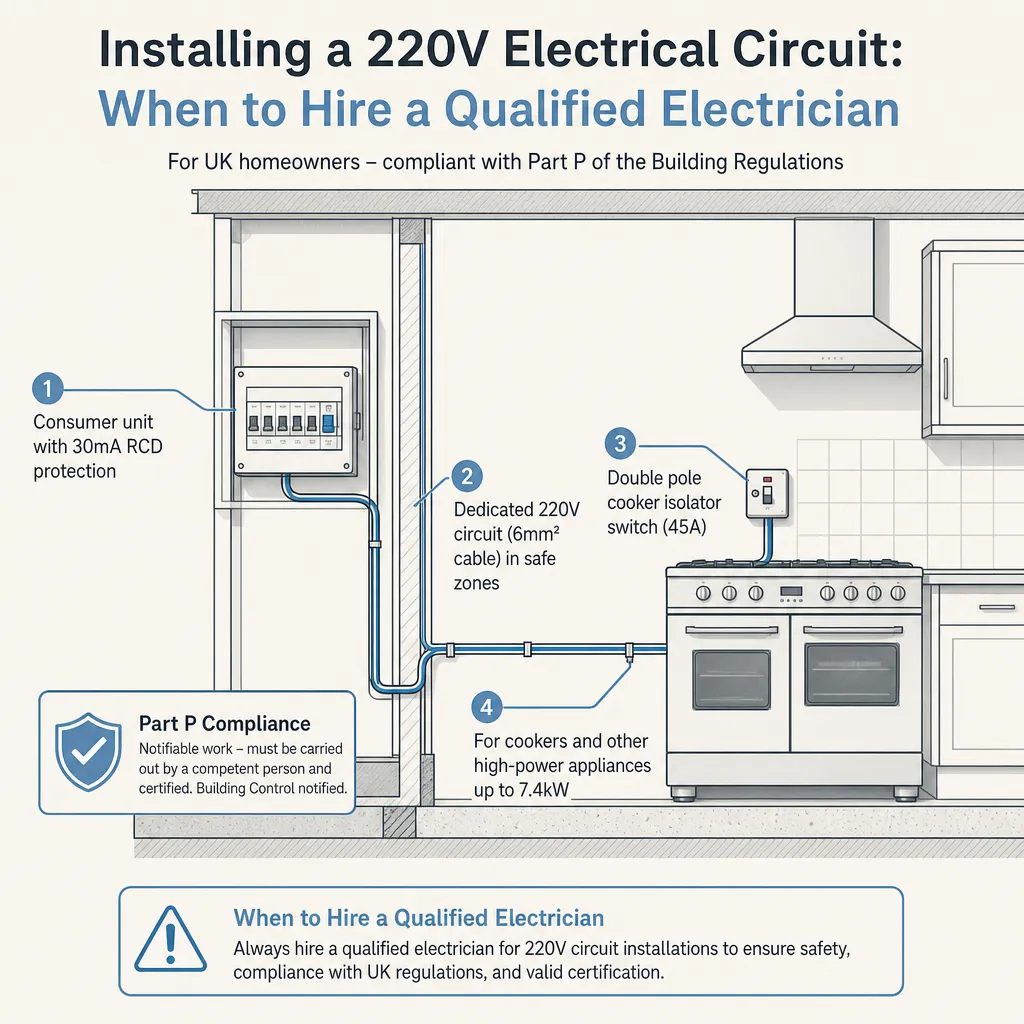
Installing a 220V Electrical Circuit: When to Hire a Qualified Electrician
In the UK, domestic mains supply is 230V — not 220V — and any dedicated high-current circuit for a cooker, shower, or EV charger is notifiable work under Part P of the Building Regulations.
 Surveys & Inspections
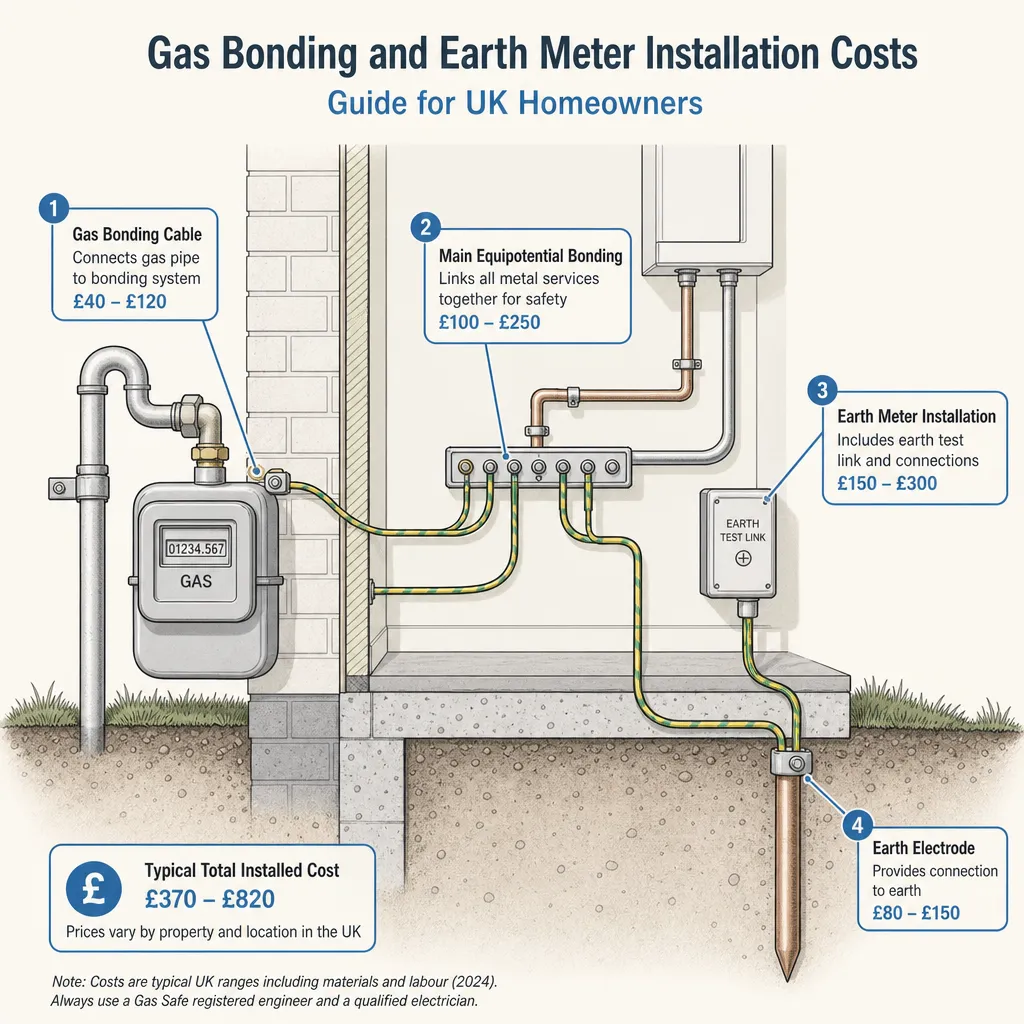
Gas Bonding and Earth Meter Installation Costs
Main gas bonding connects your gas pipework to the electrical earthing terminal, preventing dangerous voltage differences.
 Surveys & Inspections
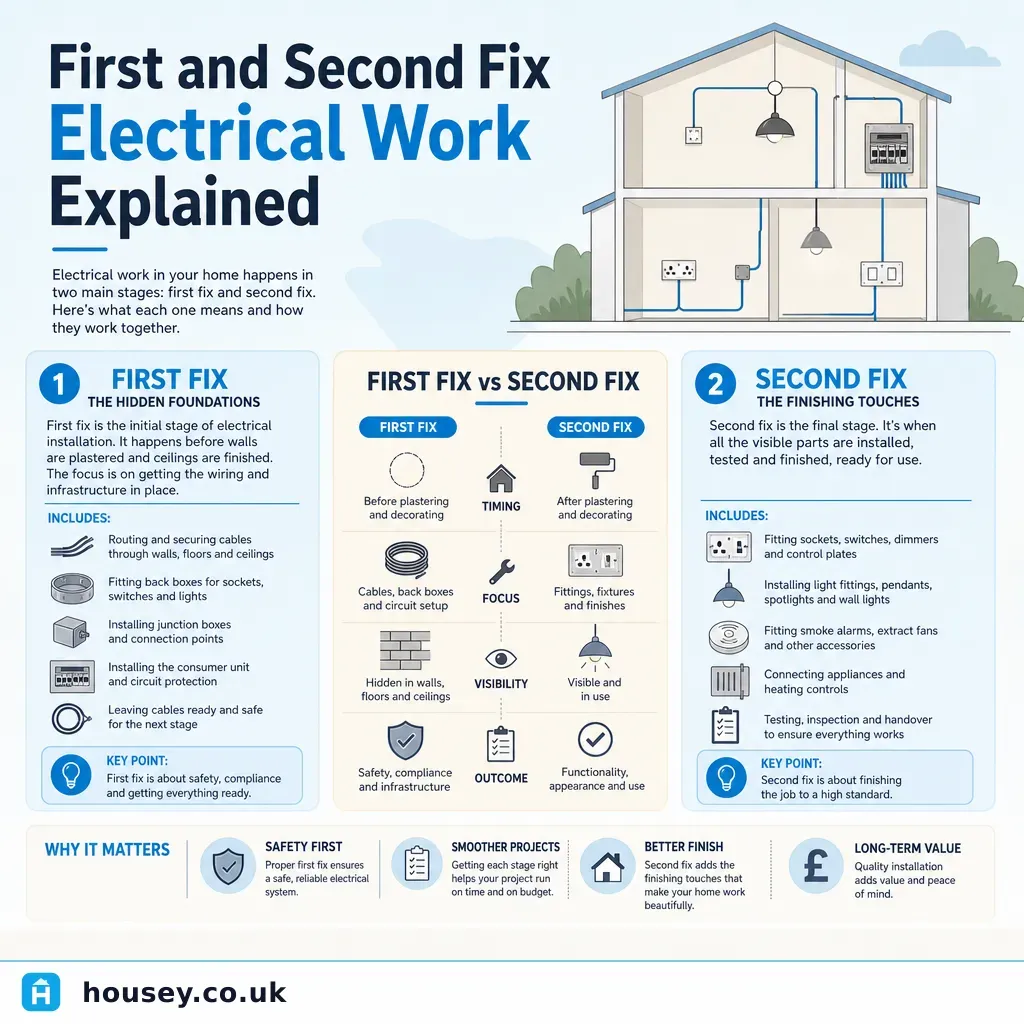
First and Second Fix Electrical Work Explained
First fix electrical work covers hidden infrastructure — cables, back boxes, and conduit — installed before plastering.