Electrical Panel Replacement: When and Why Your Home Needs an Upgrade
By Housey · Last reviewed 10th of May 2026
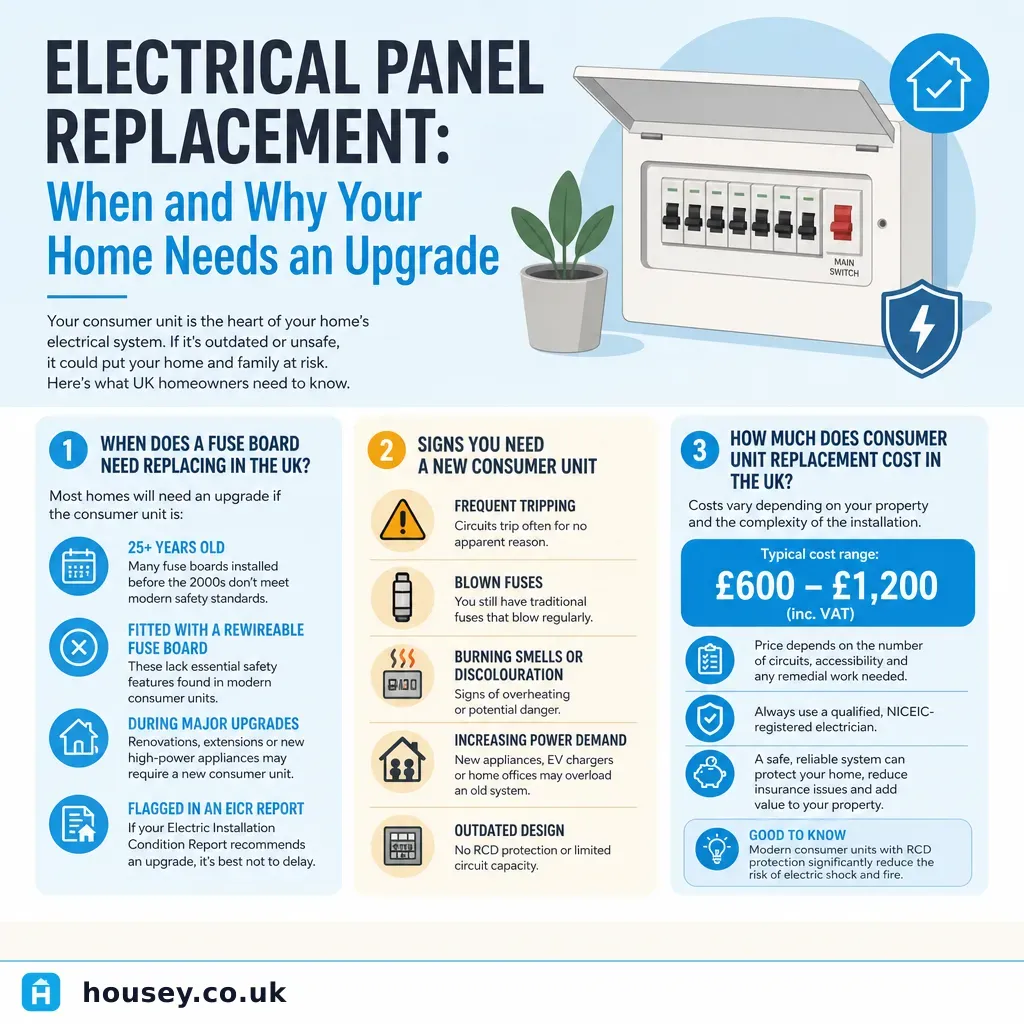
Electrical Panel Replacement: When and Why Your Home Needs an Upgrade
Consumer unit replacement is one of those jobs that homeowners often put off until something goes wrong — a tripped circuit, concerns flagged on an Electrical Installation Condition Report (EICR), or an issue raised during a property sale. In the UK, a consumer unit (sometimes still called a fuse board or fuse box) controls every circuit in your home, and an ageing or non-compliant unit can create genuine safety risks and legal complications. Understanding when replacement is needed, what the regulations require, and who must carry out the work helps you plan ahead rather than act in a crisis.
Key points
- Consumer unit replacement is notifiable work under Part P of the Building Regulations (England and Wales) — it must be carried out by a competent person or notified to your local building control authority.
- Since 2008, UK wiring standards have required residual current devices (RCDs) on socket, bathroom, and garden circuits; the 18th Edition of BS 7671:2018 extends this protection to most circuits.
- Homes with rewirable fuse boards predate RCD protection and are typically flagged as unsatisfactory on an EICR.
- A registered electrician on an approved scheme — such as NICEIC, NAPIT, or ELECSA — can self-certify the work without a separate building control application.
- Indicative cost for a standard consumer unit replacement in an average three-bedroom home: £500–£1,200 installed (Indicative UK costs, last reviewed 2026-05-10 — obtain quotes, as prices vary by property and region).
What is a consumer unit and what does it do?
A consumer unit is the main distribution board that receives the incoming electricity supply from the meter and splits it across your home's circuits — lighting, sockets, cooker, shower, and so on. Each circuit has its own protective device: either an old rewirable fuse (a piece of fuse wire) or, in modern units, a miniature circuit breaker (MCB) or residual current breaker with overcurrent protection (RCBO).
The unit also contains one or more residual current devices (RCDs). These detect earth faults — for example, a person contacting a live conductor — and cut the circuit in milliseconds. Homes without RCDs on high-risk circuits have significantly reduced protection against electric shock and fire caused by wiring faults.
Signs your consumer unit may need replacing
The following are red flags that warrant assessment by a qualified electrician. Do not attempt to inspect or work on a consumer unit yourself.
Red flags — arrange a professional inspection if:
- The board uses rewirable fuse wire rather than MCBs or RCBOs.
- There are no RCDs, or RCDs are present but do not cover socket, bathroom, or outdoor circuits.
- The unit has a wooden back or is constructed from older materials (pre-1960s equipment).
- Circuits trip frequently for no obvious reason.
- You notice a burning smell near the board, or the casing feels warm to the touch.
- An EICR has returned a C2 (potentially dangerous) or C1 (danger present) code relating to the consumer unit.
- You are planning a loft conversion, extension, or kitchen or bathroom refit that will require new circuits.
- You are selling or letting your property and an old board has been flagged by a surveyor or solicitor.
Old fuse board versus modern consumer unit
Feature | Rewirable fuse board | Modern consumer unit (BS 7671:2018) |
|---|---|---|
Circuit protection | Fuse wire — must be replaced manually after a fault | MCBs or RCBOs — reset with a switch |
RCD protection | None | RCDs cover most or all circuits |
AFDD protection | None | AFDDs recommended for sleeping accommodation circuits under Amendment 2 (2022) |
Typical EICR outcome | C2 or C1 (potentially or immediately dangerous) | Satisfactory, if installed and tested correctly |
Mortgage and insurance impact | Some lenders and insurers flag old boards | Generally acceptable to lenders and insurers |
Part P compliance route | Replacement required | Self-certify via a registered competent person |
Part P of the Building Regulations: what the rules say
Part P of the Building Regulations (England and Wales) covers electrical safety in dwellings. Replacing a consumer unit is classified as notifiable work, meaning it must either be:
- Carried out by a registered competent person on an approved scheme — NICEIC, NAPIT, ELECSA, or similar. These electricians self-certify the work and notify building control on your behalf.
- Notified to your local building control authority before work starts, if the electrician is not registered under a competent-person scheme. Building control will inspect and certify the installation, typically for a fee.
In Scotland, electrical work in dwellings is covered by the Building (Scotland) Regulations. In Northern Ireland, Part P (Northern Ireland) applies with some differences. Wales follows England's framework — check GOV.Wales for current updates.
After completion, you should receive a BS 7671 Electrical Installation Certificate and, where building control is involved, a Completion Certificate. Keep these documents safe — they are routinely requested when selling or remortgaging.
How much does consumer unit replacement cost?
Indicative UK costs, last reviewed 2026-05-10. Prices vary by property size, region, number of circuits, and whether additional works are required. Always obtain at least three written quotes.
Scenario | Typical indicative range |
|---|---|
Standard 10–16 circuit unit, three-bedroom house | £500–£1,000 |
Larger or split-load board, four or five-bedroom house | £800–£1,200 |
Consumer unit plus remedial work on one or two circuits | £1,000–£1,800 |
Full rewire alongside consumer unit replacement | £3,000–£7,000+ |
These figures are indicative only. Quotes will vary by electrician, location, access, and the specification of the new unit.
Important limitations
This article provides general information about consumer unit replacement in the UK. It is not a substitute for a professional electrical inspection or formal advice from a Part P-registered electrician. Rules and requirements can vary depending on your property's age, construction type, existing wiring condition, and location. In Scotland and Northern Ireland, the regulatory framework differs from England and Wales — verify current requirements with a qualified, scheme-registered electrician in your area before proceeding.
When to get professional help
Contact a Part P-registered electrician promptly if any of the following apply:
- Your home has an old rewirable fuse board (fuse wire type).
- You have received an EICR with a C1 or C2 code relating to the consumer unit or wiring.
- You are planning a loft conversion, extension, or kitchen or bathroom refit that requires new circuits.
- You are about to sell or let your property and an old board has been flagged.
- Circuits trip repeatedly or you notice a burning smell near the board.
Do not attempt to work on a consumer unit yourself. Consumer unit work is legally restricted to competent persons under Part P of the Building Regulations. Faults in a consumer unit can cause electric shock and fire.
What to ask a qualified professional
Before instructing an electrician to replace your consumer unit, ask:
- Are you registered with an approved Part P competent-person scheme, such as NICEIC, NAPIT, or ELECSA?
- Will you provide a BS 7671 Electrical Installation Certificate and notify building control on my behalf?
- Does your quote include testing of all existing circuits and a full installation condition assessment?
- What size and configuration of consumer unit do you recommend, and why?
- Will Arc Fault Detection Devices (AFDDs) be fitted on bedroom circuits in line with 18th Edition Amendment 2 recommendations?
- Is VAT included in the quote?
- How will you communicate any additional costs if existing wiring is found to be sub-standard during the job?
How Housey can help
If your consumer unit replacement is taking place alongside wider building works that require building control sign-off, a building control consultant can guide you through the notification process, inspection requirements, and certification for your project.
Frequently asked questions
Do I need building control approval for a consumer unit replacement?
If the work is carried out by a Part P-registered electrician — such as one registered with NICEIC, NAPIT, or ELECSA — they can self-certify and notify building control on your behalf. You do not need to make a separate application. If the electrician is not registered under a competent-person scheme, you must notify your local building control authority before work starts.
Can I replace my consumer unit myself?
No. Consumer unit replacement is notifiable work under Part P of the Building Regulations and must be carried out by a competent person. Uncertified DIY work on a consumer unit is dangerous and can affect your buildings insurance, mortgage, and ability to sell your home. Always instruct a Part P-registered electrician.
How long does a consumer unit replacement take?
A straightforward replacement in an average home typically takes between half a day and a full day. Larger properties, or those requiring additional circuit testing or remedial wiring work, may take longer. Your electrician should provide an estimated timeframe when giving a written quote.
Will I need a new consumer unit when selling my house?
Not automatically, but an old rewirable fuse board is likely to be flagged on an EICR. Many buyers' solicitors and mortgage lenders request evidence that the electrical installation is satisfactory. Upgrading before listing can prevent delays or renegotiation at the point of sale.
What is an AFDD and do I need one?
An Arc Fault Detection Device (AFDD) detects dangerous electrical arcing, a leading cause of house fires. The 18th Edition of BS 7671 (Amendment 2, 2022) recommends AFDDs on circuits serving sleeping accommodation. They are not currently mandatory in existing homes, but are increasingly installed as best practice when a consumer unit is replaced.
Sources and further reading
- Part P of the Building Regulations — Electrical Safety — GOV.UK
- BS 7671 Wiring Regulations (18th Edition) — IET
- NICEIC: Find a Registered Contractor — NICEIC
- NAPIT: Approved Competent Persons Scheme — NAPIT
- Consumer Unit and Fuse Board Safety — Electrical Safety First
Useful next reads
 Planning & Pre-Build
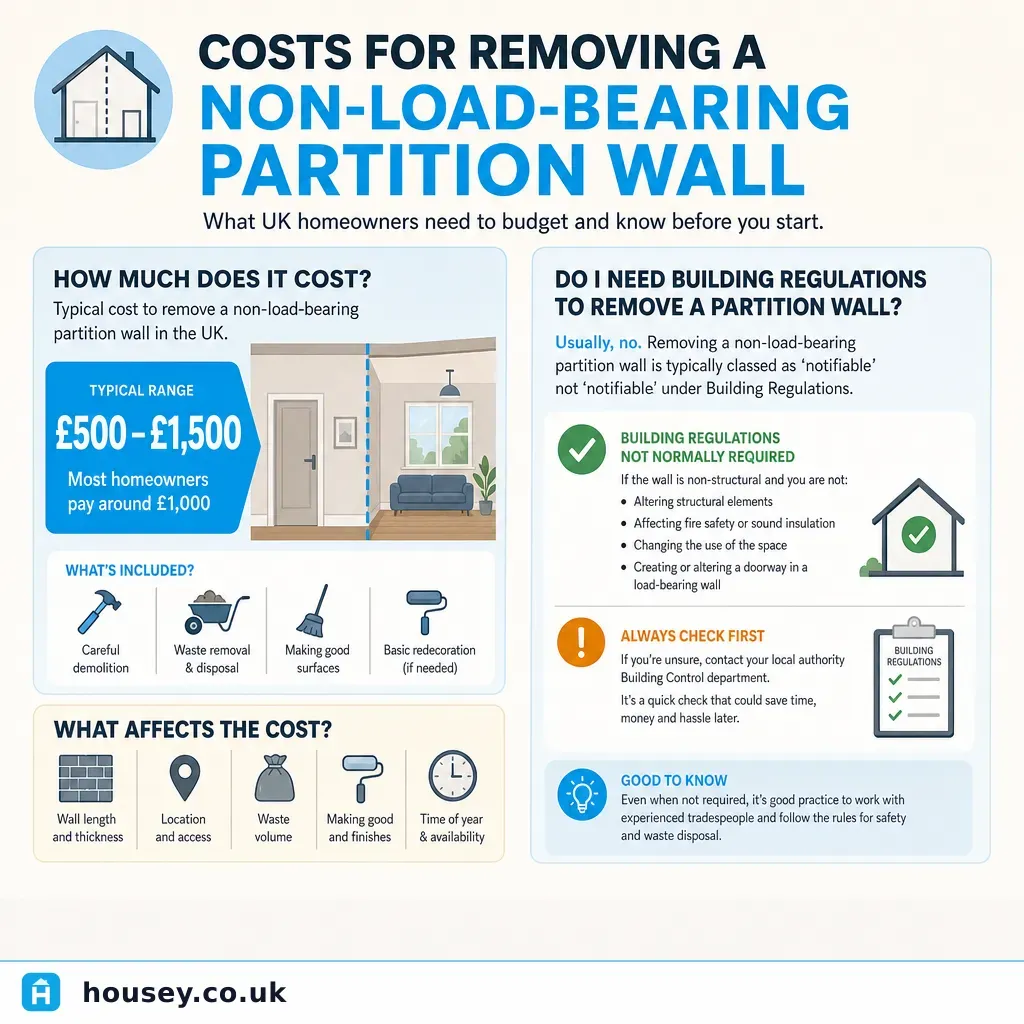
Costs for removing a non-load-bearing partition wall
Removing a non-load-bearing partition wall in a UK home typically costs £300–£1,500 in labour, plus £200–£600 or more for replastering and making good.
 Planning & Pre-Build
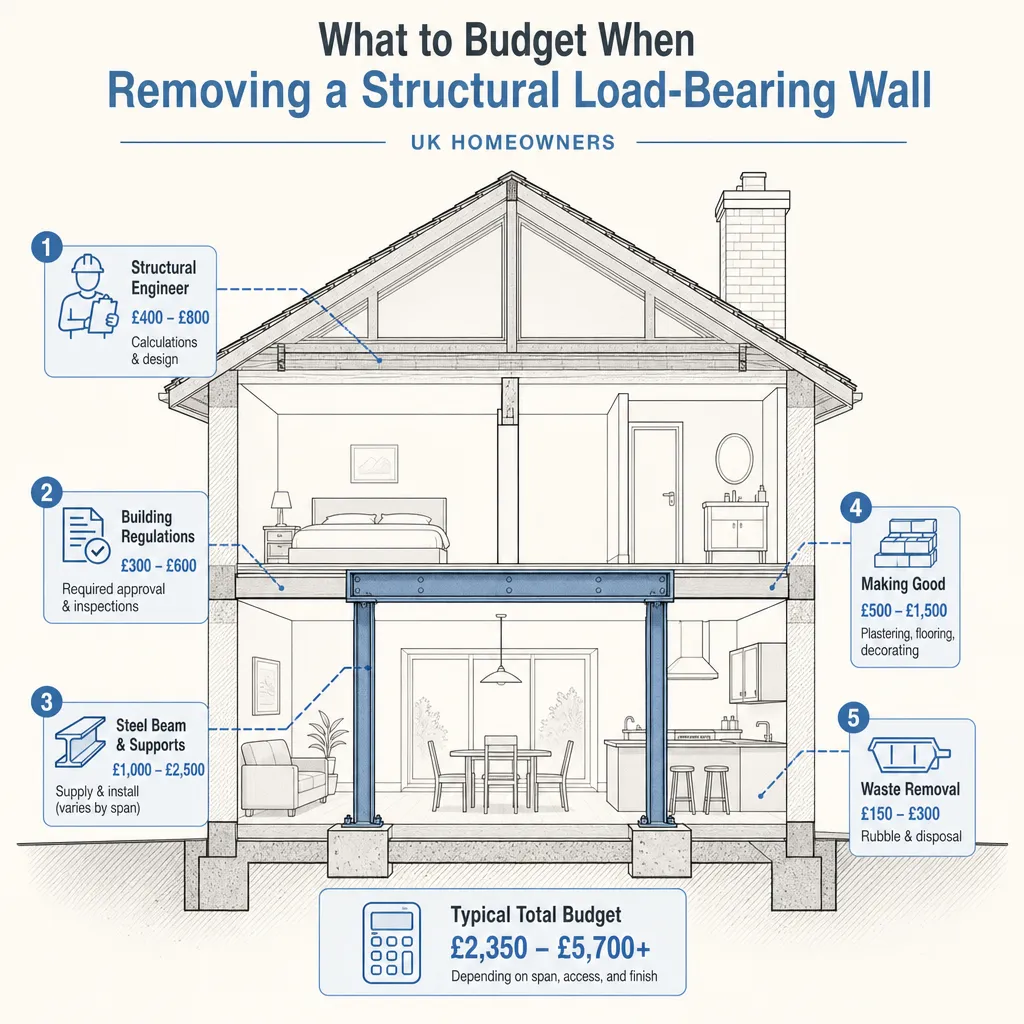
What to Budget When Removing a Structural Load-Bearing Wall
Removing a load-bearing wall in a typical UK home costs £2,500–£8,000 or more in total, covering a structural engineer's calculations, Building Regulations approval, the steel beam, builder's labour, and replastering.
 Planning & Pre-Build
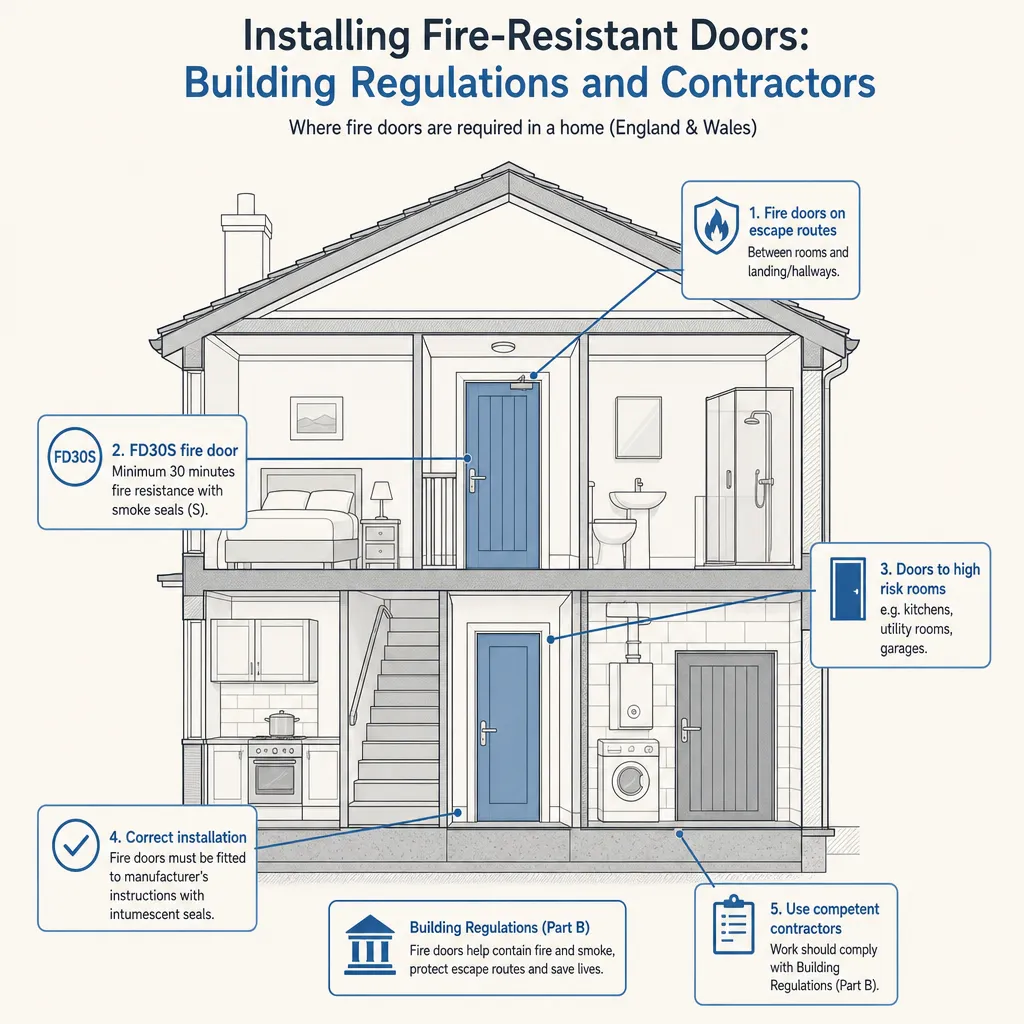
Installing Fire-Resistant Doors: Building Regulations and Contractors
Fire doors are required by Building Regulations in specific locations — including integral garages, properties of three or more storeys, loft conversions, and HMOs.
 Planning & Pre-Build
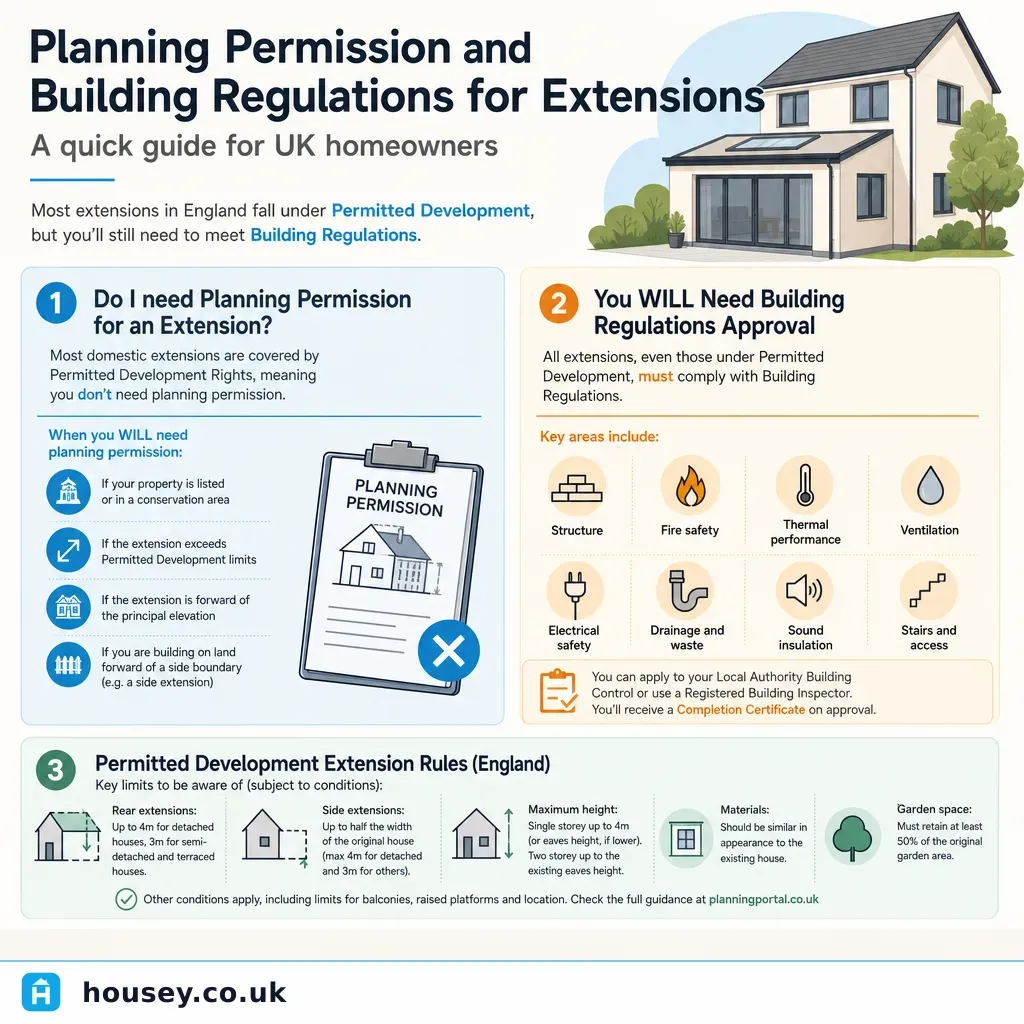
Planning Permission and Building Regulations for Extensions
UK home extensions usually require both planning permission and Building Regulations approval, though most smaller rear extensions qualify as Permitted Development under the GPDO 2015 and need no planning application.
 Planning & Pre-Build
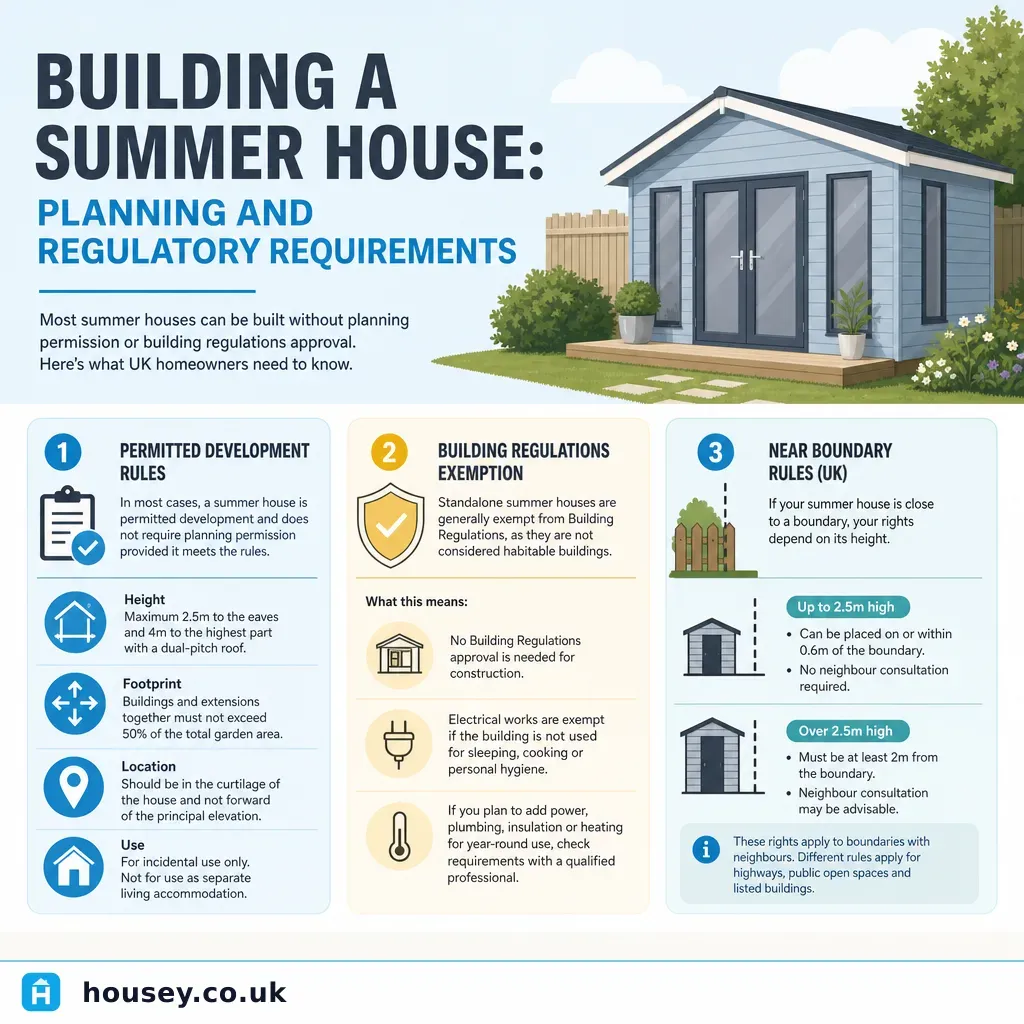
Building a Summer House: Planning and Regulatory Requirements
Most garden summer houses in England fall under Class E permitted development and need no planning permission, provided they are single-storey, within height limits, and not used for sleeping.