Installing Fire-Resistant Doors: Building Regulations and Contractors
By Housey · Last reviewed 31st of May 2026
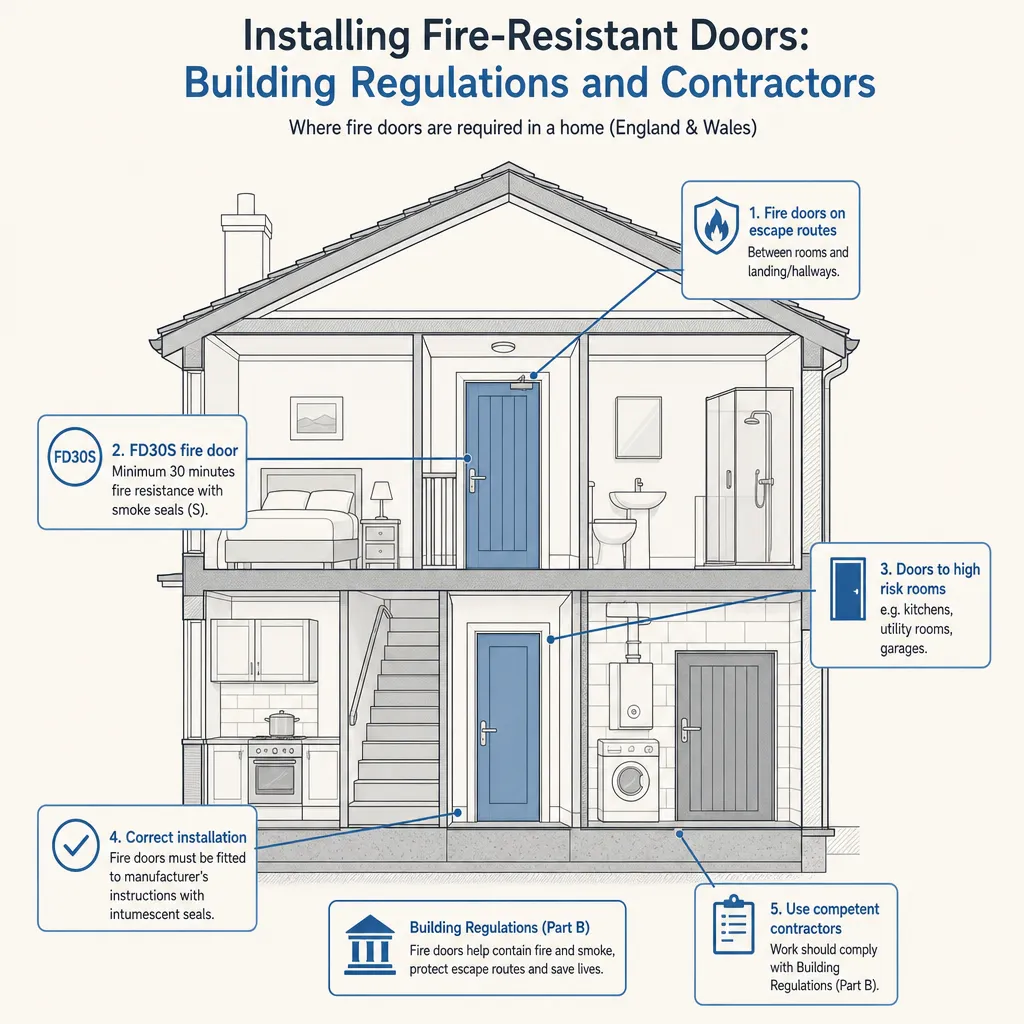
Installing Fire-Resistant Doors: Building Regulations and Contractors
Fire door requirements in UK homes changed significantly when the Building Safety Act 2022 and updated Approved Document B came into force, and many homeowners are still uncertain about where fire doors are needed, what specification is correct, and who is qualified to install them. Getting this wrong carries real consequences — both to life safety and to legal compliance if you are a landlord, carrying out a loft conversion, or undertaking works that require building control sign-off.
Key points
- Building Regulations Approved Document B requires self-closing FD30S fire doors between an integral garage and the house, and on habitable room doors opening onto escape routes in properties of three or more storeys.
- Fire doors must be third-party certificated to BS 476-22 or BS EN 1634-1, installed with the correct certificated frame, intumescent strips, cold smoke seals, and self-closing device.
- The Building Safety Act 2022 introduced new duties for higher-risk residential buildings of 18 metres or more (7 or more storeys), including mandatory fire door inspection programmes.
- Landlords of Houses in Multiple Occupation (HMOs) must comply with fire safety requirements under the Regulatory Reform (Fire Safety) Order 2005, which includes fire door standards.
- FIRAS and the BWF Certifire Scheme are the main third-party accreditation routes for fire door installation; using an accredited installer provides auditable evidence of competence.
Where are fire doors required in a UK home?
Approved Document B sets out where fire doors are required in residential properties. The rules depend on property type, use, and the nature of the works being carried out.
Decision guide: does your situation require a fire door?
- New-build house with integral garage: yes — FD30S door required between garage and house.
- New-build house of three or more storeys: yes — FD30S doors required on habitable rooms opening onto the staircase or escape route at each level.
- Loft conversion creating a new storey: check — Approved Document B typically requires a protected staircase, meaning fire doors at each floor level on the escape route.
- HMO (licensed or licensable): yes — fire doors required in accordance with your fire risk assessment and licensing conditions; specification varies by property type and occupancy.
- Single-family house of two storeys, no conversion: generally not required under Building Regulations alone — but check any existing building control approval, mortgage lender conditions, or insurer requirements.
- Higher-risk residential buildings (18 metres or more): consult a qualified fire safety professional — the Building Safety Act 2022 imposes additional duties via the Building Safety Regulator.
If you are uncertain about your property's requirements, a fire risk assessment carried out by a qualified assessor is the appropriate starting point.
FD30 vs FD60: which specification do you need?
Specification | Fire resistance | Where typically required | Notes |
|---|---|---|---|
FD30 | 30 minutes | Domestic garage doors, some internal doors in conversions | Minimum residential standard |
FD30S | 30 minutes + cold smoke seal | Domestic escape routes — most common residential requirement | 'S' suffix denotes cold smoke seal included |
FD60 | 60 minutes | Higher-risk buildings, stairwells in taller residential blocks | Less common in standard houses |
FD60S | 60 minutes + cold smoke seal | Communal areas in higher-risk residential buildings | Often specified by a fire engineer |
For most domestic projects, FD30S is the relevant specification. Check your building control approval or fire risk assessment to confirm before ordering.
What makes a compliant fire door assembly?
A fire door is a system — not just a door leaf. All components must be correct for the assembly to perform as certificated:
- Certificated door leaf — third-party certificated to BS 476-22 or BS EN 1634-1, with a visible intumescent plug or certification label.
- Certificated frame — door and frame must be tested together; a certificated door in an uncertified or incorrect frame is non-compliant.
- Intumescent strips — expand under heat to seal the gap between door and frame; may be factory-fitted or fitted on site by the installer.
- Cold smoke seals — required for FD30S; prevent smoke passage at ambient temperature before heat activates the intumescent strips.
- Self-closing device — required on all FD30 and above; must fully close the door from any open position without manual assistance.
- Compatible ironmongery — handles, hinges, locks, and hold-open devices must be tested and compatible with the certified door assembly.
Installing only the door leaf while retaining an existing uncertified frame, or omitting seals, is one of the most common compliance failures found during inspections.
Choosing a qualified installer
There is no single mandatory licence to install fire doors in domestic properties, but using a third-party accredited installer provides significantly more assurance:
- FIRAS — third-party certification scheme for passive fire protection installers; audited against defined competence standards.
- BWF Certifire Scheme — British Woodworking Federation scheme covering fire door supply and installation.
- FDIS (Fire Door Inspection Scheme) — provides competency assessment for fire door inspectors, useful for post-installation verification and regulatory sign-off.
For HMOs and higher-risk buildings, check whether your local fire authority or licensing team specifies installer accreditation requirements before commissioning work.
Important limitations
This article provides general information about fire door requirements under UK Building Regulations and associated legislation. Fire safety law is complex and depends on property type, use, tenure, occupancy, building height, and local building control or fire authority interpretation. This guide does not constitute legal or fire safety advice. Where you are uncertain about your property's requirements, a fire risk assessment carried out by a qualified and competent assessor is the appropriate starting point — not a general guide.
When this becomes urgent
Seek immediate professional advice if:
- A fire has damaged a fire door or its frame — do not assume a repair restores compliance without professional sign-off.
- A building control inspector or fire officer has identified fire door deficiencies and issued an improvement or enforcement notice.
- You are a landlord receiving an improvement notice or prohibition notice from the fire authority relating to fire doors.
- A self-closing fire door is routinely propped open — this defeats its purpose entirely and may constitute a legal breach in regulated properties.
- You are selling or remortgaging a property and a surveyor or solicitor has raised fire door compliance questions requiring documentary evidence.
What to ask a qualified professional
Before instructing a contractor to supply and install fire doors, ask:
- Are you third-party accredited for fire door installation — FIRAS, BWF Certifire, or equivalent — and can you provide your certificate?
- Will you supply certificated door and frame assemblies together, and can you provide product data sheets and certification references?
- Will you issue a completion certificate or installation record I can retain for building control or regulatory purposes?
- Have you reviewed my building control approval, fire risk assessment, or licensing conditions for this property?
- Who will carry out the physical installation, and what are their qualifications and experience?
- What happens if the existing structural opening or frame proves non-standard once work begins?
- Is VAT included in your quote?
When to get professional help
A competent fire door installer should handle supply and installation, but additional professional advice is needed if:
- You are converting or extending a property and need building control sign-off on fire door compliance.
- You are a landlord of an HMO or multiple-occupancy building where a fire risk assessment is a licensing requirement.
- Previous works may not have been completed to the correct specification — an FDIS-accredited inspector can verify compliance.
- You are in a higher-risk building and Building Safety Act 2022 duties may apply to your situation.
How Housey can help
Housey connects you with building control consultants who can advise on fire door compliance requirements and help you navigate Approved Document B for your specific property and project type. Submit your details to receive quotes from qualified professionals.
Frequently asked questions
Do I need a fire door between my garage and house?
Yes, if the garage is integral (attached to or beneath the house). Approved Document B requires a minimum FD30S door — with the correct certificated frame, intumescent seals, and self-closing device — between the garage and any habitable part of the house. This applies to new-build and conversion works requiring building control approval.
Can I fit a fire door myself as a DIY project?
Technically possible in an owner-occupied domestic property, but strongly inadvisable. A fire door incorrectly installed — wrong frame, missing seals, or self-closer not adjusted — will not perform as certificated in a fire. For regulated works including building control sign-off or HMOs, a competent and ideally third-party accredited installer who can provide documentary evidence of compliance is required.
How much do fire doors cost to supply and install in the UK?
A supply-and-install cost for a single FD30S door in a domestic property typically ranges from £400 to £900, depending on specification, frame condition, and any remedial work to the existing opening. Indicative UK costs, last reviewed 2026-05-31. Always obtain at least three quotes from accredited installers.
What is a third-party certificated fire door?
Third-party certification means an independent, UKAS-accredited body has tested and regularly audits the product against the stated fire performance standard — such as BS 476-22 or BS EN 1634-1. This provides greater confidence than self-declared compliance. Look for a visible intumescent plug, certification label, or product data sheet confirming the scheme and scope.
Sources and further reading
- Approved Document B: fire safety (volumes 1 and 2) — HM Government / MHCLG
- Regulatory Reform (Fire Safety) Order 2005 — legislation.gov.uk
- FIRAS: passive fire protection installer certification — FIRAS
- BWF Certifire Scheme — British Woodworking Federation
- Fire Door Inspection Scheme (FDIS) — Fire Door Inspection Scheme
Useful next reads
 Planning & Pre-Build
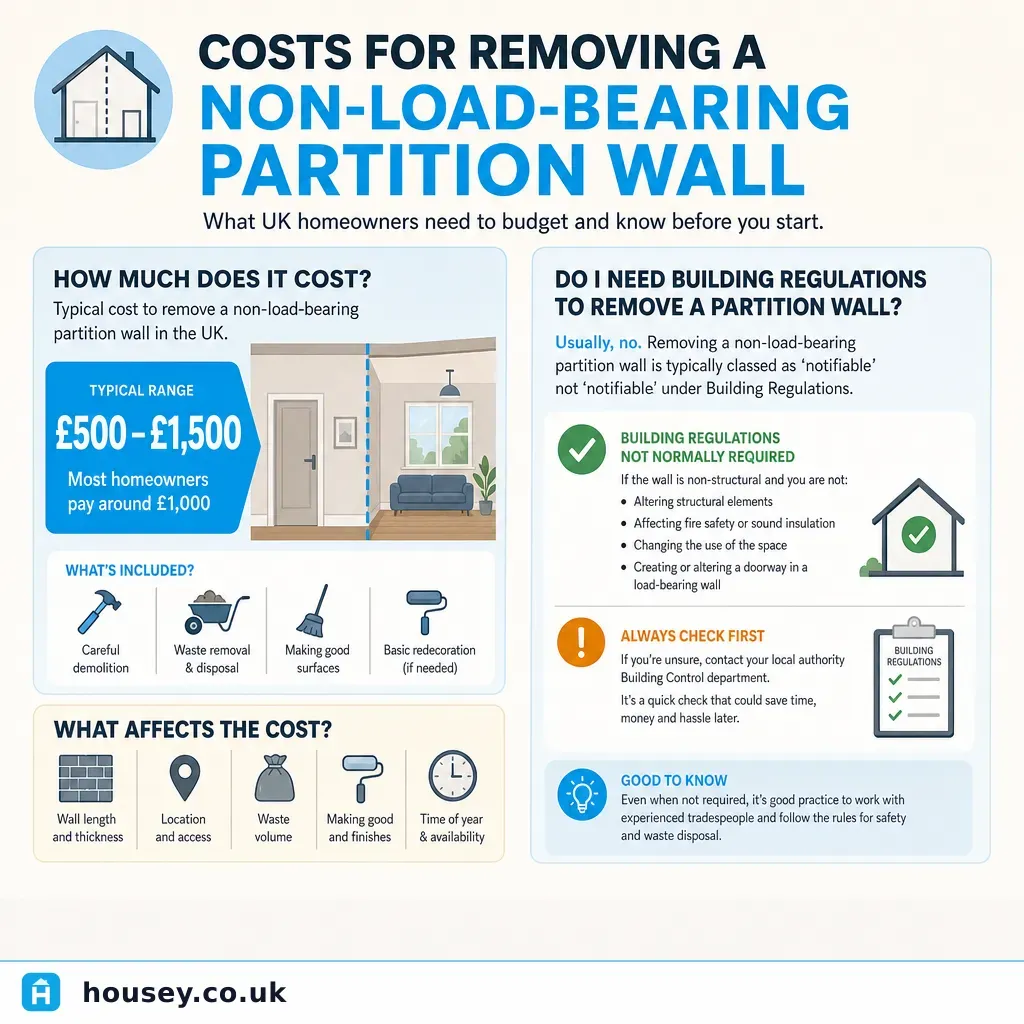
Costs for removing a non-load-bearing partition wall
Removing a non-load-bearing partition wall in a UK home typically costs £300–£1,500 in labour, plus £200–£600 or more for replastering and making good.
 Planning & Pre-Build
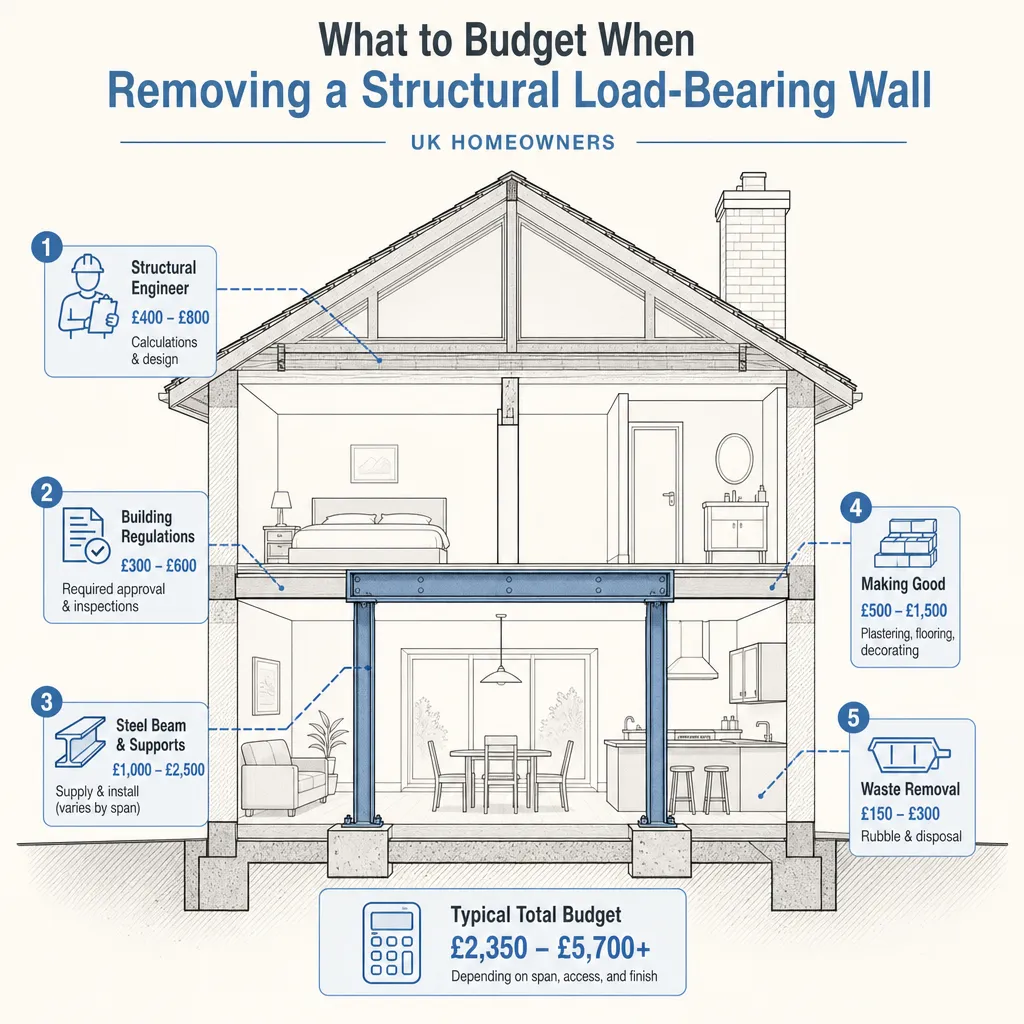
What to Budget When Removing a Structural Load-Bearing Wall
Removing a load-bearing wall in a typical UK home costs £2,500–£8,000 or more in total, covering a structural engineer's calculations, Building Regulations approval, the steel beam, builder's labour, and replastering.
 Planning & Pre-Build
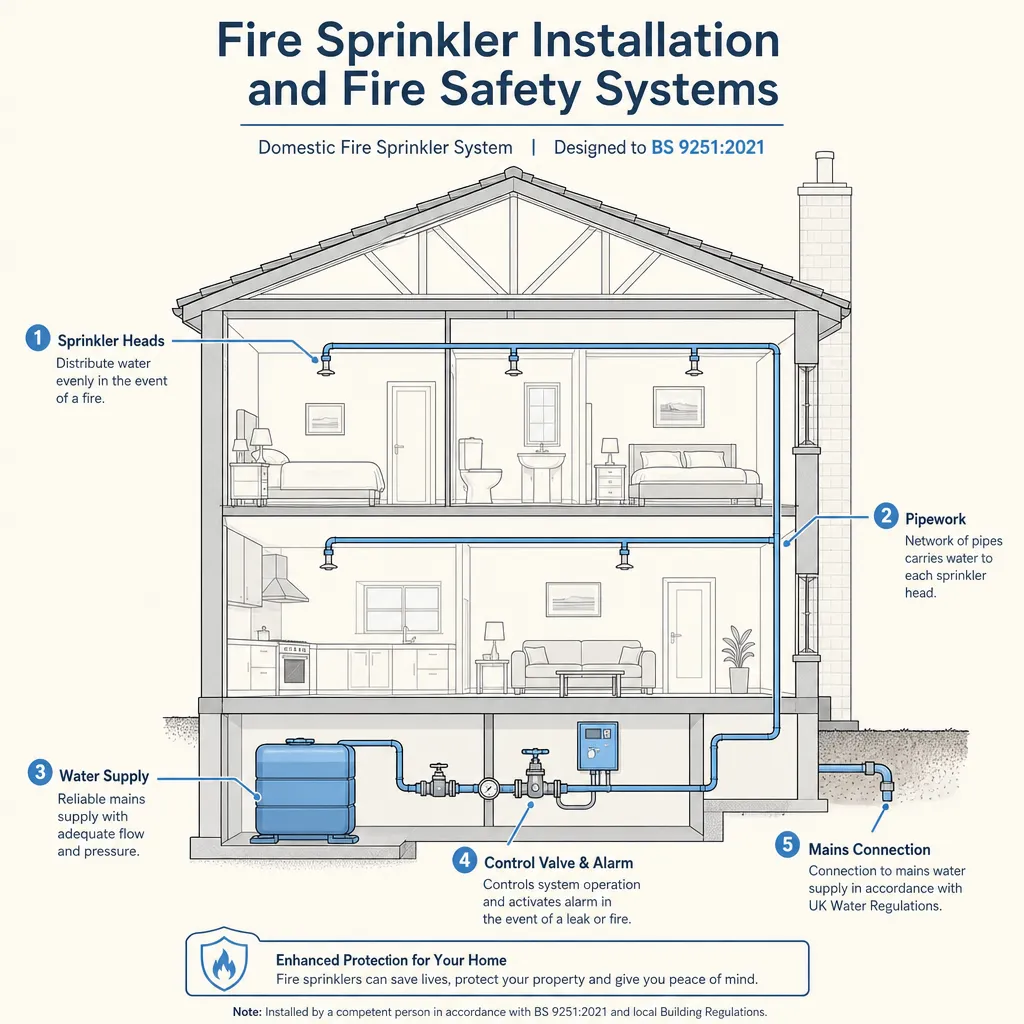
Fire Sprinkler Installation and Fire Safety Systems
Residential fire sprinkler systems in the UK must comply with BS 9251:2021.
 Planning & Pre-Build
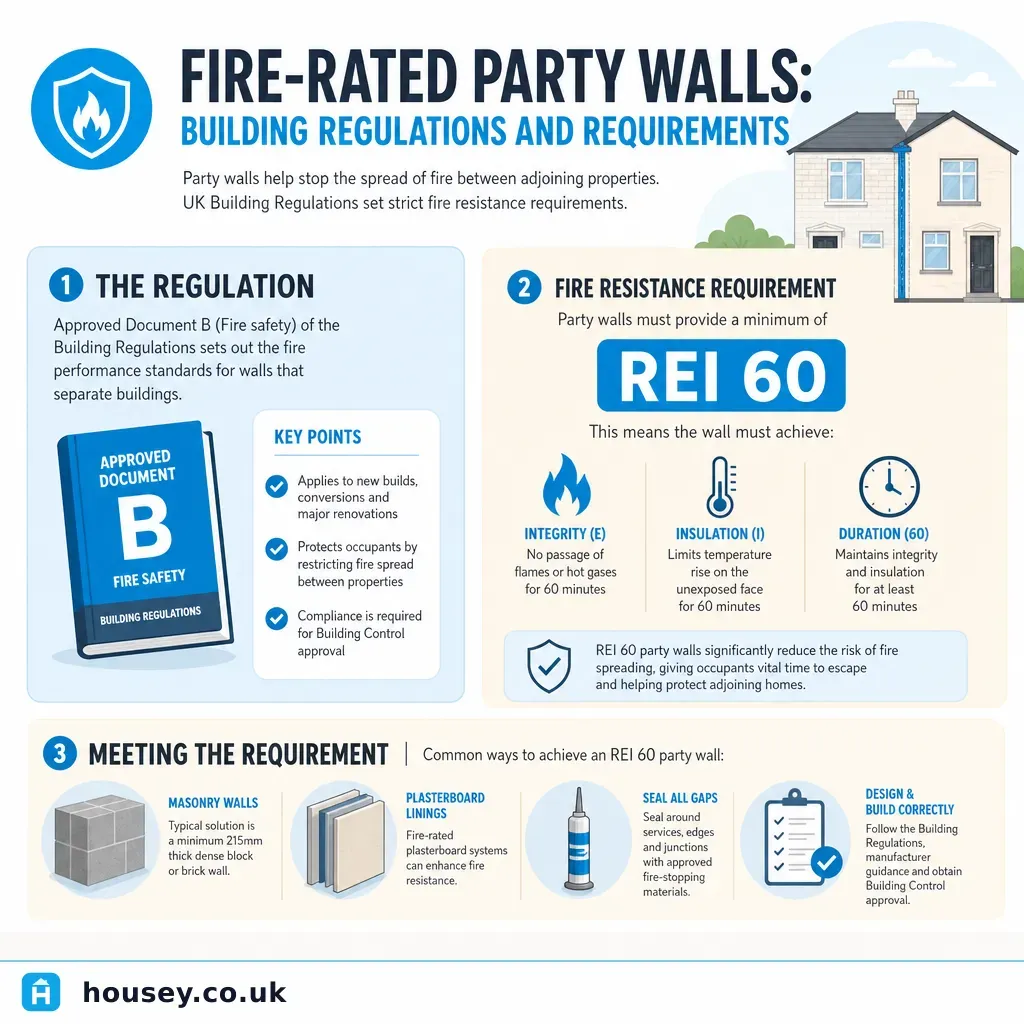
Fire-Rated Party Walls: Building Regulations and Requirements
Party walls between dwellings must achieve at least 60 minutes' fire resistance, expressed as REI 60, under Building Regulations Approved Document B.
 Planning & Pre-Build
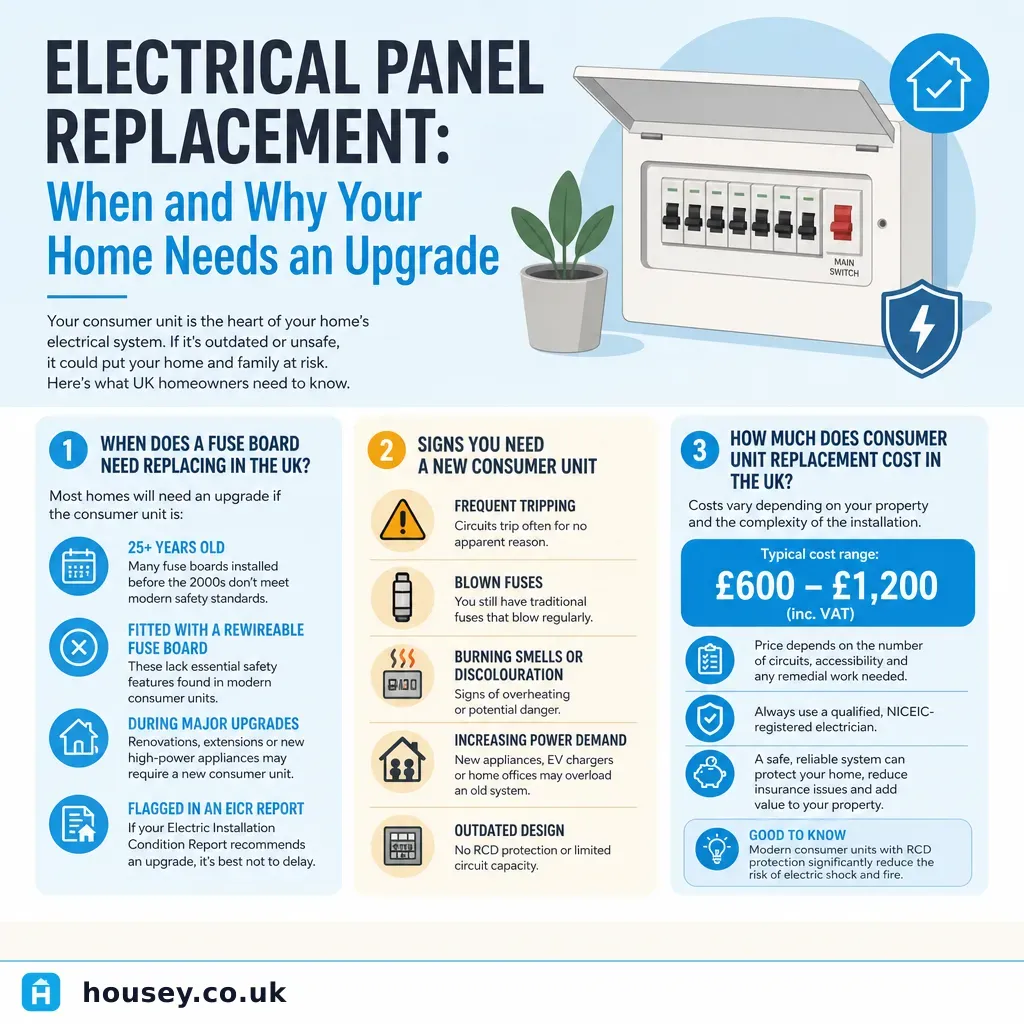
Electrical Panel Replacement: When and Why Your Home Needs an Upgrade
Most UK homes need a consumer unit replacement when they have rewirable fuse wire, lack residual current devices (RCDs), or experience frequent circuit tripping.