Endless Pool Installation: Design and Cost Considerations
By Housey · Last reviewed 9th of May 2026
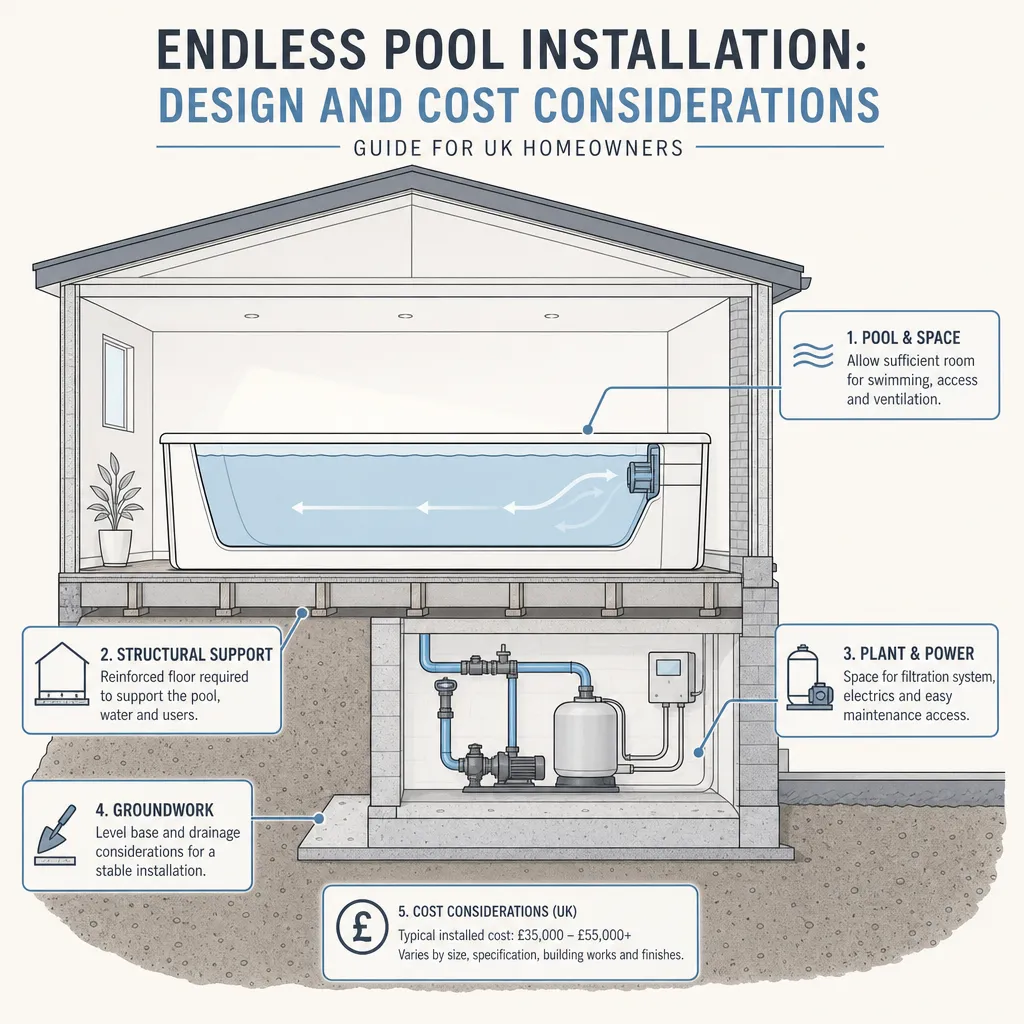
Endless Pool Installation: Design and Cost Considerations
Endless pools and swim spas are increasingly popular in UK homes where space rules out a conventional swimming pool, but where a dedicated aquatic fitness or hydrotherapy facility is the goal. The decision to install one typically arises during a house extension, garden landscaping project, or a broader home upgrade — each route carrying its own planning, structural, and cost implications that are worth mapping out carefully before committing to a unit.
Key points
- Endless pools use a propulsion current to allow continuous swimming in a compact tank, typically 3.7–7.3 metres long — far shorter than the 25 metres needed for a conventional lap pool.
- An above-ground unit placed in a rear garden usually falls within permitted development rights under the Town and Country Planning (General Permitted Development) Order 2015, but an enclosing structure or new extension may require planning permission and a Building Regulations application.
- Indicative installation costs range from approximately £15,000–£28,000 for a basic above-ground outdoor installation to £50,000–£80,000+ for a fully enclosed indoor pool room (indicative UK costs, last reviewed 2026-05-09).
- Endless pools require a dedicated 32A–63A electrical circuit installed by a NICEIC or NAPIT-registered electrician — this is notifiable work under Approved Document Part P of the Building Regulations.
- The Swimming Pool and Allied Trades Association (SPATA) represents approved UK pool installers and offers consumers a deposit protection scheme and build guarantee.
What is an endless pool and how does it work?
An endless pool — sometimes described as a swim spa or current pool — generates a laminar (smooth, wall-to-wall) current using one or more propulsion units. The swimmer swims against this current and remains stationary relative to the tank, making a continuous workout possible in a tank as short as 3.7 metres.
Modern units often combine a swimming current zone at one end with hydrotherapy jets at the other, giving two functions in one installation: lap swimming and hot tub-style relaxation. Dual-zone swim spas are available from several UK-accessible manufacturers including Endless Pools, HydroPool, and Master Spas.
Installation can be above-ground (a self-contained unit placed on a prepared base), partially sunk, or fully in-ground, depending on the design brief and site constraints.
Indoor vs outdoor installation
Both options work well in the UK, but each involves different planning, structural, and cost considerations.
Factor | Outdoor above-ground | Indoor installation |
|---|---|---|
Typical siting | Rear garden, patio, or decking area | Purpose-built room, garage conversion, new extension |
Planning permission | Usually not required; check conservation area or listed building status | Often required if a new building or extension is involved |
Building Regulations | Less commonly required for above-ground unit | Likely required: structure (Part A), ventilation (Part F), electrical (Part P), drainage (Part H) |
Year-round usability | Possible with thermal cover; some weather exposure | Climate-controlled; fully usable year-round without weather interruption |
Ventilation requirement | Not applicable | Essential — pool room humidity requires MVHR or dedicated dehumidification unit |
Noise and privacy | More exposed; screening or fencing may be needed | Contained within building envelope; acoustics more manageable |
Approx. additional structural cost | Concrete base and decking: £3,500–£8,000 | Enclosure construction: £25,000–£60,000+ depending on size and spec |
Indicative costs last reviewed 2026-05-09. Costs vary by region, specification, and site conditions.
Planning permission and building regulations
Outdoor above-ground units: Placing an above-ground swim spa in a rear garden generally falls within permitted development rights in England under the Town and Country Planning (General Permitted Development) Order 2015. However, check whether:
- The property is in a conservation area, an Article 4 direction area, or within the curtilage of a listed building (permitted development rights may be restricted or removed entirely).
- The total area already covered by outbuildings and extensions on the plot approaches permitted development thresholds.
- You intend to erect a permanent enclosing structure — this may require planning permission depending on size and siting relative to the property boundary.
Indoor and below-ground installations: If the pool is to be housed in a new extension or significant conversion, a Building Regulations application will be required. Relevant Approved Documents include Part A (structure), Part F (ventilation), Part G (sanitation and hot water), Part P (electrical safety), and Part H (drainage). Below-ground excavation for an in-ground pool will also need structural engineering input.
Scotland, Wales, and Northern Ireland: Planning rules differ from those in England. Check with your local planning authority for the applicable legislation in your area.
Enforcement action for unpermitted development can require removal or alteration at the owner's expense. Always confirm with your local planning authority before starting any work.
Costs and a worked example
Indicative UK costs, last reviewed 2026-05-09. Always obtain at least three itemised quotes for your specific project.
Worked example: outdoor swim spa, 1990s semi-detached garden, Surrey
A homeowner installs a 5.5-metre dual-zone swim spa above-ground on a new reinforced concrete slab, with a hardwood decking surround and a dedicated 32A electrical circuit run from the consumer unit.
Item | Indicative cost |
|---|---|
Swim spa unit (mid-range, dual-zone) | £18,000–£25,000 |
Reinforced concrete base | £2,500–£4,500 |
Hardwood decking surround (approx. 20 m²) | £3,000–£6,000 |
Dedicated electrical supply (32A circuit) | £800–£1,500 |
Delivery, crane lift, and commissioning | £600–£1,500 |
Estimated total | £24,900–£38,500 |
An enclosed indoor installation within a purpose-built pool room would add £25,000–£60,000+ for construction, MVHR or dehumidification, tiling, and lighting, depending on specification and whether structural alterations are required.
Homeowner checklist before installation
Work through this list before instructing any contractor:
When to get professional help
The swim spa unit is typically delivered and commissioned by the manufacturer's dealer or an approved installer. The surrounding works require qualified professionals:
- Groundworks and base construction: A qualified groundworker or builder should design and construct the concrete base or carry out any excavation — particularly for partially sunk or in-ground installations.
- Electrical installation: A NICEIC or NAPIT-registered electrician must install the dedicated supply circuit — this is notifiable work under Part P of the Building Regulations.
- Structural engineering: For in-ground or partially sunk installations, or for any indoor installation involving structural alterations, engage a chartered structural engineer before work begins.
- Ventilation design: For indoor pool rooms, a mechanical ventilation specialist should size and specify the humidity management system to protect the structure.
- Planning and building control: If consent or a Building Regulations application is needed, confirm in writing who is responsible for submitting and managing the process before instructing anyone.
How Housey can help
If your endless pool project involves a new building or extension to enclose the installation, Housey can connect you with experienced extension builders who can manage the construction element. For base preparation, excavation, and drainage, groundworkers on Housey can assess your site and provide detailed quotes for slab construction and any in-ground works.
Frequently asked questions
Does an endless pool need planning permission in the UK?
An above-ground endless pool placed in a rear garden usually falls within permitted development rights in England and does not need planning permission. However, if you are erecting an enclosing structure, building an extension, or your property is in a conservation area or is listed, planning permission is likely required. Rules differ in Scotland, Wales, and Northern Ireland. Always confirm with your local planning authority before starting work.
How long does an endless pool installation take?
For an above-ground outdoor installation on a prepared base, delivery, positioning, and commissioning of the unit typically takes one to three days. Total project time — including groundworks, electrical work, and decking — is usually four to ten weeks. An indoor installation within a new extension will take considerably longer depending on the construction programme.
Can an endless pool be used outdoors in UK winters?
Yes. Endless pools and swim spas are designed for year-round use. The water is thermostatically heated, typically to 28–38°C, and units are well-insulated. A quality thermal cover is essential for heat retention and managing running costs during cold months. Many UK owners find they use the pool more frequently in winter than in summer.
What is the difference between an endless pool and a swim spa?
An endless pool uses a propulsion current to allow swimming in place in a compact tank. A swim spa is a broader product category covering units that combine a swimming current zone with hot tub-style hydrotherapy jets — often in separate zones within one tank. Endless Pools is a specific brand; swim spa is the general category term used by multiple manufacturers.
What electrical supply does an endless pool require?
Most endless pools and swim spas require a dedicated 32A or 63A single-phase supply, depending on heating and jet specification. This must be installed by a qualified electrician as notifiable electrical work under Part P of the Building Regulations. Budget for approximately £60–£150 per month in energy running costs for a mid-range unit in typical UK conditions, depending on use and insulation quality.
Sources and further reading
- Planning Portal: Common projects — outbuildings — Planning Portal (GOV.UK)
- GOV.UK: Building Regulations Approved Documents — GOV.UK
- Town and Country Planning (General Permitted Development) Order 2015 — legislation.gov.uk
- SPATA: Swimming Pool and Allied Trades Association — SPATA
- NICEIC: Find a registered electrician — NICEIC
Useful next reads
 Improvement & Build
Heated Driveways: Is the Investment Worth Considering?
A heated driveway uses electric resistance cables or hydronic water pipes beneath the surface to prevent ice and snow build-up.
 Improvement & Build
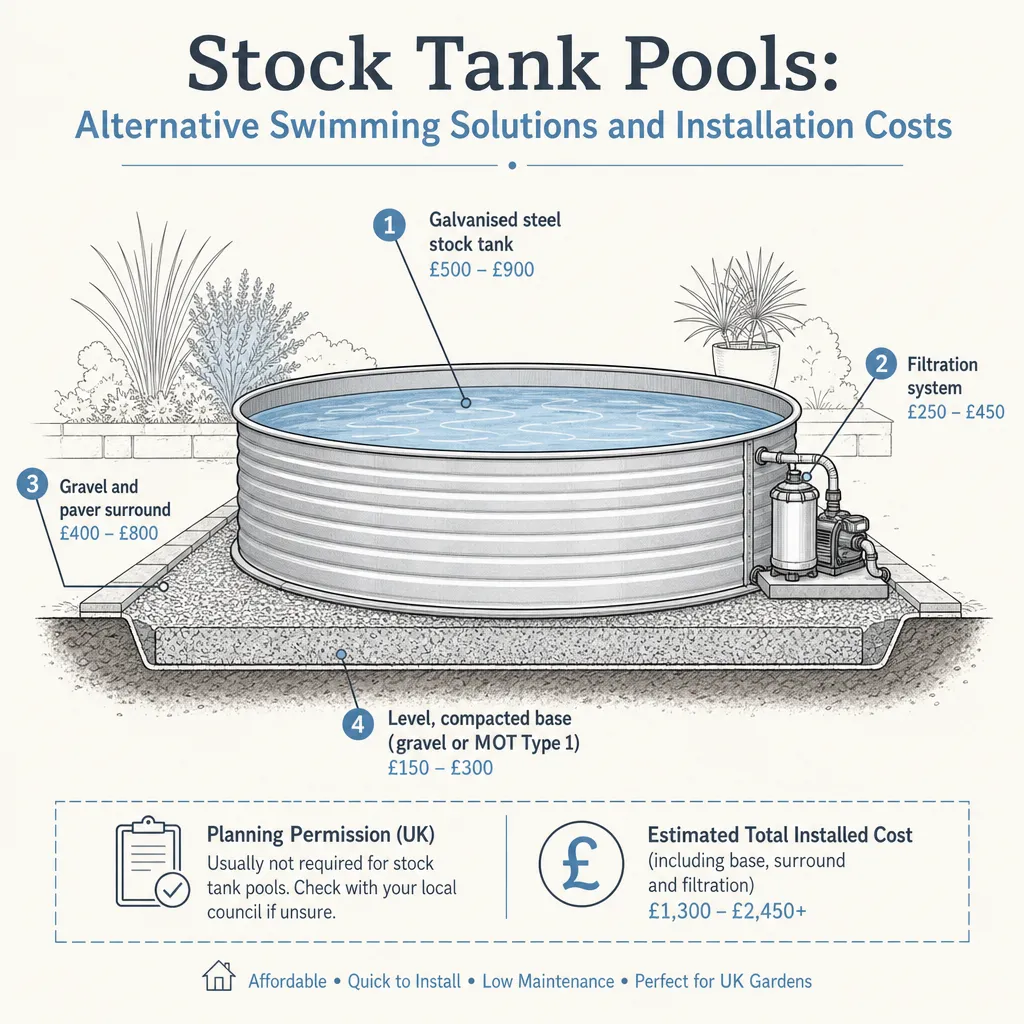
Stock Tank Pools: Alternative Swimming Solutions and Installation Costs
A stock tank pool is a galvanised steel agricultural trough repurposed as a garden plunge or swimming pool.
 Improvement & Build
Home improvements for selling: investments that increase your property value
Not all home improvements deliver equal return when selling.
 Improvement & Build
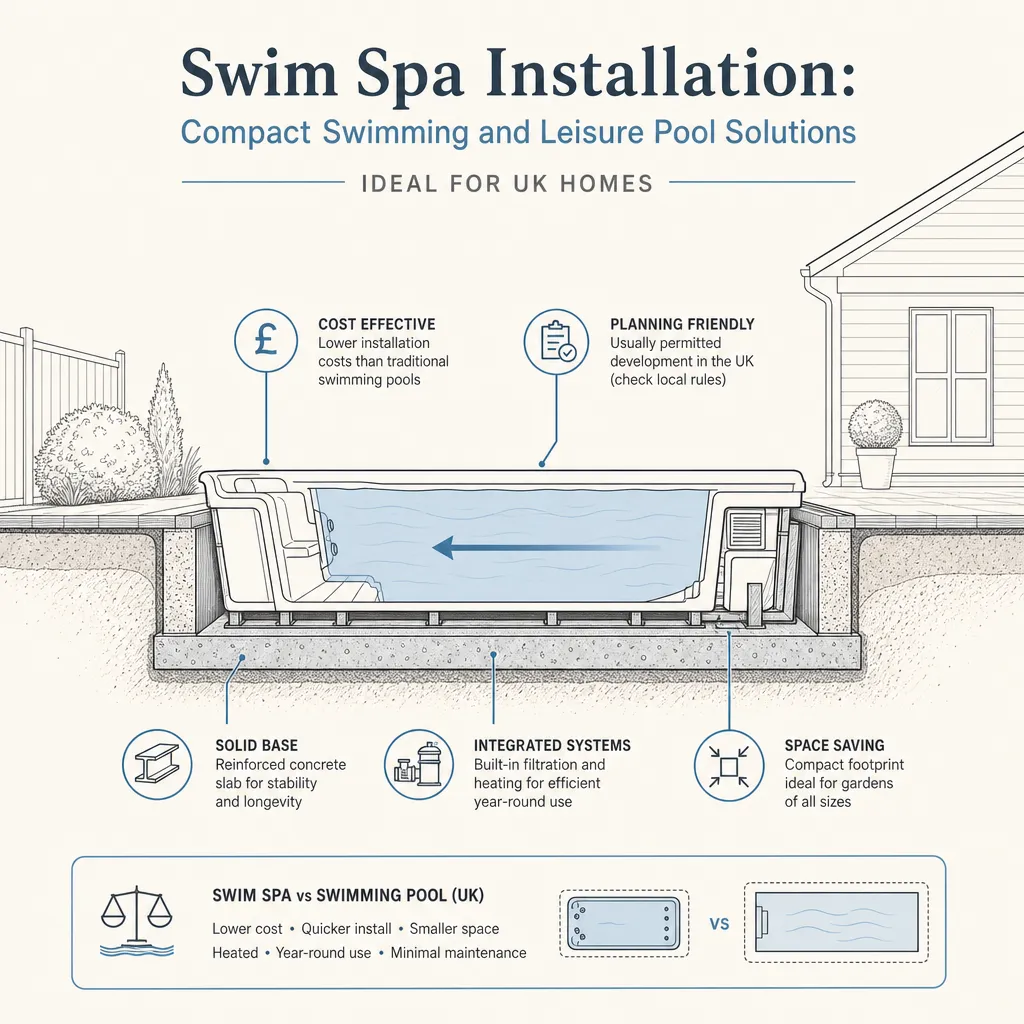
Swim Spa Installation: Compact Swimming and Leisure Pool Solutions
A swim spa typically needs a reinforced concrete base, a dedicated 32A or 63A electrical supply installed by a Part P-registered electrician, and site preparation by a groundworker.
 Improvement & Build
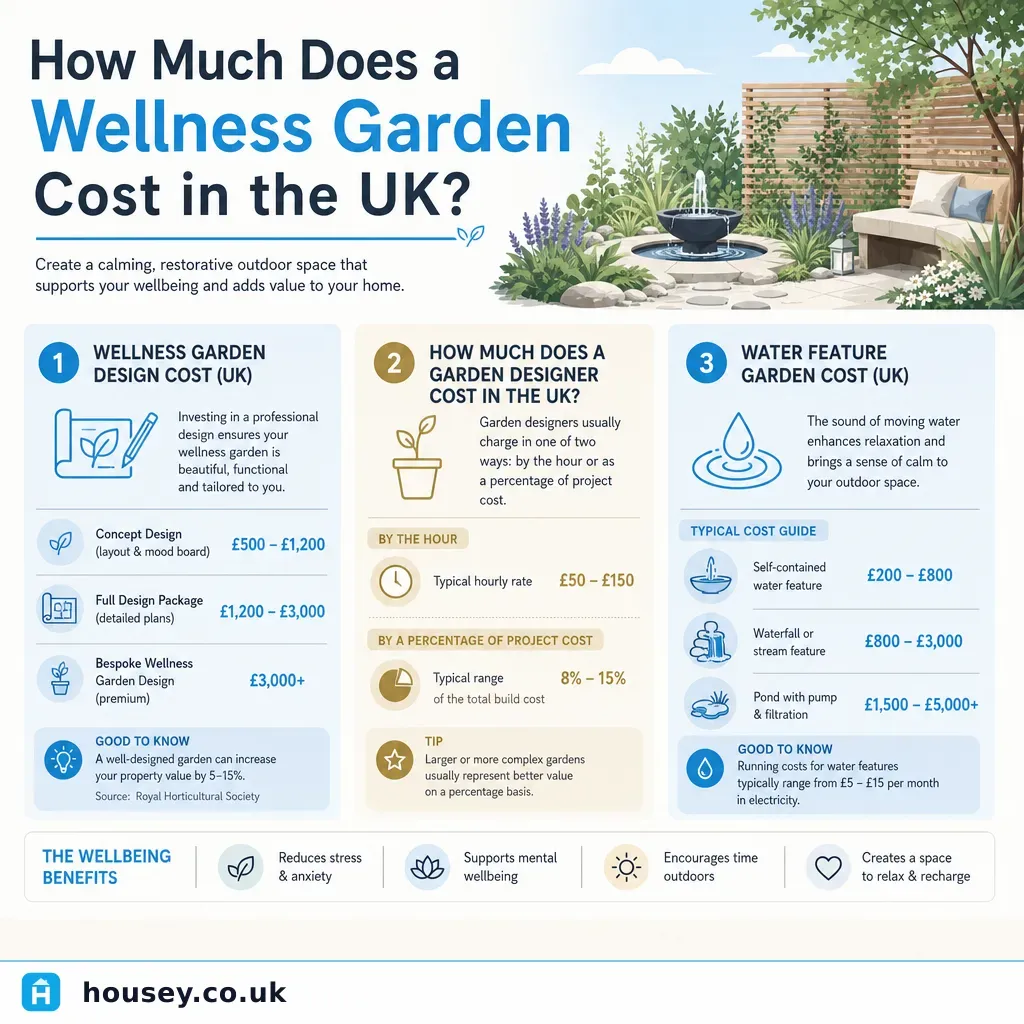
How Much Does a Wellness Garden Cost in the UK?
A wellness garden in the UK typically costs £8,000–£40,000 for a mid-sized design-and-build project.