Energy Efficiency and Home Comfort: Resources for Homeowners
By Housey · Last reviewed 30th of May 2026
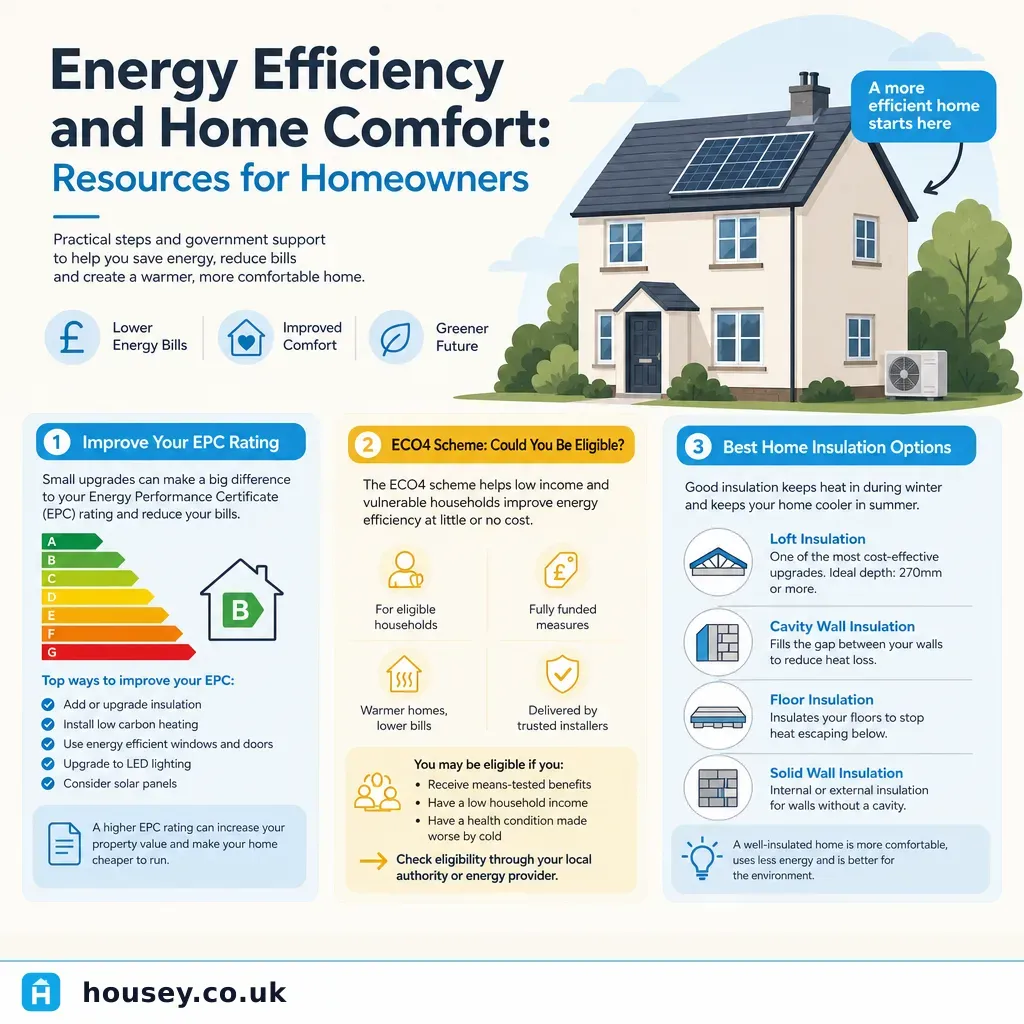
Energy Efficiency and Home Comfort: Resources for Homeowners
Rising energy bills, tightening rental regulations, and the UK's net-zero commitments have made home energy efficiency a mainstream concern for homeowners, landlords, and buyers alike. For many households — particularly those in older, poorly insulated properties — improving energy performance is both a financial decision and a legal consideration. Knowing where to start and which professionals to involve makes a significant difference to how effective and safe any improvements turn out to be.
Key points
- Privately rented homes in England and Wales must achieve at least EPC band E under the Minimum Energy Efficiency Standards (MEES); a proposed tightening to band C by 2030 is under government consultation.
- Loft insulation is typically the highest-return first measure for uninsulated homes — the Energy Saving Trust estimates savings of up to £310 per year for a semi-detached home (2025 figures).
- The ECO4 scheme, delivered through energy suppliers, funds insulation and heating upgrades for low-income and vulnerable households — eligibility is means-tested.
- PAS 2035 is the BSI framework for domestic retrofit; work funded through publicly backed schemes including ECO4 must comply with it and involve a qualified Retrofit Coordinator.
- Solid-wall insulation for pre-1920 homes is significantly more expensive than cavity wall fill and carries additional moisture management risk if not properly designed.
Start with an EPC: what it tells you and what it does not
An Energy Performance Certificate (EPC) rates a property's energy efficiency from A (most efficient) to G (least) and estimates annual energy costs. It is produced by an accredited domestic energy assessor and is legally required when selling or letting a property.
The EPC is a useful starting point but has real limitations:
- It is a standardised calculation, not a measured energy audit — it does not reflect how you actually use the property.
- Recommendations in the EPC report are generic; they are not a tailored retrofit plan.
- EPC ratings do not capture airtightness, ventilation adequacy, or thermal bridging in detail.
For a more actionable picture, a retrofit assessment carried out by a qualified assessor working to PAS 2035 provides a whole-house evaluation that sequences improvements and considers interactions between measures — for example, adding insulation without improving ventilation can increase moisture risk in older solid-wall homes.
The most cost-effective improvements by property type
Different UK property types have different starting points and improvement priorities:
Property type | Likely best first measures | Watch out for |
|---|---|---|
Post-1990 cavity-wall home | Cavity wall fill (if uninsulated); loft insulation top-up | Check cavity condition before filling — some cavities are unsuitable |
1930s–1970s semi or terrace | Loft insulation; cavity wall fill; boiler upgrade if over 15 years old | Cavity quality varies; some 1930s homes have solid ground-floor walls |
Pre-1920 solid-wall property | Draught-proofing; loft insulation; internal or external wall insulation | IWI or EWI is expensive and needs careful moisture management |
Leasehold flat | Draught-proofing; heating controls upgrade | Some measures require freeholder consent or a building-wide approach |
Post-2016 new-build | Heat pump if gas-heated; solar PV if not already installed | Homes are already well insulated; focus on low-carbon heat and renewables |
Government grants and funding schemes
ECO4 (Energy Company Obligation 4)
Delivered through energy suppliers, ECO4 funds insulation and heating improvements for owner-occupiers and private tenants who receive qualifying benefits or have a low income. Check eligibility with your energy supplier or via the Simple Energy Advice service.
Great British Insulation Scheme (GBIS)
Targets homes with EPC D–G ratings regardless of income, offering a single insulation measure per home. Check eligibility at the GOV.UK GBIS page.
Boiler Upgrade Scheme (BUS)
Provides a grant of £7,500 towards an air source heat pump or ground source heat pump (correct as of May 2026 — check gov.uk/boiler-upgrade-scheme for current amounts). Administered through MCS-accredited installers.
Devolved funding
Scotland (Warmer Homes Scotland), Wales (Nest and Optimised Retrofit Programme), and Northern Ireland (NISEP) each have separate funding streams — check the relevant devolved government website.
Decision guide — which scheme might apply to you?
- Choose ECO4 if you receive qualifying benefits or have a household income below the scheme threshold — contact your energy supplier first.
- Choose the Great British Insulation Scheme if your EPC is rated D, E, F, or G and you do not qualify for ECO4.
- Use the Boiler Upgrade Scheme if you want to replace a gas or oil boiler with a heat pump — the installer must be MCS-accredited to apply on your behalf.
- Consider a PAS 2035 retrofit assessment before undertaking multiple measures — this ensures improvements are sequenced safely and avoids unintended moisture or ventilation problems.
Before applying for any scheme — homeowner checklist:
Understanding PAS 2035 and whole-house retrofit
PAS 2035 is a BSI framework introduced in 2019 that sets out how domestic retrofit projects should be assessed, designed, installed, and evaluated. It is required for ECO4 and other publicly funded programmes.
Key roles under PAS 2035:
- A Retrofit Assessor surveys the property and produces a whole-house assessment document.
- A Retrofit Coordinator uses that assessment to design a sequenced improvement plan that avoids unintended consequences — for example, trapping moisture by insulating before ventilation is addressed.
- Installers must be TrustMark-registered.
For homeowners funding improvements privately, PAS 2035 is not mandatory — but following its principles is good practice, especially in pre-1920 solid-wall properties where insulation changes carry meaningful moisture risk. An energy efficiency consultant can help you understand the right sequencing for your property without a full publicly funded retrofit programme.
Heat pumps and low-carbon heating
Air source heat pumps (ASHPs) extract heat from outside air and are the main low-carbon alternative to gas boilers in UK homes. They work effectively in UK temperatures but perform best in well-insulated properties with appropriately sized radiators or underfloor heating.
Key considerations:
- Heat pumps require a heat loss calculation to BS EN 12831 before sizing — an undersized unit will not heat the property adequately; an oversized one cycles inefficiently.
- Running costs depend on the system's coefficient of performance (COP) and your electricity tariff — with a well-designed system and a dedicated heat pump tariff, operating costs can be competitive with gas.
- Listed buildings, conservation areas, and some flats may face planning constraints on external units — check with your local planning authority before installation.
- The Boiler Upgrade Scheme provides £7,500 towards an ASHP; the installer must be MCS-accredited to apply on your behalf.
Heat pump sizing and system design require a qualified MCS-accredited engineer. Do not size a heat pump based on an online calculator alone.
Quick wins: draught-proofing and low-cost measures
Before committing to major works, low-cost measures can reduce bills and improve comfort:
- Draught-proofing external doors, letterboxes, and keyholes: typically £200–£300 professionally installed. The Energy Saving Trust estimates savings of up to £45 per year for a semi-detached home.
- Heating controls upgrade — a programmable room thermostat and thermostatic radiator valves (TRVs): typically £150–£500. Matching heat output to actual demand reduces waste.
- Hot water cylinder insulation: if your cylinder is uninsulated, a British Standard jacket costs under £30 and reduces standing heat loss noticeably.
- Loft hatch insulation: often missed even when the loft itself is insulated — a well-sealed, insulated hatch prevents significant heat loss through an otherwise poorly treated junction.
Indicative UK costs, last reviewed 2026-05-30. Always obtain quotes before proceeding.
When to get professional help
Get professional advice before proceeding if:
- Your property was built before 1920 and you are considering insulation — moisture management in solid-wall homes requires professional assessment.
- You are applying for ECO4 or GBIS — work must be carried out by TrustMark-registered, PAS 2035-compliant contractors.
- You are considering a heat pump — sizing and system design must be done by an MCS-accredited engineer.
- Your EPC rating is F or G and you rent the property — you may be in breach of MEES and face local authority enforcement.
- You are planning multiple improvements and are unsure of the right sequence — a Retrofit Coordinator can prevent costly mistakes.
How Housey can help
Housey connects homeowners with qualified energy efficiency consultants and retrofit assessment professionals who can survey your property, identify the right improvement sequence, and help you understand available funding. Submit a job request to receive quotes from up to four local specialists.
Frequently asked questions
What EPC rating do I need to rent out my property?
In England and Wales, privately rented properties must currently achieve at least EPC band E under the Minimum Energy Efficiency Standards (MEES). Properties rated F or G cannot legally be let to new tenants, with limited exemptions. A proposed tightening to band C by 2030 is under government consultation — check the GOV.UK MEES guidance for the current position.
Is cavity wall insulation always a good idea?
Not always. Cavity wall insulation works well in homes with a clean, continuous, correctly sized cavity. Properties with defective, partially filled, or narrow cavities, or those in exposed locations prone to driving rain, may experience moisture penetration if the wrong product or installation method is used. A cavity wall survey before installation is strongly advisable.
Do I need planning permission for solar panels?
Most solar panel installations on private homes in England fall under permitted development and do not require planning permission, provided panels do not protrude more than 200mm from the roof slope. Restrictions apply to listed buildings and conservation areas. Check GOV.UK permitted development guidance and confirm with your local planning authority before proceeding.
What is the difference between a Retrofit Assessor and a Retrofit Coordinator?
A Retrofit Assessor surveys the property and produces the whole-house assessment document. A Retrofit Coordinator uses that assessment to design a sequenced improvement plan, oversee installation, and ensure compliance with PAS 2035. For publicly funded schemes both roles are required. For privately funded work they may be the same person — confirm qualifications and TrustMark registration before instructing.
Sources and further reading
- Energy Performance Certificates — GOV.UK
- ECO4 scheme guidance — GOV.UK
- Great British Insulation Scheme — GOV.UK
- Boiler Upgrade Scheme — GOV.UK
- Minimum Energy Efficiency Standards: landlord guidance — GOV.UK
- Home insulation advice — Energy Saving Trust
Useful next reads
 Energy & Retrofit
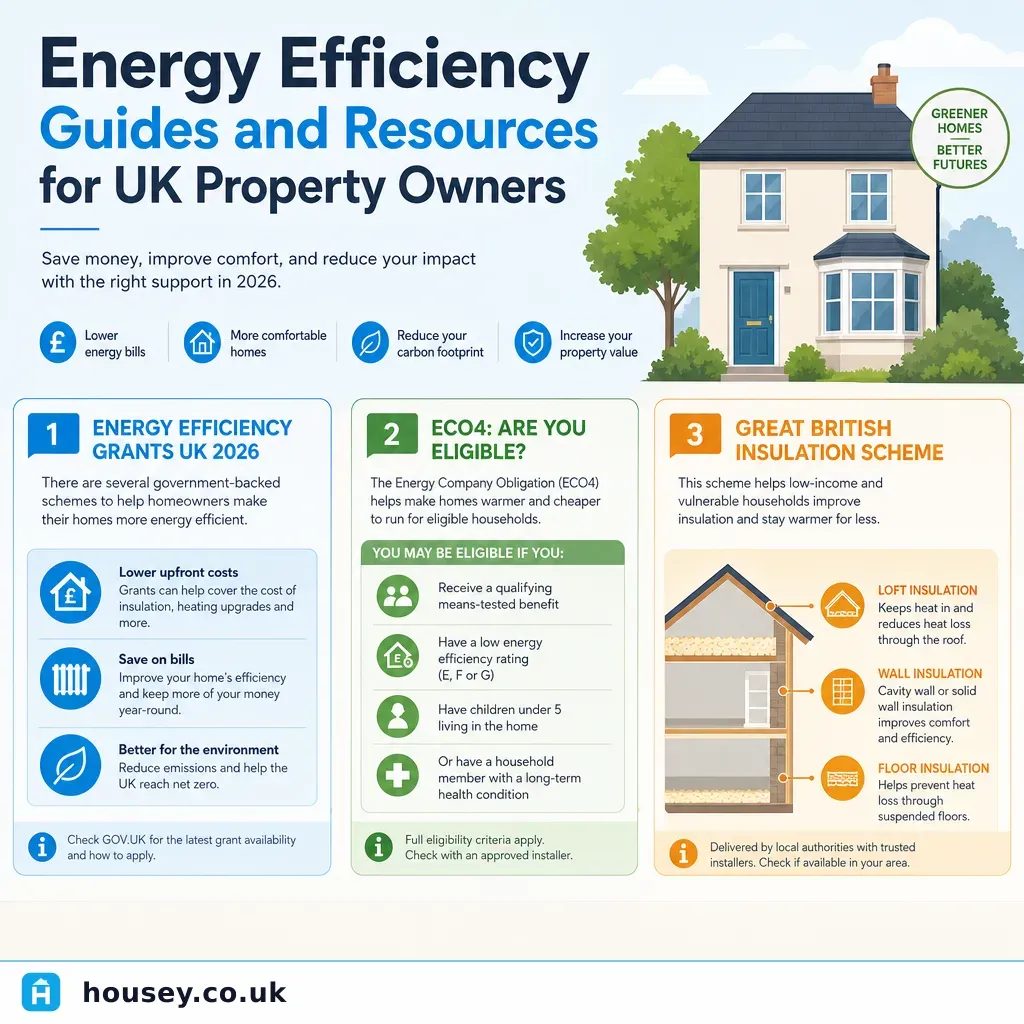
Energy Efficiency Guides and Resources for UK Property Owners
UK homeowners can improve energy efficiency through a range of measures — from loft and cavity wall insulation to heat pumps, solar panels, and improved heating controls.
 Energy & Retrofit
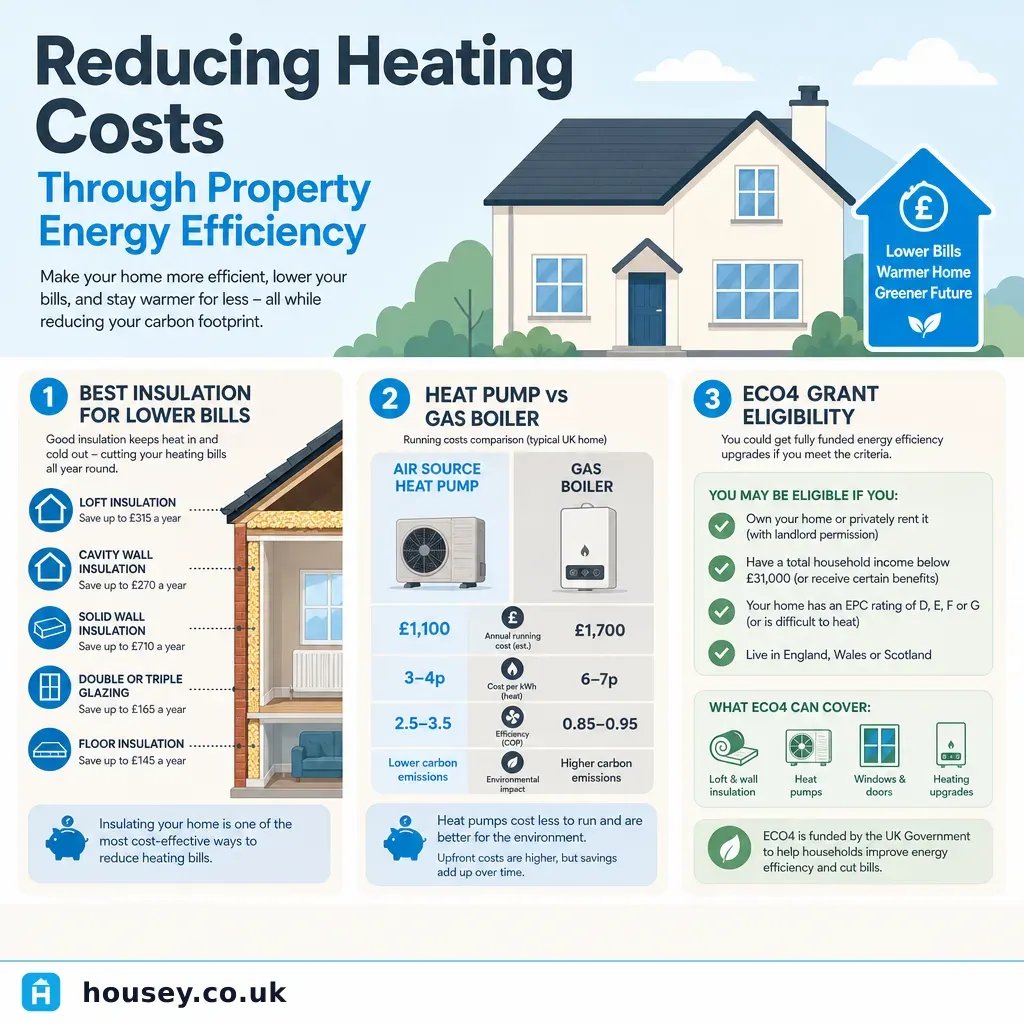
Reducing Heating Costs Through Property Energy Efficiency
Reducing heating costs starts with identifying where heat is lost — typically walls (30–35%), roof (20–25%), and windows.
 Energy & Retrofit
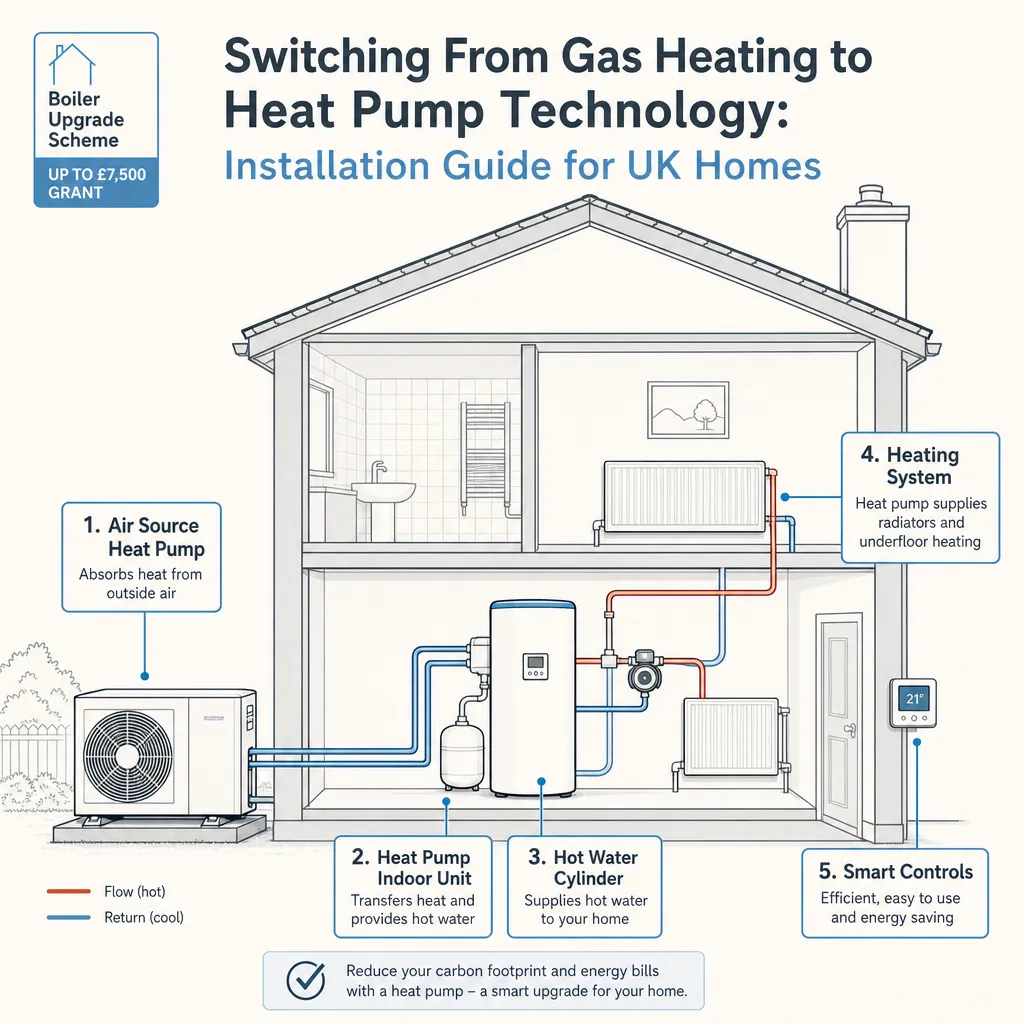
Switching From Gas Heating to Heat Pump Technology: Installation Guide
Switching from gas to a heat pump requires a heat loss calculation, correctly sized equipment, and often radiator upgrades before installation.
 Energy & Retrofit
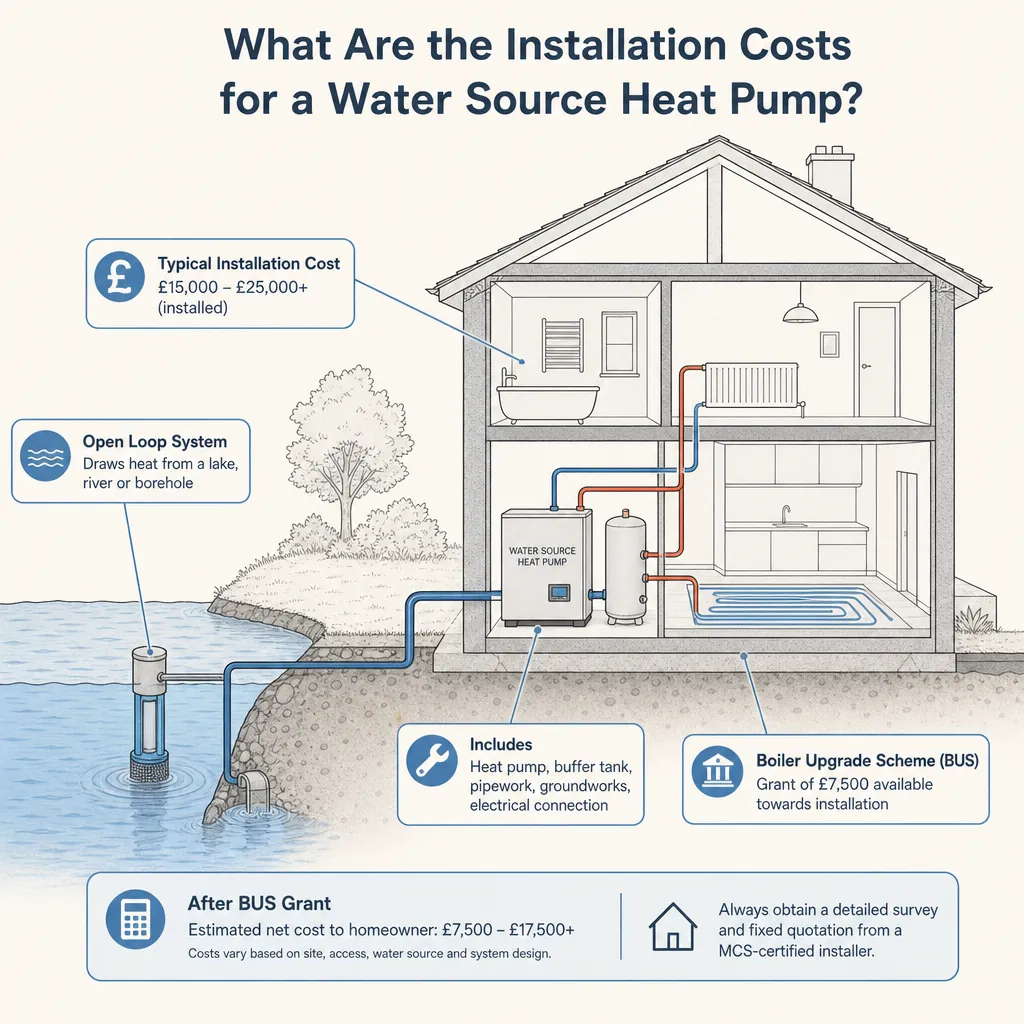
What Are the Installation Costs for a Water Source Heat Pump?
Water source heat pump installation in the UK typically costs £15,000–£45,000, depending on system type (open-loop or closed-loop), required heat output, and site complexity.
 Energy & Retrofit
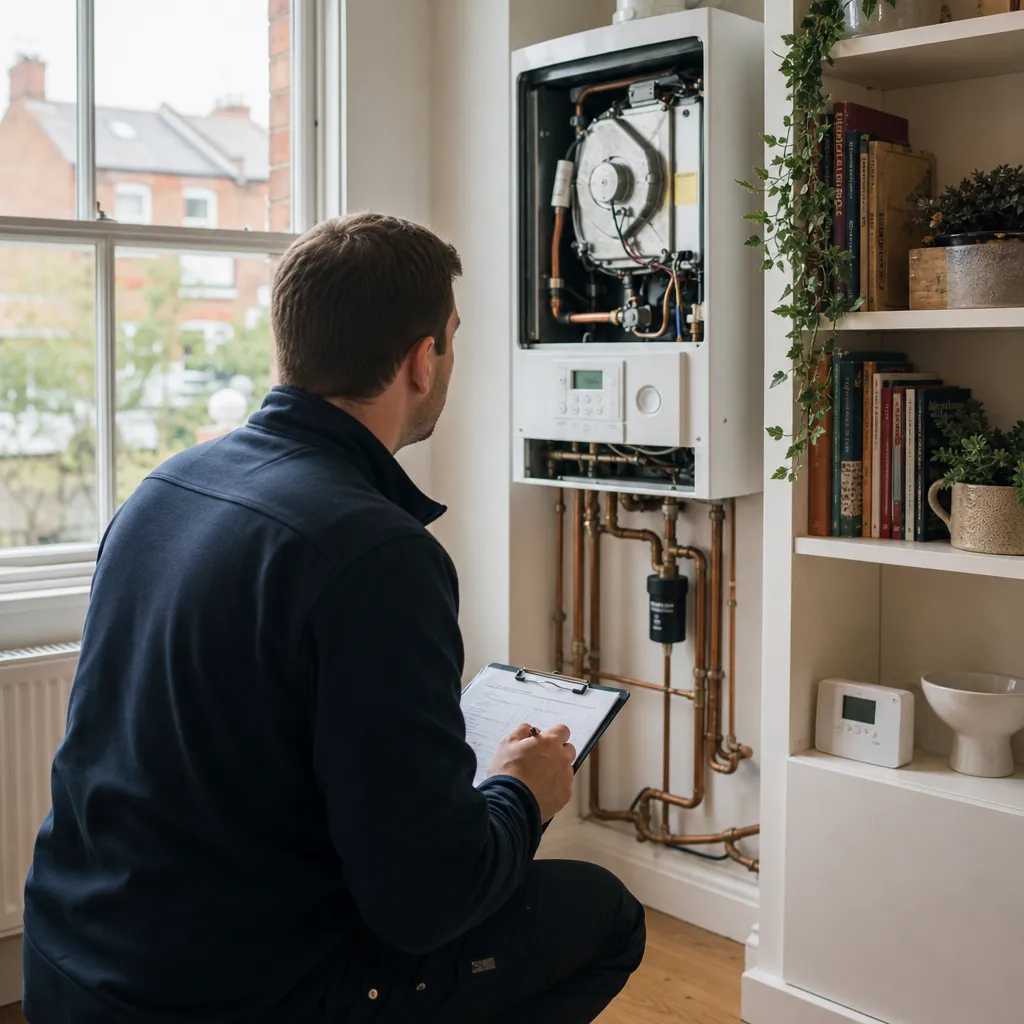
Common Home Heating Mistakes: Efficiency and Safety
The most common heating mistakes UK homeowners make include setting the boiler flow temperature too high, assuming constant low heat is cheaper than a timed programme, and neglecting annual Gas Safe servicing.