What Are the Installation Costs for a Water Source Heat Pump?
By Housey · Last reviewed 11th of May 2026
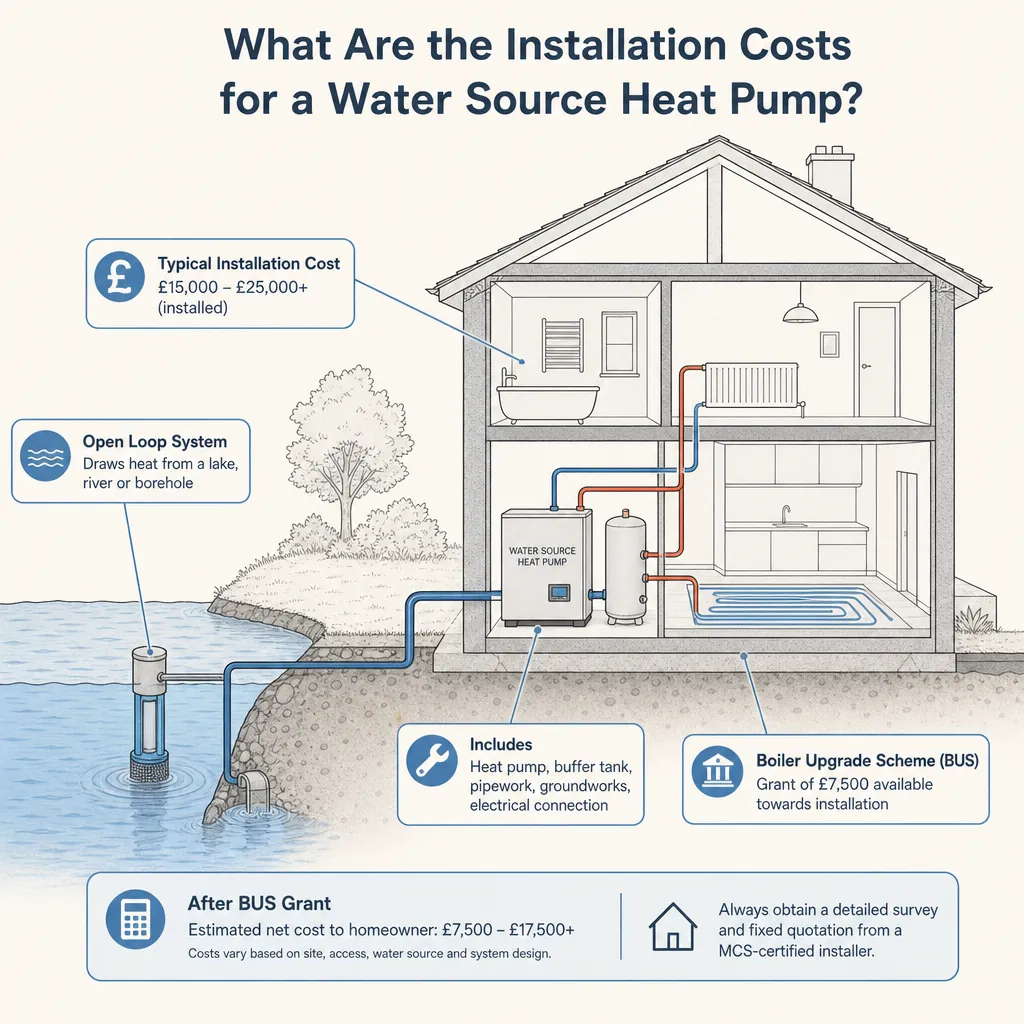
What Are the Installation Costs for a Water Source Heat Pump?
Water source heat pumps occupy a niche but high-performance corner of the UK's renewable heating market. They suit a specific subset of properties — those with access to a river, lake, borehole, or suitable groundwater resource — and can deliver seasonal efficiencies that exceed both air source and ground source alternatives when conditions are right. Homeowners typically start investigating costs after purchasing a rural or waterside property, when an ageing oil or LPG boiler is due for replacement, or when interest in the Boiler Upgrade Scheme prompts a closer look at alternatives beyond air source heat pumps.
Key points
- Water source heat pump installation in the UK typically costs £15,000–£45,000 depending on system type, required heat output, and site complexity (indicative, last reviewed 2026-05-11).
- The Boiler Upgrade Scheme (BUS) offers a £7,500 grant for eligible water source heat pump installations in England and Wales; only MCS-certified installers can apply on your behalf.
- Open-loop systems drawing from a river, lake, or borehole may require an Environment Agency abstraction licence — operating without one where one is required is a criminal offence.
- The system must be sized using a building-specific heat loss calculation; undersizing reduces comfort and efficiency, while oversizing wastes capital expenditure.
- Seasonal Coefficient of Performance (SCOP) for well-installed water source systems typically ranges from 3.5 to 5.0 — broadly higher than equivalent air source heat pumps in most UK conditions.
What does a water source heat pump installation cost?
Installation costs span a wide range because the scope of works depends heavily on site type and system configuration. The table below breaks down typical cost elements for a UK residential installation.
Cost element | Indicative range (2026) |
|---|---|
Heat pump unit (15–30 kW output) | £8,000–£20,000 |
Open-loop borehole drilling (per metre) | £60–£120/m |
Closed-loop submerged coil (river or lake) | £3,000–£8,000 |
Heat distribution upgrade (underfloor heating or larger radiators) | £4,000–£15,000 |
Hot water cylinder and controls | £1,500–£4,000 |
Electrical supply upgrade (if consumer unit or cable capacity is insufficient) | £500–£2,000 |
Abstraction licence application professional fees (where required) | £500–£2,000 |
Typical total range | £15,000–£45,000+ |
Indicative UK costs, last reviewed 2026-05-11. Site-specific factors — including borehole depth, existing heat distribution system, property insulation standard, and local groundwater conditions — mean actual quotes can fall outside this range. Obtain at least three quotes from MCS-certified installers.
After the Boiler Upgrade Scheme grant of £7,500 (deducted from your invoice by the installer), net costs for a mid-range installation often fall in the region of £10,000–£30,000.
Open-loop vs closed-loop: which affects your costs?
The most fundamental cost and regulatory decision is whether the installation uses an open-loop or closed-loop configuration.
System type | How it works | Typical additional site cost | Key consents needed | Best for |
|---|---|---|---|---|
Open-loop (surface water) | Draws water from a river or lake, extracts heat, returns cooled water | Intake and return pipework: £2,000–£6,000 | Environment Agency abstraction licence; possible environmental permit | Properties directly adjacent to a river, canal, or lake |
Open-loop (groundwater/borehole) | Pumps groundwater from a borehole, extracts heat, recharges via a return borehole | Borehole drilling: £6,000–£18,000 | Environment Agency abstraction licence | Rural properties on permeable geology (chalk, limestone, sandstone) |
Closed-loop (submerged coil) | Sealed refrigerant or water-glycol loop submerged in a water body | Coil and installation: £3,000–£8,000 | Landowner consent; possible Environment Agency permit | Properties with a pond, lake, or slow-moving watercourse |
The closed-loop submerged coil is generally the lowest-risk regulatory option but requires a suitable water body of sufficient volume and depth. Open-loop systems typically offer higher efficiency in many cases but trigger abstraction licensing requirements that add time and professional fees to the project.
Which system should you choose?
- Choose a closed-loop submerged coil if you own or have rights over a lake, large pond, or slow-moving river of sufficient depth — commission a heat loss survey and a water body assessment before proceeding.
- Choose an open-loop groundwater system if your property sits on permeable geology with a suitable water table — a hydrogeological assessment is needed to confirm viability before design work begins.
- Choose an open-loop surface water system if a river or watercourse runs adjacent to your boundary — engage with the Environment Agency at pre-application stage before spending money on design.
- Consider a ground source or air source alternative if none of the above apply — water source heat pumps are not feasible without a suitable water body or groundwater resource within reach of the property.
- Ask a specialist before ruling any option out — site geology, groundwater depth, and water body characteristics are not always obvious without a professional site assessment.
Grants and financial support
Boiler Upgrade Scheme (BUS): the primary government grant for replacing fossil fuel heating with a low-carbon alternative. As of May 2026, the BUS offers £7,500 for eligible heat pump installations in England and Wales. The grant is applied by the MCS-certified installer and deducted from your invoice — you pay the net balance. Verify current eligibility criteria on GOV.UK before committing, as terms and funding levels can change.
Energy Company Obligation (ECO4): available to lower-income households meeting specific eligibility criteria. Contact your energy supplier to check whether your household qualifies.
VAT: heat pump installations currently attract 0% VAT under the UK energy-saving materials relief introduced in 2022. Confirm the current rate with your installer — VAT treatment for energy measures is subject to legislative change.
Smart Export Guarantee (SEG): applies to solar PV rather than heat pumps directly, but a combined solar-and-heat-pump installation can generate SEG export payments that help offset electricity running costs.
Important limitations
This article provides general information only. Water source heat pump suitability, system sizing, abstraction licensing requirements, planning permission, and grant eligibility all depend on your specific property, its insulation standard, local geology, access to a water source, and current government policy — none of which this guide can assess on your behalf.
Do not commission an installation based solely on this article. A qualified MCS-certified installer must carry out a heat loss assessment and a site survey of the water source before any system is specified or priced. Abstraction licensing requirements must be confirmed with the Environment Agency before any works affecting a watercourse or groundwater begin. The information in this article reflects the position as of May 2026; always verify current grant levels, eligibility criteria, and licensing thresholds on GOV.UK before making any financial commitment.
When to get professional help
Seek specialist advice before spending money on surveys or design if any of the following apply:
- You are unsure whether your water source is legally available for abstraction or requires an Environment Agency licence
- Your property is listed, in a conservation area, or within a designated flood risk zone
- Your existing radiators have not been assessed for compatibility with heat pump flow temperatures (typically 35–55°C, lower than a conventional gas boiler)
- Your property has solid walls, poor insulation, or a high calculated heat loss — fabric improvements may be needed before a heat pump can operate efficiently
- You have received conflicting advice from different installers about system type, heat output, or water source viability
What to ask a qualified professional
Before instructing an MCS-certified installer or commissioning a heat pump survey, ask:
- Can you carry out a full building heat loss calculation (to BS EN 12831 or equivalent) before specifying the system size?
- What water body or source are you proposing to use, and have you assessed its temperature, volume, and legal availability for abstraction?
- Will an Environment Agency abstraction licence be required, and will you manage that application?
- Is my existing heat distribution system — radiators or underfloor heating — compatible with heat pump flow temperatures, or will upgrades be needed?
- What Seasonal Coefficient of Performance (SCOP) do you expect to achieve in this installation, and what assumptions underpin that figure?
- Are you MCS-certified, and will you apply for the Boiler Upgrade Scheme grant on my behalf?
- What does your maintenance contract cover, and what are the annual servicing costs after the first year?
How Housey can help
Housey connects you with MCS-certified specialists who can carry out heat pump surveys to assess your property's suitability and water source options before you commit to any capital expenditure. Starting with a professional feasibility survey is the most effective way to avoid a costly mismatch between system type and site conditions.
Frequently asked questions
Is my property suitable for a water source heat pump?
Suitability depends on access to a river, lake, pond, or groundwater source with sufficient volume and temperature, adequate space for pipework or borehole drilling, and favourable local geology. Not all water sources are legally available for abstraction. A site survey by an MCS-certified specialist is essential before committing any expenditure on design or equipment.
How long does a water source heat pump installation take?
Most installations take two to four weeks from mobilisation, covering groundworks, pipework, heat pump commissioning, and controls setup. Borehole drilling typically takes two to five days depending on required depth. Environment Agency abstraction licence applications can take several months and should be initiated well in advance of any physical work beginning on site.
What are the running costs of a water source heat pump?
Running costs depend on system efficiency (SCOP), electricity tariff, property insulation standard, and occupancy patterns. A well-insulated four-bedroom home with a SCOP of 4.0 might use 4,000–6,000 kWh of electricity annually for space heating — roughly £1,000–£1,500 at current tariffs. Indicative figure, last reviewed 2026-05-11; electricity tariffs change regularly and individual results will vary.
Do I need planning permission for a water source heat pump?
Many heat pump installations in England fall within permitted development rights and do not require planning permission, subject to conditions. Listed buildings, conservation areas, and any works affecting a watercourse require a check with your local planning authority before proceeding. Permitted development rules differ in Scotland, Wales, and Northern Ireland — check the relevant guidance for your location.
Sources and further reading
- Boiler Upgrade Scheme — apply for a grant — GOV.UK
- MCS — find a certified heat pump installer — Microgeneration Certification Scheme
- Apply for a water abstraction or impoundment licence — Environment Agency / GOV.UK
- Heat pumps explained — Energy Saving Trust
- Approved Document L — conservation of fuel and power — GOV.UK
Useful next reads
 Energy & Retrofit
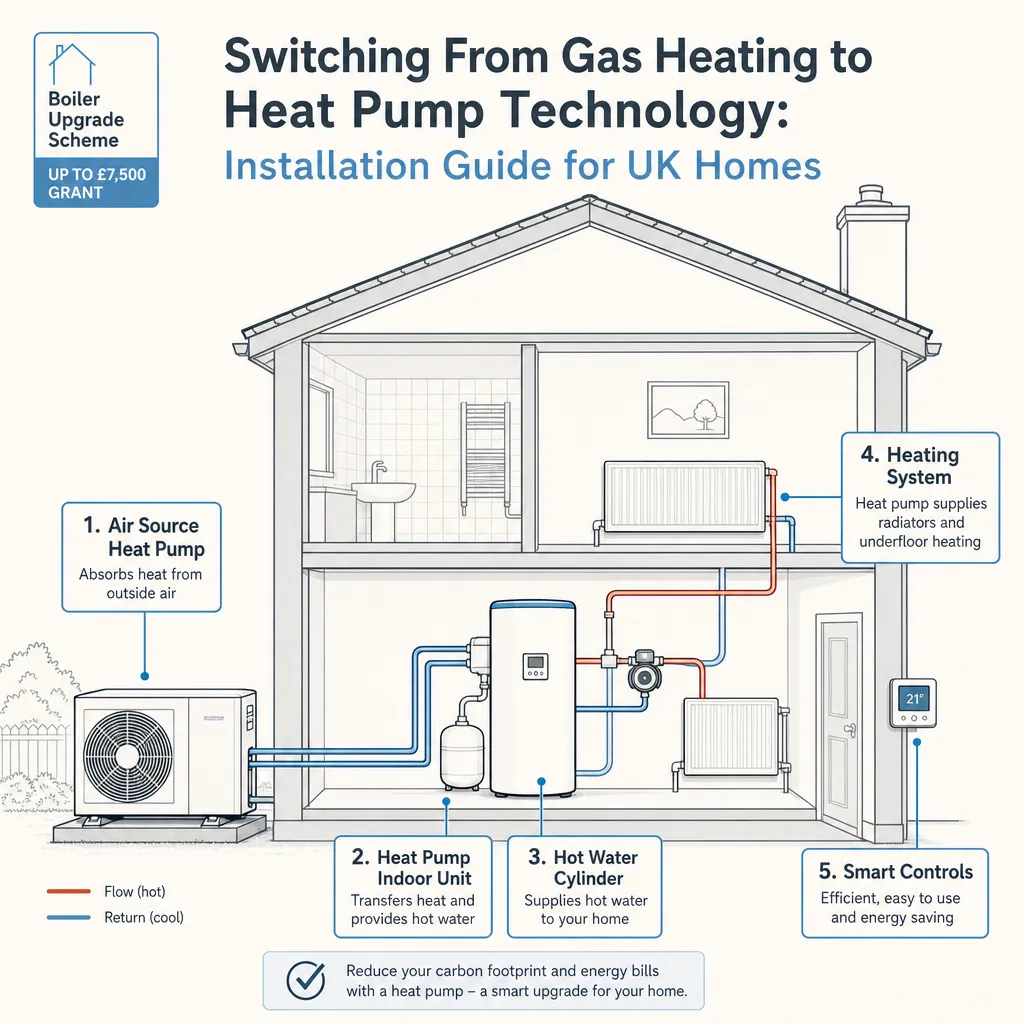
Switching From Gas Heating to Heat Pump Technology: Installation Guide
Switching from gas to a heat pump requires a heat loss calculation, correctly sized equipment, and often radiator upgrades before installation.
 Energy & Retrofit
Reducing Heating Costs Through Property Energy Efficiency
Reducing heating costs starts with identifying where heat is lost — typically walls (30–35%), roof (20–25%), and windows.
 Energy & Retrofit
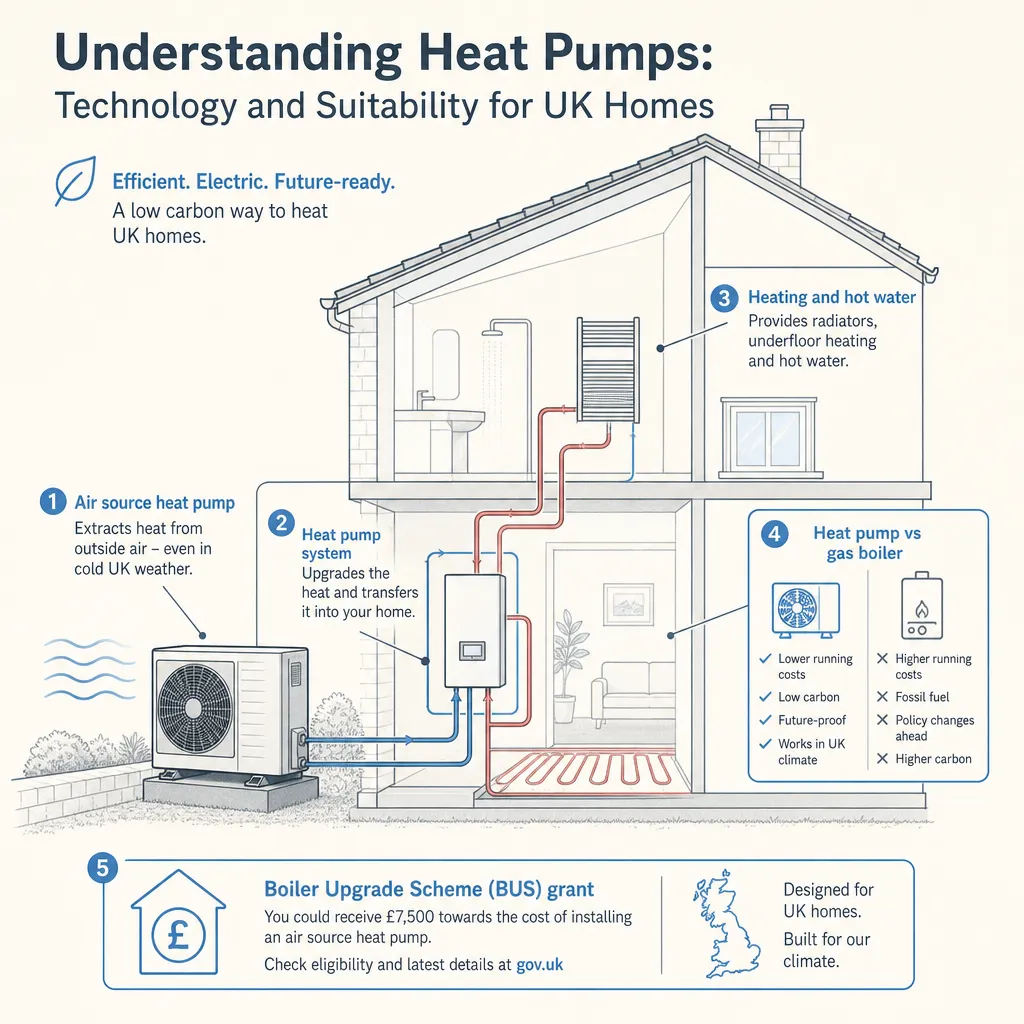
Understanding Heat Pumps: Technology and Suitability for UK Homes
Heat pumps extract heat from the air or ground and transfer it indoors, typically achieving efficiencies of 250–400% compared to a conventional boiler's near 100%.
 Energy & Retrofit
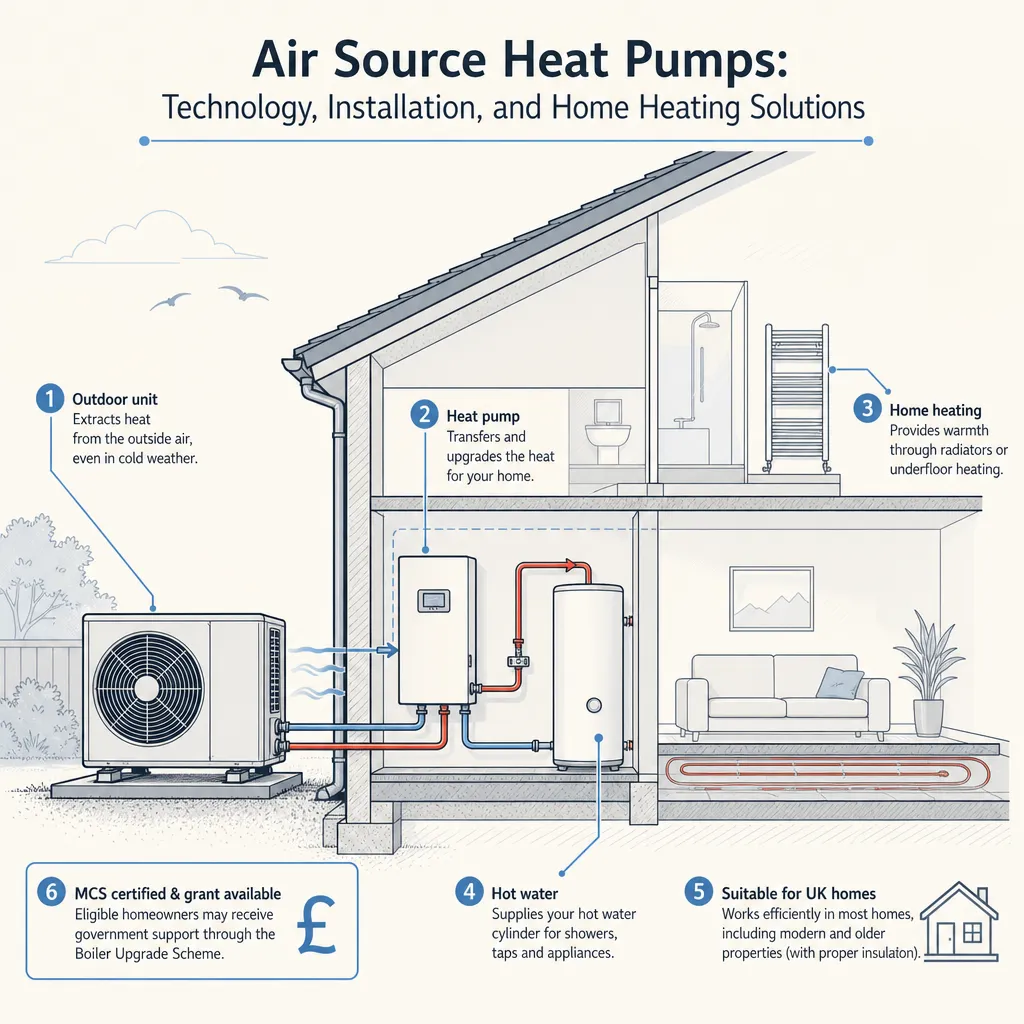
Air Source Heat Pumps: Technology, Installation, and Home Heating Solutions
An air source heat pump extracts heat from outdoor air and transfers it indoors via a refrigerant cycle, typically delivering 2.
 Energy & Retrofit
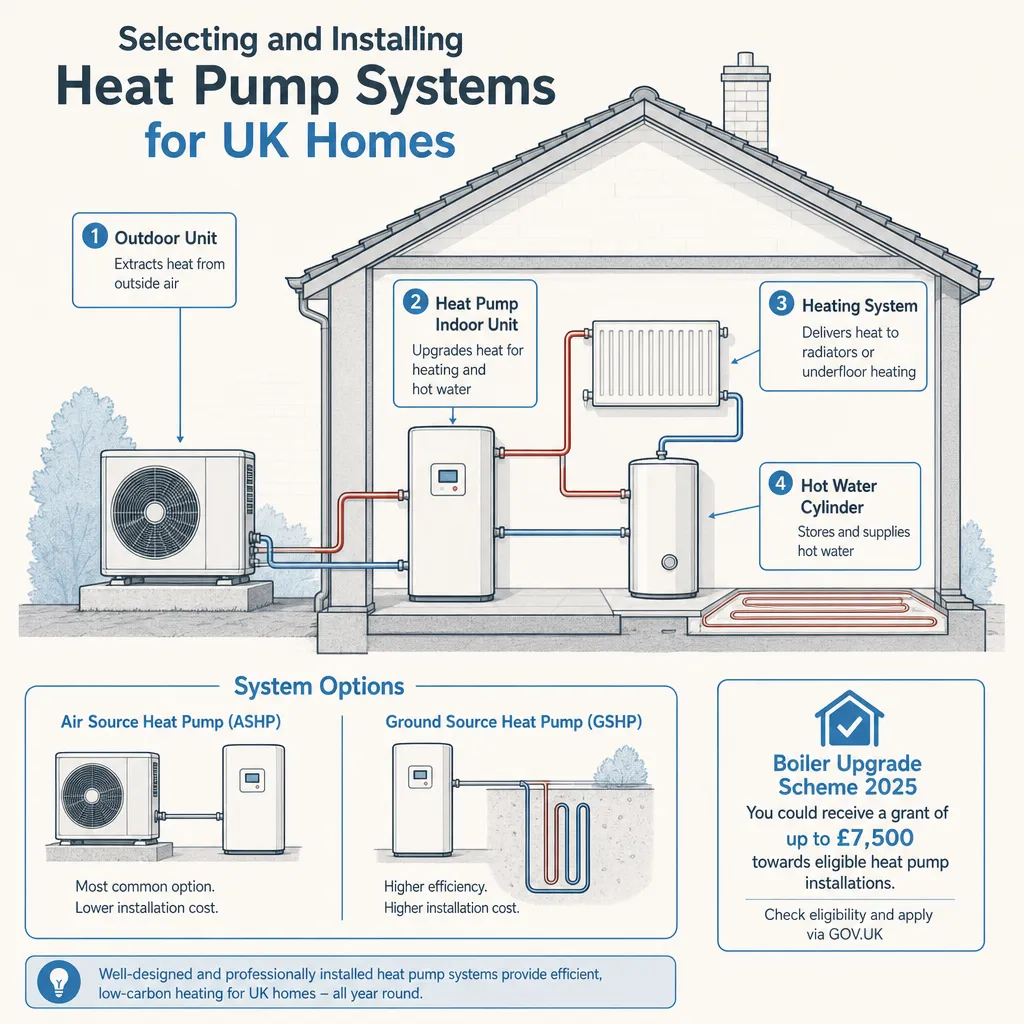
Selecting and Installing Heat Pump Systems for UK Homes
Selecting a heat pump for a UK home requires a site-specific heat loss calculation, an assessment of existing heat emitters, and a check on fabric insulation before any system is chosen.