Energy-Efficient Homes: Building Better Properties Through EPC Standards
By Housey · Last reviewed 18th of May 2026
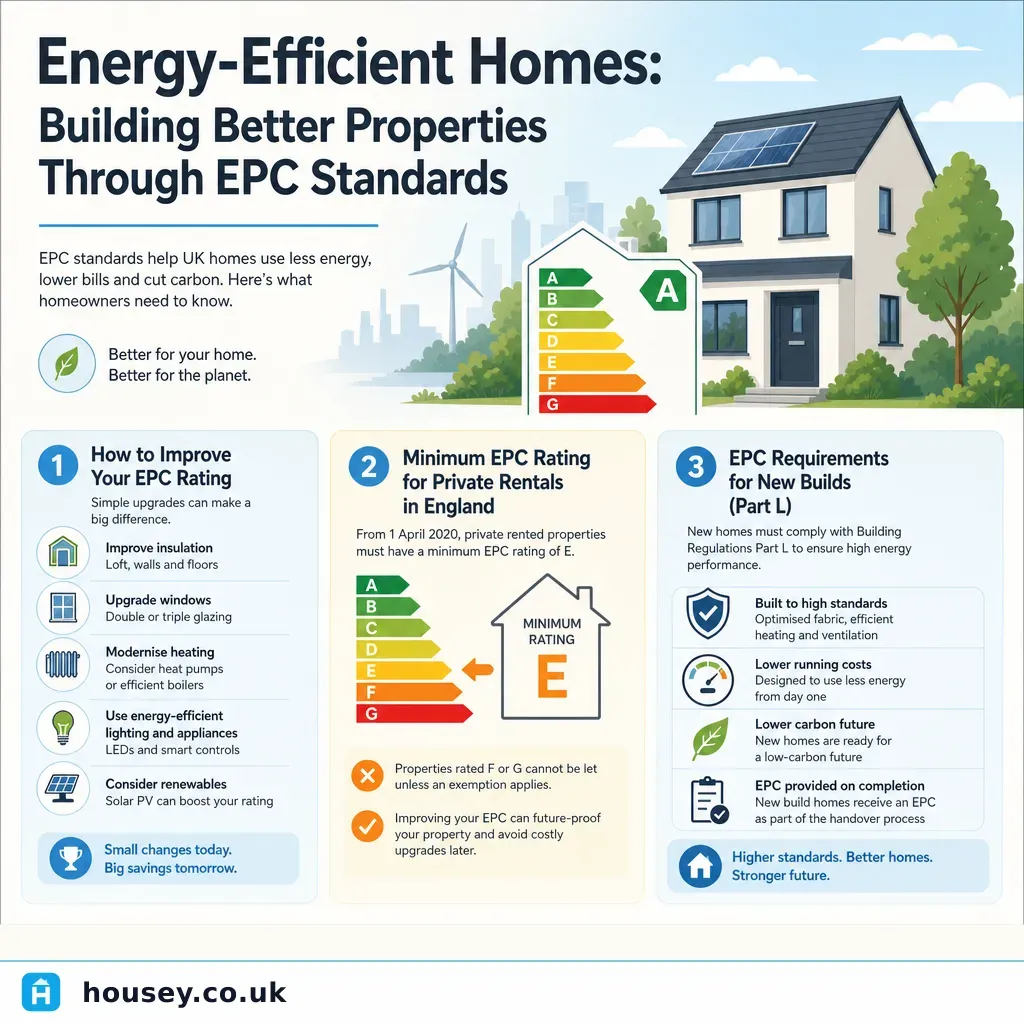
Energy-Efficient Homes: Building Better Properties Through EPC Standards
Whether you are buying a 1930s semi, renting out a Victorian terrace, or planning a full retrofit, your home's Energy Performance Certificate (EPC) rating has become one of the most closely scrutinised numbers in UK property. Tightening regulations, rising energy costs, and government retrofit targets mean that understanding how EPCs work — and where the standards are heading — affects almost every decision you make about a home.
Key points
- EPC ratings run from A (most efficient) to G (least efficient), assessed using the Standard Assessment Procedure (SAP 10.2 or RdSAP for existing homes).
- Private rented homes in England must hold at least EPC E under the Minimum Energy Efficiency Standards (MEES) Regulations 2018; landlords who let below that threshold risk fines of up to £30,000 per property.
- New homes in England must comply with Part L of the Building Regulations (Conservation of Fuel and Power); the Future Homes Standard, expected from 2025, is set to require new builds to produce 75–80% less carbon than under the 2013 Part L baseline.
- EPCs must be produced by an accredited domestic energy assessor (DEA) registered with a government-approved scheme such as Elmhurst Energy or Stroma Certification; certificates are valid for 10 years.
- Indicative cost for an EPC on a standard UK home: £60–£150 (Indicative UK costs, last reviewed 2026-05-18; costs vary by region and assessor — obtain quotes).
What an EPC rating actually measures
An EPC assesses the energy efficiency of a building's fabric — walls, roof, windows, and floors — and its fixed heating and hot-water systems. The result appears as both a numerical SAP score (1 to 100+) and a letter band from A to G. Most existing UK homes currently fall in bands D and E.
The certificate also shows a potential rating: the band your home could reach by implementing the recommended improvements listed. Recommendations such as loft insulation, cavity wall insulation, or a heat pump are prioritised by cost-effectiveness.
What an EPC does not cover
An EPC is not a structural survey, a damp report, or a record of actual energy bills paid. It models the theoretical energy use of a standardised occupancy pattern, not how a particular household uses the property. Actual savings depend on occupant behaviour, the condition of existing insulation, and whether improvements are installed correctly.
EPC requirements by property type
Situation | EPC required? | Minimum standard |
|---|---|---|
Property for sale | Yes — before marketing begins | Any band (disclosure only) |
Private rental (England) | Yes — current throughout tenancy | Band E (MEES 2018); Band C proposed for new tenancies from 2028 (under consultation) |
New-build (England) | Yes — lodged at completion | Currently Band B or better |
Listed building | Often exempt | Check with local authority or Historic England |
Short-term holiday let | EPC required if marketed separately | MEES may not apply — check GOV.UK |
How to improve your EPC rating
The most effective improvements depend on your home's current fabric and heating system. Use the EPC recommendations section as a starting point, but note that retrofit measures must be correctly sequenced — insulating before addressing ventilation can create condensation and damp problems in solid-wall or poorly ventilated homes.
Fabric-first improvements (typically highest SAP impact):
- Loft insulation to ≥270 mm, recommended for most pre-2000 homes
- Cavity wall insulation for post-1920 properties with unfilled cavity walls
- External or internal wall insulation for solid-wall homes built before circa 1920
- Draught-proofing and floor insulation for suspended timber ground floors
- Double or triple glazing
Heating and low-carbon technology:
- Replacing an ageing gas boiler with a high-efficiency condensing boiler improves SAP points but does not remove the carbon intensity of gas
- Air source or ground source heat pumps can significantly raise an EPC rating when replacing gas — correct sizing and adequate fabric preparation are essential; a heat pump survey should precede any installation
- Solar PV panels are modelled within SAP and can produce a noticeable band improvement
Grants and funding for energy improvements
Several government schemes can reduce upfront costs:
- ECO4 (Energy Company Obligation Phase 4): funded by energy suppliers, targets low-income and fuel-poor households for insulation and heating upgrades, delivered by TrustMark-registered contractors under PAS 2035
- Boiler Upgrade Scheme (BUS): provides a grant of up to £7,500 towards an air source heat pump (check GOV.UK for the latest amounts, as figures are subject to change)
- Great British Insulation Scheme: supports single insulation upgrades, targeting homes in EPC bands D–G
- Local authority flexible eligibility schemes: some councils run additional funding for households not meeting national criteria — check your local authority website
Do you need a new or updated EPC?
- Selling your home? → Check whether your existing EPC is still within its 10-year validity. If it has expired or you have made significant improvements, arrange a new assessment before listing.
- Letting to new tenants in England? → Verify your current EPC band. If it is F or G, you must improve before letting. If E, begin planning for the proposed future minimum of C.
- Planning major renovation? → Works subject to full plans building control may trigger a new Part L calculation. Speak to your architect or building control body before starting.
- Applying for ECO4 or BUS funding? → A current EPC is usually required; some schemes additionally require a PAS 2035 retrofit assessment.
- No plans to sell, let, or apply for funding? → An EPC is not legally required, but an updated assessment after improvements formally records your new rating on the national register.
When to get professional help
A standard EPC is carried out by an accredited DEA. For more complex improvement planning — particularly for older or solid-wall homes — consider engaging an energy-efficiency consultant or commissioning a full retrofit assessment to correctly sequence measures and identify moisture risk.
Red flags that warrant professional input before proceeding:
- Your home is solid-walled (typically pre-1920) and you are considering insulation — moisture management must be assessed by a qualified professional
- You plan to install a heat pump — sizing errors are costly and directly affect the EPC outcome
- The EPC recommendations appear inconsistent with your property's actual construction or condition
- You are a landlord facing an enforcement notice or a MEES compliance deadline
How Housey can help
Housey connects homeowners and landlords with accredited professionals for EPCs, retrofit assessments, heat pump surveys, and independent energy-efficiency consultants. Whether you need a straightforward EPC for a sale or a whole-house improvement plan, compare quotes from vetted local providers through a single platform.
Frequently asked questions
How long does an EPC assessment take and what does it involve?
A domestic EPC assessment usually takes 30–60 minutes for a standard-sized home. The assessor inspects construction type, insulation, glazing, heating system, and controls, then uses RdSAP software to calculate the rating. You receive a certificate and recommendations report, both lodged on the national EPC Register. Assessors must be registered with a government-approved scheme such as Elmhurst Energy or Stroma Certification.
Can I improve my EPC rating myself?
Some improvements, such as adding loft insulation, may be DIY-appropriate. However, cavity wall insulation, heat pumps, and solar PV must be installed by qualified professionals to comply with relevant standards and to register with schemes such as MCS or CIGA. Always commission a new EPC assessment after significant works so improvements are formally recorded and your updated band appears on the national register.
My rental property is currently EPC E — what should I do?
EPC E currently meets the MEES minimum for England. However, the government has consulted on raising the minimum to EPC C for new tenancies by 2028 and all tenancies by 2030. This policy was under consultation at the time of review — check GOV.UK for current status. Planning improvements now avoids the cost and disruption of a rushed retrofit once a new deadline is confirmed.
Does a listed building need an EPC?
Listed buildings are often exempt from the EPC requirement, as many energy improvement measures require listed building consent and could affect the building's character. The exemption is not automatic for all listed buildings. Check with your local planning authority or Historic England for guidance specific to your property before assuming you are exempt.
Sources and further reading
- Energy Performance Certificates: buying and selling your home — GOV.UK
- Domestic private rented sector: minimum energy efficiency standard — GOV.UK
- Approved Document L: Conservation of fuel and power — Ministry of Housing, Communities & Local Government
- Boiler Upgrade Scheme — GOV.UK
- Retrofitting and renovation guidance — Energy Saving Trust
Useful next reads
 Energy & Retrofit
The Scale of Energy Inefficiency: Why UK Homes Need Upgrading
Around 19 million UK homes hold an EPC rating of D or below, and buildings account for approximately 17% of the country's greenhouse gas emissions.
 Energy & Retrofit
Designing and Building High-Performance Sustainable Homes with Eco-Friendly Systems
High-performance sustainable homes in the UK follow a fabric-first approach: maximise insulation and airtightness before adding low-carbon heating such as heat pumps, then layer in renewables like solar PV.
 Energy & Retrofit
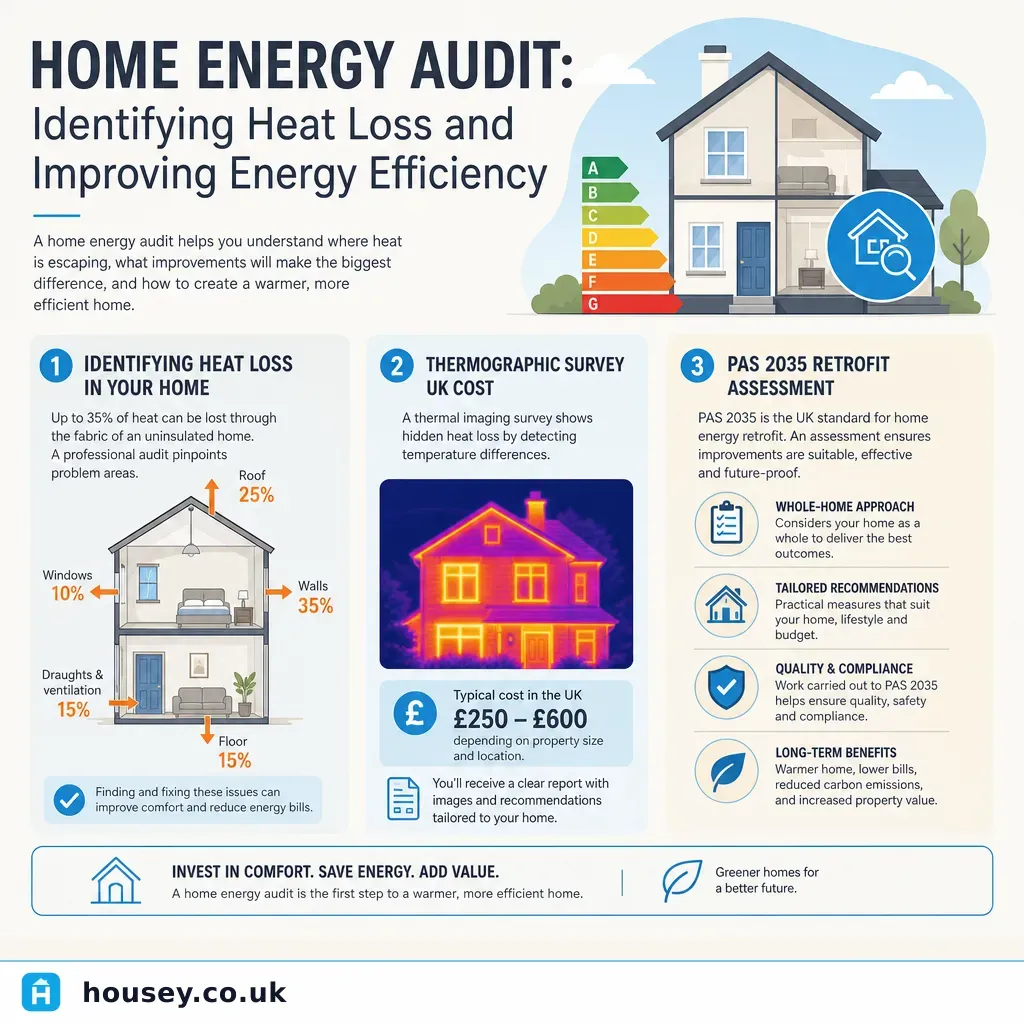
Home Energy Audit: Identifying Heat Loss and Improving Energy Efficiency
A home energy audit is a structured assessment of where your property loses heat and how efficiently it uses energy.
 Energy & Retrofit
Solar window film: enhancing thermal performance and energy efficiency
Solar window film is a thin laminate applied to glass that reduces solar heat gain by 30–80% depending on specification.
 Energy & Retrofit
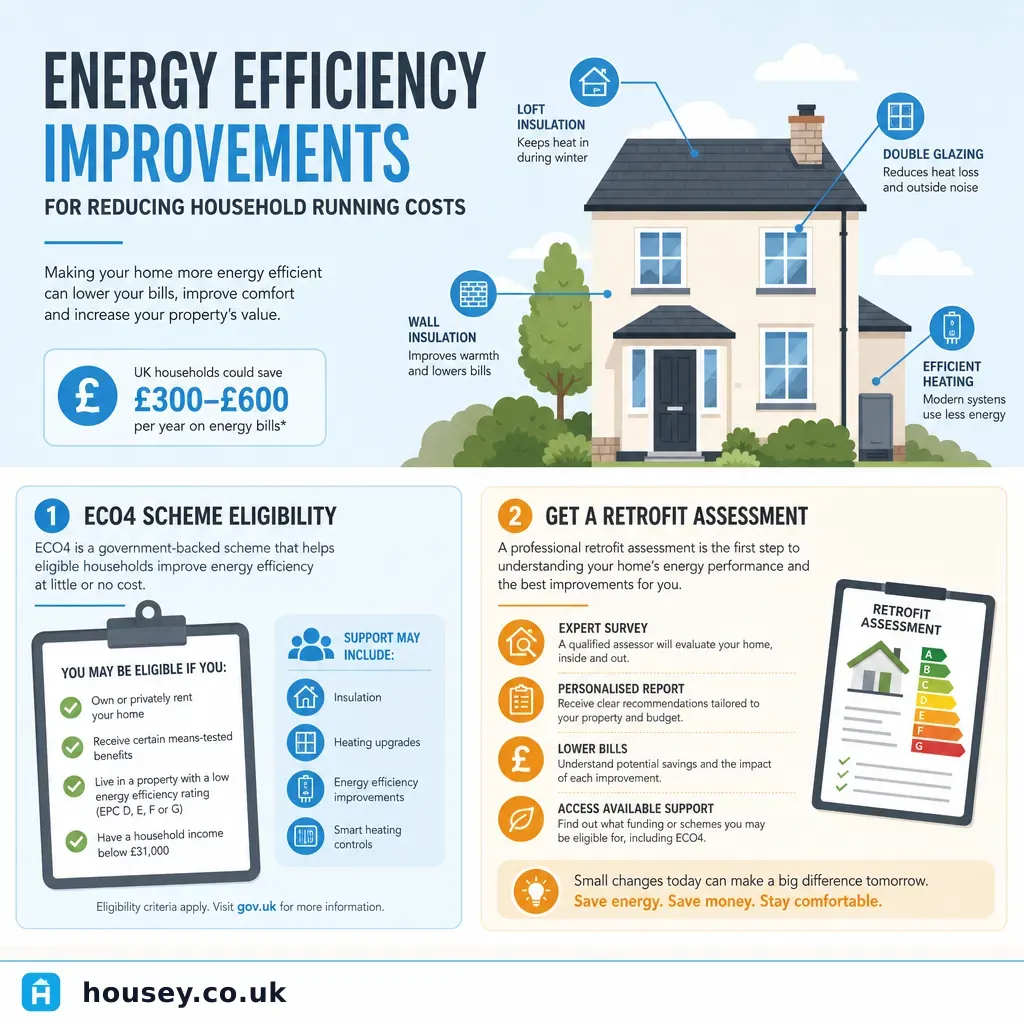
Energy Efficiency Improvements for Reducing Household Running Costs
Reducing household running costs usually starts with draught-proofing and loft insulation — the measures with the best savings-to-cost ratio.