Home Energy Audit: Identifying Heat Loss and Improving Energy Efficiency
By Housey · Last reviewed 24th of May 2026
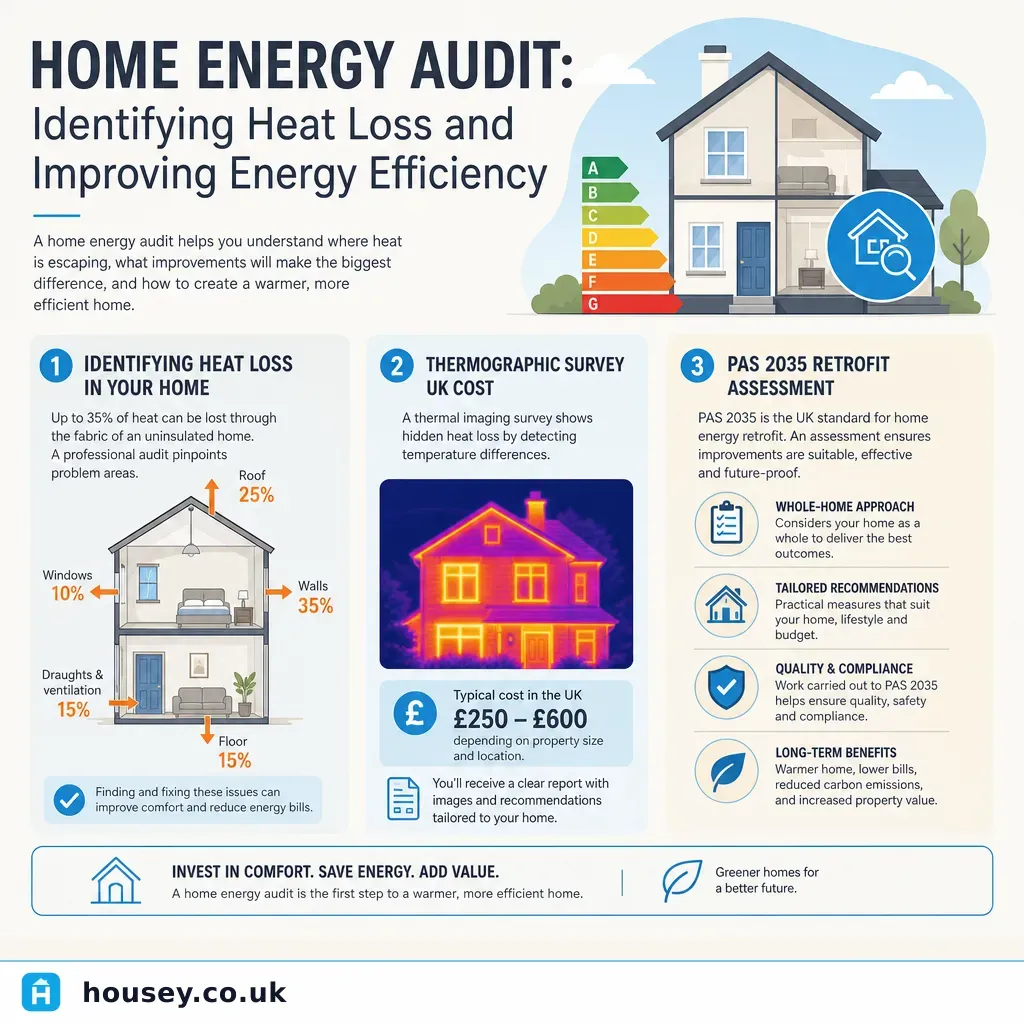
Home Energy Audit: Identifying Heat Loss and Improving Energy Efficiency
When energy bills rise or a property feels persistently cold in winter, a home energy audit is often the logical next step. Homeowners in older UK properties — Victorian terraces, 1930s semis, solid-wall cottages — frequently discover that significant heat is escaping through walls, roofs, and gaps invisible to the naked eye. Understanding where and how heat leaves your home gives you a clear basis for prioritising improvements and accessing grant funding where it is available.
Key points
- A standard Energy Performance Certificate (EPC) rates your home's energy efficiency on a scale of A to G but does not locate specific heat loss pathways within the building fabric.
- PAS 2035 retrofit assessments are a legal requirement before installing insulation or low-carbon heating measures funded through schemes such as ECO4 or the Great British Insulation Scheme.
- Thermographic (infrared) surveys can reveal cold bridges, insulation defects, and air infiltration points that are invisible during a standard visual inspection.
- The Energy Saving Trust notes that uninsulated solid walls are among the largest single sources of heat loss in pre-1920 homes built with solid brick or stone construction.
- Homes rated EPC D or below may qualify for government-funded retrofit support under ECO4 — check eligibility via GOV.UK or your energy supplier before commissioning any works.
What is a home energy audit?
A home energy audit is a structured assessment of how well your property retains heat and uses energy. The scope varies considerably depending on what you need.
Basic desktop audit: Reviews your EPC, energy bills, and building age to identify likely weak points. Often provided by energy advisers or utility companies at little or no cost — a useful starting point before booking tradespeople.
Whole-house assessment: A qualified energy assessor visits your property, inspects insulation, heating systems, windows, and ventilation, and produces a costed report with prioritised recommendations.
PAS 2035 retrofit assessment: A more rigorous process required before publicly funded retrofit measures can be installed. Carried out by a qualified Retrofit Assessor, it feeds into a Retrofit Coordinator's whole-house improvement plan and is a prerequisite for most grant schemes.
Thermographic survey: Uses an infrared camera to map surface temperatures and identify cold spots, air leakage points, and areas where insulation is absent or damaged. Most effective during cold weather with a temperature differential of at least 10°C between inside and outside.
Where does heat escape from a typical UK home?
Area | Likely contribution to heat loss | Common solution |
|---|---|---|
Uninsulated solid walls | High — particularly in pre-1920 homes | External or internal wall insulation |
Poorly insulated loft | High | Loft insulation (minimum 270mm mineral wool) |
Windows and doors | Moderate | Double or triple glazing, draught sealing |
Suspended timber floor | Moderate | Underfloor insulation or draught-proofing |
Air infiltration (gaps, service penetrations) | Moderate | Airtightness measures, draught-proofing strips |
Thermal bridges (lintels, window reveals) | Lower but persistent | External insulation or careful detailing |
Indicative guidance, last reviewed 2026-05-24. Actual heat loss depends on property type, condition, and occupancy.
Which audit type should you choose?
- Choose a basic desktop review if you want a no-cost starting point — your EPC and bills together can highlight obvious priorities.
- Choose a whole-house assessment if you are planning a sequence of improvements and want costed recommendations from a qualified assessor.
- Choose a PAS 2035 retrofit assessment if you are applying for ECO4, the Great British Insulation Scheme, or the Boiler Upgrade Scheme — most funded schemes require this as a legal prerequisite.
- Choose a thermographic survey if you suspect hidden insulation defects, want to verify the quality of recently installed insulation, or are buying a property and want more building-performance detail than a standard RICS survey provides.
- Ask a Retrofit Coordinator if your home has solid walls, complex construction, or existing damp — these properties carry a higher moisture risk from poorly designed insulation and need specialist oversight.
How to prepare for a professional energy audit
A well-prepared homeowner gets more useful output from an audit. Gather the following before the assessor arrives:
- Your most recent EPC (check the EPC Register on GOV.UK — all certificates are publicly searchable by address).
- Twelve months of gas and electricity bills, or smart-meter data if available.
- Records of any building work — loft conversions, extension planning permissions, window installation FENSA certificates.
- Details of any insulation already installed, including the product, depth, and installer if known (cavity wall, loft, underfloor).
- Notes on rooms that feel noticeably cold, any condensation or mould problems, and where draughts are felt.
What a thorough audit report should include
A reliable energy audit report typically covers:
- Your current EPC rating and an estimated post-improvement rating.
- Priority measures ranked by cost-effectiveness.
- Indicative costs and expected savings for each recommended measure.
- Eligibility for available grants or funded schemes.
- Risks and sequencing considerations — improving airtightness before addressing ventilation can worsen moisture problems in some properties, and a good report will flag this.
If a report does not mention ventilation risks alongside airtightness improvements, treat that as a red flag. Seek a second opinion from a PAS 2035-qualified assessor before proceeding with any significant works.
When to get professional help
Most homeowners should involve a qualified professional for anything beyond a basic desktop review. Seek expert help if:
- Your home has solid walls and you are considering insulation — moisture risk and detailing complexity require professional assessment under PAS 2035.
- You have received a heat pump quote and want to confirm your building fabric is suitable before committing.
- You are applying for any government-funded grant scheme — PAS 2035 compliance is a legal requirement, not an optional step.
- Your home has persistent damp, condensation, or mould — these issues can worsen significantly with poorly specified insulation.
- You want to verify that recently installed insulation has been fitted correctly and is performing as expected.
How Housey can help
Housey connects you with qualified energy-efficiency consultants who can assess your home and recommend a sequenced improvement plan. Where a visual inspection is not enough, thermographic survey specialists use infrared imaging to pinpoint exactly where heat is escaping — giving you evidence-based priorities rather than guesswork.
Frequently asked questions
How much does a home energy audit cost in the UK?
Costs vary by scope. A basic energy advice session may be free through your energy supplier or local authority. A full whole-house assessment by a qualified assessor typically costs between £200 and £500. A thermographic survey usually costs £150 to £400 depending on property size. PAS 2035 retrofit assessments are often funded as part of a grant scheme. Indicative UK costs, last reviewed 2026-05-24.
Do I need a PAS 2035 assessment to get ECO4 funding?
Yes. ECO4 requires all measures to be designed and overseen under the PAS 2035 framework, meaning a Retrofit Assessment and a Retrofit Coordinator must be involved. Your energy supplier or local authority can help arrange this as part of the application process. Without it, grant-funded installation cannot legally proceed.
Can I do an energy audit myself?
You can carry out a useful initial check — reviewing your EPC, feeling for draughts, checking loft insulation depth, and noting cold rooms — but a professional audit provides far more detail and is a requirement for grant-funded schemes. A thermographic survey in particular requires calibrated equipment and training to interpret results correctly.
What is the difference between an EPC and an energy audit?
An EPC is a standardised rating document produced using a software model (SAP or RdSAP), required when a property is sold or let. An energy audit is a broader assessment that may include a physical inspection, thermographic imaging, and specific recommendations for your property. An EPC states the rating; an audit explains why and what to do about it.
Sources and further reading
- Energy Performance Certificates — GOV.UK
- ECO4 scheme guidance — GOV.UK
- PAS 2035 retrofit framework — TrustMark
- Insulation and heat loss guidance — Energy Saving Trust
- Great British Insulation Scheme — GOV.UK
Useful next reads
 Energy & Retrofit
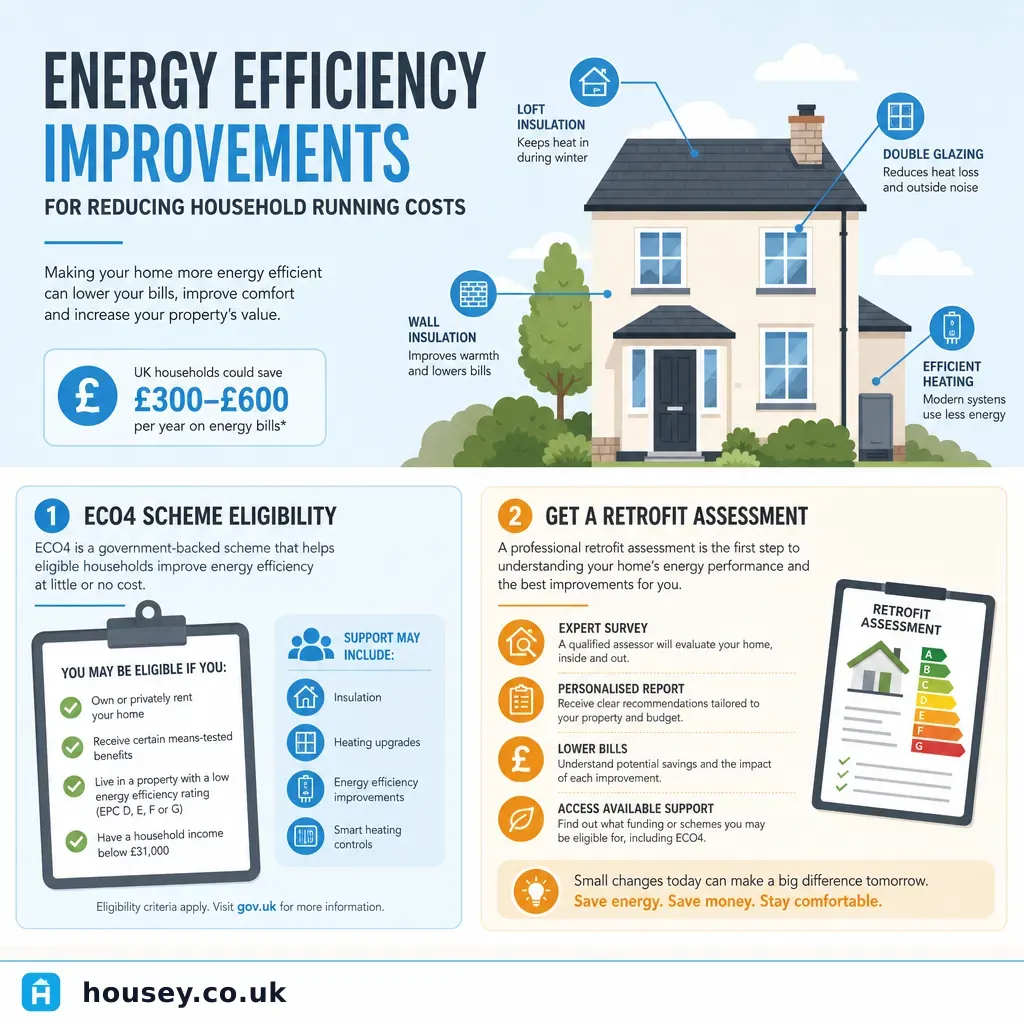
Energy Efficiency Improvements for Reducing Household Running Costs
Reducing household running costs usually starts with draught-proofing and loft insulation — the measures with the best savings-to-cost ratio.
 Energy & Retrofit
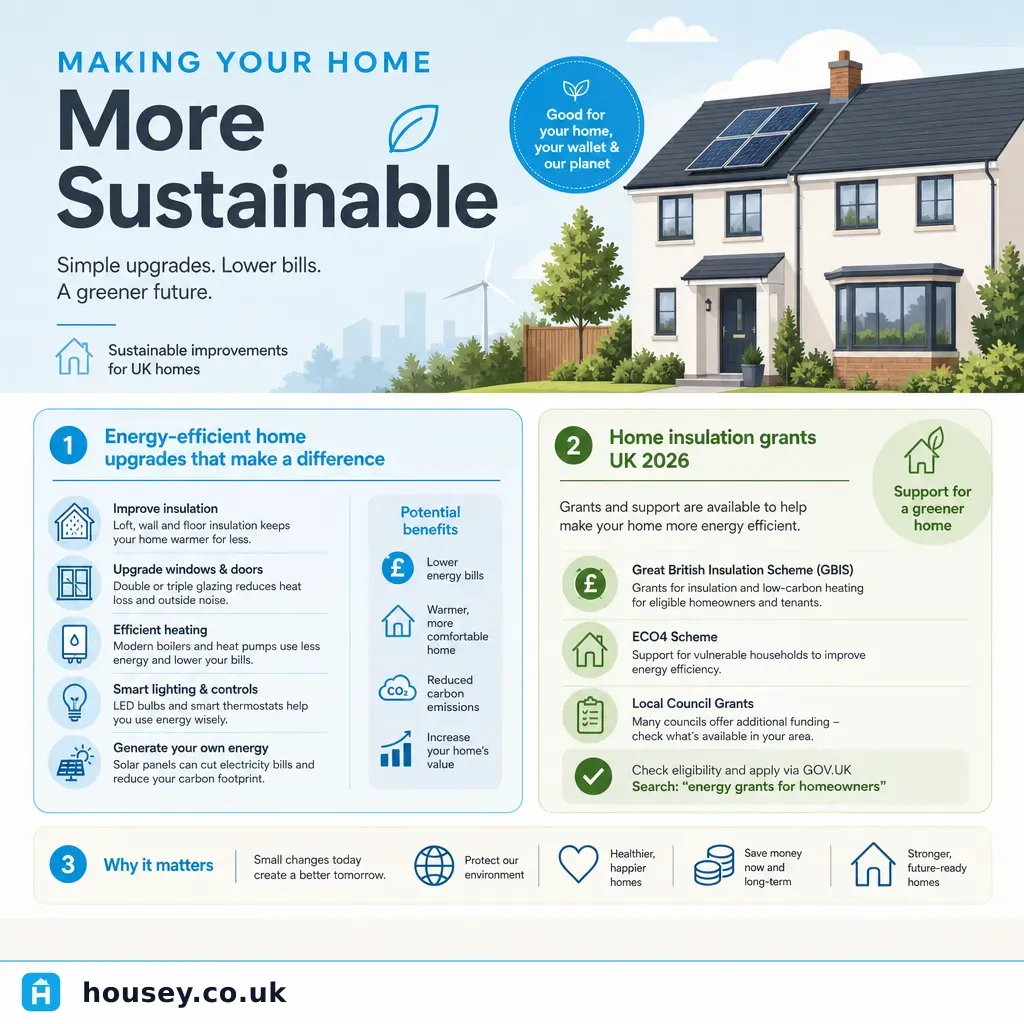
Making your home more sustainable
Making a UK home more sustainable usually starts with fabric-first improvements such as insulation, draught-proofing, and efficient glazing before adding renewable energy systems like solar panels or a heat pump.
 Energy & Retrofit
Solar window film: enhancing thermal performance and energy efficiency
Solar window film is a thin laminate applied to glass that reduces solar heat gain by 30–80% depending on specification.
 Energy & Retrofit
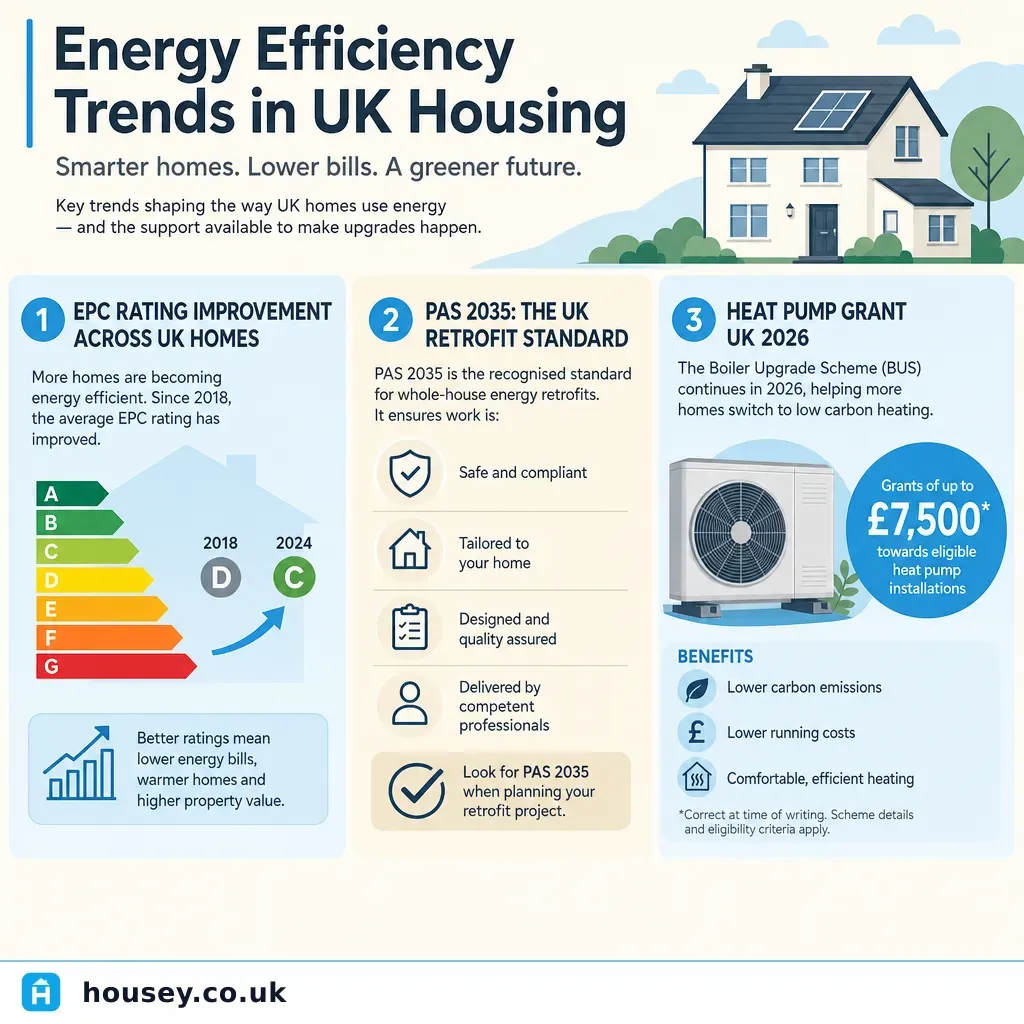
Energy Efficiency Trends in UK Housing
UK housing faces significant pressure to improve energy performance ahead of the 2050 net-zero target, with around 55% of English homes currently rated EPC D or below.
 Energy & Retrofit
Designing and Building High-Performance Sustainable Homes with Eco-Friendly Systems
High-performance sustainable homes in the UK follow a fabric-first approach: maximise insulation and airtightness before adding low-carbon heating such as heat pumps, then layer in renewables like solar PV.