Understanding Local Property Values: What Homes Sold For in Your Area
By Housey · Last reviewed 10th of May 2026
Understanding Local Property Values: What Homes Sold For in Your Area
Knowing what properties have actually sold for — not what they were listed at — is one of the most useful inputs when buying, selling, or simply tracking what your home might be worth. Sold price data in the UK is a matter of public record, held by HM Land Registry in England and Wales, Registers of Scotland, and Land and Property Services in Northern Ireland. Knowing how to access, read, and apply that data to a specific street or neighbourhood takes care and context.
Key points
- HM Land Registry publishes the Price Paid Dataset for England and Wales — a record of every residential property transaction since 1995, updated monthly and freely searchable at gov.uk/search-house-prices.
- Sold prices reflect the completion date, not the date of offer acceptance — a recently published completion may relate to an offer accepted three to six months earlier, in a different market.
- The Land Registry dataset distinguishes between freehold and leasehold transactions, and between new-build and established properties — comparisons across these categories are frequently misleading.
- In Scotland, transaction records are held by Registers of Scotland; in Northern Ireland, by Land and Property Services.
- Portal estimates such as Zoopla's Zed-Index are algorithmic and should be treated as indicative only — they can diverge significantly from actual market value, particularly for unusual or mixed-tenure properties.
Where to find UK sold price data
The most authoritative starting point for England and Wales is the HM Land Registry Price Paid Data, which allows you to search by postcode and view individual transaction records. It is updated monthly, though there is typically a lag of six to eight weeks between completion and publication.
Nation | Data source | Where to search |
|---|---|---|
England and Wales | HM Land Registry Price Paid Data | gov.uk/search-house-prices |
Scotland | Registers of Scotland | ros.gov.uk |
Northern Ireland | Land and Property Services | nidirect.gov.uk/articles/house-price-index |
Portal sites including Rightmove, Zoopla, and OnTheMarket also display sold price histories for individual properties and streets, drawing from Land Registry data. These are convenient but are not updated in real time and may occasionally show incomplete or lagged records.
How to read and compare sold price data
Raw sold price data is useful but requires careful interpretation.
Check the transaction type. The Land Registry dataset distinguishes freehold from leasehold, and new-build from established properties. A leasehold flat and a freehold terrace are not directly comparable even on the same street. New-build properties often carry a premium at point of sale that does not necessarily persist, so using a new-build sale as a comparable for an established property can distort your analysis significantly.
Account for timing. A sale that completed in January 2024 likely reflects an offer accepted in September or October 2023. If the market has moved materially in the intervening period, the figure needs to be read in that context.
Consider property specifics. Two houses on the same street can have materially different values based on size, condition, garden orientation, extension history, and parking provision. Sold price data shows what a buyer paid for a specific property — not a standardised price per square metre.
Look at volume, not just price. A single high or low sale in a small postcode can skew any average. Look for a cluster of recent transactions to identify a reliable trend.
Why sold prices vary within the same street
Buyers sometimes find that two apparently similar houses on the same street sold for very different amounts. Common reasons include:
- Condition and presentation: A recently refurbished property will typically achieve a higher price than one needing significant work, even with identical square footage.
- Tenure and lease length: A leasehold flat with 75 years remaining will sell for less than an otherwise identical flat with 150 years remaining, because short leases create difficulties with mortgage lending and significant future extension costs.
- Buyer circumstances: Cash buyers or those in a chain-free position may pay a modest premium to secure a property quickly in a competitive market.
- Date of sale: A house that sold in summer 2022 near the peak of post-pandemic demand may have achieved significantly more than an equivalent property sold in late 2023 as mortgage rates peaked.
Worked UK property scenario
A buyer is considering a three-bedroom semi-detached house in a suburb of Sheffield. Land Registry records show four similar semis on the same street sold in the past 18 months: one at £220,000 (new-build, 2023), one at £185,000 (leasehold flat, January 2024), one at £195,000 (freehold, extended, March 2024), and one at £200,000 (freehold, unextended, August 2024). The target property is freehold and unextended. Setting aside the new-build and the leasehold flat as unsuitable comparables, the two relevant freehold established transactions sit at £195,000 to £200,000 — a useful starting range before accounting for the specific condition of the subject property.
Tools for researching local property values
Tool | What it shows | Best for | Limitation |
|---|---|---|---|
HM Land Registry Price Paid Data | Individual transactions, England and Wales, from 1995 | Verifying actual sold prices | 6–8 week lag; no condition or specification data |
Registers of Scotland | Individual transaction records, Scotland | Scottish properties | Different data fields to England and Wales |
Rightmove sold prices | Street-level histories with listing photos | Quick visual research by address | Relies on Land Registry feed; not real-time |
Zoopla Zed-Index | Automated valuation model | Approximate area-level sense-check | Can be materially inaccurate for individual properties |
ONS UK House Price Index | Monthly index by local authority | Understanding local authority trends | Area averages only; several weeks lag |
Nationwide and Halifax indices | Quarterly national and regional averages | Tracking broad market direction | Not property-specific |
Homeowner checklist: researching local sold prices before a transaction
Use this checklist whether you are buying, selling, or preparing to instruct a valuer:
Important limitations
This article provides general guidance on how to find and interpret publicly available sold price data. It does not constitute a property valuation and should not be used as a substitute for a formal assessment by a qualified professional. Property values depend on factors — including condition, legal title, planning history, flood risk, and structural integrity — that are not visible in transaction records alone. For mortgage, probate, legal, or insurance purposes, a formal RICS valuation will be required.
Automated valuation models used by portals and some lenders have known accuracy limitations, particularly for unusual properties, leasehold flats with short leases, listed buildings, and properties in thin rural markets. Treat AVM figures as a starting point only, not as a reliable basis for significant financial decisions.
What to ask a qualified professional
If you are instructing a RICS-regulated surveyor or valuer, useful questions include:
- What comparable evidence are you drawing on, and how recent is it?
- Are any of the comparables new-build or non-standard transactions?
- How does the subject property's condition affect its value relative to comparables?
- What is the current direction of values in this postcode — rising, stable, or falling?
- Is this a RICS Red Book valuation, and if not, on what basis is it prepared?
- How long is the valuation valid for, and what circumstances might cause it to change?
When to get professional help
Sold price research is a useful starting point, but a formal valuation from a RICS-regulated valuer is needed for:
- Mortgage applications — lenders require a valuation conducted by an approved panel valuer.
- Probate and inheritance tax — HMRC may require a Red Book valuation at the date of death.
- Matrimonial proceedings — courts typically require formal RICS valuations from each party.
- Lease extension negotiations — the premium calculation depends on formal valuations by both the freeholder's and leaseholder's valuers.
- Significant purchases where the property is unusual, mixed-tenure, or sits in a market with few comparable sales.
If sold prices in your target area are highly variable or comparable sales are scarce, that is a clear signal to seek professional input rather than rely on self-research alone.
How Housey can help
If you need a formal view of what a property is worth, Housey can help you request quotes from RICS-regulated professionals. A valuation survey gives you a professional opinion for mortgage, probate, or purchase purposes, while a RICS Home Survey combines a thorough condition assessment with broader context on the property's value and any issues that might affect it.
Frequently asked questions
How accurate is HM Land Registry sold price data?
The Price Paid Dataset accurately records the consideration paid on completion. It does not capture conditions of sale, non-monetary arrangements, or factors such as the property's condition or specification. It is reliable as a record of what was paid, but interpreting that figure in relation to a specific property you are buying or selling requires additional professional judgement.
How long does it take for a sale to appear on Land Registry?
Typically six to eight weeks after completion, though complex transactions can take longer. If you are searching for a very recent sale, it may not yet be registered. Rightmove and Zoopla update from the same Land Registry feed and will show the same lag.
Can I use sold price data to challenge a RICS valuation?
You can raise specific comparable evidence with a surveyor, but the surveyor is responsible for exercising their professional judgement and applying it to the subject property. If you believe a RICS Red Book valuation is materially incorrect, you can raise a formal complaint through RICS's dispute resolution service. Self-researched sold price data is useful context but is not a substitute for professional assessment.
Is asking price a reliable guide to property value?
No. Asking prices represent the seller's starting position, not the market's assessment of value. In active markets, some properties sell above the asking price; in cooler markets, substantial reductions are common. Always use actual completed sold prices as your primary reference, rather than current listings or automated portal estimates.
Where can I find sold prices for Scottish properties?
Registers of Scotland publishes transaction data at ros.gov.uk. The Scottish House Price Index is published monthly by Registers of Scotland and the Scottish Government. Rightmove and Zoopla also display Scottish sold prices drawing from the same source, though they may not update in real time.
Sources and further reading
- HM Land Registry Price Paid Data — GOV.UK
- ONS UK House Price Index — Office for National Statistics
- Registers of Scotland House Price Statistics — Registers of Scotland
- RICS Valuation Global Standards (Red Book) — RICS
- Land and Property Services House Price Index — nidirect (Northern Ireland)
Useful next reads
 Buying & Moving
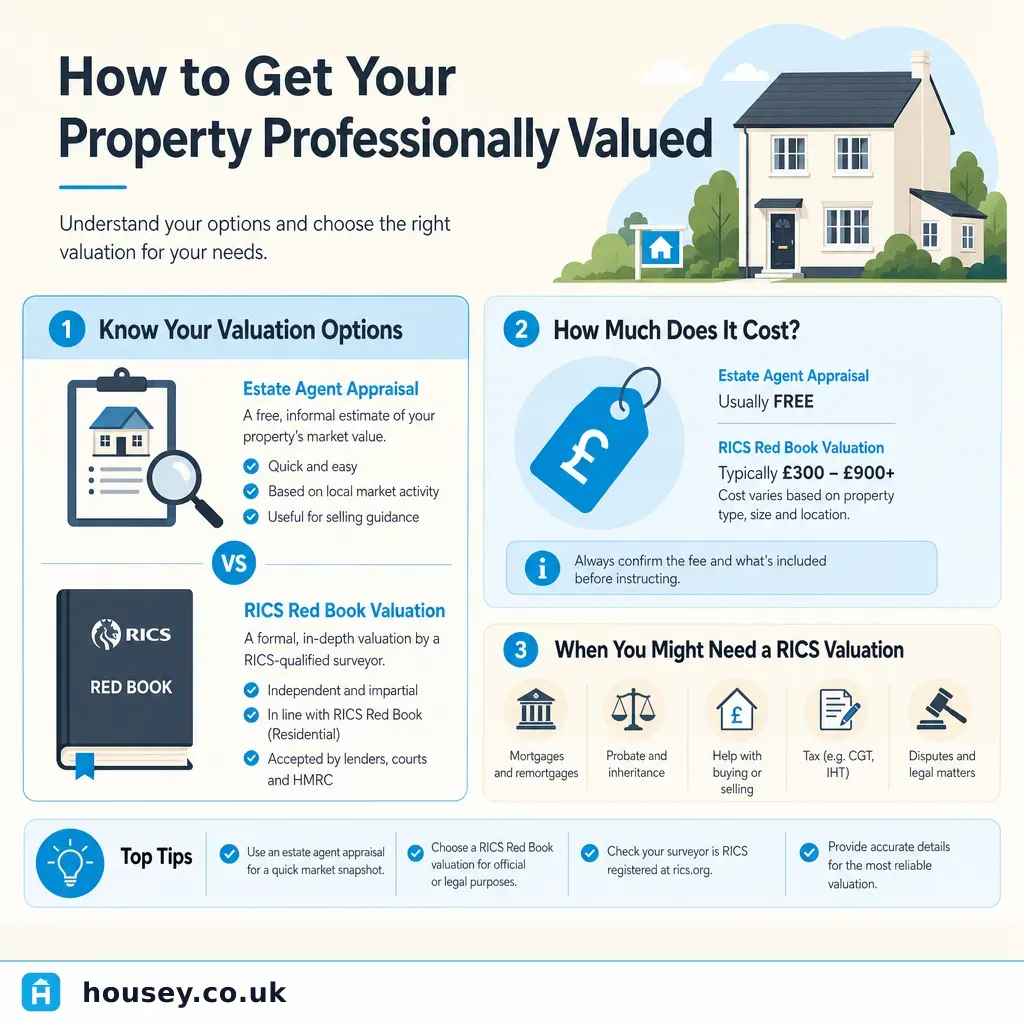
How to Get Your Property Professionally Valued
To get a professional property valuation in the UK, instruct a RICS Registered Valuer for any formal purpose — mortgage, probate, Help to Buy, or legal proceedings.
 Buying & Moving
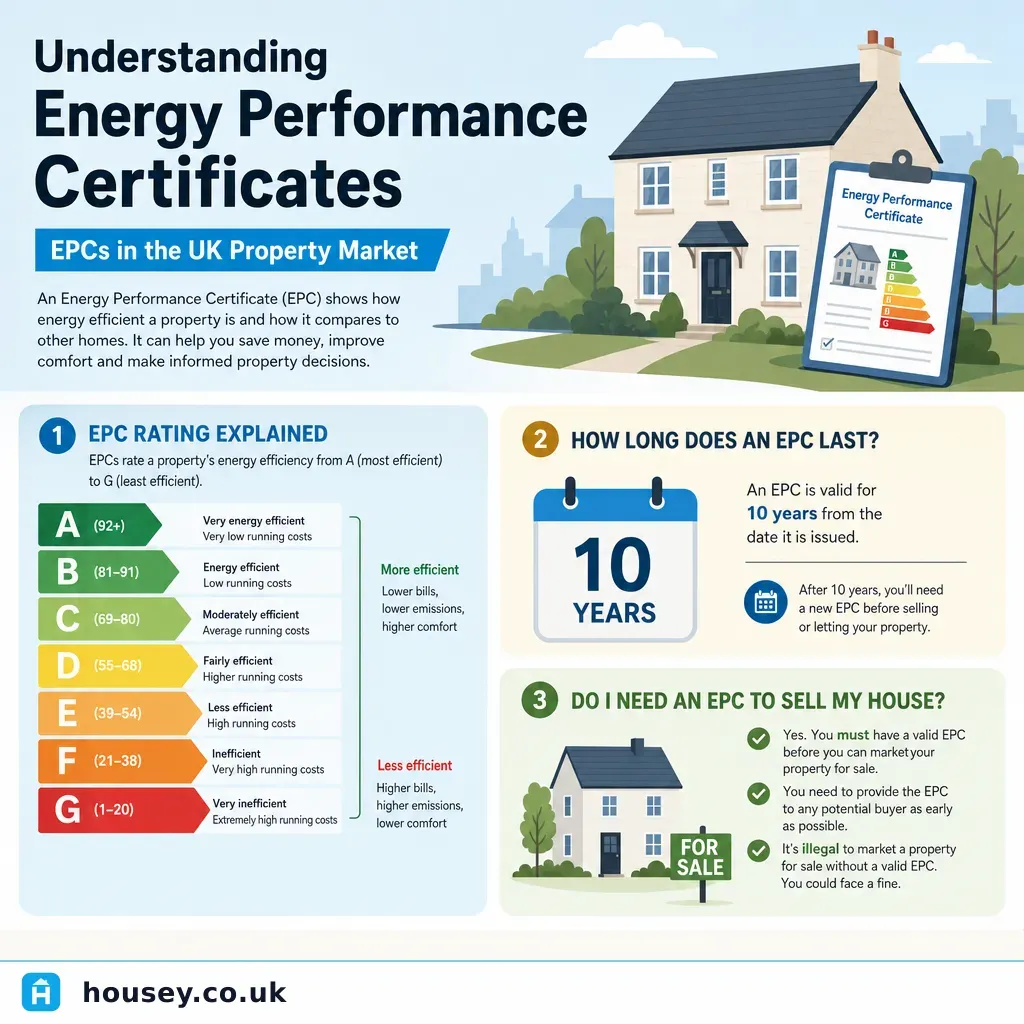
Understanding Energy Performance Certificates: EPCs in the UK Property Market
An Energy Performance Certificate (EPC) rates a property's energy efficiency on a scale from A (most efficient) to G (least efficient).
 Buying & Moving
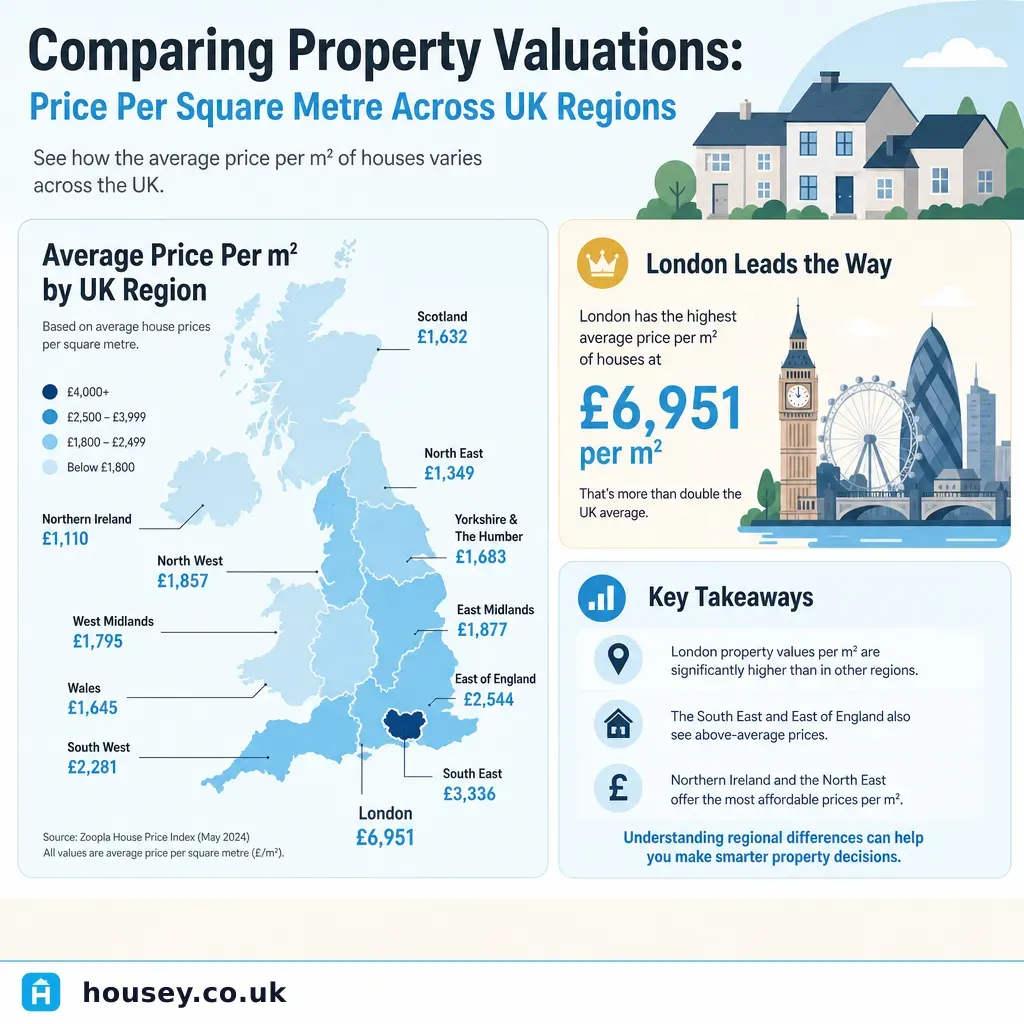
Comparing Property Valuations: Price Per Square Metre Across UK Regions
Property prices per square metre vary dramatically across UK regions.
 Buying & Moving
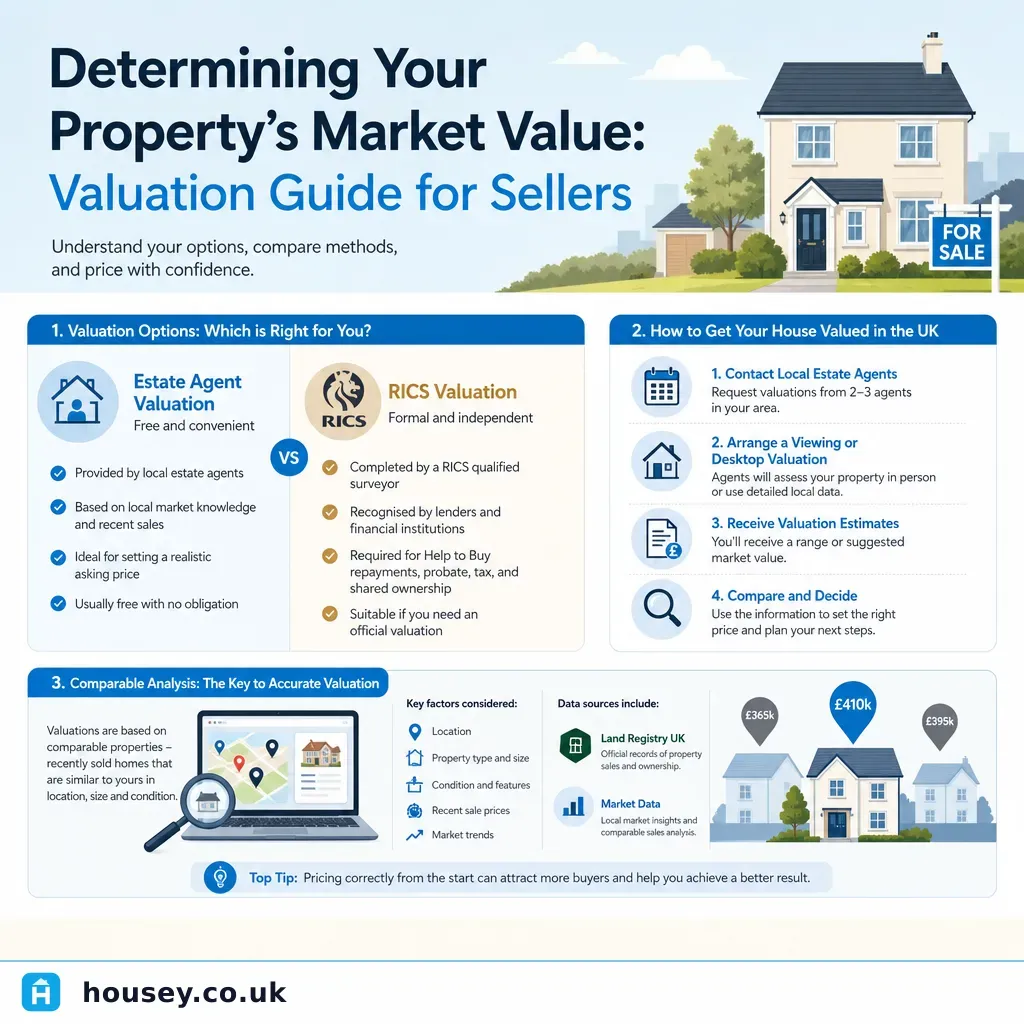
Determining Your Property's Market Value: Valuation Guide for Sellers
Market value in the UK is most reliably established by combining estate agent appraisals with your own analysis of recent sold prices on the HM Land Registry database.
 Buying & Moving
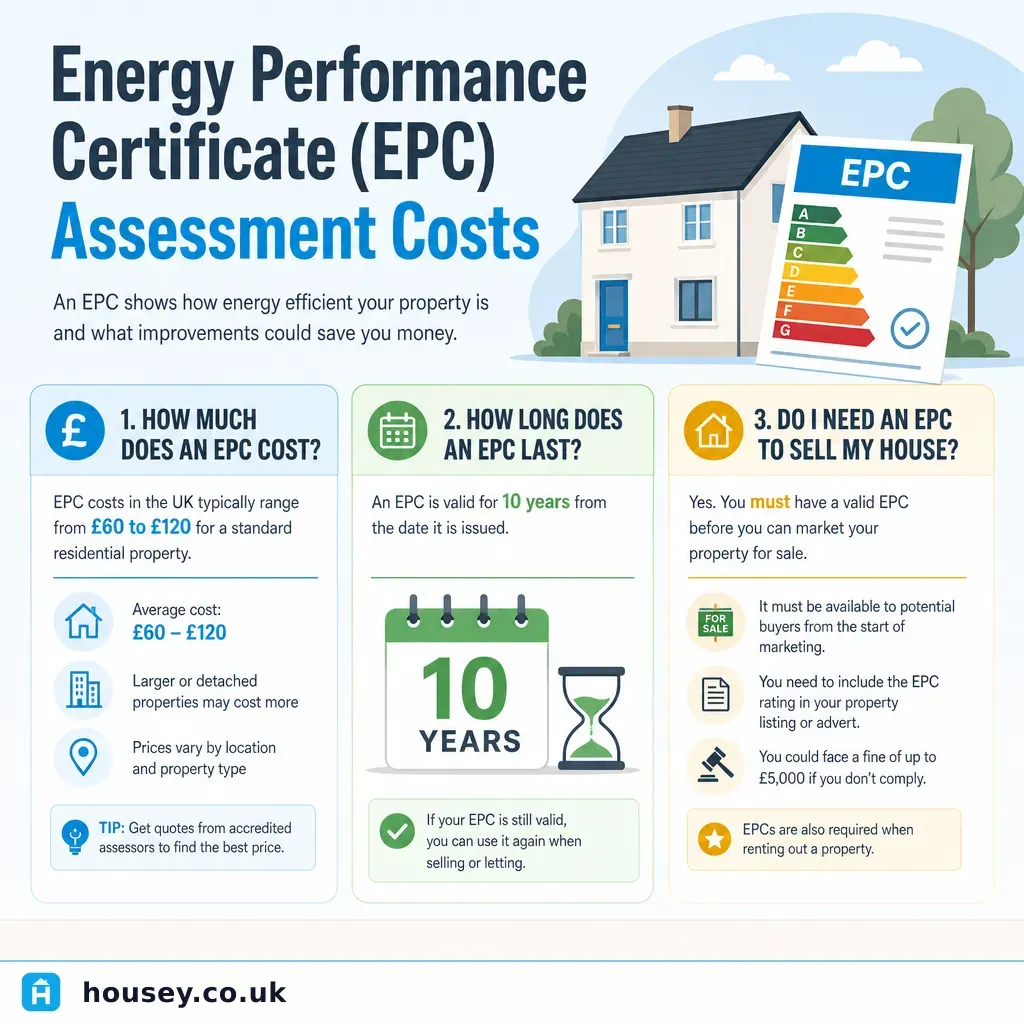
Energy Performance Certificate (EPC) Assessment Costs
An EPC typically costs between £60 and £120 for a standard UK home, though prices vary by property size and assessor.