Enhancing Fire Safety in Your Property: Essential Steps and Compliance
By Housey · Last reviewed 24th of May 2026
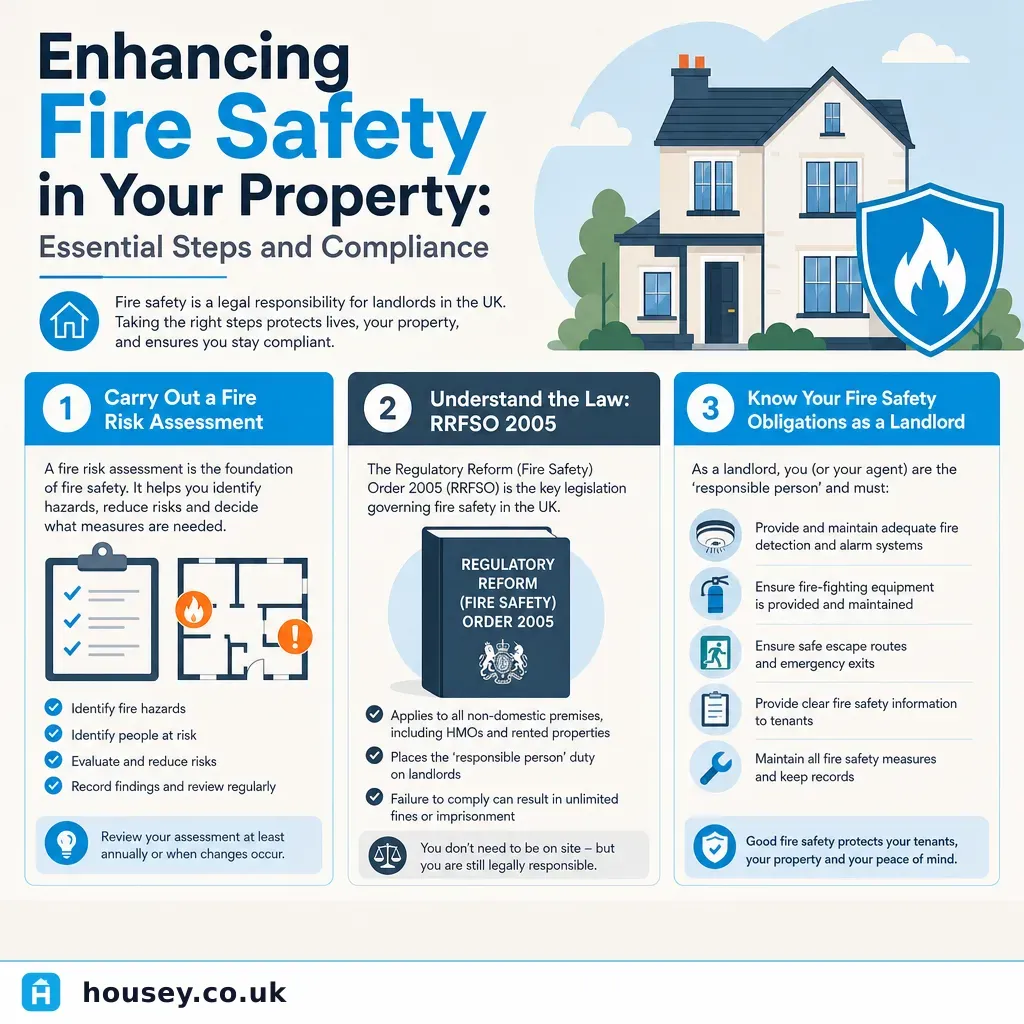
Enhancing Fire Safety in Your Property: Essential Steps and Compliance
Fire safety requirements for UK properties have been significantly strengthened following the Grenfell Tower disaster in 2017 and the subsequent Building Safety Act 2022. Whether you own a single dwelling, let out a property, or act as a responsible person for a block of flats or house in multiple occupation (HMO), understanding your legal duties and taking measured steps to reduce fire risk is both a statutory obligation and a matter of life safety. The rules that apply depend on the building type, its occupation, its height, and whether it falls under the Regulatory Reform (Fire Safety) Order 2005.
Key points
- The Regulatory Reform (Fire Safety) Order 2005 (RRO) requires a written fire risk assessment for all non-domestic premises and the common areas of multi-occupied residential buildings, including purpose-built flats and HMOs — to be carried out by a competent person and reviewed regularly.
- Building Regulations Approved Document B (Fire Safety) sets minimum standards for new construction and material alterations, covering means of escape, compartmentation, structural fire resistance, surface finishes, and smoke alarm installation.
- The Building Safety Act 2022 introduced a higher-risk building regime for residential buildings over 18 m tall or 7 or more storeys: such buildings must be registered with the Building Safety Regulator (operated by HSE) and responsible persons must maintain an ongoing safety case.
- Since October 2022, landlords in England must fit at least one smoke alarm on every storey and a carbon monoxide alarm in every room with a fixed combustion appliance (other than a gas cooker), under the Smoke and Carbon Monoxide Alarm (Amendment) Regulations 2022.
- Fire doors in common areas of multi-occupied residential buildings must achieve FD30S standard (30 minutes' fire integrity plus smoke control); since January 2023, responsible persons for buildings over 11 m must carry out quarterly checks of flat entrance doors and annual checks of all fire doors in common areas.
Who is the responsible person under the Fire Safety Order?
The Regulatory Reform (Fire Safety) Order 2005 places duties on the responsible person:
- In a workplace, this is the employer.
- In common areas of a multi-occupied residential building, this is the person who has control of the premises — typically the freeholder, managing agent, or right-to-manage (RTM) company.
- Where no other person has control, it is the owner.
In a leasehold flat building, individual leaseholders are not the responsible person for common areas — the freeholder or their managing agent carries that duty. Leaseholders remain responsible for fire safety within their own demised flat. Where there is any ambiguity, the Fire Safety Act 2021 clarified that the RRO applies to the building's structure, external walls, and flat entrance doors, not only common corridors and stairwells.
What does a fire risk assessment involve?
A fire risk assessment is a systematic evaluation of a premises to identify fire hazards, determine who is at risk, and establish whether existing precautions are adequate. For premises subject to the RRO, the assessment must be written if the employer has five or more employees, or if the premises are licensed or subject to an alterations notice. It must be reviewed regularly and whenever a significant change occurs.
A competent assessor for complex or higher-risk buildings should be registered with a recognised body such as the Institute of Fire Safety Managers (IFSM) or the Institution of Fire Engineers (IFE).
What a qualified fire risk assessor examines:
Area assessed | What is checked |
|---|---|
Means of escape | Evacuation routes, door widths, travel distances, directional signage |
Fire detection and warning | Type, coverage, condition, and testing of the alarm system |
Fire doors | Self-closing action, intumescent strips, smoke seals, frame integrity |
Compartmentation | Integrity of party walls, floors, and penetration fire-stops |
Firefighting equipment | Location, type, capacity, and servicing of extinguishers |
Hazardous materials | Flammable substance storage, electrical installation condition |
Sleeping risk | Additional precautions where occupants sleep on the premises |
Approved Document B: key requirements for building work
For any building work — including extensions, loft conversions, change of use, or material alterations — Approved Document B (Fire Safety) must be satisfied. Key requirements for dwellings include:
- Means of escape: every habitable room requires a direct or acceptable escape route. Inner rooms — accessible only through another room — require additional measures such as interlinked smoke alarms or a compliant escape window.
- Structural fire resistance: load-bearing elements, separating floors, and compartment walls must achieve minimum fire resistance periods, typically REI 30 for dwellings under three storeys.
- Smoke alarms: new dwellings and material alterations require mains-powered interlinked smoke alarms on each storey, with a heat alarm in the kitchen. Battery-only alarms do not meet the requirements for new construction or notifiable alterations.
- Surface finishes: wall and ceiling materials in escape routes must meet flame spread classification requirements (Class 1 or better).
- Sprinkler systems: mandatory for all new dwellings in Wales since 2016, and for new high-rise residential buildings in England.
Red flags: when fire safety may be compromised
The following signs warrant immediate professional assessment and should not be left unaddressed:
- Fire doors that do not self-close fully, have visible gaps greater than 3 mm at the frame, or lack intumescent strips or smoke seals.
- Cable or pipe penetrations through compartment walls or floors that have not been fire-stopped with appropriate intumescent materials.
- Escape routes — corridors, stairwells, or final exit doors — that are obstructed, locked, or reduced in width by stored items.
- No working fire detection or alarm system in an HMO or block of flats.
- Building works that have removed or altered fire compartmentation without building regulations approval.
- Cladding, external insulation, or render systems that have not been assessed for fire performance following post-Grenfell guidance.
- A fire risk assessment that is more than three years old and has not been reviewed since building alterations were carried out.
Important limitations
This article provides general information about fire safety law and Approved Document B requirements in England. Legislation changes regularly, and specific requirements for any building depend on its type, age, height, construction, occupation, and history. This article is not legal or professional safety advice. Fire risk management for any building with sleeping accommodation, any building subject to the RRO, or any higher-risk building must be carried out by a competent, qualified fire risk assessor. Do not rely on this guide in place of a professional assessment.
When this becomes urgent
Seek immediate professional help if:
- Escape routes in your rented property or building are consistently blocked or fire doors cannot close properly.
- You have received a notice or enforcement action from the fire and rescue service or local authority.
- Your building has cladding or external insulation that has not been assessed for fire performance.
- You are a responsible person for a multi-occupied building without a current, written fire risk assessment.
- You are planning building works that will affect compartmentation, fire doors, the structure, or the fire alarm system.
- You manage a higher-risk building over 18 m or 7 storeys and have not registered with the Building Safety Regulator.
What to ask a qualified professional
Before instructing a fire risk assessor or fire safety consultant:
- Are you registered with a recognised professional body such as IFSM, IFE, or IFPO?
- What type of fire risk assessment is appropriate for this building — and is a Type 1, 2, 3, or 4 assessment needed?
- What will the written report include, and how will action priorities be graded (critical, significant, or low)?
- Do you have experience with properties of this type, age, construction, and occupancy?
- What follow-up support is available if remedial works are needed following the assessment?
- Will the assessment and report satisfy the requirements of the Regulatory Reform (Fire Safety) Order 2005?
How Housey can help
Housey connects property owners, landlords, and responsible persons with qualified specialists offering fire risk assessments for residential and commercial buildings. For projects involving building works that affect fire safety provisions, building regulations drawings prepared by a specialist can demonstrate compliance with Approved Document B before work begins. Where past alterations may have affected the building fabric, a structural survey can help establish the current state of compartmentation and structural fire resistance before commissioning remedial works.
Frequently asked questions
Does the Regulatory Reform (Fire Safety) Order apply to a single private dwelling?
No. The Regulatory Reform (Fire Safety) Order 2005 does not apply to single private dwellings occupied by one household. However, Building Regulations Part B applies to any building work, and landlords have separate statutory duties under the Smoke and Carbon Monoxide Alarm Regulations. If a room is let to a lodger, or the property houses more than one household, different rules may apply and the RRO may become relevant to any common areas.
How often should a fire risk assessment be reviewed?
There is no fixed statutory review interval, but the guidance under the Regulatory Reform (Fire Safety) Order 2005 is clear: the assessment must be reviewed whenever there is reason to suspect it is no longer valid — after building alterations, a change of use, a significant change in occupancy, or a fire or near-miss. Responsible persons for most multi-occupied residential buildings review annually and commission a fresh assessment every three to five years or after material changes.
What is an FD30S fire door?
FD30S denotes a fire door achieving 30 minutes of fire integrity in standardised testing, with the S suffix indicating additional smoke control performance. FD30S is the standard required for fire doors in common areas of most multi-occupied residential buildings. Individual flat entrance doors in higher-risk buildings are also required to meet fire door standards under the Building Safety Act 2022 regime, and responsible persons must carry out regular checks of these doors.
What are a landlord's fire safety obligations for a rented property?
Private landlords in England must fit at least one working smoke alarm on every storey used as living accommodation, and a carbon monoxide alarm in every room with a fixed combustion appliance other than a gas cooker. Alarms must be tested at the start of each tenancy. For HMOs, additional requirements typically include a Grade D interlinked smoke alarm system, fire doors to habitable rooms, emergency lighting, and a written fire risk assessment. Local authorities enforce these requirements and can issue civil penalties for non-compliance.
Sources and further reading
- Regulatory Reform (Fire Safety) Order 2005 — legislation.gov.uk — legislation.gov.uk
- Fire safety in the home — GOV.UK — GOV.UK
- Building Safety Act 2022 — legislation.gov.uk — legislation.gov.uk
- Approved Document B: Fire Safety — GOV.UK — Ministry of Housing, Communities and Local Government
- Smoke and Carbon Monoxide Alarm (Amendment) Regulations 2022 — GOV.UK — GOV.UK
- Institute of Fire Safety Managers (IFSM) — IFSM
Useful next reads
 Surveys & Inspections
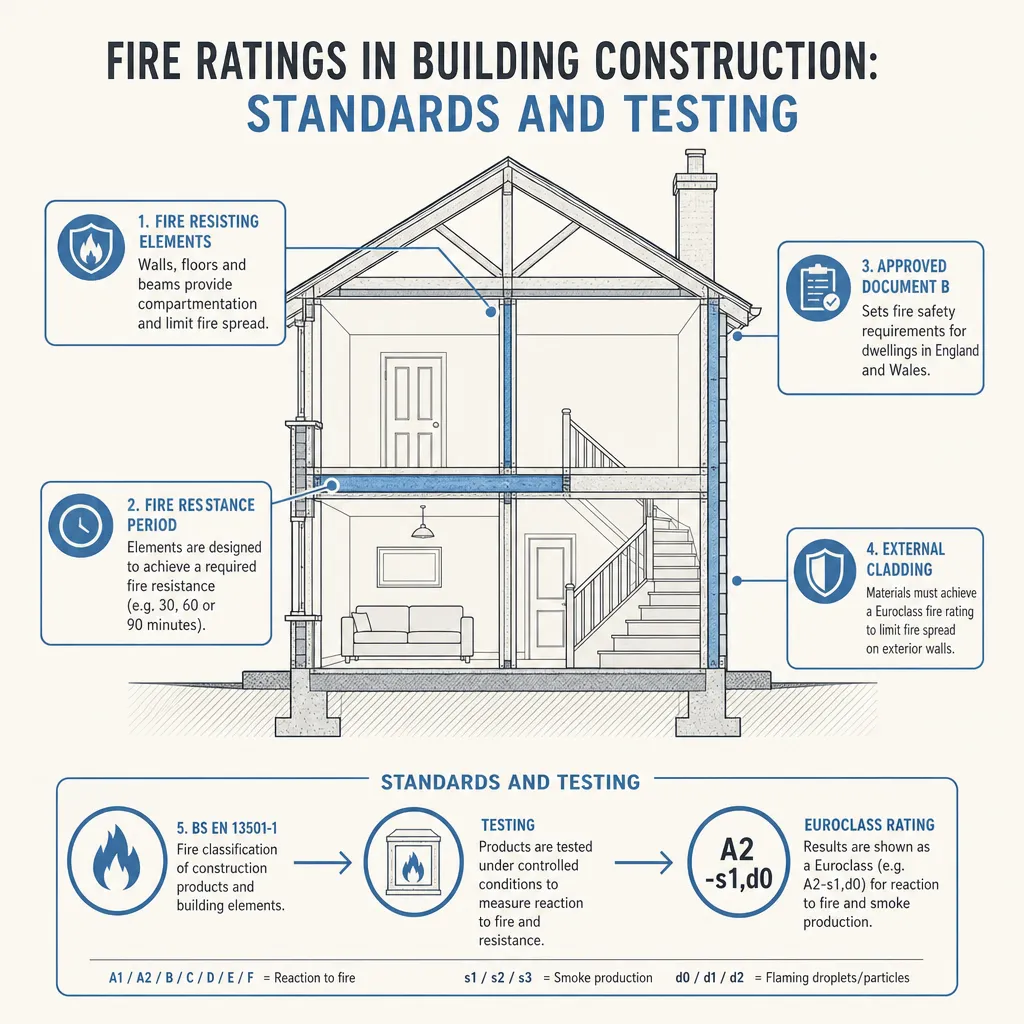
Fire Ratings in Building Construction: Standards and Testing
In UK construction, fire ratings describe how long a structural element or building assembly maintains load-bearing capacity, integrity, and insulation when exposed to a standard fire test — typically 30, 60, 90, or 120 minutes.
 Surveys & Inspections
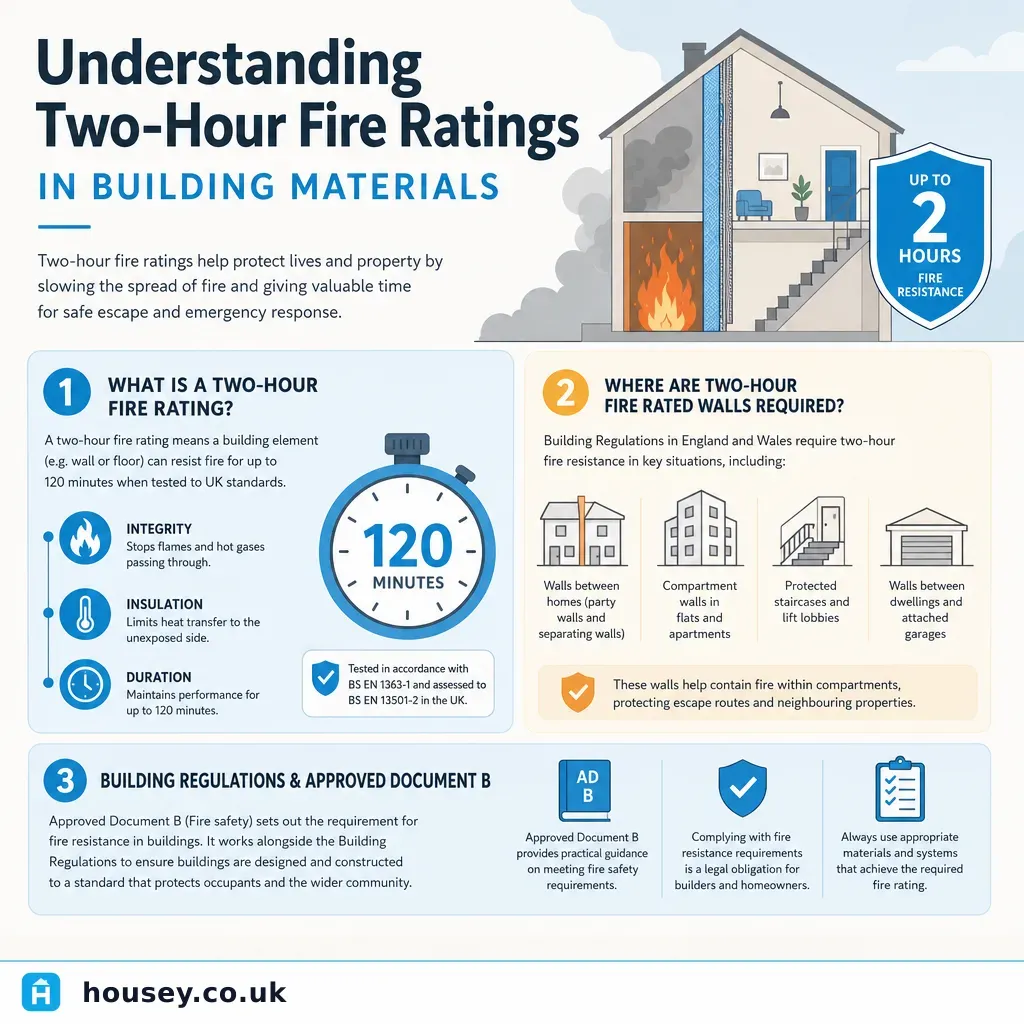
Understanding Two-Hour Fire Ratings in Building Materials
A two-hour fire rating — FR 120 or REI 120 — means a building element maintains loadbearing capacity, resists flame penetration, and limits heat transfer for 120 minutes under standardised test conditions to BS EN 13501-2.
 Surveys & Inspections
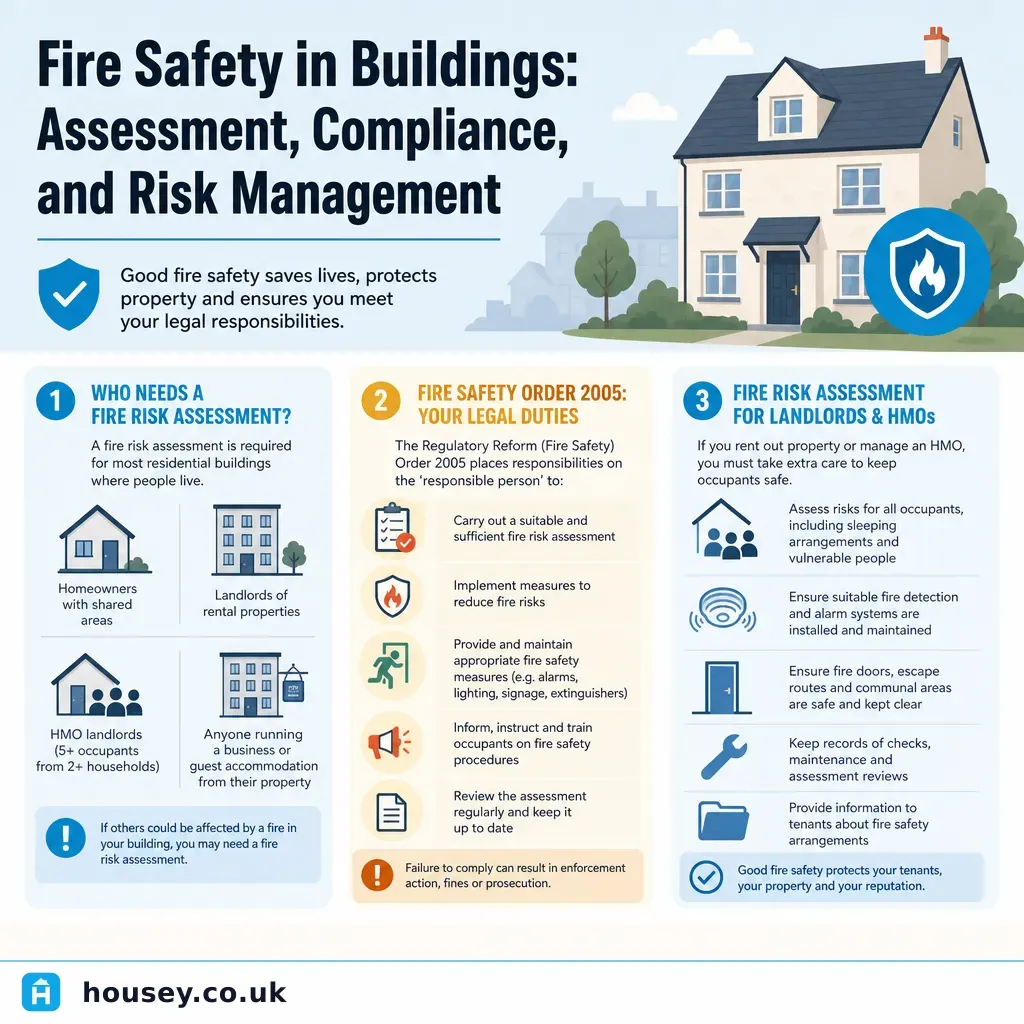
Fire Safety in Buildings: Assessment, Compliance, and Risk Management
The Regulatory Reform (Fire Safety) Order 2005 requires most non-domestic and multi-occupied residential buildings to have a written fire risk assessment carried out by a competent person.
 Surveys & Inspections
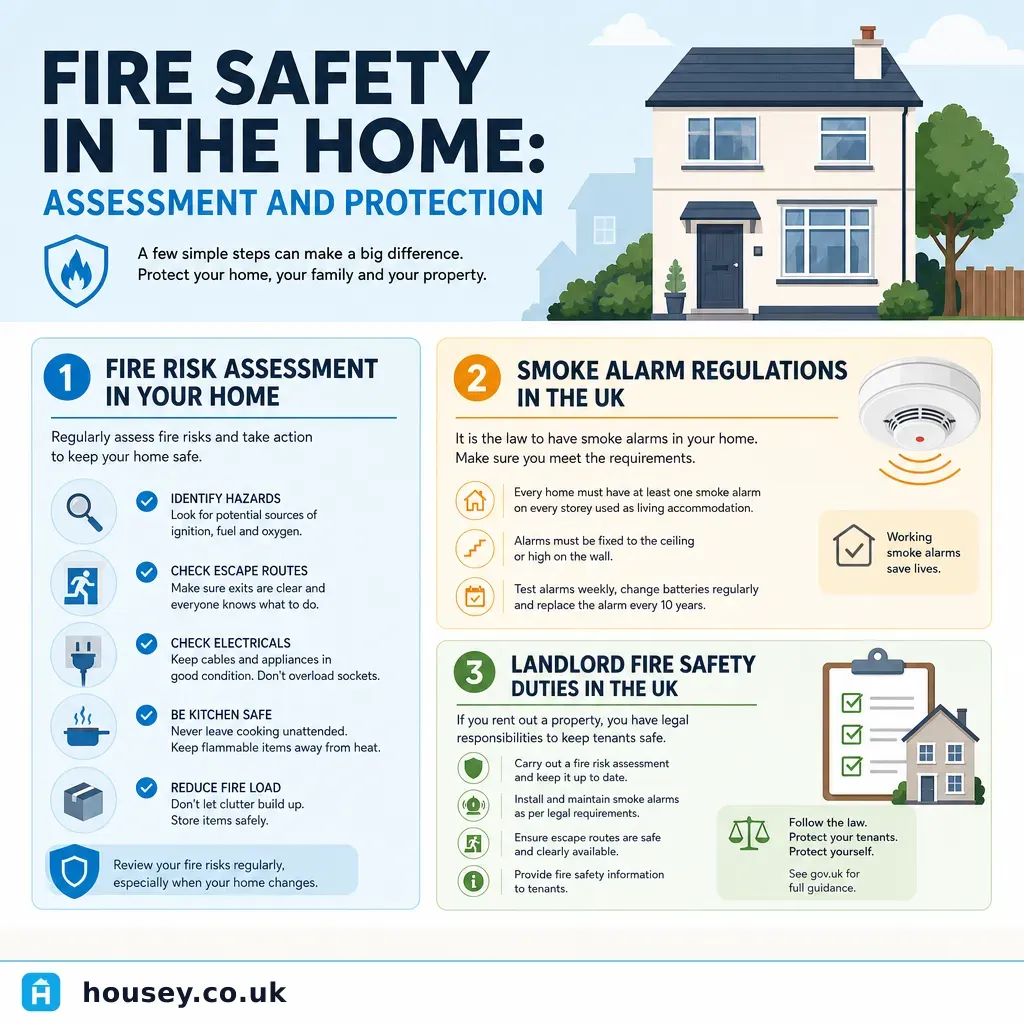
Fire Safety in the Home: Assessment and Protection
Most UK owner-occupied homes are the homeowner's responsibility to make fire-safe, while landlords have a legal duty to carry out fire risk assessments under the Regulatory Reform (Fire Safety) Order 2005.
 Surveys & Inspections
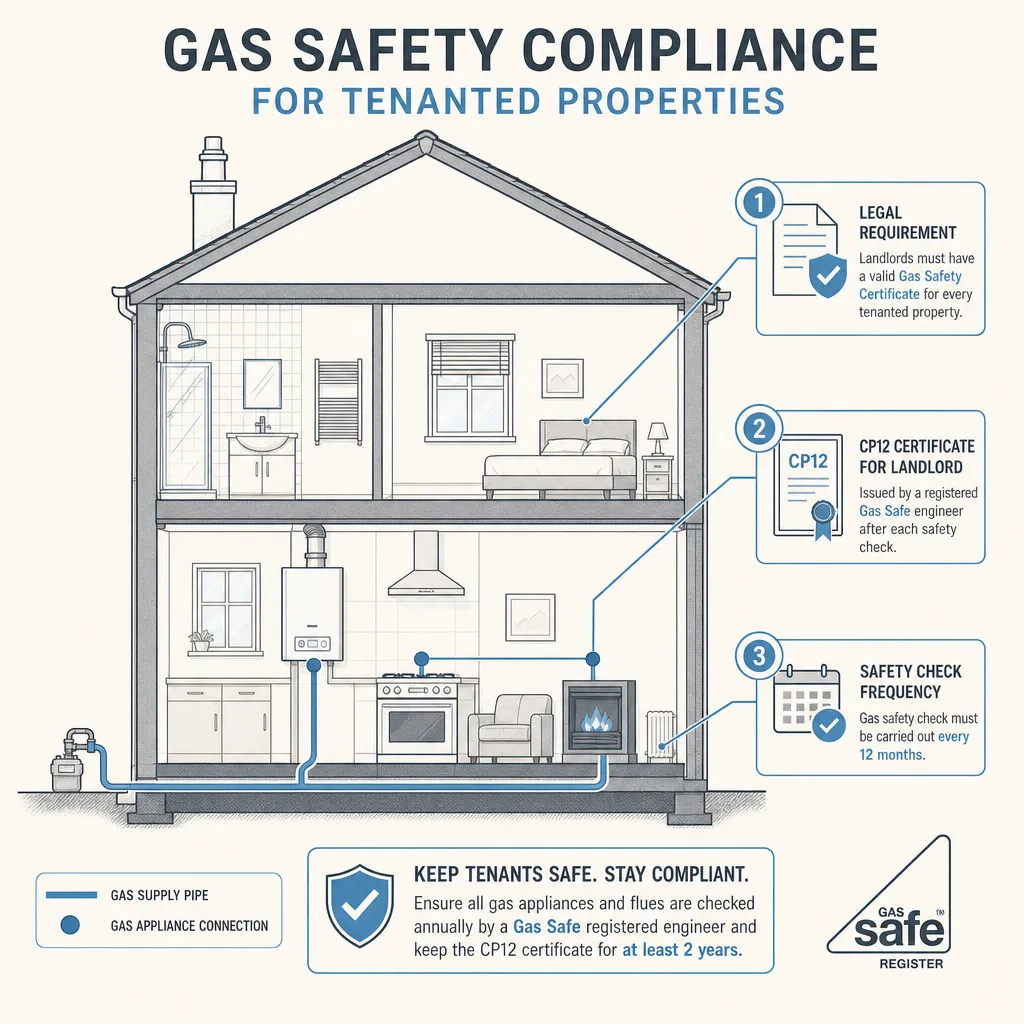
Gas Safety Compliance for Tenanted Properties
UK landlords are legally required to arrange an annual gas safety check by a Gas Safe registered engineer for every tenanted property with a gas appliance.