Fire Safety in Buildings: Assessment, Compliance, and Risk Management
By Housey · Last reviewed 19th of May 2026
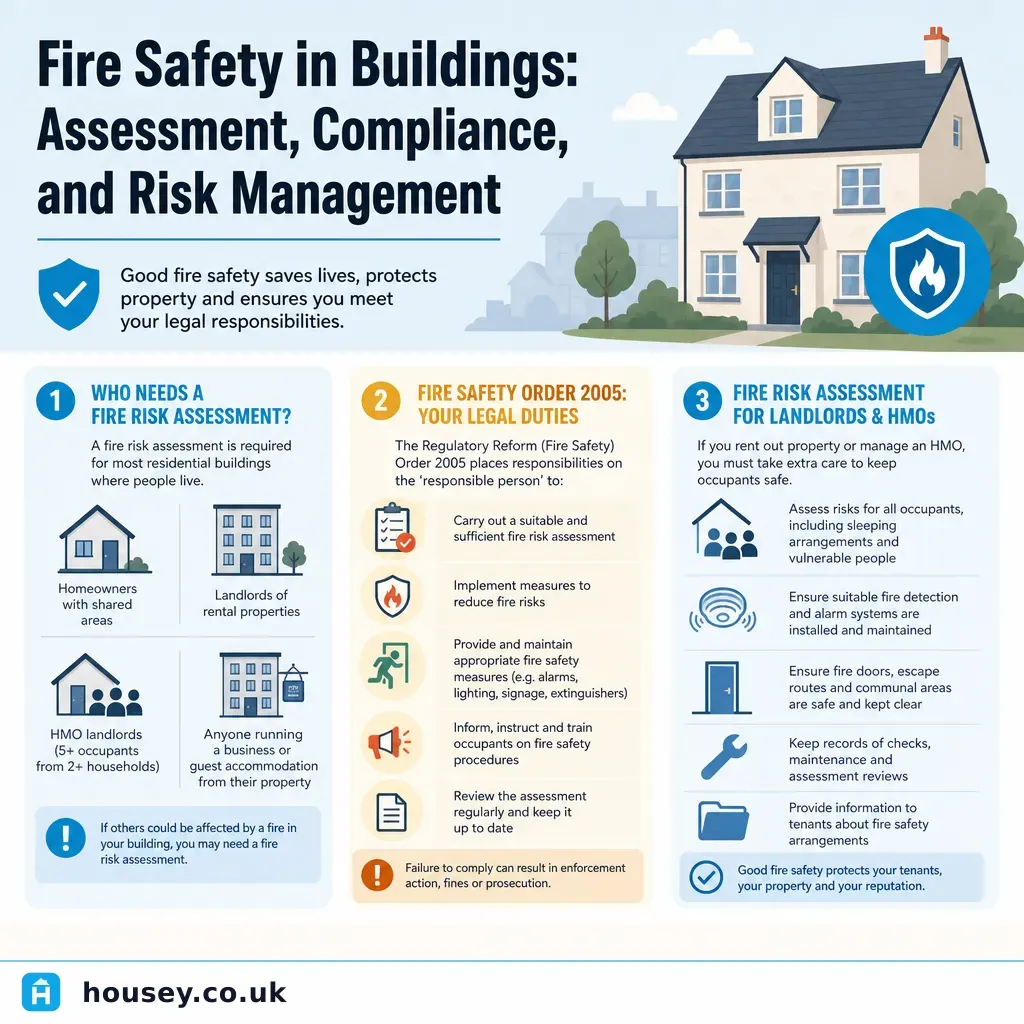
Fire Safety in Buildings: Assessment, Compliance, and Risk Management
Fire safety compliance is a legal duty for most non-domestic and multi-occupied residential buildings in the UK — not an optional best practice. Whether you are a landlord of an HMO, a freeholder of a block of flats, an employer responsible for commercial premises, or a managing agent for a mixed-use development, the obligations imposed by the Regulatory Reform (Fire Safety) Order 2005 and the Building Safety Act 2022 are substantial, and the consequences of non-compliance are serious.
Key points
- The Regulatory Reform (Fire Safety) Order 2005 (FSO) requires the 'responsible person' for most non-domestic and multi-occupied residential premises to commission a fire risk assessment and implement its findings.
- The Building Safety Act 2022 introduced new duties for higher-risk residential buildings (over 18 m or 7 storeys), including mandatory registration with the Building Safety Regulator (BSR) and a Building Safety Case.
- HMO landlords must ensure interlinked smoke alarms on every floor, heat alarms in kitchens, and carbon monoxide alarms where solid fuel or gas appliances are present, in addition to a fire risk assessment.
- Fire risk assessors must be 'competent' under the FSO; BAFE SP205 (Third Party Certification Scheme for Life Safety Fire Risk Assessment) is the widely recognised benchmark for demonstrating competence.
- Enforcement is carried out by local fire and rescue services, who can issue Enforcement Notices, Prohibition Notices requiring immediate restriction or closure of the building, and pursue prosecution for non-compliance.
Who needs a fire risk assessment?
The Regulatory Reform (Fire Safety) Order 2005 applies to virtually all premises except private single-occupancy dwellings. Those with a legal duty to commission one include:
- Landlords of HMOs and properties let to multiple households or tenants.
- Freeholders, management companies, and Right to Manage companies for blocks of flats, covering common areas such as corridors, lobbies, stairwells, bin stores, and plant rooms.
- Employers and building owners of commercial, retail, and office premises.
- Operators of licensed premises, schools, care homes, and places of worship.
- Any building where members of the public access non-domestic parts.
For blocks of flats, the assessment typically covers common areas rather than individual flats, but must consider how fire could spread between dwellings and whether compartmentation is intact.
For higher-risk buildings (over 18 m or 7 storeys), the Building Safety Act 2022 requires registration with the Building Safety Regulator, appointment of a Principal Accountable Person (PAP), and production of a Building Safety Case demonstrating the building is safe to occupy.
What a fire risk assessment involves
A competent fire risk assessor will typically carry out the following steps:
- Identify fire hazards — ignition sources, fuel loads, and oxygen sources within the premises.
- Identify people at risk — residents, employees, visitors, and people with disabilities or reduced mobility.
- Evaluate, remove, or reduce risks — physical measures, management procedures, and evacuation strategies.
- Record findings — a written report with action items, risk ratings (typically critical, high, medium, or low), and recommended timescales.
- Review and update — the assessment must be reviewed when there is reason to believe it is no longer valid, including after alteration, change of use, or a significant incident.
The assessment must be recorded in writing for premises with five or more employees, or any licensed premises. Best practice is to record it in writing for all premises regardless of size.
Evacuation strategies: a comparison
Strategy | Applies to | How it works | Key conditions |
|---|---|---|---|
Simultaneous evacuation | Most commercial premises, HMOs, smaller residential buildings | All occupants evacuate immediately on alarm | Suitable detection and audible alarms throughout the building |
Stay put (defend in place) | Purpose-built blocks of flats with intact compartmentation | Residents remain in their flat unless directly affected by fire | Fire-resistant construction between flats verified and maintained |
Temporary simultaneous evacuation (TSE) | Blocks where compartmentation is compromised or under investigation | All occupants evacuate while remediation proceeds | Requires review and reassessment once works complete |
Phased evacuation | Large commercial buildings, hospitals, tall office blocks | High-risk floors evacuated first on a rolling programme | Requires warden system and zoned alarm panel |
Post-Grenfell guidance from the National Fire Chiefs Council (NFCC) has led many building owners to move away from 'stay put' strategies in blocks where cladding or compartmentation is unverified.
What qualifications should a fire risk assessor hold?
The FSO requires a 'competent' assessor but does not prescribe a single qualification pathway. Recognised credentials include:
- BAFE SP205 — the benchmark third-party certification scheme for life safety fire risk assessors; verifies competence, insurance, and ongoing CPD.
- IFE (Institution of Fire Engineers) membership or the Associate Fire Risk Assessors (AFRA) register.
- Fire Industry Association (FIA) accredited assessors.
- IFSM (Institute of Fire Safety Managers) qualified practitioners.
For higher-risk or complex buildings, look for assessors holding Level 4 or Level 6 qualifications in fire risk assessment, registered on a third-party certification scheme, and carrying adequate professional indemnity insurance.
Red flags in fire safety
The following signs may indicate that fire safety is inadequate in a building you own, manage, or are considering purchasing:
- No written fire risk assessment in place for a premises legally required to have one.
- Assessment carried out by the building's own staff or managing agent with no relevant fire safety qualifications.
- Outdated assessment not reviewed since a change of use, structural alteration, or significant incident.
- Fire doors missing, damaged, held open by wedges, or failing to close fully in corridors and stairwells of residential buildings.
- Escape routes blocked, obstructed, or poorly lit.
- No interlinked smoke alarms in an HMO.
- Cladding or external wall insulation of uncertain fire performance on a building above two storeys.
- A 'stay put' strategy in a block where compartmentation has not been verified since 2017.
- Overdue fire extinguisher, emergency lighting, or suppression system service records.
Important limitations
This article is general information only and does not constitute legal or fire safety advice. Fire safety law is complex, and the specific duties applicable to a building depend on its use, construction, occupancy, tenure, and height. The Regulatory Reform (Fire Safety) Order 2005, the Building Safety Act 2022, the Housing Act 2004, and associated Approved Documents apply differently across building types. Consult a competent, third-party-certified fire risk assessor and, where appropriate, a specialist solicitor for advice specific to your property.
When this becomes urgent
Seek qualified professional help immediately if:
- Your building has received an Enforcement Notice or Prohibition Notice from the local fire and rescue service.
- A fire incident has occurred on the premises, however minor.
- You discover cladding of uncertain fire performance or evidence of compromised compartmentation.
- A fire door or emergency escape route is found to be non-compliant during any inspection.
- Your building meets the higher-risk threshold under the Building Safety Act 2022 and has not been registered with the Building Safety Regulator.
- You are about to exchange contracts on a building and have not seen a current fire risk assessment for the common areas.
What to ask a qualified professional
Before appointing a fire risk assessor:
- Are you registered on the BAFE SP205 scheme or an equivalent recognised third-party certification scheme?
- What experience do you have with buildings of this type, size, and occupancy?
- Will the assessment follow PAS 79-1 (commercial and other buildings) or PAS 79-2 (housing)?
- What professional indemnity insurance do you hold, and does it cover this instruction?
- Will the report include a prioritised action plan with risk ratings and recommended timescales?
- How do you keep current with changes to fire safety legislation and NFCC guidance?
- For higher-risk buildings: do you have experience of the Building Safety Act 2022 regime and the Building Safety Regulator?
When to get professional help
Fire risk assessment is not a task for an unqualified person, however well-intentioned. Commission a BAFE SP205-certified or equivalent third-party-accredited assessor. For higher-risk buildings subject to the Building Safety Act 2022, the Principal Accountable Person must register with the Building Safety Regulator and comply with the Higher-Risk Buildings regime.
Key triggers for commissioning or reviewing an assessment:
- Any change of use, structural alteration, or significant renovation.
- Discovery of non-compliant cladding or suspected compartmentation failure.
- A tenant complaint or incident involving fire safety equipment.
- New legal duties coming into force affecting your building type or height.
How Housey can help
Housey connects building owners, landlords, and managing agents with vetted fire risk assessment professionals qualified to assess properties of all types and sizes across the UK. Compare quotes from certified assessors to ensure your building meets its legal obligations.
Frequently asked questions
Who needs a fire risk assessment?
The Regulatory Reform (Fire Safety) Order 2005 applies to most non-domestic and multi-occupied residential premises. This includes HMOs, blocks of flats (common areas), commercial premises, offices, retail units, and any building where people work or the public has access. Private single-family dwellings are excluded, but most other occupied buildings are in scope.
How often should a fire risk assessment be carried out?
The FSO requires the assessment to be reviewed regularly and whenever circumstances change. Most assessors recommend a full review every 1–3 years for lower-risk premises, annually for higher-risk buildings, and immediately after any structural alteration, change of use, significant incident, or change in occupancy. There is no single statutory review frequency.
What qualifications should a fire risk assessor hold?
While the FSO requires competence without specifying a qualification, the recognised benchmark is BAFE SP205 third-party certification. Look also for IFE membership, FIA accreditation, or IFSM qualification. For higher-risk buildings, assessors should hold Level 4 or Level 6 fire risk assessment qualifications and carry adequate professional indemnity insurance.
What happens if a fire risk assessment identifies serious risks?
The assessor assigns risk ratings and provides a prioritised action plan. Critical and high risks should be addressed immediately. The local fire and rescue service can issue Enforcement Notices or Prohibition Notices for unremedied serious risks. Persistent non-compliance can result in prosecution, an unlimited fine, or a custodial sentence for the responsible person.
Sources and further reading
- Fire safety in the workplace — HM Government
- Regulatory Reform (Fire Safety) Order 2005 — legislation.gov.uk
- Building Safety Act 2022 — legislation.gov.uk
- SP205 Life Safety Fire Risk Assessment scheme — BAFE
- Fire safety guidance for blocks of flats — National Fire Chiefs Council
- Fire safety at work — HSE
Useful next reads
 Surveys & Inspections
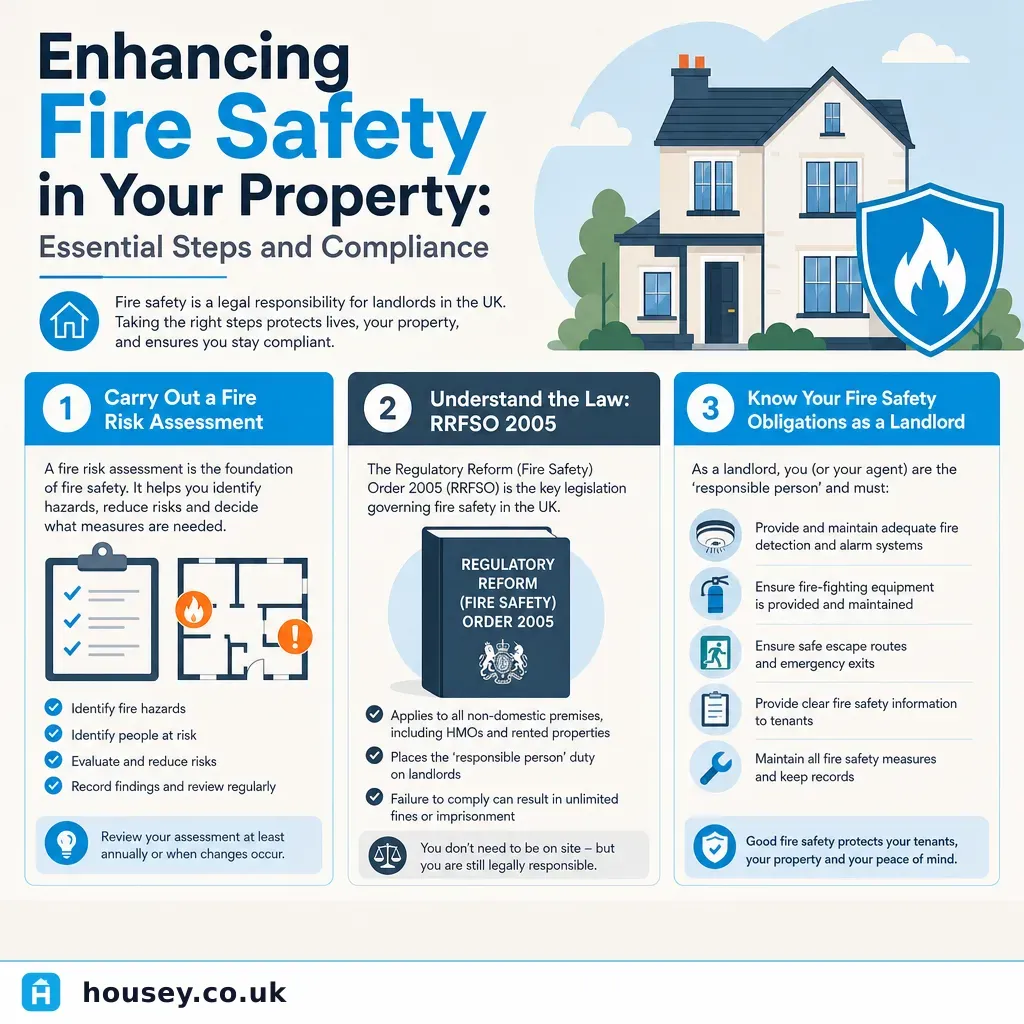
Enhancing Fire Safety in Your Property: Essential Steps and Compliance
Fire safety in UK properties is governed by Building Regulations Approved Document B and, for non-domestic and multi-occupied residential buildings, the Regulatory Reform (Fire Safety) Order 2005.
 Surveys & Inspections
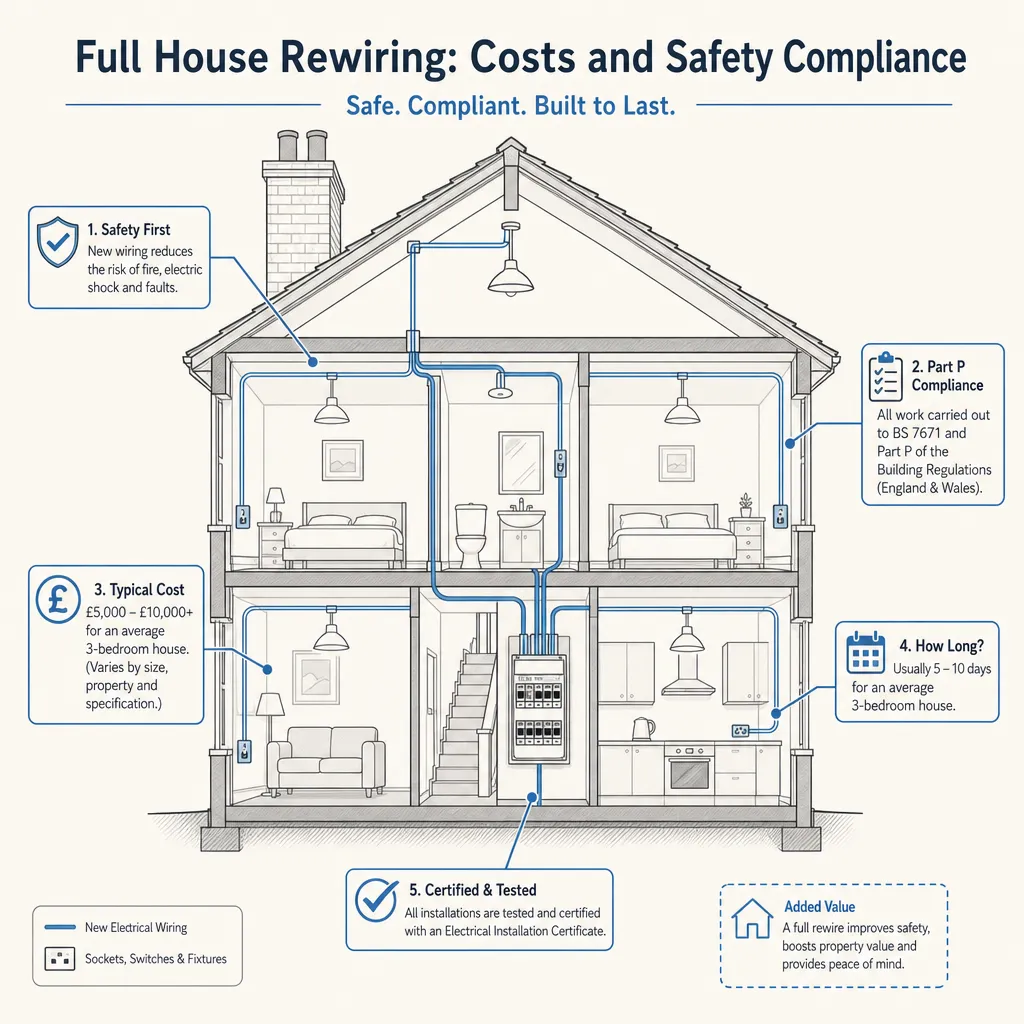
Full House Rewiring: Costs and Safety Compliance
A full house rewire in the UK typically costs £3,500–£6,000 for a three-bedroom semi and must comply with BS 7671:2018 and Building Regulations Part P.
 Surveys & Inspections
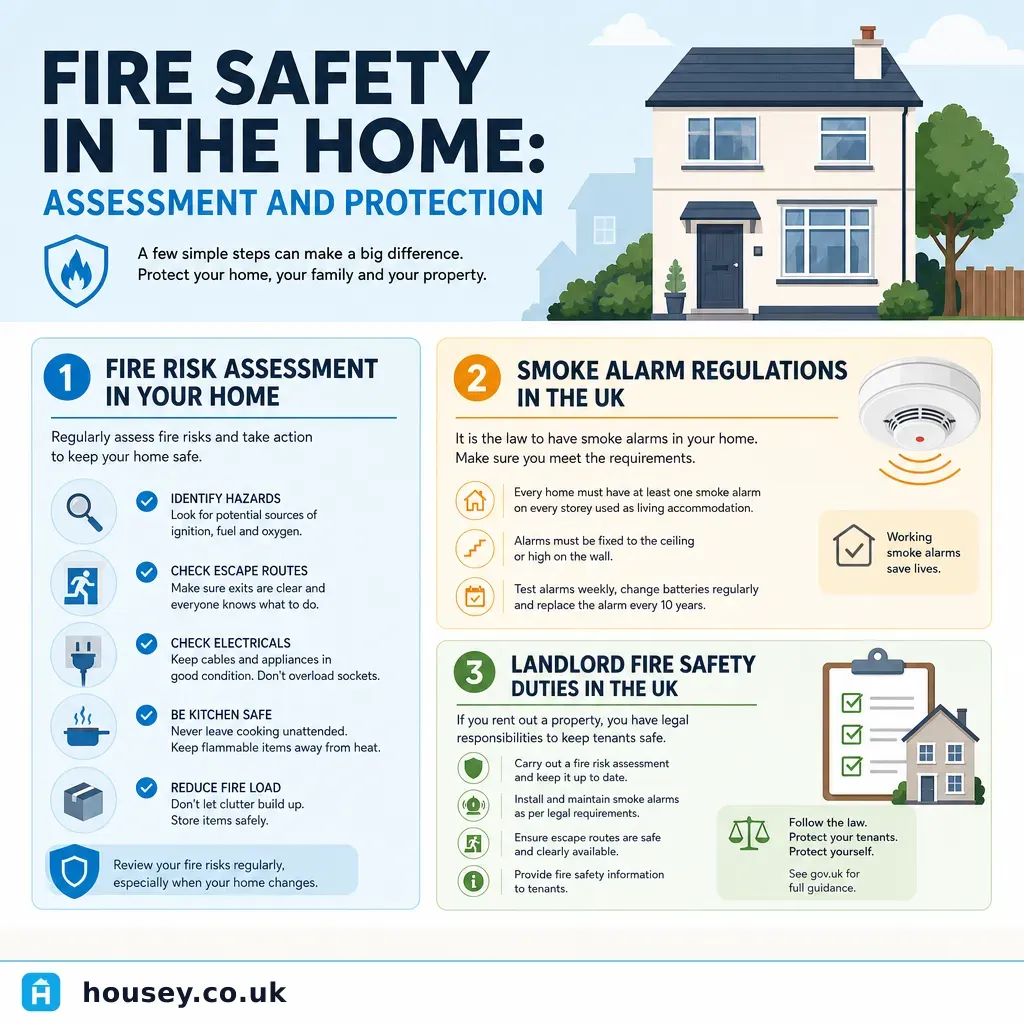
Fire Safety in the Home: Assessment and Protection
Most UK owner-occupied homes are the homeowner's responsibility to make fire-safe, while landlords have a legal duty to carry out fire risk assessments under the Regulatory Reform (Fire Safety) Order 2005.
 Surveys & Inspections
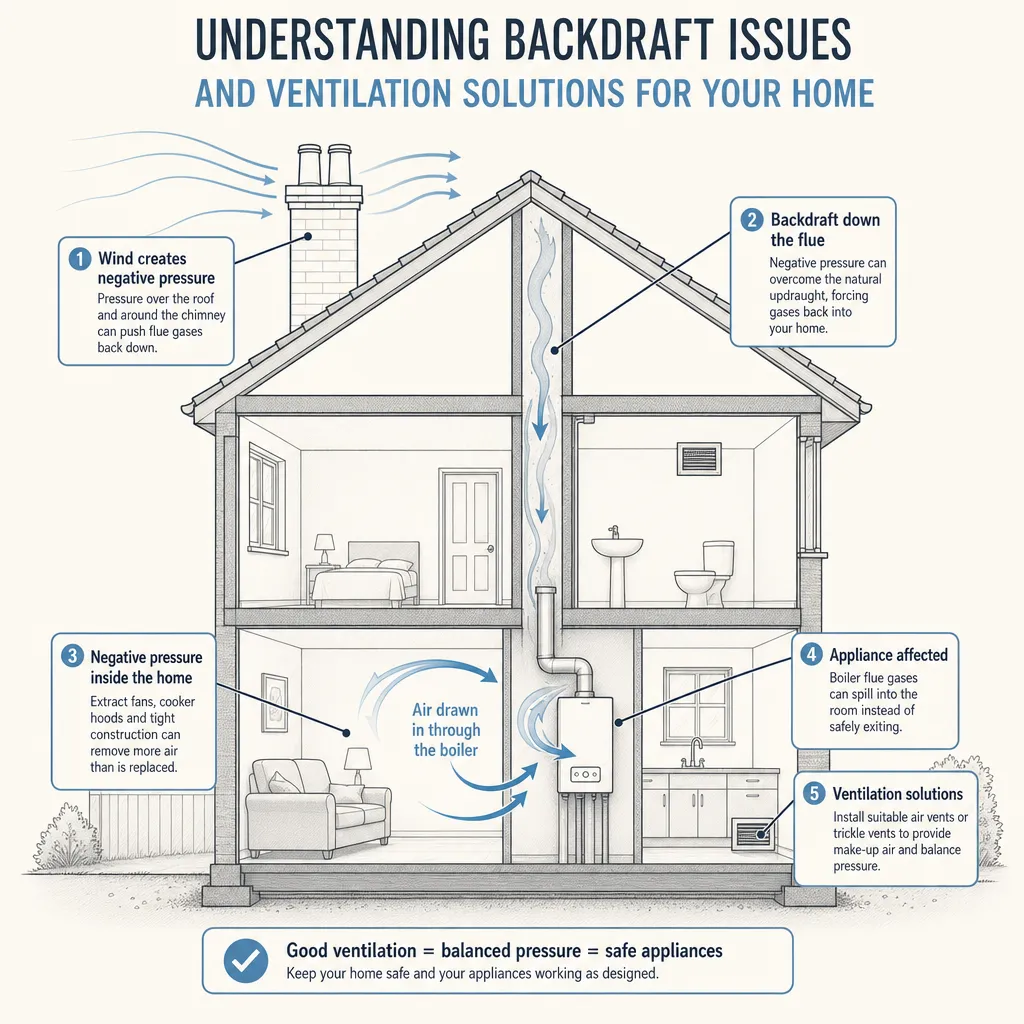
Understanding backdraft issues and ventilation solutions for your home
Backdraft occurs when negative pressure inside a building draws combustion gases back through a flue or chimney instead of expelling them outside.
 Surveys & Inspections
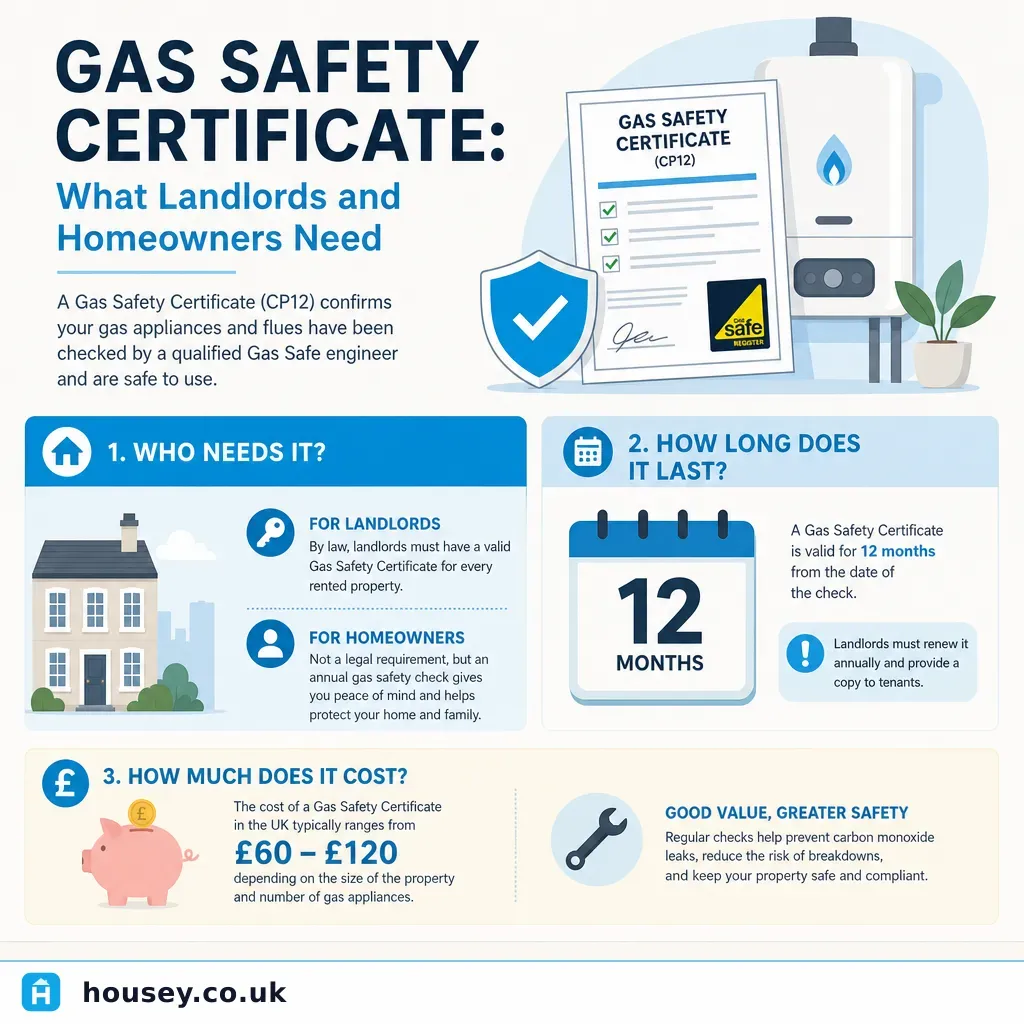
Gas Safety Certificate: What Landlords and Homeowners Need
Landlords in England, Scotland, and Wales must arrange a gas safety check every 12 months by a Gas Safe registered engineer under the Gas Safety (Installation and Use) Regulations 1998.