Environmental Compliance in UK Property Development: Understanding Regulatory Requirements
By Housey · Last reviewed 1st of June 2026
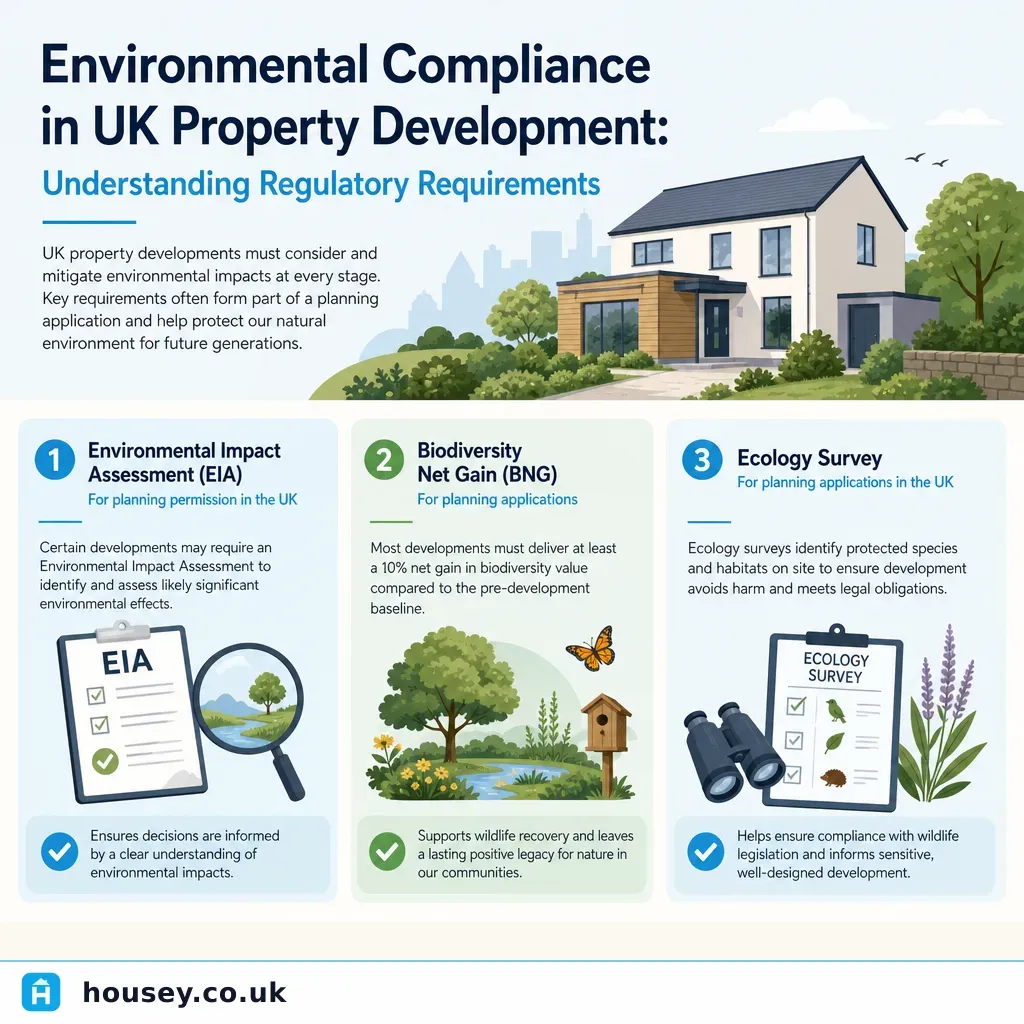
Environmental Compliance in UK Property Development: Understanding Regulatory Requirements
Planning a new build, extension, or change of use in the UK involves considerably more than architectural drawings and permitted development checks. Environmental regulations now form a core part of the planning system, and failing to address them early — whether through ecology, contaminated land, drainage, or air quality requirements — is one of the most common causes of planning delays and costly conditions. The obligations have intensified since the Environment Act 2021 and the phased roll-out of mandatory biodiversity net gain in England from February 2024, making early-stage environmental due diligence more important than at any previous point in the planning process.
Key points
- Biodiversity Net Gain (BNG) of at least 10% is mandatory in England for most planning applications submitted after 12 February 2024, under Schedule 14 of the Environment Act 2021; small sites (under 0.5 hectares with fewer than 9 dwellings) entered the mandatory regime from 2 April 2024.
- Environmental Impact Assessment (EIA) is a legal requirement under the Town and Country Planning (Environmental Impact Assessment) Regulations 2017 for all Schedule 1 developments and for Schedule 2 developments where significant environmental effects are likely.
- Protected species surveys — including bats, great crested newts, dormice, and breeding birds — must be conducted within specific seasonal windows; missing the correct window can delay a planning application by up to twelve months.
- Brownfield development typically requires at minimum a Phase 1 Preliminary Risk Assessment (desk study) for contaminated land before planning permission is granted, in line with the National Planning Policy Framework (NPPF).
- Development in or adjacent to an Air Quality Management Area (AQMA), or generating significant additional vehicle movements, may trigger a mandatory air quality assessment as a validation requirement or planning condition.
What environmental compliance means in the planning system
Environmental compliance in the UK planning context means satisfying a local planning authority (LPA) that a proposed development will not cause unacceptable harm to ecology, water quality, air, soil, or local amenity — and, increasingly, that it will actively improve biodiversity. These obligations sit across several legal frameworks: the Town and Country Planning Act 1990, the Wildlife and Countryside Act 1981 (as amended), the Conservation of Habitats and Species Regulations 2017, the Environment Act 2021, and NPPF policy.
For most residential applications — including moderately sized extensions and new self-build plots — the LPA will use a pre-application checklist or validation requirements to set out which environmental reports are needed before the application can be registered. Submitting without the required reports leads either to validation refusal or to substantial pre-commencement conditions that can hold up construction for months. Commissioning the right surveys at the right time is therefore a planning programme decision, not just a compliance formality.
Environmental Impact Assessment: when is one required?
An EIA is required by law for Schedule 1 developments (always) and for Schedule 2 developments where the LPA determines that significant environmental effects are likely, under the Town and Country Planning (EIA) Regulations 2017. If you are uncertain whether your project requires an EIA, you may request a screening opinion from your LPA free of charge; the authority must respond within three weeks. For larger or more complex sites, a scoping opinion sets out in advance the information the Environmental Statement must cover.
Development type | EIA requirement |
|---|---|
Motorways, airports, large-scale power stations, major industrial installations | Schedule 1 — always required |
Housing developments above 150 dwellings or 5 hectares | Schedule 2 — screened; often required |
Urban development projects in sensitive locations (SSSI, AONB, flood zone) | Schedule 2 — screened; often required |
Single dwellings and minor domestic extensions on ordinary sites | Screening usually not required |
Any development within or directly adjacent to a European Protected Site | Likely required regardless of scale |
A completed EIA produces an Environmental Statement (ES) submitted with the planning application. The ES must address whichever environmental topics the scoping opinion or LPA identifies as potentially significant: ecology, landscape, traffic, noise, air quality, water, and socio-economic effects are common chapters.
Biodiversity Net Gain: what applicants must now demonstrate
From 12 February 2024, most planning applications in England must demonstrate a minimum 10% biodiversity net gain measured using the DEFRA Biodiversity Metric (version 4.0). This is a legal requirement under Schedule 14 of the Environment Act 2021, enforced through the planning system. In practice, it means:
- A baseline habitat survey of the site before development.
- A biodiversity metric calculation comparing pre- and post-development habitat value.
- Where 10% gain cannot be achieved on-site, off-site habitat units may be purchased through a registered biodiversity gain site, or statutory biodiversity credits may be purchased from Natural England as a last resort.
- A biodiversity gain plan must be submitted with most major and minor planning applications.
BNG applies in England only; Wales, Scotland, and Northern Ireland have separate biodiversity and environmental obligations under their respective planning frameworks.
Ecology surveys and protected species
Many development sites — including gardens, paddocks, converted outbuildings, and overgrown urban plots — support legally protected species. Disturbing or harming a protected species without a licence is a criminal offence under the Wildlife and Countryside Act 1981 and the Conservation of Habitats and Species Regulations 2017.
Common surveys triggered by planning applications include:
- Bat surveys: required where trees, hedgerows, or buildings with potential roost features are affected. Activity surveys must typically be conducted between May and October, with multiple nocturnal visit requirements.
- Great crested newt (GCN) surveys: eDNA surveys in ponds from mid-February to end of June; traditional presence/absence surveys April to June. District-level GCN licensing schemes operated by Natural England are now available in many areas, potentially simplifying the process.
- Breeding bird surveys: works affecting hedgerows, scrub, or mature trees between March and August may require a survey or trigger construction timing conditions.
- Badger surveys: required before destroying or blocking setts; a licence from Natural England may be needed.
Decision tree: do you need an ecology survey before submitting?
- Commission a Phase 1 Habitat Survey if: the site contains any vegetation, hedgerows, trees, ponds, watercourses, or buildings over approximately 20 years old.
- Commission targeted protected species surveys if: the Phase 1 identifies moderate or high potential for protected species, or if the LPA requests them during pre-application discussions.
- Apply for a mitigation licence if: targeted surveys confirm protected species presence and the development cannot avoid affecting them.
- Check seasonal survey windows immediately if: you plan to submit a planning application within the next 6–12 months — bat and GCN windows may already be closed for this calendar year.
- Engage a district-level GCN licensing scheme if: the development is in an area where Natural England operates one — this can substantially reduce the time and cost of licensing.
Contaminated land and ground investigations
Development on brownfield land, former industrial sites, petrol stations, railway land, or any site with uncertain historic use requires investigation under NPPF guidance (paragraphs 183–186). The LPA may require:
- Phase 1 Preliminary Risk Assessment (PRA): a desk-based study reviewing historical Ordnance Survey maps, geological records, and environmental databases. This is the minimum requirement for most brownfield sites and should be submitted with the planning application.
- Phase 2 Site Investigation: intrusive investigation including boreholes, trial pits, and soil or groundwater sampling, carried out where Phase 1 identifies a potentially significant pollutant linkage.
- Remediation Scheme and Verification Report: where contamination is confirmed at unacceptable levels, a remediation strategy must be approved by the LPA and Environment Agency before or during construction, with a verification report confirming completion.
Contaminated land investigations should follow Environment Agency guidance (Land Contamination Risk Management, 2020) and be undertaken by consultancies with appropriately qualified staff.
Air quality, noise, and sustainable drainage
Air quality: Development within or near an AQMA, or generating significant road traffic, may need an air quality assessment using dispersion modelling or screening tools. The LPA will usually indicate this requirement in validation checklists or pre-application advice.
Noise: Developments near roads, railways, industrial uses, or entertainment venues — or developments that themselves generate noise — may require a noise assessment. Relevant standards include BS 4142:2014+A1:2019 (rating industrial and commercial noise) and BS 8233:2014 (internal noise levels for residential uses).
Sustainable Drainage Systems (SuDS): From April 2024, Schedule 3 of the Flood and Water Management Act 2010 applies in England: all new drainage for major developments (10 or more dwellings, or 1,000 m² or more of floorspace) must be approved by the Lead Local Flood Authority to national SuDS standards. Wales has operated a mandatory SuDS approval regime since January 2019.
Which environmental professional do you need?
Environmental matter | Typical professional | Relevant qualification or accreditation |
|---|---|---|
Ecology survey, protected species, and BNG metric | Ecologist or ecological consultant | CIEEM membership (Chartered Institute of Ecology and Environmental Management) |
EIA coordination and Environmental Statement | Environmental consultant or EIA practitioner | IEMA, CIEEM, or CIWEM membership |
Contaminated land investigation | Environmental or geotechnical consultant | CGeol, CEnv, or SiLC (Specialist in Land Condition) |
Air quality assessment | Air quality consultant | IAQM (Institute of Air Quality Management) membership |
Noise assessment | Acoustic consultant | IOA (Institute of Acoustics) membership |
SuDS design and drainage strategy | Civil or drainage engineer | ICE or CIWEM membership |
Flood Risk Assessment | Flood risk consultant | CIWEM or ICE membership |
Important limitations
The information in this article is general guidance only. Environmental compliance requirements vary significantly by site, location, proposed development type, and the policies of the relevant local planning authority. Planning policy — including BNG thresholds, permitted development rights, and EIA thresholds — is subject to government review and may change. Rules in Scotland, Wales, and Northern Ireland differ from those in England in important respects. Always verify current LPA validation requirements and seek independent advice from a qualified environmental consultant or planning consultant before committing to a survey programme or planning submission timetable.
What to ask a qualified professional
Before commissioning environmental surveys or reports, ask:
- Which surveys are required for my specific site and development type, and are any seasonal windows approaching or already closed for this year?
- Are there any designated sites — SSSIs, National Nature Reserves, European Protected Sites, AQMAs, or flood zones — within or adjacent to my site?
- Will my project trigger a mandatory EIA under the 2017 Regulations, and if so, what scope and programme should I expect?
- What is the current baseline biodiversity metric score, and can the 10% BNG requirement realistically be met on-site?
- If contaminated land investigation is required, what level of intrusive investigation is likely and what might remediation involve?
- What pre-application advice from the LPA would you recommend seeking before the survey programme is finalised?
When to get professional help
Commission a qualified ecologist and, where relevant, other environmental specialists as early as possible — ideally before finalising site layout or committing to a planning submission programme. Specific triggers to seek professional help without delay include:
- Trees, hedgerows, or buildings on or adjacent to the site that may support bats or nesting birds.
- Any pond or watercourse within 500 metres of the site (potential great crested newt habitat).
- A brownfield or formerly industrial site with unknown or mixed historic use.
- Any notification from the LPA that the site is near a SSSI, National Nature Reserve, or European Protected Site.
- Receipt of a planning validation checklist requiring ecology, contaminated land, or environmental reports.
- A development programme that requires planning permission within the next 12 months — seasonal survey windows close quickly.
How Housey can help
Housey connects homeowners, self-builders, and developers with qualified professionals across the UK — including planning consultants and specialist surveyors — who can assess the environmental requirements your project may face and advise on the right survey programme before a planning application is submitted. Use Housey to compare professionals and request quotes for your pre-application environmental work.
Frequently asked questions
Is biodiversity net gain required for permitted development?
No. Biodiversity net gain under the Environment Act 2021 applies to developments that require planning permission. Works carried out under permitted development rights do not require a BNG assessment, although a local planning authority may impose conditions if permitted development rights have been removed by an Article 4 Direction.
How long does an ecology survey take?
It depends on the surveys required. A Phase 1 Habitat Survey can often be completed in a single site visit and reported within a few weeks. Targeted protected species surveys — particularly bat surveys — require multiple visits across a defined seasonal window and can take several months from instruction to final report.
What happens if protected species are found on my site?
If protected species are confirmed, development affecting them normally requires a mitigation strategy and, in most cases, a European Protected Species licence from Natural England or the equivalent body in Scotland or Wales. Specific legal tests must be met before a licence can be granted, and work must not begin until the licence is in place.
Does environmental compliance apply to small domestic extensions?
Full EIA and biodiversity net gain requirements typically do not apply to minor domestic extensions, but the site may still support protected species — bats and nesting birds are protected by law regardless of development scale. A brief ecological appraisal is advisable for any works affecting older buildings, outbuildings, trees, or mature vegetation.
Sources and further reading
- Town and Country Planning (Environmental Impact Assessment) Regulations 2017 — legislation.gov.uk
- Biodiversity Net Gain guidance — GOV.UK
- Environmental Impact Assessment: overview — GOV.UK
- Contaminated land: how to manage the risk — GOV.UK / Environment Agency
- Protected species and development: guidance — GOV.UK / Natural England
- Guidelines for Preliminary Ecological Appraisal — Chartered Institute of Ecology and Environmental Management (CIEEM)
Useful next reads
 Planning & Pre-Build
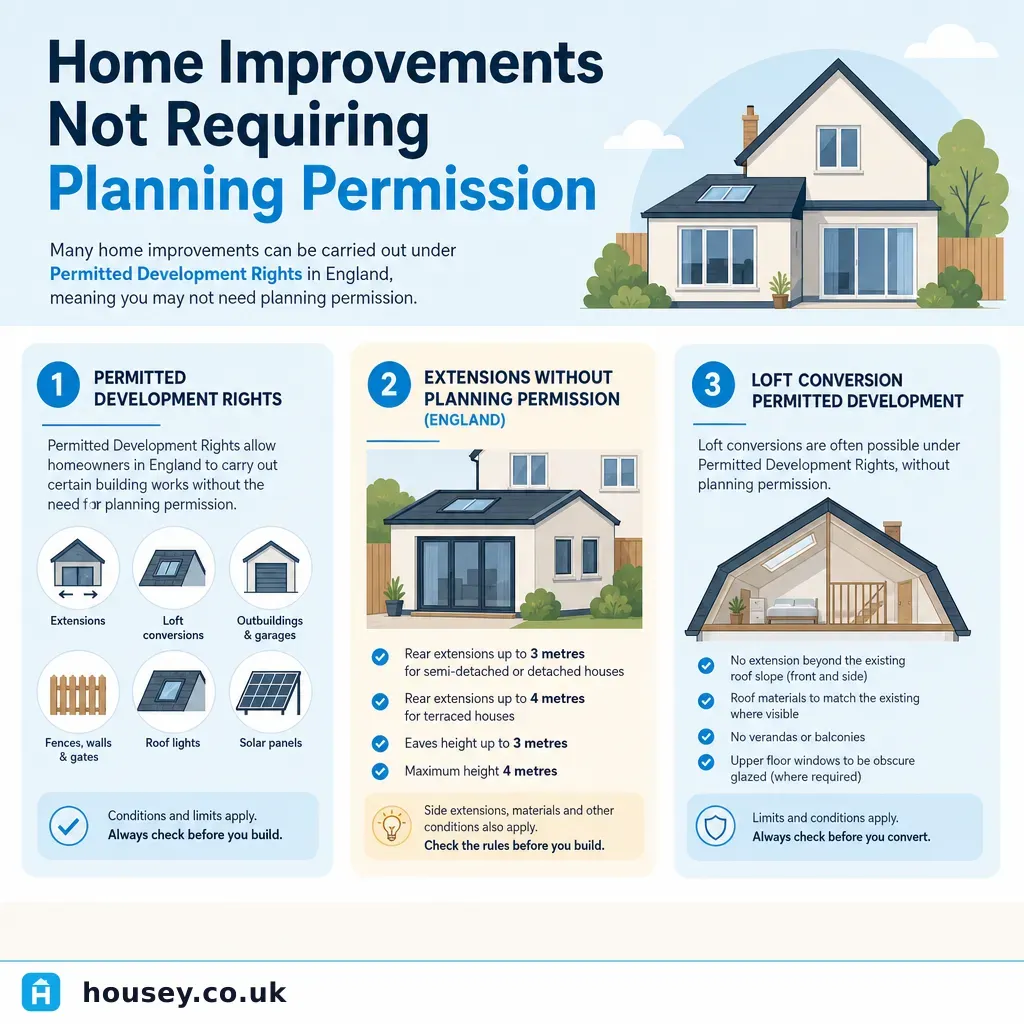
Home Improvements Not Requiring Planning Permission
Many common home improvements in England fall under Permitted Development Rights and do not require a planning application.
 Planning & Pre-Build
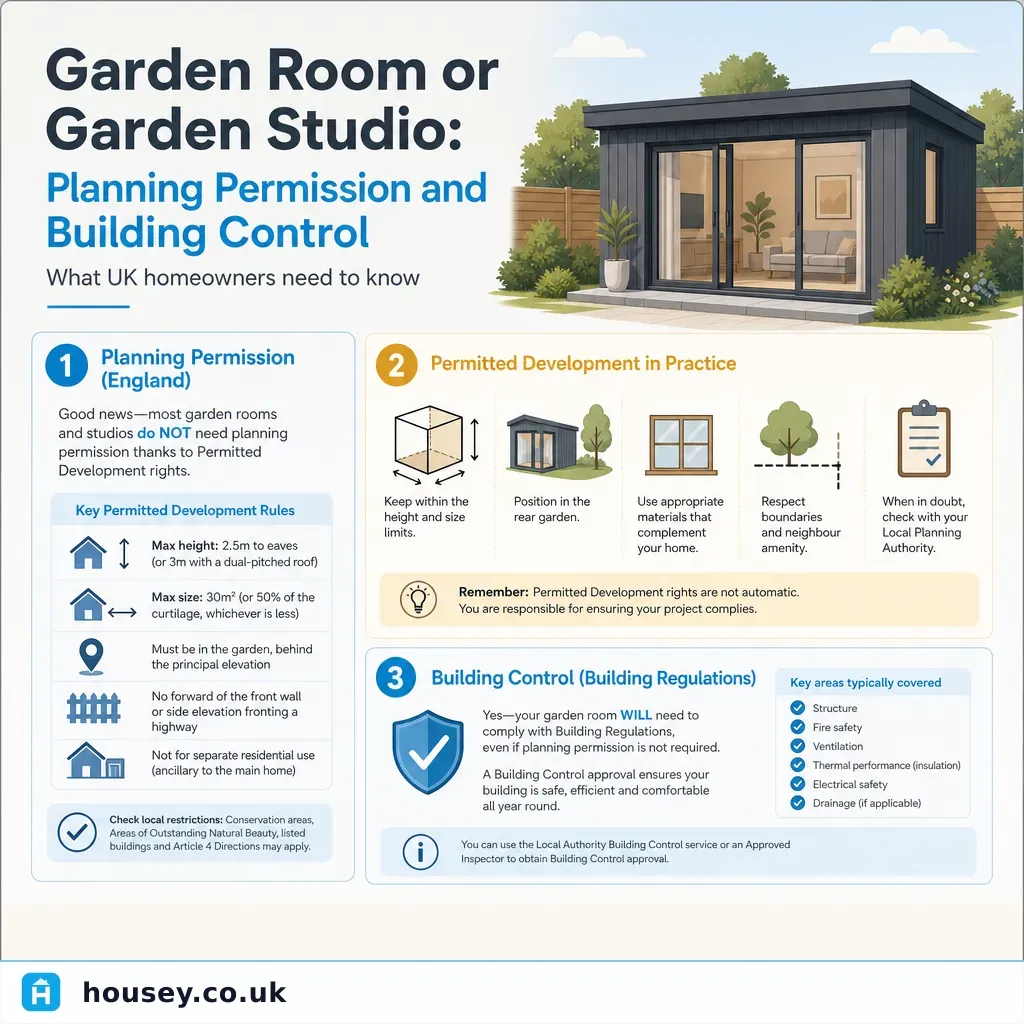
Garden Room or Garden Studio: Planning Permission and Building Control
A garden room or studio often qualifies as permitted development in England, meaning no planning application is needed — provided it occupies no more than 50% of the total curtilage, sits within height limits, and is not used as a separate dwelling.
 Planning & Pre-Build
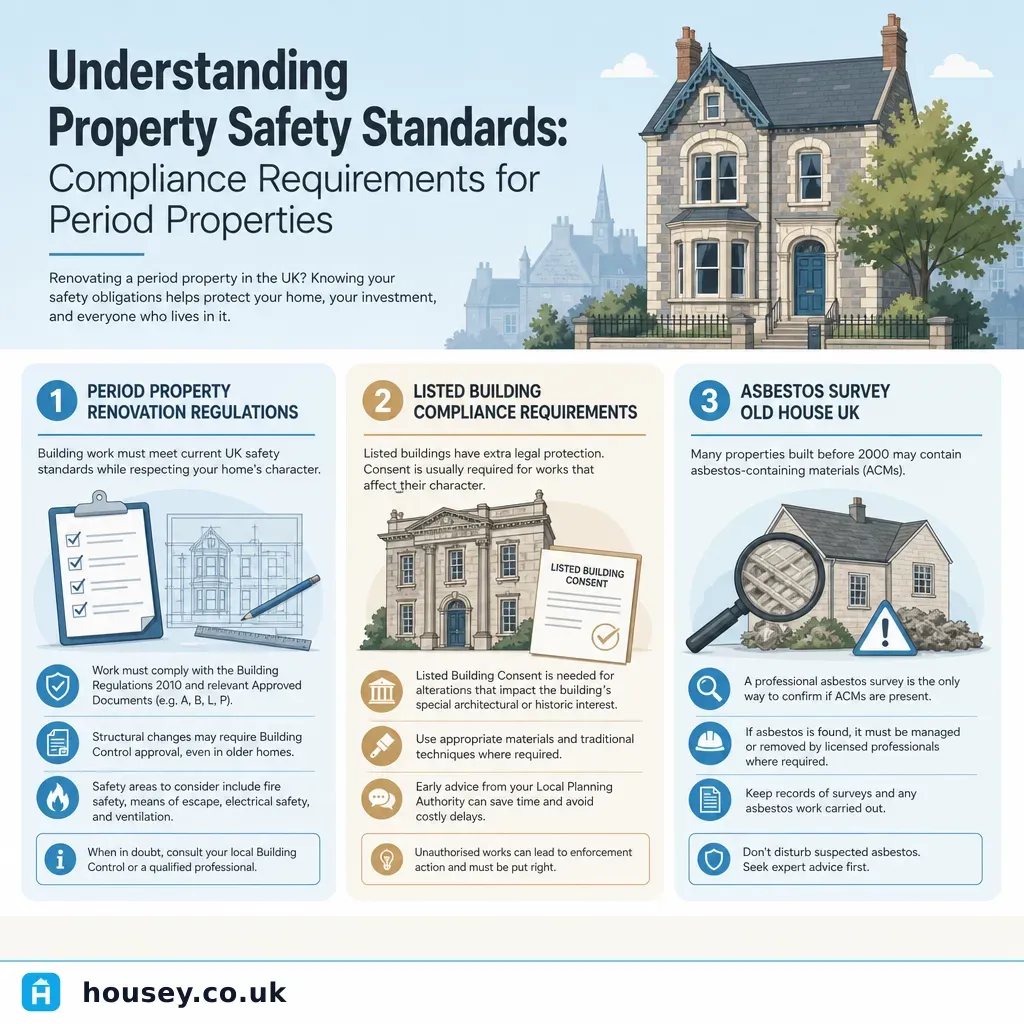
Understanding Property Safety Standards: Compliance Requirements for Period Properties
Period properties in England are not automatically exempt from current Building Regulations — any notifiable work must comply with today's Approved Documents.
 Planning & Pre-Build
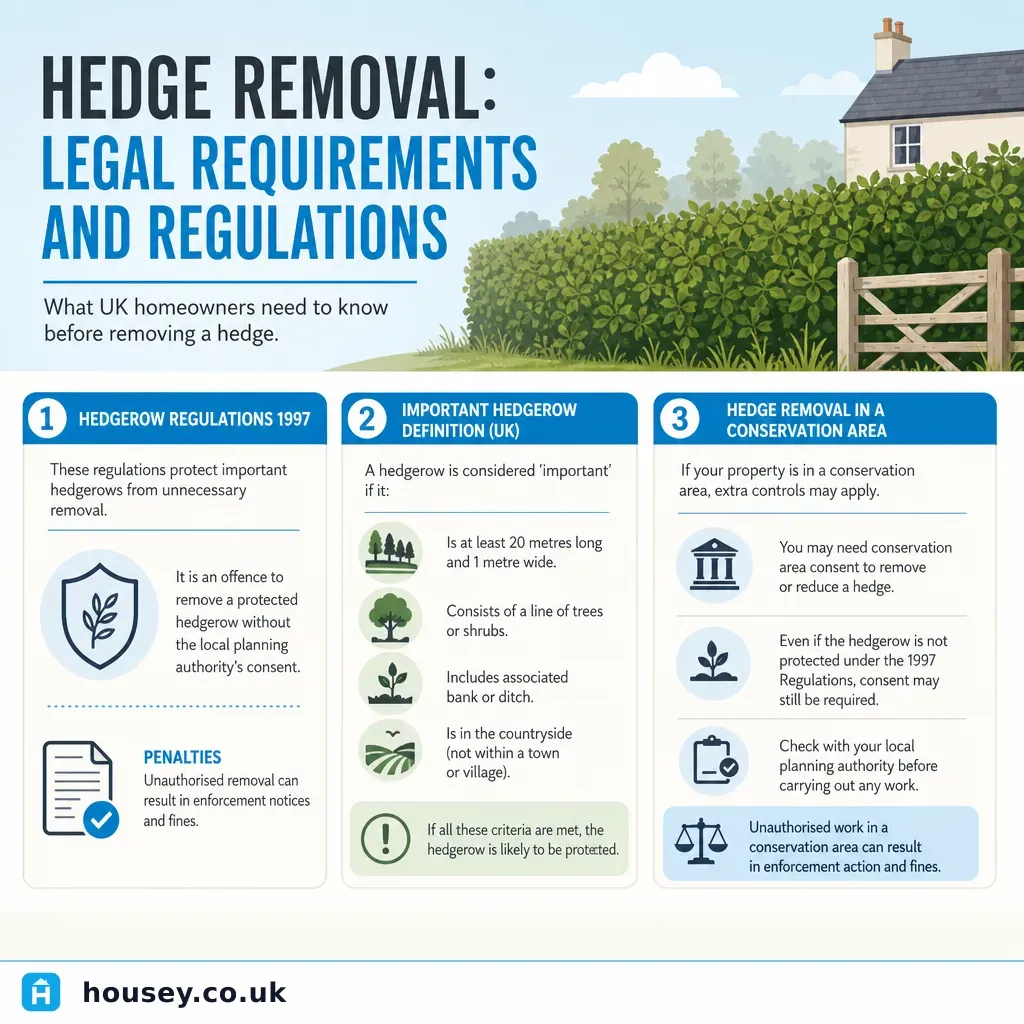
Hedge Removal: Legal Requirements and Regulations
Whether you need permission to remove a hedge in the UK depends on its location, age, and what it contains.
 Planning & Pre-Build
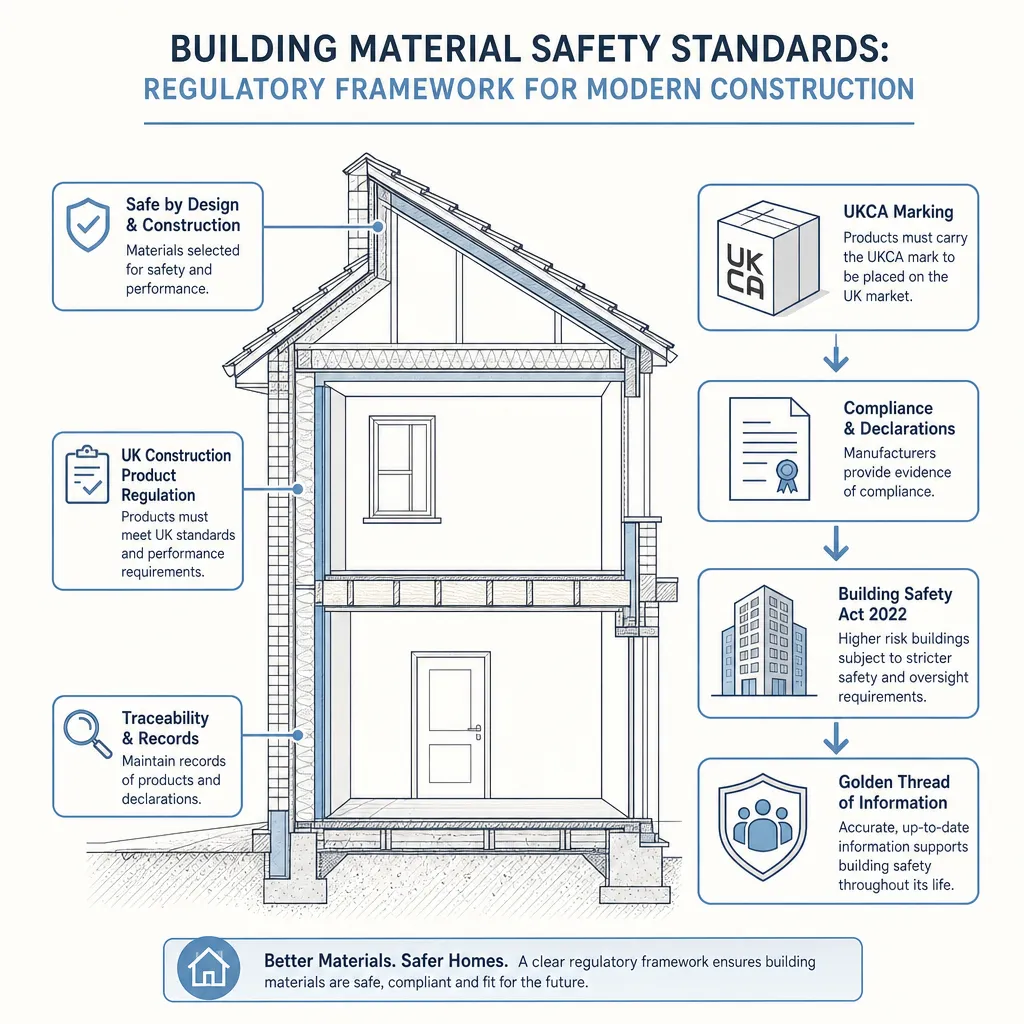
Building Material Safety Standards: Regulatory Framework for Modern Construction
UK building material safety standards are set through the Building Regulations 2010 and associated Approved Documents covering structure, fire, damp, energy, and ventilation.