Garden Room or Garden Studio: Planning Permission and Building Control
By Housey · Last reviewed 11th of May 2026
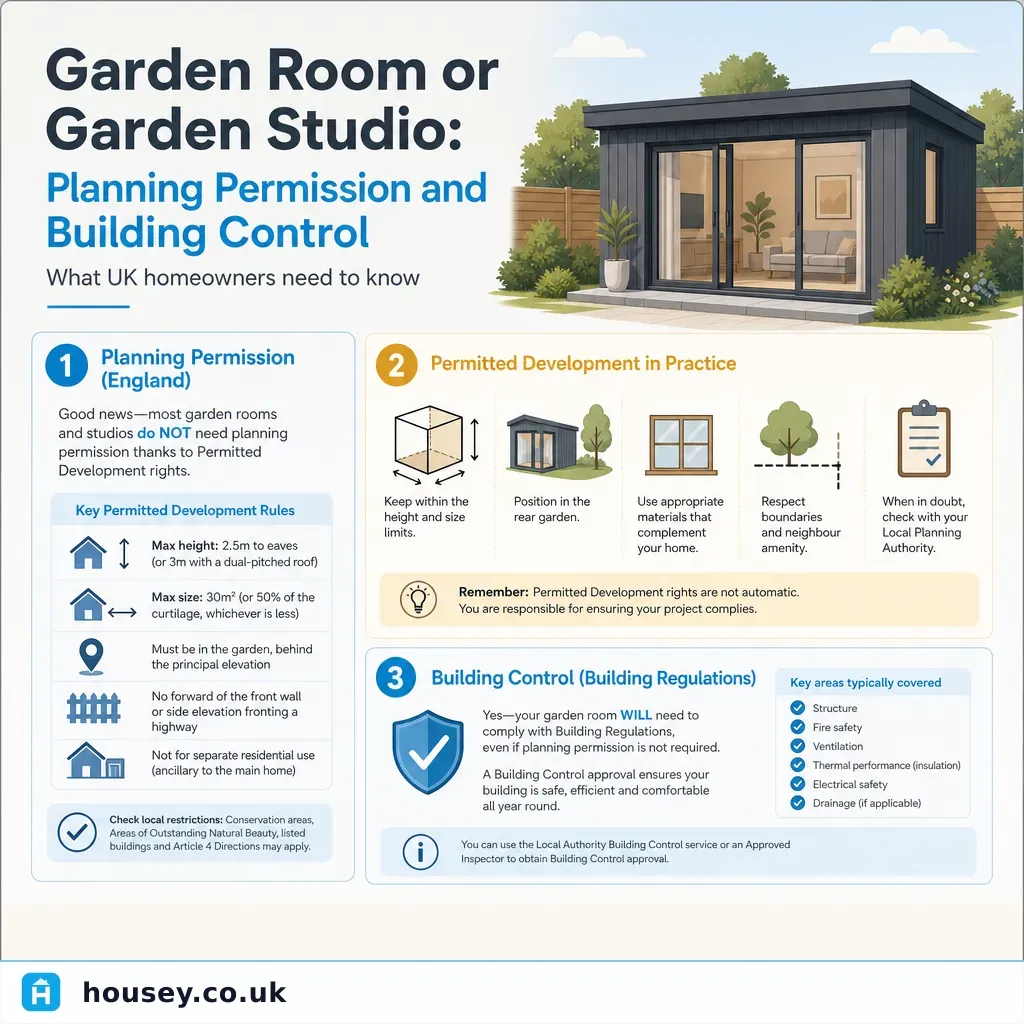
Garden Room or Garden Studio: Planning Permission and Building Control
Garden rooms and garden studios have become one of the most popular home improvement projects across the UK — driven by remote working, the desire for a dedicated hobby space, or the need for an extra room without a full extension. Whether your project falls within permitted development or requires a formal planning application can depend on half a dozen overlapping rules, and getting it wrong risks enforcement action or complications when you come to sell.
Key points
- Under England's permitted development rules, a garden room is classified as an outbuilding and is allowed without planning permission provided it covers no more than 50% of the total garden area (excluding the original house footprint).
- Maximum height is 4 metres for a dual-pitched roof and 3 metres for any other roof type; within 2 metres of a boundary, the maximum height drops to 2.5 metres regardless of roof style.
- Permitted development rights for outbuildings are removed or restricted in Conservation Areas, Areas of Outstanding Natural Beauty (AONBs), National Parks, and for Listed Buildings — where Listed Building Consent may be required in addition to planning permission.
- Building regulations approval is generally required once a detached outbuilding exceeds 30 m², or where it contains sleeping accommodation, fixed plumbing, or a consumer-unit electrical installation.
- Scotland, Wales, and Northern Ireland each have their own permitted development rules, which differ from those in England — always check the relevant national guidance for your location.
Do I need planning permission for a garden room?
In England, a garden room counts as an outbuilding and is usually covered by Class E permitted development rights under the Town and Country Planning (General Permitted Development) (England) Order 2015. This means no planning application is needed if all of the following conditions are met:
- The outbuilding sits within the curtilage of the dwelling — behind the principal elevation and not to the front of the property.
- The total area of all outbuildings, decking, and extensions does not exceed 50% of the land area surrounding the original house.
- The building is single storey and does not exceed the relevant height limits (4 m dual-pitched roof; 3 m flat or other roof; 2.5 m within 2 m of a boundary).
- The structure is not used as a separate dwelling.
- The property is not a Listed Building (where permitted development rights are withdrawn entirely for outbuildings).
Decision tree: which consent do you need?
- Choose permitted development (no application needed) if your garden room meets all size, height, and position limits and your property is not listed or in a designated area.
- Apply for full planning permission if you are in a Conservation Area and the building would be to the side or forward of the rear wall, or if the structure exceeds permitted development limits.
- Apply for Listed Building Consent (and possibly full planning permission) if the property is a Listed Building — consult your local planning authority before ordering materials.
- Check your local planning authority if the property is in a National Park, AONB, or World Heritage Site — permitted development limits differ in designated areas.
- Consult a planning professional if your curtilage is unusual, the title deeds contain restrictive covenants, the property has a history of extensions, or prior approval conditions affect your rights.
Which building regulations apply?
Even where no planning application is required, building regulations may still apply. The table below summarises the most common scenarios for detached outbuildings in England.
Scenario | Building Regulations Required? |
|---|---|
Detached outbuilding under 15 m², no sleeping accommodation | No (exempt) |
15 m²–30 m², no sleeping accommodation, more than 1 m from boundary or non-combustible materials | No (exempt) |
15 m²–30 m², within 1 m of boundary and combustible materials | Yes |
Over 30 m² (any use) | Yes |
Any size with sleeping accommodation | Yes |
Fixed plumbing (toilet, sink) | Yes — drainage and water supply elements |
Consumer-unit electrical installation | Yes — notifiable under Part P |
Where building regulations apply, you will need to submit either a Full Plans application (recommended for complex builds) or a Building Notice to your local authority building control (LABC) or an Approved Inspector. Work must be inspected at key stages and a Completion Certificate issued — this document will be requested during property conveyancing.
Boundaries, covenants, and neighbour considerations
Planning and building regulations are independent of civil law. Even if your garden room is fully permitted development, you should check:
- Title deeds and restrictive covenants — your deeds may prohibit outbuildings or limit structures without landlord or neighbour consent. A conveyancing solicitor or mortgage lender may raise this at sale or remortgage.
- Party Wall etc. Act 1996 — generally does not apply to standalone garden buildings unless you are excavating within 3 or 6 metres of a neighbouring building's foundations.
- Neighbour notification — not a legal requirement for permitted development, but informing neighbours early reduces the risk of formal enforcement complaints to the local authority.
Garden rooms in Conservation Areas and on listed properties
Permitted development rights for outbuildings are restricted in Conservation Areas. A garden room that would be visible from a highway and positioned to the side of the principal elevation requires a planning application. In practice, many local authorities scrutinise rear garden works more carefully in designated areas too.
For Listed Buildings, permitted development rights are effectively withdrawn — all outbuildings in the curtilage of a Listed Building require full planning permission and may also require Listed Building Consent. Carrying out work without consent on a listed property is a criminal offence under the Planning (Listed Buildings and Conservation Areas) Act 1990.
Homeowner checklist — before ordering a garden room
Important limitations
This article provides general information about typical permitted development and building regulations rules in England as of the last review date. Rules are subject to change and vary significantly by local authority, property type, tenure, prior consents, and location within a designated area. This is not planning or legal advice. Always confirm the position with your local planning authority or a qualified planning consultant before committing to a build.
What to ask a qualified professional
Before instructing a planning consultant or submitting an application, ask:
- Does this property have any Article 4 Directions removing permitted development rights?
- Are there any restrictive covenants in the title that would affect this project?
- Is a Certificate of Lawful Development worth obtaining even if planning permission is not formally required?
- What is the local authority's track record on enforcement in this area?
- If building regulations apply, which route — Full Plans or Building Notice — is more appropriate for this project?
When to get professional help
Seek professional advice if:
- The property is listed or in a Conservation Area, AONB, or National Park.
- The proposed garden room is close to the 50% curtilage limit.
- The building will contain sleeping accommodation or fixed plumbing.
- Your title deeds contain restrictions on outbuildings.
- A neighbour has raised an objection or the local authority has been in contact about the proposal.
- An enforcement notice has previously been issued relating to the property.
How Housey can help
If your project requires a planning application, a Certificate of Lawful Development, or compliant technical drawings, Housey connects you with vetted local planning consultancy specialists and professionals who produce building regulations drawings for garden building projects across the UK.
Frequently asked questions
Can I use my garden room as a home office without planning permission?
In most cases, yes. A garden room used as a home office is considered incidental to the enjoyment of the house and falls within permitted development, provided size, height, and position limits are met. If you regularly see clients at the property or it operates as commercial premises, the use may change in planning terms and you should check with your local planning authority before proceeding.
Does a garden room need building regulations approval?
Most detached garden rooms under 15 m² are fully exempt. Between 15 m² and 30 m², exemption applies only where there is no sleeping accommodation and the building is either more than 1 metre from a boundary or constructed from non-combustible materials. Over 30 m², or where you add fixed plumbing or a consumer-unit electrical installation, building regulations approval is required.
Do conservation area rules affect my garden room?
Yes. In a Conservation Area, a garden room positioned to the side of the house where it would be visible from a highway falls outside permitted development and requires a planning application. Some local authorities also scrutinise rear garden works more carefully. Always check with your local planning authority before starting work.
Can a garden room be used as a separate dwelling or short-term let?
No — permitted development rights for outbuildings explicitly exclude use as a separate self-contained dwelling. Operating a garden room as permanent living accommodation or as a frequent short-term let may constitute a material change of use requiring a planning application. Your mortgage lender or building insurer may also raise objections.
Sources and further reading
- Permitted Development Rights for Householders: Technical Guidance — GOV.UK
- Town and Country Planning (General Permitted Development) (England) Order 2015 — legislation.gov.uk
- Outbuildings: common projects guidance — Planning Portal
- Search for property information (title deeds) — HM Land Registry
Useful next reads
 Planning & Pre-Build
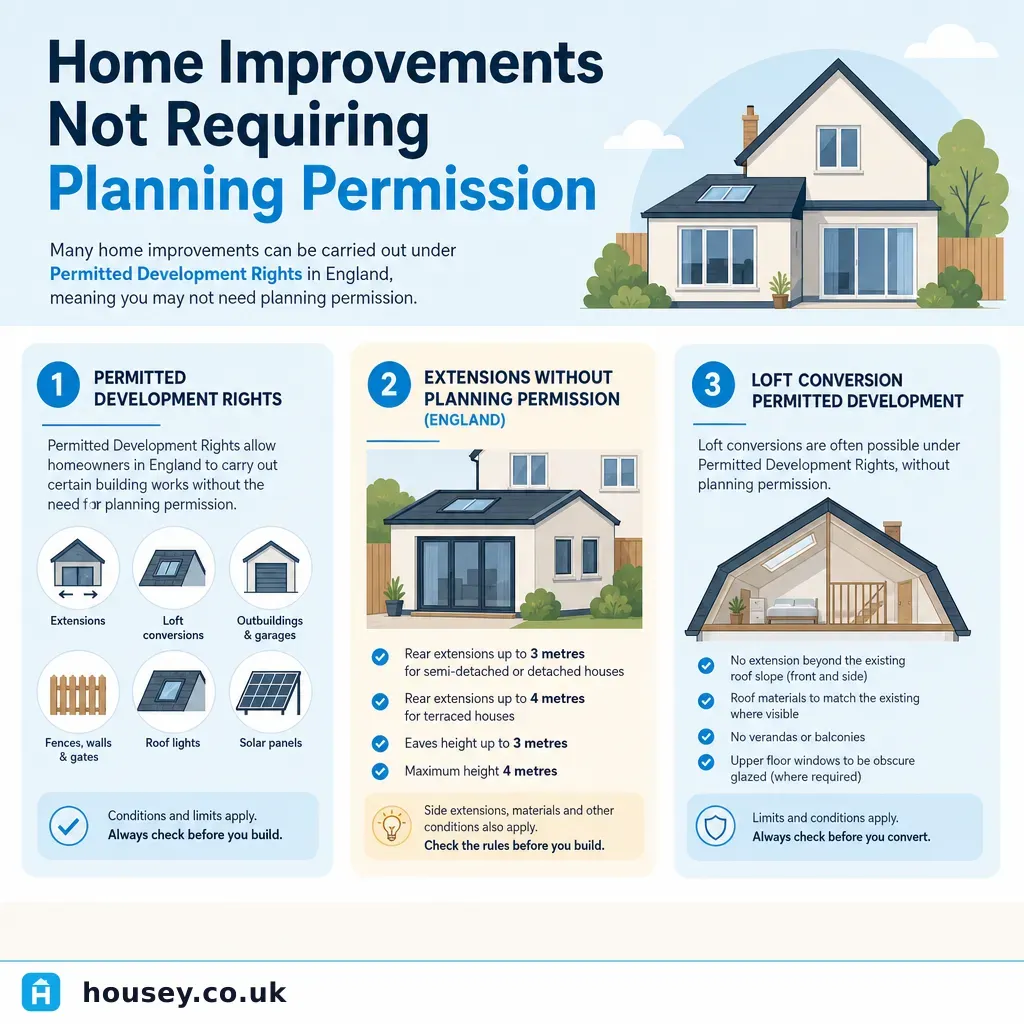
Home Improvements Not Requiring Planning Permission
Many common home improvements in England fall under Permitted Development Rights and do not require a planning application.
 Planning & Pre-Build
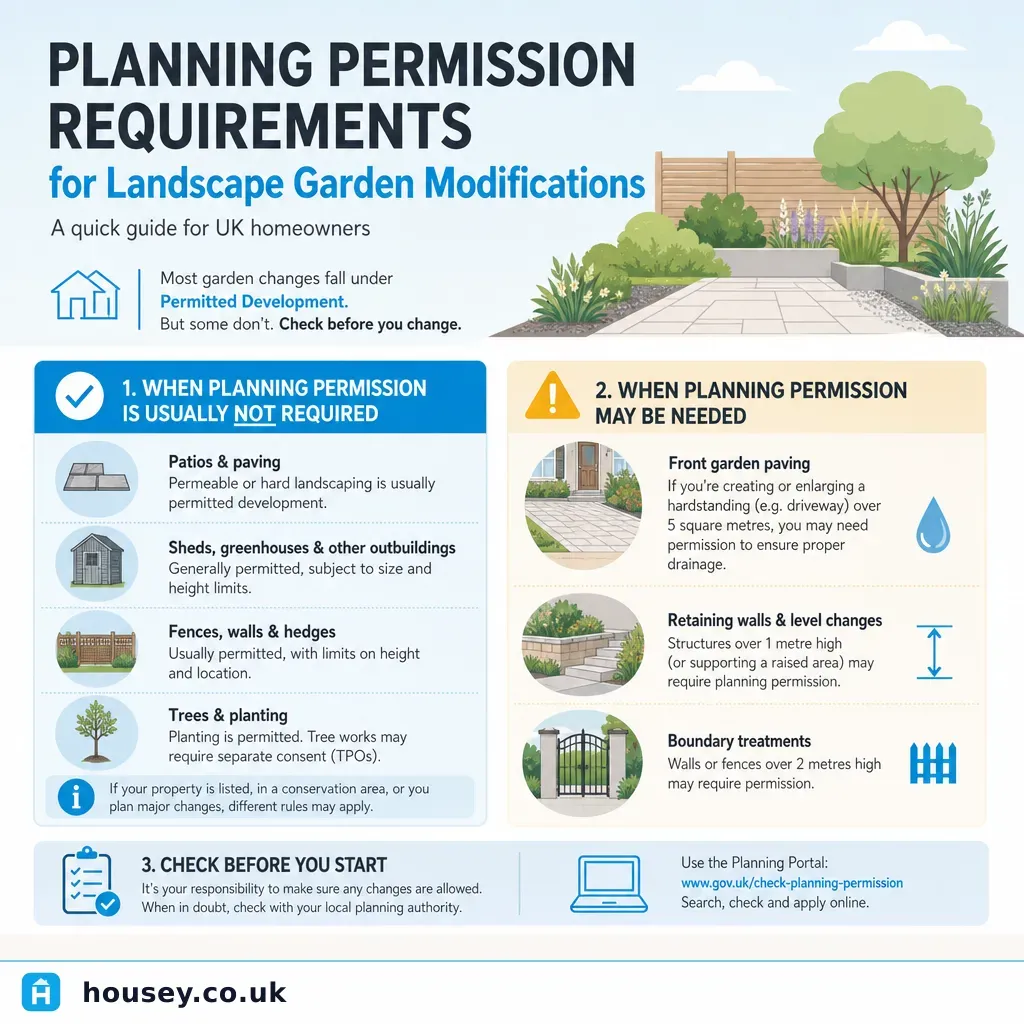
Planning Permission Requirements for Landscape Garden Modifications
Most garden landscaping in England does not require planning permission.
 Planning & Pre-Build
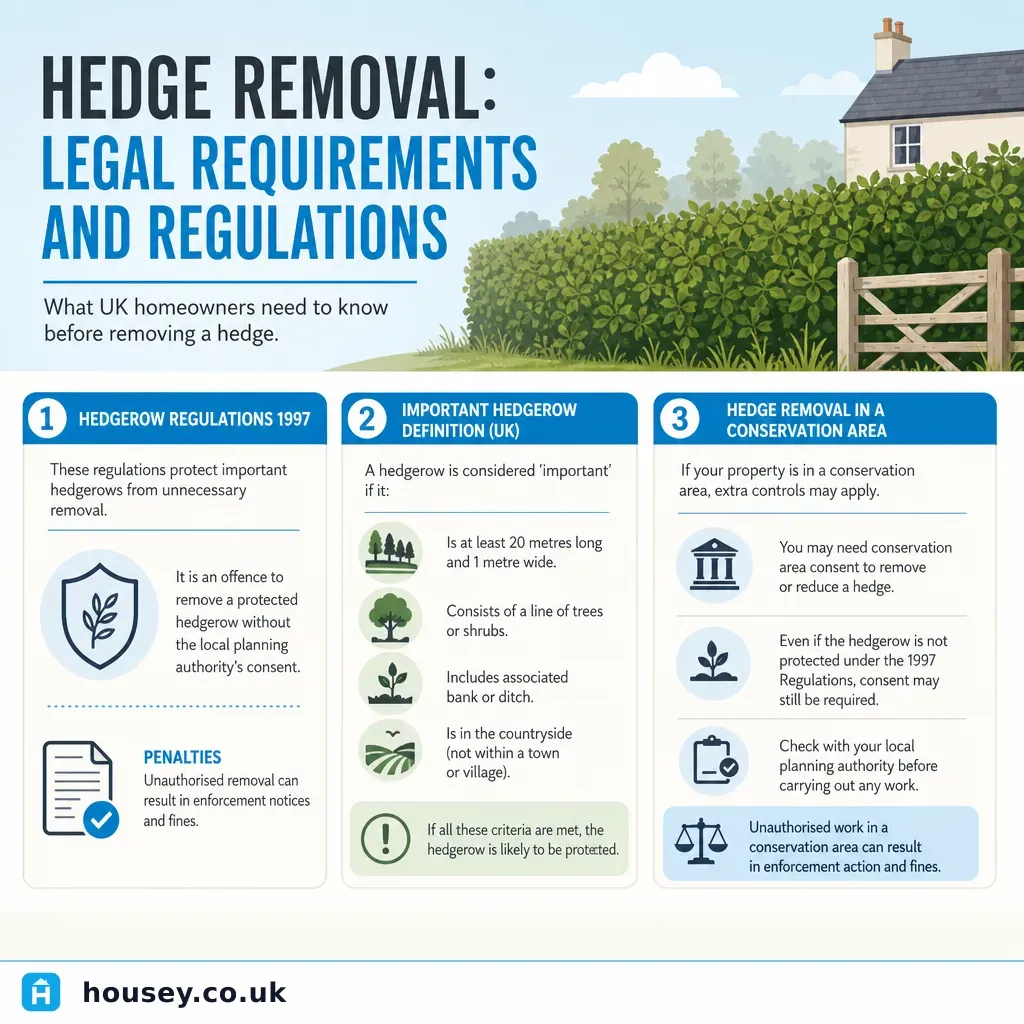
Hedge Removal: Legal Requirements and Regulations
Whether you need permission to remove a hedge in the UK depends on its location, age, and what it contains.
 Planning & Pre-Build
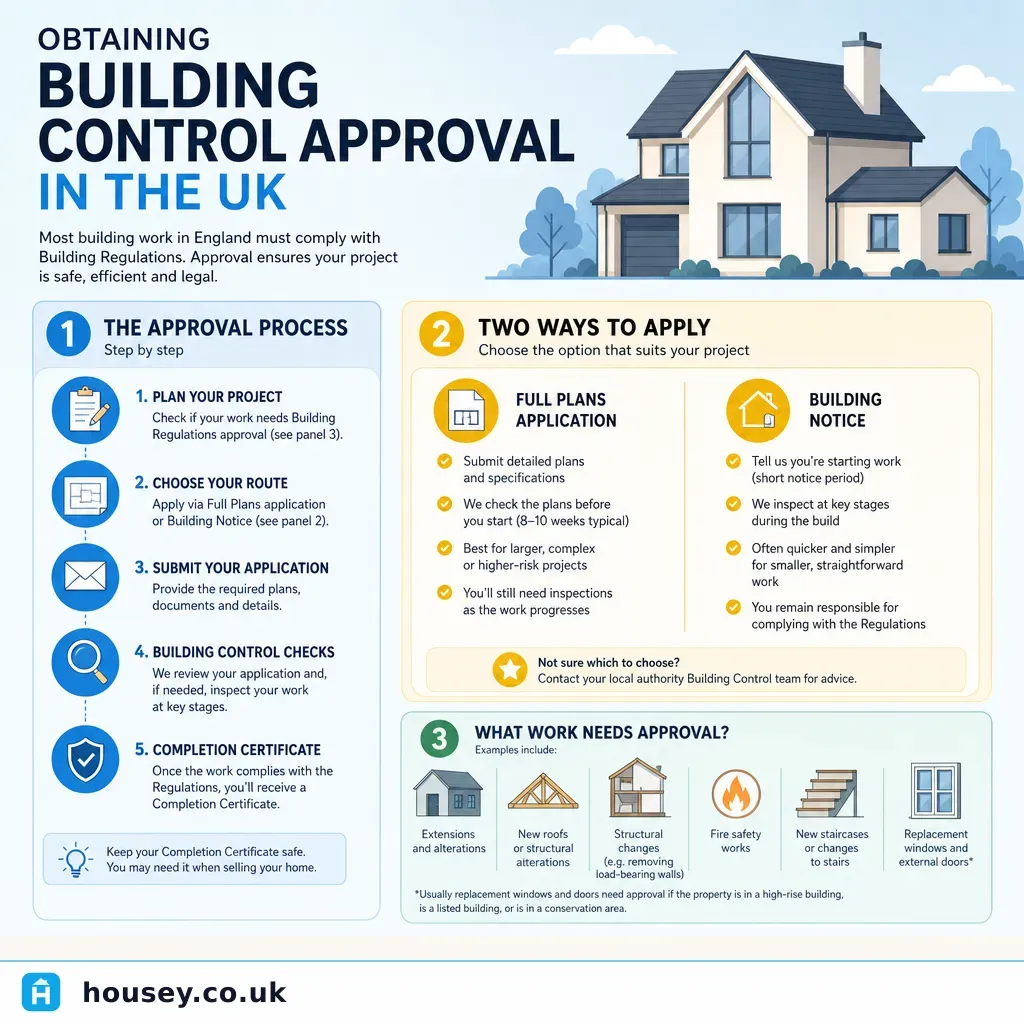
Obtaining Building Control Approval in the UK
Building control approval in the UK is required for most structural changes, extensions, loft conversions, and new builds.
 Planning & Pre-Build
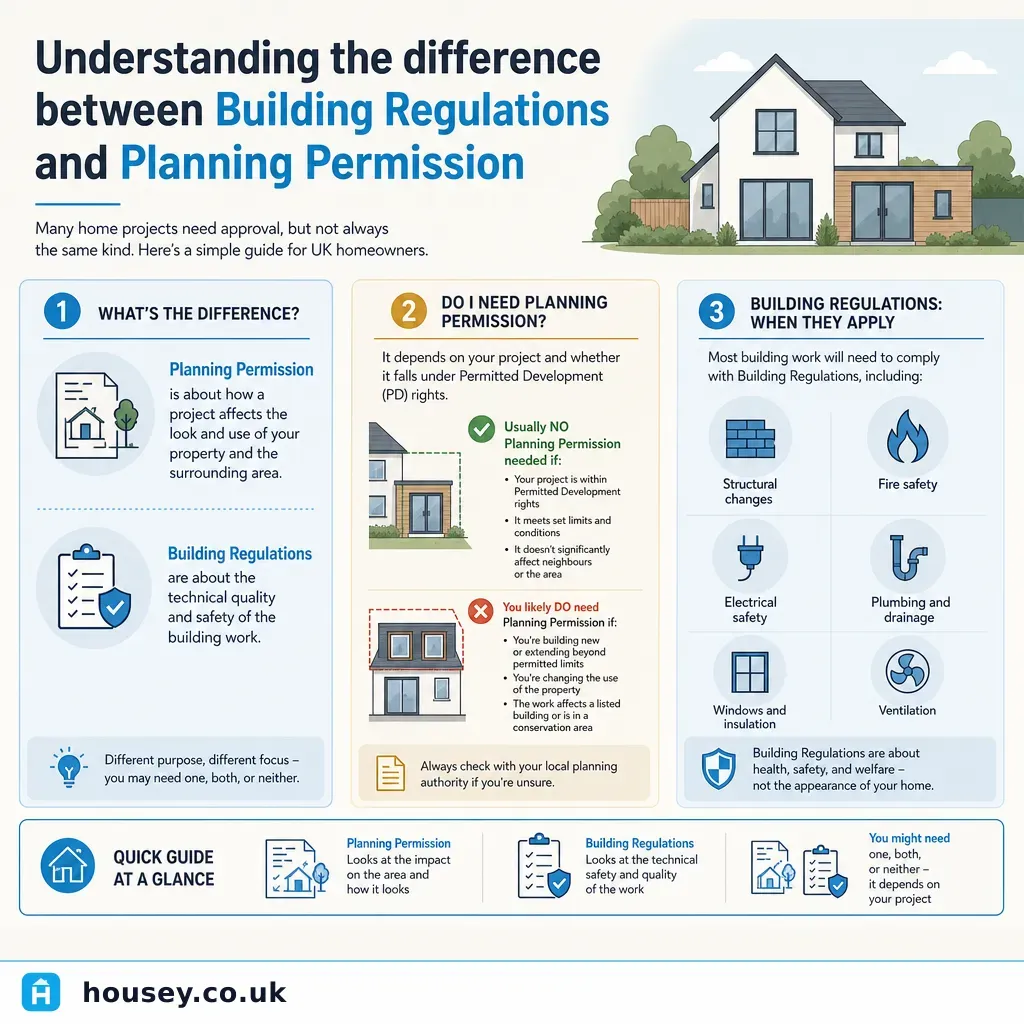
Understanding the difference between building regulations and planning permission
Planning permission is granted by your Local Planning Authority and controls whether a development is acceptable in principle — its appearance, use, and impact on the area.