Professional House Clearance Services for Your Home
By Housey · Last reviewed 24th of May 2026

Professional House Clearance Services for Your Home
House clearance is most commonly needed when a property is being sold, after a bereavement, ahead of a significant renovation, or at the end of a tenancy. The sheer volume of items involved — and the legal obligations around waste disposal — make it worth understanding exactly what a professional service covers and what to verify before you book.
Key points
- Waste carriers operating in England and Wales must hold a current registration with the Environment Agency; in Scotland they register with SEPA. You can verify any company's registration number on the Environment Agency's public register on GOV.UK.
- Using an unregistered carrier is illegal and, if waste is subsequently fly-tipped, the householder can face a fixed penalty notice of up to £400 or prosecution under the Environmental Protection Act 1990.
- Many clearance firms sort items for charity donation, resale, or recycling before anything goes to landfill — ask what proportion of waste they divert and how they evidence it.
- White goods and electrical items (WEEE) must be disposed of at an approved treatment facility under the Waste Electrical and Electronic Equipment Regulations 2013; a responsible firm handles this separately from general waste.
- Probate clearances involving potentially valuable items — antiques, jewellery, artwork, or collectable vehicles — may benefit from a pre-clearance valuation so nothing is inadvertently discarded.
What does a house clearance involve?
A full house clearance means removing all contents from a property: furniture, appliances, clothing, general rubbish, and sometimes garden waste. A partial clearance targets specific rooms or categories of items.
Most reputable firms follow a similar process:
- Carry out a pre-clearance survey — on-site or from photos — to estimate volume and provide a written price.
- Supply a trained team and appropriate vehicle(s) on the agreed date.
- Sort items into reusable, recyclable, and residual waste streams on site.
- Transport and dispose of everything at a licensed waste transfer station, or pass saleable items to charity.
- Leave the property broom-clean — confirm this is included in the quote if it matters to you.
Some firms also offer specialist services such as garden clearance, loft or garage clearance, office clearance, and end-of-tenancy clearance. These are usually priced separately.
How to choose a reputable house clearance company
What to look for before booking
Feature | Why it matters |
|---|---|
Environment Agency waste carrier registration | Legal requirement; absence is a significant red flag |
Public liability insurance | Protects you if property is damaged during the clearance |
Written, itemised quote | Prevents unexpected charges on the day |
Clear recycling and donation policy | Reduces your environmental liability and may offset cost |
Waste transfer note on completion | Your legal proof of compliant disposal under the duty of care |
Questions to ask before you confirm a booking
- Are you registered as a waste carrier, and what is your registration number?
- Do you hold public liability insurance, and for what value?
- Is the quote fixed, or could costs change on the day — and under what circumstances?
- What proportion of items do you divert from landfill through donation or recycling?
- Will you provide a waste transfer note after the job is complete?
- Does the price cover all rooms, including the loft, garage, and any outbuildings — or are those charged separately?
- Will you leave the property clean and ready?
What happens to items after clearance?
Responsible clearance companies operate a waste hierarchy: reuse and recycling come before landfill.
- Charity and resale: working furniture, clothing, books, and appliances are often passed to local charity shops or sold through resale platforms, which can offset clearance costs.
- Recycling: metal, glass, cardboard, and certain plastics are sorted and taken to licensed recycling centres.
- WEEE (electrical items): fridges, washing machines, televisions, and similar appliances must go to an approved treatment facility under the Waste Electrical and Electronic Equipment Regulations 2013.
- Hazardous waste: paint, batteries, chemicals, and fluorescent tubes require specialist disposal routes. Confirm whether the firm handles these and at what additional cost before you book.
Costs and what affects the price
Indicative UK costs, last reviewed 2026-05-24. Prices vary significantly by region, property size, and item volume. Always obtain at least two written quotes.
Typical price drivers include:
- Volume: number of rooms cleared, plus loft, garage, and outbuildings.
- Access: narrow staircases, no off-street parking, or properties above ground level add time and labour cost.
- Hazardous items: asbestos-containing materials, chemicals, or specialist electrical items require separate disposal routes and increase the price.
- Timing: urgent bookings and weekend slots usually attract a premium.
- Location: rural properties with limited nearby recycling infrastructure may cost more.
Some firms offset part of their costs by retaining and reselling items of value. Ask whether any such offset has been reflected in your quote.
When to get professional help
Most house clearances are straightforward, but seek additional specialist advice if:
- The property has been unoccupied for a long period and may contain hazardous materials — suspected asbestos-containing materials such as textured coatings, old floor tiles, or pipe lagging require assessment before any disturbance.
- You are managing a probate clearance and are uncertain about the legal position on specific belongings or contested items.
- There are items of potential value that should be assessed before clearance begins — antiques, artwork, jewellery, or vehicles.
- A local authority has issued an enforcement notice regarding property condition or the accumulation of waste.
Important: If you suspect asbestos-containing materials are present, do not disturb them. Arrange a professional asbestos survey before any clearance work begins. The HSE guidance on asbestos in the home explains the risks and what to do.
How Housey can help
Housey connects homeowners with vetted, Environment Agency-registered providers offering house clearance services across the UK. Describe what needs clearing, receive up to four fixed quotes, and compare recycling policies, availability, and pricing before you commit.
Frequently asked questions
Do I need to be present during a house clearance?
You do not have to be present throughout, but it is advisable to be on site at the start to identify items to keep. Many firms will work with a keyholder or estate agent if the owner cannot attend. Confirm this arrangement and any access arrangements in writing before the job begins.
Can a house clearance firm take fitted items like a kitchen?
Most general clearance firms handle loose furniture, appliances, and contents. Fixtures such as fitted kitchens, sanitary ware, and built-in wardrobes are usually outside scope — confirm what is included in your written quote before booking. A separate trade contractor is typically needed for fixture removal.
What is a waste transfer note and do I need one?
A waste transfer note is a legal document confirming that waste has passed from you to a registered carrier. Under the Environmental Protection Act 1990 you have a duty of care when transferring waste. You should request this note from your clearance firm and retain it for at least two years.
Can I reduce costs by disposing of some items myself?
Yes — using household waste recycling centres (HWRCs), arranging charity collections, or selling usable items through online platforms before the clearance team arrives can reduce the volume they need to handle and bring the overall price down. Discuss this with your provider when getting a quote.
Sources and further reading
- Waste carriers, brokers and dealers register — Environment Agency
- Your waste responsibilities: overview — GOV.UK
- Asbestos in the home — Health and Safety Executive
- Waste Electrical and Electronic Equipment (WEEE) explained — GOV.UK / DEFRA
Useful next reads
 Buying & Moving
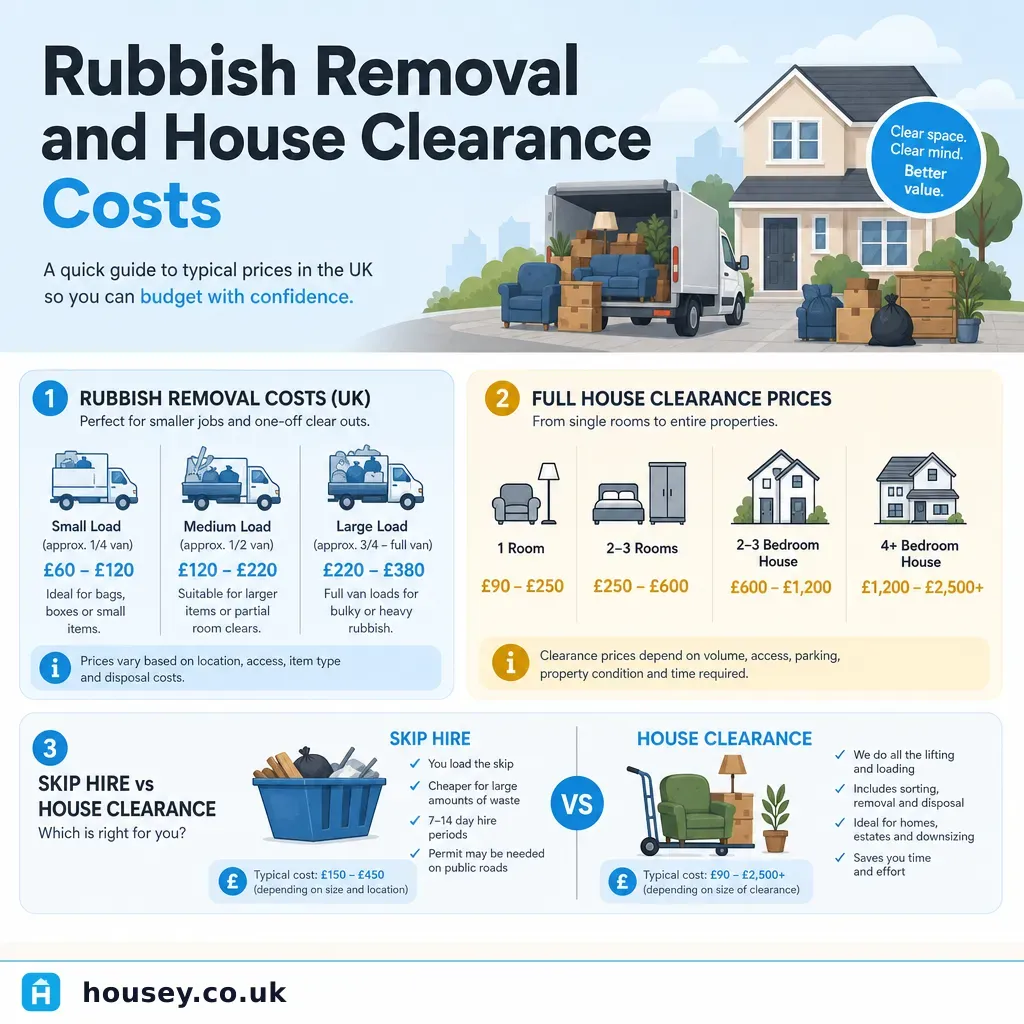
Rubbish Removal and House Clearance Costs
House clearance in the UK typically costs £150–£400 for a single room and £500–£1,500 for a full three-bedroom property, depending on volume, access, and hazardous items.
 Buying & Moving
House Clearance Pricing and Service Options
House clearance costs in the UK range from around £150 for a one-bedroom flat to £1,500 or more for a four-bedroom house, depending on volume, location, and how much can be donated or recycled.
 Buying & Moving
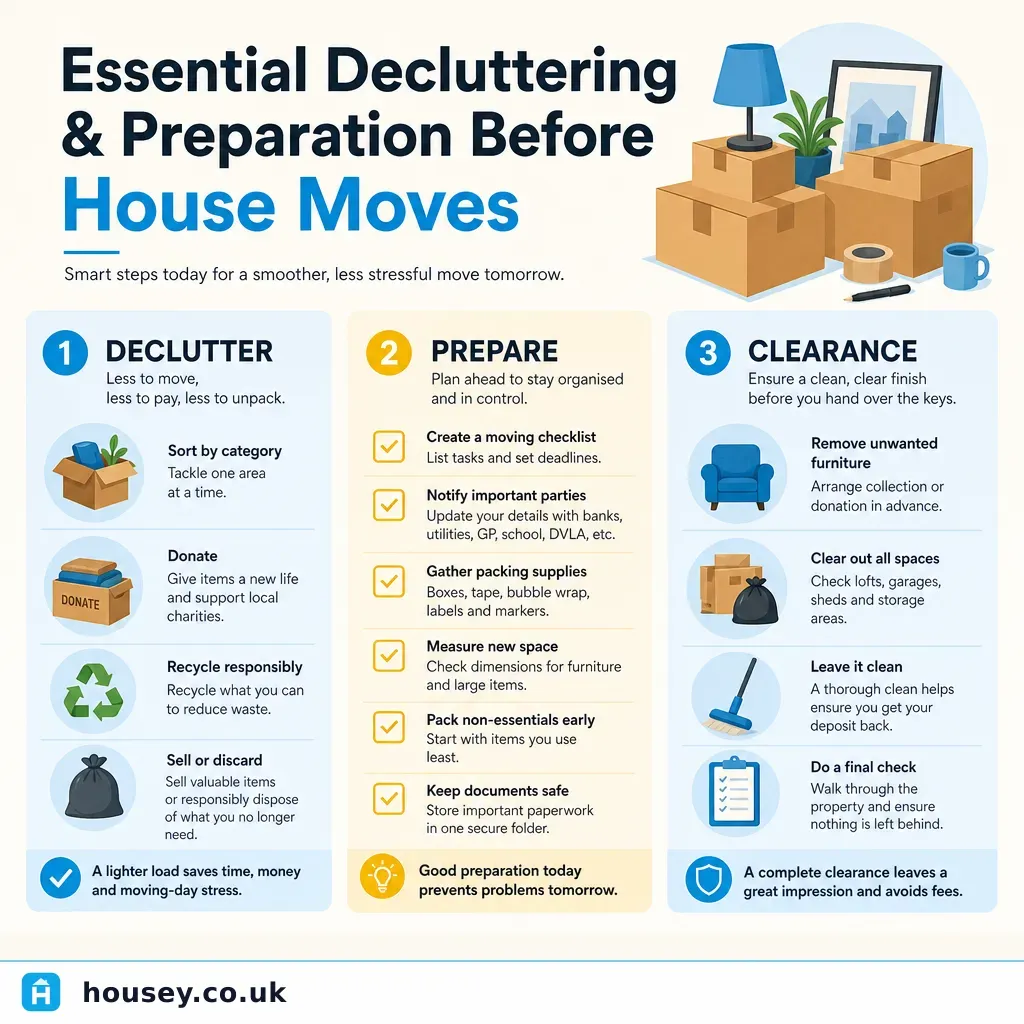
Essential decluttering and preparation before house moves
Decluttering before a house move reduces removal costs, improves property photographs, and simplifies unpacking.
 Buying & Moving
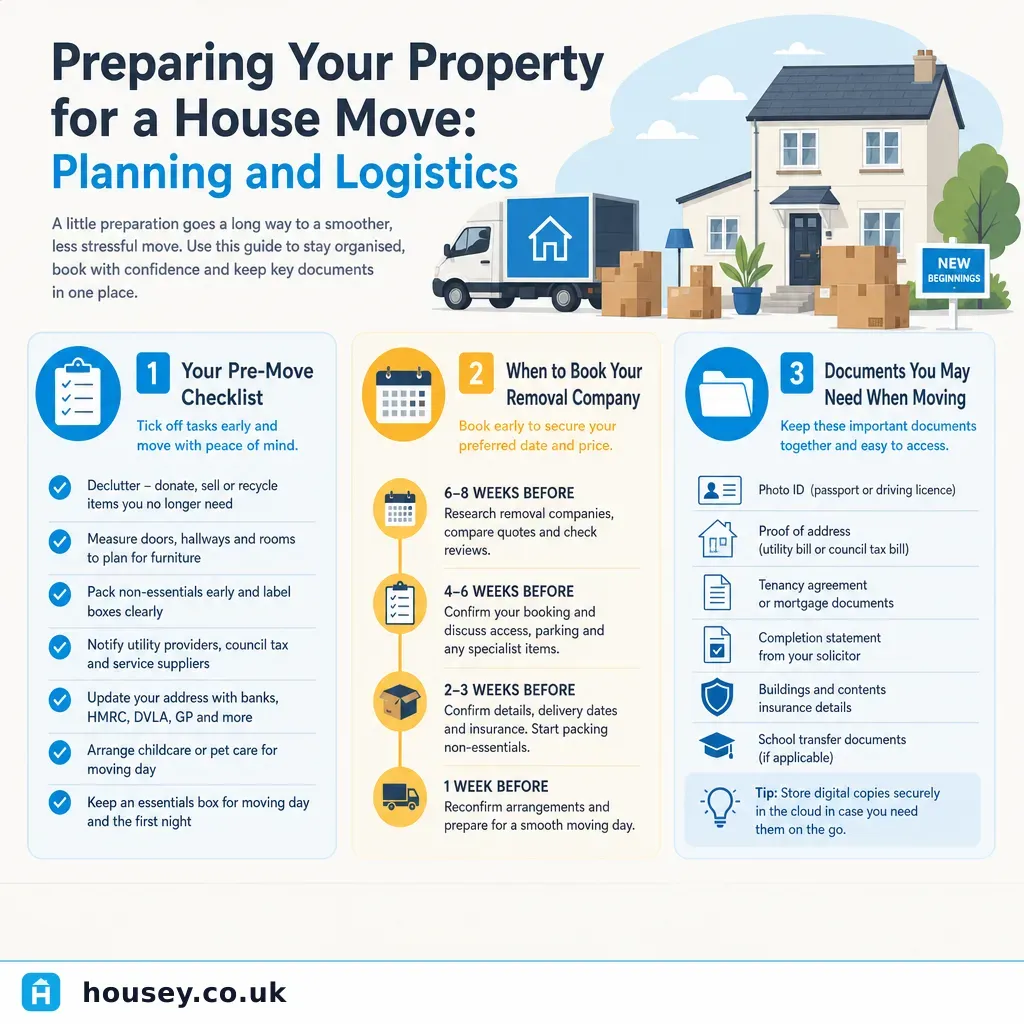
Preparing Your Property for a House Move: Planning and Logistics
Start preparing for a house move 6–8 weeks before your expected completion date.
 Buying & Moving
How to Plan a House Move: A Practical Guide to Residential Relocations
A UK house move goes more smoothly with planning that starts 6–8 weeks before moving day.