Essential Tools and Techniques for Home Inspection
By Housey · Last reviewed 11th of May 2026
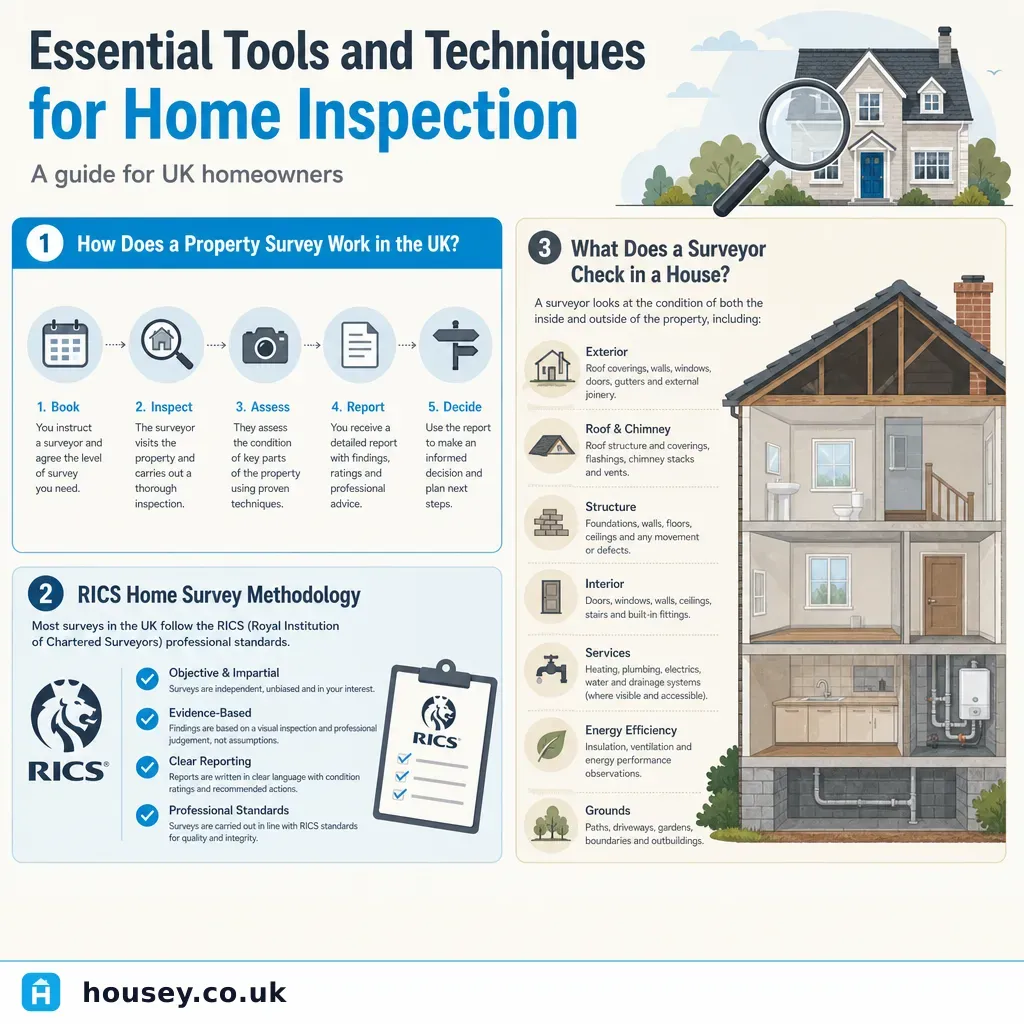
Essential Tools and Techniques for Home Inspection
When a chartered surveyor attends a property, the tools and techniques deployed have a direct bearing on which defects can be found — and which lie beyond the scope of a standard visual inspection. For buyers about to receive a survey report, or homeowners trying to understand what a professional commission actually covers, knowing how an inspection is structured helps make sense of both the findings and the caveats that accompany them. The methodology differs meaningfully between a RICS Level 1, Level 2, and Level 3 survey.
Key points
- The RICS Home Survey Standard (2021) sets the methodology and scope requirements for Level 1, Level 2, and Level 3 surveys across England, Wales, and Northern Ireland; Scottish surveys follow RICS guidance within a different legal and conveyancing framework.
- All RICS home surveys are visual and non-invasive — surveyors do not lift floorboards, drill into walls, or move furniture unless separately instructed to carry out an invasive defect investigation.
- Moisture meters and damp-detection probes are standard equipment for Level 2 and Level 3 surveys; a reading above approximately 20% WME (wood moisture equivalent) in timber indicates elevated moisture but does not diagnose its cause.
- Thermal imaging cameras can reveal heat loss, hidden moisture, and missing insulation not visible to the naked eye, but they are not included in a standard Level 2 survey — they typically form part of a specialist energy or enhanced defect assessment.
- A RICS Level 3 Building Survey uses a more extensive methodology than a Level 2, including inspection of accessible roof spaces and subfloor voids, detailed assessment of construction materials, and condition ratings with repair recommendations.
What tools do surveyors use during a home inspection?
Chartered surveyors attending a residential inspection carry a core set of equipment, with additional specialist instruments deployed for more detailed commissions. The table below summarises the most common tools and what each detects:
Tool | What it detects | Typically used in |
|---|---|---|
Moisture meter / damp probe | Elevated moisture levels in walls, floors, and timber | Level 2 and Level 3 surveys |
Binoculars | Roof covering condition, chimney flashings, ridge tiles — viewed from ground level | All survey levels |
Spirit level / plumb line | Floor slopes and walls out of plumb | Level 2 and Level 3 |
Torch | Dark spaces: loft, understairs cupboards, subfloor void | All survey levels |
Drain inspection camera | Blockages, root intrusion, pipe deformation, joint failure | Specialist drain survey — not standard |
Thermal imaging camera | Heat loss, hidden moisture, cold bridges, missing insulation | Specialist or enhanced Level 3 commission |
Borescope / endoscope | Inaccessible cavities or concealed service runs | Specialist or enhanced Level 3 commission |
Manhole cover lifter | Inspection of drainage access points and flow | Level 3; some Level 2 commissions |
Visual inspection techniques
The foundation of any residential survey is systematic visual inspection. A qualified surveyor follows a structured methodology — typically from the exterior inward and from the top of the building downward — to ensure no element is overlooked.
External inspection covers:
- Roof covering, ridges, hips, valleys, verges, and leadwork or flashing details around chimneys and dormers
- Chimney stacks, pots, and pointing
- Gutters, downpipes, and surface water drainage channels
- External walls: brickwork bond, mortar joint condition, render, movement cracks, and staining patterns
- Windows and external doors: frame material and condition, glazing seals, sills, and lintels
- Ground-level drainage, paved areas, boundary structures, retaining walls, and any outbuildings
Internal inspection covers:
- Roof space: structural members, insulation depth and placement, signs of water ingress or daylight, condensation, and vermin evidence
- Ceilings and cornices: staining, cracking patterns, and sagging
- Walls: plasterwork condition, damp patches, bulging or bowing, and crack morphology
- Floors: deflection, springiness, surface condition, and (where accessible) the subfloor void
- Windows and internal doors: operation, draughts, condition of frames and ironmongery
- Kitchens and bathrooms: ventilation provision, visible plumbing connections, surface and fitting condition
- Services: a visual observation only — the surveyor does not test, operate, or certify gas, electrical, or heating systems
Specialist equipment and when it is used
A standard Level 2 or Level 3 survey is a visual inspection. When a surveyor identifies a concern — or when a buyer requires deeper investigation — additional specialist assessments can be commissioned separately:
Concern identified | Recommended specialist assessment |
|---|---|
Elevated moisture meter readings in walls or timber | Invasive damp investigation by a qualified damp and timber specialist |
Suspected structural movement or significant cracking | Structural engineer's defect investigation and written report |
Older property or poorly mapped drainage | CCTV drain survey |
High heat loss or suspected missing or degraded insulation | Thermal imaging energy assessment (relevant to PAS 2035 retrofit planning) |
Pre-2000 property with original tile, insulation, or artex materials | Asbestos management or refurbishment/demolition survey by a UKAS-accredited provider |
Older timber roof or floor structure with signs of insect damage | Specialist timber and damp survey |
What homeowners and buyers can do before a survey
Practical preparation makes a survey more thorough and reduces the risk of the surveyor being unable to inspect key areas:
- Ensure the loft hatch is accessible and not blocked by stored items or insulation boards placed over the opening
- Unlock and clear all internal rooms, service cupboards, meter enclosures, outbuildings, and cellars
- Do not redecorate or cosmetically repair areas of visible concern shortly before the inspection — surveyors are trained to identify recent cosmetic work over defects, and concealment may give rise to misrepresentation issues in a transaction
- Gather relevant paperwork in advance: building regulations completion certificates, FENSA certificates for replacement windows, Gas Safe service records, electrical installation certificates, and any NHBC or structural warranty documentation
- Make a note of anything you have observed yourself: a ceiling stain that appeared after heavy rain, a sticking door that is getting worse, or a persistent damp smell in a particular room
Red flags that may prompt specialist follow-up
Even within a standard visual survey, certain findings consistently lead to recommendations for further specialist investigation:
- Moisture meter readings persistently above 20% WME in timber framing, or above approximately 75% relative moisture content in masonry — both indicate active moisture ingress requiring diagnosis
- Horizontal cracking along bed joints in brick walls, which may indicate lateral movement or wall tie failure in cavity properties built from the 1930s onwards
- Diagonal cracking above window and door openings, which can indicate lintel failure or differential settlement between elements
- Softness or springiness underfoot in timber floors, which may indicate wet rot, dry rot, or wood-boring beetle infestation
- Ceiling staining in upper rooms with no identifiable corresponding roof defect found during external inspection
- Bulging or bowing in external walls, particularly in Victorian or Edwardian solid-wall properties built without cavity ties
When to get professional help
A RICS-regulated survey is the appropriate professional inspection for most property transactions, but some situations call for expertise beyond a general survey:
- Commission a structural engineer if there is clear evidence of significant structural movement, widespread stepped cracking in brickwork, or suspected subsidence — a general survey flags the concern but an engineer provides diagnosis and remediation advice
- Instruct a specialist asbestos surveyor before any invasive renovation work in a property built before the year 2000
- Request a CCTV drain survey if the property is older, drains are not mapped on public records, or the surveyor specifically flags drainage concerns in the report
- Seek legal advice if the seller has carried out significant alterations without building regulations completion certificates — missing documentation may require a Regularisation Certificate or indemnity insurance before exchange
How Housey can help
Housey connects buyers and homeowners with RICS-regulated surveyors who carry out RICS Home Surveys at Levels 1, 2, and 3, as well as structural surveys for properties requiring a more detailed or specialist investigation. Providing surveyors with clear access and relevant documents before their visit helps them deliver the most complete and useful report possible.
Frequently asked questions
Why can't surveyors lift floorboards or drill into walls?
Standard RICS surveys are non-invasive — the surveyor inspects what is visible and accessible without causing damage to the property. Invasive investigation requires the owner's permission and is arranged as a separate specialist instruction when a standard survey identifies a concern that warrants closer examination. This boundary protects both the property and the surveyor's professional scope.
What is the difference between a moisture meter reading and a specialist damp survey?
A moisture meter is a screening tool that detects elevated moisture levels in building materials. An elevated reading prompts further investigation but does not diagnose the cause. Rising damp, condensation, penetrating damp, and plumbing leaks all produce different patterns. A specialist damp investigation, carried out by a qualified damp professional, interprets those readings and recommends specific remediation.
Can a surveyor check gas or electrical installations?
No. RICS surveyors make a visual observation of visible gas pipework, electrical fittings, and heating equipment, but they do not test or certify these systems. Gas safety is confirmed via a Gas Safe registered engineer's service record; electrical condition should be assessed via an Electrical Installation Condition Report (EICR) carried out by a qualified electrician registered with NICEIC or NAPIT.
Is a Level 3 Building Survey worth it for a newer property?
Usually, a Level 2 survey is sufficient for a conventional property built after around 1980 in apparent reasonable condition. A Level 3 is more appropriate for older, larger, unusual, altered, or visibly defective properties. If uncertain, ask a RICS surveyor to advise based on the specific property's age, construction type, and visible condition before you instruct.
Sources and further reading
- RICS Home Survey Standard (2021) — RICS
- Surveys and valuations: buying or selling your home — GOV.UK
- Electrical safety guidance for homeowners — Electrical Safety First
- Gas Safe Register: find a registered engineer — Gas Safe Register
Useful next reads
 Surveys & Inspections
Getting a Valuation Survey Before Selling Your Property
Before selling, a free estate agent appraisal gives a market price guide, but only a RICS Red Book valuation carries formal professional standards and legal weight.
 Surveys & Inspections
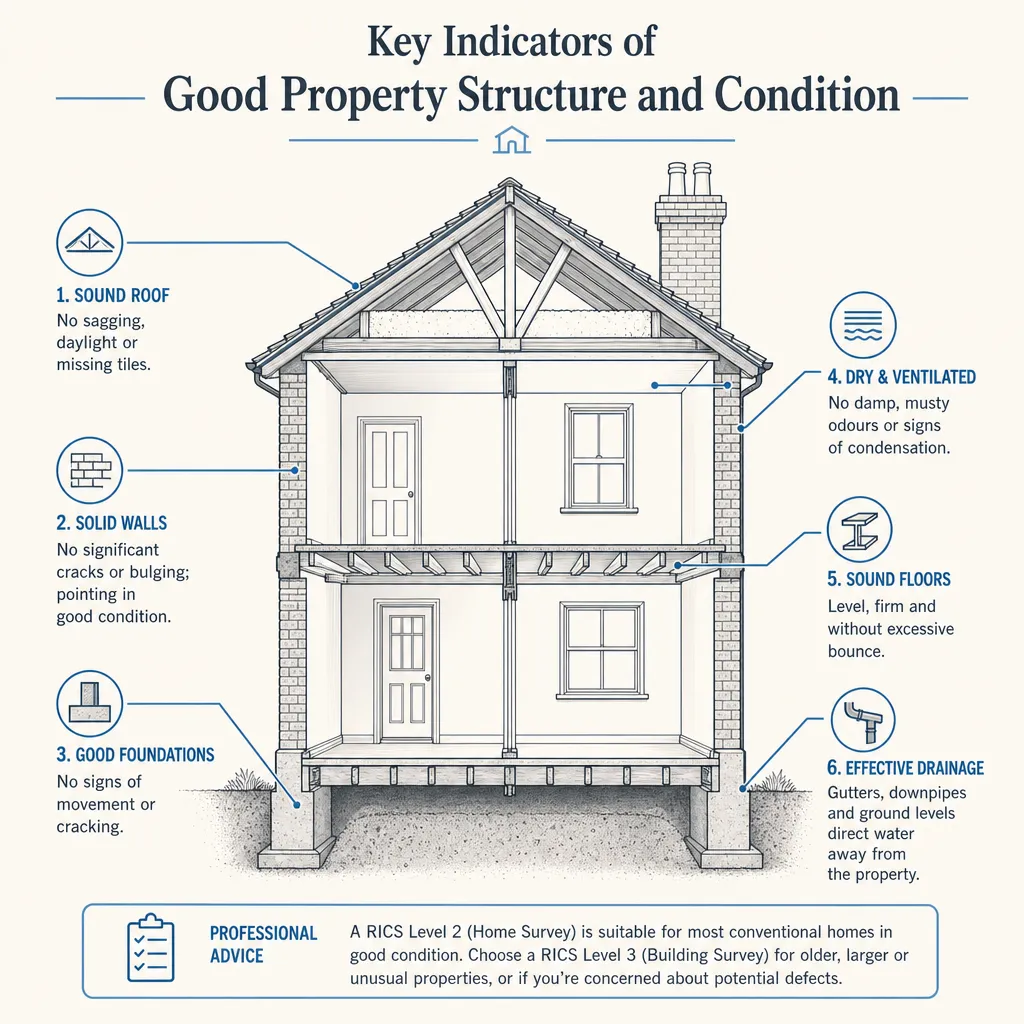
Key Indicators of Good Property Structure and Condition
Good property structure is indicated by plumb walls, level floors, crack-free masonry at corners and above openings, an intact roof covering, and dry internal surfaces.
 Surveys & Inspections
How Professional Home Surveys Deliver Real Value For Buyers
A professional home survey by a RICS-registered surveyor can identify defects, legal compliance gaps, and cost liabilities before exchange of contracts, giving buyers an evidence base for negotiation or withdrawal.
 Surveys & Inspections
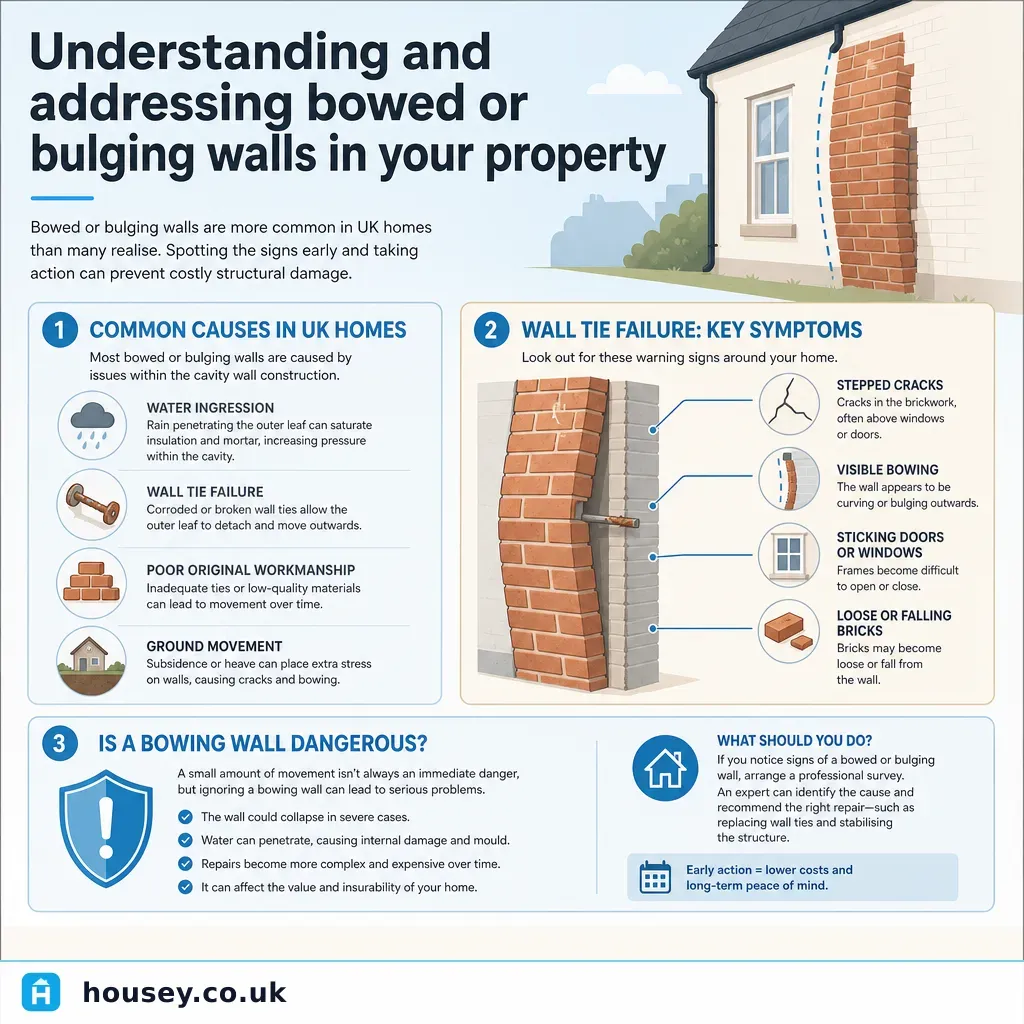
Understanding and addressing bowed or bulging walls in your property
A bowed or bulging wall may indicate wall tie failure, foundation movement, or overloading.
 Surveys & Inspections
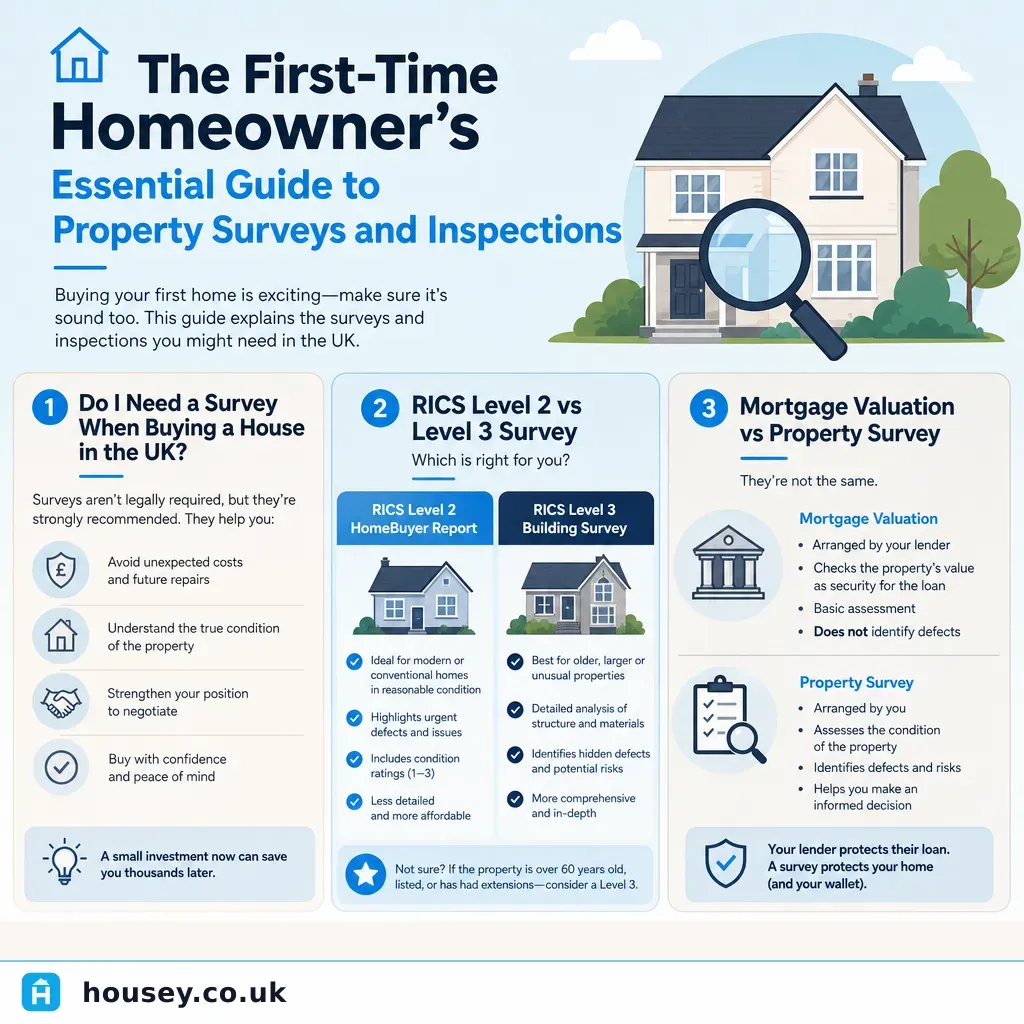
The First-Time Homeowner's Essential Guide to Property Surveys and Inspections
First-time buyers in the UK need more than the mortgage valuation — that report protects the lender, not you.