Guidelines for Estimating Your Residential Construction Project Costs
By Housey · Last reviewed 31st of May 2026
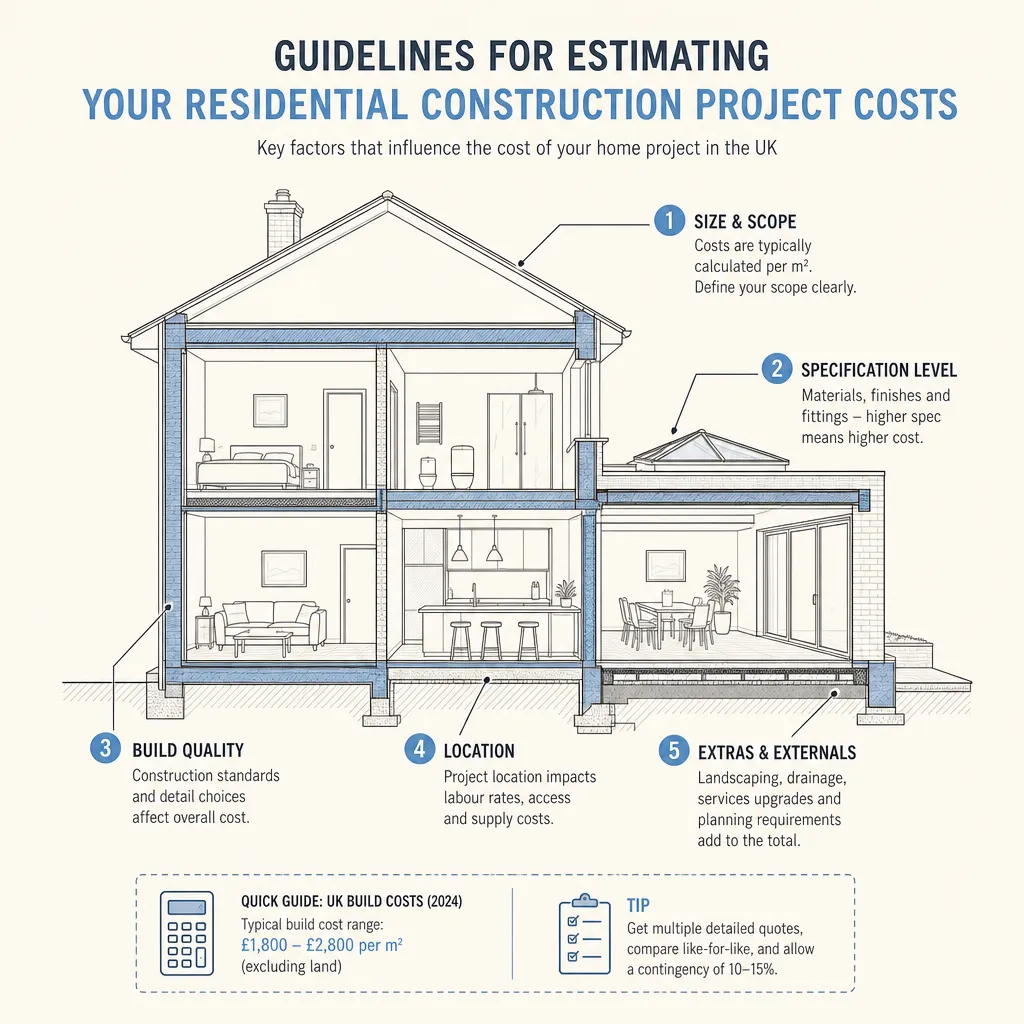
Guidelines for Estimating Your Residential Construction Project Costs
UK homeowners planning an extension, conversion, or new build face the same early challenge: how do you arrive at a credible budget figure before a contractor sets foot on site? Getting this wrong — either over- or under-estimating by a wide margin — can cause projects to stall mid-build, make a planning application unviable, or leave you unable to commit to any work at all. Understanding how estimates are produced, and how their accuracy changes as design develops, helps you make better decisions at every stage.
Key points
- The RICS Building Cost Information Service (BCIS) publishes indicative residential construction costs per square metre, broken down by region and building type — these are the industry-standard reference for early-stage feasibility.
- A bill of quantities (BoQ) produced by a quantity surveyor at RIBA Stage 3 or 4 gives the most accurate pre-tender cost picture and is the basis for competitive tender.
- Regional cost variation is significant: construction costs in London and the South East can be 20–30% above the national average, while the North of England and Wales often run 10–15% below.
- Ground investigation (trial pit or borehole survey) should be factored into any estimate involving new foundations, as abnormal ground conditions can add tens of thousands to a project.
- Preliminaries — contractor site setup, hoarding, scaffolding, welfare, and waste removal — typically add 10–20% on top of measured trade costs and are commonly underestimated in early informal figures.
What does "estimating" actually mean at each project stage?
Estimation is not a single event; it is a series of increasingly refined calculations as the design develops. Understanding where you are in this progression helps you interpret any figure you receive.
RIBA Stage | Design status | Estimate type | Typical accuracy range |
|---|---|---|---|
0–1: Strategy / Preparation | No drawings | Order of magnitude / feasibility | ±30–40% |
2: Concept Design | Outline drawings, area schedule | Elemental cost plan | ±20–25% |
3: Spatial Coordination | Developed design, outline specification | Detailed cost plan | ±10–15% |
4: Technical Design | Full working drawings and specification | Bill of quantities / tender | ±5–10% |
Post-tender | Accepted contractor price | Contract sum | Reflects accepted tender |
An estimate given at RIBA Stage 2 is not a quote; treat it as a planning tool, not a financial commitment.
Key cost drivers for residential construction
Several factors push costs above or below national benchmarks.
Location London and the South East carry a significant labour cost premium. BCIS regional indices are the most reliable way to adjust national benchmarks to your specific area.
Specification level A standard kitchen in a rear extension costs a fraction of a bespoke joinery kitchen. Separating the shell-and-core cost from fitting-out costs helps keep early estimates realistic and prevents a low initial figure obscuring the true project cost.
Site access and logistics A terraced house in a dense urban street with no vehicle access costs more to build than a detached home with direct road access. Crane hire, restricted working hours, and manual handling all add to preliminaries costs.
Ground conditions Standard strip or raft foundations are priced into most benchmarks. If your site has made ground or fill, a high water table, clay shrinkage risk (common in London and the South East), or proximity to trees, abnormal foundation costs can be significant. A ground investigation report typically costs £500–£2,500 depending on scope and is usually worth commissioning before finalising a budget. Indicative UK costs, last reviewed 2026-05-31.
Existing structure condition For extensions to older properties, unforeseen structural issues — inadequate existing foundations, corroded lintels, damp ingress — discovered during work typically generate variations. Build in a higher contingency (15–20%) for pre-1945 properties.
Residential construction cost benchmarks
The following are indicative benchmark ranges only, derived from published BCIS data and industry guidance, last reviewed 2026-05-31. Actual costs depend on specification, location, site conditions, and prevailing market conditions. Always obtain multiple quotes based on full drawings and specification before committing to a budget.
Project type | Indicative cost per m² or total (excl. VAT, UK average) | Notes |
|---|---|---|
Single-storey rear extension | £1,800–£2,800/m² | Specification-dependent; excludes fit-out above standard level |
Two-storey extension | £1,600–£2,500/m² | Some economies of scale over single-storey |
Loft conversion (dormer) | £35,000–£75,000 total | Highly variable; depends on roof structure and finish |
Garage conversion | £15,000–£35,000 total | Depends on insulation, services connection, and finish |
New-build house (traditional masonry) | £1,800–£3,000/m² | Excludes land; highly location-dependent |
Barn conversion | £2,000–£4,000+/m² | Structural and planning costs are significant additional factors |
These are broad benchmarks. A RICS-accredited quantity surveyor should be engaged to produce a project-specific cost plan before approaching contractors for tenders.
Decision tree: which cost advice do you need?
- Order of magnitude feasibility only? Use BCIS benchmarks or an online cost calculator as a rough guide. Do not make financial commitments on this basis.
- Cost plan to support a planning or finance application? Engage a RICS-accredited QS for an elemental cost plan at RIBA Stage 2, based on outline design proposals.
- Ready to go to tender? Commission full working drawings and specification, then have a QS produce a bill of quantities for competitive tender with multiple contractors.
- Already have quotes — do they stack up? A QS can independently review and compare tenders, checking arithmetic, scope gaps, and abnormally low bids.
- In dispute about a final account? A RICS-registered QS can act as an independent assessor or expert witness in adjudication or litigation.
How to get quotes you can actually compare
Getting multiple quotes only works if all contractors are pricing the same scope. A quote-comparison template helps.
What to ask for in a written quote
- A full itemised breakdown of labour, materials, and preliminaries — not a single lump sum.
- Confirmation of whether VAT is included or excluded.
- Named subcontractors, or confirmation that the main contractor completes all work.
- Programme: start date, duration, and milestone dates.
- Payment schedule: how and when payments fall due.
- Provision for variations: what rate applies to any instructed changes.
- Retention terms, if applicable.
- Assumptions and exclusions: ground conditions, builder's work for services, specialist items.
Red flags in a quote
- A single-line price with no breakdown of labour, materials, or preliminaries.
- No mention of VAT.
- A large upfront payment requested before work begins.
- No start or end dates given.
- No mention of how variations will be priced once work is under way.
- A price substantially lower than all other quotes — check what scope has been excluded.
When to get professional help
Engage a RICS-accredited quantity surveyor or cost consultant:
- Before securing finance or mortgage facilities based on a project cost figure.
- When quotes from contractors vary by more than 20–25% — this often signals different scope interpretations rather than a genuine pricing difference.
- When a project involves unknown ground conditions, structural alteration, or an older property with a complex history.
- When the project value exceeds approximately £50,000.
- Before signing any contract where your financial exposure is significant.
Self-produced estimates using online calculators or cost-per-m² benchmarks are useful for early feasibility but should not be the basis for financial commitments.
How Housey can help
Housey connects UK homeowners with RICS-accredited professionals for build cost estimating and residential project managers. You can request quotes from local quantity surveyors and cost consultants and compare their scope, fees, and accreditations before committing.
Frequently asked questions
How accurate is a cost-per-square-metre estimate for a home project?
Cost-per-m² figures are useful for order-of-magnitude feasibility only. They do not capture specification level, site-specific constraints, regional variation within a county, or scope items such as demolition, abnormal groundworks, or Party Wall matters. RICS guidance cautions against treating benchmark rates as reliable project budgets without further analysis from a qualified QS.
Do I need a quantity surveyor for a domestic extension?
A QS is not a legal requirement for a domestic extension but is strongly advisable for projects above approximately £50,000. A QS provides an independent cost plan, supports competitive tendering, certifies payment valuations, and advises on variations and final account settlement. Their fee is typically recovered in better cost control and avoided disputes.
What are 'preliminaries' on a building estimate?
Preliminaries cover contractor costs not attributable to a specific trade: site management, scaffolding, hoarding, welfare facilities, skips, waste disposal, insurance, temporary services, and site security. These typically add 10–20% to measured trade costs and are often omitted or underestimated in early informal estimates. Always check whether a quote shows preliminaries separately or embeds them in trade rates.
Can I estimate costs before getting planning permission?
Yes — and you should, as part of assessing feasibility before spending money on a planning application. At this stage, use BCIS benchmarks or commission a QS for a RIBA Stage 1–2 cost plan based on outline proposals. Flag key assumptions such as standard ground conditions and standard specification so the figure can be updated once planning is granted and detailed design develops.
Sources and further reading
Useful next reads
 Improvement & Build
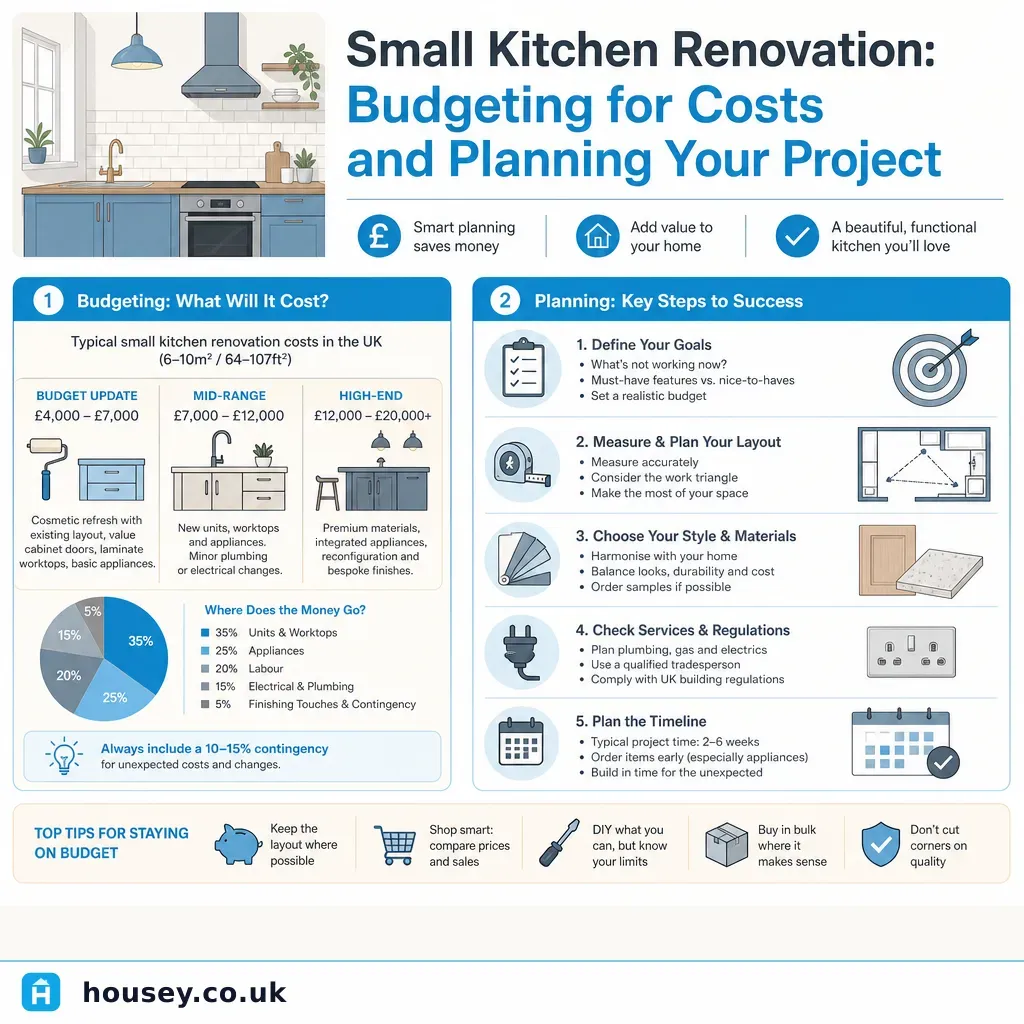
Small kitchen renovation: budgeting for costs and planning your project
A small kitchen renovation in the UK typically costs £5,000–£15,000 for a full refresh including new units, worktops, tiling, and appliances, though costs vary widely by specification, region, and whether structural changes or rewiring are involved.
 Improvement & Build
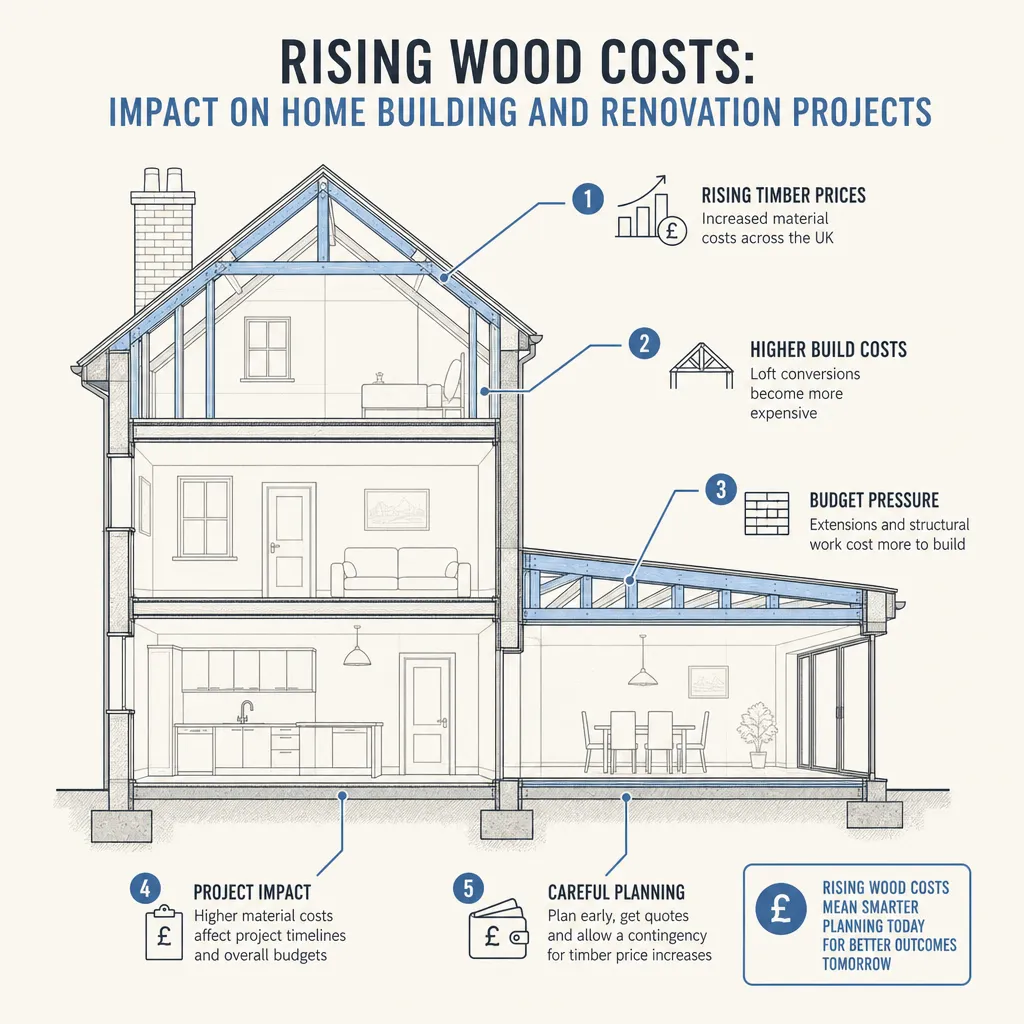
Rising Wood Costs: Impact on Home Building and Renovation Projects
Rising timber prices affect UK home renovation budgets most on timber-frame extensions, loft conversions, and self-builds, where structural wood can account for 15–25% of material costs.
 Improvement & Build
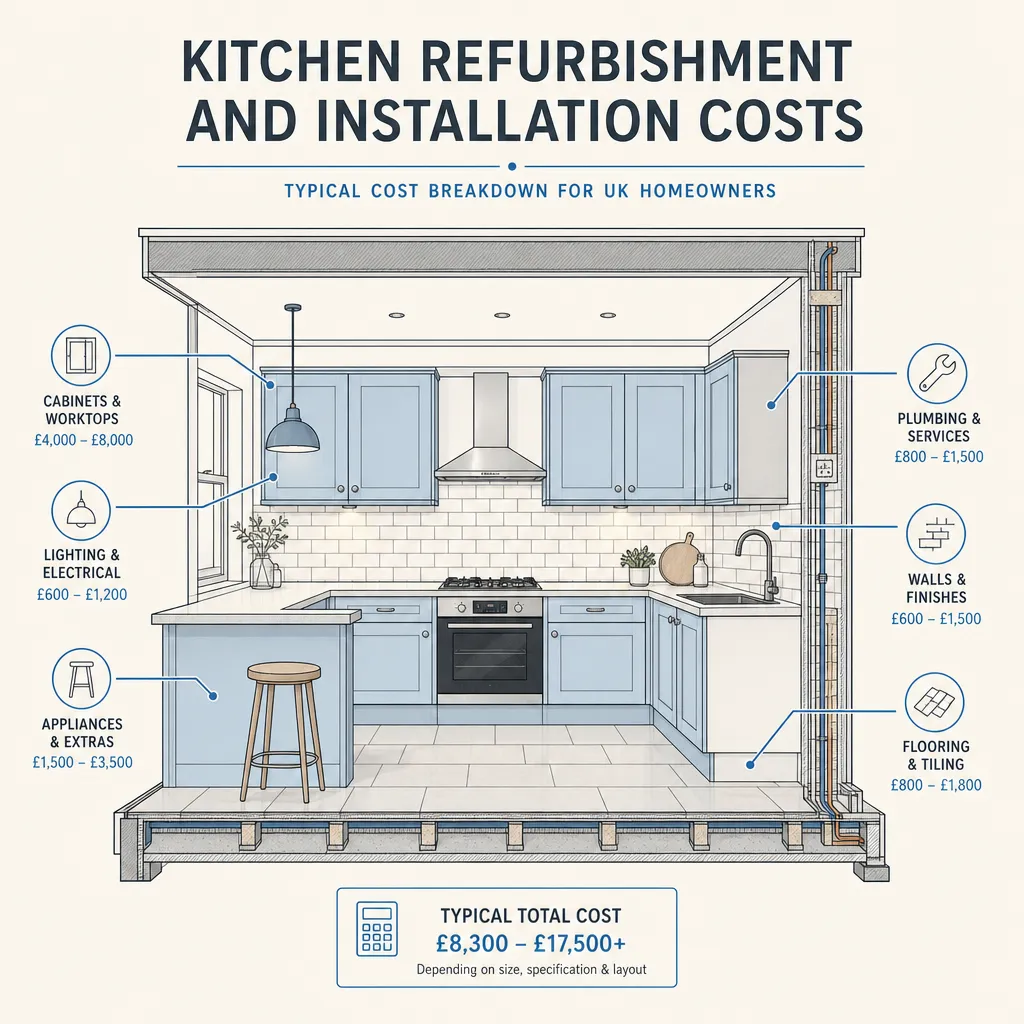
Kitchen Refurbishment and Installation Costs
A kitchen refurbishment in the UK typically costs between £3,000 and £40,000 or more, depending on whether you are replacing units only or carrying out a full design-and-build project.
 Improvement & Build
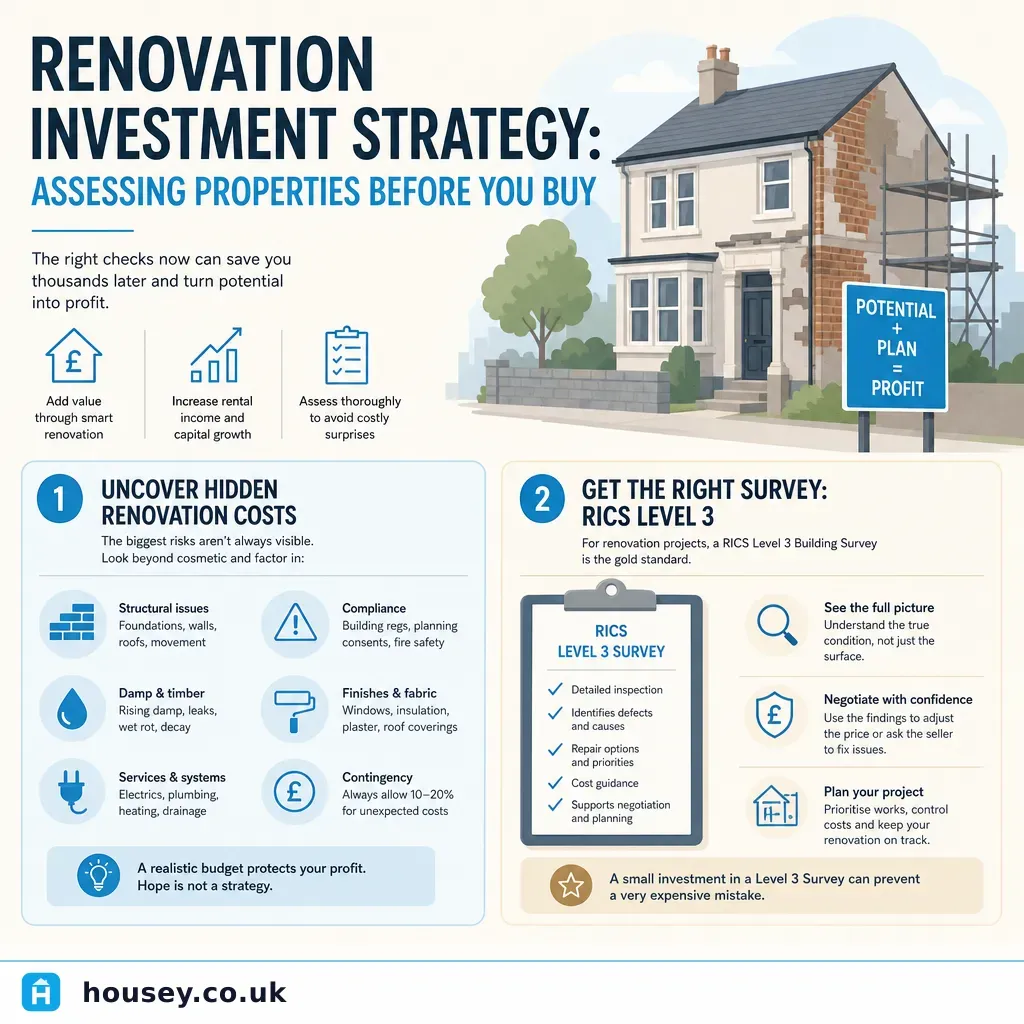
Renovation Investment Strategy: Assessing Properties Before You Buy
Renovation investment properties require more due diligence than a standard home purchase.
 Improvement & Build
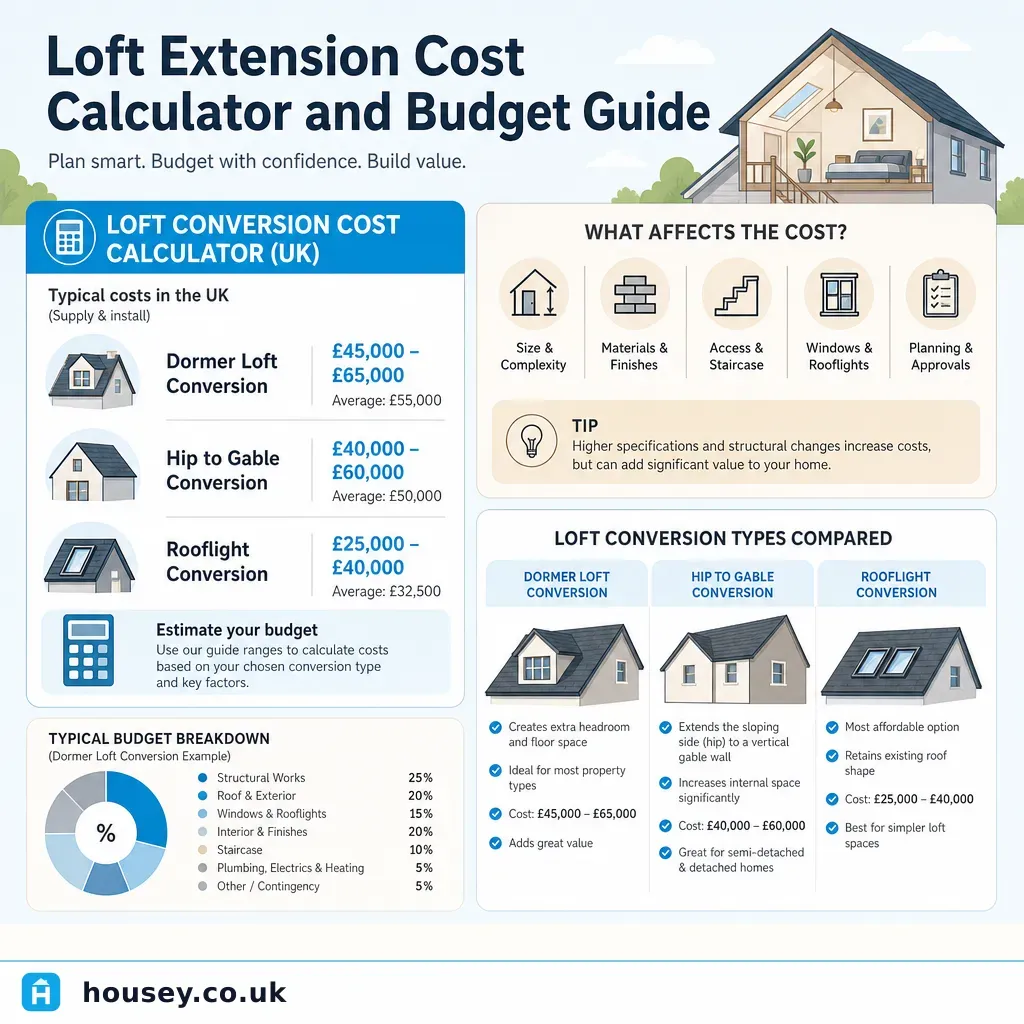
Loft Extension Cost Calculator and Budget Guide
Loft extension costs in the UK typically range from £15,000 for a basic Velux conversion to £75,000 or more for a mansard or L-shaped dormer.