Understanding Electric Vehicle Charger Installation Costs
By Housey · Last reviewed 10th of May 2026
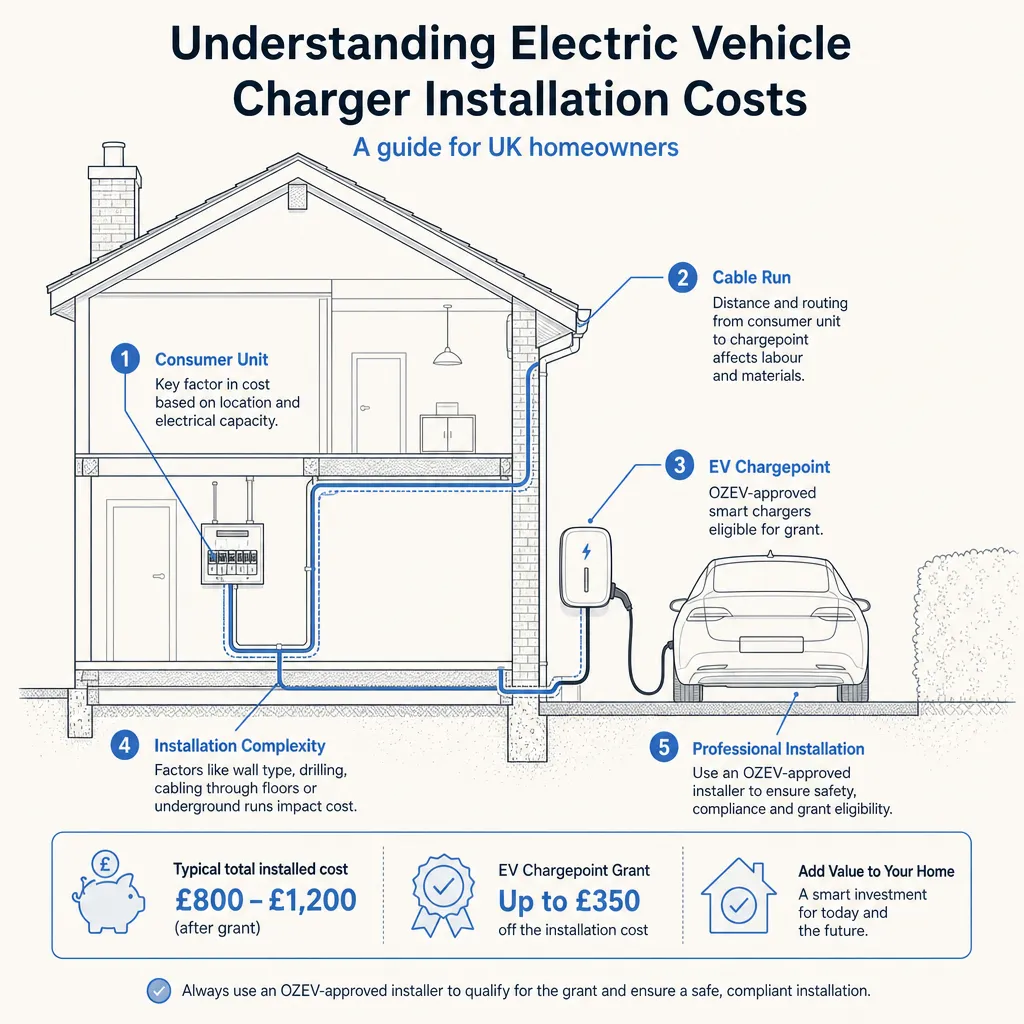
Understanding Electric Vehicle Charger Installation Costs
As more UK households switch to electric vehicles, arranging home charging has become a routine part of EV ownership rather than an afterthought. For most drivers, a dedicated wallbox charger — installed by an Office for Zero Emission Vehicles (OZEV)-approved electrician — offers the most convenient and cost-effective way to charge overnight. However, installation costs vary considerably depending on charger specification, the condition of your existing electrical supply, and whether you qualify for government grant support. Understanding what drives the price helps you evaluate quotes accurately and avoid unexpected costs once work has begun.
Key points
- A standard 7kW smart wallbox charger, installed by an OZEV-approved installer, typically costs £800–£1,200 all-in (Indicative UK costs, last reviewed 2026-05-10 — obtain quotes as prices vary by location and property).
- The EV Chargepoint Grant (administered by the Office for Zero Emission Vehicles — OZEV) provides up to £350 or 75% of purchase and installation cost, whichever is lower, for eligible flat owners and landlords of residential properties.
- Since 30 June 2022, all new home charge points must comply with The Electric Vehicles (Smart Charge Points) Regulations 2021 — smart functionality including demand response and scheduling is a legal requirement, not an optional feature.
- Home EV charger installation is notifiable under Part P of the Building Regulations (England and Wales) and must be carried out by a registered competent person.
- Most 7kW chargers need a 100A meter supply and a spare way in the consumer unit — upgrades to either add to the overall installation cost.
What type of home EV charger do you need?
Most UK homeowners choose a Mode 3 AC wallbox for home installation. The comparison below covers the main options and their practical suitability.
Charger type | Power output | Charging speed (approx.) | Suitable for home install? | Grant-eligible? |
|---|---|---|---|---|
3-pin plug with EVSE cable (Mode 2) | 2.3kW | ~8–12 miles of range per hour | Emergency or temporary use only | No |
7kW AC wallbox (Mode 3, single-phase) | 7kW | ~25–30 miles per hour | Yes — standard home installation | Yes (if eligible) |
22kW AC wallbox (Mode 3, three-phase) | 22kW | ~75–80 miles per hour | Rare — most homes have single-phase supply | Yes (if eligible) |
DC rapid charger | 50kW+ | Very rapid | No — commercial and public use only | No |
For most UK homes with a single-phase supply, a 7kW wallbox is the practical and cost-effective choice. A 22kW charger requires a three-phase supply, which is uncommon in domestic properties — check with a qualified electrician before specifying anything above 7kW.
What affects the cost of EV charger installation?
Several factors influence whether you pay at the lower or higher end of the typical range:
- Cable run length: A long cable run from the consumer unit to the charger location — for example, a detached garage at the end of a garden — adds material and labour costs.
- Groundworks: Burying cables between a house and a detached garage or outbuilding requires trenching. Depending on distance and ground conditions, expect to add approximately £200–£600.
- Consumer unit capacity: If your consumer unit has no spare ways or is underpowered, a new way, load-limiting device, or full replacement may be needed — typically adding £300–£800 or more.
- Meter supply rating: Some older properties have a 60A supply; a 7kW charger draws up to 32A and needs a 100A supply. A supply upgrade requires co-ordination with your Distribution Network Operator (DNO) and can take several weeks to arrange.
- Charger specification: Premium brands with solar integration, larger displays, or advanced load-balancing features cost more upfront. Basic compliant units start from around £300–£500 in hardware cost alone.
- Access and location: Installations on outbuildings, in difficult-access locations, or requiring additional weatherproofing may attract higher labour costs.
The EV Chargepoint Grant: how to claim
The EV Chargepoint Grant replaced the previous Electric Vehicle Homecharge Scheme (EVHS) in April 2022. The current grant is available to:
- People living in flats (whether owning or renting) with access to associated off-street parking.
- Landlords of residential properties — a separate landlord stream applies.
Homeowners of houses (not flats) are no longer eligible for the homeowner EV Chargepoint Grant. Check current eligibility criteria on the OZEV pages of GOV.UK before committing to an installer, as scheme rules can change.
How to claim:
- Choose an OZEV-approved installer — they administer the grant on your behalf at the point of installation.
- The installer claims the grant and passes the saving directly to you — you pay the net cost after the discount is applied.
- You do not apply for the grant separately or receive a rebate after payment.
The maximum grant is £350 or 75% of the total purchase and installation cost, whichever is the lower figure.
Are you eligible for the EV Chargepoint Grant?
Use this decision tree to check your likely eligibility before contacting an installer:
- Own a house with off-street parking? → The homeowner EV Chargepoint Grant is no longer available for this group. Full installation cost applies.
- Own or rent a flat with associated off-street parking? → Likely eligible. Use an OZEV-approved installer to access the grant at the point of installation.
- Landlord of a residential property? → Check the landlord stream of the EV Chargepoint Grant on GOV.UK for current eligibility and terms.
- No off-street parking? → A home wallbox is not suitable. Consider on-street charging solutions or public charge points available in your area.
- Unsure whether your electrical supply can support a charger? → Ask your installer for a pre-installation survey before confirming your order.
What to ask an EV charger installer before booking
- Are you approved by OZEV for the EV Chargepoint Grant scheme?
- Are you registered under a Part P competent-person scheme — NICEIC, NAPIT, or equivalent?
- Will you carry out a pre-installation survey to assess my consumer unit and meter supply?
- What charger brand and model are you quoting, and does it comply with The Electric Vehicles (Smart Charge Points) Regulations 2021?
- Does the quote include all cabling, trunking, consumer unit work, and outdoor fixtures?
- Is there an additional charge if cables need to be buried or groundworks are required?
- What warranty is provided on the hardware and on the installation workmanship?
- Is VAT included in the quoted price?
- How long will the installation take, and will I need to be present throughout?
When to get professional help
Always instruct an OZEV-approved, Part P-registered installer for a home EV charger. Do not attempt to self-install — a wallbox draws up to 32A continuously and installation errors carry serious safety risks. Self-installed units will also fail to comply with The Electric Vehicles (Smart Charge Points) Regulations 2021 and will void any manufacturer warranty. Seek independent electrical advice if:
- Your consumer unit is old or you are uncertain whether your supply can support the additional load.
- You live in a flat or HMO and need to confirm that installation is feasible and that relevant consents are in place.
- Your installer's quote includes significant additional works such as a consumer unit replacement or a DNO supply upgrade.
How Housey can help
Housey makes it straightforward to find and compare EV charger installers who are OZEV-approved and Part P-registered. Submit your details once and receive quotes from qualified local installers — with credentials already verified — so you can compare costs and book with confidence.
Frequently asked questions
How long does a home EV charger installation take?
A standard wallbox installation on a house with an accessible consumer unit and a short cable run typically takes 2–4 hours. More complex installations — cable trenching for a detached garage, consumer unit work, or a DNO supply upgrade — may require a full day or a return visit. Your installer should give you a programme estimate when quoting.
Do I need planning permission to install a home EV charger?
In most cases, no. Installing an EV charger at a house or flat is generally permitted development, subject to conditions on size and position. If you live in a listed building or a conservation area, check with your local planning authority before installation, as restrictions may apply.
Can I install an EV charger in a shared car park?
This depends on your lease terms and the freeholder's consent. In a leasehold flat, you will typically need written permission from the freeholder or managing agent before installing any electrical infrastructure in shared or communal areas. Raise this early in the process — obtaining consent can take time and may involve legal advice.
What smart charging requirements apply to new home chargers?
Under The Electric Vehicles (Smart Charge Points) Regulations 2021, in force from 30 June 2022, all new private charge points must be smart-enabled — including randomised delay to prevent grid demand peaks, demand-side response capability, and data interoperability. Your installer must supply a compliant unit; ask for written confirmation that the model meets these regulations.
Can overnight EV charging reduce my electricity bill?
If you are on a time-of-use tariff — such as Octopus Go or a dedicated EV tariff — overnight charging can be significantly cheaper than daytime rates. A smart charger with scheduling capability allows you to set charging to run automatically during your tariff's off-peak period. Speak to your energy supplier about available EV-specific tariffs before your charger is installed.
Sources and further reading
- EV Chargepoint Grant — GOV.UK (OZEV) — GOV.UK / OZEV
- The Electric Vehicles (Smart Charge Points) Regulations 2021 — legislation.gov.uk
- Part P of the Building Regulations — Electrical Safety — GOV.UK
- NICEIC: Find a Registered EV Charger Installer — NICEIC
- Electric vehicle charging at home — Energy Saving Trust
Useful next reads
 Energy & Retrofit
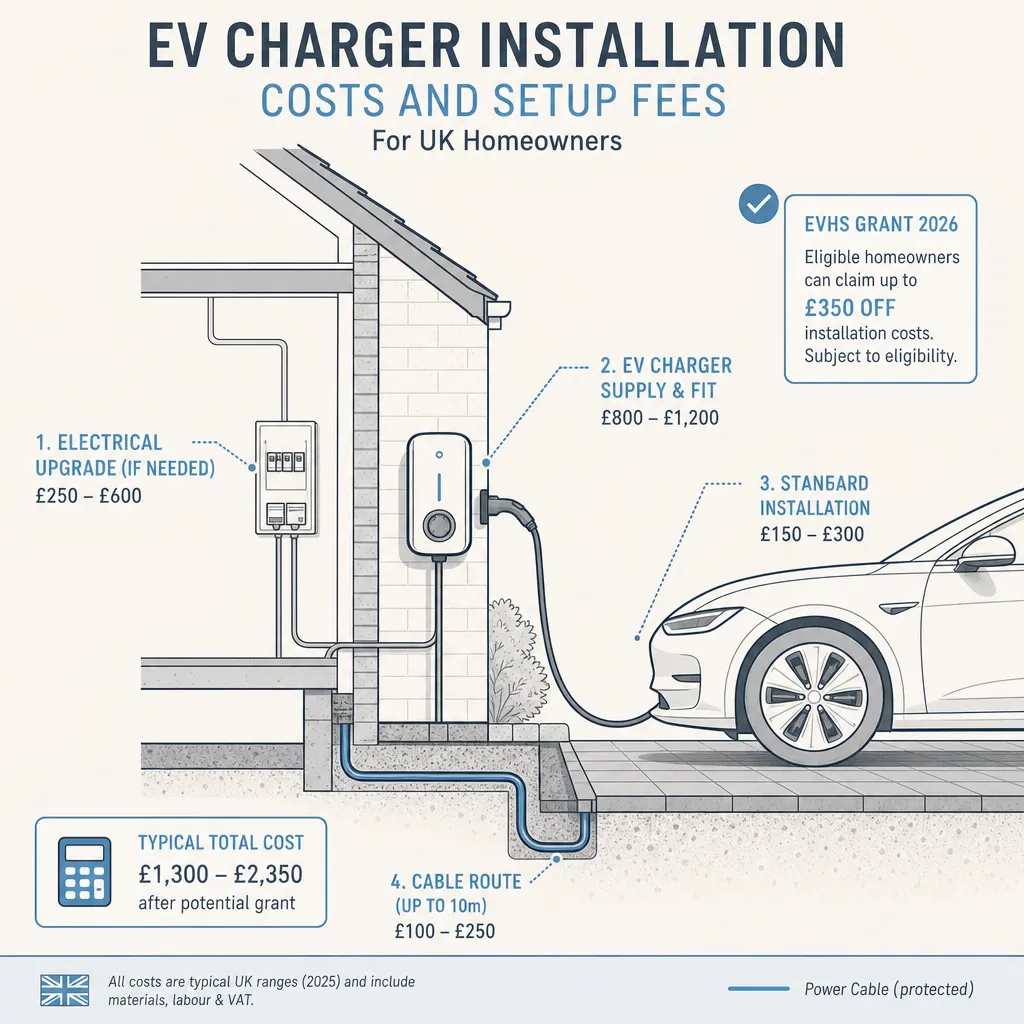
EV Charger Installation Costs and Setup Fees
A home EV charger typically costs £700–£1,200 installed in the UK, including unit and labour.
 Energy & Retrofit
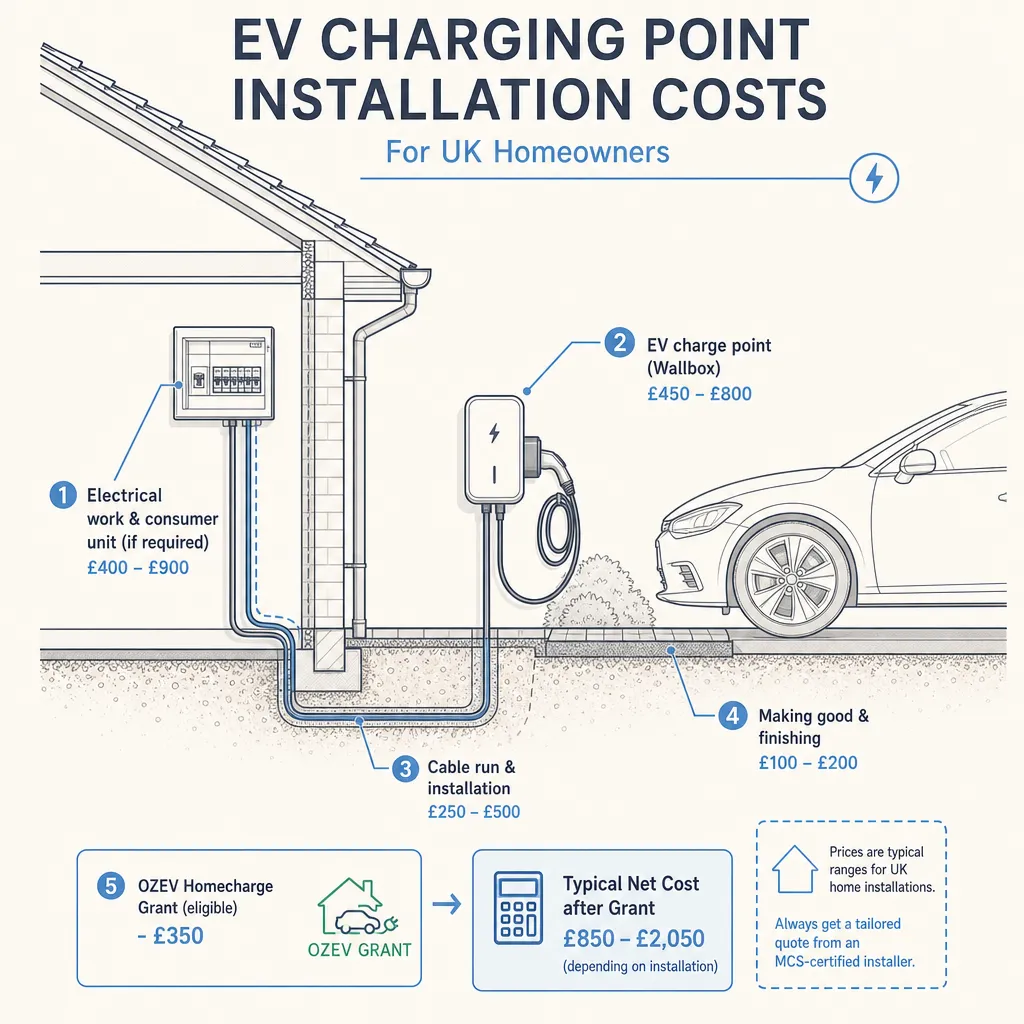
EV Charging Point Installation Costs
A home EV charging point in the UK typically costs £800 to £1,200 for a 7 kW smart wallbox including installation.
 Energy & Retrofit
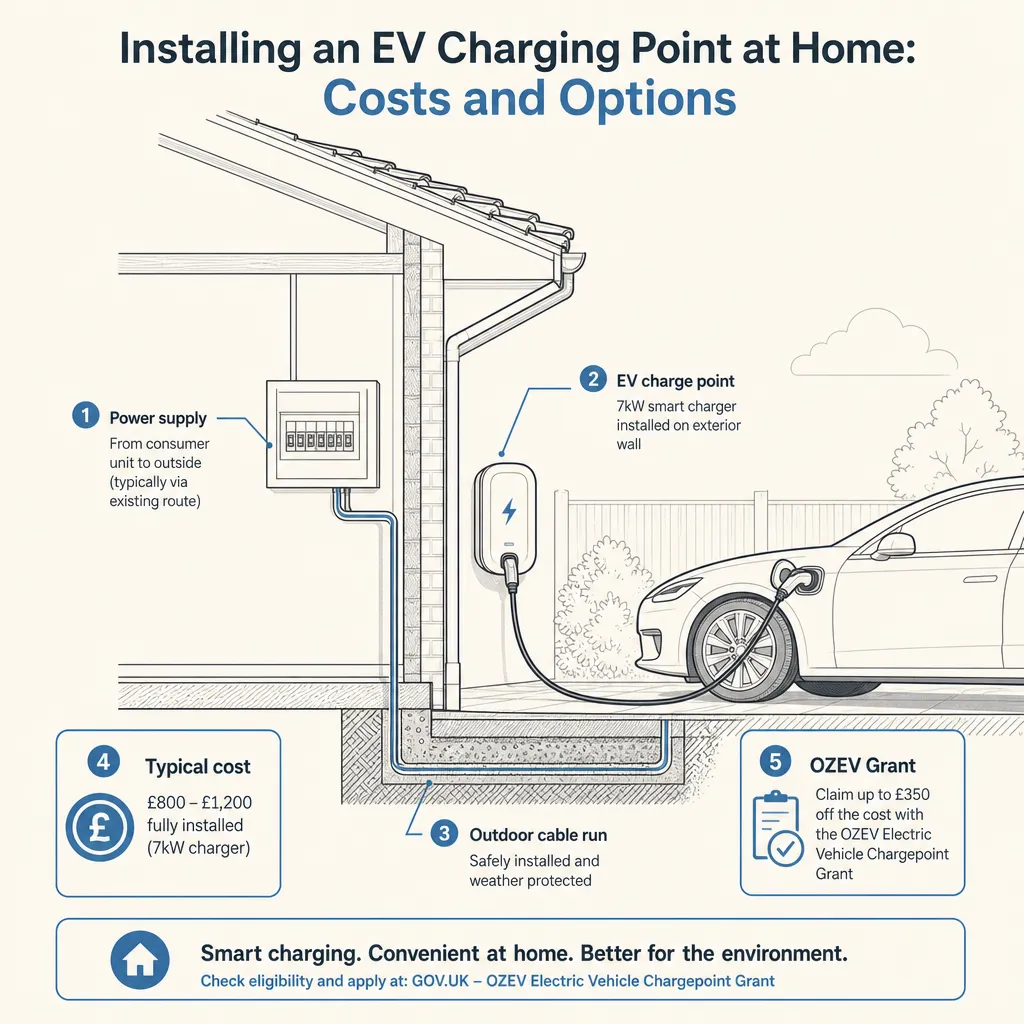
Installing an EV Charging Point at Home: Costs and Options
Installing a home EV charging point in the UK typically costs £300–£800 after the OZEV Electric Vehicle Chargepoint Grant of up to £350.
 Energy & Retrofit
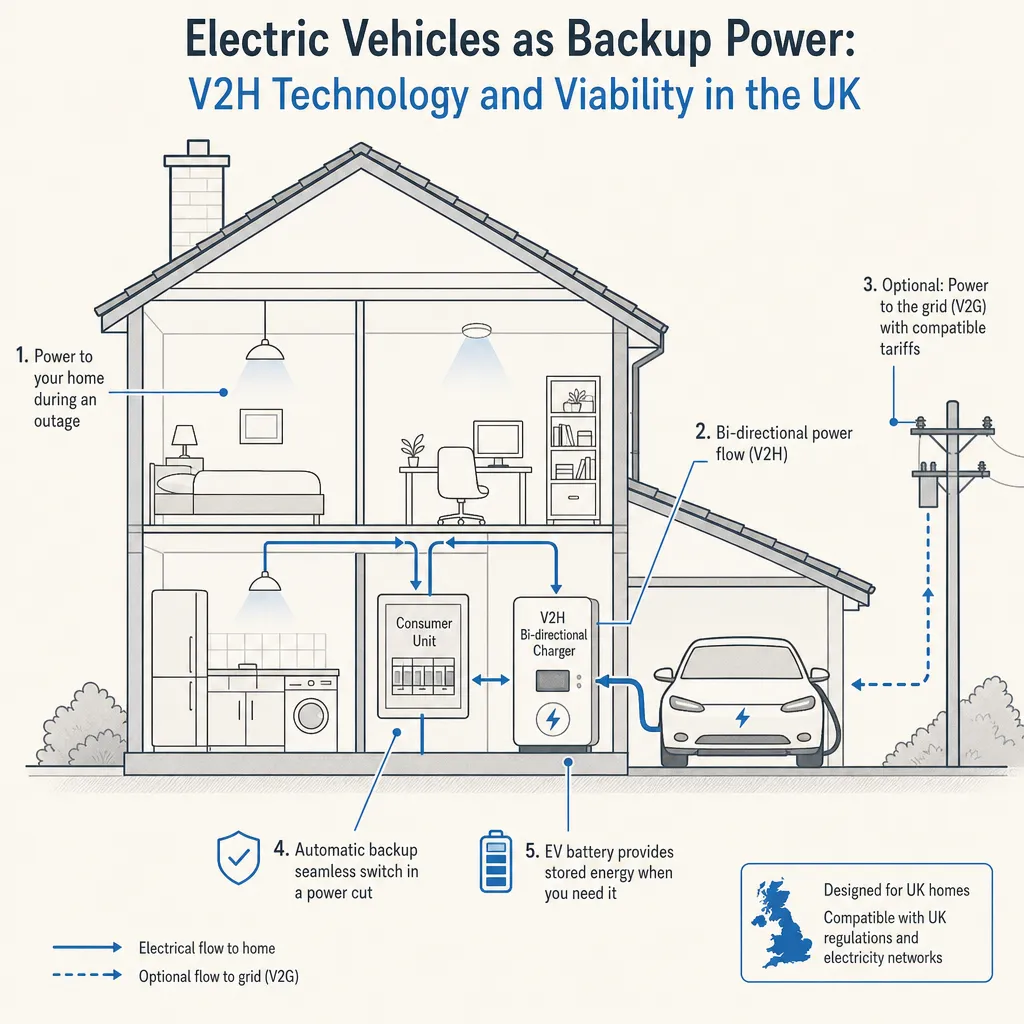
Electric Vehicles as Backup Power: V2H Technology and Viability in the UK
Vehicle-to-Home (V2H) technology uses your electric vehicle's battery to supply electricity to your home, either as backup power during grid outages or to shift cheap overnight charging into daytime use.
 Energy & Retrofit
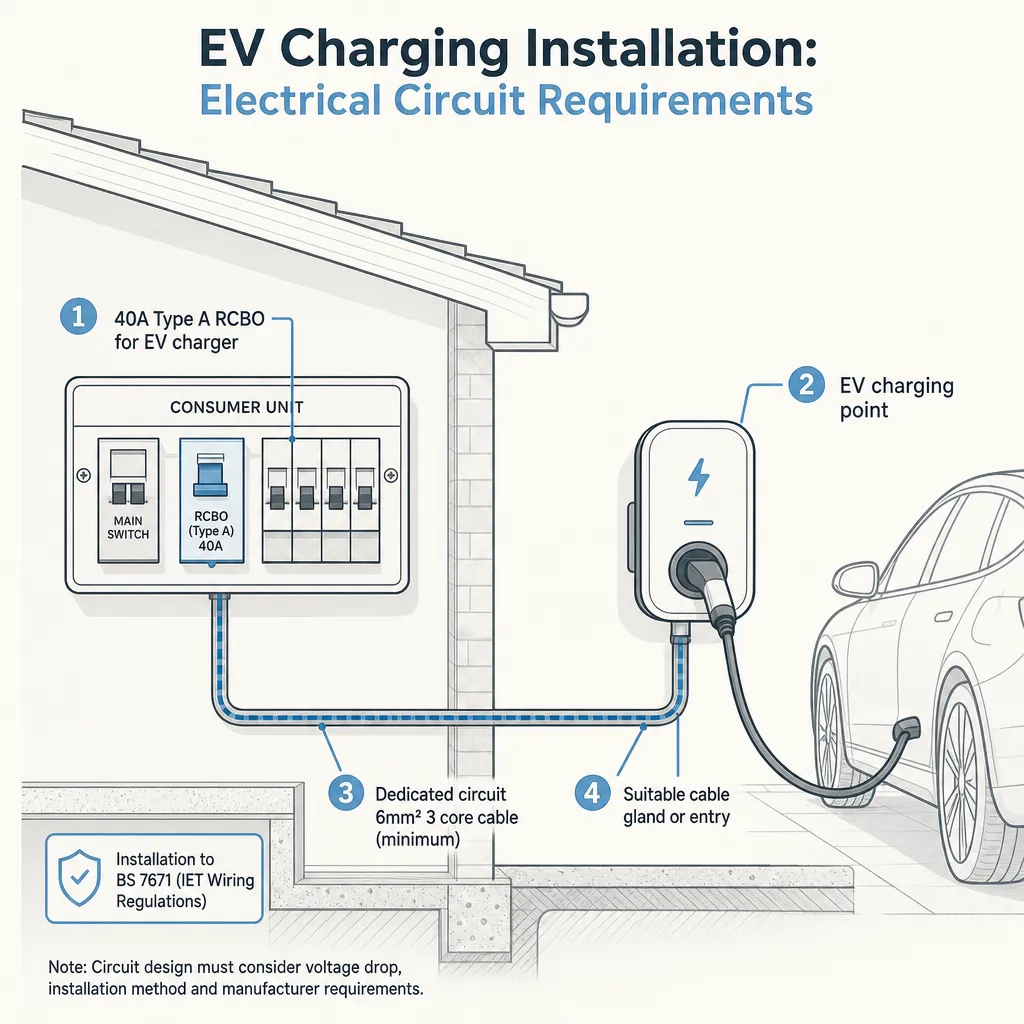
EV Charging Installation: Electrical Circuit Requirements
A home EV charger (7 kW) requires a dedicated single-phase 32 A circuit run directly from the consumer unit, installed by a registered electrician.