EV Charging Installation: Electrical Circuit Requirements
By Housey · Last reviewed 11th of May 2026
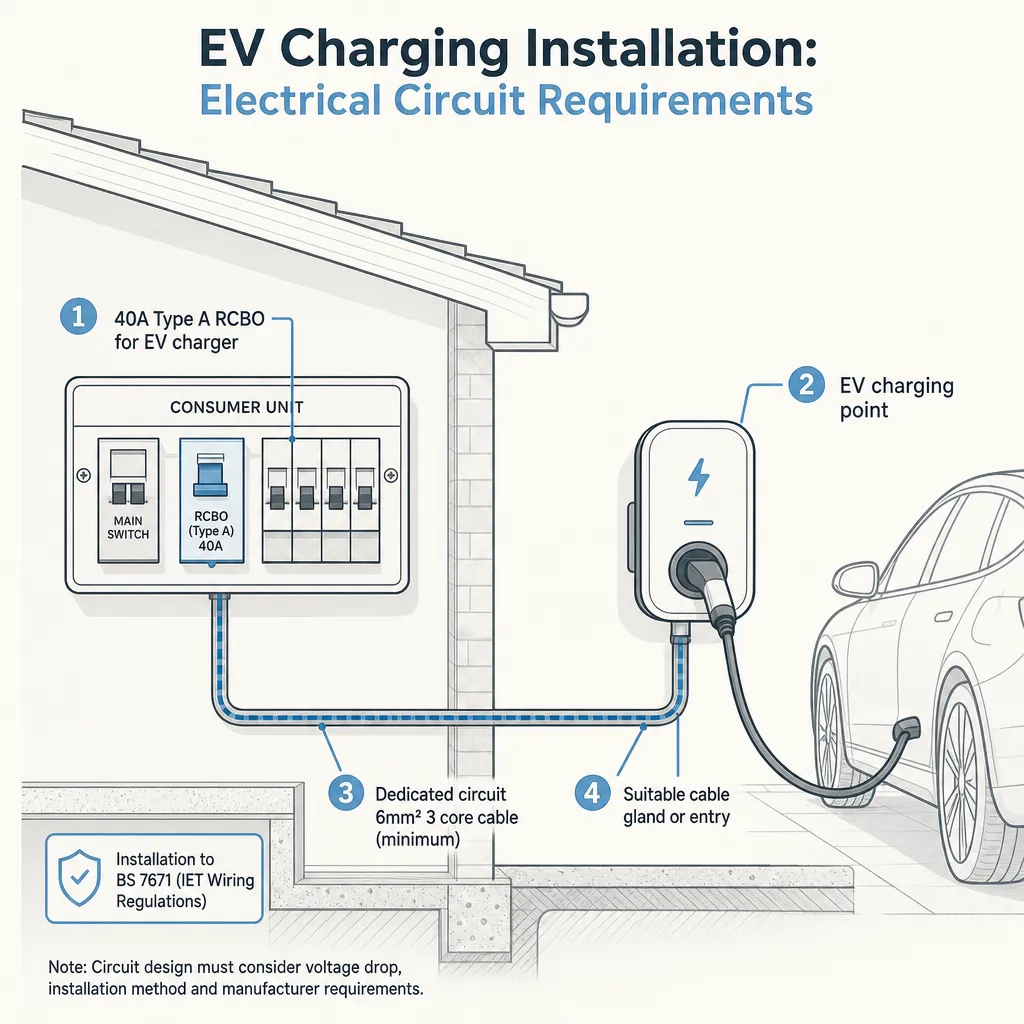
EV Charging Installation: Electrical Circuit Requirements
Adding a home electric vehicle charger is one of the most popular energy upgrades UK homeowners are making — but the electrical infrastructure it needs is more demanding than most other household circuits. Getting the wiring, circuit protection, and earthing right from the outset avoids nuisance tripping, premature charger failure, and, more critically, electrical safety risks. Whether you are installing your first charger or upgrading from an occasional three-pin socket, understanding what the installation actually involves helps you appoint the right contractor and ask the right questions.
Key points
- A standard 7 kW home EV charger draws up to 32 A continuously and requires its own dedicated radial circuit from the consumer unit — it must not share a circuit with other loads.
- All EV charger installations in England and Wales are notifiable electrical work under Part P of the Building Regulations and must be carried out by a registered competent person.
- Installers must comply with BS 7671:2018 (Amendment 2, 2022) — the IET Wiring Regulations — including the specific requirements at Regulation 722 for electric vehicle charging points.
- A Protective Multiple Earthing (PME) supply — the most common type in UK residential streets — requires additional earthing measures or a PEN fault protection device before the charger can be safely connected.
- The government's Electric Vehicle Homecharge Scheme (EVHS) closed to homeowners in April 2023; grants may still be available to renters and flat owners via OZEV's current guidance.
What circuit does a home EV charger need?
A 7 kW (single-phase, 32 A) charger — the most common domestic choice — requires:
- A dedicated 32 A radial circuit run in 6 mm² twin-and-earth cable (or appropriate armoured cable for outdoor runs), from a spare 32 A MCB in the consumer unit directly to the charger.
- A Type B RCD (or combined RCBO) rather than the Type A devices used on most domestic circuits. Type B is necessary because EV chargers can produce DC residual current that a standard Type A device cannot detect reliably, leading to nuisance tripping or — worse — failure to trip on a genuine fault.
- An appropriate surge protection device (SPD) where the installation is at elevated risk from transient overvoltages; most installers include one as standard.
- Correct earthing arrangement — addressed in the PME section below.
Single-phase vs three-phase home charging
Charger type | Typical power | Circuit required | Charge speed (60 kWh EV) | Notes |
|---|---|---|---|---|
3-pin socket (Mode 1) | 2.3 kW | Existing 13 A socket | ~26 hours | Not recommended for regular use |
7 kW home unit (Mode 3) | 7 kW | Dedicated 32 A radial | ~9 hours | Standard domestic choice |
11 kW three-phase | 11 kW | Dedicated 3-phase circuit | ~6 hours | Requires 3-phase supply — unusual in UK homes |
22 kW three-phase | 22 kW | Dedicated 3-phase circuit | ~3 hours | Network operator upgrade required |
Most UK homes are single-phase only. Three-phase supply requires a separate application to your Distribution Network Operator (DNO) and may take 3–12 months to arrange.
The PME earthing requirement
The majority of UK homes are supplied via a Protective Multiple Earthing (PME) network, where the neutral and earth conductors are combined on the distribution system. Under certain fault conditions, a voltage can appear on the vehicle chassis during charging — a potentially lethal hazard.
BS 7671:2018 Regulation 722.411.4.1 requires that where a PME earthing terminal is used for an EV charging installation, one of the following measures is applied:
- Install a PEN fault protection device (earthing monitor or relay) that disconnects the charger if a PEN fault is detected. Most modern OZEV-approved chargers include this as standard — it is the simplest solution for the majority of UK homes.
- Provide a separate TT earthing electrode (a ground rod) independent of the PME earth, combined with an RCD.
- Install the charger in a location where there is no risk of simultaneous contact between the vehicle and any earthed metalwork — rarely practical on a typical driveway.
Your installer should explain how PME protection is being addressed. If they cannot, that is a red flag.
Does the consumer unit need upgrading?
Many homes have a spare MCB slot; if so, the installer adds a new 32 A breaker and the existing unit remains in place. If there are no spare ways, you may need:
- A consumer unit with additional ways — full replacement typically costs £300–£600 for the unit and labour. Indicative UK costs, last reviewed 2026-05-11; quotes vary by location and installer.
- A separate sub-board for the garage or external location, fed from the existing consumer unit.
Consumer units installed before 2016 may lack RCD protection on all circuits. If the installation is ageing or undocumented, arranging an Electrical Installation Condition Report (EICR) before committing to the EV charger work is advisable.
Which professional do I need?
- Standard 7 kW charger, PME supply, consumer unit has a spare way → appoint an OZEV-approved EV charger installer registered with a Part P competent-person scheme (NICEIC, NAPIT, or SELECT in Scotland).
- Consumer unit needs replacement or significant alteration → confirm the installer's competent-person registration covers consumer unit work, or appoint a separate qualified electrician for that element.
- Unsure about the condition of existing wiring → commission an EICR first; this informs the installation scope and can prevent the charger from being installed on a compromised circuit.
- Three-phase supply needed → contact your DNO first — this is a separate application and may take several months.
- Listed building or conservation area → check with your local planning authority whether permitted development rights apply before instructing work.
What the completed installation should include
A compliant installation should provide you with:
- An Electrical Installation Certificate (EIC) for the new circuit, signed by the competent installer.
- Building control notification handled by the installer under their competent-person scheme registration.
- Manufacturer warranty documentation for the charger unit.
- Written confirmation of how PME earthing protection has been achieved.
- An instruction manual and, where applicable, guidance on app or smart-tariff connectivity.
If you are not given an EIC, the work has not been properly notified and may create difficulties when you sell the property.
Important limitations
This guide provides general information about typical domestic EV charger electrical requirements as of May 2026. Wiring regulations, grant schemes, and DNO requirements can change. Every installation varies depending on the property's existing electrical infrastructure, supply characteristics, cable routes, and local authority rules. Do not work on the consumer unit or fixed wiring yourself. A qualified, registered electrician must assess and carry out all notifiable work.
When this becomes urgent
- You are currently charging from a 3-pin extension lead regularly — this is a known fire risk and should be replaced with a dedicated circuit.
- Your consumer unit is old or unprotected and you are planning any high-load circuit addition.
- You are buying a property with an existing EV charger — request the EIC before exchange and verify the charger is OZEV-approved.
- An existing charger is causing nuisance RCD tripping — this may indicate an inappropriate protection device or a wiring fault.
What to ask a qualified professional
Before accepting a quote from an EV charger installer:
- Are you registered with an OZEV-approved scheme and a Part P competent-person scheme such as NICEIC or NAPIT?
- How will you address the PME earthing requirement — does the proposed unit include a PEN fault protection device?
- Will you assess the consumer unit capacity and loading before starting, and is any necessary upgrade included in the quote?
- What cable route do you propose, and is it rated for continuous outdoor use if applicable?
- Will you provide an Electrical Installation Certificate on completion and handle building control notification?
- Is VAT included in the quoted price?
- What is your process if unexpected wiring problems or access issues arise once work has begun?
When to get professional help
EV charger installation is not a DIY task — it is notifiable electrical work requiring a registered competent person. Contact a qualified EV charger installer to assess your property and carry out the installation. If there is any doubt about the condition of your existing wiring, arrange an EICR beforehand.
How Housey can help
Housey connects you with OZEV-approved EV charger installers who can assess your property's electrical infrastructure, advise on the right charger and circuit arrangement, and handle all certification and building control notification. If your installation requires a full electrical assessment first, our network of EICR specialists can carry out a condition report before any new circuit work begins.
Frequently asked questions
Can I install an EV charger myself?
No. EV charger installation involves work on or from the consumer unit, which is notifiable under Part P of the Building Regulations in England. It must be carried out by a registered competent person. Attempting to self-install risks invalidating your home insurance, creating a safety hazard, and causing difficulties on property sale.
How long does a home EV charger installation take?
Most straightforward installations — where the consumer unit has a spare way and the cable route is clear — take around 2–4 hours. If a consumer unit upgrade or a long outdoor cable run is needed, allow a full working day.
Will my electricity supply cope with a 7 kW charger?
Most UK domestic supplies are rated at 100 A, which comfortably supports a 32 A EV charger alongside normal household loads. If you have electric heating, a hot tub, or other high-draw appliances, the installer should check the total load before proceeding. Smart chargers can also be programmed to avoid simultaneous peak loads.
Do I need planning permission for a home EV charger?
In most cases, a domestic EV charger is permitted development in England and does not require planning permission, provided it meets the conditions in Schedule 2, Part 2, Class K of the Town and Country Planning (General Permitted Development) (England) Order 2015. Listed buildings and conservation area properties may face different requirements.
Sources and further reading
- IET Wiring Regulations BS 7671:2018 (Amendment 2, 2022) — IET
- Approved Document P: electrical safety in dwellings — GOV.UK
- Government grants for low emission vehicles — GOV.UK / OZEV
- NICEIC: find a registered electrician — NICEIC
- Energy Saving Trust: home EV charging — Energy Saving Trust
Useful next reads
 Energy & Retrofit
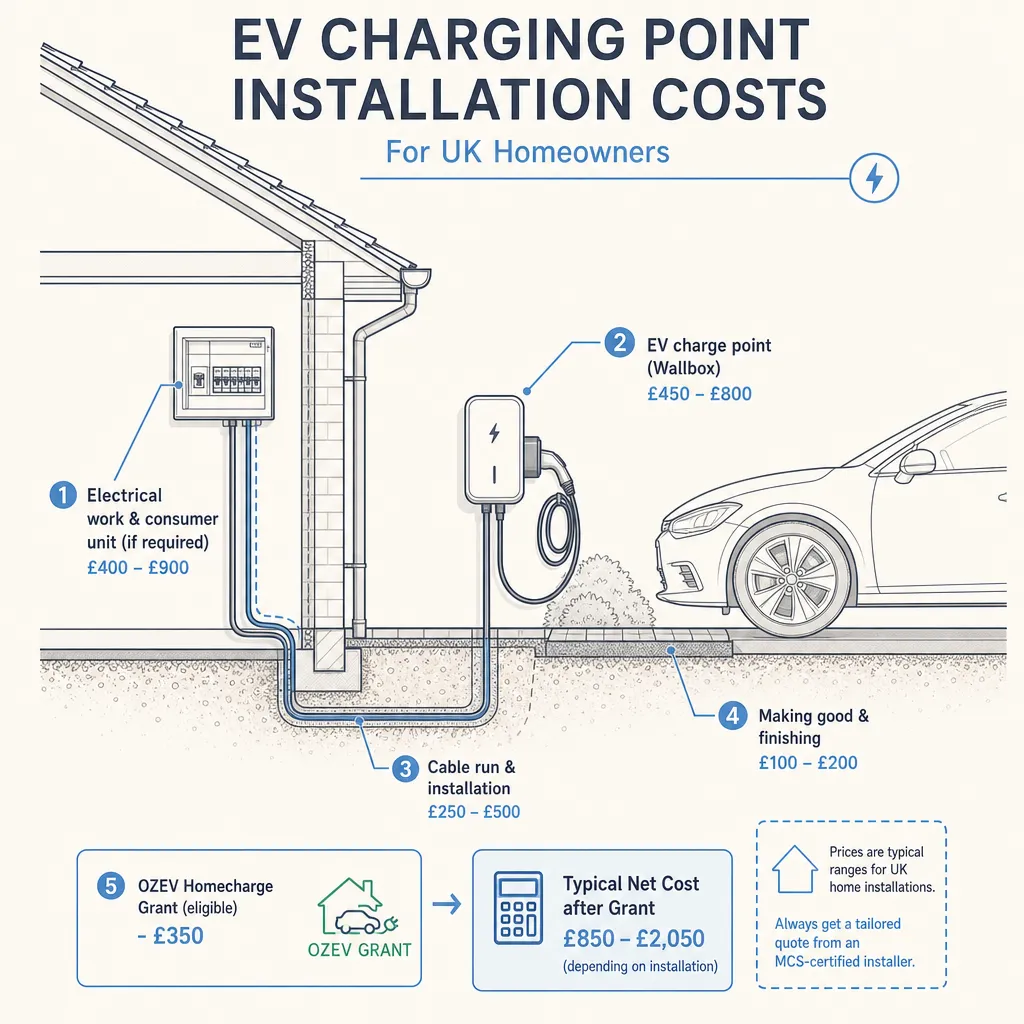
EV Charging Point Installation Costs
A home EV charging point in the UK typically costs £800 to £1,200 for a 7 kW smart wallbox including installation.
 Energy & Retrofit
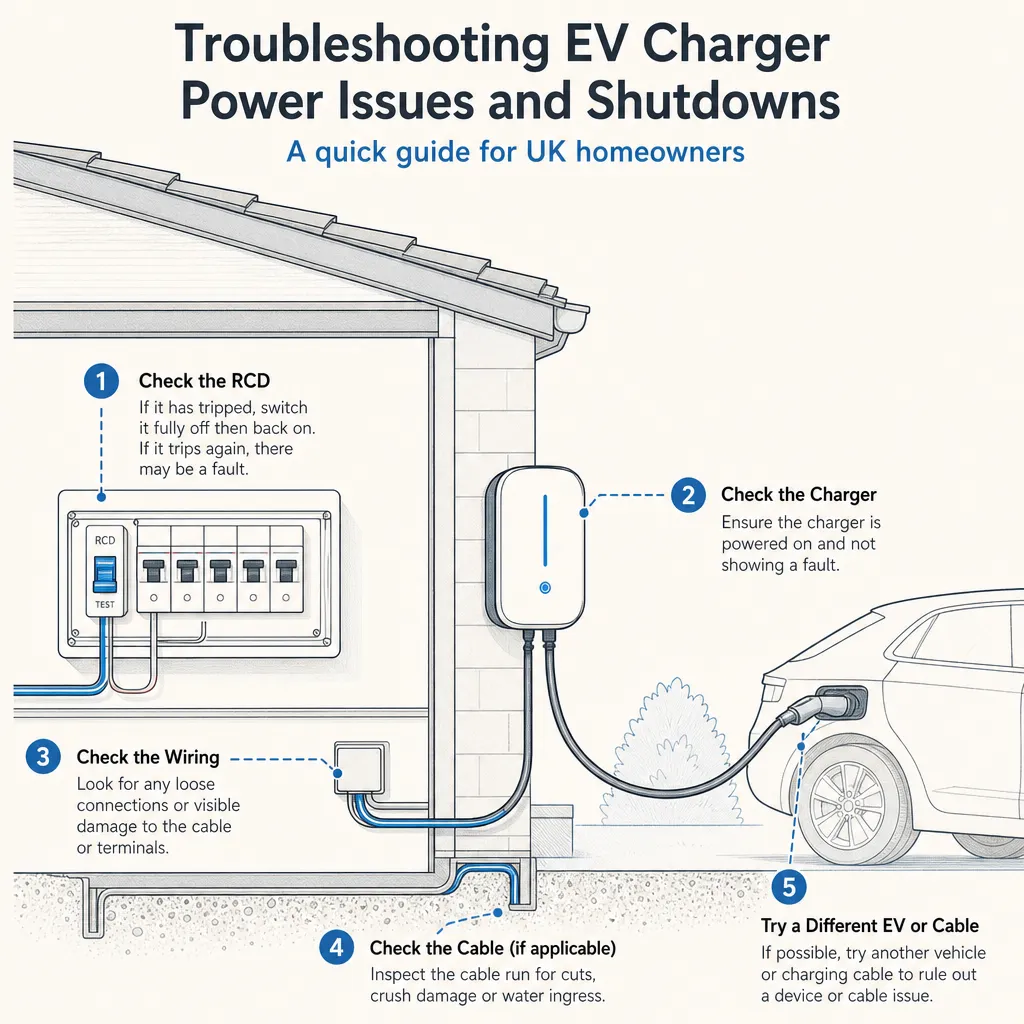
Troubleshooting EV Charger Power Issues and Shutdowns
Most home EV charger shutdowns are caused by a tripped RCD or MCB, a firmware issue, or a communication error with the vehicle.
 Energy & Retrofit
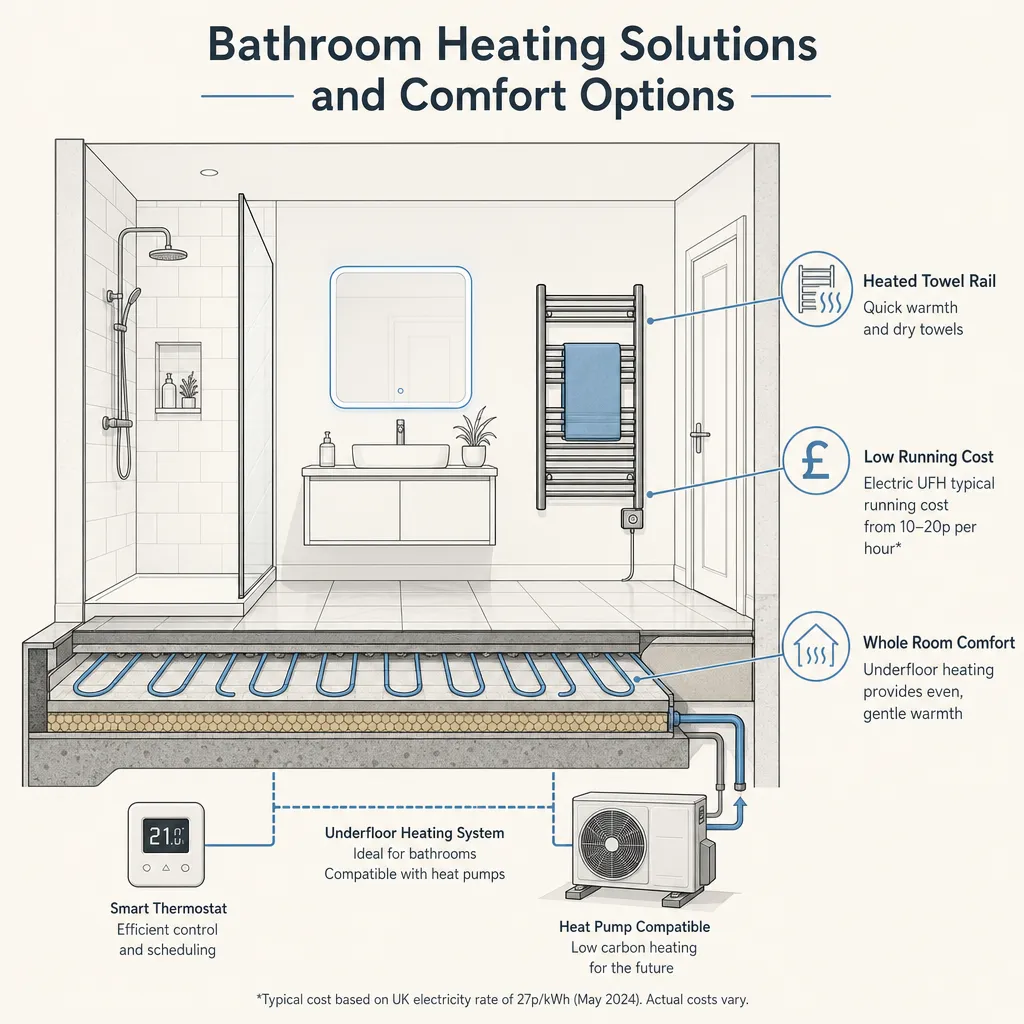
Bathroom Heating Solutions and Comfort Options
UK bathrooms can be heated using electric towel rails, wet radiators on the central heating circuit, electric or wet underfloor heating, or infrared panels.
 Energy & Retrofit
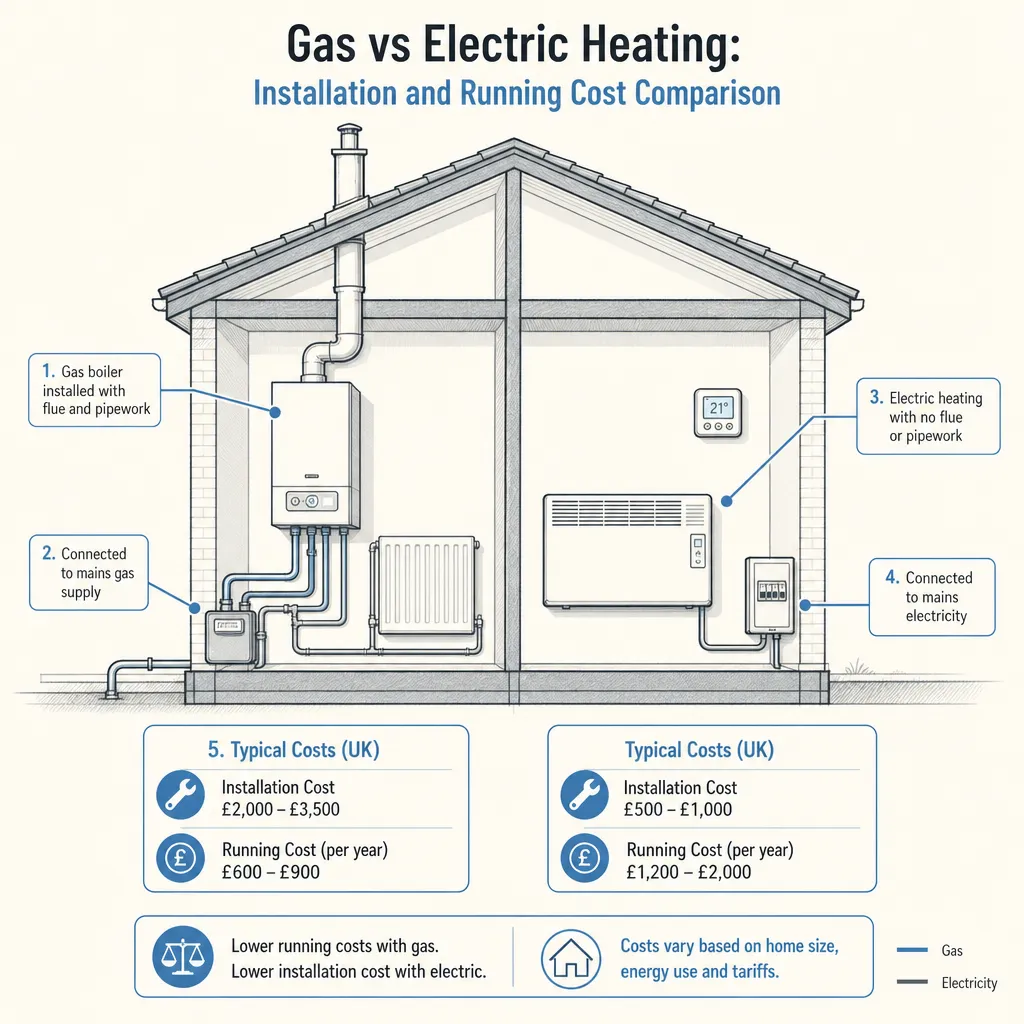
Gas vs Electric Heating: Installation and Running Cost Comparison
Gas central heating usually has lower running costs per kWh than direct electric heating in the UK, though heat pumps can change that equation.
 Energy & Retrofit
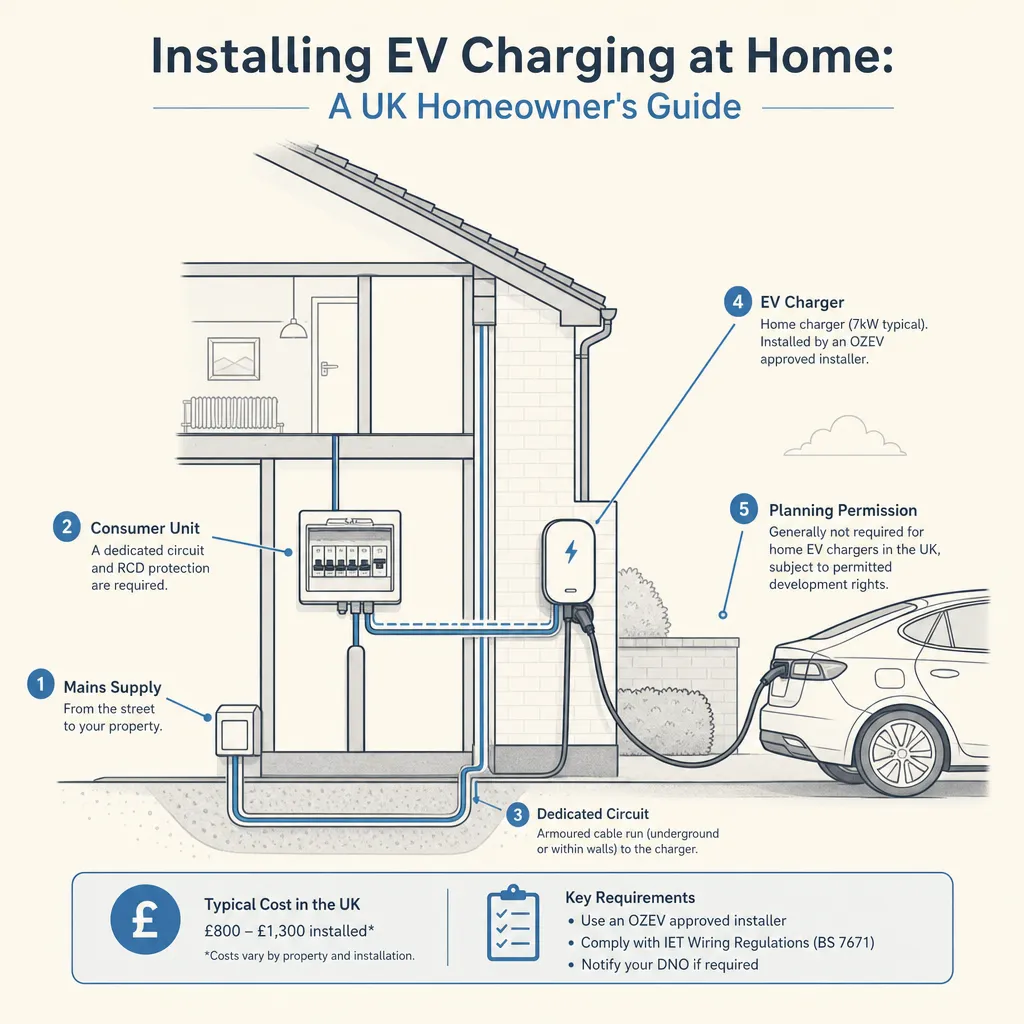
Installing EV Charging at Home: A UK Homeowner's Guide
Most UK homeowners install a 7 kW AC wallbox, which adds around 25–30 miles of range per hour on a dedicated 32A circuit.