Installing EV Charging at Home: A UK Homeowner's Guide
By Housey · Last reviewed 31st of May 2026
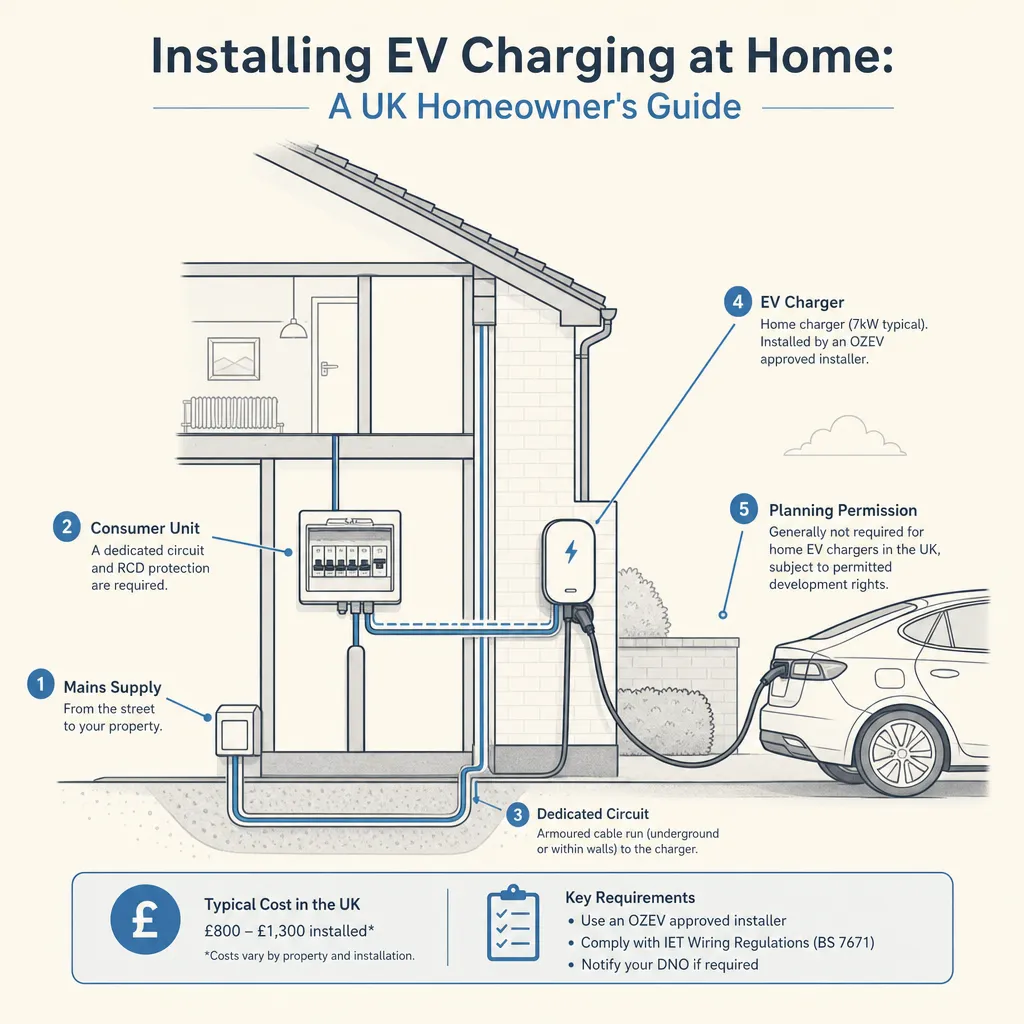
Installing EV Charging at Home: A UK Homeowner's Guide
Demand for home EV chargers has grown sharply as electric vehicle ownership rises across the UK, and many homeowners are now navigating the step from relying on public infrastructure to having a dedicated charging point on their own property. Whether you have just ordered a first electric car or are upgrading ageing equipment, getting the installation right — the right charger, the right installer, the right circuit — matters for both daily convenience and long-term safety.
Key points
- A 7 kW AC wallbox is the most common home charger in the UK, adding approximately 25–30 miles of range per hour of charging on a dedicated 32A circuit.
- Since 30 June 2022, all newly installed home chargepoints must comply with the Smart EV Chargepoint Regulations 2021, requiring built-in scheduling and demand-response capability.
- The EV Chargepoint Grant (administered by OZEV) offers up to £350 towards installation for eligible applicants, including renters and flat owners; homeowners of standalone houses should check current GOV.UK eligibility criteria.
- All home EV charger installations must be carried out by an OZEV-approved installer, who registers the chargepoint on your behalf.
- Planning permission is not usually required for a home EV charger under permitted development rights, but listed buildings and properties in conservation areas should check with their local planning authority before proceeding.
Which type of home charger should you choose?
Most UK homeowners install a 7 kW AC wallbox. This is the practical sweet spot between cost, installation complexity, and charging speed for residential use. The three main options are:
Charger type | Output | Approx. range added per hour | Best for | Supply requirement |
|---|---|---|---|---|
3-pin plug / portable EVSE cable | 2.3 kW | ~8 miles | Emergency top-up only | Standard 13A socket |
7 kW AC wallbox | 7.2 kW | ~25–30 miles | Most UK homeowners | Dedicated 32A single-phase circuit |
22 kW AC wallbox | 22 kW | ~75–80 miles | Three-phase supply properties | Three-phase 32A circuit |
A 3-pin plug solution is not recommended as a permanent arrangement: drawing continuous high current from a standard socket for many hours can cause socket overheating over time.
A 22 kW unit is rarely necessary for home use unless your property already has a three-phase electricity supply, which is more common in rural properties, some new-builds, and properties with a prior commercial use. For most homes on a standard single-phase supply, a 7 kW wallbox will fully charge a typical EV (60–77 kWh battery) overnight.
What does home EV charger installation involve?
On the day, an OZEV-approved electrician will:
- Assess your consumer unit (fuse board) to confirm there is sufficient capacity for a new dedicated 32A circuit.
- Run a dedicated cable from the consumer unit to your chosen installation point — typically a garage wall, external wall, or car port.
- Mount and wire the wallbox.
- Commission the charger, pair it with any associated app, and configure smart scheduling.
- Register the installation with OZEV and provide you with a certificate of installation.
If your consumer unit is older or already near capacity, the electrician may recommend an upgrade before proceeding. This is common in pre-2000s properties. A consumer unit upgrade adds cost but is a safety requirement, not an optional extra.
Most installations in properties with an accessible consumer unit and off-street parking take three to six hours. Properties with more complex cable runs — through walls, under floors, or across outbuildings — may take longer.
How much does home EV charger installation cost in the UK?
Indicative UK costs, last reviewed 2026-05-31.
A typical 7 kW wallbox and installation by an OZEV-approved electrician costs in the range of £800–£1,200 all-in, covering the charger unit, labour, cabling, and commissioning. The main cost drivers are:
- Cable run length — a charger on an outside wall adjacent to the consumer unit is cheaper to wire than one at the far end of a garage or across a driveway.
- Consumer unit upgrade — if needed, this typically adds £400–£600 to the total.
- Charger brand and features — entry-level OZEV-listed units start around £200–£300; premium models with integrated load balancing or solar integration cost more.
- Access and groundworks — running cable across a garden or through an outbuilding increases labour time and cost.
Always obtain at least two quotes and ask for a breakdown of supply costs, labour, and any enabling works. Confirm whether VAT is included.
EV charger grants: what's available in the UK?
The EV Chargepoint Grant, administered by the Office for Zero Emission Vehicles (OZEV), offers up to £350 (or 75% of the total installed cost, whichever is lower) per chargepoint.
Eligibility: the grant is currently available to people who live in flats or apartments (whether owner-occupiers or renters) and to people renting any type of residential property. Homeowners of standalone houses with off-street parking are not currently eligible for the residential grant. Check current GOV.UK guidance on the EV Chargepoint Grant before booking an installation, as criteria have changed previously and may change again.
OZEV-approved installers handle the grant application on your behalf — you should not need to claim it independently.
Does a home EV charger need planning permission?
In most cases in England, no. Under permitted development rights, installing an EV chargepoint on a dwelling is generally permitted provided the unit protrudes no more than 0.2 m from the wall or roof and certain other conditions are met.
Always check with your local planning authority if:
- The property is a listed building.
- The property is in a conservation area.
- Your lease or title deeds contain covenants restricting exterior alterations — common in leasehold flats and some freehold estate developments.
In Scotland, Wales, and Northern Ireland, devolved planning rules apply. Broadly similar permitted development provisions exist, but confirm locally before proceeding.
When to get professional help
EV charger installation must always be carried out by an OZEV-approved electrician. Do not attempt to wire a dedicated charging circuit yourself. Any work at the consumer unit must be undertaken by a competent person registered under a Part P self-certification scheme (such as NICEIC or NAPIT) or notified to building control.
Seek specific professional advice if:
- Your consumer unit is more than 20 years old or uses rewirable fuses.
- You share an electrical supply with another dwelling — common in converted houses.
- You rent your home or live in a leasehold flat and need landlord or freeholder consent before installation.
- You are considering a solar-integrated or load-balancing charger, which may require a separate assessment of your solar and electrical configuration.
What to ask before accepting a quote
- Are you listed as an OZEV-approved installer on the GOV.UK approved installer register?
- Which charger models are you quoting, and are they on the OZEV-approved product list?
- Does the quote include a consumer unit assessment, and will you flag any required upgrades before starting work?
- Does the quote include the grant application where eligible?
- Does the charger comply with the Smart EV Chargepoint Regulations 2021?
- Will you provide an installation certificate and register the unit with OZEV?
- Is VAT included in the quoted price?
- What warranty covers the charger, and who handles claims — the manufacturer or your company?
How Housey can help
Housey connects you with vetted EV charger installers who are OZEV-approved and experienced across a range of UK property types, from Victorian terraces to new-build estates. Describe your property and parking situation, receive quotes from local installers, and compare credentials and pricing before committing.
Frequently asked questions
Can I install an EV charger in a rented home in the UK?
You can apply for a home chargepoint as a renter, but you will usually need written permission from your landlord before installation. The EV Chargepoint Grant is available to renters. Speak to your landlord early — some are open to it, as it improves the property's attractiveness to future tenants. Check current GOV.UK eligibility criteria before applying.
How long does a home EV charger last?
Most quality wallboxes carry a minimum three-year warranty, with many manufacturers offering optional extended cover. Units often remain serviceable for ten years or more. The cable and connector can wear with daily use and may need replacing before the charger unit itself.
Will installing a home EV charger significantly increase my electricity bill?
Yes, but typically far less than the equivalent petrol cost. Charging a 60 kWh battery from near-empty costs approximately £12–£18 at average domestic rates as of 2026. Smart chargers allow overnight scheduling to take advantage of cheaper time-of-use tariffs, several of which are designed specifically for EV owners.
Do I need to inform my home insurer about a new EV charger?
Yes. A permanently installed chargepoint is a material change to your property and you should notify your buildings insurer. Most insurers treat it as straightforward, but failing to disclose it could affect a future claim. Check your policy wording or contact your insurer if unsure.
Sources and further reading
- EV Chargepoint Grant — GOV.UK — Office for Zero Emission Vehicles
- Smart EV Chargepoint Regulations 2021 — legislation.gov.uk — UK Parliament
- Charging an electric vehicle at home — Energy Saving Trust — Energy Saving Trust
- Permitted development rights for householders: technical guidance — GOV.UK — Ministry of Housing, Communities and Local Government
Useful next reads
 Energy & Retrofit
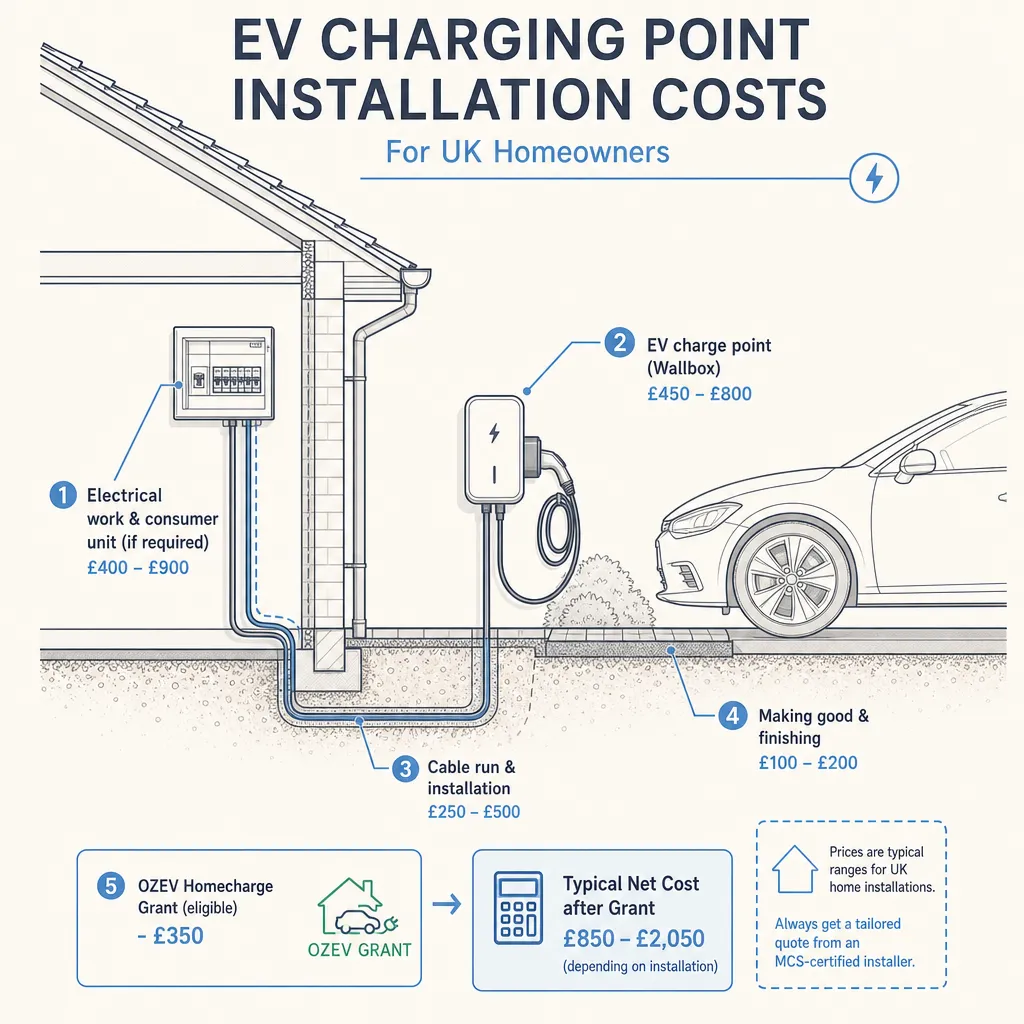
EV Charging Point Installation Costs
A home EV charging point in the UK typically costs £800 to £1,200 for a 7 kW smart wallbox including installation.
 Energy & Retrofit
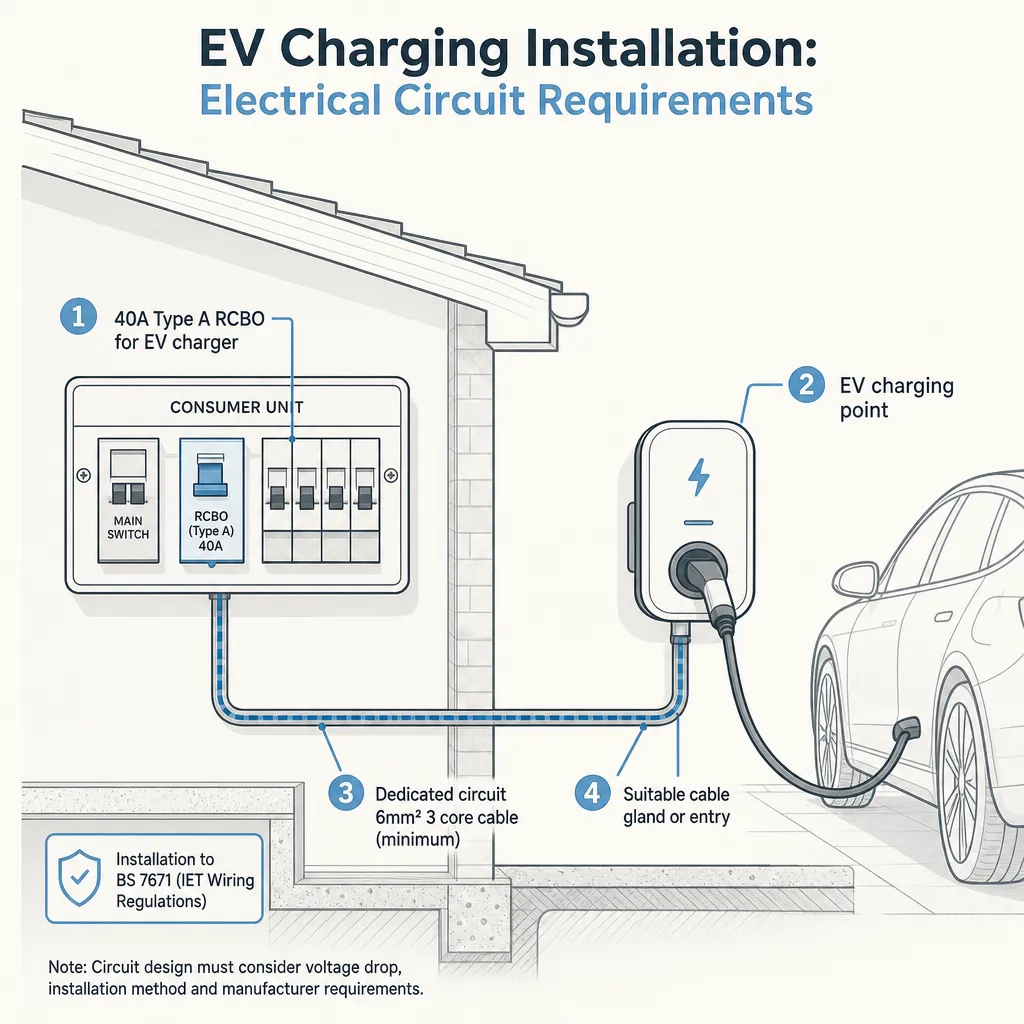
EV Charging Installation: Electrical Circuit Requirements
A home EV charger (7 kW) requires a dedicated single-phase 32 A circuit run directly from the consumer unit, installed by a registered electrician.
 Energy & Retrofit
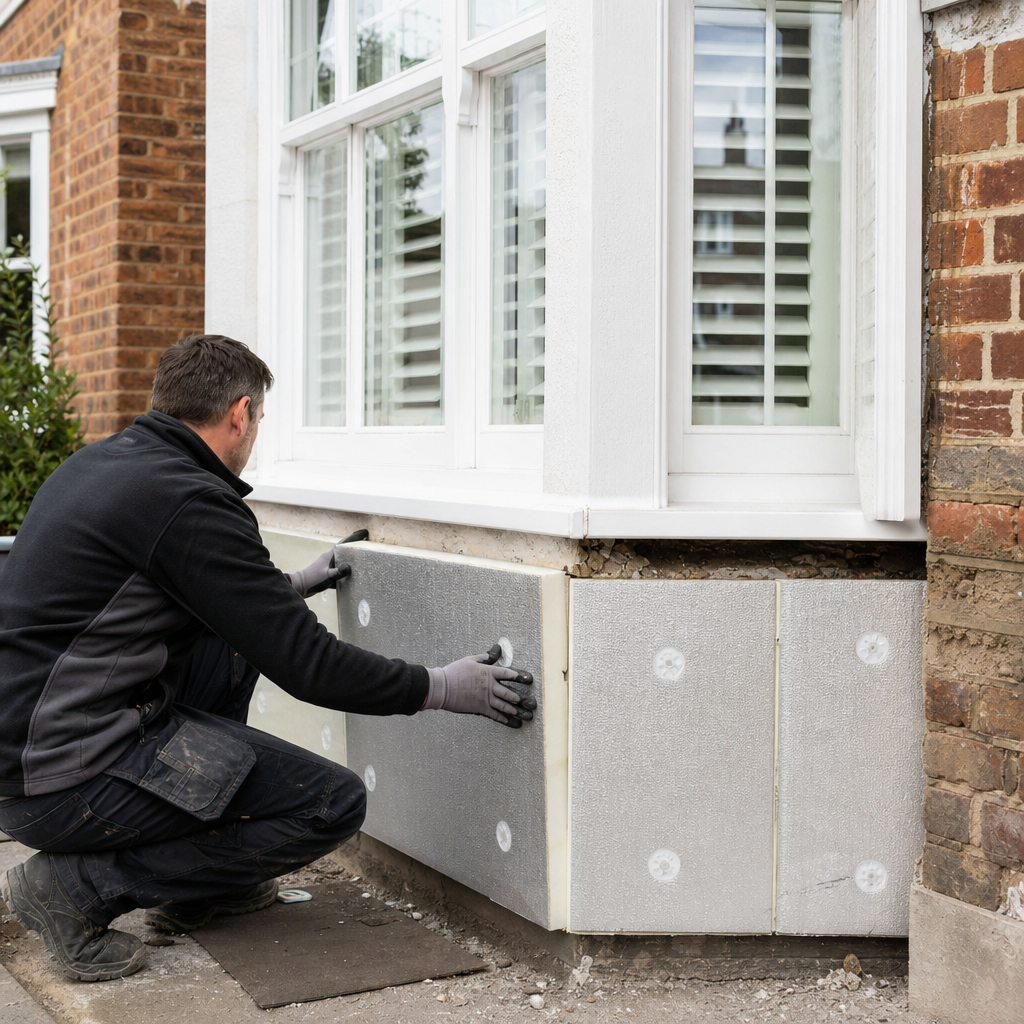
Insulating Solid Masonry Walls Under Bay Windows: Technical Guidance
Insulating solid masonry walls under bay windows requires specialist detailing at angled wall faces, window reveals, and the bay floor and ceiling junctions.
 Energy & Retrofit
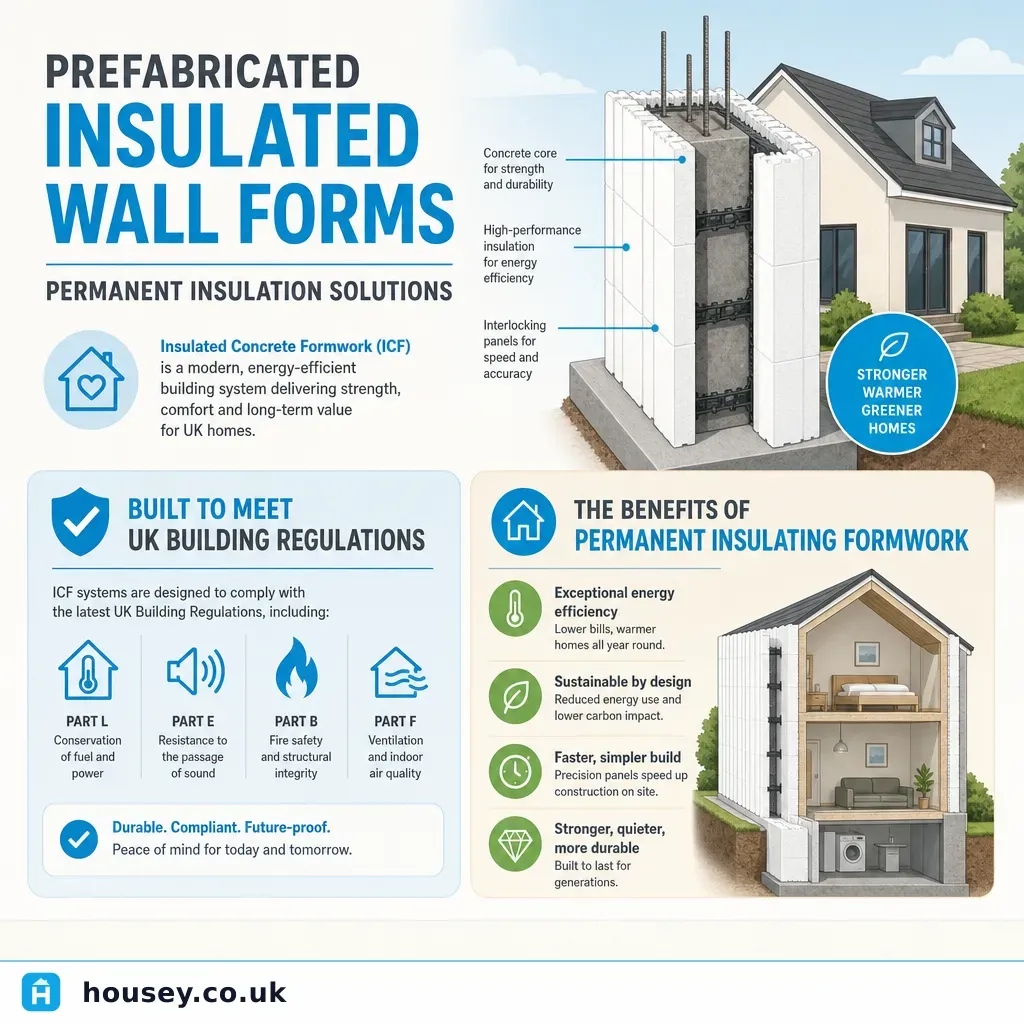
Prefabricated Insulated Wall Forms: Permanent Insulation Solutions
Prefabricated insulated wall forms — including ICF and SIPs systems — deliver high thermal performance by combining permanent insulation with structural concrete or timber in a single wall assembly.
 Energy & Retrofit
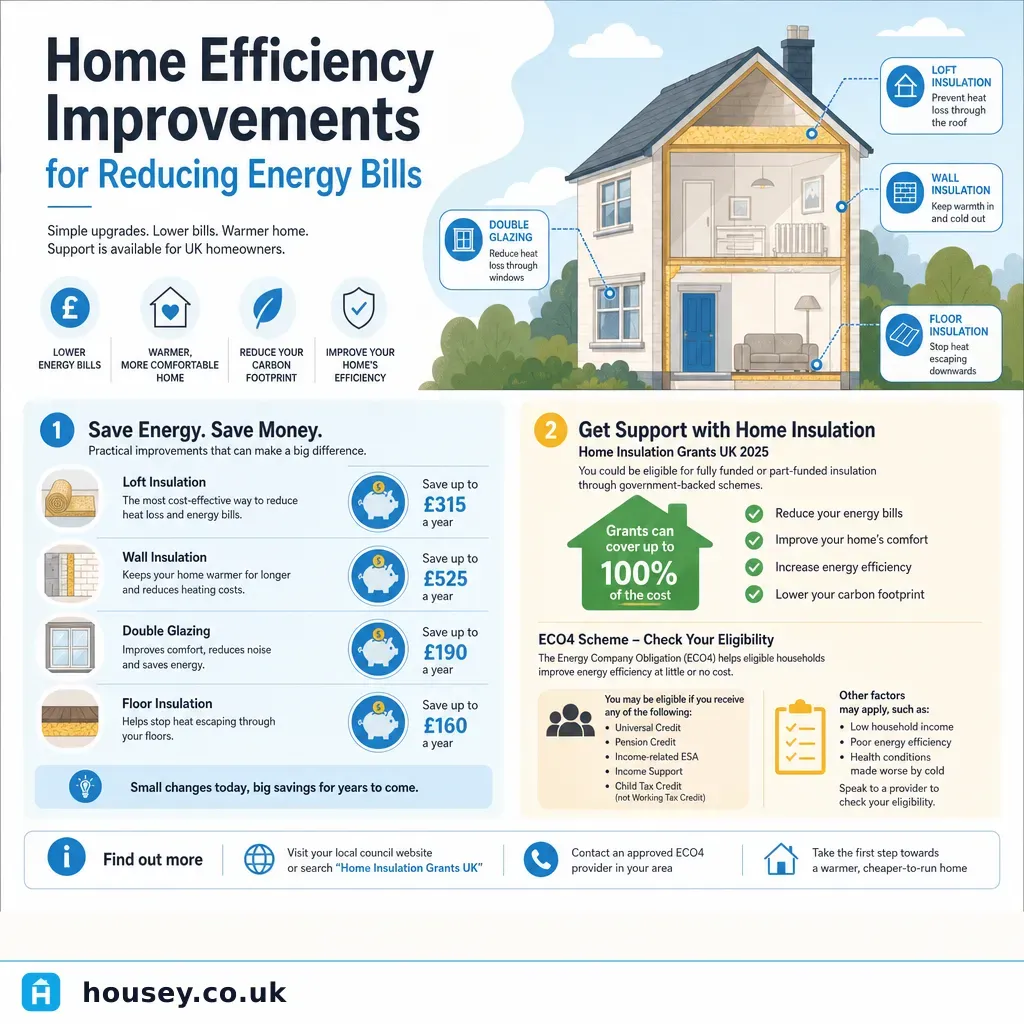
Home Efficiency Improvements for Reducing Energy Bills
The most cost-effective UK home efficiency improvements are usually loft insulation, cavity wall insulation, draught-proofing, and upgrading heating controls.