Evaluating your contractor's green credentials: what to look for
By Housey · Last reviewed 19th of May 2026
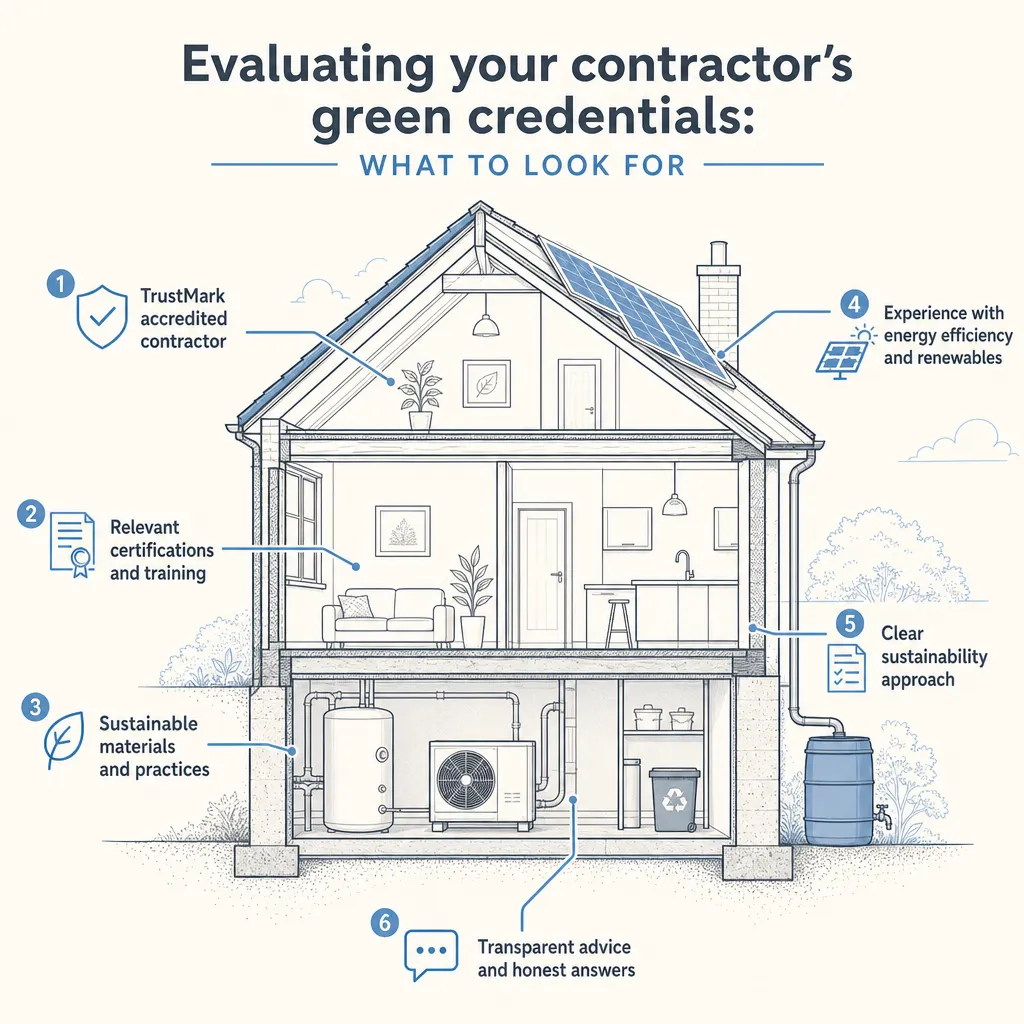
Evaluating your contractor's green credentials: what to look for
As sustainability becomes a meaningful criterion for homeowners commissioning build or renovation work, the gap between genuine environmental practice and marketing language has widened considerably. A contractor might hold multiple independently verified accreditations while another uses terms like eco-friendly and low carbon without any supporting evidence. Whether you are planning an extension, an energy retrofit, or a full refurbishment, the ability to distinguish between the two protects both your project outcomes and your budget.
Key points
- TrustMark is the government-endorsed quality scheme for tradespeople and requires members to meet standards covering technical competence, customer protection, and sustainability practices.
- MCS (Microgeneration Certification Scheme) certification is required for contractors installing heat pumps, solar PV, solar thermal, or battery storage if you want to access Boiler Upgrade Scheme grant payments.
- PAS 2030:2023 and PAS 2035:2023 are the mandatory British Standards for energy efficiency measures funded through government schemes including ECO4 and the Great British Insulation Scheme.
- Any contractor removing waste from your property is legally required to hold a waste carrier licence under the Environmental Protection Act 1990 — the Environment Agency public register allows you to verify this in minutes.
- FSC (Forest Stewardship Council) and PEFC (Programme for the Endorsement of Forest Certification) chain-of-custody certificates provide independently audited verification that timber products come from sustainably managed sources.
Why green credentials vary so much
The UK construction industry has no single universal sustainability standard for residential work. Different parts of a project fall under different regulatory regimes: energy retrofit is tightly regulated under PAS 2030 and PAS 2035; general building and extension work is not. Some accreditations require third-party audits and annual renewals; others are self-declared by the contractor. Environmental claims in marketing are not monitored in real time by any single body in residential construction.
The practical implication for homeowners is that a contractor's sustainability claims must be evaluated specifically — by asking for named accreditation numbers and checking them against publicly available registers — rather than accepted at face value.
The key accreditations and what they mean
Accreditation | Issued by | What it covers | How to verify |
|---|---|---|---|
TrustMark | TrustMark (government-endorsed) | Technical quality, customer protection, and sustainability standards | trustmark.org.uk — searchable public register |
MCS | Microgeneration Certification Scheme | Heat pumps, solar PV, solar thermal, biomass, battery storage | mcscertified.com — searchable public register |
PAS 2030 / PAS 2035 | UKAS-accredited certification bodies | Energy efficiency measures; mandatory for ECO4 and government-funded retrofit | Request the certificate; confirm the certification body is UKAS-accredited |
Waste Carrier Licence | Environment Agency (England) / NRW (Wales) / SEPA (Scotland) | Legal authorisation to remove waste from a property | GOV.UK waste carrier registration check |
ISO 14001 | UKAS-accredited certification bodies | Environmental management system (more common on larger firms) | Request certificate; verify certification body accreditation |
FSC / PEFC chain of custody | FSC UK / PEFC UK | Sustainably sourced timber in materials and products | Ask for the chain-of-custody number; verify via FSC or PEFC databases |
Which credentials should I look for?
Match the type of work to the credentials that matter most for your project:
- Choose a contractor with MCS certification if installing a heat pump, solar panels, solar thermal, or battery storage — without it, you cannot access Boiler Upgrade Scheme grant payments and the quality of the installation is harder to verify independently.
- Check for PAS 2030 certification if any energy efficiency measures are being funded through ECO4 or the Great British Insulation Scheme — this certification is a legal requirement for funded measures.
- Ask for a TrustMark registration number for any general building, renovation, or improvement work — TrustMark checks technical competence and customer protection standards, not just sustainability.
- Request proof of a waste carrier licence for any contractor who will be removing material from your site — this is a basic legal requirement and one of the easiest credentials to verify independently.
- Ask for FSC or PEFC documentation if significant timber volumes are specified in the build — particularly relevant for structural timber, cladding, decking, or bespoke joinery.
- Appoint a Retrofit Coordinator independently if you are unsure which certification applies to a complex whole-house retrofit — PAS 2035 requires one on most projects involving multiple funded measures.
What to ask a contractor before appointing them
Use this checklist when reviewing quotes or speaking to contractors at tender stage:
- Are you registered with TrustMark? Please provide your registration number so I can verify it online.
- Do you hold a current waste carrier licence? Can I have the registration number to check with the Environment Agency?
- What proportion of site waste do you divert from landfill, and how is this evidenced — do you provide waste transfer notes?
- Do you hold MCS certification? (Ask only for heat pump, solar, battery, or similar low-carbon technology installation.)
- Are you certified to PAS 2030? (Ask only if the project involves government-funded energy efficiency measures.)
- Can you provide an FSC or PEFC chain-of-custody number for the structural timber or joinery specified?
- Do you have a written site waste management plan or environmental policy you can share?
Note which questions receive a direct, verifiable answer and which produce vague or marketing-style responses. A contractor confident in their credentials will provide registration numbers and tell you exactly where to check them.
Red flags: signs that green claims may not be genuine
Watch for these patterns when evaluating a contractor's sustainability credentials:
- Unverifiable claims: phrases such as fully sustainable, zero waste, carbon neutral, or eco-friendly materials with no accompanying certification number or third-party documentation
- No waste carrier licence: every contractor removing waste from a residential property is legally required to hold one; its absence is a compliance failure, not merely a credibility concern
- Expired certifications: TrustMark, MCS, and PAS 2030 accreditations expire and require renewal — always check the certificate date, not just whether one was ever held
- Greenwashed materials: a contractor who describes a product as natural or sustainable without specifying which recognised standard it meets
- Resistance to providing documentation: a genuine commitment to sustainability produces verifiable records; reluctance to share them suggests the claims may not hold up to scrutiny
What not to assume
Common assumption | Why it may be wrong |
|---|---|
They mentioned recycling, so they're sustainable | Diverting some site waste is a minimum baseline, not a meaningful sustainability indicator |
A large or well-known company must meet high standards | Size and reputation do not guarantee third-party environmental accreditation |
The cheapest quote uses the most eco materials | Sustainable sourcing and certified installation practices often reflect genuine investment in training and process |
If they do retrofit work, they must be PAS 2030 certified | Many retrofit contractors are not PAS 2030 certified; this must be explicitly verified, especially for privately funded work |
Timber labelled sustainable is always FSC or PEFC certified | These are specific, independently audited certifications — generic sustainability labelling is not equivalent |
When to get professional help
For projects where sustainability is a key contractual deliverable — particularly PAS 2035-compliant whole-house retrofits — consider appointing a Retrofit Coordinator independently of your main contractor. PAS 2035 requires a Retrofit Coordinator on most projects involving multiple or complex energy efficiency measures funded through government schemes. Their role is to assess the property, produce a medium-term improvement plan, manage moisture and ventilation risks, and oversee installation quality.
For larger or more complex builds, an independent project manager can audit a contractor's sustainability claims and site practices, which is especially valuable where a written environmental plan or specific material certification formed part of the agreed contract.
How Housey can help
Housey can connect you with vetted extension builders whose qualifications, trade memberships, and accreditations are checked before they join the platform. For more complex or larger-scale projects, a project manager sourced through Housey can help you assess sustainability credentials at the tender stage and hold contractors to the commitments they make in their proposals.
Frequently asked questions
Is TrustMark membership a guarantee of sustainability?
TrustMark membership means a business has passed checks covering technical competence, customer protection, and environmental standards. It is a meaningful indicator of quality and accountability, but it does not guarantee that every specific sustainability goal you have for a project will be met. Always ask for accreditation numbers relevant to your specific work — such as MCS or PAS 2030 — and verify them independently against the relevant public register.
Do I need a PAS 2035-certified contractor for all insulation work?
PAS 2035 is mandatory only for insulation and energy efficiency measures funded through government schemes such as ECO4 and the Great British Insulation Scheme. For privately funded insulation work not connected to a grant or funded scheme, PAS 2035 is not a legal requirement, though many contractors work to its standards as a quality benchmark. Always confirm whether your specific project falls under a funded scheme before appointing a contractor.
What is a Retrofit Coordinator and do I need one?
A Retrofit Coordinator is a qualified professional — trained to PAS 2035 standards — who oversees the design and delivery of a whole-house retrofit. PAS 2035 requires a Retrofit Coordinator on most projects involving multiple or complex energy efficiency measures funded under government schemes. Their role includes conducting a property assessment, producing a medium-term improvement plan, managing moisture and ventilation risks, and verifying quality on completion.
Can I ask to see a contractor's waste transfer notes?
Yes. Waste transfer notes are legal documents required under the Environmental Protection Act 1990 every time waste is transferred between parties, including at the point of disposal. A contractor working on your property should be able to produce these notes on request as evidence that waste was handled legally and responsibly. Asking for them is a reasonable and legitimate due-diligence step.
Sources and further reading
- TrustMark: find a tradesperson — TrustMark
- MCS: find a certified installer — Microgeneration Certification Scheme
- Apply for the Boiler Upgrade Scheme — GOV.UK
- Waste carrier, broker and dealer registration — GOV.UK / Environment Agency
- FSC UK: chain-of-custody certification — FSC UK
- Energy Company Obligation (ECO4) scheme — GOV.UK
Useful next reads
 Improvement & Build
Pervious Concrete Surfaces: Modern Sustainable Driveway Solutions
Pervious concrete (also called porous or no-fines concrete) is a specialist concrete mix with large voids that allow rainwater to pass through the surface and into the sub-base below.
 Improvement & Build
Japanese Knotweed: Identification, Legal Obligations and Removal in the UK
Japanese knotweed is a legally controlled invasive plant in the UK.
 Improvement & Build
Solar-powered outdoor lighting: designing efficient garden illumination
Solar-powered outdoor lighting suits most UK gardens and requires no mains wiring, making it a practical, low-disruption option for paths, borders, and security.
 Improvement & Build
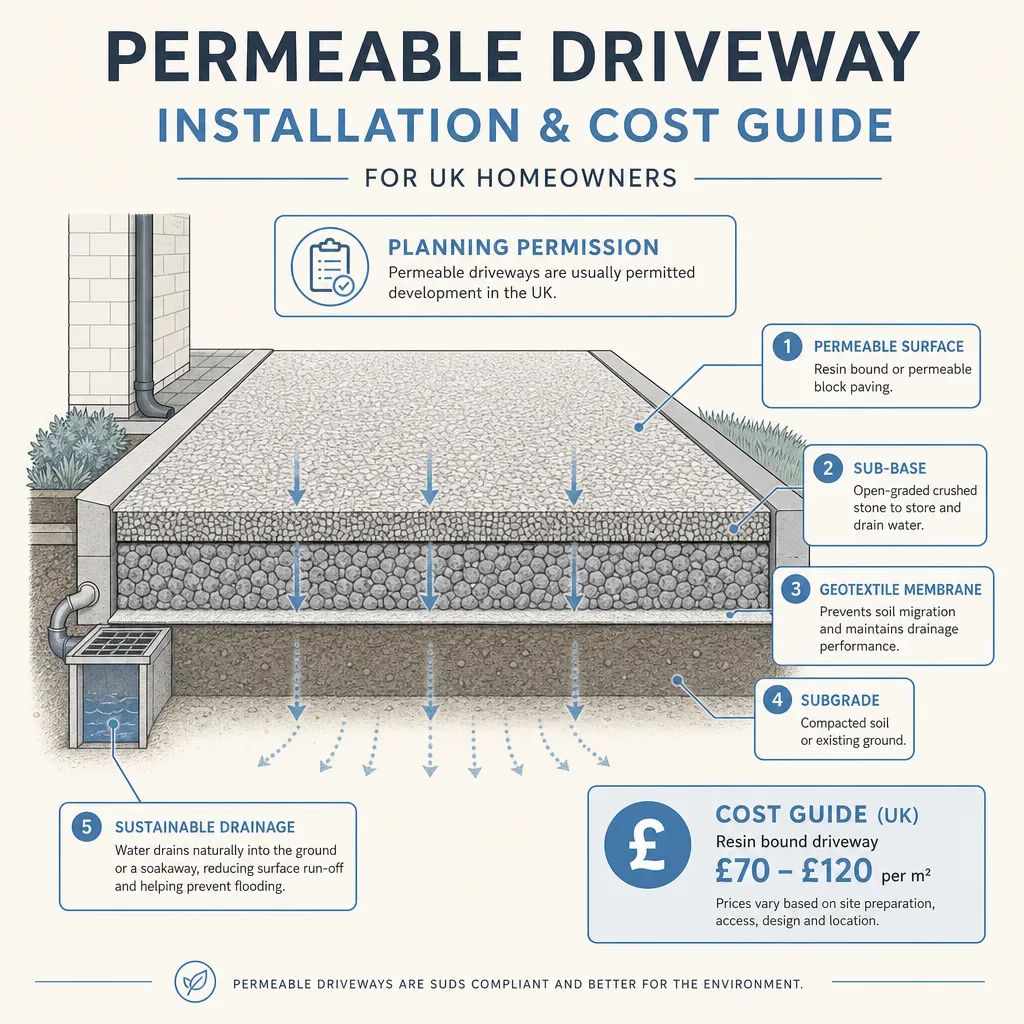
Permeable Driveway Installation and Cost Guide
A permeable driveway lets rainwater drain through or around the surface rather than running off into the road or drainage system.
 Improvement & Build
Yard waste removal: recycling, donating and reusing options
UK councils collect garden waste kerbside — often by annual subscription — or you can drop it free at a Household Waste Recycling Centre.