Permeable Driveway Installation and Cost Guide
By Housey · Last reviewed 7th of May 2026
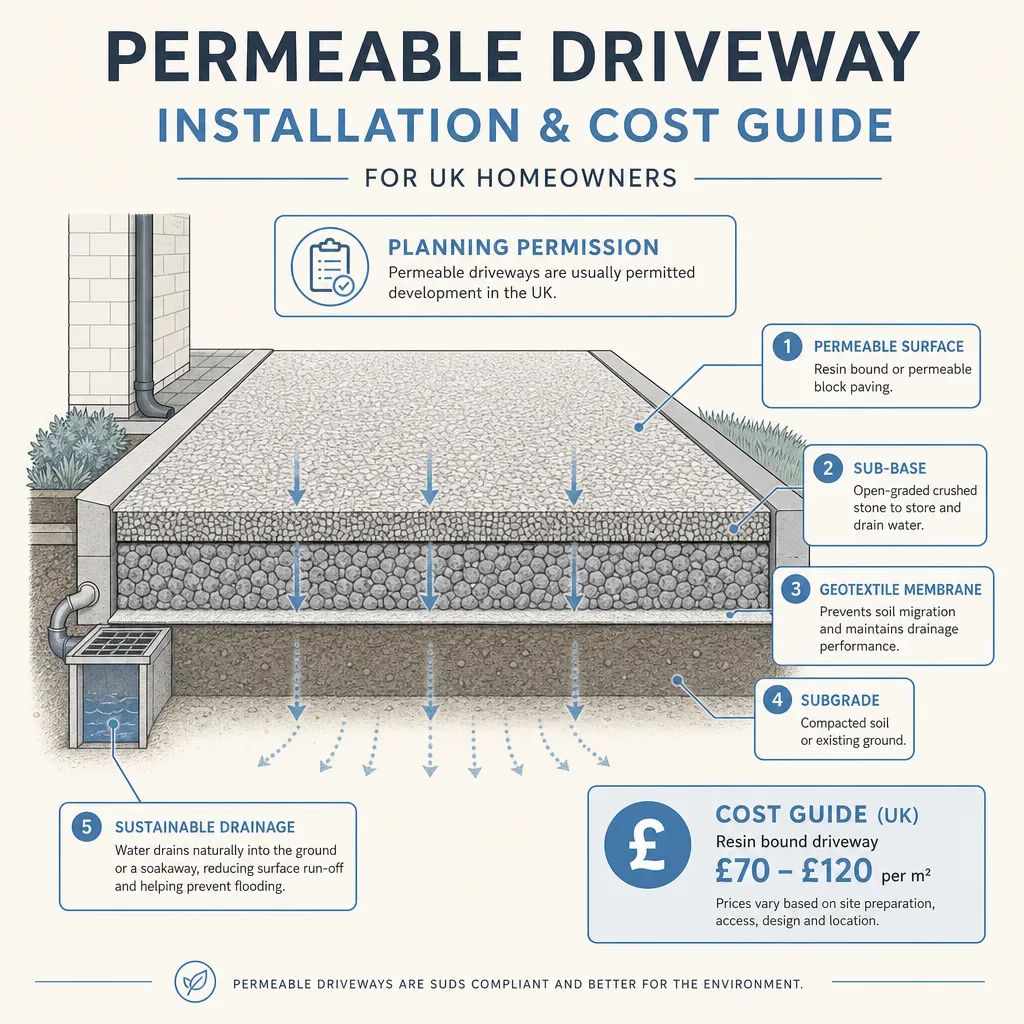
Permeable Driveway Installation and Cost Guide
Replacing or adding a driveway is one of the most common home improvement projects in the UK, and the choice of surface material carries planning and drainage implications that many homeowners only discover once work has started. Since 2008, front garden surfaces have been subject to specific rules designed to reduce stormwater runoff, and the material you choose directly determines whether planning permission is required. With urban drainage systems under increasing pressure from higher-intensity rainfall events, local authorities are paying close attention to how new hard surfaces are managed.
Key points
- Since 2008, front driveways over 5m² must use a permeable surface or direct runoff to a lawn or border — otherwise planning permission is required under Part 1, Class F of the Town and Country Planning (General Permitted Development) Order.
- Resin-bound gravel typically costs £50–120/m² installed; loose gravel starts from around £15/m²; permeable block paving falls between at £40–80/m².
- SuDS (Sustainable Drainage Systems) policy means new drainage in England must generally manage water on-site rather than directing it straight to the sewer network.
- MOT Type 3 open-graded aggregate is the standard sub-base for most permeable surface systems — an inadequate sub-base is the most common cause of early failure.
- In a conservation area or on a listed building, even a permeable surface may require planning consent before work begins.
Why permeable surfaces matter
Until 2008, any front garden driveway was generally permitted development regardless of what it was made from. An amendment to the General Permitted Development Order changed that: a new or replacement hard surface in the front garden now requires planning permission unless it is permeable or drains to a permeable area such as a lawn or planted border. The rationale was to curb the wave of impermeable concrete and tarmac front gardens contributing to local flooding and sewer overload.
Choosing a permeable surface therefore serves two practical purposes: it typically removes the need for planning permission, and it handles rainwater sustainably on your own land.
This rule applies in England only. Wales, Scotland, and Northern Ireland have separate planning regimes — check with the relevant planning authority before starting work.
Permeable driveway material options
Material | Typical installed cost (per m²) | Drainage method | Best for | Key considerations |
|---|---|---|---|---|
Loose gravel | £15–30 | Water passes through gaps | Budget installs, rural properties | Migrates underfoot; needs solid edging; poor on slopes |
Resin-bound gravel | £50–120 | Bound aggregate lets water through | Contemporary look; low maintenance | Specialist installer required; correct sub-base critical |
Permeable block paving | £40–80 | Open joints and sub-base drainage | Traditional look; durable | Joints need periodic topping; sub-base specification matters |
Grasscrete or grass grid | £20–50 | Drains through grass or soil | Green aesthetic; occasional use | Not for heavy regular traffic; mowing required |
Open-cell gravel grid | £20–40 | Water passes through cells | Moderate traffic; stable | May gather debris; less refined appearance |
Permeable tarmac | £30–60 | Porous asphalt structure | High-traffic or sloped drives | Less widely available; specialist installer needed |
Indicative UK costs, last reviewed 2026-05-07. Prices vary by region, access, and site preparation. Obtain at least three itemised quotes.
What affects the final price?
Sub-base preparation is often the largest variable. Soft, contaminated, or previously concreted ground requires excavation and disposal before the sub-base can be laid, adding meaningful cost. Site access and shape — narrow gateways, slopes, tree roots, and irregular outlines all increase labour time. Edging and drainage channels add to materials and install costs but improve long-term performance. Location also matters: labour rates in London and the South East are generally higher than elsewhere in England.
Planning permission: a decision tree
- Is the surface in the front garden (between house and road)?
- No → planning permission not required for material choice alone.
- Yes → continue.
- Is the hard surface area over 5m²?
- No → planning permission not required.
- Yes → continue.
- Is the surface permeable, or does it drain to a lawn or permeable border?
- Yes → planning permission not required under the GPDO.
- No → planning permission is required before installation.
- Is the property in a conservation area, AONB, or listed?
- Yes → contact your local planning authority before proceeding — additional restrictions may apply regardless of surface type.
Rules may also vary where permitted development rights have been removed by an Article 4 Direction — check with your local planning authority if in any doubt.
Homeowner checklist before installation
Maintenance and lifespan
Resin-bound gravel lasts 15–25 years with minimal upkeep — periodic brushing and jet washing prevents silt blocking drainage channels. Permeable block paving can last 30 or more years structurally but jointing compounds may need replenishing every few years. Loose gravel needs ongoing raking and replenishment. All permeable surfaces lose drainage capacity over time if fine material silts up the void spaces; an inspection after the first winter catches problems early.
When to get professional help
Most driveway projects are straightforward for an experienced contractor, but seek specialist advice when:
- Standing water regularly collects on or near the site after rain.
- The site slopes significantly and runoff could affect a neighbour or the highway.
- Large tree roots are present close to the excavation zone.
- The property is listed or in a conservation area.
- Underground services run near the planned excavation.
- A new drainage channel is to connect to an existing drain — this may require Building Regulations approval.
How Housey can help
Housey connects homeowners with vetted driveway installers across the UK. Describe your project and surface preference to receive competitive quotes from local contractors.
Frequently asked questions
Does a permeable driveway need planning permission?
Generally no — provided the surface is genuinely permeable and the property is not in a conservation area or subject to an Article 4 Direction removing permitted development rights. The 2008 GPDO amendment requires hard front garden surfaces over 5m² to be permeable, or drain to a permeable area, to avoid needing consent. Always confirm with your local planning authority if in doubt.
Is resin-bound gravel the same as resin-bonded gravel?
No. Resin-bound gravel fully encapsulates aggregate in resin, creating a porous matrix water drains through. Resin-bonded gravel scatters aggregate on top of a resin base — it is not permeable and not SuDS-compatible. Only resin-bound qualifies as permeable for planning and drainage purposes. Ask any contractor to confirm which product they are supplying before work starts.
How long does a permeable driveway last?
Lifespan depends on material and sub-base quality. Resin-bound gravel typically lasts 15–25 years; permeable block paving can last 30 or more years with good maintenance. Loose gravel requires ongoing replenishment. A correctly specified MOT Type 3 open-graded sub-base is the single biggest factor in long-term performance across all surface types.
Can I install a permeable driveway myself?
Loose gravel is within most homeowners' DIY capability provided edging and sub-base preparation are correct. Resin-bound systems and permeable block paving generally require specialist skills and equipment to achieve a flat, well-draining result. Poor installation — particularly an inadequate sub-base — commonly leads to early failure or water pooling at the surface.
Does a permeable driveway reduce flooding risk?
It reduces stormwater runoff from your plot, with a cumulative neighbourhood benefit when widely adopted. On free-draining soil a permeable drive can virtually eliminate runoff. On heavy clay a soak-away or designed drainage scheme may also be needed to prevent water pooling on site rather than simply pushing the problem into the sub-base.
Sources and further reading
- When is planning permission required? — GOV.UK — GOV.UK planning guidance
- Sustainable drainage systems (SuDS) — GOV.UK — Defra and Environment Agency
- Town and Country Planning (General Permitted Development) Order 2015 — legislation.gov.uk — legislation.gov.uk
- Dial Before You Dig — LSBUD — UK underground services strike prevention
Useful next reads
 Improvement & Build
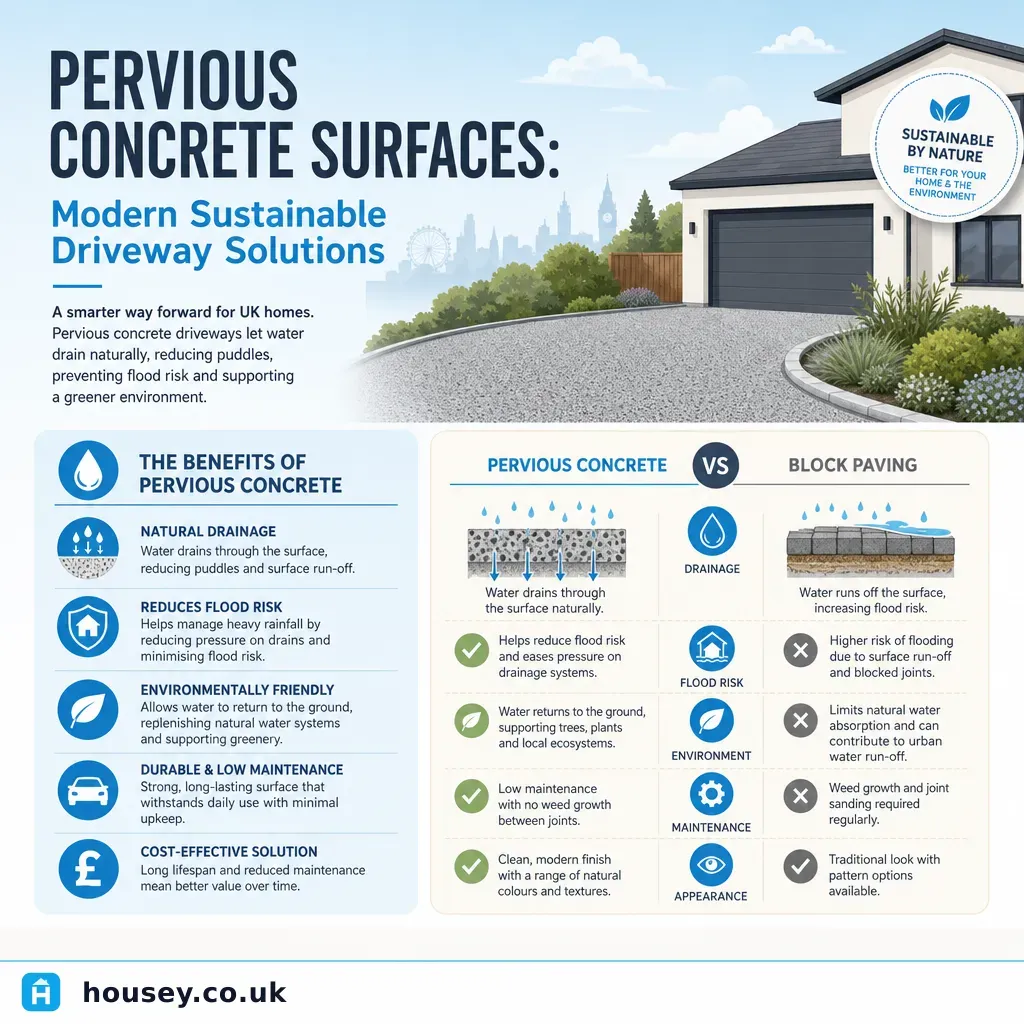
Pervious Concrete Surfaces: Modern Sustainable Driveway Solutions
Pervious concrete (also called porous or no-fines concrete) is a specialist concrete mix with large voids that allow rainwater to pass through the surface and into the sub-base below.
 Improvement & Build
Soffit replacement: repair options and installation costs explained
Soffit replacement typically costs £500–£1,200 for a semi-detached home in the UK, depending on material choice and the extent of work.
 Improvement & Build
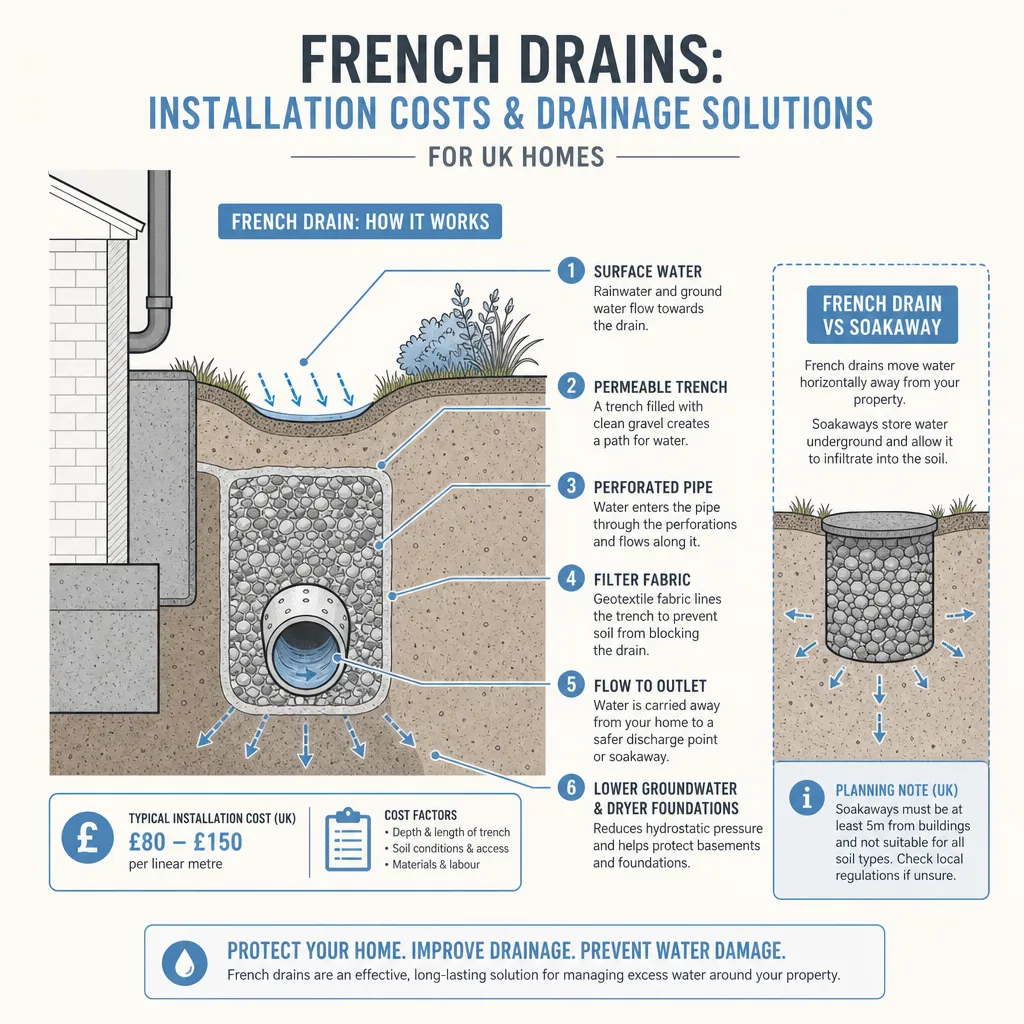
French Drains: Installation Costs and Drainage Solutions
A French drain is a gravel-filled trench with a perforated pipe that redirects groundwater away from a building or waterlogged area.
 Improvement & Build
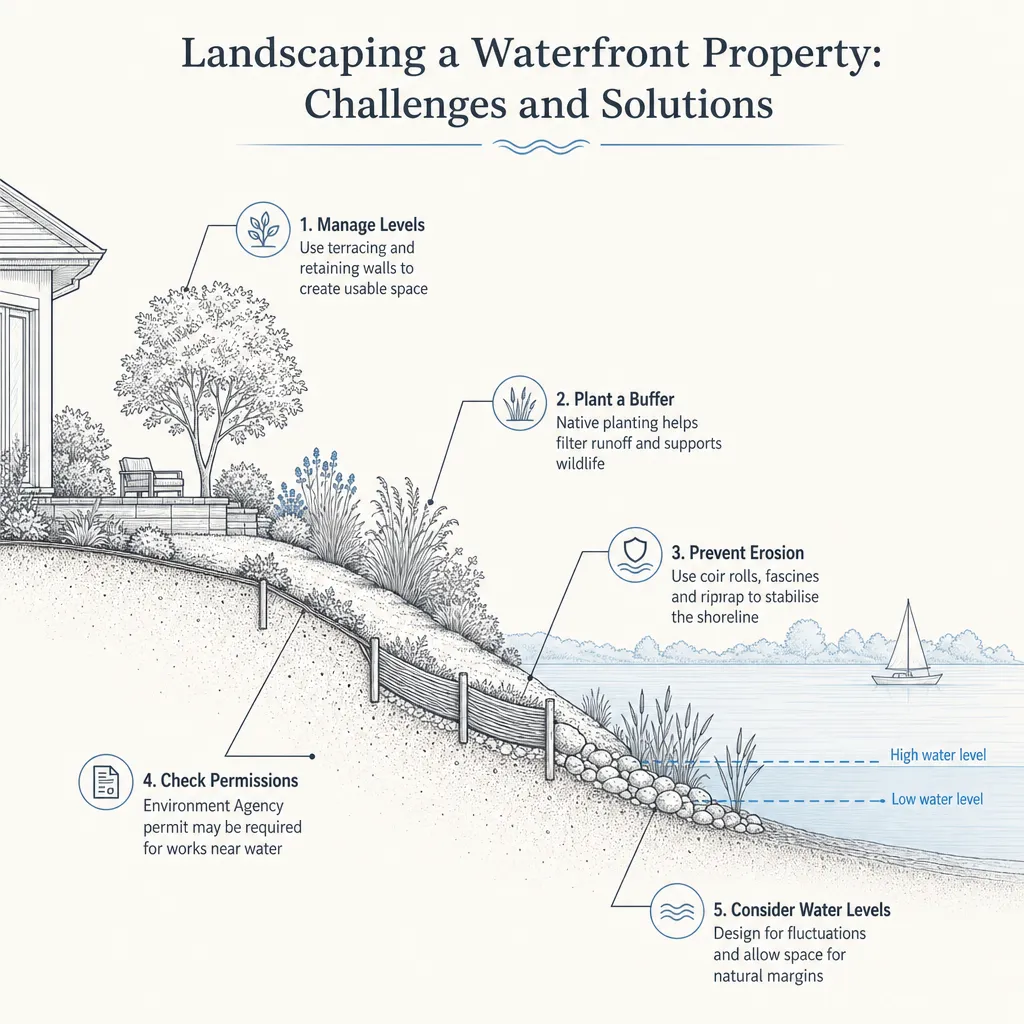
Landscaping a Waterfront Property: Challenges and Solutions
Waterfront landscaping requires specialist planning to manage erosion, flooding, and drainage.
 Improvement & Build
Retaining Wall Installation: Cost, Design and Maintenance
A retaining wall holds back soil on a sloped or banked site.