Japanese Knotweed: Identification, Legal Obligations and Removal in the UK
By Housey · Last reviewed 1st of June 2026
Japanese Knotweed: Identification, Legal Obligations and Removal in the UK
Japanese knotweed is one of the few plant species that can simultaneously derail a property sale, trigger legal liability, and require a multi-year management programme. Whether you have spotted bamboo-like canes at the garden boundary or a surveyor has flagged it in a Level 2 or Level 3 report, understanding what the law requires and what your practical options are is essential before you decide how to act.
Key points
- Japanese knotweed is listed under Schedule 9 of the Wildlife and Countryside Act 1981; allowing it to spread to neighbouring land, a public right of way, or a watercourse can constitute a criminal offence punishable by an unlimited fine or up to two years' imprisonment.
- Knotweed plant material, contaminated soil, and root matter must be disposed of as controlled waste under the Environmental Protection Act 1990 — it cannot be placed in a household skip or taken to a civic amenity site without a waste transfer note.
- RICS uses a four-category distance-based risk framework to assess knotweed's impact on property value and mortgage eligibility.
- Most mainstream mortgage lenders will not proceed on a property with active knotweed unless an insurance-backed management plan (IBMP) from a Property Care Association (PCA) accredited specialist is in place.
- Herbicide-based management typically takes 3–5 growing seasons to achieve consistent control; physical excavation is faster but significantly more expensive and generates large volumes of controlled waste.
How to identify Japanese knotweed
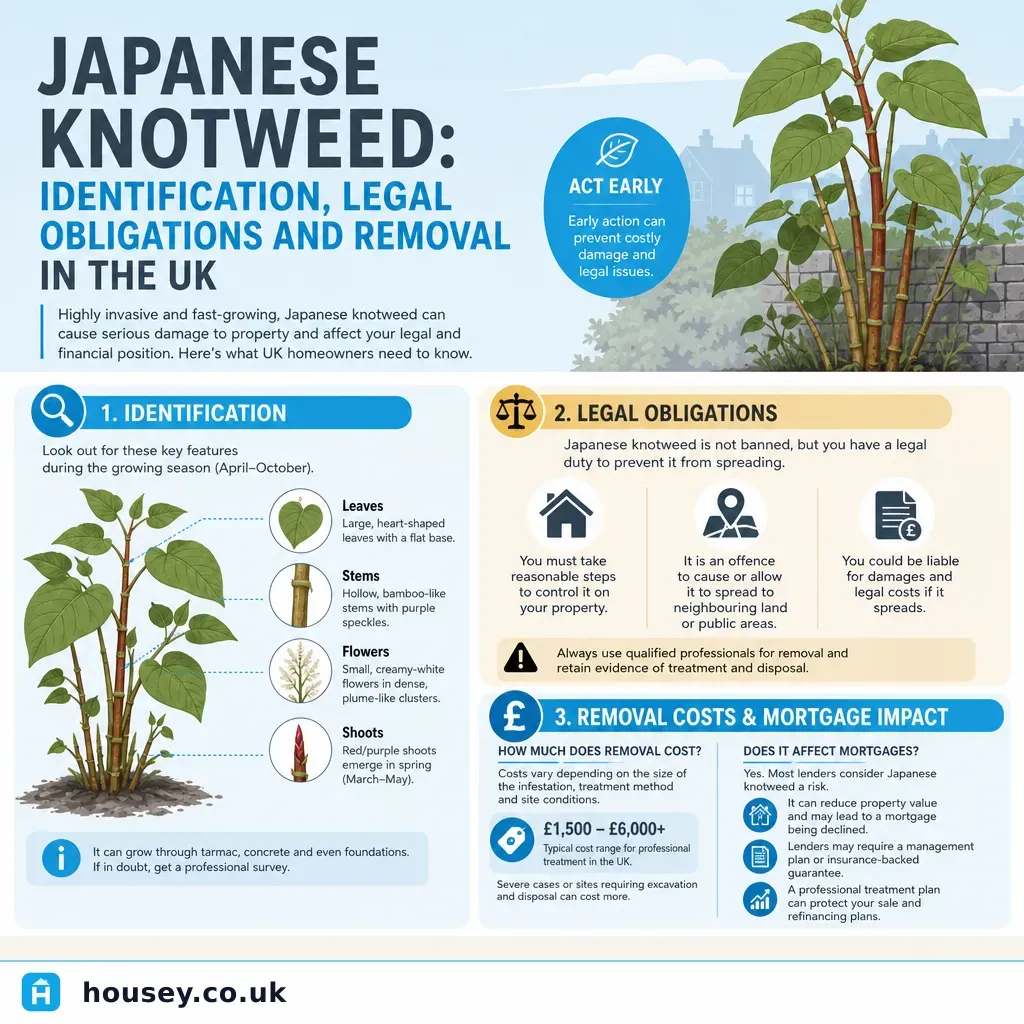
Japanese knotweed (Fallopia japonica) is most distinctive between May and October. Key identification features include:
- Stems: Hollow, bamboo-like, red-purple speckled, growing up to 3 m tall by late summer.
- Leaves: Heart- or shield-shaped, up to 12 cm across, arranged alternately along the stem with a flat or slightly indented base.
- Flowers: Small, creamy-white clusters appearing in late summer (August–September).
- In winter: Stems die back to leave brown, cane-like skeletons; the crown and rhizome network remain alive underground.
Red flags: plants often confused with knotweed
Plant | Key difference from knotweed |
|---|---|
Bamboo | Round, solid-looking stems; leaves much narrower; no red-purple speckle |
Bindweed | Climbing habit; trumpet-shaped flowers; much smaller overall |
Himalayan balsam | Pink or purple flowers; annual plant that dies completely each winter |
Russian vine | Climbing, woody stems; lacks the hollow-stemmed bamboo appearance |
If you are not certain of the identification, arrange a formal assessment by a qualified ecologist or knotweed specialist before taking any action — misidentification in either direction carries real consequences.
What are your legal obligations?
The law distinguishes between what you must not do and what you are required to do.
You must not:
- Cause knotweed to spread to neighbouring land, a public right of way, or a watercourse (Wildlife and Countryside Act 1981, Schedule 9).
- Dispose of knotweed material improperly — it is controlled waste under the Environmental Protection Act 1990, and fly-tipping or placing it in a regular skip without documentation is an offence.
You are not legally required to:
- Remove knotweed from your own land if it is not spreading. There is no general statutory obligation to eradicate knotweed confined within your own boundaries.
However, the practical consequences of inaction — mortgage refusals, reduced sale price, and potential nuisance claims from neighbours — mean that a management plan is almost always in your interests.
Neighbour disputes and civil nuisance
If knotweed encroaches onto a neighbour's land from yours, they may have a civil claim against you in private nuisance. Conversely, if a neighbour's knotweed spreads onto your land, you may have a claim against them. Early communication and agreeing a joint management approach is usually more practical and cost-effective than litigation.
How knotweed affects your property and mortgage
RICS guidance uses a four-category risk framework based on proximity to habitable spaces and structures:
RICS Category | Description | Typical mortgage impact |
|---|---|---|
1 | Knotweed within 7 m of a habitable space or boundary, with evidence of structural damage | Significant; IBMP almost always required before lending |
2 | Within 7 m of a habitable space or boundary, no structural damage evident | IBMP likely required; most lenders will not proceed without one |
3 | Within the boundary but more than 7 m from habitable spaces | IBMP often required; lender policies vary |
4 | Historically recorded on or near the property; no active growth visible | Minimal impact if prior management is evidenced |
When selling, you must answer the Law Society TA6 property information form question about knotweed honestly. Concealing known knotweed can expose you to a misrepresentation claim after completion.
Treatment and removal options
Which approach should you choose?
- Choose herbicide treatment if you have time (3–5 growing seasons), a standard garden setting, and no urgent sale or development timeline. This is the most cost-effective approach for most residential properties.
- Choose excavation and disposal if you need faster results, are preparing a site for development, or have a severe infestation with structural impact. Expect significantly higher costs and large volumes of controlled waste requiring specialist haulage.
- Ask a PCA-accredited specialist if your site is near a watercourse, a protected habitat, or a listed building — some herbicide products require specific Environment Agency approval before use near water.
- Check with your lender if you are buying or remortgaging — they may specify the IBMP policy wording they will accept.
Indicative costs
Indicative UK costs, last reviewed 2026-06-01. Costs vary significantly by site size, infestation extent, and access conditions. Obtain at least three quotes from PCA-accredited contractors.
Treatment type | Typical range (residential) | Notes |
|---|---|---|
Herbicide management plan (3–5 years) | £1,000–£5,000+ | Includes annual site visits and IBMP certificate |
Excavation and off-site disposal | £5,000–£20,000+ | Controlled waste haulage and licensed tip disposal adds significantly to cost |
Stem injection | Part of a wider plan; specialist pricing | Sometimes preferred near watercourses; requires specialist application |
Indicative ranges reflect Property Care Association guidance and general market data; costs vary by region and site complexity.
Important limitations
This article provides general information about Japanese knotweed in a UK residential context. Legal obligations, lender requirements, and treatment recommendations vary depending on property type, location, and the specific nature of the infestation. Identification should be confirmed by a qualified ecologist or specialist — not from photographs or general descriptions alone. Nothing in this guide constitutes legal advice. If a neighbour dispute has arisen, consult a solicitor.
When this becomes urgent
Seek professional assessment without delay if:
- A RICS Level 2 or Level 3 survey has flagged knotweed in a report.
- You are selling or buying a property and knotweed has been disclosed on the TA6 form.
- Knotweed is within 7 m of a structure, boundary wall, or drainage run.
- A neighbour has made a complaint or indicated a legal claim.
- You have material you suspect is knotweed in a bag or skip — do not transport it further until you have confirmed correct disposal requirements with a licensed waste carrier.
What to ask a qualified professional
Before instructing a knotweed specialist or ecologist, ask:
- Are you accredited by the Property Care Association (PCA) or a member of the Invasive Non-Native Specialists Association (INNSA)?
- Will you provide a formal site identification report and assessment before recommending treatment?
- What treatment method do you recommend for my specific site, timeline, and proximity to water or structures?
- Will the management plan include an insurance-backed guarantee (IBMP), and do major high-street lenders accept your policy wording?
- How will contaminated material be disposed of, and will you provide a waste transfer note?
- What happens if knotweed regrows after the treatment period — is retreatment included?
How Housey can help
If you have found — or suspect — Japanese knotweed on your property, Housey can connect you with qualified environmental survey specialists who carry out formal identification, site assessment, and knotweed management planning. For invasive plant and boundary vegetation work in conjunction with trees or wider landscape features, our tree surgeons and landscape contractors directory lists experienced contractors who can support broader site clearance and management.
Frequently asked questions
Does Japanese knotweed always affect a mortgage?
Not always, but it frequently does. Most mainstream lenders will want to see an insurance-backed management plan (IBMP) if knotweed is present within or near the property boundary. Some specialist lenders take a more flexible approach depending on the RICS risk category. Check directly with your lender or mortgage broker for their specific requirements before exchanging contracts.
Can I remove Japanese knotweed myself?
You can apply herbicide to knotweed on your own land following label instructions, but you must not allow cuttings, roots, or contaminated soil to be disposed of incorrectly. Professional treatment is strongly recommended: specialists hold the correct licences, manage legally compliant waste disposal, and can issue the insurance-backed management plan certificate that most mortgage lenders require.
What does Japanese knotweed look like in winter?
In winter, knotweed dies back to hollow, brown canes that remain standing through the season. Underground, the rhizome network — which can extend 3 m deep and 7 m laterally — remains fully viable. Do not assume the plant has died; it will re-emerge from the crown each spring.
Do I have to declare Japanese knotweed when selling?
Yes. The Law Society's TA6 property information form asks sellers directly about Japanese knotweed. Providing an inaccurate or dishonest answer can expose you to a misrepresentation claim after completion. If you are genuinely unsure whether knotweed is present within your boundaries, arrange a specialist survey before exchanging contracts.
Sources and further reading
- Wildlife and Countryside Act 1981 — Schedule 9 — legislation.gov.uk
- Invasive non-native species: rules in England — GOV.UK
- Japanese knotweed: managing an invasive weed — GOV.UK
- Japanese knotweed and residential property — RICS
- Japanese knotweed guidance for homeowners — Property Care Association
Useful next reads
 Improvement & Build
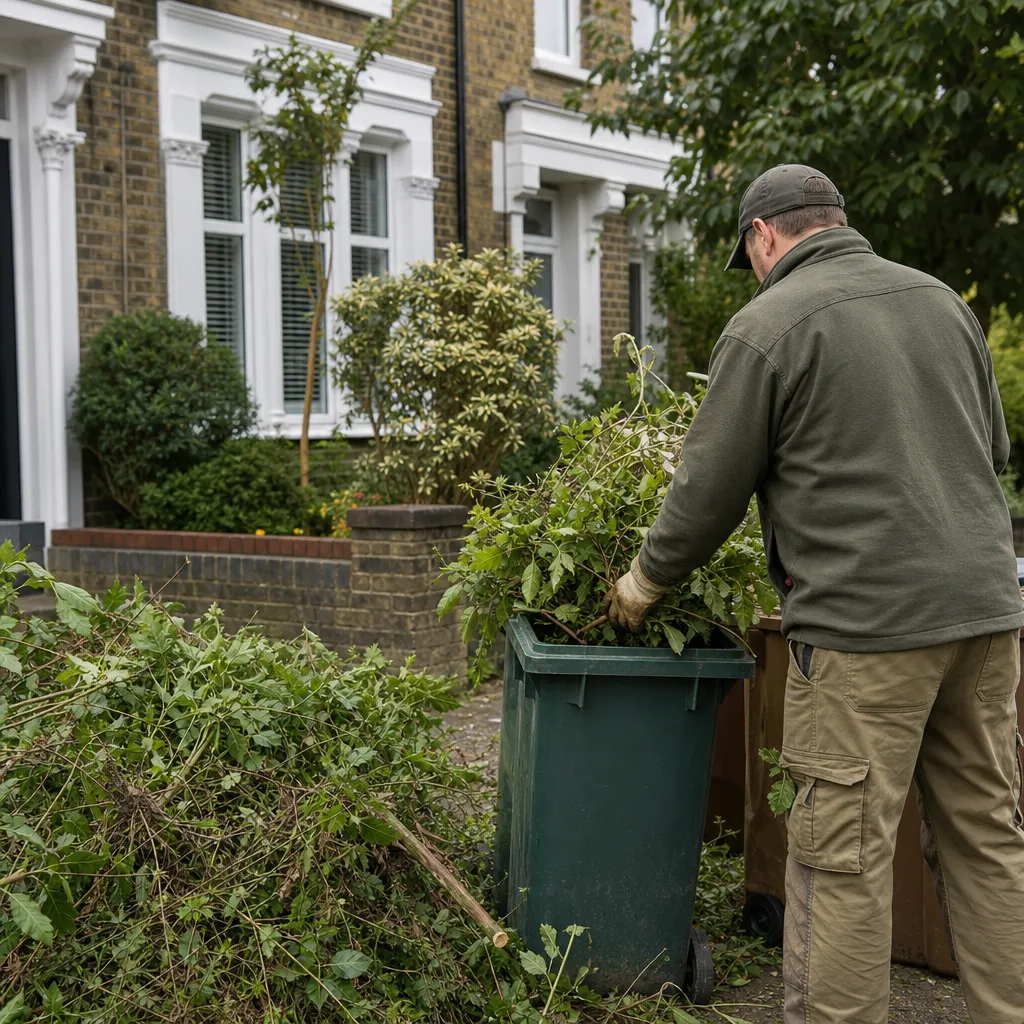
Yard waste removal: recycling, donating and reusing options
UK councils collect garden waste kerbside — often by annual subscription — or you can drop it free at a Household Waste Recycling Centre.
 Improvement & Build
Pervious Concrete Surfaces: Modern Sustainable Driveway Solutions
Pervious concrete (also called porous or no-fines concrete) is a specialist concrete mix with large voids that allow rainwater to pass through the surface and into the sub-base below.
 Improvement & Build
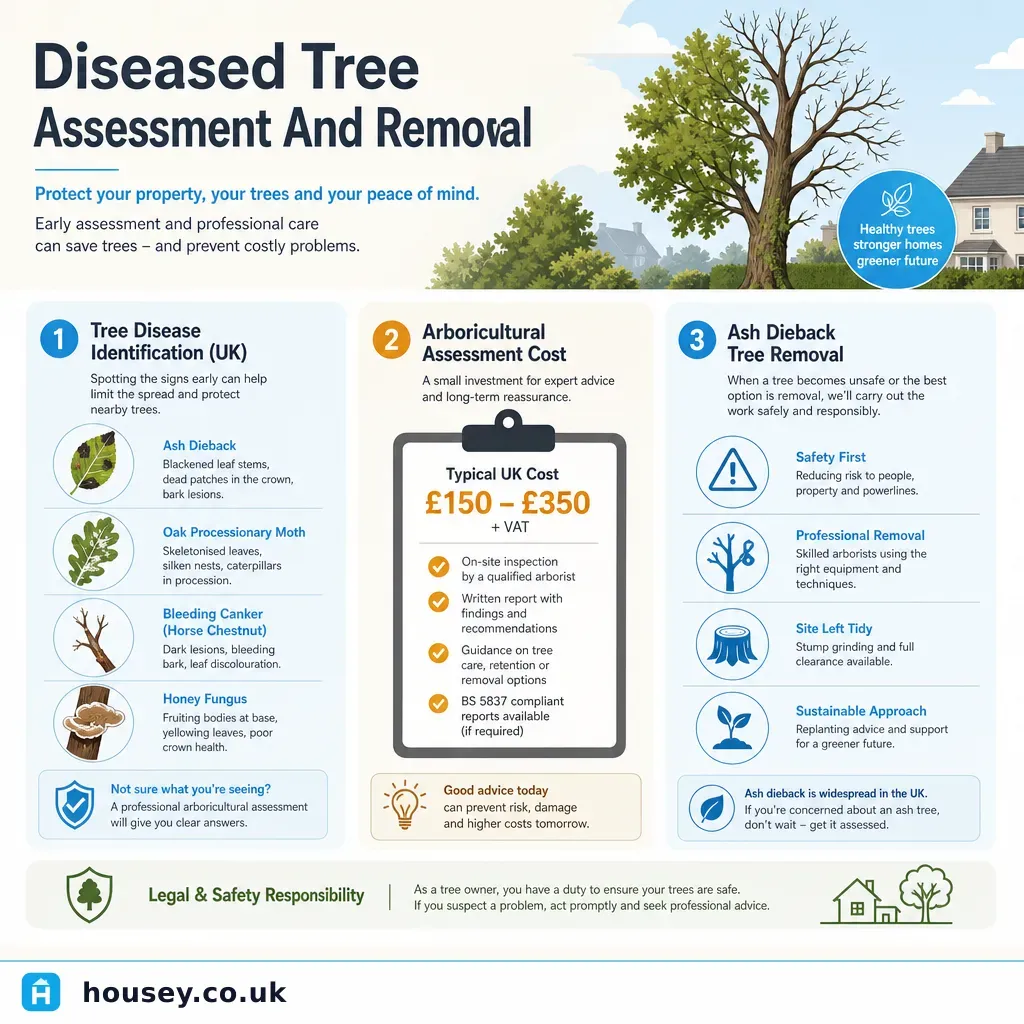
Diseased Tree Assessment And Removal
A diseased or structurally compromised tree can pose a serious safety risk, but not every unhealthy-looking specimen needs to come down.
 Improvement & Build
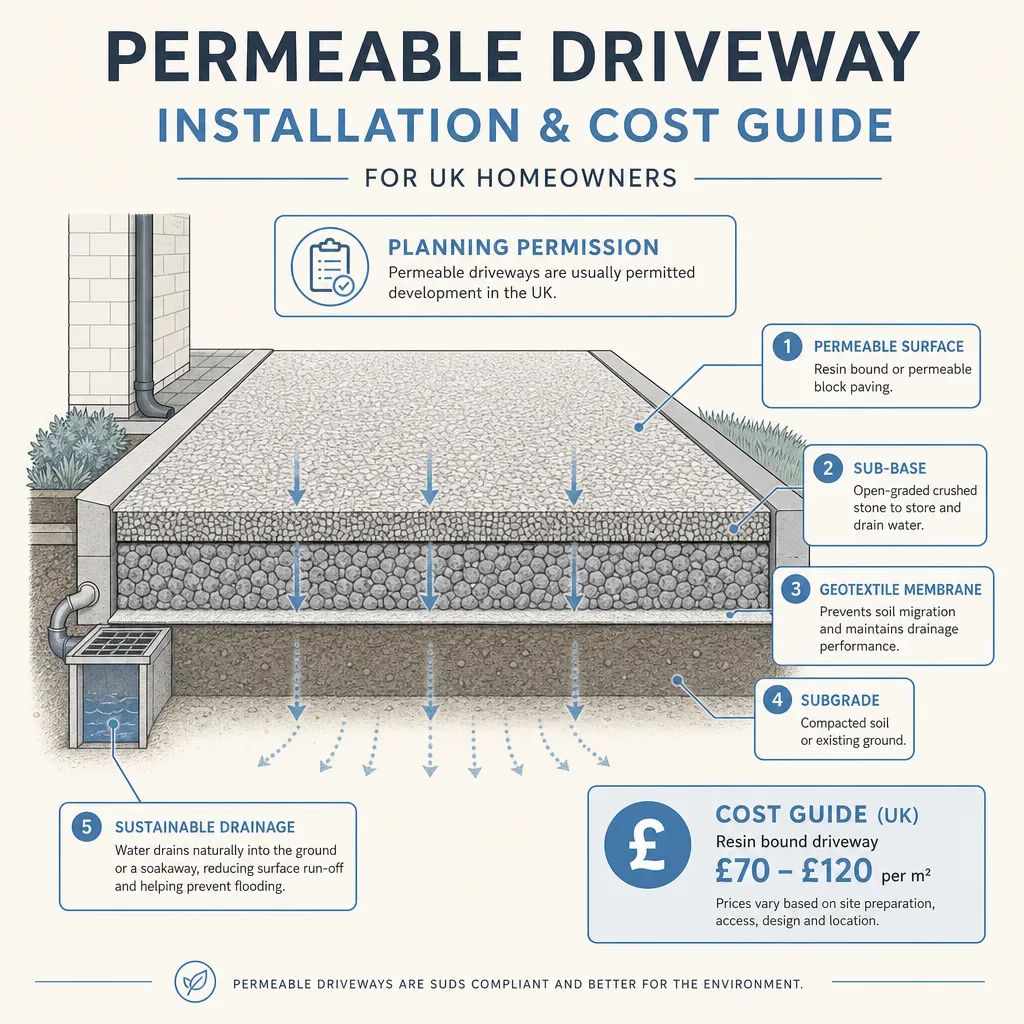
Permeable Driveway Installation and Cost Guide
A permeable driveway lets rainwater drain through or around the surface rather than running off into the road or drainage system.
 Improvement & Build
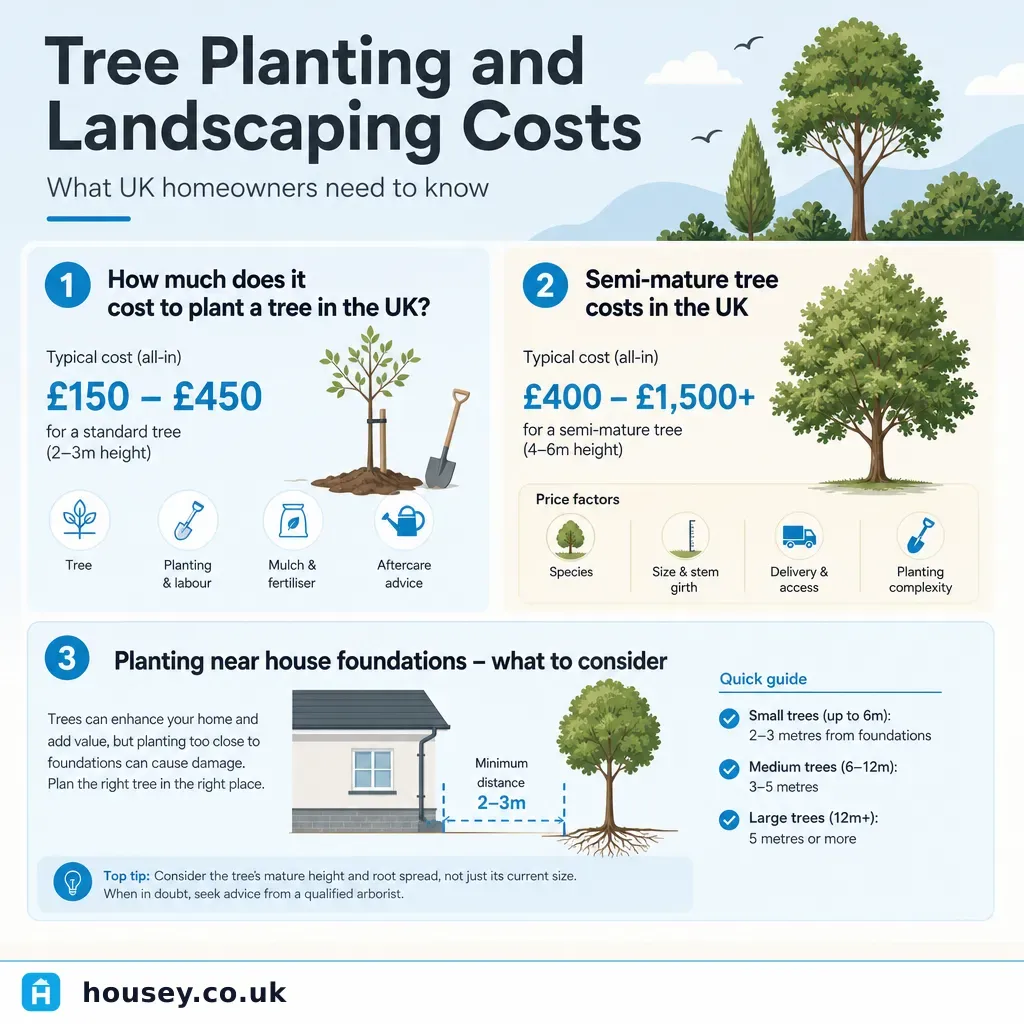
Tree Planting and Landscaping Costs
Tree planting costs range from around £5 for a bare-root whip to £5,000 or more for a semi-mature specimen with professional planting.