Extending Your Leasehold: What Homeowners Need to Know
By Housey · Last reviewed 18th of May 2026
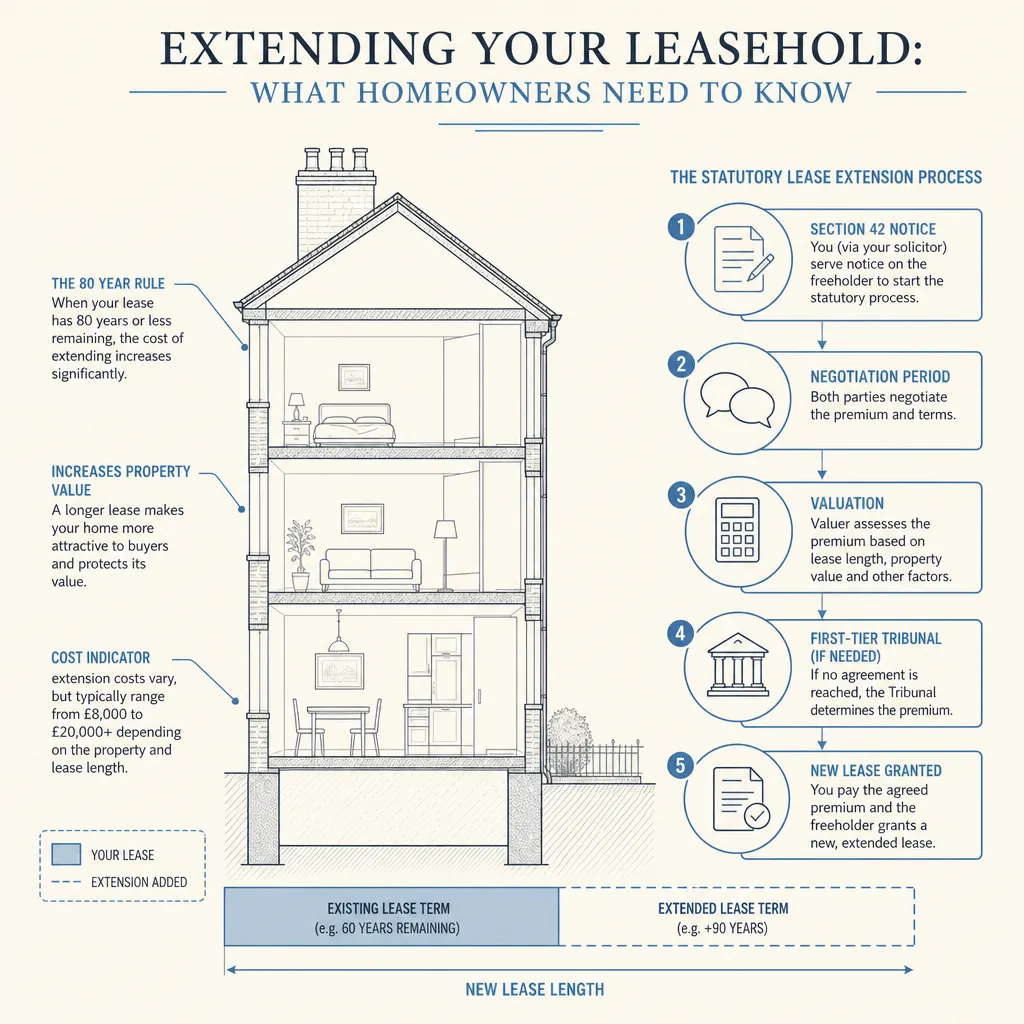
Extending Your Leasehold: What Homeowners Need to Know
Leasehold flat ownership comes with a built-in clock: as the unexpired lease term shortens, the property becomes harder to sell, harder to mortgage, and more expensive to fix. For the nearly five million leasehold dwellings in England, knowing when and how to extend is one of the most consequential decisions a property owner faces. The rules are set by statute, the negotiation is specialist work, and the cost rises steeply once a lease falls below a critical threshold.
Key points
- The Leasehold Reform, Housing and Urban Development Act 1993 gives qualifying flat owners the statutory right to extend their lease by 90 years above the current unexpired term, with ground rent reduced to a peppercorn (zero).
- You must have owned the leasehold title for at least two years before you can serve a statutory Section 42 notice on your freeholder.
- When a lease falls below 80 years, marriage value applies — the freeholder becomes entitled to 50% of the increase in property value that the extension creates, sharply raising the premium.
- Most mortgage lenders require at least 70–85 years remaining at the end of a mortgage term; a short lease can block remortgaging or a sale.
- Leaseholders are required to pay the freeholder's reasonable legal and surveyor costs in addition to their own, so the total outlay often exceeds the premium alone.
Statutory versus informal lease extension
Two routes exist: the statutory process under the 1993 Act, and an informal (voluntary) negotiation with the freeholder. Each suits different circumstances.
| Statutory route | Informal route |
|---|---|---|
Legal basis | Leasehold Reform, Housing and Urban Development Act 1993 | Contractual agreement between parties |
Extension length | 90 years added to current term | Whatever both parties agree |
Ground rent after extension | Peppercorn (£0) | Freeholder may seek to retain or increase it |
Eligibility requirement | 2 years' ownership of the leasehold | None — available from day one |
Freeholder can refuse | No, if you qualify | Yes, at any time |
Typical timescale | 3–12 months | Weeks to several months |
Main risk | Costs and delays if Tribunal involved | Fewer statutory protections; terms may favour the freeholder |
Best suited to | Most qualifying leaseholders wanting certainty | Owners below the 2-year threshold, or where speed is critical |
The statutory route is generally preferred: the freeholder cannot refuse, and the 90-year extension at peppercorn ground rent is the legal entitlement. The informal route may suit you if you have owned the property for fewer than two years and need to act quickly — for instance, if a sale is pending and the buyer has flagged the lease length.
When to act: the 80-year threshold
The 80-year mark is the most critical milestone in lease extension planning. Once the unexpired term drops below 80 years, marriage value applies and the freeholder becomes entitled to 50% of the uplift in the property's value that the extension creates. This can add tens of thousands of pounds to the premium. Every year below 80 also makes sale and remortgage more difficult, as many lenders will not advance on properties with fewer than 70–85 years remaining at the end of a mortgage term.
Use this as a guide:
- Act now if the lease has fewer than 85 years remaining — costs are rising and lender risk is increasing.
- Plan and obtain a valuation if the lease has 85–90 years remaining — you have a window, but it is narrowing.
- Monitor if the lease has more than 90 years remaining — the cost of extension is lower and there is time to plan.
- Take legal advice immediately if the property is listed, in a conservation area, or the freehold is held by an overseas or corporate entity — these situations add complexity.
- Speak to a specialist solicitor if you have a sale agreed and the buyer is concerned about lease length — your statutory right may be assignable to the buyer.
How the statutory process works
- Instruct a RICS-qualified surveyor to value the likely premium before you serve notice. This gives you a realistic opening figure for the Section 42 notice and helps you assess the freeholder's counter-proposals.
- Instruct a specialist leasehold solicitor experienced in enfranchisement under the 1993 Act.
- Serve a Section 42 notice (the tenant's notice) on the freeholder. This formal document must meet specific statutory requirements, including your proposed premium. Errors can invalidate it.
- The freeholder has two months to serve a Section 45 counter-notice, accepting your terms or proposing a different premium.
- Negotiate through respective surveyors. Most cases settle at this stage without Tribunal involvement.
- Apply to the First-tier Tribunal (Property Chamber) if agreement cannot be reached within six months of the counter-notice. The Tribunal determines a fair premium; its decision is binding.
- Complete and register. The new lease is executed, the premium paid, and the extended lease registered with HM Land Registry.
What does a lease extension cost?
The premium paid to the freeholder is calculated using a specialist valuation methodology that accounts for the unexpired term, the current ground rent, the property's market value, and — where applicable — marriage value. In addition to the premium, budget for:
- Your RICS surveyor's fees: indicatively £800–£2,000 or more for valuation and negotiation support.
- Your solicitor's fees: indicatively £1,500–£3,000 or more depending on complexity.
- The freeholder's reasonable costs: their legal and surveyor fees, payable by the leaseholder under statute.
- HM Land Registry registration fee: £20–£910 depending on property value.
- Stamp Duty Land Tax: may apply in some circumstances — ask your solicitor.
- VAT on all professional fees.
Indicative UK costs, last reviewed 2026-05-18. Costs vary significantly by property value, lease length, location, and complexity. Always obtain at least two quotes.
Important limitations
This article provides general information about leasehold extension in England and Wales. The law and its application can vary depending on your lease terms, the structure of the freehold ownership, the property type, and your individual circumstances. This is not legal or financial advice. A qualified solicitor specialising in leasehold enfranchisement and a RICS-qualified surveyor should review your specific situation before any formal steps are taken. Rules in Scotland and Northern Ireland differ significantly — seek advice under the relevant jurisdiction.
When this becomes urgent
- Your lease has fewer than 80 years remaining — every month below this threshold increases the premium.
- A sale is agreed and the buyer or their lender has flagged the lease length as a problem.
- Your lender has declined a remortgage application because of insufficient remaining lease term.
- You have received unsolicited correspondence from your freeholder about the lease or a proposed variation.
- You are about to complete on a purchase and have not yet checked the unexpired term.
What to ask a qualified professional
Questions for your leasehold solicitor:
- Am I eligible to extend under the 1993 Act, and are there any disqualifying factors in my situation?
- Can my statutory right to extend be assigned to a buyer if I sell before the extension completes?
- Are there unusual clauses in my current lease that could complicate or affect the extension?
- What are the freeholder's legal and surveyor costs likely to be, and can they be challenged if unreasonable?
Questions for your RICS surveyor:
- What is the likely premium range for my extension, and what are the key variables?
- Will marriage value apply to my case, and by how much is it likely to increase the premium?
- How long do negotiations typically take in cases like mine, and what is your Tribunal experience?
- What documentation do you need from me to carry out the valuation?
When to get professional help
Leasehold extension is a specialist legal and valuation process. Do not attempt to serve a Section 42 notice or negotiate with a freeholder without instructing both a solicitor and a RICS-qualified surveyor. Seek immediate professional help if:
- Your lease has fewer than 80 years remaining.
- You have received any formal notice or document from your freeholder relating to the lease.
- You are buying or selling a leasehold property where the unexpired term has been flagged as a concern.
- You are considering signing an informal agreement offered by the freeholder without independent advice.
How Housey can help
Housey connects leaseholders with RICS-qualified surveyors who specialise in lease extension valuations. Getting an independent valuation before you serve your Section 42 notice — or promptly after receiving a counter-notice — gives you a clear and defensible view of the premium range and strengthens your position throughout negotiations.
Frequently asked questions
How long does a leasehold extension take in the UK?
The statutory process typically takes between three and twelve months from serving the Section 42 notice to completing the new lease. Straightforward cases where both valuers reach agreement early can complete in three to four months. Contested cases that proceed to the First-tier Tribunal can take twelve months or longer. The informal route is often faster but offers fewer statutory protections for the leaseholder.
What happens if my freeholder refuses to engage?
Under the statutory route, a qualifying freeholder cannot refuse to grant the extension — they can only dispute the premium. If the freeholder fails to serve a counter-notice within two months, or if agreement on the premium cannot be reached within six months of the counter-notice, either party may apply to the First-tier Tribunal (Property Chamber) to determine a fair premium. The Tribunal's decision is binding on both parties.
Can I extend my lease before I have owned the property for two years?
Not via the statutory route, which requires at least two years of leasehold ownership. You may negotiate an informal extension with the freeholder at any time, regardless of how long you have owned the property. Be aware that the freeholder may offer less favourable terms — for example, a shorter extension or a retained ground rent — compared to what you would be entitled to under statute. Take specialist legal advice before accepting any informal offer.
Will the Leasehold and Freehold Reform Act 2024 change the process?
The Act received Royal Assent in May 2024 and proposes significant changes, including the abolition of marriage value and amendments to the premium calculation methodology for lease extensions. As of May 2026, some provisions are in force and others are still awaiting secondary legislation before they take effect. The implementation timetable is subject to government decisions. A specialist solicitor can advise on which provisions currently apply to your case.
Sources and further reading
- Leasehold property — GOV.UK
- Leasehold Reform, Housing and Urban Development Act 1993 — legislation.gov.uk
- Leasehold and Freehold Reform Act 2024 — legislation.gov.uk
- First-tier Tribunal (Property Chamber) — GOV.UK
- HM Land Registry registration services fees — HM Land Registry
Useful next reads
 Buying & Moving
Essential Steps to Selling Your Home Successfully
Selling your home successfully in the UK involves obtaining a valid EPC, choosing an estate agent or alternative method, instructing a solicitor or conveyancer early, and completing the Seller's Property Information Form accurately.
 Buying & Moving
Complete Homebuying Checklist and Essential Services for First-Time Buyers
First-time buyers in the UK should commission an independent RICS Home Survey before exchange — a mortgage lender's valuation does not protect you.
 Buying & Moving
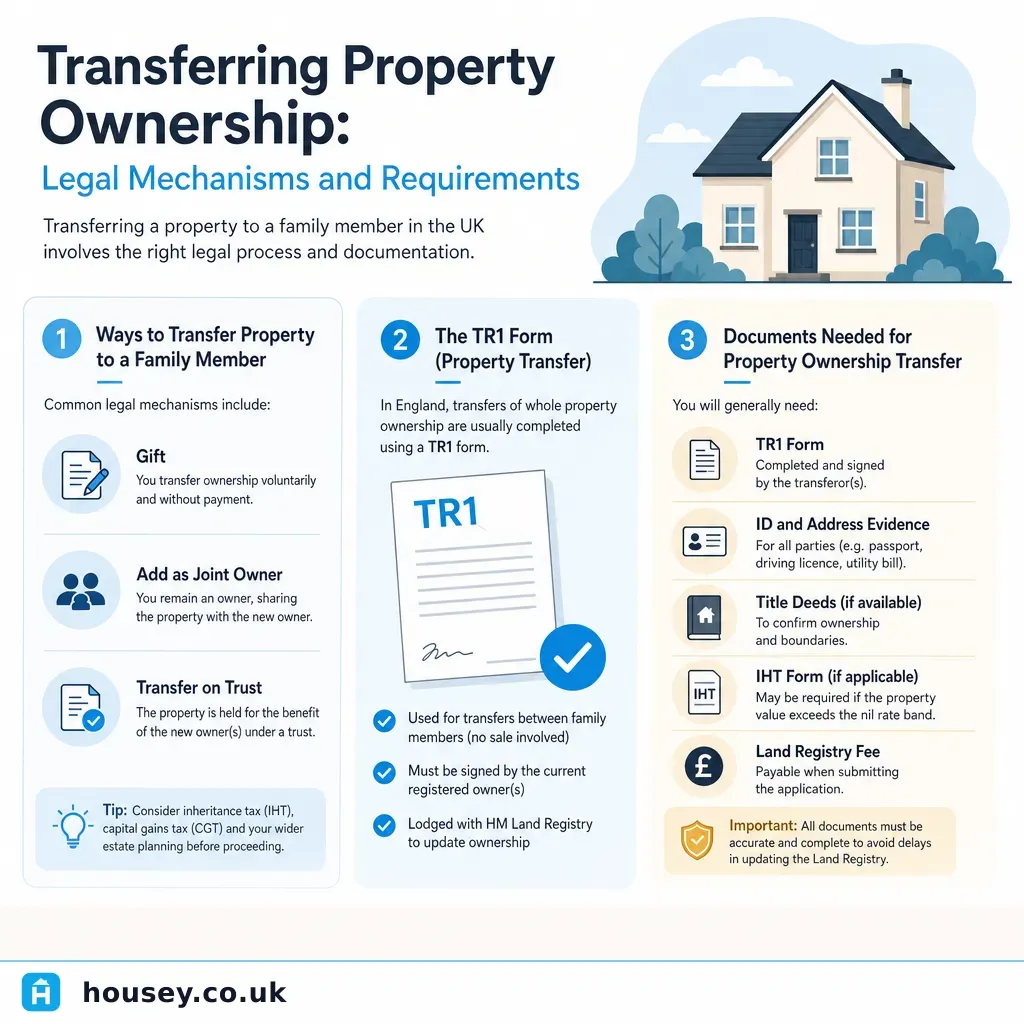
Transferring Property Ownership: Legal Mechanisms and Requirements
In England and Wales, property ownership transfers when HM Land Registry records a change of proprietor, triggered by a completed TR1 deed for full transfers or a TP1 for partial ones.
 Buying & Moving
London Property Market Conditions And Buyer Advisory For Investors
London's property market varies enormously by borough, tenure, and property type.
 Buying & Moving
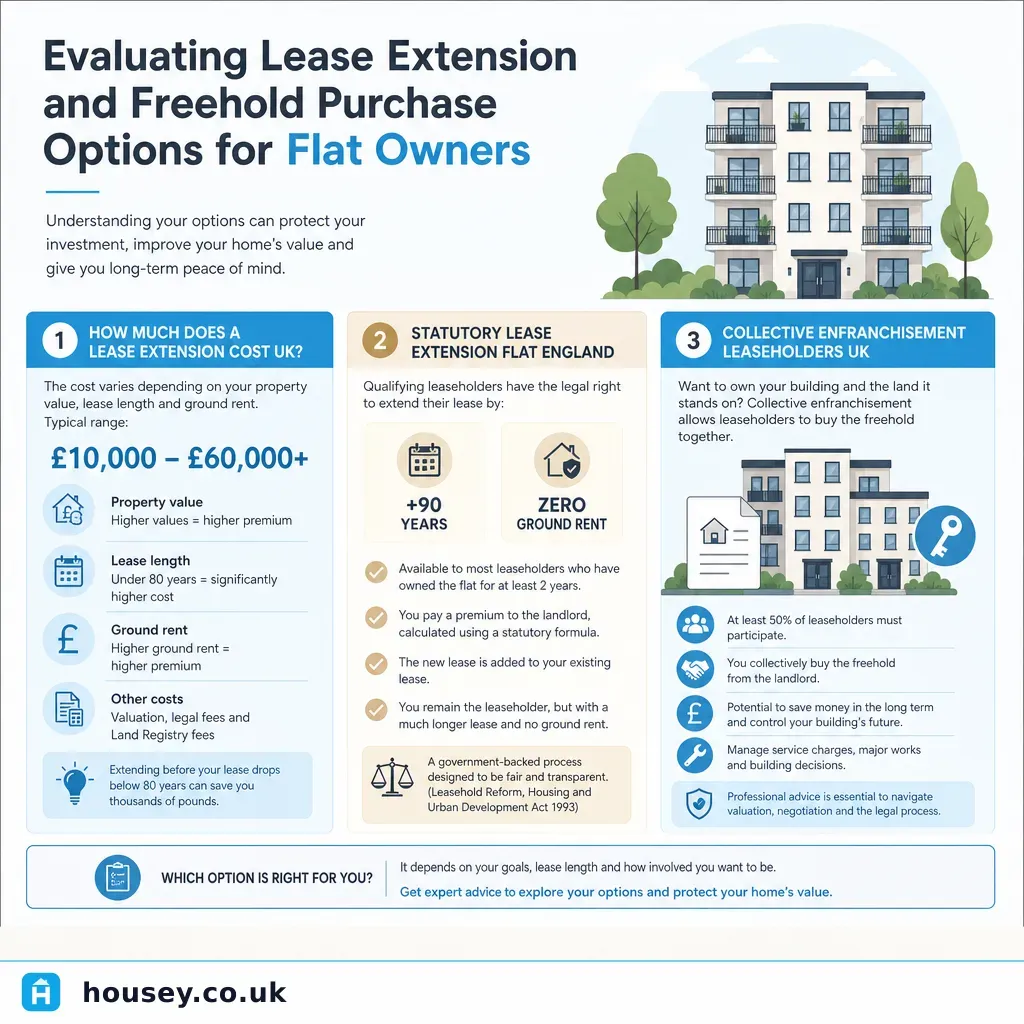
Evaluating Lease Extension and Freehold Purchase Options for Flat Owners
Flat owners in England and Wales can extend their lease by 90 years — increasing to 990 years under pending 2024 reforms — or collectively purchase the freehold.