Expenses for Moving or Relocating a Gas Meter
By Housey · Last reviewed 6th of May 2026
Expenses for Moving or Relocating a Gas Meter
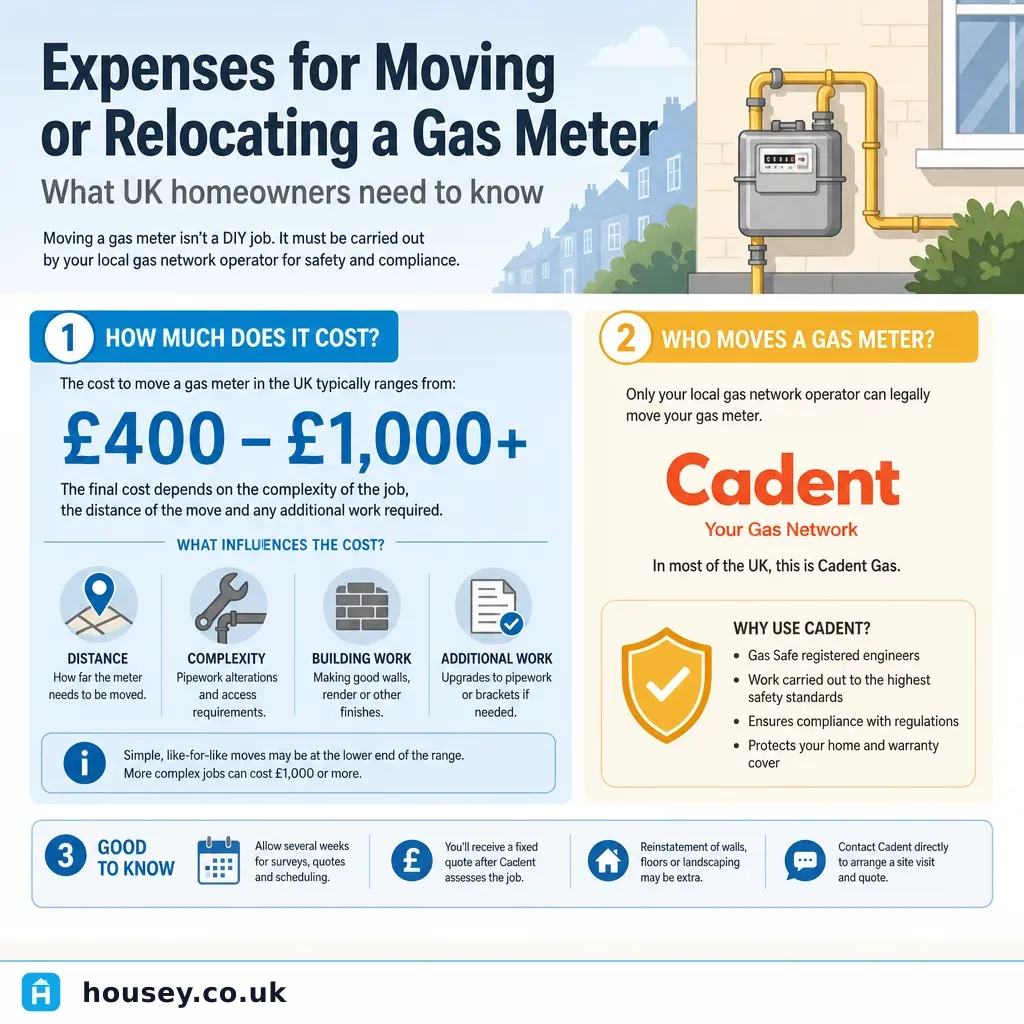
A gas meter relocation is commonly triggered by a home extension, kitchen renovation, or garage conversion that leaves the existing meter in an inconvenient or inaccessible position. Unlike most building work, it cannot be arranged through a private Gas Safe engineer — the meter itself is owned and managed by your regional gas distribution network operator, which means the process, cost structure, and lead times operate quite differently from standard trade quotations.
Key points
- Gas meter relocation is carried out exclusively by the gas distribution network operator for your region (Cadent Gas, SGN, Northern Gas Networks, or Wales & West Utilities) — not by a private Gas Safe engineer.
- Contact your gas supplier (the company named on your gas bill) to initiate a meter move; they coordinate with the network operator on your behalf.
- Indicative costs range from approximately £500 to £1,500 for a simple domestic move of one to two metres; complex or long-distance relocations can exceed £3,000 (Indicative UK costs, last reviewed 2026-05-06).
- The network operator will not carry out the meter move until internal gas pipework modifications — which must be done by a Gas Safe registered engineer — are completed or coordinated.
- Internal gas pipework changes are notifiable under Building Regulations in England and Wales and can be self-certified through the Competent Person Scheme.
Who moves a gas meter — and why it matters
Gas meters in the UK are owned and managed by the gas distribution network operator (DNO) for your region, not by your energy supplier. This distinction determines who you contact, how costs are set, and what the process looks like. Importantly, the network operator sets a fixed price for the metering work — you cannot seek competitive quotes for that element.
The four gas distribution network operators in Great Britain are:
Network operator | Area served |
|---|---|
Cadent Gas | North West, East of England, West Midlands, North London |
SGN | Scotland and South East England |
Northern Gas Networks | North East England and Yorkshire |
Wales & West Utilities | Wales and South West England |
To confirm which operator manages your area, use the network finder on the Ofgem website or check your gas bill. In Northern Ireland, the gas network is operated by firmus energy and Phoenix Natural Gas — contact them directly.
How much does it cost to move a gas meter?
Costs depend on the complexity of the move, the length of the new pipework run, and whether the external entry point (where gas enters your property) needs to change.
Move type | Indicative cost range | Key variables |
|---|---|---|
Short domestic move (up to ~1 m) | £500–£1,000 | New bracket, capping existing position |
Longer domestic move (up to ~3 m) | £1,000–£2,000 | Extended pipework, possible new entry point |
Meter moved outside the property (e.g. to external box) | £1,000–£2,500 | External housing, weatherproofing, pressure testing |
Complex relocation (e.g. for extension or garage conversion) | £2,000–£4,000+ | Long pipe run, possible ground excavation |
Indicative UK costs, last reviewed 2026-05-06. Contact your network operator for a firm quotation. Costs are set by the operator and are not open to competitive tendering.
These figures do not include internal gas pipework modifications beyond the meter, which are arranged separately with a Gas Safe registered engineer and typically cost an additional £300–£600 depending on the extent of the work.
Step-by-step: how to arrange a gas meter relocation
- Contact your gas supplier — the company named on your gas bill. They act as the first point of contact and raise the request with the network operator.
- Network operator survey — a surveyor visits to assess the proposed new position, check pipework routes, and confirm technical feasibility.
- Receive a quotation — the network operator provides a fixed-price quote. You cannot seek competing bids for this element of the work.
- Arrange internal pipework — appoint a Gas Safe registered engineer to adapt the internal pipework to suit the new meter position. Confirm with the network operator whether this must be completed before or after their visit.
- Meter relocation appointment — the network operator carries out the move, usually in a single visit.
- Reinstatement — any disturbed external masonry, driveway, or footway should be reinstated by the network operator; confirm this in writing before work begins.
- Building Regulations notification — where required, your Gas Safe engineer self-certifies the internal works through the Competent Person Scheme and provides a compliance certificate.
Worked example: meter relocation for a rear kitchen extension
A homeowner in Birmingham is planning a single-storey rear kitchen extension. The existing gas meter, in an internal cupboard near the back of the house, falls within the proposed extension footprint.
- The homeowner contacts their gas supplier, who raises a meter move request with Cadent Gas.
- Cadent sends a surveyor; the new position is agreed as an external meter box on the side elevation.
- Cadent quotes approximately £1,400 for the external housing, pipework amendment, and pressure testing.
- The homeowner separately appoints a Gas Safe engineer to extend the internal pipework from the new meter position to the existing appliances, quoted at £350–£500.
- The meter relocation is completed approximately six to eight weeks after the initial request.
- Estimated total cost: approximately £1,750–£1,900, plus any reinstatement of external render around the new meter box.
This scenario is illustrative. Timescales, processes, and costs vary by network operator and by property.
Important limitations
This article provides general guidance for informational purposes only. Gas meter infrastructure is owned and managed by licensed gas distribution network operators; their processes, timescales, and charges are not standardised across all regions and may change. The costs given are indicative ranges based on typical UK market conditions as of May 2026 and are not a substitute for a formal quotation from your network operator. Rules regarding leasehold consent, Building Regulations, and internal pipework can vary by tenure, property type, and local conditions. Seek advice from a qualified Gas Safe registered engineer for any internal gas work, and consult your freeholder or managing agent if your property is leasehold.
When this becomes urgent
Call the Gas Emergency Service on 0800 111 999 immediately and leave the property if you smell gas at or near the meter or pipework. Do not attempt to move, adjust, or tamper with a gas meter under any circumstances.
Escalate to your gas supplier urgently if:
- The meter position is becoming physically unsafe because structural work is encroaching on it.
- The meter has been physically damaged or shows a fault indicator.
- You need the gas supply isolated ahead of imminent demolition work.
What to ask when arranging a gas meter relocation
Before accepting the network operator's quotation:
- What does the quote include — external pipework, meter housing, pressure testing, and reinstatement of any disturbed surfaces?
- What is the expected lead time for the survey visit and for the relocation appointment itself?
- Do I need to complete internal pipework adaptation before your visit, or will you coordinate the sequence?
- Who reinstates any disrupted external masonry, driveway, or public footway, and to what standard?
- Is there any risk the proposed new location is not technically feasible due to underground services or proximity to other openings?
- Will I receive written confirmation of the new meter serial number and its position for my property records?
When to get professional help
No part of a gas meter relocation can be undertaken by a homeowner. The meter itself is handled exclusively by the network operator; internal gas pipework must be adapted by a Gas Safe registered engineer.
Red flags that require immediate action:
- Any sign of gas leakage at the meter, fittings, or nearby pipework — leave the property and call 0800 111 999.
- A meter that is visibly corroded, physically damaged, or showing a fault indicator.
- A meter in a space that is structurally compromised or at risk from adjacent building work.
If your property is leasehold, check your lease before instructing any gas infrastructure work. Many leases require written consent from the freeholder or managing agent before works affecting shared services can proceed.
How Housey can help
Housey connects UK homeowners with verified property and building service professionals. If you are planning an extension, conversion, or renovation that requires a gas meter relocation to proceed, Housey can help you find and compare quotes from local specialists to coordinate the wider project and avoid costly sequencing delays.
Frequently asked questions
Who is responsible for moving a gas meter?
Your regional gas distribution network operator owns and manages the meter infrastructure. You cannot appoint a private Gas Safe engineer to move the meter itself. In practice, contact your gas supplier — the company named on your gas bill — who will raise the request with the correct network operator for your area.
How do I start the process of moving my gas meter?
Contact your gas supplier to initiate a meter move request. They will raise the request with your regional gas distribution network operator, who will arrange a survey to assess feasibility and issue a fixed-price quotation. Internal gas pipework modifications beyond the meter are arranged separately with a Gas Safe registered engineer.
How long does a gas meter relocation take?
Expect at least four to eight weeks from initial request to completion under normal conditions. Where external excavation or a new external wall penetration is required, this can extend to several months. Factor this lead time into your building project programme and discuss it with your main contractor at an early stage.
Can I move a gas meter myself?
No. It is illegal and extremely dangerous to interfere with a gas meter or the installation pipework. Only the licensed gas distribution network operator is authorised to relocate a gas meter. Tampering could result in a gas escape, loss of your gas supply contract, and potential prosecution under the Gas Act 1986.
Does a gas meter relocation need building regulations approval?
The network operator handles regulatory compliance for the metering infrastructure itself. However, internal gas pipework modifications carried out by a Gas Safe engineer are notifiable under Building Regulations in England and Wales. The engineer can self-certify these works through the Competent Person Scheme and will provide you with a compliance certificate on completion.
Sources and further reading
- Gas distribution network operators — Ofgem
- Gas Safety (Installation and Use) Regulations 1998 — Health and Safety Executive
- Competent Person Schemes: Building Regulations approval — GOV.UK
- Move my meter — Cadent Gas
Useful next reads
 General property advice
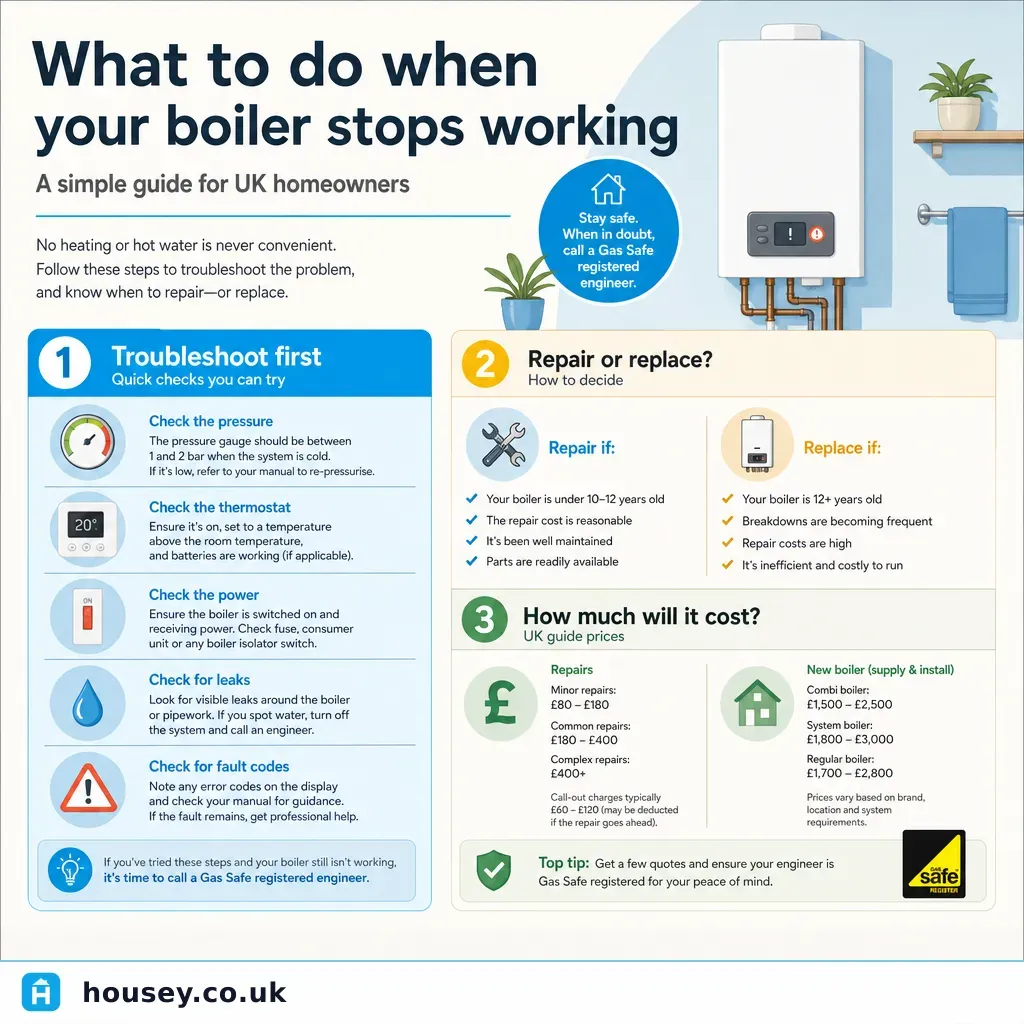
What to do when your boiler stops working
When your boiler stops working, check the pressure gauge (should read 1–1.
 General property advice
Property Market Trends: Activity Growth and Price Movements
UK property market activity is measured through completed sale registrations (HM Land Registry), lender mortgage data, and transaction volumes from HMRC.
 General property advice
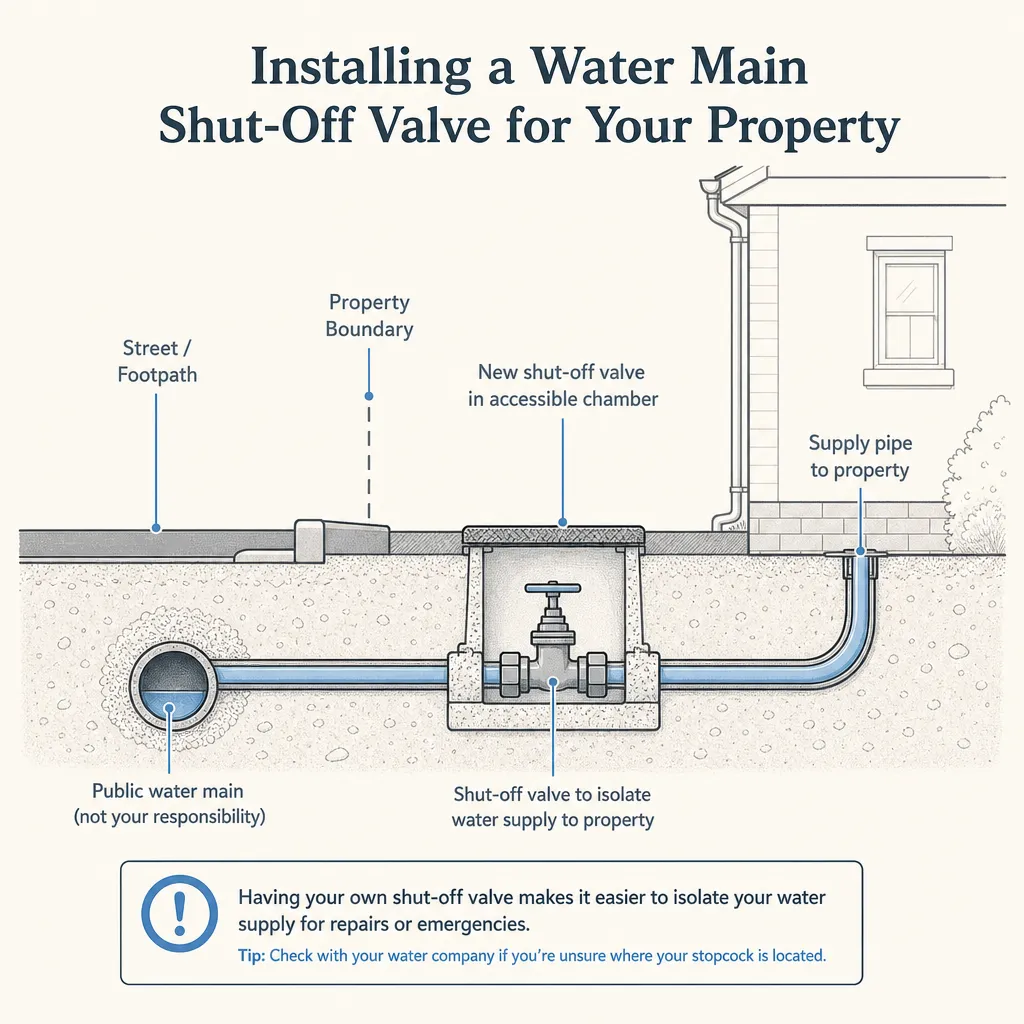
Installing a water main shut-off valve for your property
A water main shut-off valve — commonly called a stopcock — controls all water entering your home from the mains.
 General property advice
Monthly House Price Index: August Market Report and Analysis
The UK House Price Index is published monthly using completed Land Registry transaction data, meaning August figures typically reflect sales agreed months earlier.
 General property advice
Scottish Property Market: Activity and Regional Trends
Scotland's property market operates under distinct legal rules: sellers must provide a Home Report before marketing, transactions become legally binding at conclusion of missives rather than exchange of contracts, and Land and Buildings Transaction Tax replaces Stamp Duty.