Expert Roofing Installation: Quality Materials and Craftsmanship
By Housey · Last reviewed 24th of May 2026
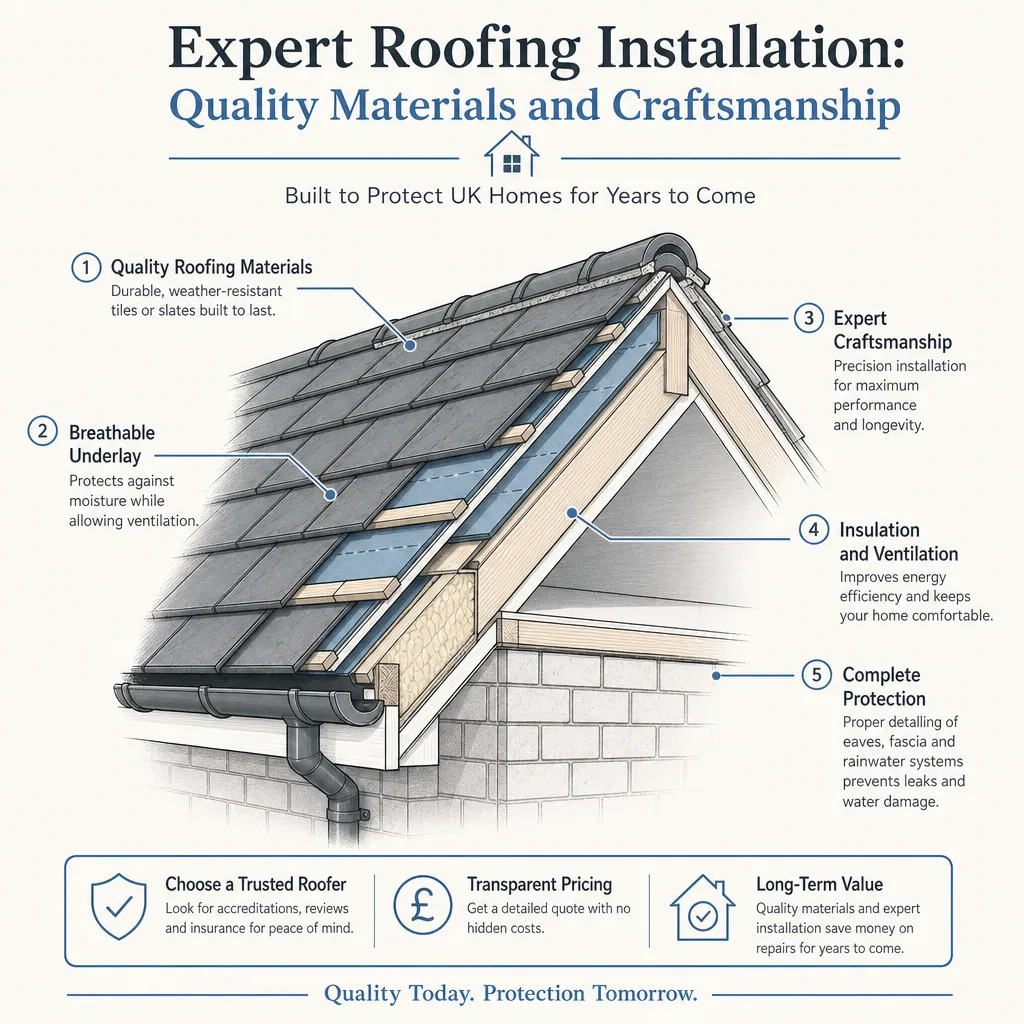
Expert Roofing Installation: Quality Materials and Craftsmanship
Roof replacement or repair typically arises after storm damage, a failed survey, persistent leaks, or when a property reaches the end of its natural roof life — often 30 to 60 years depending on materials and maintenance. Whether you own a Victorian terrace, a 1930s semi, or a 1990s estate house, choosing the right materials and a suitably qualified roofer determines how long the finished job will last and whether building regulations requirements are properly met. Getting these decisions wrong can lead to costly remedial work, void warranties, or insurance complications further down the line.
Key points
- Clay tiles carry an expected lifespan of 40–80 years; concrete tiles 30–50 years; EPDM and GRP fibreglass flat-roof membranes typically last 30–50 years with correct installation and maintenance.
- Significant reroofing work in England and Wales triggers energy performance requirements under Building Regulations Part L (conservation of fuel and power) in addition to weather-resistance requirements under Approved Document C.
- Roofers are not required to hold a single mandatory licence in the UK, but membership of the National Federation of Roofing Contractors (NFRC) or the Confederation of Roofing Contractors (CORC) indicates a minimum professional standard and access to dispute-resolution schemes.
- Any structural alteration to a roof — including changing the pitch, adding a dormer, or removing rafters or purlins — requires building control notification, regardless of property type.
- A specialist roof survey before specifying works can identify hidden defects such as batten rot, sarking felt failure, and deteriorated chimney flashings that a ground-level visual inspection will miss.
Choosing the right roofing material
The best material for a UK roof depends on property type, planning constraints, expected lifespan, and budget. The table below sets out the main options.
Material | Typical lifespan | Best for | Not ideal for | Notes |
|---|---|---|---|---|
Natural slate | 75–150 years | Period properties, conservation areas, listed buildings | Budget-conscious projects | Higher cost; may need structural check for added weight |
Clay tiles | 40–80 years | Traditional UK housing stock, pre-1960s properties | Modern flat-section roofs | Matches most historic streetscapes; check local authority requirements |
Concrete tiles | 30–50 years | 1960s–1990s housing; general replacement | Listed or conservation properties | Heavier than clay; typically lower unit cost |
GRP fibreglass (flat) | 25–50 years | Flat roofs, extensions, dormers | Pitched roofs | Cold-applied; durable when correctly installed and finished |
EPDM rubber (flat) | 30–50 years | Flat roofs, garage roofs | Pitched roofs | Highly flexible; excellent UV and freeze-thaw resistance |
Felt (built-up, flat) | 10–20 years | Budget flat-roof option | Long-term performance required | Shorter lifespan; often upgraded to GRP or EPDM at next replacement |
Indicative lifespans, last reviewed 2026-05-24. Actual performance depends on installation quality, ventilation, maintenance, and local climate.
If your property is in a conservation area or is listed, the local planning authority may require specific materials — typically natural slate or plain clay tiles — to preserve the character of the area. Check before specifying materials, as using an unapproved material on a listed building or in a conservation area can require retrospective consent and costly remediation.
What roofing work requires building regulations approval?
Not all roofing work requires formal building regulations approval, but much of it does. Key triggers include:
- Reroofing more than 25% of the total roof area in any 12-month period — this activates thermal performance requirements under Part L in England and Wales.
- Structural alterations: changing roof pitch, adding or altering a dormer, or removing rafters, purlins, or other structural members.
- Flat-to-pitched conversions or significant flat-roof replacements on extensions.
- Insulation upgrades carried out as part of reroofing works.
For like-for-like repairs — replacing a small number of broken tiles, repointing a chimney, or patching a small flat-roof area — building regulations usually do not apply. Confirm with your local building control authority if you are uncertain about the scope.
Roofers operating under a Competent Person Scheme (such as the NFRC's approved self-certification route) can self-certify certain types of work, meaning you receive a compliance certificate without a separate building control application. Ask any contractor you consider whether this applies to your project.
How to find a qualified roofer
Which roofer you choose matters as much as which materials you specify. Use this guidance when selecting:
- Choose an NFRC or CORC member for a trade body benchmark, access to insurance-backed guarantees, and a formal complaints or dispute-resolution process.
- Ask for a full written specification — detailing materials (manufacturer, grade, colour), method of fixing, underlay specification, ventilation provision, and flashing details — before accepting any quote.
- Request a certificate of public liability and employers' liability insurance; do not accept verbal assurances.
- Confirm whether scaffolding is included in the quote or itemised separately — most reroofing work requires a scaffold.
- Consult a structural engineer or RICS surveyor if you have any concern about the roof structure before a roofer starts cutting into load-bearing timbers.
What to ask before accepting a roofing quote
Use this checklist when comparing written quotes from roofers:
- What materials will be used, including underlay, battens, and fixings? Which manufacturer and grade?
- Is scaffolding included? Who is responsible for erection and dismantling, and at what cost?
- Will building regulations approval be required? If so, who submits the application or self-certifies?
- What warranty applies to materials, and is there a separate installer's guarantee?
- What is the payment schedule? Avoid paying in full before work begins.
- What insurance does the contractor hold? Can I see the current certificate?
- How will roof ventilation and condensation risk be managed once new materials are installed?
- What happens if hidden defects — rotten battens, failed rafters, structural problems — are found once work is under way?
Red flags when hiring a roofer
Stop and seek alternative quotes if a contractor:
- Knocks on your door uninvited and says your roof is urgently dangerous — this is a well-documented rogue-trader approach.
- Requests a large cash deposit before ordering any materials or erecting scaffolding.
- Cannot or will not provide a written quote with a material specification.
- Has no verifiable business address, registration, or online presence.
- Pressures you to sign an agreement on the same visit.
- Cannot produce a current public liability insurance certificate on request.
If you have already paid and the work is substandard or incomplete, contact Citizens Advice for guidance on your rights under the Consumer Rights Act 2015, including the right to have services performed with reasonable care and skill.
When to get professional help
Most roofing work beyond minor repairs warrants a professional. Seek expert advice before proceeding if:
- You can see daylight through the roof boards from inside the loft space.
- There are signs of sagging, spreading rafters, or movement in the ridge line or gable end.
- Damp patches have appeared on upper ceilings following heavy rain or after a prolonged dry period.
- A RICS Level 2 or Level 3 survey has flagged the roof as requiring urgent attention.
- The property is listed or within a conservation area and you are unsure which materials are approved.
A roof survey by a qualified professional can identify underlying structural or material issues before you instruct any roofer — potentially saving significant cost if the scope turns out to be larger or more complex than initially apparent.
How Housey can help
Housey connects UK homeowners with vetted roofers who can provide detailed written quotes for pitched and flat roof projects of all scales. If your project involves building regulations compliance, structural changes, or new-build roof elements, you can also find experienced building control consultants through Housey to manage the approval process from application to sign-off.
Frequently asked questions
Do I need planning permission to replace my roof in the UK?
Like-for-like roof replacement generally does not require planning permission under permitted development rights in England and Wales. However, if you are changing the roof shape, adding a dormer, or altering a listed building, planning consent is required. Properties in conservation areas may also face restrictions on materials. Always check with your local planning authority before specifying any changes.
How long does a full roof replacement take?
A full reroofing of a typical three-bedroom semi-detached house usually takes 3–7 working days, depending on roof size, materials specified, and weather. Scaffold erection and dismantling add time either side of the main works. Your contractor should provide a clear written programme before starting, including what happens if delays occur.
Is VAT charged on roofing work?
Most roofing work is subject to standard-rate VAT at 20% in the UK. A reduced rate of 5% may apply to certain energy-saving materials — such as roof insulation — installed as part of qualifying works. Ask your roofer to confirm the correct VAT treatment for your specific project before accepting a quote.
What should a roofing guarantee cover?
Most reputable roofers offer an installer's guarantee of 10–20 years alongside manufacturers' product warranties. Guarantees from NFRC members may be backed by a deposit protection or insurance-backed scheme. Always obtain your guarantee in writing and confirm whether it covers labour, materials, or both — and what voids it.
Sources and further reading
Useful next reads
 Improvement & Build
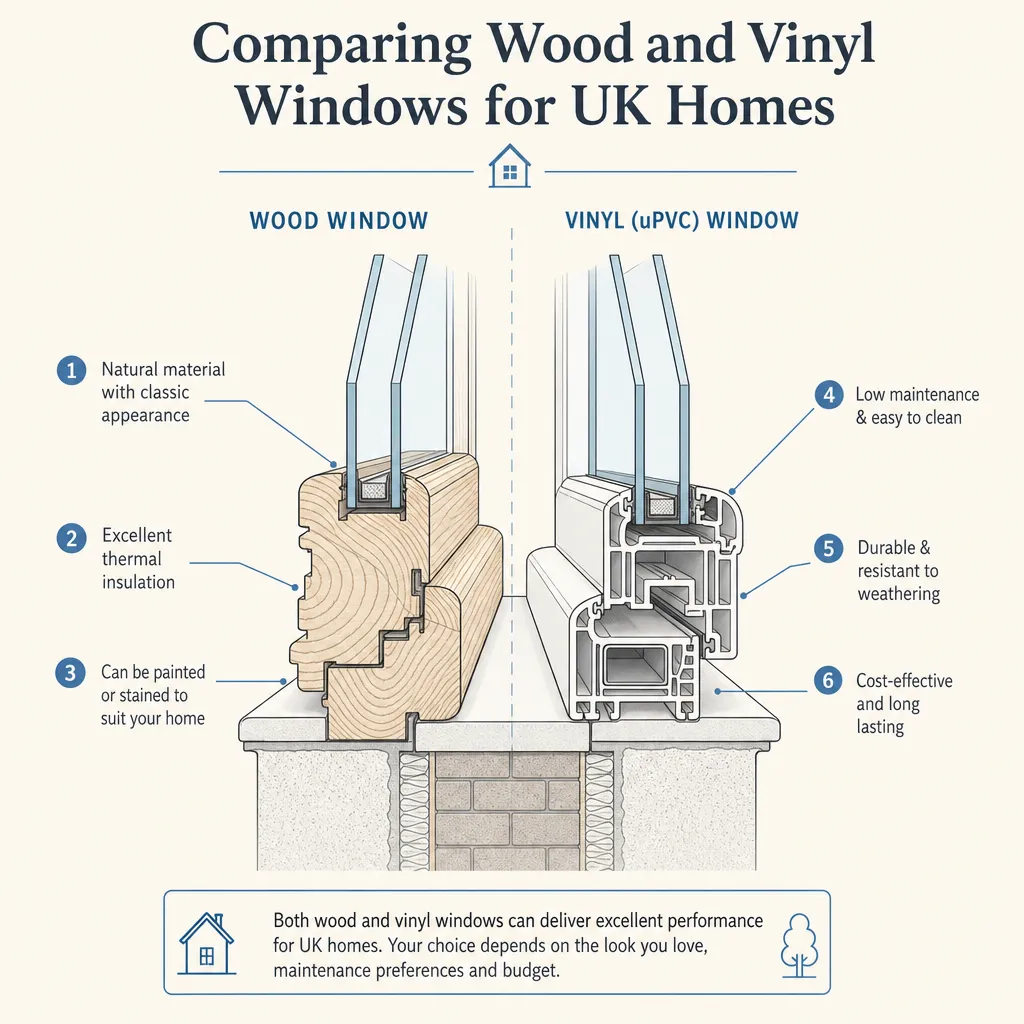
Comparing Wood and Vinyl Windows for UK Homes
Timber windows typically cost more upfront than uPVC but can last twice as long with regular maintenance.
 Improvement & Build
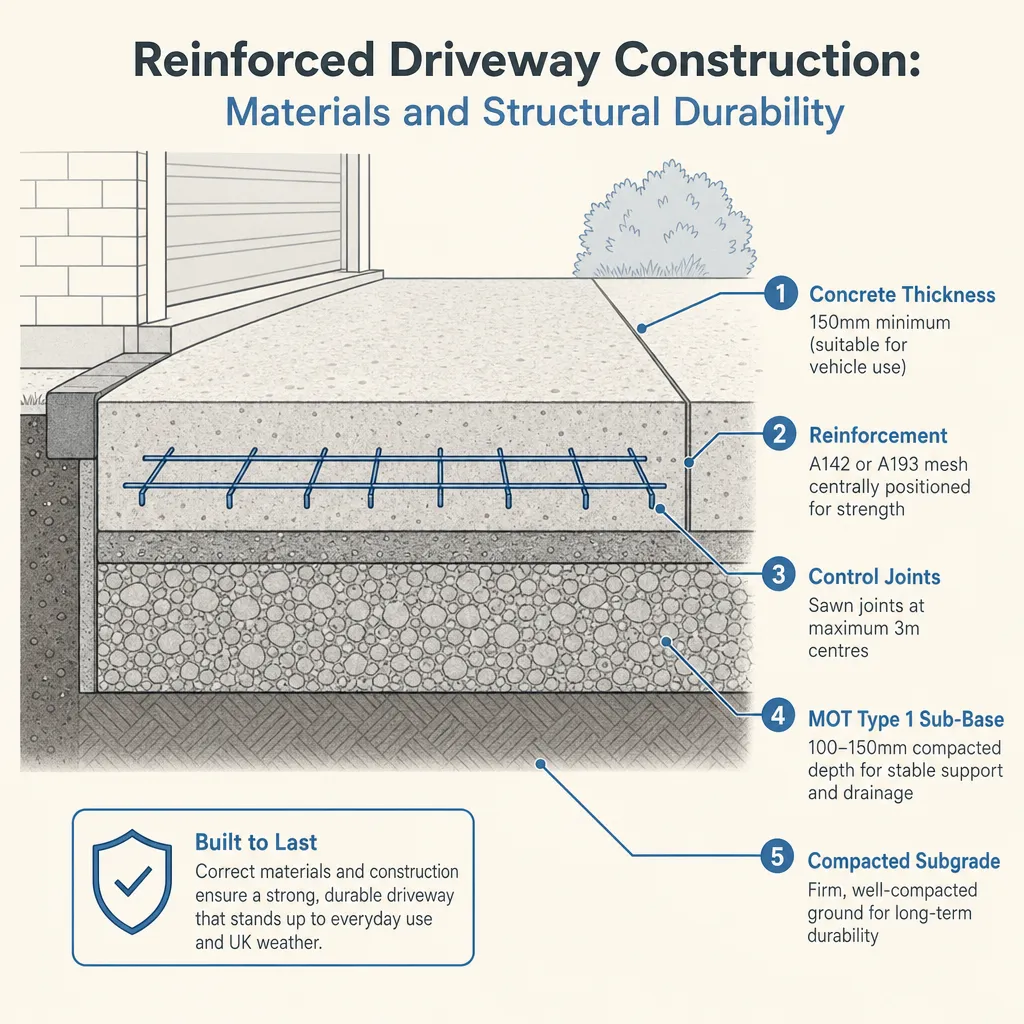
Reinforced Driveway Construction: Materials and Structural Durability
A domestic concrete driveway should be at least 100 mm thick — 150 mm where vans or heavier vehicles use it — on a compacted 100–150 mm MOT Type 1 sub-base, with A142 or A193 steel fabric mesh placed at mid-depth and expansion joints every 3–4 m.
 Improvement & Build
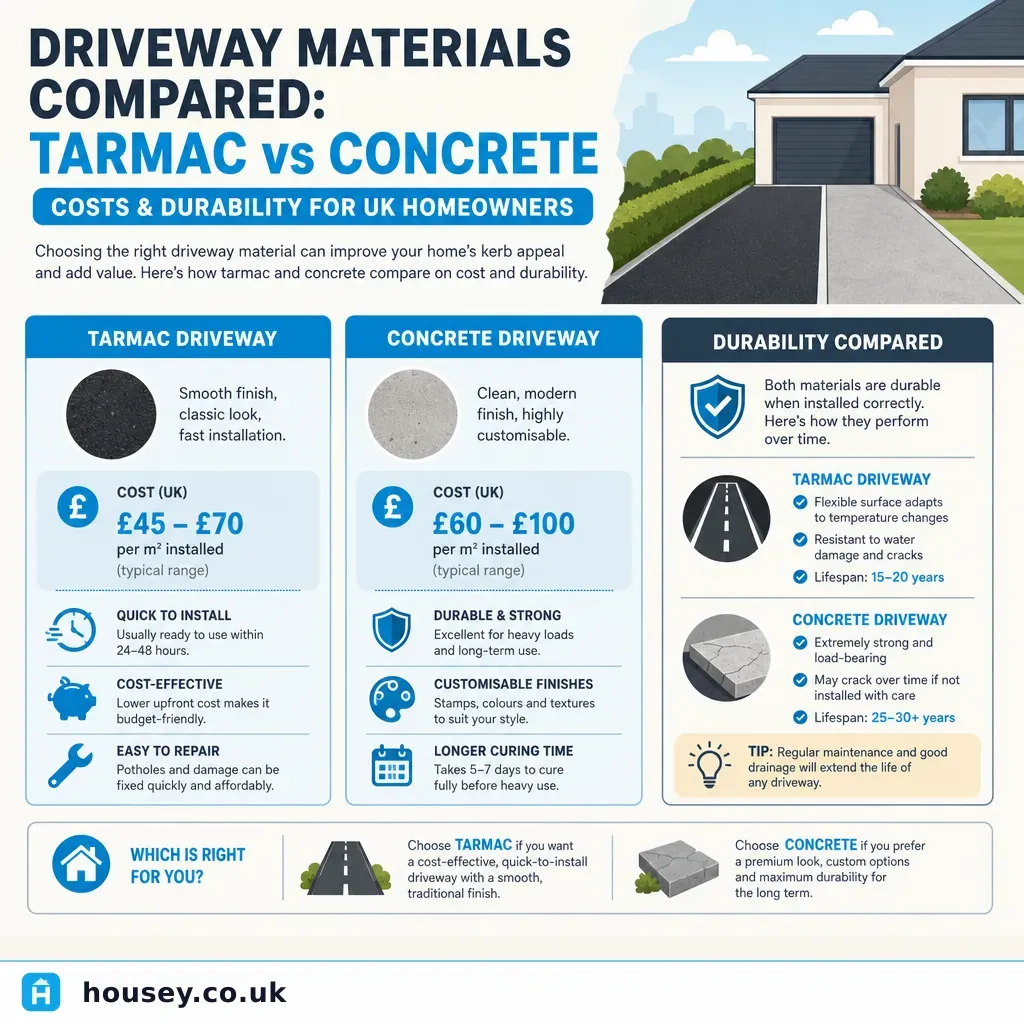
Driveway Materials Compared: Tarmac vs Concrete Costs and Durability
Tarmac driveways typically cost £50–£80 per square metre installed and can be used within 24 hours, while concrete costs £80–£130 per square metre but lasts longer and offers more finish options.
 Improvement & Build
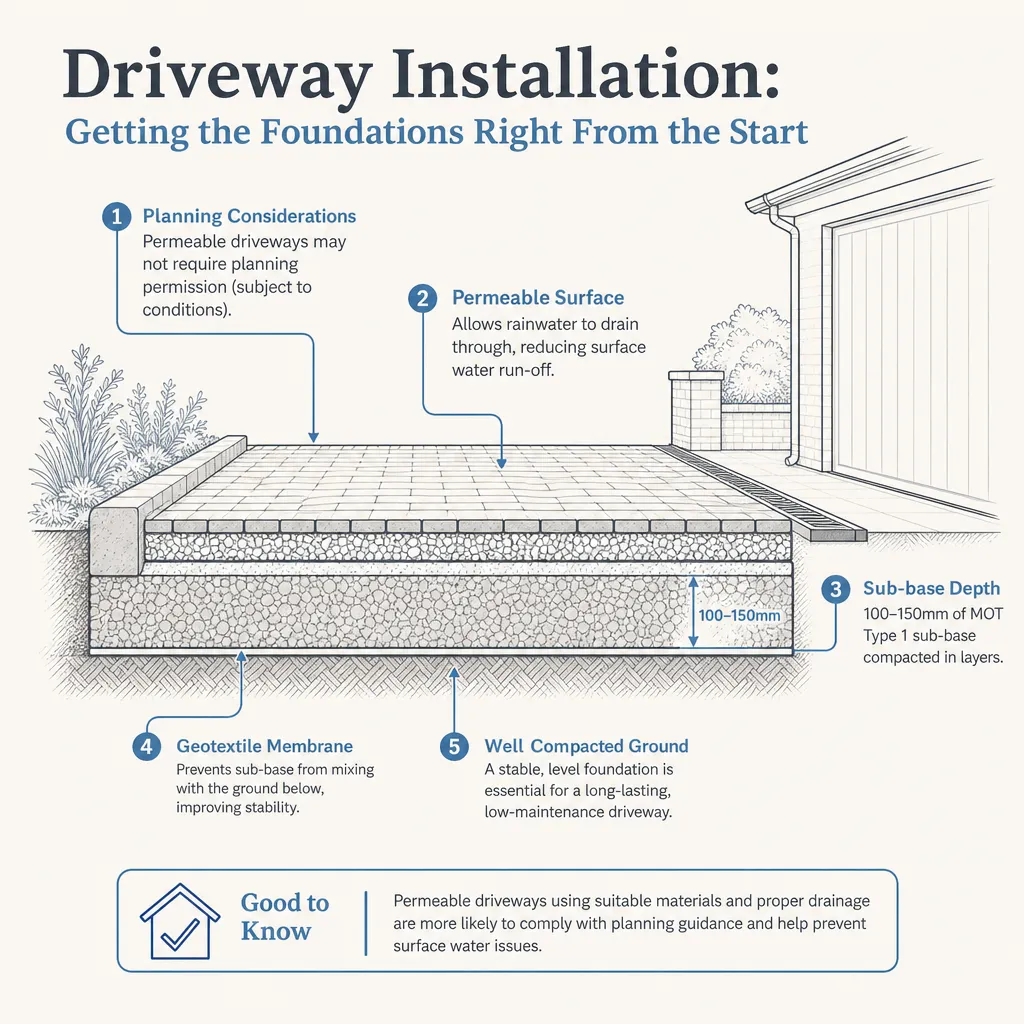
Driveway Installation: Getting the Foundations Right From the Start
A long-lasting driveway depends more on sub-base depth and drainage design than on the surface material chosen.
 Improvement & Build
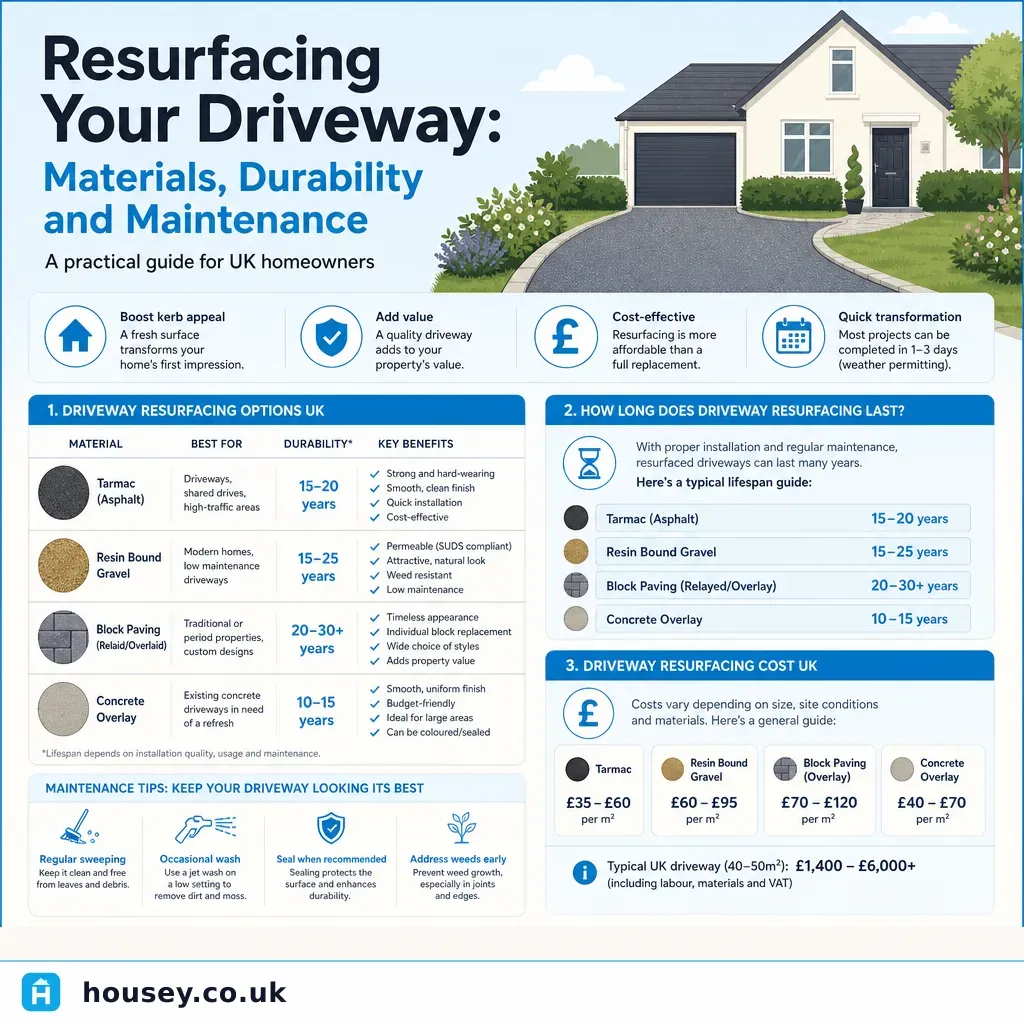
Resurfacing Your Driveway: Materials, Durability and Maintenance
Driveway resurfacing involves overlaying or replacing the existing surface with tarmac, block paving, resin-bound aggregate, gravel, or concrete.