Extending a Bungalow: Planning, Building Regulations, and Costs
By Housey · Last reviewed 5th of May 2026
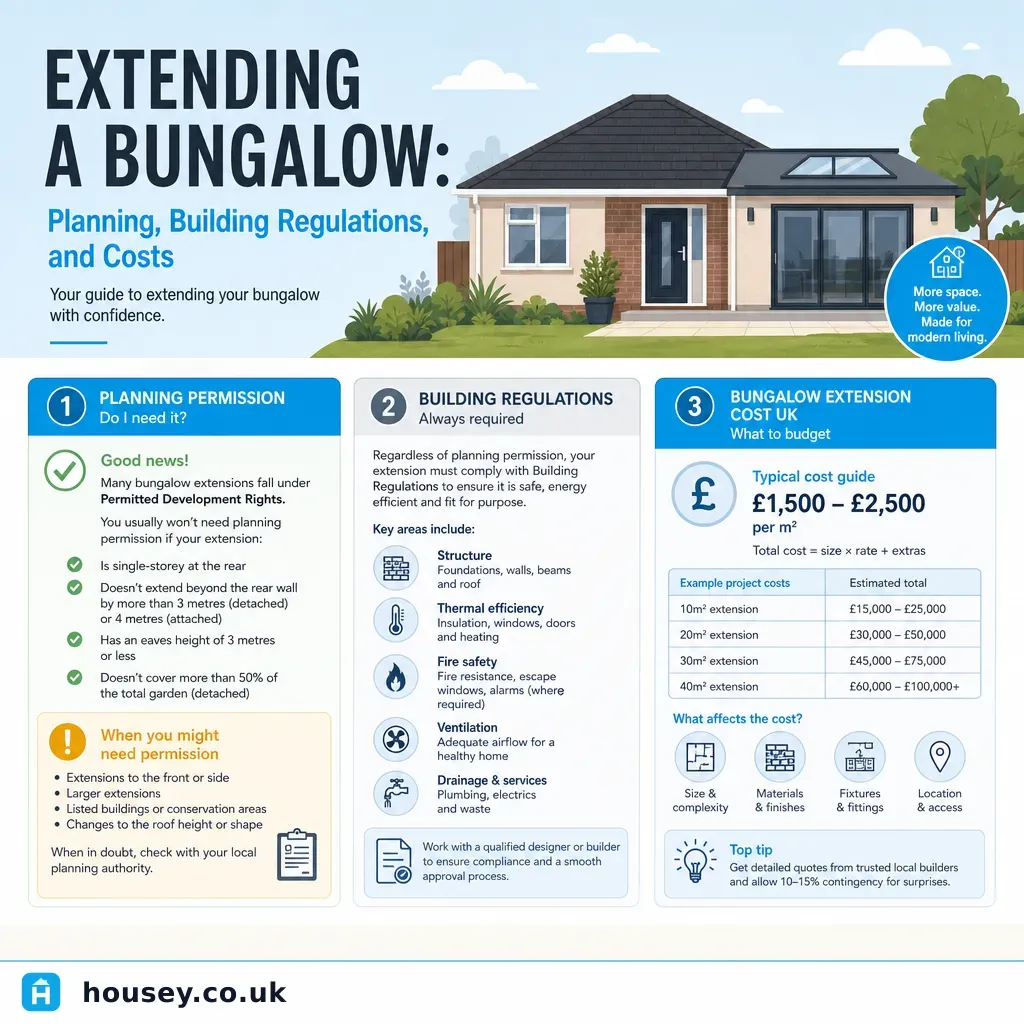
Extending a Bungalow: Planning, Building Regulations, and Costs
Bungalow owners often reach a point where the single-storey layout feels limiting — a growing family, the need for a home office, or the desire for an open-plan kitchen-diner are common triggers. Unlike two-storey houses, bungalows typically sit on a larger footprint relative to their internal floor area, which gives more scope for ground-floor extensions. That said, the planning and regulatory framework applies in full, and getting the sequence right — design, approvals, structural input, and build — avoids costly surprises on site.
Key points
- Single-storey rear extensions on detached bungalows can be built under permitted development without a planning application if they extend no more than 4 metres from the original rear wall (3 metres for semi-detached or terraced) and are no taller than 4 metres at the ridge.
- A prior approval application under the Larger Home Extension Scheme allows rear extensions up to 8 metres on detached bungalows and 6 metres on attached properties, subject to a 42-day neighbour consultation period.
- All bungalow extensions — regardless of planning status — require building regulations approval covering structure (Approved Document A), fire safety (Approved Document B), energy efficiency (Approved Document L), and ventilation (Approved Document F).
- Extensions in conservation areas, on listed buildings, or within Article 4 Direction areas may require full planning permission even where permitted development would otherwise apply — always verify with your local planning authority before starting work.
- Indicative build costs for a standard single-storey bungalow extension range from £1,500 to £2,500 per square metre, excluding VAT, professional fees, building control fees, and any groundworks or structural complications. (Indicative UK costs, last reviewed 2026-05-05.)
Types of bungalow extension
Bungalows lend themselves to several types of extension, each with different planning and structural implications.
Rear extension — the most common choice. A single-storey structure added to the back of the property, typically used for a kitchen-diner, garden room, or family room. Usually the most straightforward in planning terms.
Side extension — built from the side elevation, often used to extend a garage, add a utility room, or create an additional bedroom. Under permitted development, a side extension must not exceed half the original width of the house.
Wrap-around extension — combines rear and side elements into an L-shaped structure. These typically require a full planning application because they exceed the individual size limits for either direction alone.
Dormer or loft conversion — adding habitable rooms above the existing roof level. Depending on design and scale, this may be treated as adding a storey rather than a simple extension, which changes both the planning classification and the structural requirements. Some local authorities treat a full upper-floor addition on a bungalow as a material change of use from a single-storey to a two-storey dwelling.
When planning permission is required
Most bungalow owners begin by checking whether the proposed extension falls within permitted development (PD) rights. PD rights allow certain works to proceed without a formal planning application, provided the development meets the criteria in the Town and Country Planning (General Permitted Development) (England) Order 2015.
Decision tree: does my bungalow extension need planning permission?
- Choose permitted development (no application needed) if: the rear extension extends no more than 3 m from the original rear wall (semi-detached or terraced) or 4 m (detached), the ridge height does not exceed 4 m, the extension covers no more than half the total garden area, and external materials match the existing house in appearance.
- Use the prior approval route (Larger Home Extension Scheme) if: the extension extends up to 6 m (attached) or 8 m (detached) from the original rear wall, and you are prepared to notify the council and allow a 42-day neighbour consultation period before starting work.
- Apply for full planning permission if: the extension is a wrap-around design, exceeds PD size limits, adds a new storey or substantial dormer, or the property is listed, sits in a conservation area, or falls within an Article 4 Direction area.
- Check with your local planning authority if: the property has had previous extensions (which count against the original footprint for PD purposes), it is on a corner plot, or if there is any doubt about whether PD rights have been removed by a condition attached to an earlier planning consent.
The Planning Portal provides a self-assessment tool and a householder application portal for England. Scotland, Wales, and Northern Ireland operate separate planning regimes with different permitted development thresholds and application processes.
Building regulations for a bungalow extension
Planning permission and building regulations are separate legal frameworks. Even where no planning application is required, building regulations approval is needed for all extension work covered by the Building Act 1984 and the Building Regulations 2010.
Key Approved Documents that typically apply to a bungalow extension:
- Approved Document A (Structure): foundations, walls, beams, lintels, and roof must be designed to carry imposed and dead loads safely.
- Approved Document B (Fire safety): means of escape and fire resistance of walls and floors must meet minimum standards.
- Approved Document L (Energy efficiency): new extensions must achieve required U-values for walls, roofs, floors, and glazing. The 2021 edition introduced more demanding thermal targets.
- Approved Document F (Ventilation): habitable rooms require sufficient fresh-air provision, typically via background ventilators and purge ventilation.
- Approved Document H (Drainage): any new WC, sink, or alteration to drainage must comply.
- Structural calculations: your structural engineer provides calculations for beam sizes, foundation loads, and any structural element required to satisfy building control.
| Full plans application | Building notice |
|---|---|---|
Best for | Extensions with complex structure, drainage changes, or high specification | Small, straightforward extensions on uncomplicated sites |
How it works | Drawings submitted and checked before construction begins | Inspector visits at set stages during construction |
Main advantage | Certainty before build costs are committed | Faster start on site |
Main risk | Slower to mobilise — approval takes several weeks | Issues found on site, after foundations are poured |
Completion certificate | Issued on satisfactory completion | Issued on satisfactory completion |
A private registered building inspector (approved inspector) can be appointed as an alternative to local authority building control under the Building Safety Act 2022 regime.
Typical costs for a bungalow extension
Extension costs vary significantly depending on specification, ground conditions, location, and complexity. The following ranges are indicative for budgeting purposes only.
Extension type | Indicative cost per m² (build only) | Notes |
|---|---|---|
Basic single-storey shell (brick cavity wall, flat or shallow-pitch roof) | £1,500–£1,900 | Structure and weathertight envelope; no internal fit-out |
Standard single-storey (plastered, electrics, tiled floor finish) | £1,900–£2,200 | Habitable standard, ready to furnish |
High specification (underfloor heating, bi-fold doors, structural glazing) | £2,200–£2,800+ | Premium finishes and features |
Indicative UK costs, last reviewed 2026-05-05. Costs exclude VAT, professional fees (typically 8–15% of build cost), building control fees (£400–£1,500 depending on floor area), structural engineer fees (£500–£2,000+), and party wall surveyor costs where applicable.
Additional items to budget for separately:
- Householder planning application fee: £258 in England (confirm current fee with your local planning authority, as fees are subject to change)
- Structural engineer: £500–£2,000 depending on scope
- Building control fees: £400–£1,500 depending on floor area
- Party wall surveyor (if applicable): £700–£1,500 per surveyor
Finding the right professionals
A bungalow extension typically involves at least three professionals working in sequence:
Architect or architectural technologist — prepares planning and building regulations drawings, advises on design options, and can manage the approvals process on your behalf.
Structural engineer — provides structural calculations for beams, lintels, foundations, and any load-bearing element. Required for building regulations submission.
Extension builder or main contractor — carries out the construction work. Obtain at least three written quotes; check for membership of the Federation of Master Builders or a comparable trade body.
Housey can connect you with vetted extension builders experienced in bungalow projects, building control consultants to manage your building regulations application, and structural engineering specialists to produce the calculations your project requires.
Important limitations
This article provides general information about bungalow extensions in England. Planning and building regulations are complex and may differ materially depending on your property's location, history, tenure, and physical condition.
- Planning rules in Scotland, Wales, and Northern Ireland differ from England — permitted development thresholds and application processes vary in each nation.
- Permitted development rights can be removed by planning conditions attached to earlier consents, Article 4 Directions made by the local planning authority, or restrictive covenants registered against the property title. Always verify the planning history of your specific property before starting work.
- Building regulations requirements are updated periodically — confirm current standards with your building control body before submitting drawings, particularly regarding energy efficiency under Approved Document L.
- This article is general information only. It is not a substitute for professional planning, architectural, structural engineering, or legal advice specific to your property and circumstances.
What to ask a qualified professional
Before appointing an architect, architectural technologist, structural engineer, or contractor for a bungalow extension, ask:
- What planning route do you recommend for this project, and why?
- Does this property have any restrictions that could affect permitted development rights — conditions, covenants, or Article 4 Directions?
- Which building regulations Approved Documents are most relevant to this extension design?
- What structural elements will require engineer-certified calculations?
- How will you handle ground condition risks, and what happens if foundation conditions differ from expectations?
- What are your fees, and what exactly is included in your scope of service?
- Will you manage the building control application and stage inspections, or do I need to appoint a building control body separately?
- What is a realistic programme from design appointment through to practical completion?
When to get professional help
Always consult qualified professionals before starting any extension work. Seek advice without delay if:
- The property is listed, in a conservation area, or within an Article 4 Direction area — permitted development rights may not apply at all.
- You intend to remove or alter any load-bearing wall as part of the build.
- There are existing signs of structural movement — cracks in brickwork, sloping floors, or sticking doors and windows.
- The extension will be close to a shared boundary, will affect drainage shared with a neighbour, or involves work on or near a party wall.
- A neighbour has raised concerns, or is likely to object, to the proposed works.
- You are uncertain whether permitted development rights apply to your specific property.
How Housey can help
Housey can connect you with vetted extension builders who work on bungalow projects across the UK, as well as building control consultants to handle your building regulations application and structural engineering specialists for the design calculations your project needs. Request quotes from multiple providers to compare experience, approach, and price before committing.
Frequently asked questions
Do I need planning permission for a rear extension on a bungalow?
Not necessarily. Most single-storey rear extensions on detached bungalows up to 4 metres from the original rear wall can be built under permitted development, without a planning application. Semi-detached and terraced bungalows have a 3-metre limit. Always check whether permitted development rights still apply to your property — conditions, covenants, or Article 4 Directions can remove them.
What is the difference between planning permission and building regulations for a bungalow extension?
Planning permission controls whether an extension is acceptable in planning policy terms — its impact on neighbours, street scene, and local character. Building regulations set minimum standards for structural safety, fire safety, energy efficiency, drainage, and ventilation. An extension can often proceed without planning permission, but almost always needs building regulations approval before structural work begins.
How long does a bungalow extension take to complete?
A typical single-storey bungalow extension takes 3–6 months from appointing an architect to practical completion. Design and planning (if required) takes 4–12 weeks; a full plans building regulations application takes 4–6 weeks to be checked; construction typically takes 6–16 weeks depending on size, specification, and contractor programme. Delays in planning decisions or material supply can extend this considerably.
Can I extend a bungalow upwards to add a first floor?
Yes, but adding a full upper storey is treated differently from a single-storey extension. It typically requires a full planning application, as the property effectively becomes a two-storey house and usually exceeds permitted development limits. Existing foundations and wall construction may also need upgrading to carry the additional load. A structural engineer's assessment is essential before committing to this approach.
Do I need a party wall agreement for a bungalow extension?
You may. If the extension is built within 3 metres of a neighbouring property's foundations, or involves work on or near a shared wall, the Party Wall etc. Act 1996 applies. You must serve written notice on affected neighbours before work begins. If they consent in writing, no surveyor is needed. If they do not consent, a party wall agreement must be prepared by a party wall surveyor.
Sources and further reading
- Permitted development rights for householders: technical guidance — GOV.UK
- Extensions: Planning permission — Planning Portal
- Building regulations approval — GOV.UK
- Approved Document A: Structure — GOV.UK / DLUHC
- Approved Document L: Conservation of fuel and power — GOV.UK / DLUHC
- Party Wall etc. Act 1996: explanatory booklet — GOV.UK
Useful next reads
 Improvement & Build
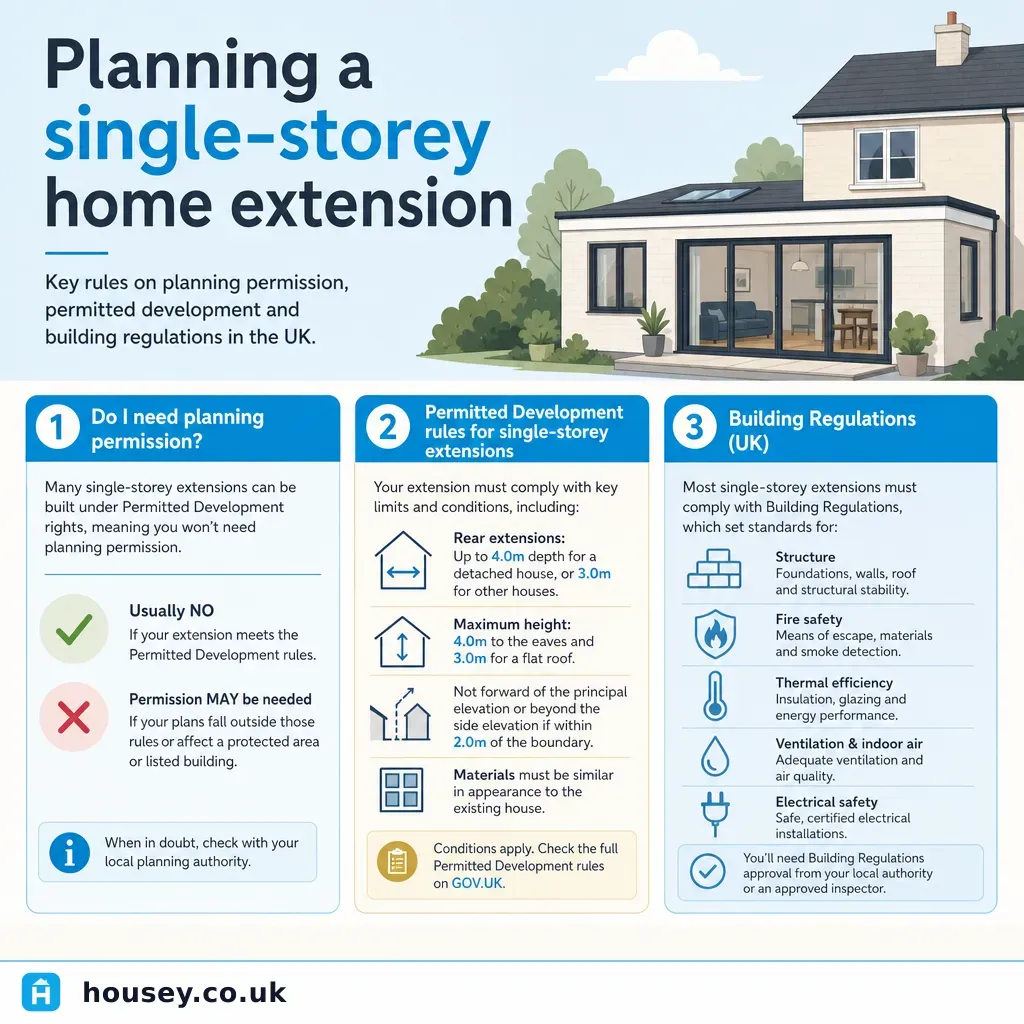
Planning a single-storey home extension
A single-storey extension may fall under permitted development rights, avoiding full planning permission, but only if it meets size, height, and boundary conditions simultaneously.
 Improvement & Build
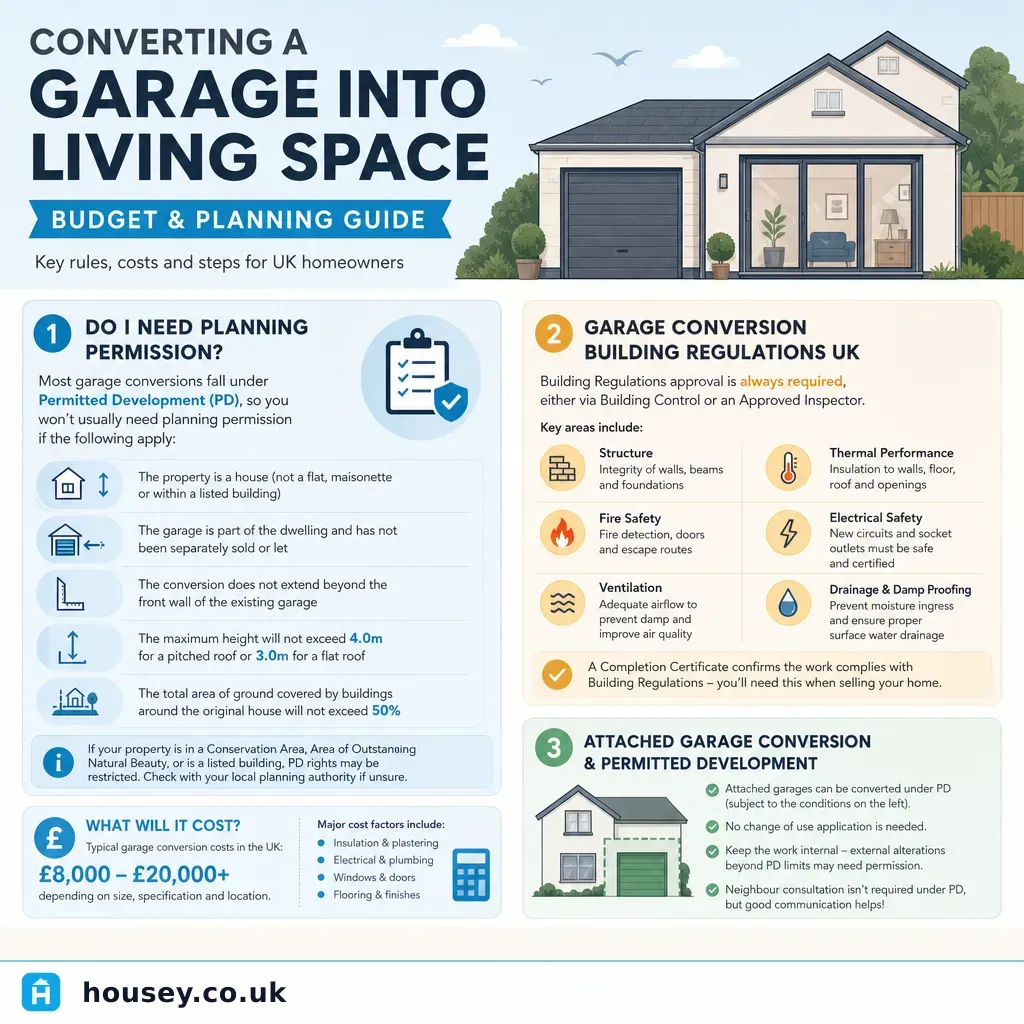
Converting a Garage into Living Space: Budget and Planning Guide
A single-garage conversion typically costs £8,000–£20,000 in the UK.
 Improvement & Build
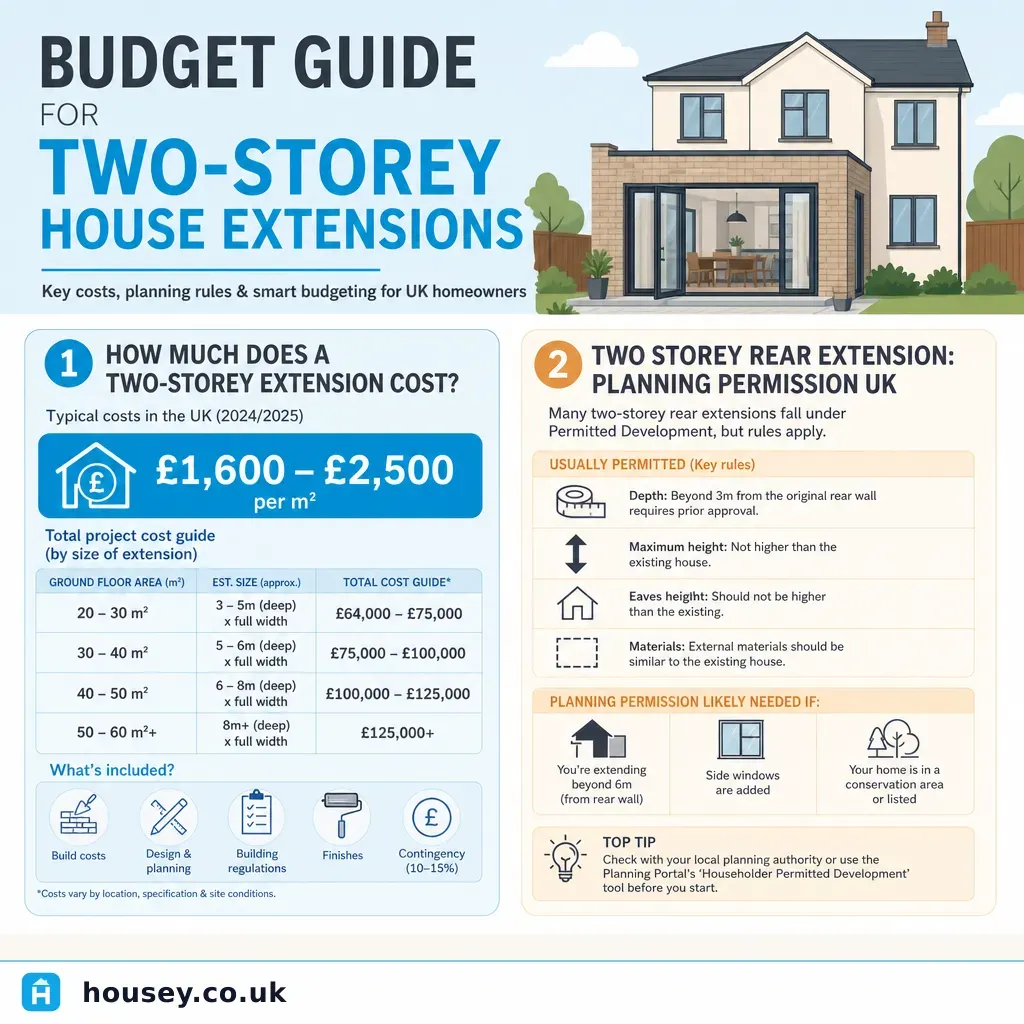
Budget Guide for Two-Storey House Extensions
A two-storey house extension in the UK typically costs £1,800–£3,000+ per square metre for the build alone.
 Improvement & Build
Laundry Room Renovation and Fitting Costs
A basic UK laundry room fit-out typically costs £2,000–£6,000 where plumbing and electrics are already in place, rising to £8,000–£15,000 or more when structural work, new drainage connections, or new electrical circuits are needed.
 Improvement & Build
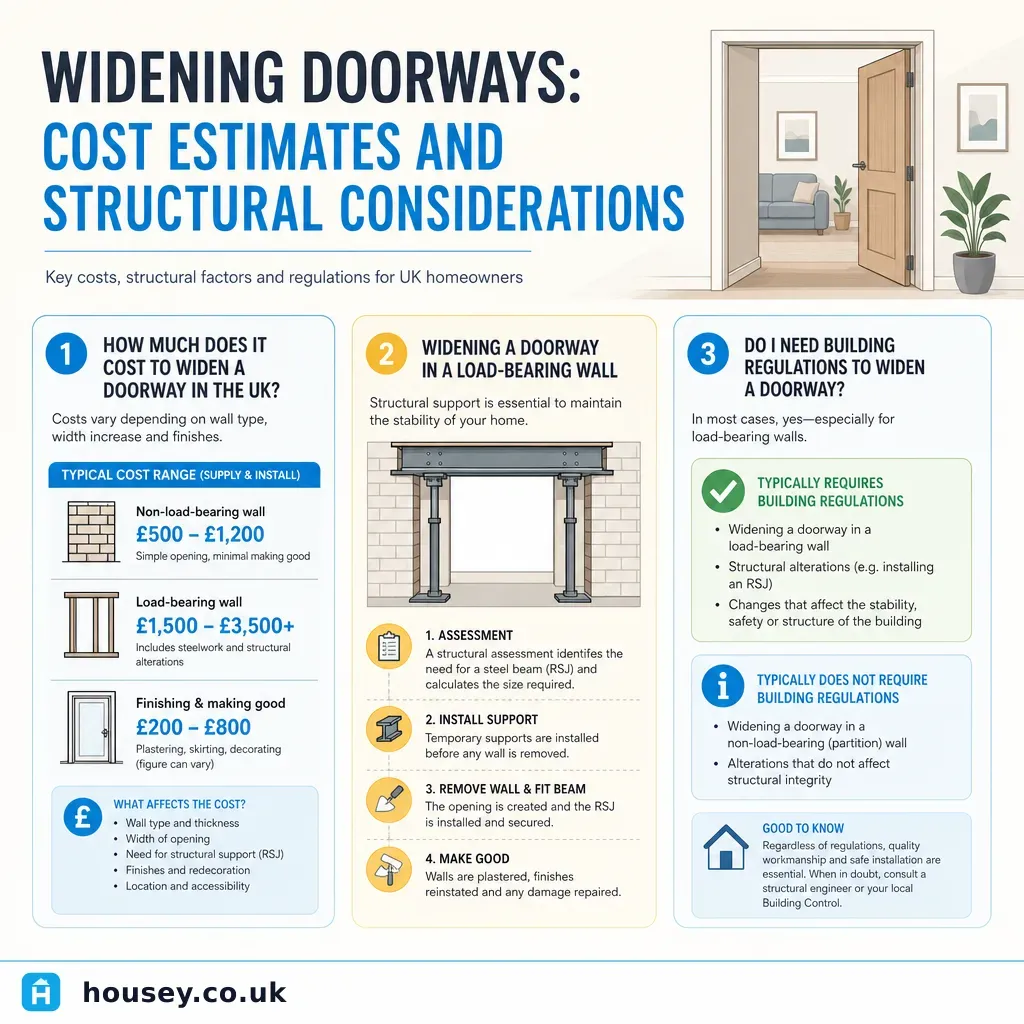
Widening Doorways: Cost Estimates and Structural Considerations
A doorway in a non-load-bearing partition can usually be widened for £500–£1,500.