Widening Doorways: Cost Estimates and Structural Considerations
By Housey · Last reviewed 19th of May 2026
Widening Doorways: Cost Estimates and Structural Considerations
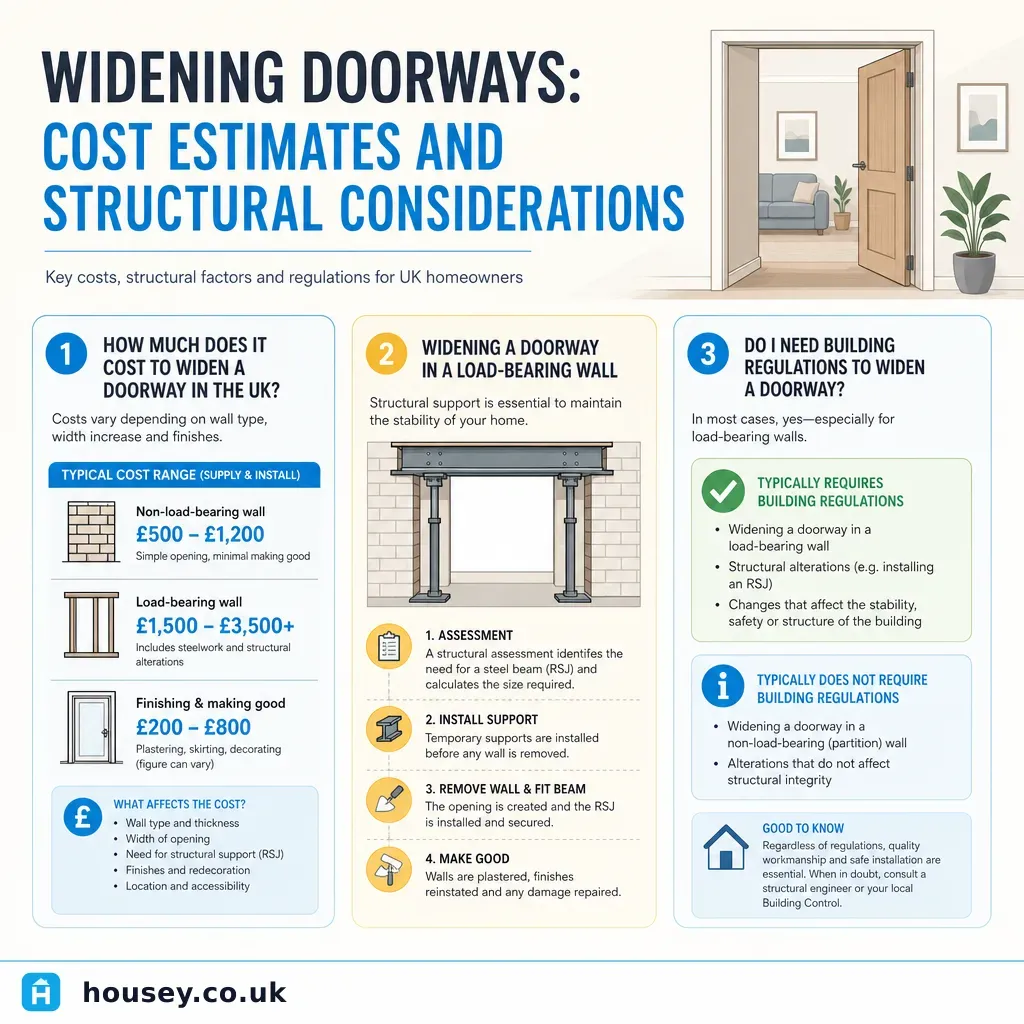
Widening a doorway is one of the more common structural home-improvement projects in UK houses, whether to install a wider door for furniture access, meet accessibility requirements under Building Regulations Part M, or create a more open feel between rooms. The scope and cost depend almost entirely on one factor: whether the wall containing the doorway is load-bearing. Getting this wrong can be costly and, in serious cases, structurally dangerous.
Key points
- Standard UK internal doorways are typically 686 mm or 762 mm wide; Building Regulations Part M requires a minimum 775 mm clear opening for wheelchair accessibility.
- A structural engineer must specify the lintel before any load-bearing wall is opened — an on-site assessment and calculations typically cost £300–£600 (indicative UK costs, last reviewed 2026-05-19).
- Building Regulations approval under Part A (Structure) from your local authority building control or an Approved Inspector is required when a load-bearing wall is altered.
- Widening a doorway in a non-load-bearing partition typically costs £500–£1,500; in a load-bearing wall, costs typically run £1,500–£4,000 or more (indicative, 2026-05-19 — quotes vary by region and wall construction).
- Temporary acrow propping must be installed before any masonry is removed from a load-bearing wall — this is a structural safety requirement, not an optional step.
Load-bearing or non-load-bearing: why it matters
Confirming whether the wall is load-bearing is the first and most critical step in any doorway widening project. A load-bearing wall carries the weight of the structure above — floor joists, roof timbers, or upper storeys. Removing masonry from it without proper engineering support can cause serious structural damage.
Common indicators that a wall may be load-bearing:
- It runs at 90° to floor or ceiling joists (sometimes visible in the loft or beneath a suspended floor).
- It sits directly above a similar wall on a lower storey.
- It is constructed from brick, dense block, or stone rather than lightweight timber studwork.
- Steel beams or padstones are visible in adjacent walls or the ceiling above.
These are indicators only. A structural engineer or experienced builder should confirm the wall type before any work starts. Never assume a wall is non-load-bearing without professional confirmation.
When the opening is widened in a load-bearing wall, the removed masonry can no longer carry the load from above. A new lintel — typically a rolled steel joist (RSJ) or proprietary steel beam — must bridge the wider opening and transfer load to the masonry at each side via padstones. The structural engineer calculates the beam size based on the span and the loads it must carry.
Cost breakdown: non-load-bearing vs load-bearing
Factor | Non-load-bearing partition | Load-bearing masonry or brick wall |
|---|---|---|
Structural engineer required? | Usually no | Yes — required before work starts |
Temporary propping required? | No | Yes |
Building Regulations Part A approval? | Usually not | Yes |
Typical labour and materials | £500–£1,500 | £1,500–£4,000+ |
Structural engineer fee | — | £300–£600 |
Building control application fee | — | £150–£400 |
Typical project duration | Half a day–1 day | 1–3 days plus inspections |
Indicative UK costs, last reviewed 2026-05-19. Costs vary by region, wall construction, and access. Obtain at least three written quotes.
Building Regulations: when approval is required
Internal works that alter a load-bearing element require Building Regulations approval under Part A (Structure). You must notify your local authority building control department — or appoint a private Approved Inspector — before the structural work starts. Building control will inspect the temporary propping arrangement, the lintel installation, and the finished opening.
Approval is typically not required for widening an opening in a clearly non-load-bearing stud partition, provided the work does not affect fire separation or means of escape. If in doubt, contact your local authority building control officer informally before starting — they can often advise at no cost.
If the doorway is being widened for wheelchair accessibility, GOV.UK Approved Document M sets out the minimum clear-width and threshold specifications that apply.
Accessibility standards: what clear width do you need?
Purpose | Recommended clear opening width |
|---|---|
Standard internal door (existing) | 686–762 mm |
Standard internal door (new installation) | 762–838 mm |
Wheelchair accessible — Part M minimum | 775 mm clear |
Best-practice accessible design | 900 mm clear |
Wide or double doorway | 1,200 mm+ (structural engineer required) |
Note that 'clear opening' is the usable gap after the door frame and hardware are fitted — the structural opening in the wall must be somewhat wider to accommodate the frame.
What the work typically involves
For a load-bearing wall, a reputable contractor will follow this sequence:
- Structural engineer surveys the wall and specifies the lintel, padstone dimensions, and propping arrangement.
- Temporary acrow props or needle beams are installed on both sides before any masonry is cut.
- Masonry above the new opening is carefully removed in sections.
- The new steel or concrete lintel is installed, bearing on padstones at each side.
- Masonry is made good; plastering and finishing follows.
- Building control inspector signs off the work and issues a completion certificate.
For a non-load-bearing stud partition, the stud framing is cut back, the opening reframed with a timber head, and plasterboard repaired around the new opening — typically completed in a single day.
Important limitations
This article provides general information about doorway widening in UK residential properties. Structural loads, wall construction, and Building Regulations requirements vary significantly between properties. The cost figures given are indicative only — regional variation, wall type, and access all affect the final price. No article can substitute for an on-site structural assessment by a qualified engineer or a building control officer.
When to get professional help
Widening a doorway in a load-bearing wall is not a DIY project. Engage a structural engineer as a first step — before approaching builders — so that quotes are based on a proper specification.
Red flags that mean stop and call a professional immediately:
- Any cracking or movement above or beside the doorway after demolition has started.
- A builder proposes to remove load-bearing masonry without mentioning structural calculations or building control notification.
- The wall is shared with a neighbour in a terraced or semi-detached house — the Party Wall etc. Act 1996 may require a formal agreement before work begins.
- The property is listed or in a conservation area — listed building consent may be needed even for internal structural works.
- The proposed lintel does not extend sufficiently beyond the opening on each side to provide adequate bearing.
- Existing cracks near the proposed opening have not been professionally investigated.
What to ask a qualified professional
Before instructing a builder or structural engineer:
- Is this wall load-bearing, and can you confirm that in writing?
- What lintel specification are you proposing, and can I see the structural engineer's calculations before work starts?
- Will you notify building control, and who submits the application?
- How long will temporary propping be in place, and what disruption should I expect?
- What assumptions underlie this quote, and what could change the price or timeline?
- Will I receive a building control completion certificate on completion?
- Is VAT included in the quote?
- Do you carry public liability insurance covering structural alterations?
How Housey can help
Housey connects you with vetted professionals for structural home improvement work. Use our build cost estimating service to establish realistic costings across structural engineer fees, building control charges, and construction costs before approaching contractors. When you're ready to find a builder, our extension builders network includes specialists in load-bearing structural alterations who can advise on lintel specification, propping arrangements, and building control sign-off.
Frequently asked questions
Do I need planning permission to widen a doorway in the UK?
Planning permission is rarely needed for internal doorway widening. Building Regulations approval under Part A (Structure) is what typically applies when the wall is load-bearing. If the property is listed or in a conservation area, you may also need listed building consent for internal structural works — check with your local planning authority before starting.
How do I find out if my wall is load-bearing?
A structural engineer or experienced builder can confirm wall type on-site. Common indicators include walls running perpendicular to floor joists, walls on the same structural line as those on the floor below, and solid masonry or dense-block construction. Visual indicators alone are not reliable — seek professional confirmation before any structural work begins.
Can I widen a doorway myself?
Non-load-bearing stud partitions can be widened by competent DIYers comfortable with basic carpentry and plastering. Load-bearing walls must not be altered without a structural engineer's design and building control oversight. Attempting load-bearing structural work without these safeguards risks serious structural damage and could invalidate your buildings insurance.
How long does doorway widening typically take?
A non-load-bearing partition can usually be widened in half a day to one day. A load-bearing wall project typically takes one to three days of construction, plus time for building control inspections and finishing plasterwork. Factor in two to five weeks lead time if you use the Full Plans building control application route.
Sources and further reading
- Approved Document A — Structure — GOV.UK / DLUHC
- Approved Document M — Access to and use of buildings — GOV.UK / DLUHC
- Building regulations approval — GOV.UK
- Party Wall etc. Act 1996 — legislation.gov.uk
Useful next reads
 Improvement & Build
Laundry Room Renovation and Fitting Costs
A basic UK laundry room fit-out typically costs £2,000–£6,000 where plumbing and electrics are already in place, rising to £8,000–£15,000 or more when structural work, new drainage connections, or new electrical circuits are needed.
 Improvement & Build
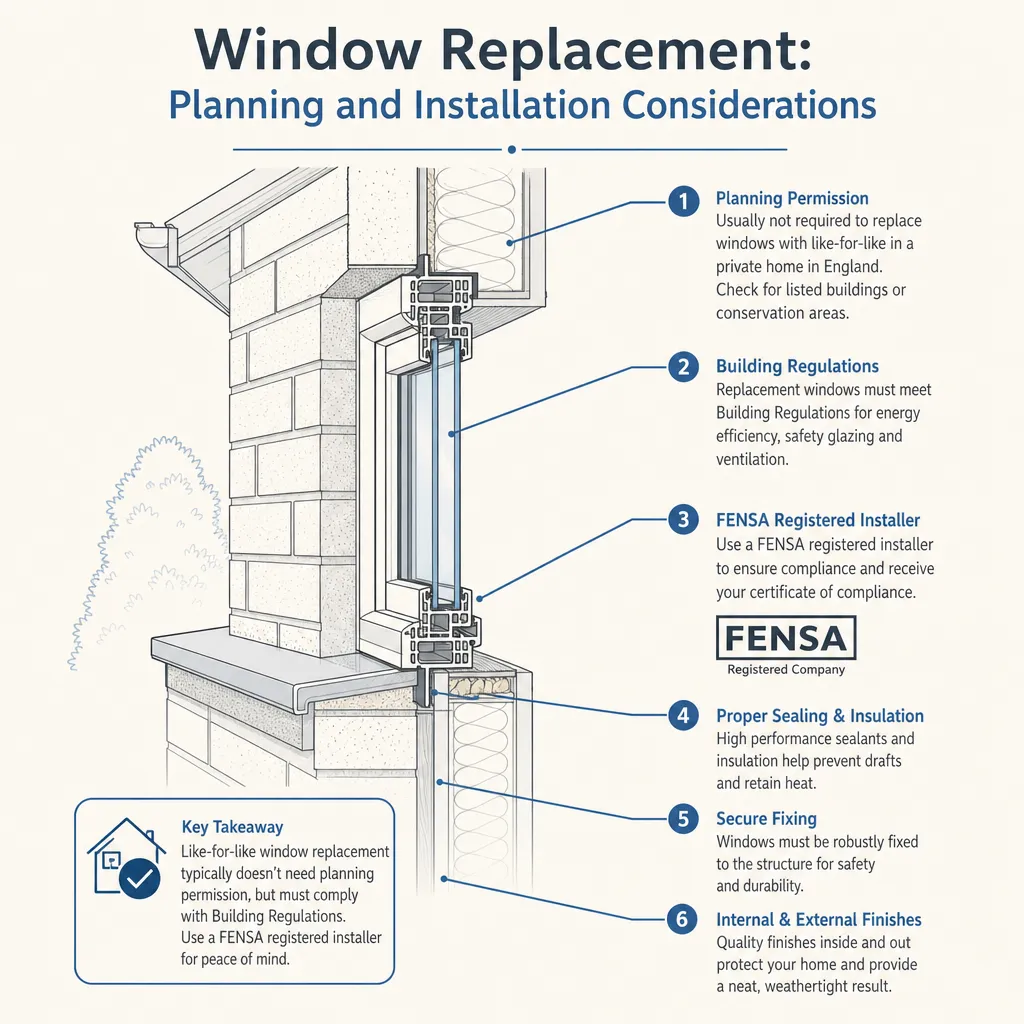
Window Replacement: Planning and Installation Considerations
Most window replacements in England fall under permitted development and do not need planning permission, though listed buildings, flats, and conservation areas are exceptions.
 Improvement & Build
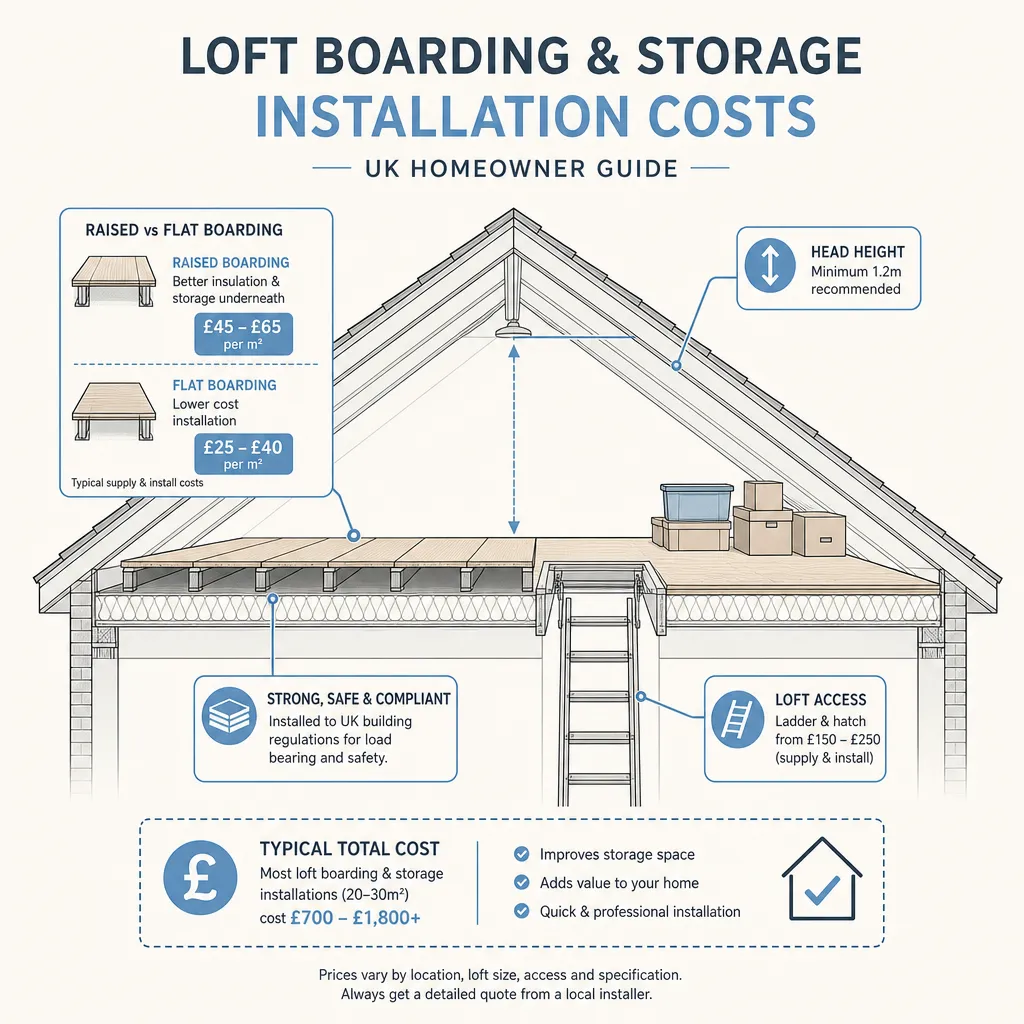
Loft Boarding and Storage Installation Costs
Basic loft boarding for an average semi-detached home costs £500–£1,500; a raised system that preserves insulation runs £800–£2,500.
 Improvement & Build
Garage Conversions: Transforming Your Garage into Living Space
Most integral garage conversions in England fall within permitted development and do not require a planning application, but Building Regulations approval is required in virtually all cases.
 Improvement & Build
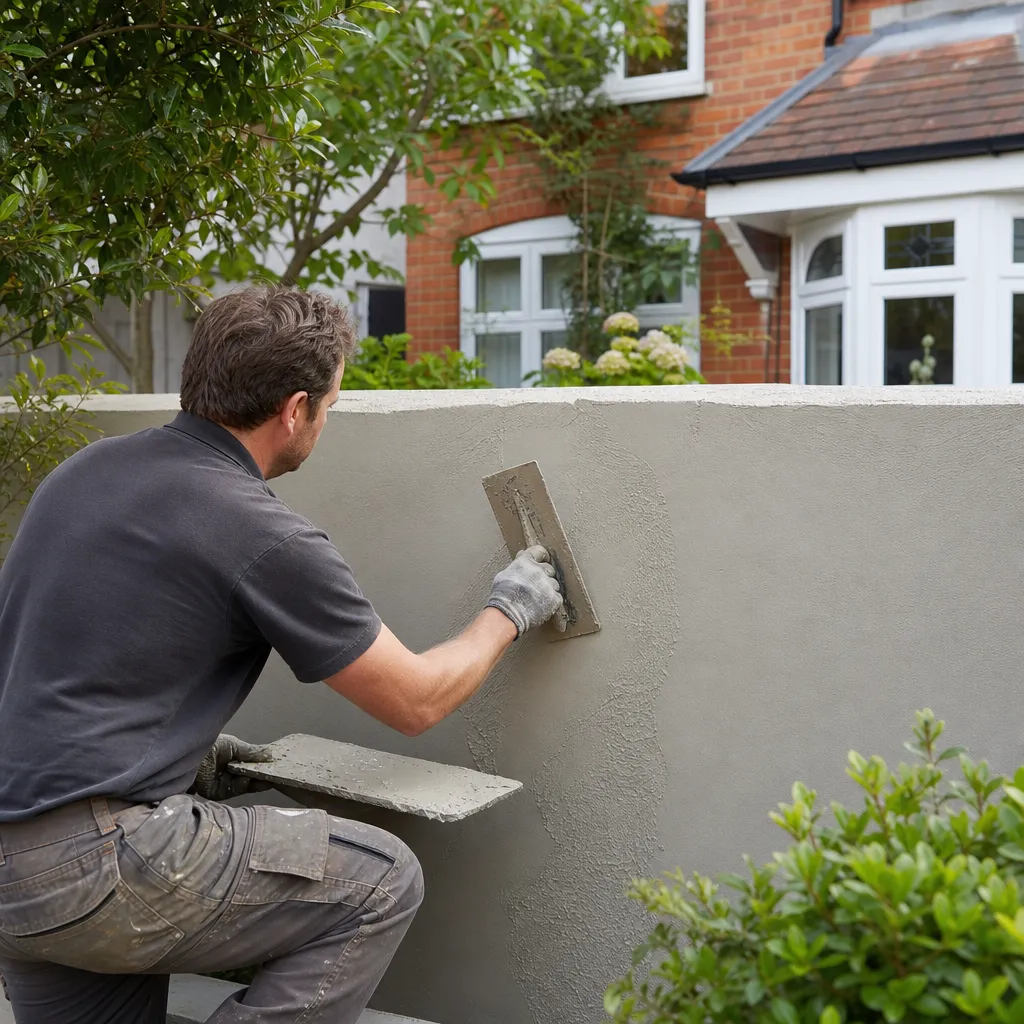
Rendering a Garden Wall: Techniques for Professional-Quality Finishes
Render a garden wall using a two-coat system: a 10–12 mm scratch coat of 4:1 sand and cement, keyed with a comb scratcher, followed by a 6–8 mm topcoat.