Extending a Conservatory: Space Expansion and Associated Costs
By Housey · Last reviewed 5th of May 2026
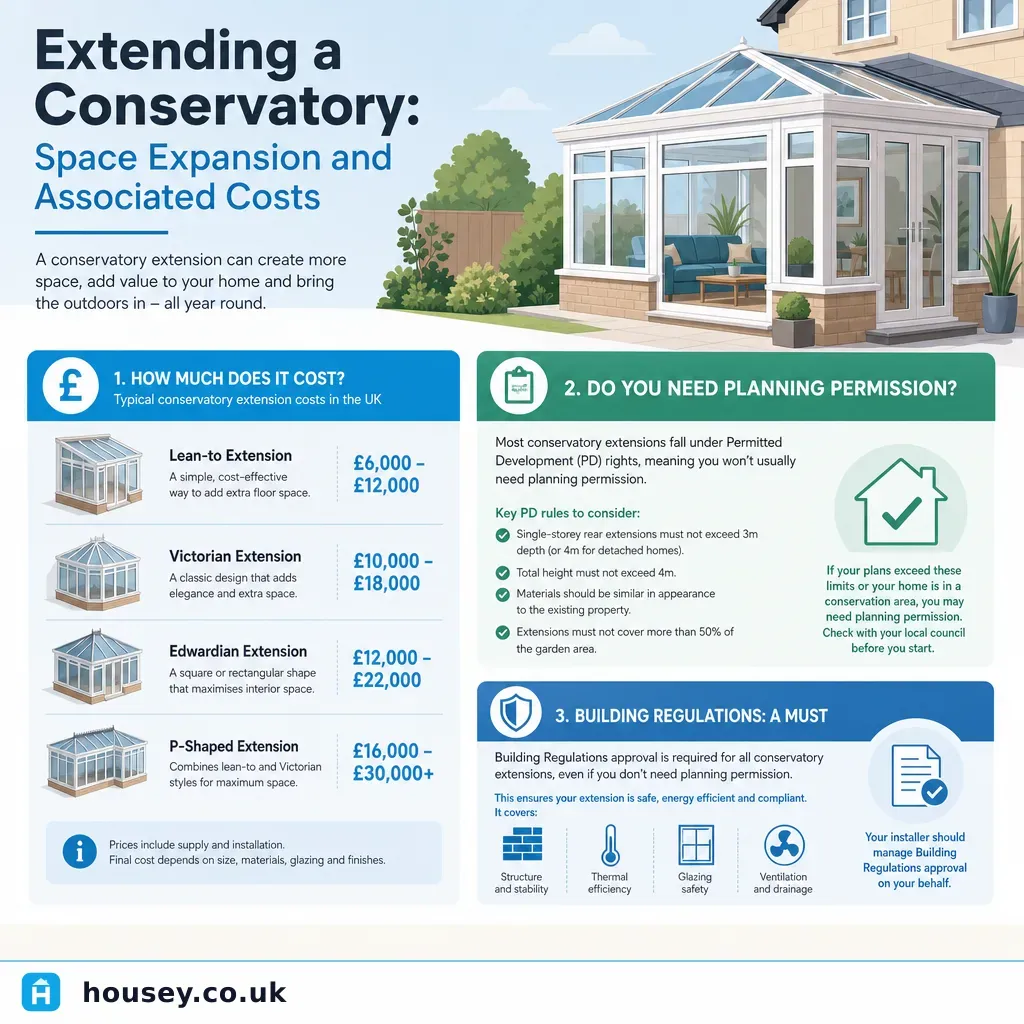
Extending a Conservatory: Space Expansion and Associated Costs
Many homeowners reach a point where an existing conservatory no longer provides enough space for how they actually use it. Whether you want a larger kitchen-diner, a proper garden room, or simply more breathing room, extending is often more cost-effective than demolishing and rebuilding. The key decisions — around planning permission, building regulations, and construction method — depend on your property type, the existing footprint, and how the extended structure will be used.
Key points
- Permitted development rights for single-storey rear extensions allow up to 4m depth for detached houses and 3m for all other house types, measured from the original rear wall — your existing conservatory counts toward this limit.
- Conservatories are exempt from building regulations only if they are separated from the main house by an external-quality door, have a glazed roof and glazed or translucent walls, do not exceed 30m², and are not used as a bedroom.
- If the extended conservatory becomes thermally integrated with the main house (no separating door), the whole structure must meet full Part L energy-efficiency requirements under the Building Regulations.
- Prior approval is required under the Larger Home Extension Scheme for extensions between 4–8m depth (detached) or 3–6m (other houses), with a 42-day neighbour consultation period.
- Properties in conservation areas, National Parks, Areas of Outstanding Natural Beauty, and listed buildings have more restrictive permitted development rights — verify with your local planning authority before starting.
Does extending a conservatory need planning permission?
Conservatory extensions fall under the same permitted development rules as single-storey rear extensions in England. Under Schedule 2, Part 1 of the Town and Country Planning (General Permitted Development) (England) Order 2015, no planning application is needed if the extension does not project more than 4m (detached house) or 3m (other houses) beyond the original rear wall, is no more than 4m high, and the total built extensions do not cover more than 50% of the land surrounding the original house.
For extensions beyond those depths (up to 8m for detached, 6m for others), prior approval under the Larger Home Extension Scheme applies. You notify your local planning authority, neighbours are consulted, and the authority has 42 days to respond. This is a formal statutory process — not the same as a full application, but it must be completed before starting work.
Full planning permission is required when:
- The extended footprint exceeds limits under both permitted development routes.
- Total extensions cover more than 50% of the original garden.
- The property is listed or subject to an Article 4 Direction removing permitted development rights.
- The property is in a conservation area and the extension is visible from a highway.
Building regulations: does an extended conservatory need approval?
Conservatories are exempt from building regulations under Regulation 9 of the Building Regulations 2010 only if they satisfy all of the following simultaneously: built at ground level; internal floor area no more than 30m²; separated from the main house by an external-quality wall, door, or window; roof and at least 75% of walls are translucent or transparent; not used as a sleeping room; and the main heating system is not extended into the conservatory.
Extending beyond 30m² removes the exemption — the whole structure, not just the new portion, must then comply with Part L (energy performance) and Part A (structural stability). Adding a solid or insulated panel roof to any part of the structure also triggers building regulations regardless of floor area.
How much does it cost to extend a conservatory?
Indicative UK costs, last reviewed 2026-05-05. Quotes vary by region, specification, and ground conditions. Always obtain at least three quotes.
Scope | Indicative cost range | Notes |
|---|---|---|
Small extension (1–2m added depth, like-for-like glazing) | £8,000–£18,000 | Standard foundations, matching uPVC spec |
Medium extension (2–4m, uPVC or aluminium) | £18,000–£35,000 | May trigger prior approval or building regs |
Larger extension with solid roof section | £30,000–£60,000+ | Full building regs required; structural input likely |
Householder planning application fee (England) | £258 | GOV.UK planning portal fees, 2025/26 |
Prior approval notification fee (England) | £120 | Larger Home Extension Scheme |
Building control fee (local authority) | £200–£800 | Varies by authority and project size |
Main cost drivers include added depth, glazing specification (uPVC is cheapest; aluminium bifold systems add considerably to cost), roof type (polycarbonate is cheapest; solid or tiled roofs need structural input), foundation type, and whether building regulations compliance is required.
Extended conservatory versus full rear extension
Factor | Extended conservatory | Full rear extension |
|---|---|---|
Typical cost | £10,000–£50,000 | £30,000–£80,000+ |
Planning route | Usually permitted development | Usually permitted development |
Building regulations | May be exempt (under 30m², glazed) | Always required |
Year-round usability | Limited without solid roof or insulation | Good — thermally connected to main house |
Best use | Garden room, home office, informal living | Kitchen-diner, dining room, bedroom |
Typical build time | Weeks once approvals are in place | 3–6 months |
Which route should you choose?
- Extend the conservatory if you want a garden room or informal space and the total footprint stays under 30m² with a glazed roof.
- Choose a full rear extension if you need a thermally integrated room or if the existing conservatory is in poor structural condition.
- Consult a planning consultant if your property is in a conservation area, is listed, or may be subject to an Article 4 Direction.
- Check with your local planning authority before starting if you are unsure whether permitted development applies to your specific property and proposal.
When to get professional help
Extending a conservatory touches planning law, building regulations, structural design, and potentially party wall matters. Consider engaging professionals if:
- The total footprint (existing plus new) exceeds 30m².
- You want a solid or semi-solid roof on any part of the structure.
- The existing conservatory shows subsidence, cracked frames, or failing seals.
- Your property is listed, in a conservation area, or subject to restrictive covenants.
- The extension is adjacent to a boundary — the Party Wall etc. Act 1996 may apply within 3–6m of a neighbouring structure.
- New electrical circuits (Part P-registered electrician) or gas connections (Gas Safe-registered engineer) are involved.
Important limitations
The planning and building regulations guidance in this article reflects rules applying in England as of May 2026. Rules differ in Scotland, Wales, and Northern Ireland. Permitted development rights can vary by individual property, local authority, and conditions attached to original planning consents. This article is general information and is not a substitute for professional or legal advice. Always verify requirements with your local planning authority or a qualified planning consultant before committing to any work.
What to ask a qualified professional
Before instructing an extension builder or planning consultant, ask:
- Does my existing conservatory have formal planning permission or was it built under permitted development, and are there conditions attached?
- Will the combined footprint trigger full planning permission or prior approval?
- Does the proposed extension require building regulations approval, and who will act as the building control body?
- Will the structure need an architect's drawings or a structural engineer's calculations?
- Is the existing conservatory structurally sound enough to extend from, or does remedial work come first?
- What are the Part L thermal performance requirements for the roof and glazing in my situation?
- Does the Party Wall etc. Act 1996 apply given the proximity to the boundary?
How Housey can help
Housey can connect you with vetted extension builders who understand the practical and regulatory side of conservatory projects. If your project may need planning permission or involves a sensitive location, you can also request a quote from a planning consultancy to clarify your permitted development position before work begins.
Frequently asked questions
Do I need planning permission to extend an existing conservatory?
Not always. If the extended conservatory stays within permitted development limits — no more than 4m deep for a detached house or 3m for others, measured from the original rear wall — you usually do not need a planning application. The existing conservatory counts toward the total depth. Some properties have had permitted development rights removed, so always verify with your local planning authority before starting.
Does extending a conservatory require building regulations approval?
It depends on the finished size and construction. Conservatories under 30m² with a fully glazed roof and separated from the main house by an external-quality door are exempt. Exceed 30m², remove the thermal separation, or add a solid roof section, and building regulations apply to the whole structure. A building control body must sign off the work and issue a completion certificate.
How long does it take to extend a conservatory?
A straightforward extension using standard uPVC or aluminium glazing typically takes 3–8 weeks on site once designs and approvals are in place. Prior approval consultations take up to 42 days; full planning applications typically take 8 weeks. Bespoke glazing systems can have 4–10 week lead times from order to delivery, so factor this into your programme.
Can I extend a uPVC conservatory?
Yes, in most cases. Structural uPVC systems can be extended using matching profiles, though colour and profile matching can be challenging on older installations. If the existing frame is more than 15–20 years old, have a builder assess the condition of the existing structure before committing to an extension to avoid compounding any underlying problems.
Will extending my conservatory add value to my home?
A well-designed and properly consented extension typically adds usable space that buyers value, particularly if the room performs well thermally year-round. Poorly insulated conservatories can be viewed negatively. Value added depends on quality of finish, local market conditions, and whether the space genuinely improves the home's functionality. Ensuring all approvals and completion certificates are in order protects saleability.
Sources and further reading
- Town and Country Planning (General Permitted Development) (England) Order 2015 — legislation.gov.uk
- Planning Portal: Extensions — Planning Portal
- Building Regulations 2010: Regulation 9 (Exemptions) — legislation.gov.uk
- GOV.UK: Fees for planning applications — GOV.UK
- Building Regulations Approved Document L — GOV.UK
Useful next reads
 Improvement & Build
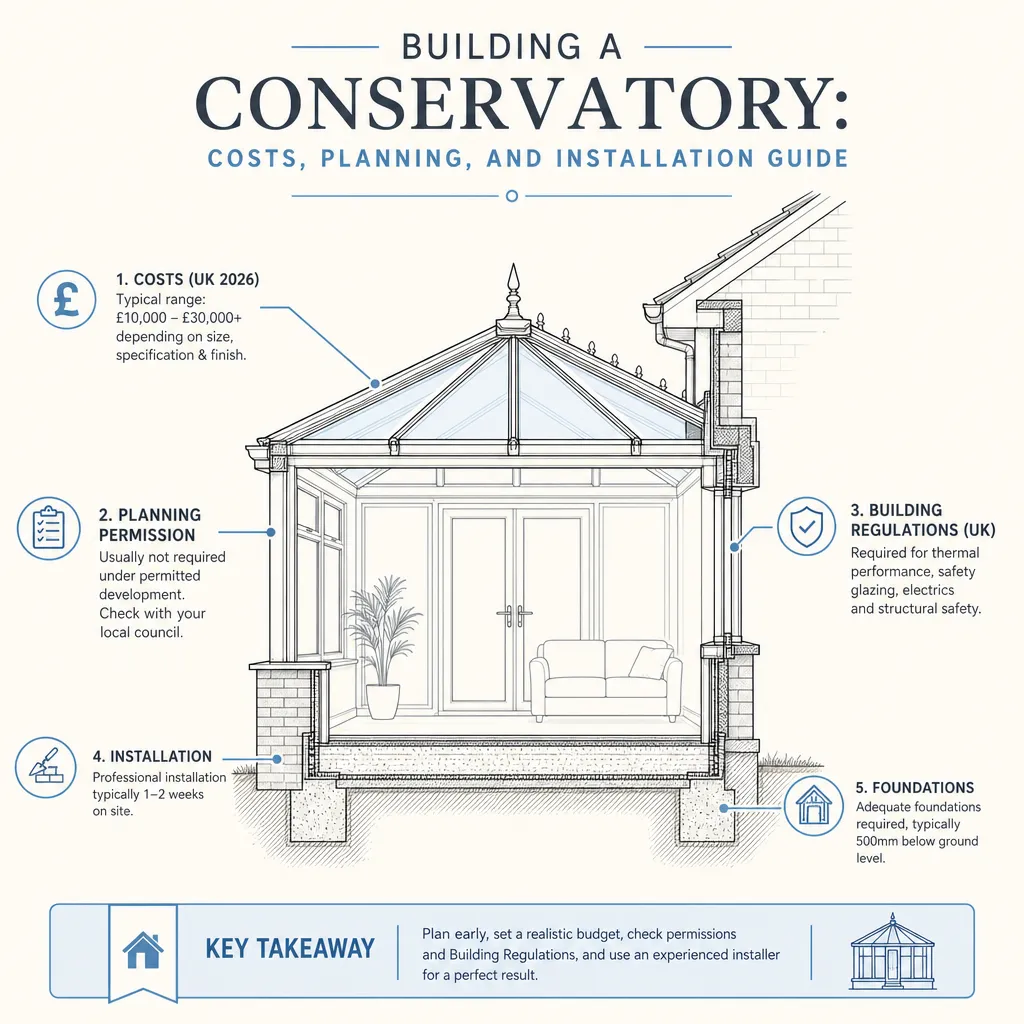
Building a Conservatory: Costs, Planning, and Installation Guide
Most UK conservatories qualify as permitted development and do not need a planning application, provided they meet the size, height, and location conditions in the Town and Country Planning (General Permitted Development) (England) Order 2015.
 Improvement & Build
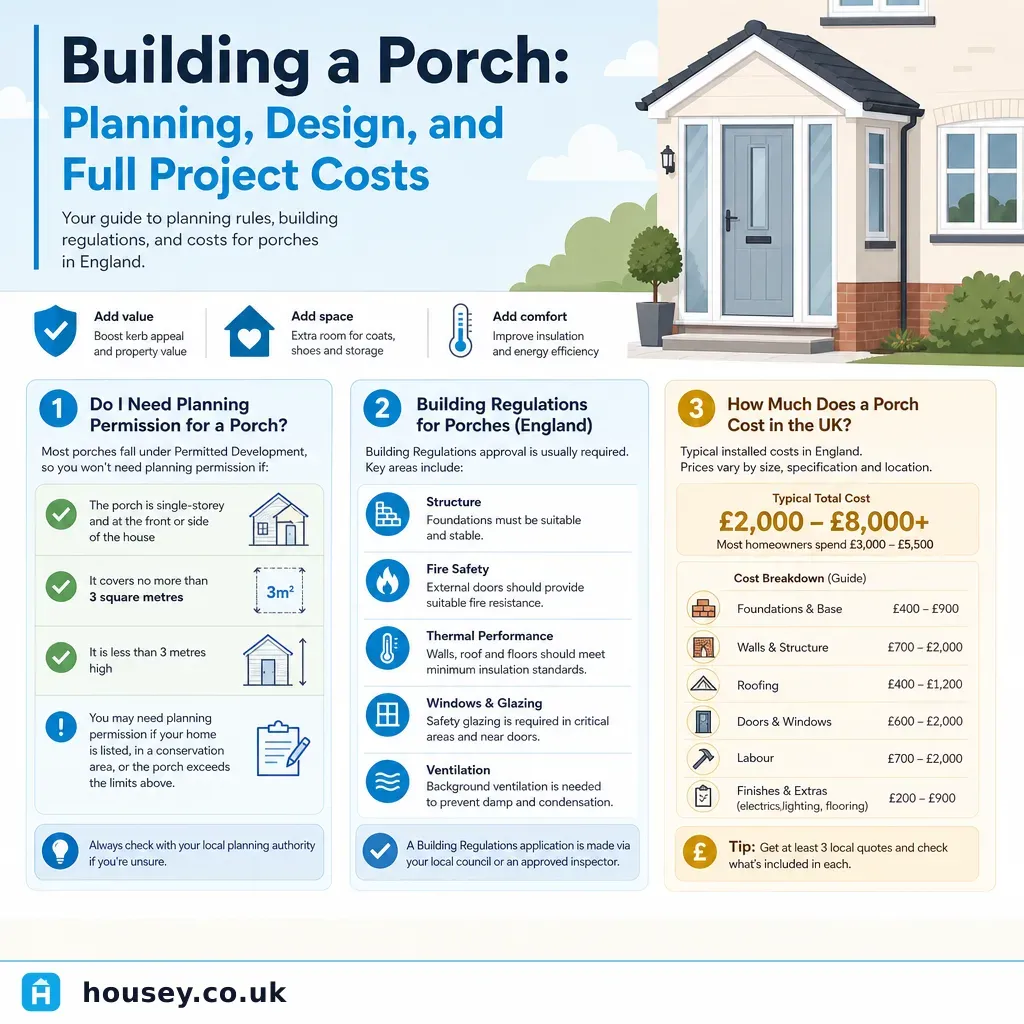
Building a Porch: Planning, Design, and Full Project Costs
Most porches with an external floor area of 3m² or less can be built without planning permission in England under permitted development rights, but building regulations approval is almost always required.
 Improvement & Build
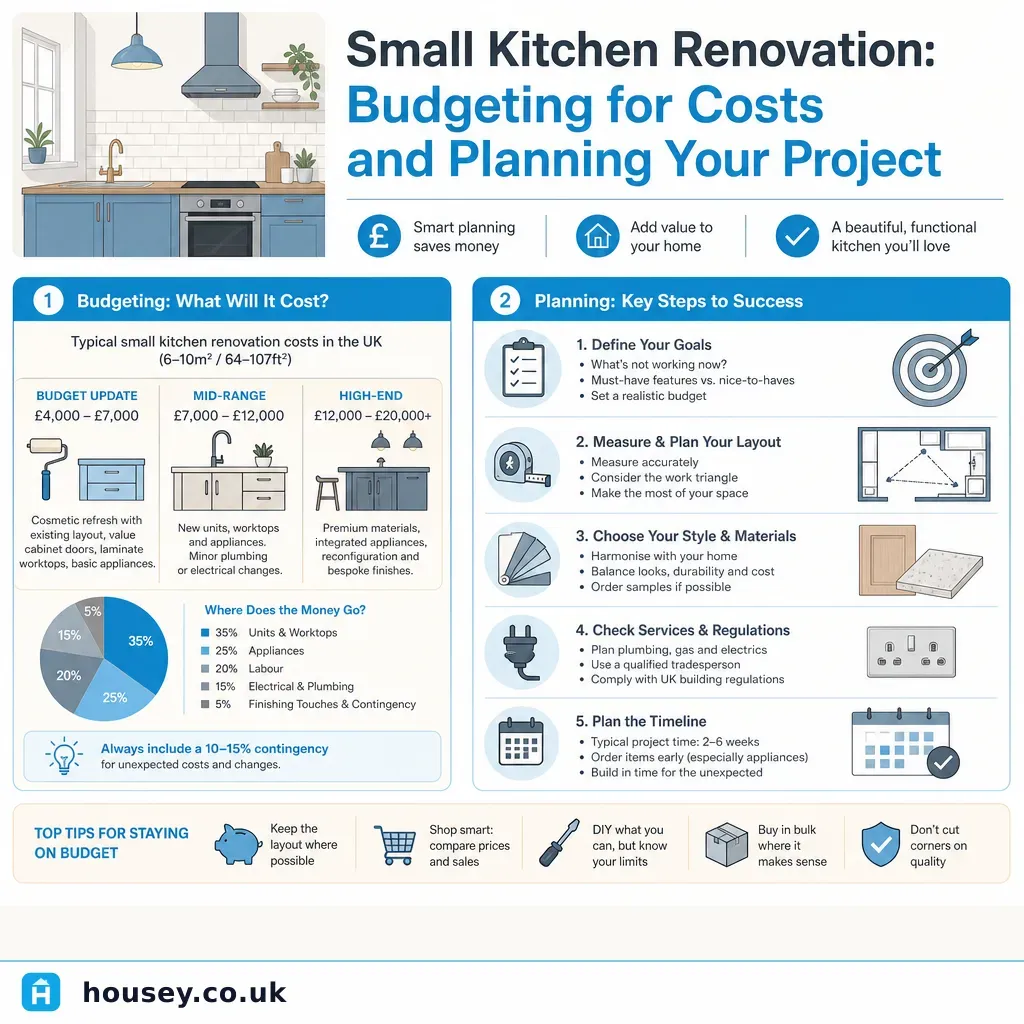
Small kitchen renovation: budgeting for costs and planning your project
A small kitchen renovation in the UK typically costs £5,000–£15,000 for a full refresh including new units, worktops, tiling, and appliances, though costs vary widely by specification, region, and whether structural changes or rewiring are involved.
 Improvement & Build
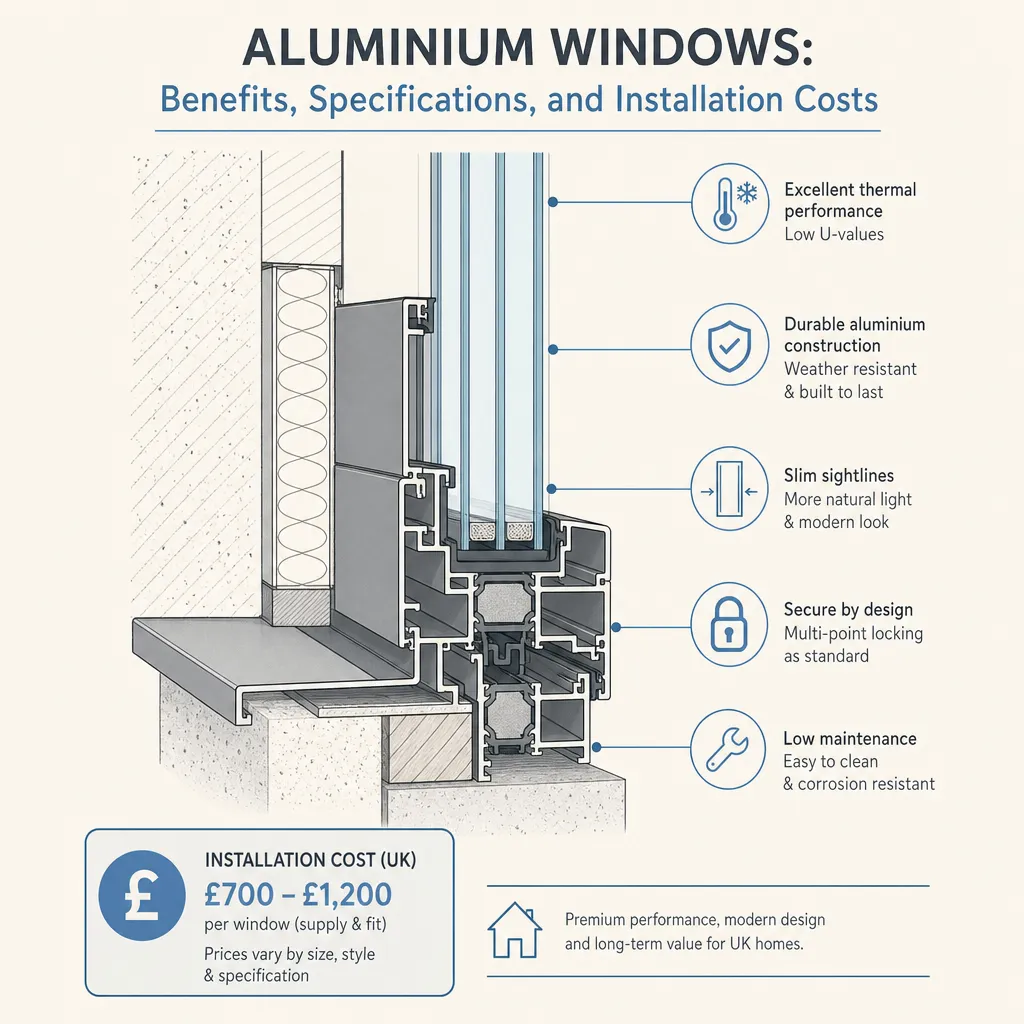
Aluminium Windows: Benefits, Specifications, and Installation Costs
Aluminium windows typically cost £600–£1,800 per window installed in the UK, depending on size and specification.
 Improvement & Build
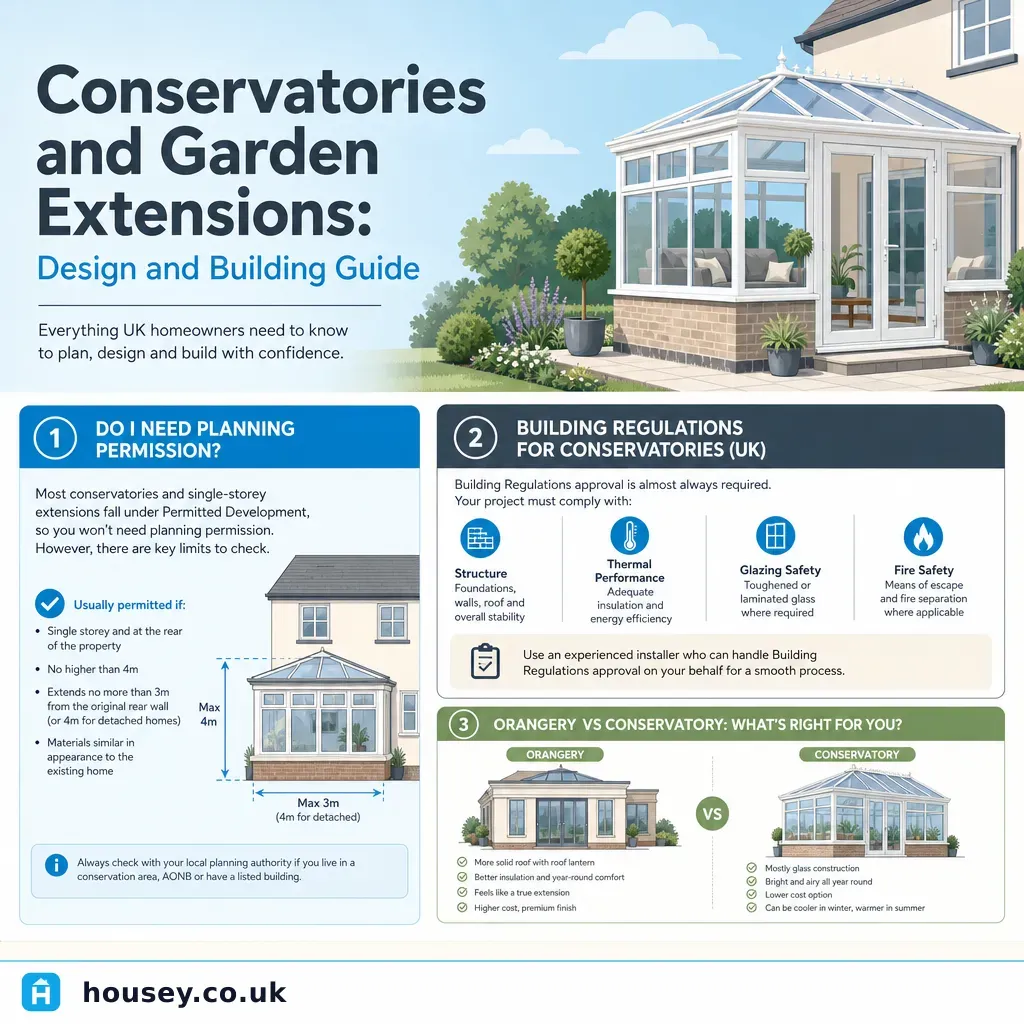
Conservatories and Garden Extensions: Design and Building Guide
Most conservatories qualify as permitted development in England if they are single-storey, within 50% of original curtilage, and meet dimensional limits.