Extending a Dormer Roof: Feasibility, Design, and Structural Implications
By Housey · Last reviewed 4th of May 2026
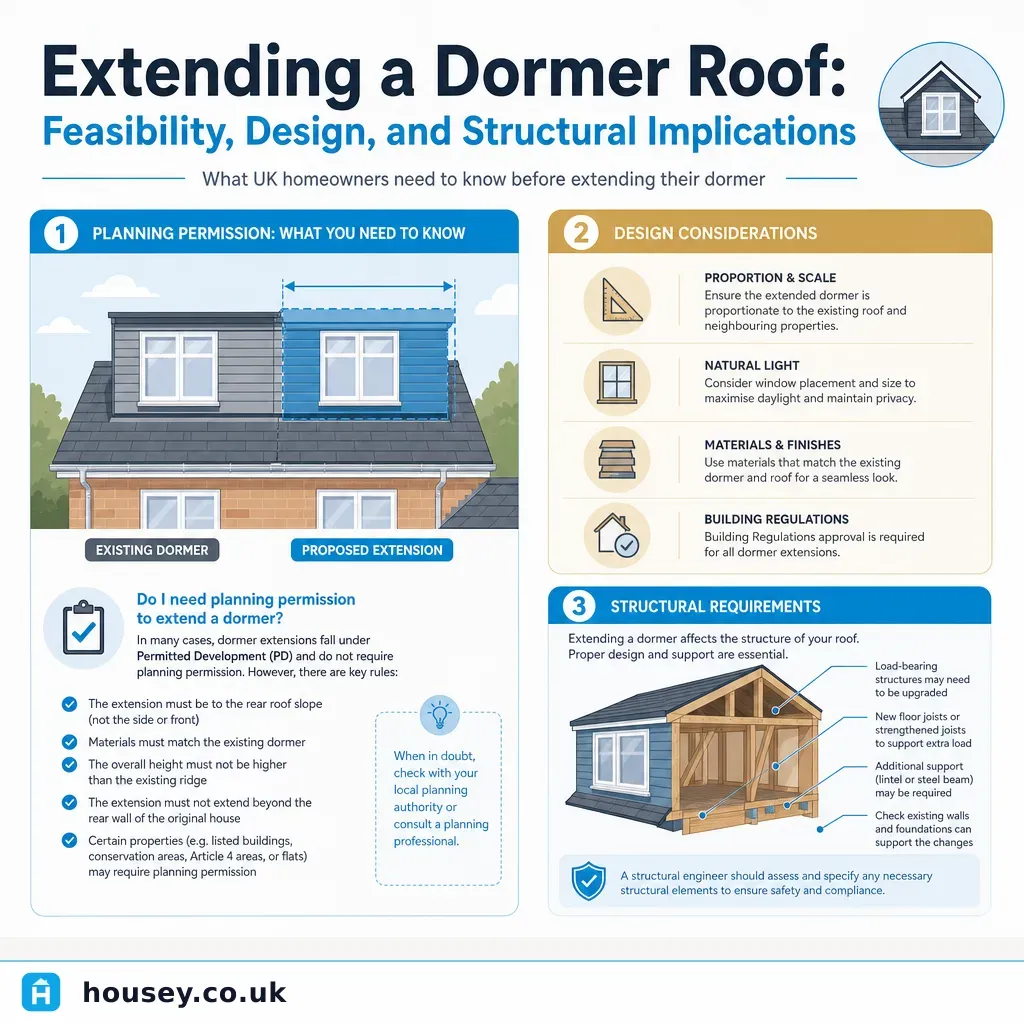
Extending a Dormer Roof: Feasibility, Design, and Structural Implications
Homeowners with an existing dormer often reach a point where it no longer provides enough usable floor area — a bedroom is too narrow, headroom falls short at the eaves, or a bathroom cannot be accommodated. Extending a dormer is structurally more complex than building one from scratch, because the existing roof has already been modified and its load paths altered. Establishing what is feasible before commissioning drawings avoids abortive design costs and planning delays.
Key points
- Under Schedule 2, Part 1, Class B of the Town and Country Planning (General Permitted Development) (England) Order 2015, rear dormer extensions on houses may not require planning permission, subject to a total roof addition volume limit of 40 m³ for terraced houses and 50 m³ for semi-detached and detached houses.
- Permitted development rights do not apply to flats, listed buildings, properties in conservation areas, National Parks, Areas of Outstanding Natural Beauty, or those subject to an Article 4 Direction.
- The volume limit applies to all additions to the original roof combined — if the existing dormer already used most of the allowance, a further extension may require a full householder planning application.
- A structural engineer must inspect and calculate the capacity of the existing roof structure — rafters, ridge, purlins, and any steelwork installed during the original dormer build — before the extended dormer is designed.
- Building regulations approval is required in all cases, covering at minimum Parts A (structure), B (fire), F (ventilation), L (energy efficiency), and O (overheating) of the Building Regulations.
What affects feasibility?
Four factors determine whether extending an existing dormer is practical:
Available permitted volume: The PD volume limit counts all additions to the original roof, not only the proposed extension. Have an architect or planning consultant calculate the volume of the existing dormer before assuming further PD headroom exists.
Structural capacity: The original dormer redistributed roof loads onto new supports — typically trimmer joists, ridge beams, or steel sections. Extending the dormer imposes additional load. A structural engineer needs to confirm whether the existing supports and the walls or foundations below can carry this safely.
Roof geometry: The pitch, span, and ridge height of the original roof determine how far the dormer can extend and what internal headroom is achievable. Very shallow-pitched roofs may offer limited gain even with a substantial extension.
Planning status: A property that is listed, in a conservation area, or subject to an Article 4 Direction removing PD rights will require a planning application regardless of scale. Checking this before design begins avoids wasted fees.
Planning permission: decision tree
This decision tree applies to England. Wales, Scotland, and Northern Ireland operate separate permitted development regimes — check with the relevant devolved authority.
- Choose permitted development if: the property is a house (not a flat or maisonette), it is not listed, not in a conservation area, AONB, National Park, or Article 4 Direction area, and the total volume of all roof additions (including the existing dormer) will not exceed 40 m³ for a terraced house or 50 m³ for a semi-detached or detached house, and the dormer is positioned to the rear and does not protrude beyond the principal elevation.
- Apply for householder planning permission if: the property is in a conservation area or other designated area; an Article 4 Direction removes PD rights; the cumulative volume limit is already met or would be exceeded; or any part of the extended dormer would be visible from the principal elevation.
- Obtain listed building consent in addition to any planning permission if the property is listed — this applies regardless of the scale of works and is required for all internal and external structural alterations.
- Submit a pre-application enquiry to your local planning authority (LPA) if you are uncertain about PD status — this is a paid service but provides written confirmation before design costs are committed. A planning consultant can manage this process on your behalf.
Structural design: what a structural engineer assesses
Extending a dormer changes load paths in the roof. A chartered structural engineer will typically:
- Inspect the existing dormer construction on site — assessing the size, species, and condition of trimmer joists, ridge beam or steel, any flitch beams, purlin positions, and how loads transfer to the walls below.
- Carry out calculations for the proposed extension, covering new rafters, cheek walls, any new or enlarged steelwork, and temporary propping requirements during construction.
- Produce structural drawings and calculations for submission to building control.
- Specify timber grades, structural connections, and fixings to comply with Building Regulations Approved Document A.
Common structural interventions when extending an existing dormer include enlarging or replacing the ridge beam, introducing new trimmer joists to carry extended cheek walls, strengthening ceiling joists to form a habitable floor, and, in some cases, upgrading load paths through upper storeys to the foundations. The structural engineer should be appointed at the design stage, not called in after problems emerge on site. Request quotes from structural engineers for dormer assessments before committing to a scheme.
Design and building regulations requirements
Beyond structural and planning matters, extending a dormer involves compliance across several parts of the Building Regulations:
Weatherproofing: The junction between the existing dormer cheeks, the extended cheeks, and the original roof slope is a common point of future water ingress if detailed poorly. Architects and roofers should specify appropriate breathable membranes, lead soakers, stepped flashings, and adequate drainage falls.
Thermal performance (Part L): New roof elements must meet current U-value requirements. For pitched roof slopes the target is 0.18 W/m²K and for flat roof sections 0.15 W/m²K under current Approved Document L values — check the current approved document, as these figures are subject to revision.
Overheating (Part O): Applicable in England since June 2022, Part O requires designers to demonstrate that new or extended habitable rooms have adequate measures to limit solar and internal heat gain. South- or west-facing roof lights in extended dormers are a common trigger.
Ventilation (Part F): New habitable rooms must meet whole-dwelling ventilation requirements. A bathroom or en suite in the extended dormer will require extract ventilation to an appropriate standard.
Fire safety (Part B): Converting or extending a loft into habitable accommodation typically requires a protected staircase, fire doors at key locations, and in some configurations a sprinkler or mist system. The exact requirements depend on the number of storeys in the dwelling.
Architects experienced in loft and roof projects can coordinate all of these requirements into a single set of drawings, reducing the risk of building control queries during the build. Building control consultants can advise on compliance before the application is submitted.
What to ask a qualified professional
Before instructing an architect or structural engineer for a dormer extension:
- Have you worked on dormer extensions of a comparable scale and construction type?
- Can you confirm the permitted development position for this property, or recommend a pre-application enquiry?
- What site inspection will you carry out before producing structural calculations or design drawings?
- Will your drawings address all relevant parts of the Building Regulations — A, B, F, L, and O?
- Who will submit to building control — your practice or the main contractor?
- How do you detail the weatherproof junction between the existing and extended dormer?
- What is your fee structure, and does it cover building control queries and revisions?
- Do you recommend involving a party wall surveyor, and at what stage?
Important limitations
This article provides general information for homeowners in England. Permitted development rules differ in Wales, Scotland, and Northern Ireland — consult the relevant planning authority for your location. PD rights can be removed or modified by individual planning conditions attached to earlier consents, or by local Article 4 Directions that are not always easily visible in public registers. Structural feasibility depends entirely on the specific construction of the existing roof and dormer, which only a site inspection by a qualified structural engineer can determine. Nothing in this article constitutes planning advice or structural engineering advice.
When to get professional help
Appoint an architect and structural engineer before any construction work — or detailed design — begins. A planning consultant can provide a formal permitted development assessment or manage a pre-application enquiry where there is any doubt about planning status.
Seek immediate professional advice if:
- You are unsure whether permitted development rights apply to your property.
- The property is listed or in a conservation area.
- Work has already started without building regulations approval.
- You notice cracking, deflection, or movement in the existing dormer or the roof structure around it.
- Your lease (if leasehold) restricts structural alterations and you have not obtained freeholder consent.
How Housey can help
Housey connects homeowners with the professionals needed at each stage of a dormer extension project. You can request quotes from architects experienced in loft and roof projects, structural engineers for dormer assessments, planning consultants for permitted development advice, and building control consultants through Housey — helping you assemble the right team from the outset rather than after problems arise.
Frequently asked questions
Do I always need planning permission to extend an existing dormer?
Not always. In England, extending a rear dormer on a house may fall under permitted development, provided the total volume of all roof additions — including the existing dormer — does not exceed 40 m³ for terraced houses or 50 m³ for semi-detached and detached houses. PD rights do not apply to flats, listed buildings, or properties in conservation areas, National Parks, AONBs, or areas subject to an Article 4 Direction. Always verify with your local planning authority before starting.
How much does it cost to extend a dormer?
Costs vary considerably depending on the size of the extension, structural complexity, location, existing construction quality, and internal specification. As a rough guide, extending a modest rear dormer might cost between £15,000 and £40,000 or more, including structural works, roofing, windows, and basic internal finishing (indicative UK costs, last reviewed 2026-05-04; obtain at least three quotes). Structural steelwork requirements, poor existing construction, or conservation area constraints can significantly increase costs.
Will extending my dormer affect my neighbour under the Party Wall Act?
It may. If the extended dormer or its supporting structure is on or within three to six metres of a party wall or the boundary, the Party Wall etc. Act 1996 may be engaged, requiring a party wall notice to be served on adjoining owners before work begins. A party wall surveyor can advise on whether the Act applies to your specific project. Failing to serve notice when required can expose you to legal liability if the work causes damage.
Is building regulations approval required even if planning permission is not needed?
Yes. Building regulations approval is required for any structural alterations, new or extended habitable rooms, and works affecting thermal performance, ventilation, fire safety, or drainage. This applies regardless of whether a planning application or permitted development applies. You must notify your local authority building control department or an approved inspector before work commences. Proceeding without approval can complicate future sales and insurance claims.
Can I extend a dormer on a leasehold flat?
Flats and maisonettes in England do not benefit from permitted development rights under the Town and Country Planning (General Permitted Development) (England) Order 2015, so planning permission will always be required. Additionally, leasehold flat owners typically need the freeholder's written consent for any structural alterations under the terms of the lease. Review your lease and seek legal advice before commissioning any design work.
Sources and further reading
- Town and Country Planning (General Permitted Development) (England) Order 2015, Schedule 2, Part 1 — legislation.gov.uk
- Planning Portal: Permitted development — loft conversions — Planning Portal
- Building Regulations Approved Document A: Structure — GOV.UK
- Building Regulations Approved Document L: Conservation of fuel and power — GOV.UK
- Building Regulations Approved Document O: Overheating — GOV.UK
- Party Wall etc. Act 1996 — legislation.gov.uk
Useful next reads
 Planning & Pre-Build
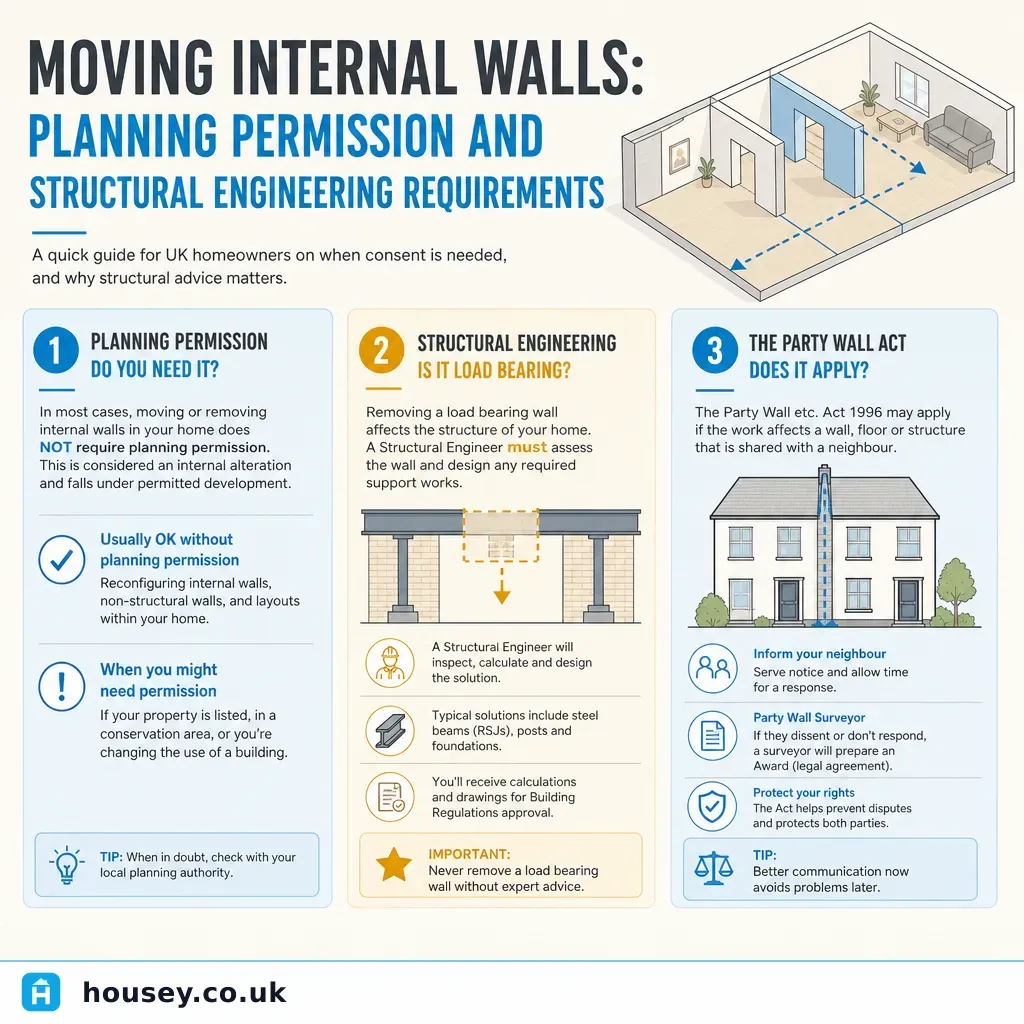
Moving Internal Walls: Planning Permission and Structural Engineering Requirements
Removing an internal wall rarely needs planning permission in England, but Building Regulations approval under Part A is almost always required if the wall is load-bearing.
 Planning & Pre-Build
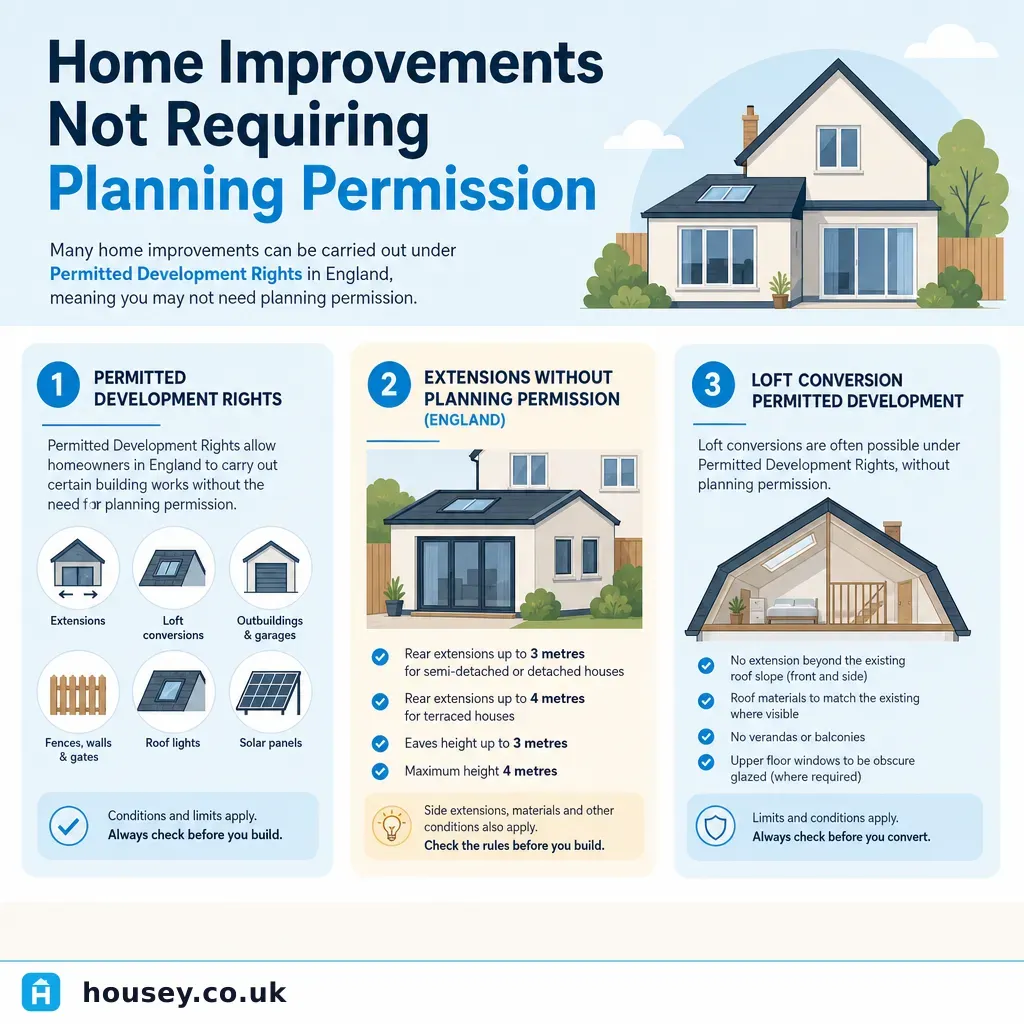
Home Improvements Not Requiring Planning Permission
Many common home improvements in England fall under Permitted Development Rights and do not require a planning application.
 Planning & Pre-Build
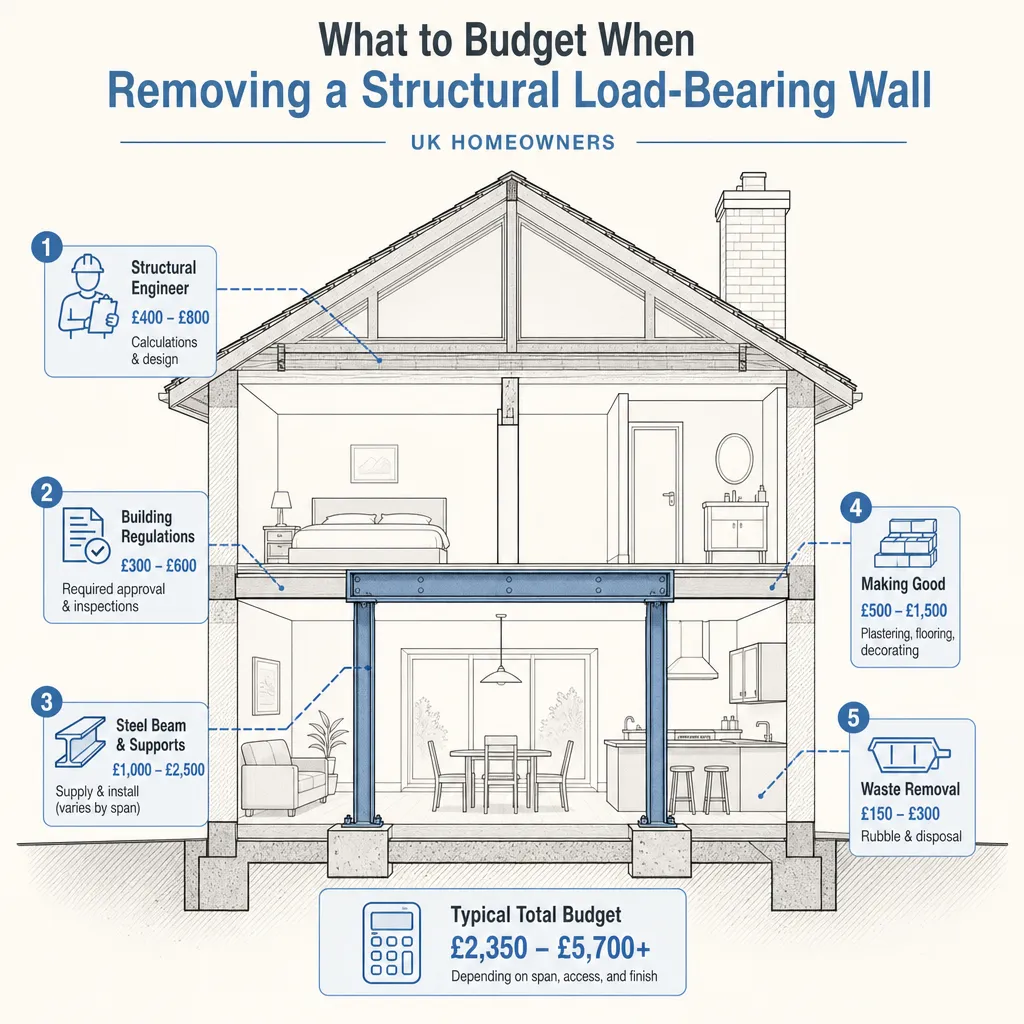
What to Budget When Removing a Structural Load-Bearing Wall
Removing a load-bearing wall in a typical UK home costs £2,500–£8,000 or more in total, covering a structural engineer's calculations, Building Regulations approval, the steel beam, builder's labour, and replastering.
 Planning & Pre-Build
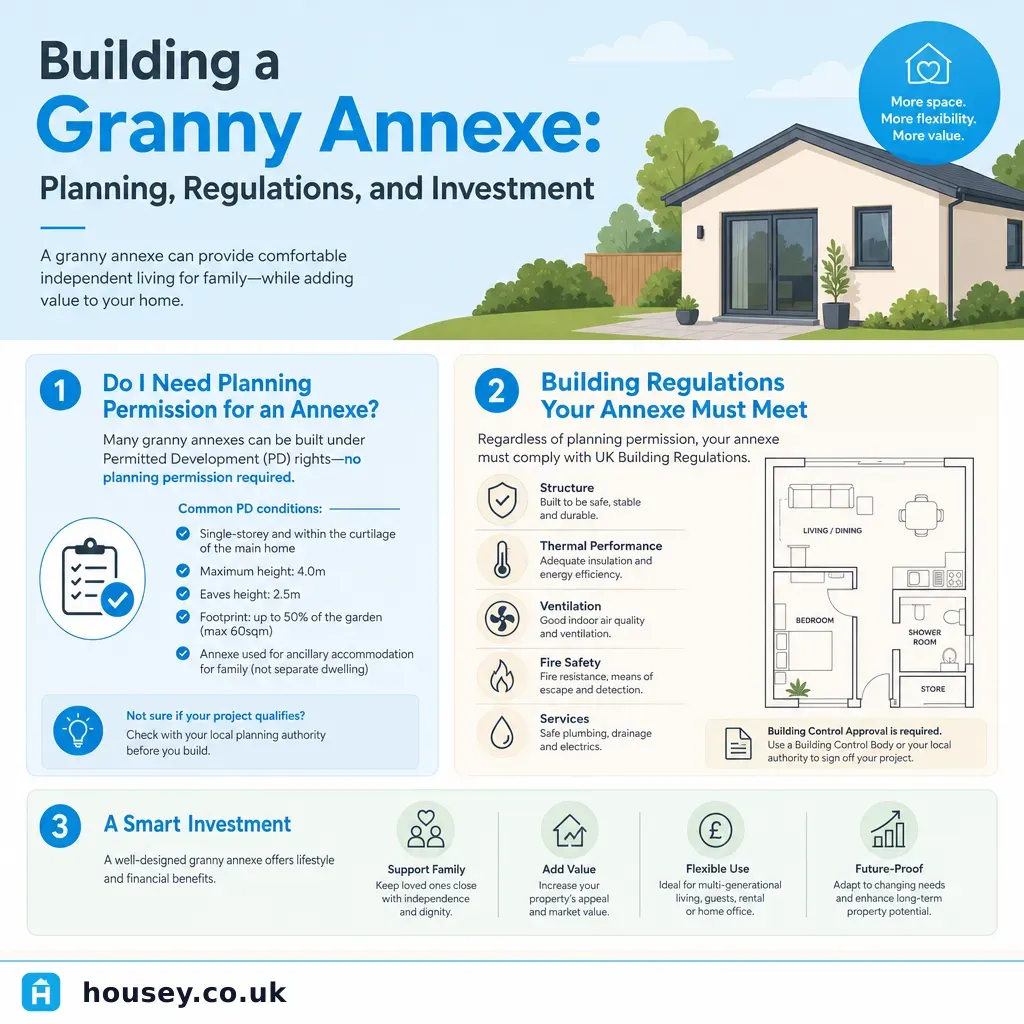
Building a Granny Annexe: Planning, Regulations, and Investment
A granny annexe in the UK may or may not need planning permission depending on whether it is classed as incidental to the main house or as a separate dwelling.
 Planning & Pre-Build
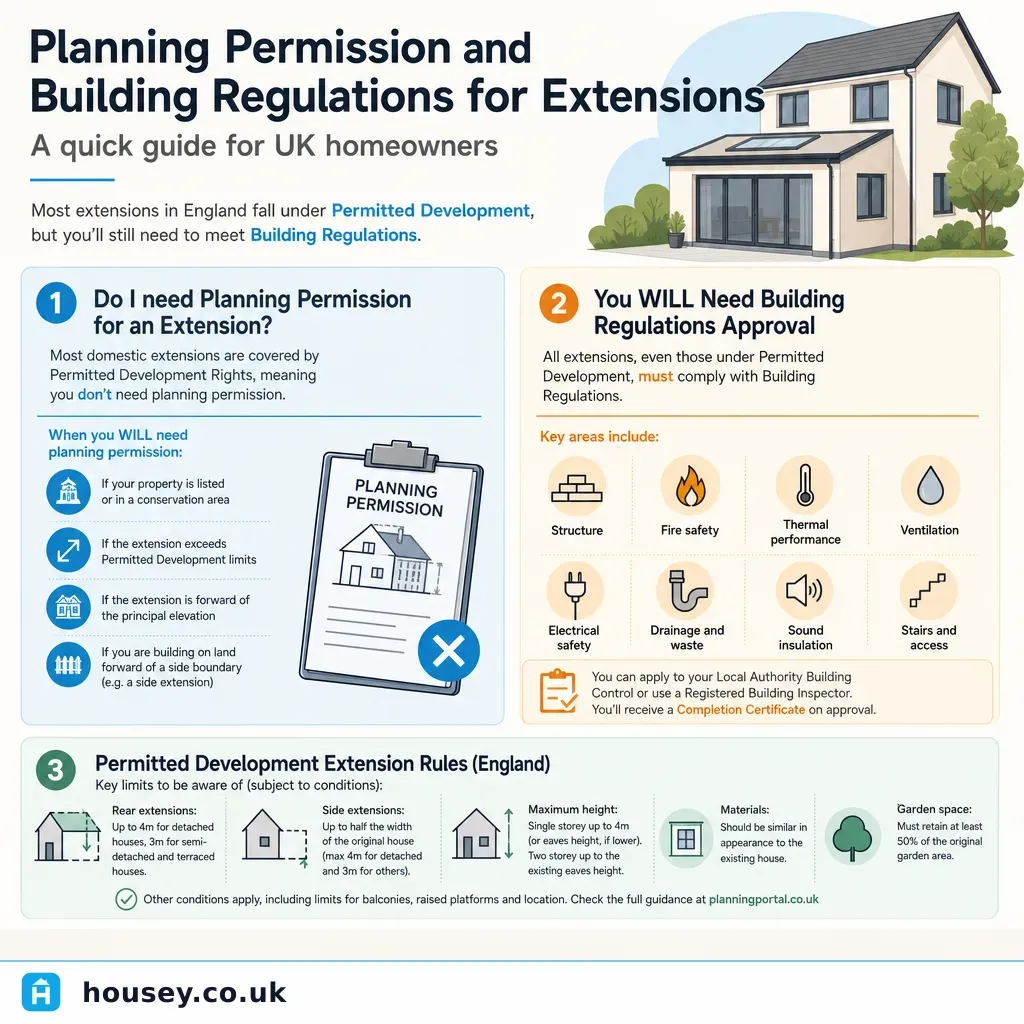
Planning Permission and Building Regulations for Extensions
UK home extensions usually require both planning permission and Building Regulations approval, though most smaller rear extensions qualify as Permitted Development under the GPDO 2015 and need no planning application.