Understanding Leasehold Property Terminology and Rights
By Housey · Last reviewed 30th of May 2026

Understanding Leasehold Property Terminology and Rights
Leasehold tenure affects around 4.98 million dwellings in England, the vast majority being flats in urban and suburban areas. If you are buying, selling, or already living in a leasehold property, the legal vocabulary in your lease — terms such as ground rent, service charge, and enfranchisement — carries direct financial and practical consequences. Recent legislative changes, including the Leasehold Reform (Ground Rent) Act 2022 and the Leasehold and Freehold Reform Act 2024, mean the rules governing leaseholders in England and Wales have shifted significantly in a short space of time.
Key points
- A lease with fewer than 80 years remaining attracts a "marriage value" premium that substantially raises the cost of a statutory lease extension under the Leasehold Reform, Housing and Urban Development Act 1993.
- The Leasehold Reform (Ground Rent) Act 2022 set ground rent to a peppercorn (effectively zero) for all new regulated residential leases in England and Wales granted on or after 30 June 2022.
- Qualifying leaseholders who have owned their flat for at least two years have a statutory right to extend their lease by 90 years and reduce ground rent to a peppercorn.
- Collective enfranchisement — where leaseholders jointly buy the freehold — requires the participation of at least 50% of qualifying flats in the building.
- Service charges must be "reasonable" under the Landlord and Tenant Act 1985; challenges to unreasonable charges are heard by the First-tier Tribunal (Property Chamber) in England.
Leasehold versus freehold: the essential distinction
When you buy a freehold property, you own the building and the land permanently. When you buy a leasehold property, you own the right to occupy it for a defined number of years — typically 99, 125, or 999 years when originally granted — while the freeholder (landlord) retains ownership of the land and structure.
Feature | Freehold | Leasehold |
|---|---|---|
Ownership | Land and building permanently | Time-limited occupation right |
Annual charges | None (council tax aside) | Ground rent (where applicable) + service charge + buildings insurance contribution |
Alterations | Generally unrestricted (planning rules aside) | Often require freeholder's written consent |
Lease length concern | Not applicable | Under 70–80 years can affect mortgage eligibility and saleability |
Route to buy the freehold | Already owned | Collective enfranchisement or voluntary purchase |
Typical property type | Houses, bungalows | Flats; some houses (particularly new-build) |
Most mortgage lenders will not offer a loan on a property with fewer than 70 years remaining at the end of the mortgage term, so lease length directly affects your ability to sell or remortgage in the future.
Core leasehold terms explained
Ground rent — A periodic payment from the leaseholder to the freeholder. For new regulated leases granted on or after 30 June 2022, the Leasehold Reform (Ground Rent) Act 2022 requires this to be a peppercorn (zero). Older leases may contain escalating ground rent clauses that have created difficulties for buyers and mortgage lenders alike.
Service charge — Payments covering maintenance of communal areas, shared structures, and buildings insurance. Under the Landlord and Tenant Act 1985, service charges must be reasonably incurred; leaseholders are entitled to a written summary of costs, and demands must include a summary of leaseholders' rights.
Sinking fund / reserve fund — Money accumulated from service charges for major planned works such as roof replacement or lift servicing. A healthy reserve fund reduces the risk of sudden large bills to leaseholders.
Forfeiture — The freeholder's right to repossess the property for serious lease breaches, including substantial unpaid charges. Forfeiture requires a court order and is rare, but keeping charges paid and addressing disputes formally limits the risk.
Enfranchisement — The collective or individual right of leaseholders to purchase the freehold or extend their lease. Rights under the Leasehold Reform, Housing and Urban Development Act 1993 require at least two years' ownership before they can be exercised.
Share of freehold — Where leaseholders jointly own the freehold through a management company, giving them control over building management, service charges, and the ability to grant lease extensions at low cost.
Licence to alter — Written consent from the freeholder to carry out alterations to the property. Obtain this before works begin; retrospective consent is harder to secure and can complicate future sales.
Deed of covenant — A legal document by which a buyer formally agrees to comply with all obligations under the lease, prepared by the conveyancer on a sale.
Notice of transfer / notice of charge — Documents that must be served on the freeholder within the period specified in the lease (often 21 days) when a property is sold or mortgaged. Failure can result in a notice fee or, in extreme cases, a technical breach of lease.
Statutory lease extension rights
Qualifying leaseholders in England and Wales can extend their lease by 90 years on top of the unexpired term, at a peppercorn ground rent, under the Leasehold Reform, Housing and Urban Development Act 1993. The premium payable to the freeholder includes:
- The reduction in the freeholder's reversionary value.
- The loss of future ground rent income.
- Marriage value — applicable only where the unexpired term is below 80 years, and potentially the most significant cost element.
A Section 42 notice — the formal notice to the freeholder of your intention to extend — must be served by a solicitor experienced in leasehold law. The freeholder has two months to respond with a counter-notice. If the parties cannot agree a premium, the First-tier Tribunal (Property Chamber) determines it.
Act before the lease falls below 80 years. Once the unexpired term drops below this threshold, marriage value enters the calculation and can significantly increase the premium.
Leaseholder checklist before exchange of contracts
Use this checklist when purchasing a leasehold property:
Important limitations
The information in this article is a general introduction to leasehold terminology and rights in England and Wales. Leasehold law is complex and has been changing: the Leasehold and Freehold Reform Act 2024 is being implemented in stages as of May 2026, and further secondary legislation may not yet be fully in force. The rules in Scotland differ substantially — Scottish property law operates under a separate system under which most residential properties are sold freehold. Nothing in this article constitutes legal advice. Always instruct a qualified solicitor with leasehold experience before making any decisions.
When this becomes urgent
Seek legal advice immediately if:
- Your lease is approaching or is already below 80 years — every year below this threshold increases the extension premium.
- You have received a major works notice for costs running to thousands of pounds and are unsure whether they are justified.
- The freeholder or managing agent is threatening forfeiture proceedings.
- You are about to exchange contracts on a leasehold property and have not yet reviewed the full lease with your solicitor.
What to ask a qualified professional
Before instructing a leasehold solicitor or conveyancer, consider asking:
- What is the unexpired lease term, and what is the estimated extension premium now versus in two years' time?
- Are there any escalating ground rent provisions that could affect my mortgage eligibility or future sale?
- What major works are planned, and is the sinking fund adequate to cover them?
- Has the freeholder or managing agent been subject to First-tier Tribunal proceedings?
- What are the notice obligations on completion, and will your firm handle these?
- Are there any restrictions on subletting, pets, or alterations that are relevant to my plans for the property?
When to get professional help
Always instruct a solicitor with leasehold expertise — not just a general residential conveyancer — when:
- The lease has fewer than 85 years remaining.
- The lease contains a ground rent above a nominal sum that increases over time.
- You are considering collective enfranchisement or a voluntary freehold purchase.
- You need a lease extension premium valuation before exchange.
- You have received a major works notice or a large unexpected service charge demand.
- There is a dispute with the freeholder or managing agent.
How Housey can help
Housey connects leaseholders and buyers with specialists for conveyancing on leasehold properties and lease extension valuations. Compare quotes from qualified professionals and get clear guidance on what to expect at each stage of the process.
Frequently asked questions
What happens if my lease runs out?
If a residential lease expires without extension, the property legally reverts to the freeholder. In practice, most leaseholders use statutory rights to extend well before expiry. Leaseholders remaining in occupation at expiry may have limited protection under the Landlord and Tenant Act 1954, but this is legally complex — anyone approaching lease expiry should seek immediate legal advice from a solicitor experienced in leasehold law.
Can I buy my leasehold house's freehold?
Qualifying leaseholders of houses can enfranchise individually under the Leasehold Reform Act 1967, and rights were extended by the Leasehold and Freehold Reform Act 2024. Eligibility depends on lease length, property value, and ownership period. A solicitor experienced in leasehold enfranchisement can confirm whether your property qualifies and estimate the premium payable to the freeholder.
Is share of freehold the same as owning the freehold?
Not exactly. Share of freehold means you hold a share in the company that owns the building's freehold, alongside other leaseholders. You still hold an individual lease, but you gain much greater control over building management and can grant yourself a lease extension at minimal cost. Legal advice is needed to manage the freehold company and any lease amendments correctly.
Does the Leasehold Reform (Ground Rent) Act 2022 apply to existing leases?
No. The Act applies to new regulated residential leases in England and Wales granted on or after 30 June 2022. Existing leases retain their original ground rent terms. The government has consulted on retrospective caps for pre-2022 leases, but no such legislation had been enacted as of May 2026. Review your existing lease with a solicitor if ground rent provisions are a concern.
Sources and further reading
- Leasehold Reform (Ground Rent) Act 2022 — legislation.gov.uk
- Leasehold and Freehold Reform Act 2024 — legislation.gov.uk
- Leasehold Reform, Housing and Urban Development Act 1993 — legislation.gov.uk
- Leasehold property — GOV.UK guidance — GOV.UK
- Service charges: leaseholder rights — GOV.UK
- RICS leasehold reform guidance — RICS
Useful next reads
 Buying & Moving
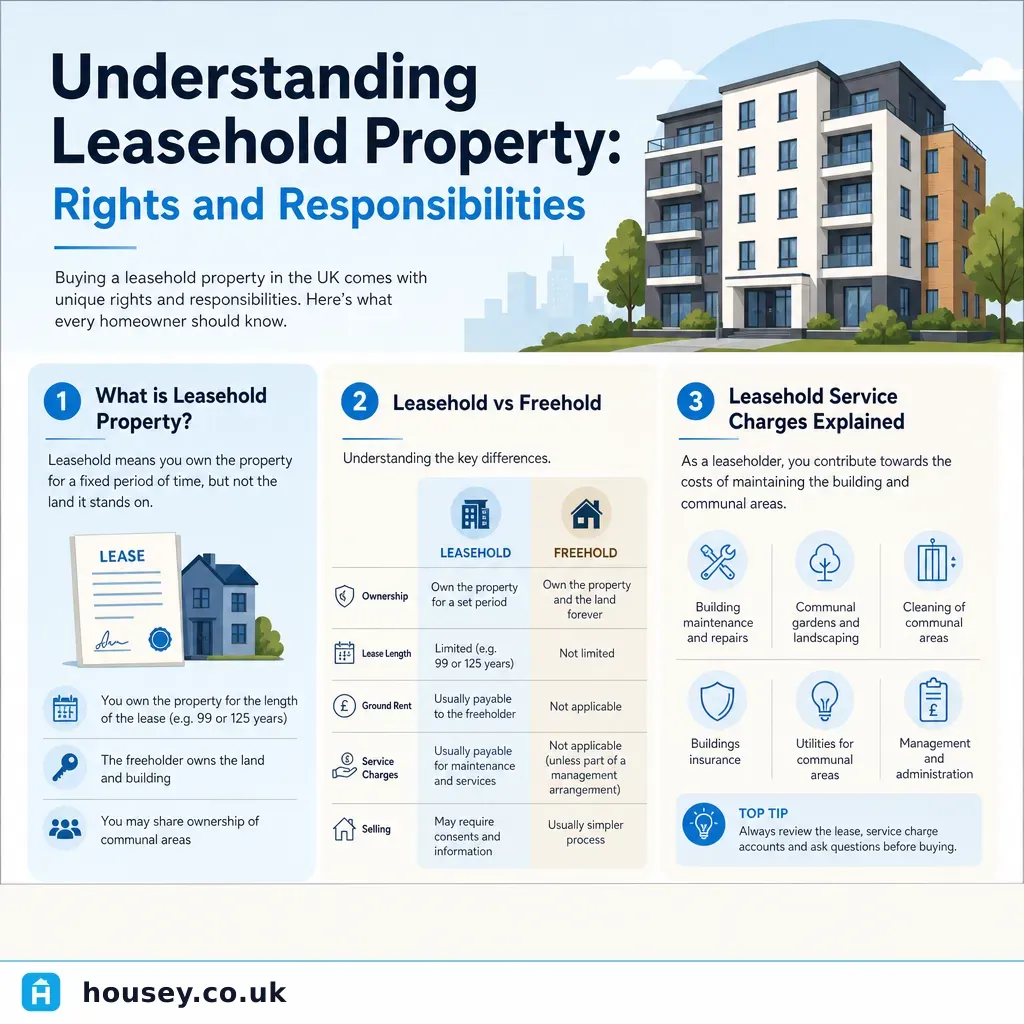
Understanding Leasehold Property: Rights and Responsibilities
Leasehold means you own a time-limited interest in a property while the freeholder owns the land and building.
 Buying & Moving
Property Covenants: Legal Restrictions You May Encounter When Buying
Property covenants are legally binding obligations tied to land and registered at HM Land Registry.
 Buying & Moving
Common Legal Questions From Property Purchasers and Legal Advisors
Conveyancing in England and Wales typically takes 8–16 weeks.
 Buying & Moving
Navigating Simultaneous Purchase and Sale of Property
When buying and selling simultaneously in England and Wales, both sets of contracts are exchanged on the same day — this is called simultaneous exchange.
 Buying & Moving
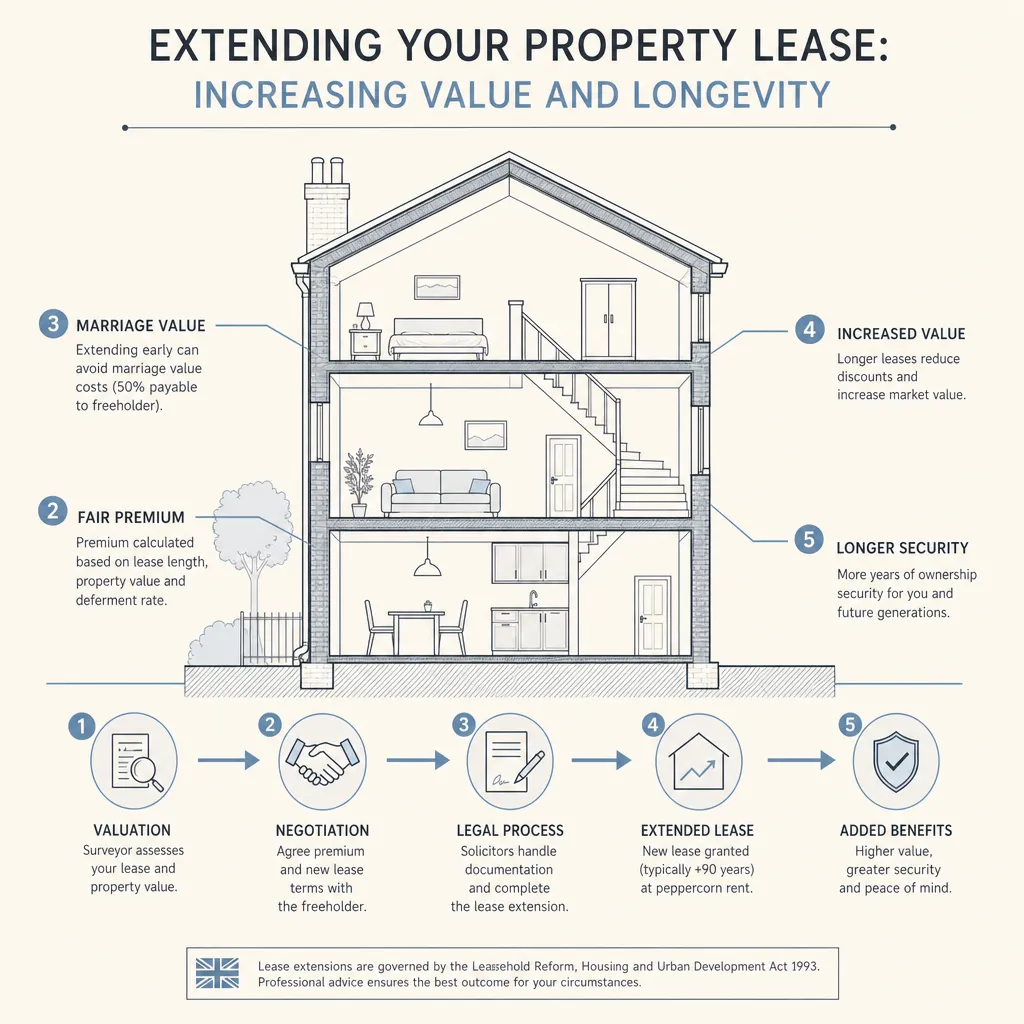
Extending Your Property Lease: Increasing Value and Longevity
Qualifying leaseholders in England and Wales can extend their lease by 90 years at a peppercorn ground rent under the Leasehold Reform, Housing and Urban Development Act 1993.