Low-Cost Home Improvements That Increase Property Value
By Housey · Last reviewed 11th of May 2026
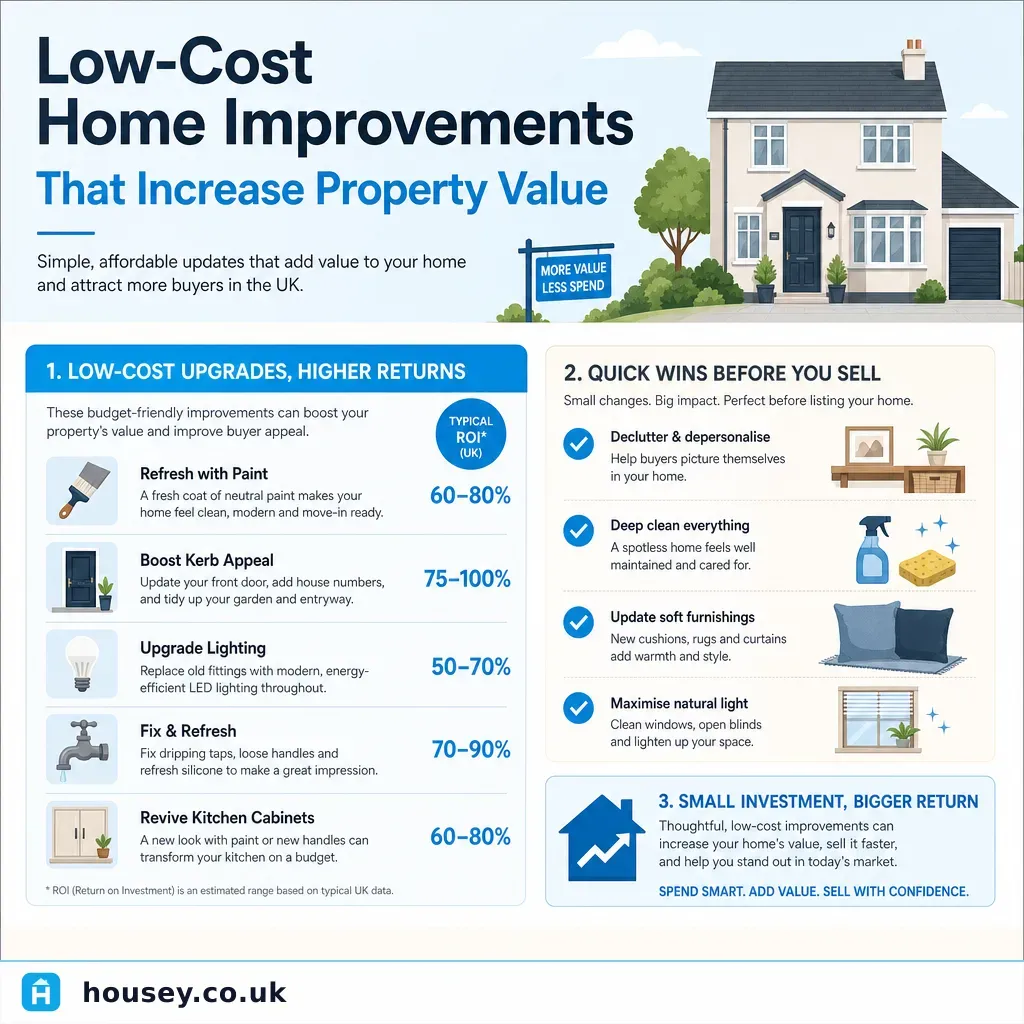
Low-Cost Home Improvements That Increase Property Value
Whether preparing to sell, remortgage, or simply get more from their home, UK homeowners often underestimate how much targeted low-cost improvements can shift a buyer's perception and a surveyor's valuation. The improvements that add the most value relative to spend are rarely the largest projects — full extensions and complete kitchen replacements can add value but carry planning, building control, and disruption costs that frequently erode returns, especially where local market ceilings limit what comparable properties achieve at sale.
Key points
- Refreshing paintwork in neutral tones can cost as little as £200–£500 in materials for a typical three-bed semi and is consistently cited by estate agents as one of the highest-return cosmetic improvements.
- A loft insulation top-up to the recommended 270 mm depth is eligible for the Great British Insulation Scheme (GBIS) grant for qualifying households and can raise an EPC rating by a band — increasingly important to buyers and buy-to-let landlords facing Minimum Energy Efficiency Standards (MEES).
- Kitchen and bathroom refreshes — new taps, handles, re-grouting, updated splashbacks — typically cost £300–£1,500 and can transform the perceived quality of a room without a full renovation.
- Building Regulations Part L requires that if a thermal element (roof, wall, or floor) is replaced as part of improvement works beyond a set threshold, that element must be brought up to current U-value standards — factor this into budgets for larger upgrades.
- First impressions from the street (kerb appeal) are disproportionately influential: Nationwide and Rightmove research consistently identifies front door condition, garden tidiness, and visible maintenance as factors that shape initial buyer valuation instincts.
Why low-cost does not mean low impact
Low-cost improvements work best when they:
- Remove reasons for a buyer to discount the asking price (visible damp, cracked plaster, tired decoration)
- Raise energy efficiency to a threshold that matters (EPC C or above, especially for the rental market)
- Improve first impressions (kerb appeal, entrance hall, kitchen surface condition)
- Allow a property to photograph and present well (declutter, neutral palette, clean finishes)
Expensive projects can overshoot the local market ceiling — the maximum price comparable properties achieve in the postcode. Spending £50,000 on a kitchen extension in an area where three-bed semis sell for £180,000 is unlikely to recover its cost at sale.
Improvement options: estimated value impact
Improvement | Typical cost (UK, 2026) | Value impact | Best for |
|---|---|---|---|
Full internal repaint in neutral tones | £300–£1,500 materials and labour | Removes decoration discount; improves photography | Properties with dated or strong colour schemes |
Front door replacement or repaint | £100–£800 | Strong kerb appeal signal; estate agents cite front doors specifically | Any property with a tired or ill-fitting door |
Garden tidy and basic landscaping | £200–£1,000 DIY to contractor | Significant for properties where garden is visible from the street | Houses with neglected front or rear gardens |
Loft insulation top-up to 270 mm | Often £0–£300 after GBIS grant | EPC rating improvement; lower running cost signal to buyers | Properties currently EPC D or below |
Smart thermostat installation | £150–£300 supply and fit | Signals lower running costs; low effort and disruption | Properties with a compatible boiler and heating system |
Kitchen handles, tap, and splashback | £300–£1,500 | Refreshes kitchen without full refit | Kitchens with sound carcasses but dated fittings |
Bathroom re-grout, new taps, mirror | £100–£600 | Removes the impression that the room needs updating | Bathrooms with discoloured grout or worn fittings |
Draught-proofing (doors, windows, loft hatch) | £100–£400 | EPC improvement; comfort signal to buyers | Older properties with sash windows or poorly sealed openings |
External repointing (front elevation) | £400–£1,500 | Reduces surveyor flags; removes visible maintenance concerns | Properties with visibly deteriorated mortar joints |
Internal declutter and deep clean | £0–£500 | Improves photography and viewing quality | Any property going to market |
Indicative UK costs, last reviewed 2026-05-11. Costs vary significantly by region, property size, and contractor. Obtain at least three quotes for any work above £500.
Worked UK property scenario
Property: 1980s three-bedroom semi-detached in the East Midlands, current EPC rating D, going to market at £220,000.
Owner's budget: £2,500.
Priority improvements chosen:
- Full internal repaint in neutral tones (owner DIY): £350 in materials
- New composite front door (mid-range): £700 supply and fit
- Kitchen handles, tap, and tiled splashback: £600
- Loft insulation top-up to 270 mm (via GBIS, no cost after grant): £0
- Garden tidy, fence paint, and new house number: £250
- Smart thermostat installation: £200 supply and fit
Total spent: approximately £2,100. EPC improved to C. Estate agent feedback: no obvious cosmetic discount required. The property photographs well, kerb appeal is strong, and EPC C broadens the buyer pool — including purchasers using green mortgages or planning to let the property in future.
The owner retained £400 for staging costs. No planning permission or building regulations approval was required for any of the works listed.
What to ask before starting work
- Does this improvement require building regulations approval? Structural changes, new windows or doors, electrical work at consumer-unit level, and heating changes may require notification or a completion certificate.
- Does the property have any planning constraints that restrict external changes? Conservation area designation, listed building status, or an Article 4 Direction may affect permitted development rights.
- Will this improvement be valued by buyers in this specific local market? A premium garden feature in a first-time-buyer market rarely recovers its cost.
- If using a contractor, do they hold relevant trade accreditations such as FENSA for windows, Gas Safe for gas work, or NICEIC/NAPIT for electrical work?
- Have at least three written quotes been obtained for any works above £500?
When to get professional help
Most cosmetic and energy improvements can be managed by a confident homeowner. Professional advice is worth seeking when:
- You are considering structural changes, extensions, or a loft conversion — input from an architect or structural engineer is advisable even if works appear to fall within permitted development
- You are unsure whether works require building regulations approval — the Planning Portal self-assessment tool is a useful starting point, but a planning or building control consultant can confirm
- An EPC assessment shows a rating of F or G — a full retrofit advice session, often available via local councils or the Energy Saving Trust, may identify more cost-effective paths than ad hoc improvements
- You are remortgaging after significant improvements — a formal RICS valuation may be required to confirm value uplift for equity release or product transfer
How Housey can help
If your planned improvements include specialist work — such as energy assessments, damp investigations, or planning queries ahead of a larger build project — Housey can connect you with qualified, vetted professionals. Browse the relevant service categories to find accredited specialists in your area.
Frequently asked questions
Does repainting a house increase its value?
Repainting does not directly add structural value, but it removes one of the most common reasons buyers offer below the asking price: visible wear, strong colours, or dated finishes that buyers mentally price in as a cost to fix. Estate agents typically recommend neutral, light tones — warm whites or soft greys — that allow buyers to project their own preferences onto the space. The return on repainting is principally about removing discounts rather than adding a premium.
What home improvement has the best return on investment in the UK?
There is no universal answer, as returns depend on the property's current condition and local market. Estate agents and property researchers consistently identify kerb appeal improvements (front door, garden, external condition), neutral redecorations, and energy efficiency upgrades as offering the best value-to-cost ratios. Large extension projects often recover less of their cost than expected when local market ceilings limit what comparable properties achieve at sale.
Does improving the garden increase house value?
A well-maintained garden — particularly a tidy front garden with good kerb appeal — measurably improves first impressions and, in turn, offers received. Nationwide research has suggested kerb appeal improvements can contribute 5–10% to perceived value in some markets, though this varies by property type and location. For most homes, a tidy lawn, clean patio, and painted fence are sufficient — elaborate landscaping rarely recovers its cost in the UK market.
Should I improve my EPC rating before selling?
For properties currently rated E, F, or G, improving the EPC rating is increasingly worthwhile. Buyers are more aware of running costs, and properties with EPC C or above are simpler to mortgage. For landlords, Minimum Energy Efficiency Standards (MEES) are tightening — check current requirements on GOV.UK. Simple measures such as loft insulation top-up, draught-proofing, and a smart thermostat can often move a property from D to C at relatively low cost.
Sources and further reading
- Great British Insulation Scheme: apply or check eligibility — GOV.UK / DESNZ
- Home insulation guide — Energy Saving Trust
- Building regulations approval: when you need it — GOV.UK / Planning Portal
- RICS residential property valuation guidance — RICS
- What adds value to your home — Rightmove
Useful next reads
 Improvement & Build
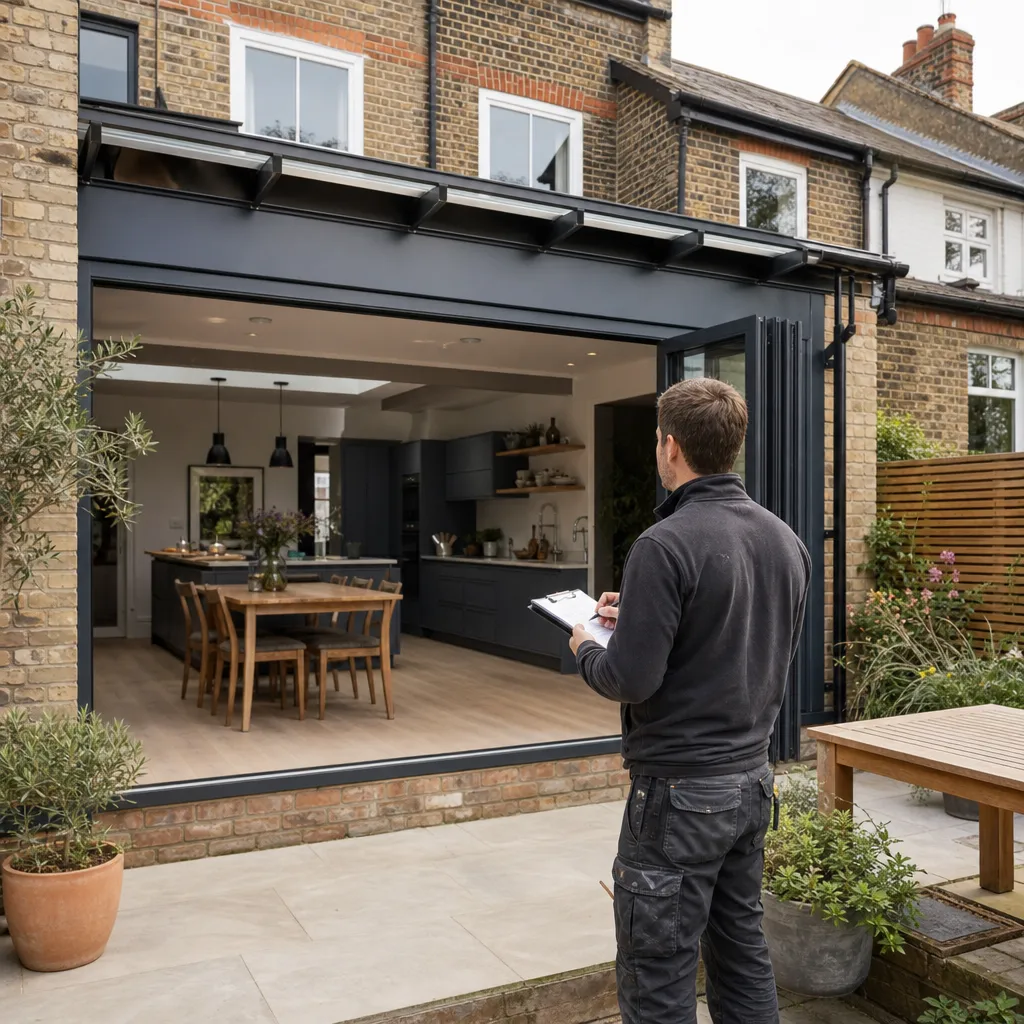
Maximising Value Through Strategic Home Improvement Projects
In the UK, loft conversions and kitchen extensions tend to deliver the strongest return on investment, with loft conversions potentially adding around 20% to property value according to Nationwide data.
 Improvement & Build
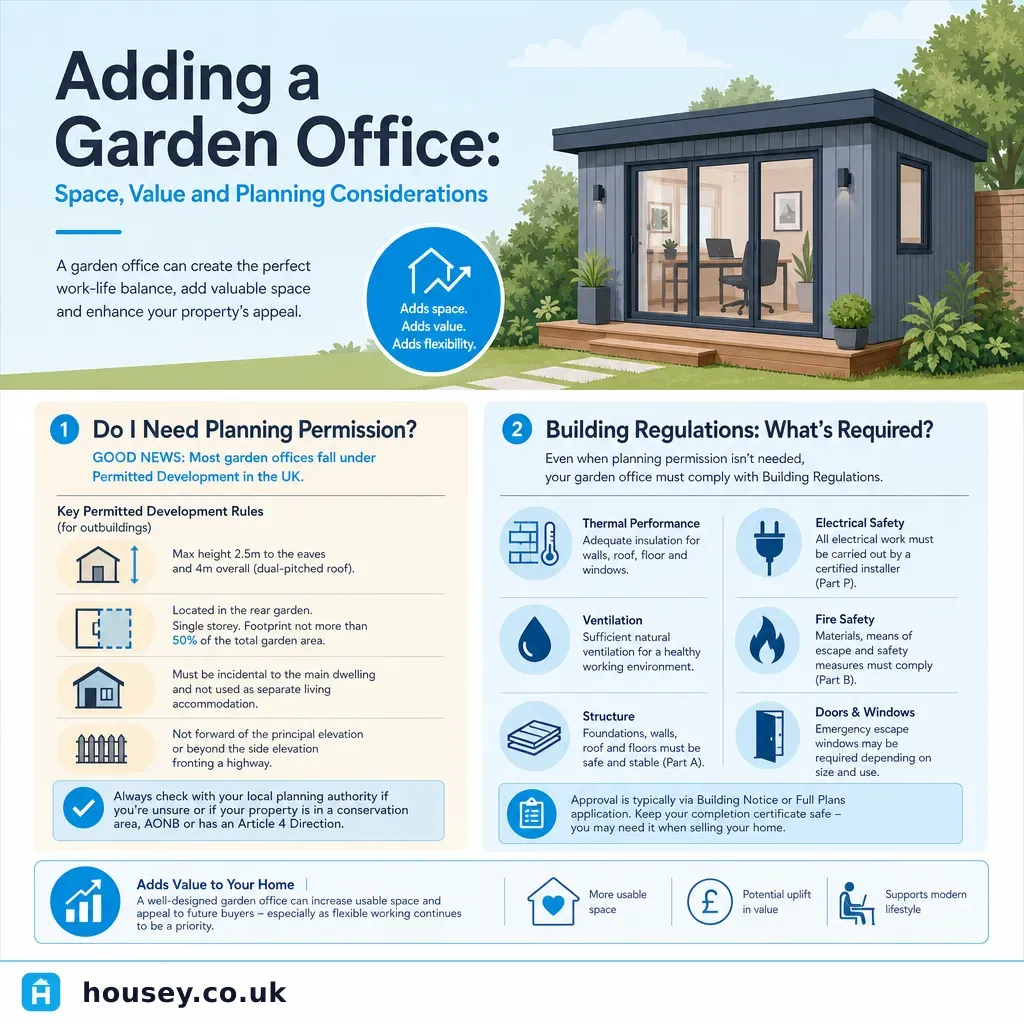
Adding a Garden Office: Space, Value and Planning Considerations
Most garden offices qualify as permitted development and do not need planning permission, provided they stay within specific size and height limits and are not used as separate sleeping accommodation.
 Improvement & Build
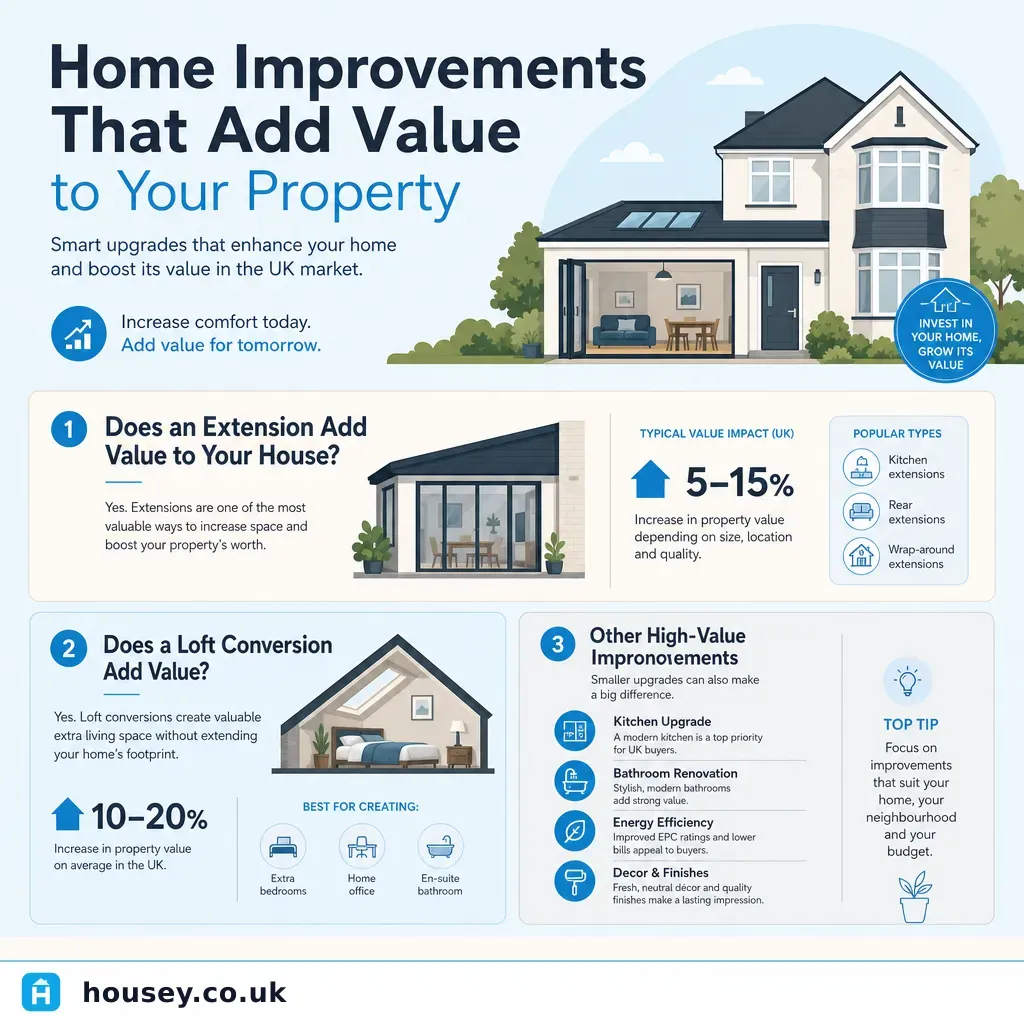
Home Improvements That Add Value to Your Property
The home improvements most likely to add value in the UK are those that add usable floor space — loft conversions and extensions — or improve EPC ratings.
 Improvement & Build
Extensions and Additions: Impact on Property Value
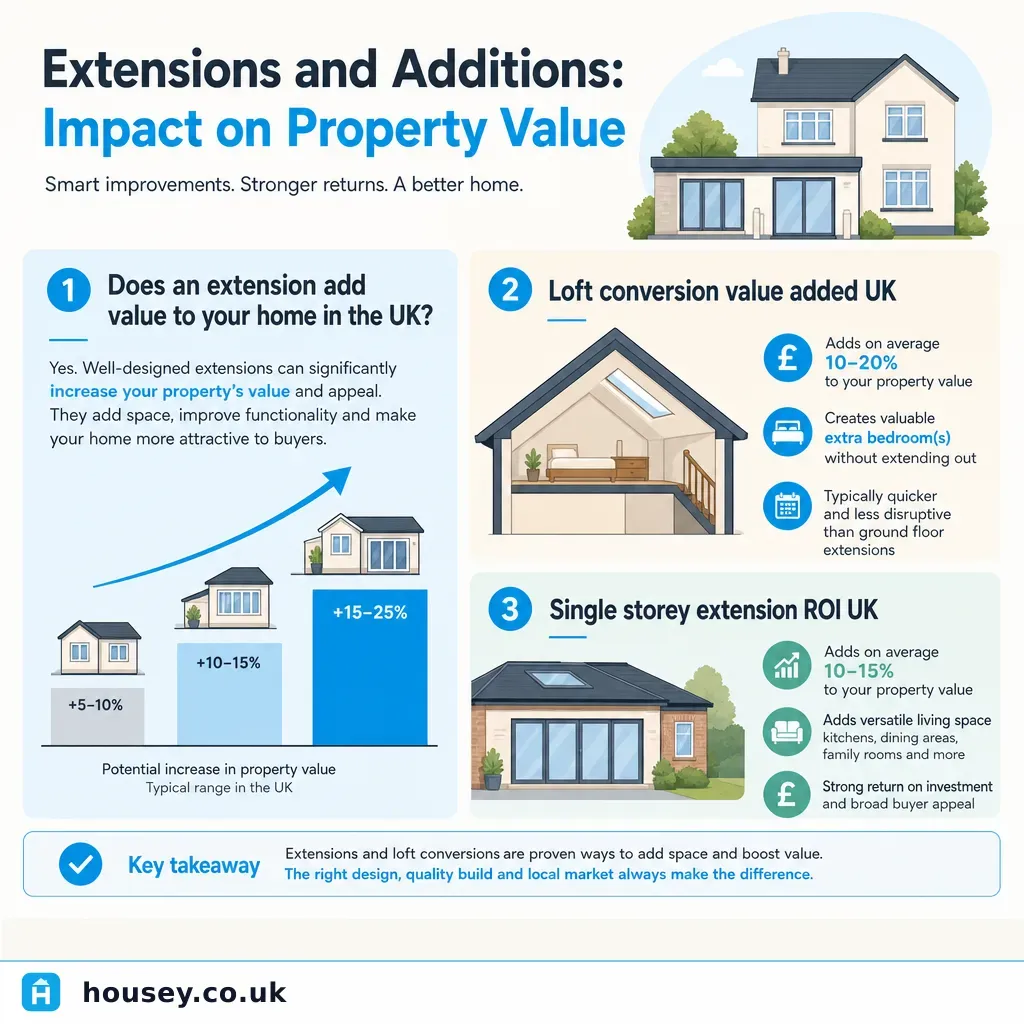
Extensions typically add 5–20% to UK property values depending on type, quality, and local market conditions.
 Improvement & Build
Small kitchen renovation: budgeting for costs and planning your project
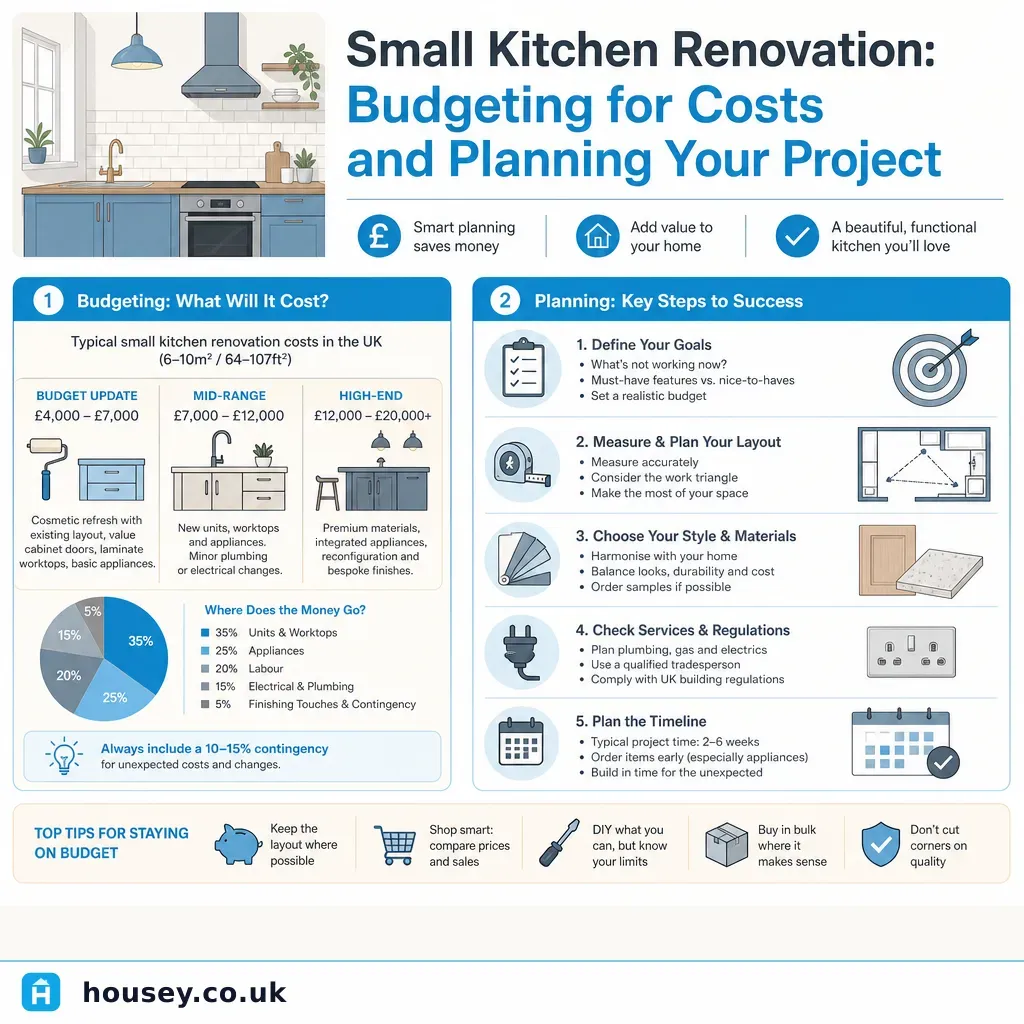
A small kitchen renovation in the UK typically costs £5,000–£15,000 for a full refresh including new units, worktops, tiling, and appliances, though costs vary widely by specification, region, and whether structural changes or rewiring are involved.