Exterior Painting for Your Home
By Housey · Last reviewed 1st of June 2026
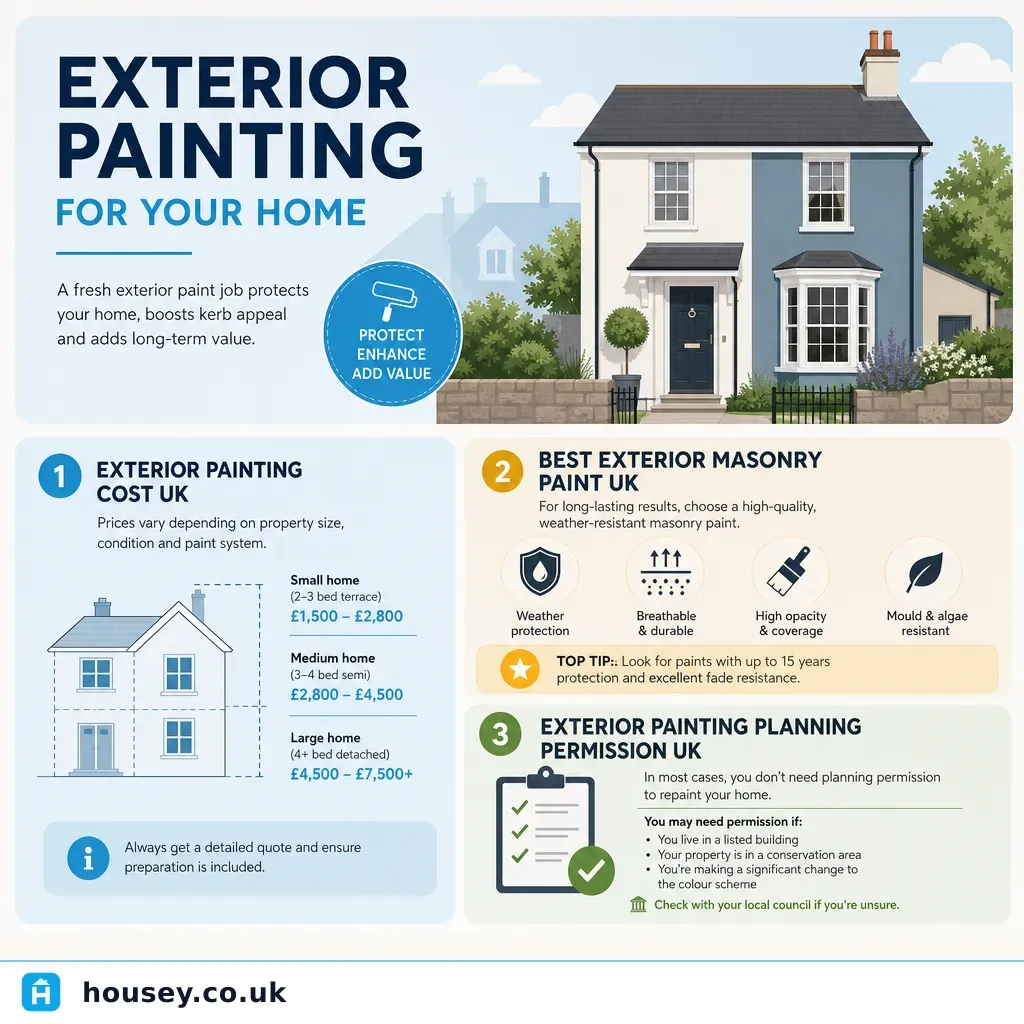
Exterior Painting for Your Home
Keeping the outside of a property well painted is one of the most cost-effective ways to protect the fabric of a building in the UK's wet, variable climate. Whether you're addressing flaking paintwork on a 1930s semi, refreshing the render of a new-build, or preparing a Victorian terrace for sale, the decisions you make about paint type, surface preparation, and access will determine how long the finish lasts and how much value the job adds.
Key points
- The Work at Height Regulations 2005 require contractors to use suitable access equipment — such as scaffolding or a mobile elevated work platform (MEWP) — for any work above 2 metres.
- Properties in conservation areas or listed buildings may require planning permission or listed building consent before repainting, particularly if the colour is changing — check with your local planning authority before starting.
- Microporous (breathable) masonry paints are recommended for pre-1919 solid-wall properties, where moisture must be able to escape through the wall to prevent spalling and trapped damp.
- Most exterior masonry paints carry a stated durability of 10–15 years under normal UK conditions; surface preparation quality is the single biggest factor in achieving that lifespan.
- Surface preparation — including filling cracks, treating mould or algae, and applying a stabilising primer — typically represents 50–70% of the total labour time on an exterior painting job.
Does exterior painting need planning permission?
For most homes, repainting the exterior in the same or a similar colour is a routine maintenance activity that does not require planning permission. However, there are important exceptions.
Conservation areas: Local planning authorities (LPAs) can remove permitted development rights in conservation areas. Some councils require specific colours or finishes to preserve the character of the area. Check with your LPA before starting — rules vary widely between authorities.
Listed buildings: If your home is a listed building (Grade I, II*, or II in England), any changes to the exterior — including repainting in a new colour or switching to a different type of paint — may require listed building consent under the Planning (Listed Buildings and Conservation Areas) Act 1990. Applying a cement-based or non-breathable paint to a lime-rendered listed building can cause serious damage and enforcement action.
Leasehold flats: If you own a leasehold flat, the external fabric of the building is usually controlled by the freeholder or management company. Confirm with your lease before arranging any exterior painting.
If you are unsure, consult your local planning authority or a chartered planning consultant before commissioning work.
Choosing the right paint for UK walls
Paint choice depends on your wall construction, existing finish, and exposure level. Using the wrong product — particularly on older properties — can trap moisture and cause significant damage over time.
Wall type | Recommended paint type | Why |
|---|---|---|
Pre-1919 solid brick or stone | Microporous / breathable masonry paint or lime wash | Allows moisture to escape; prevents spalling and trapped damp |
1920s–1980s brick, render, or pebbledash | Acrylic or elastomeric masonry paint | Flexible, weatherproof, bonds well to cement render |
New-build or modern smooth render | Silicone masonry paint | Excellent water repellency and durability; resists algae |
Timber cladding, soffits, or fascias | Exterior microporous wood paint or stain | Breathable; allows timber to move without cracking |
Metal (gutters, railings, downpipes) | Rust-inhibiting primer + gloss or satin finish | Prevents corrosion; test for lead on older surfaces before disturbing |
A note on older surfaces: Pre-1960 paintwork may contain lead. Do not sand or power-wash without first testing with a lead paint detector kit. If lead paint is confirmed, follow HSE guidance on lead paint before disturbing the surface.
What to expect from surface preparation
No paint finish can compensate for poor preparation. A professional painter should:
- Clean the surface — removing dirt, algae, moss, and loose material by brush, pressure washing, or chemical treatment.
- Allow the surface to dry fully — masonry must have a moisture content below approximately 20% before painting.
- Fill cracks and holes — using an exterior-grade flexible filler or render repair product.
- Treat mould and algae — with a biocidal solution, allowing the recommended dwell time before rinsing.
- Apply a stabilising primer — on friable, chalky, or previously unpainted surfaces.
- Undercoat timber — where applicable, prior to applying the finish coat.
Skipping any of these steps is the most common reason exterior paintwork fails before its intended lifespan.
What affects the cost of exterior painting?
Indicative UK costs, last reviewed 2026-06-01.
Exterior painting costs vary considerably depending on property size, access requirements, surface condition, number of coats, and the contractor's location. As a broad guide:
- Small terraced house (2 storeys): £800–£2,000 including scaffolding
- Large detached house (3 storeys): £3,000–£7,000+ including scaffolding
- Scaffolding hire alone: £600–£2,000+ depending on height and footprint
These are indicative figures only. Always obtain at least three like-for-like quotes from contractors who specify scope of works in writing. Key cost drivers include:
- Scaffolding or access equipment: Often the largest single cost item on a multi-storey job.
- Surface condition: Extensive preparation — filling, mould treatment, priming — adds significant material and labour cost.
- Number of coats: Most masonry paints require two finish coats; heavily porous or previously bare surfaces may need a primer plus two coats.
- Paint quality: High-quality silicone masonry paints cost more per litre but typically last longer, reducing cost per year.
- Colour depth: Very deep or custom colours may require additional coats for adequate coverage.
What to ask before accepting a quote
- Is the quote broken down by preparation, materials, and labour?
- What access equipment will be used, and who is responsible for hiring and erecting scaffolding?
- Which specific paint products will be used, and what is the manufacturer's stated durability?
- How many coats are included in the price?
- Are gutters, windows, and doors masked and protected?
- Is VAT included?
- What surface preparation is included, and what might change the price if additional problems are found?
- Does the contractor hold public liability insurance, and can they provide evidence?
When to get professional help
Exterior painting is accessible to confident DIYers for ground-floor work on a single-storey building, but professional help is strongly advisable when:
- The property is more than one storey — working at height above 2 metres carries a significant risk of serious injury and requires proper access equipment under the Work at Height Regulations 2005.
- The surface shows signs of significant damp penetration, spalling, or structural cracking — these need investigation and repair before any painting begins.
- The property is listed or in a conservation area — specialist advice on paint compatibility and consent requirements is essential.
- There is suspected lead paint in older surfaces.
- Large areas of render are hollow, blown, or delaminating — a render repair specialist may be needed before any decorative work.
- You require scaffolding — always use a contractor accredited through the CISRS (Construction Industry Scaffolding Record Scheme).
How Housey can help
Housey connects UK homeowners with vetted local tradespeople for exterior painting and general property maintenance. Submit your property details and project scope to receive comparable quotes from painters and decorators experienced with your wall type and property era.
Frequently asked questions
How often should I repaint the outside of my house in the UK?
Most exterior masonry paints are formulated to last 10–15 years under normal conditions, though this varies with exposure, surface type, and preparation quality. Timber elements — fascias, soffits, and cladding — may need repainting every 5–8 years depending on the paint system and their orientation. A visual inspection every 2–3 years is a sensible habit.
Do I need planning permission to change the colour of my exterior paint?
For most homes, no. Routine exterior repainting is classed as maintenance and does not require planning permission. However, if your property is a listed building, or in a conservation area where the local authority has removed permitted development rights, you may need listed building consent or prior approval. Check with your local planning authority before proceeding.
What is the best time of year to paint the outside of a house in the UK?
Late spring to early autumn — typically May to September — offers the most reliable conditions for exterior painting in the UK. Masonry paints generally require surface temperatures above 5°C and relative humidity below 85% to cure correctly. Avoid painting in direct bright sunlight or immediately before forecast rain.
How much does exterior house painting cost in the UK?
A typical two-storey terraced house might cost £800–£2,000 for a full exterior repaint including scaffolding; a larger detached property can run to £3,000–£7,000 or more. These are indicative UK figures, last reviewed 2026-06-01 — always obtain multiple itemised quotes, as costs vary significantly by region, access complexity, and surface condition.
Sources and further reading
- Work at Height Regulations 2005 — Health and Safety Executive
- Technical and Research Guidance: Historic Buildings — Historic England
- Listed Buildings — GOV.UK
- Planning Portal: Conservation Areas — Planning Portal
Useful next reads
 Improvement & Build
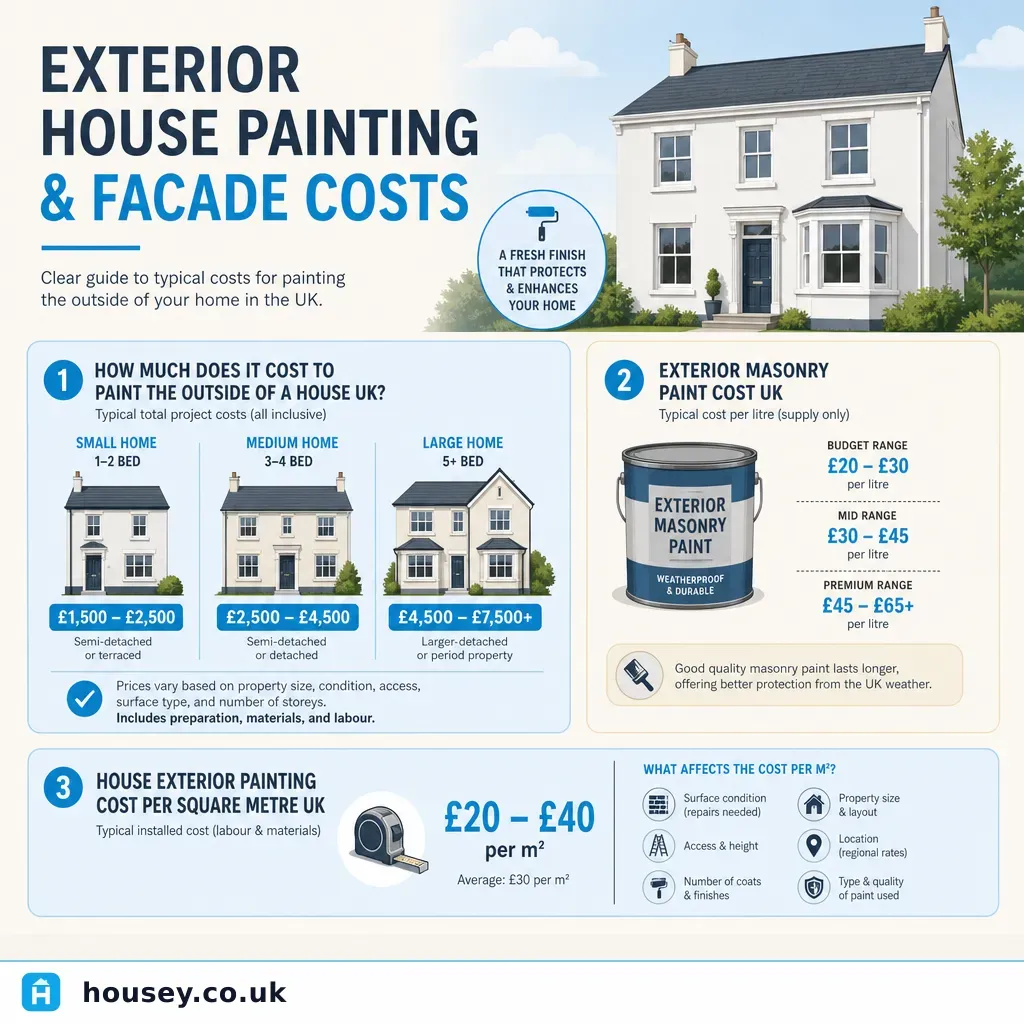
Exterior House Painting and Facade Costs
Exterior house painting in the UK typically costs between £600 and £1,500 for a small terraced house and £2,000 to £5,000 or more for a larger detached property.
 Improvement & Build
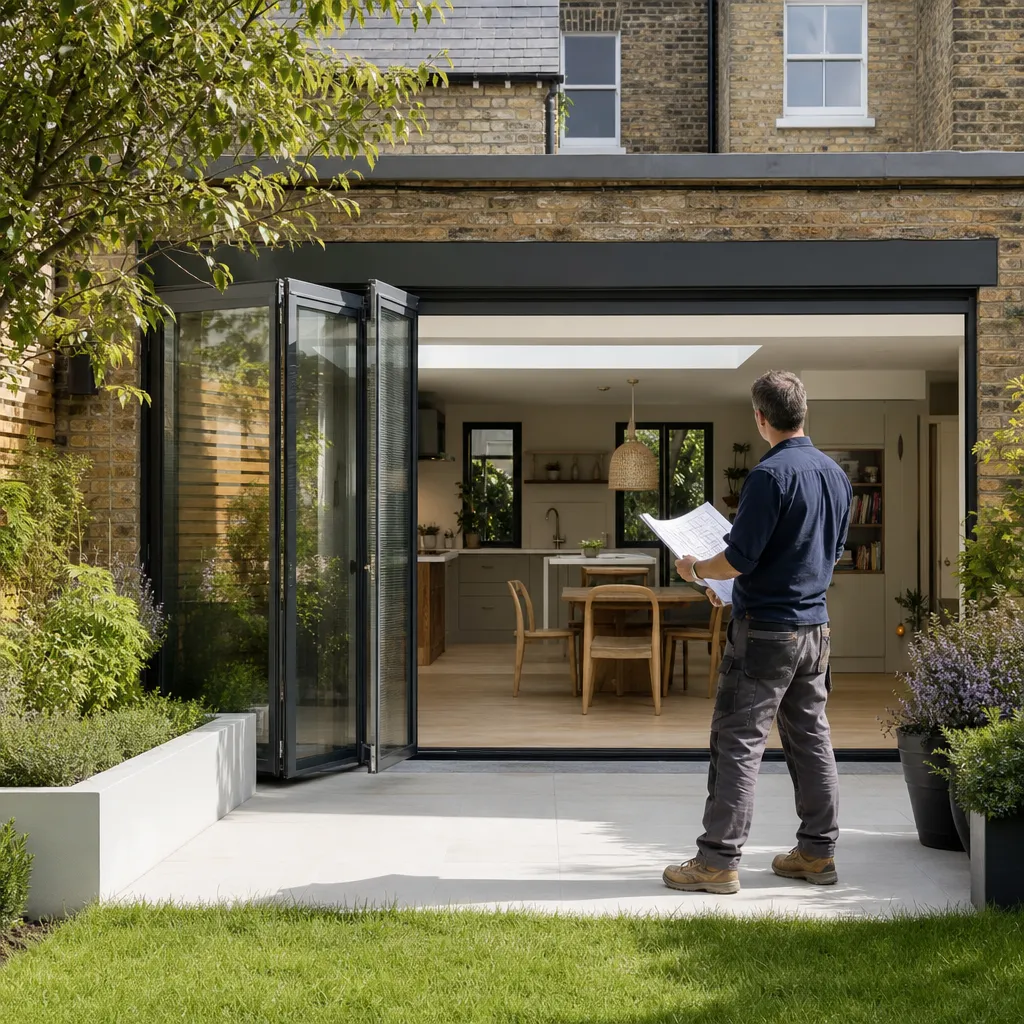
Home Improvement Projects That Add Value to Your Property
Loft conversions, rear extensions, and kitchen refurbishments typically offer the strongest return on investment for UK homeowners.
 Improvement & Build
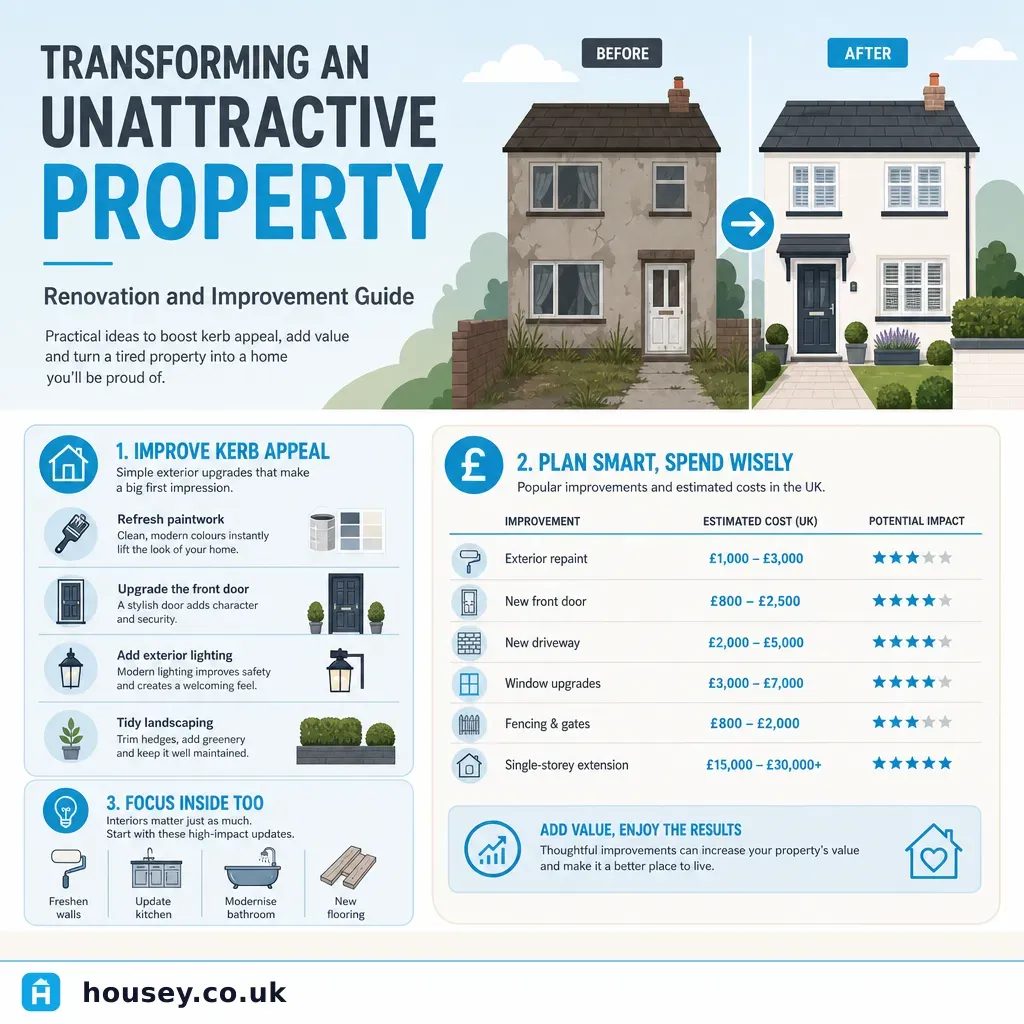
Transforming an Unattractive Property: Renovation and Improvement Guide
Transforming an unattractive UK property usually starts with surface-level improvements — render, windows, doors, and front landscaping — before tackling structural changes like extensions.
 Improvement & Build
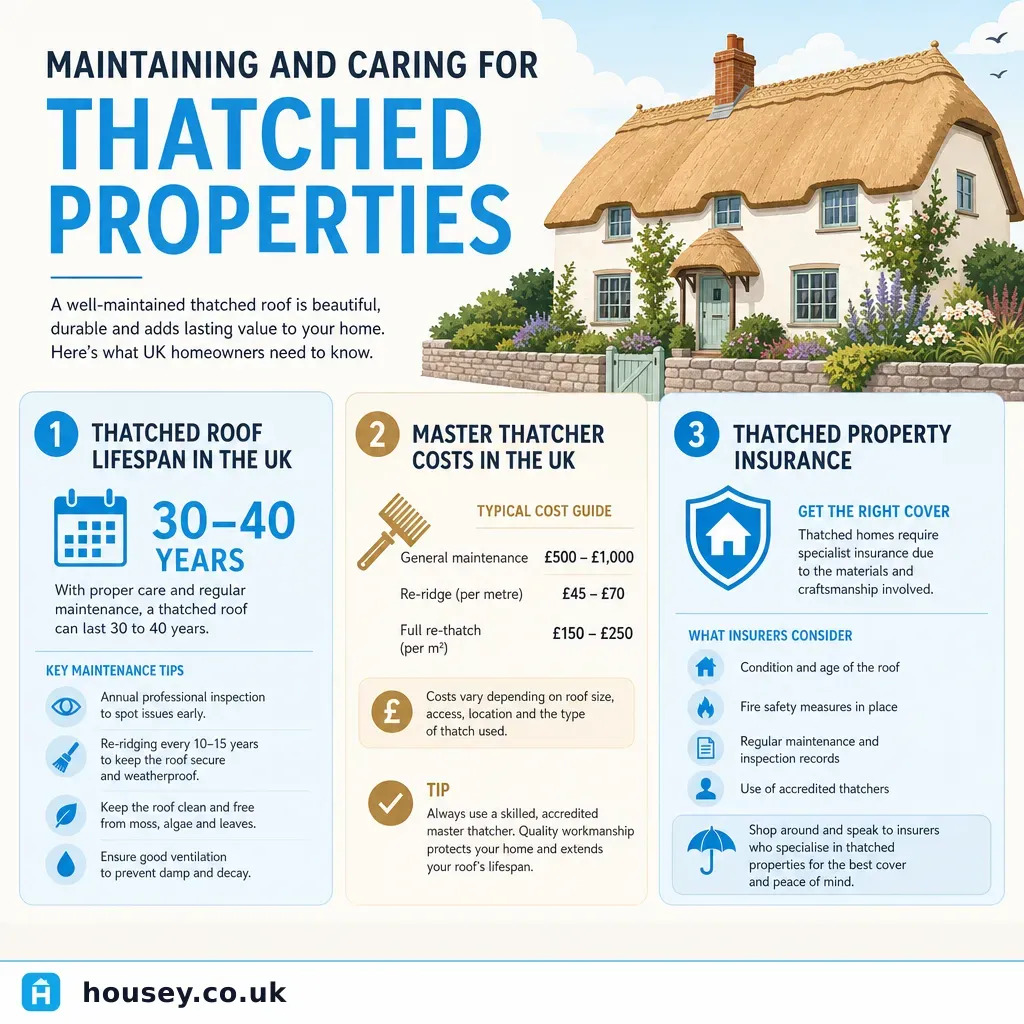
Maintaining And Caring For Thatched Properties
A thatched roof needs inspection by a master thatcher every one to two years, with ridge replacement every 10–15 years and a full re-thatch every 25–40 years depending on the material.
 Improvement & Build
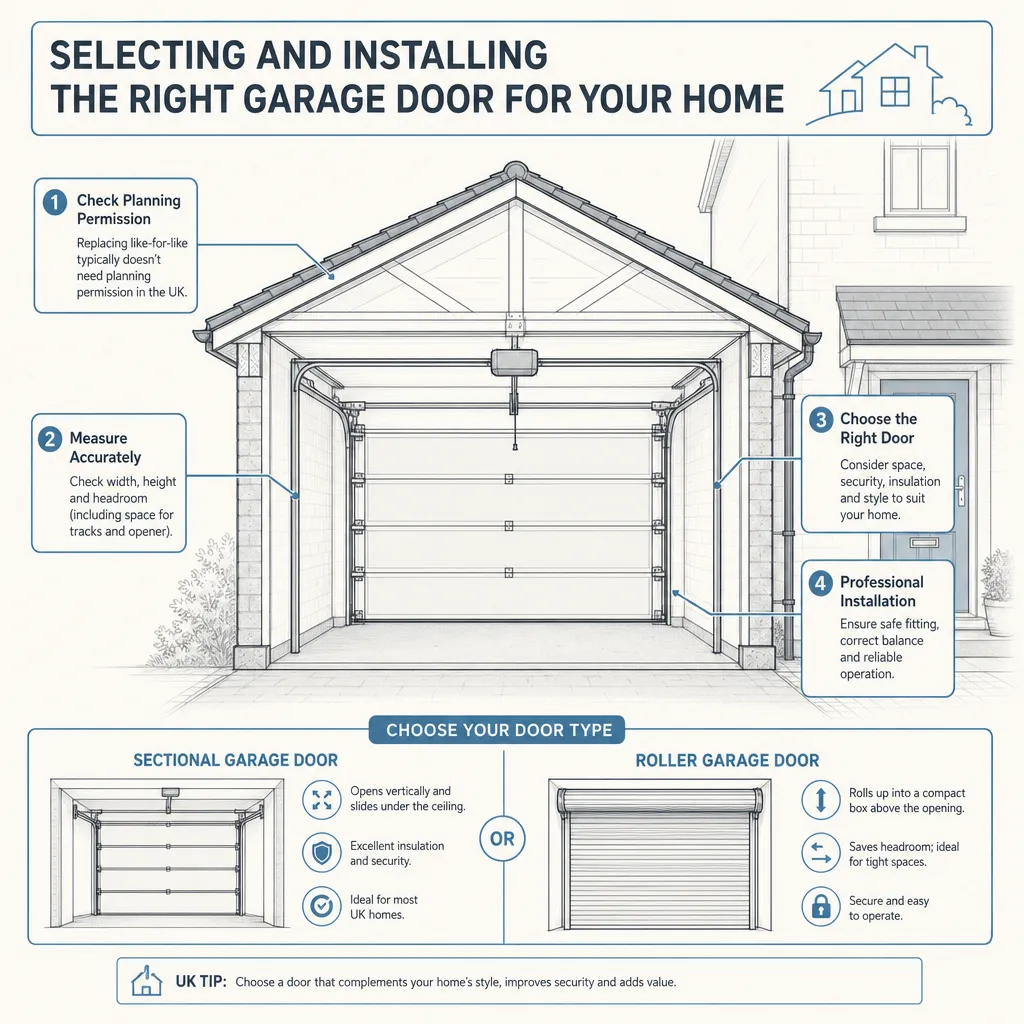
Selecting and Installing the Right Garage Door for Your Home
Choosing the right garage door depends on available headroom, opening width, security needs, and budget.