House Cladding Options: Comparing External Wall Materials and Finishes
By Housey · Last reviewed 17th of May 2026
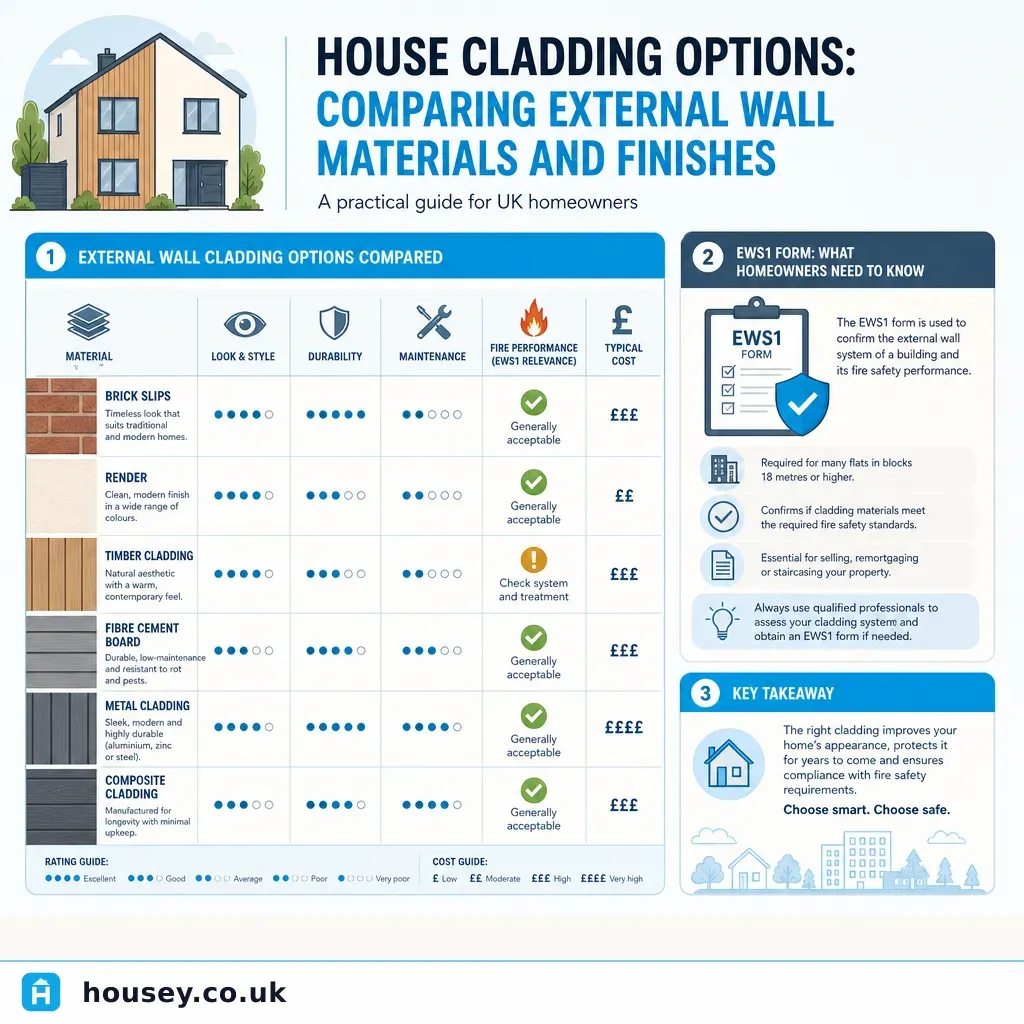
House Cladding Options: Comparing External Wall Materials and Finishes
External cladding decisions carry significant weight in the UK — they determine fire performance, thermal efficiency, planning compliance, and, for properties in multi-storey blocks, whether residents and lenders can confirm the facade is safe to insure and mortgage. The question of which external wall material to specify has become considerably more complex since the Grenfell Tower fire in 2017, with the Building Safety Act 2022 fundamentally reshaping requirements for buildings over 11 metres and guidance continuing to evolve across all building types.
Key points
- The Building Safety Act 2022 and updated Building Regulations Approved Document B impose strict fire performance requirements on external wall systems for buildings over 11 m; buildings over 18 m face near-blanket restrictions on combustible materials in the external wall assembly.
- Aluminium composite material (ACM) cladding with an unmodified polyethylene core — the type used at Grenfell Tower — is banned on all buildings above 18 m under the Building (Amendment) Regulations 2018.
- Permitted development rights do not apply to cladding changes on dwellings in conservation areas or on listed buildings — full planning permission is almost always required in these cases.
- All significant external cladding work involving changes to insulation or fire performance must comply with Building Regulations Part L (thermal performance) and Part B (fire safety), and requires building control sign-off.
- Lenders and conveyancers increasingly require an EWS1 (External Wall Survey) form for flats in multi-storey buildings before mortgage offers can proceed — the cladding system directly affects property saleability and insurability.
Types of external cladding for UK homes
Render and external wall insulation (EWI)
Mineral render over an insulated board system — external wall insulation (EWI) — is one of the most common retrofitted cladding approaches for UK solid-wall properties, particularly pre-war brick houses built without a cavity.
- EWI systems use expanded polystyrene (EPS) or mineral wool insulation boards fixed to the existing wall, finished with silicone, acrylic, or mineral render.
- Mineral wool-based EWI systems generally offer better fire performance than EPS-only systems. Always check that the chosen system holds a current British Board of Agrément (BBA) certificate.
- EWI adds 100–250 mm to the external face of the wall, which can affect window reveals, fascias, and utility meter boxes.
- EWI is frequently used in ECO4 and other government grant-funded retrofit schemes to improve wall U-values.
- Typical installed cost: £80–£150 per sq m (indicative UK costs, last reviewed 2026-05-17; costs vary significantly by property size and system specification).
Brick slip cladding
Brick slips are thin sections of real fired brick or high-quality ceramic brick-effect tiles bonded to a carrier board or directly to a backing structure, giving the appearance of traditional brickwork at a fraction of the weight.
- Generally non-combustible when using genuine fired clay brick slips with a mineral adhesive system.
- Requires building control sign-off when used as part of a significant external wall assembly.
- Heavier than most other cladding types — structural capacity of the supporting wall must be confirmed before specification.
- Typical installed cost: £90–£160 per sq m (indicative UK costs, last reviewed 2026-05-17).
Timber cladding
Timber boards — feather-edge, shiplap, or engineered wood panels — are widely used on domestic extensions, self-build homes, and barn conversions across the UK. Timber is a naturally combustible material and its use is subject to Building Regulations Approved Document B.
- Timber cladding is generally acceptable on houses and low-rise buildings but faces restrictions on taller buildings and on facades close to a boundary.
- Fire-retardant treatment is available but must be correctly specified, certified, and maintained; treatment alone does not override fire classification requirements under Approved Document B.
- Thermal movement and moisture management are critical; inadequately detailed timber cladding can warp, delaminate, or promote damp penetration into the wall structure.
- Species such as larch, Douglas fir, western red cedar, and thermally modified timber are all used in the UK; maintenance requirements range from minimal to periodic oiling or staining depending on species.
- Typical installed cost: £60–£120 per sq m (indicative UK costs, last reviewed 2026-05-17).
Metal cladding (aluminium, zinc, steel)
Standing seam and cassette metal cladding systems have grown in popularity for contemporary domestic builds and extensions.
- Aluminium and zinc are non-combustible and perform well in standard fire tests, making them a reliable choice where fire classification is critical.
- Metal cladding is non-vapour-permeable; the wall build-up behind it must include appropriate ventilation and vapour control layers to prevent interstitial condensation.
- Requires specialist fabrication and experienced installation; not suitable for DIY.
- Zinc panels typically cost £100–£200 per sq m installed; aluminium cassette systems vary widely by profile and finish (indicative UK costs, last reviewed 2026-05-17).
Fibre cement and composite panels
Fibre cement board (for example, Hardie board or Cedral) and engineered composite panels are popular low-maintenance cladding choices on timber-frame new-builds and renovations.
- Fibre cement is non-combustible and carries a strong fire-test record.
- Composite panels vary significantly in fire performance — always verify the fire classification of the specific product (at minimum Class B-s3,d2 for facades in scope of Approved Document B; Class A2 or better for taller buildings).
- Typical installed cost: £70–£140 per sq m (indicative UK costs, last reviewed 2026-05-17).
Comparison of external cladding materials
Material | Typical installed cost | Fire performance | Maintenance | Suitable for conservation/listed? | Key risks |
|---|---|---|---|---|---|
Render / EWI | £80–£150/sq m | Varies (mineral wool preferred) | Low | Sometimes (check with LPA) | Moisture ingress if poorly detailed |
Brick slip | £90–£160/sq m | Good (fired clay, non-combustible) | Low | Often acceptable | Weight; adhesive failure if poorly installed |
Timber | £60–£120/sq m | Combustible; Approved Document B restrictions apply | Medium–high | Possible with matching species | Fire risk; moisture; movement |
Aluminium / Zinc | £100–£200/sq m | Non-combustible | Low | Rarely acceptable | Specialist installation; vapour control needed |
Fibre cement | £70–£140/sq m | Non-combustible | Low | Rarely acceptable | Verify fire class of specific product |
Indicative UK costs, last reviewed 2026-05-17. Costs vary by product, system complexity, and location.
Planning permission and building regulations
Do you need planning permission?
For most detached houses and semis, changing external cladding to a material of similar appearance is permitted development. However, there are important exceptions:
- Conservation areas: any material or colour change to the principal elevation usually requires planning permission; check with your local planning authority.
- Listed buildings: listed building consent is almost always required before any external cladding change; consult your local conservation officer and Historic England guidance.
- Article 4 directions: some areas have directions that remove permitted development rights for cladding — confirm with your local planning authority before proceeding.
- Flats and apartments: permitted development rights for cladding changes generally do not apply to flats in a block.
Building regulations requirements
All significant external wall cladding work requires building control notification. Key documents:
- Approved Document B (fire safety): specifies fire performance classifications for external wall materials and assemblies. Combustibility restrictions increase for buildings over 11 m and become most stringent above 18 m.
- Approved Document L (energy efficiency): where cladding incorporates insulation, the new wall U-value must meet Part L targets for the relevant building type.
- BBA certification: a British Board of Agrément certificate confirms a system has been independently tested and assessed for UK conditions. Always request the certificate for any EWI or composite cladding system before proceeding.
Important limitations
This article provides general information about external cladding materials and is not a substitute for professional assessment. Fire performance requirements, planning rules, and structural considerations vary significantly depending on building height, construction, tenure, and location. Requirements for buildings over 11 m — and especially over 18 m — are substantially more complex than for standard two-storey houses. If you live in or manage a flat, block of flats, or mixed-use building, seek specialist professional advice before proceeding with any cladding work.
When this becomes urgent
Seek qualified professional advice immediately — before purchasing any materials or appointing a contractor — if:
- Your building is over 11 m high (typically four storeys or more)
- You are replacing cladding on a multi-storey residential block
- Existing cladding contains ACM panels, high-pressure laminate (HPL), or other materials whose fire classification is unknown or unverified
- Your mortgage lender, insurer, or conveyancer has flagged an EWS1 (External Wall Survey) requirement
- The existing cladding shows signs of delamination, water penetration, or fire damage
- A fire risk assessment or building safety report has raised concerns about the external wall system
What to ask a qualified professional
Before instructing a cladding installer or specialist, ask:
- What is the fire classification of the proposed cladding system — for example, Class A1, A2-s1,d0, or B-s3,d2?
- Does the complete system — including insulation, fixings, cavity barriers, and fire stops — hold a current BBA certificate or equivalent UKAS-accredited third-party fire certification?
- Does this system comply with Building Regulations Approved Document B for a building of this height and use class?
- Will building control approval be required, and who will manage the notification and inspection process throughout the project?
- Has a fire engineer reviewed the full wall assembly, including cavity barriers and fire stops at each floor level?
- If the property is in a conservation area or is listed, have planning requirements been confirmed with the local authority and conservation officer?
When to get professional help
External cladding installation is not suitable for DIY. Always engage:
- A building control body or approved inspector before any significant external wall changes
- A qualified fire engineer or façade consultant for multi-storey or structurally complex buildings
- A conservation officer or heritage consultant for listed buildings and conservation area properties
- A RICS-accredited surveyor if an EWS1 form is required for mortgage, sale, or insurance purposes
How Housey can help
Housey's network of vetted contractors and consultants can connect you with professionals experienced in UK cladding regulations, planning requirements, and installation standards. Whether you are improving a semi-detached house or managing a more complex project, seeking expert guidance before you start will help avoid costly errors and ensure your external wall system meets current fire safety and energy efficiency requirements.
Frequently asked questions
Is timber cladding allowed on houses in England?
Yes, timber cladding is generally acceptable on standard houses in England and can often be installed under permitted development, but timber is a combustible material. Its use on taller buildings or close to boundaries is restricted by Building Regulations Approved Document B. Fire-retardant treatment may be required in certain situations. Confirm requirements with your local building control body before installation.
What is an EWS1 form and do I need one?
An EWS1 (External Wall Survey) form is produced by a qualified professional confirming that an external wall system has been assessed for fire safety. Many mortgage lenders require it for flats in multi-storey buildings before offering a mortgage. It is not a statutory requirement but may be necessary to sell or remortgage. Whether you need one depends on building height, cladding type, and your lender's specific requirements.
Does cladding work need building regulations approval?
Yes. Any significant change to the external fabric of a building — particularly where it involves changes to insulation or fire performance — requires notification to a building control body and must comply with Approved Document B (fire) and Approved Document L (energy). Unlike window replacements, there is no self-certification scheme equivalent to FENSA for external cladding work.
Can EPS (polystyrene) insulation be used in an EWI system?
Expanded polystyrene (EPS) boards are used in many EWI systems and are not automatically prohibited. However, EPS is combustible and must be used within a certified system configuration that complies with Approved Document B, including fire barriers at appropriate intervals. Mineral wool EWI systems generally present lower fire risk. Always confirm the complete system holds current independent fire certification.
Sources and further reading
- Building Safety Act 2022 — legislation.gov.uk
- Approved Document B: Fire Safety — HM Government
- Advice for Building Owners of Multi-Storey Residential Buildings — GOV.UK
- RICS Guidance on EWS1 Forms — RICS
- British Board of Agrément Certificates — BBA
- Historic England: Guidance on Listed Buildings — Historic England
Useful next reads
 Improvement & Build
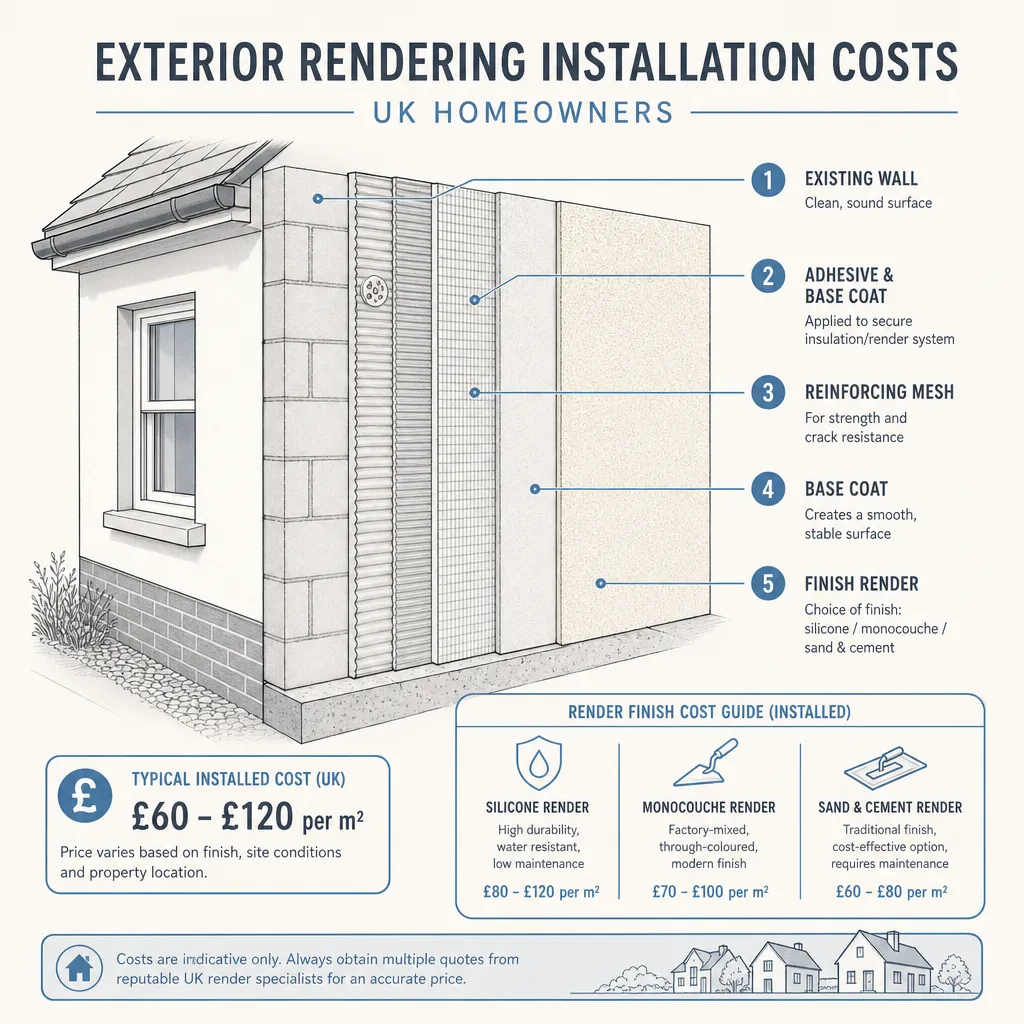
Exterior Rendering Installation Costs
Exterior rendering in the UK typically costs £20–£60 per square metre for standard render systems, or £80–£150 per square metre for External Wall Insulation with a render finish.
 Improvement & Build
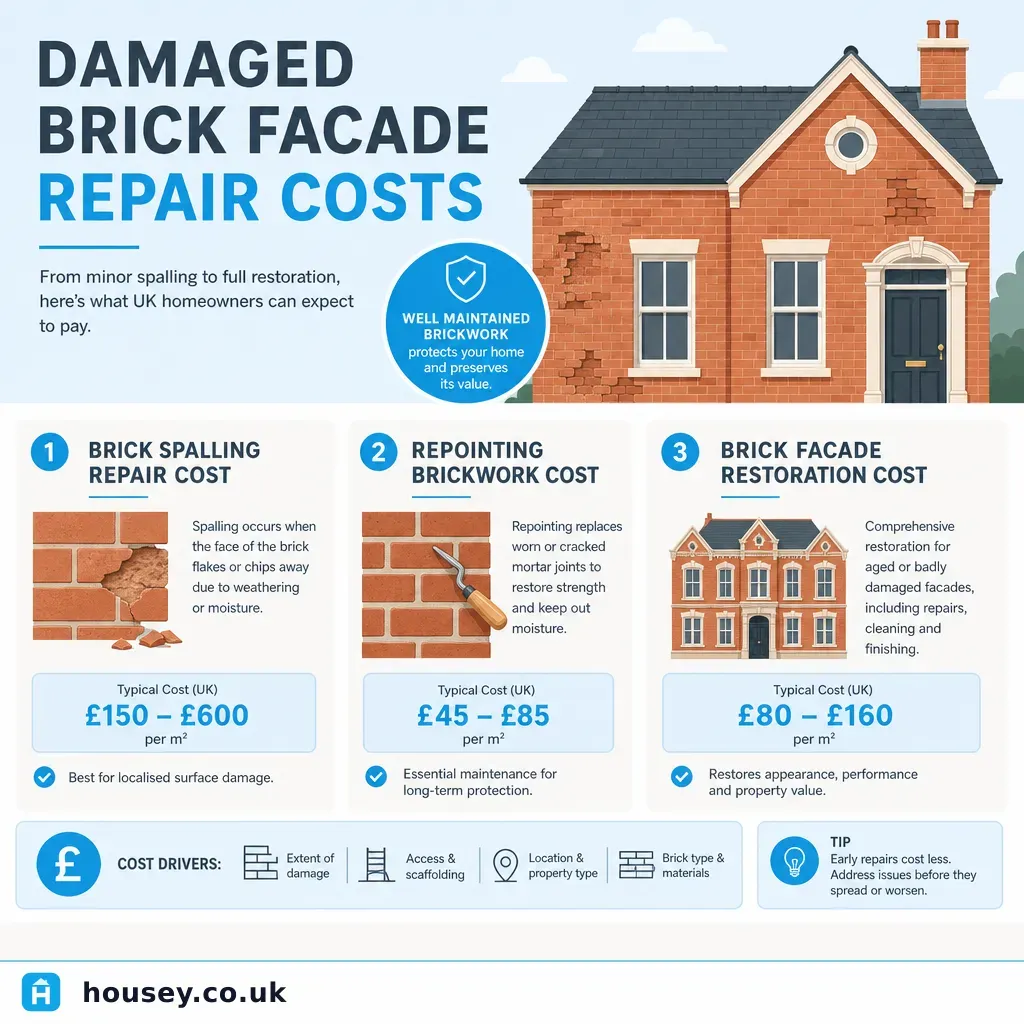
Damaged Brick Facade Repair Costs
Repairing a damaged brick facade in the UK typically involves repointing mortar joints, replacing spalled bricks, or full masonry restoration.
 Improvement & Build
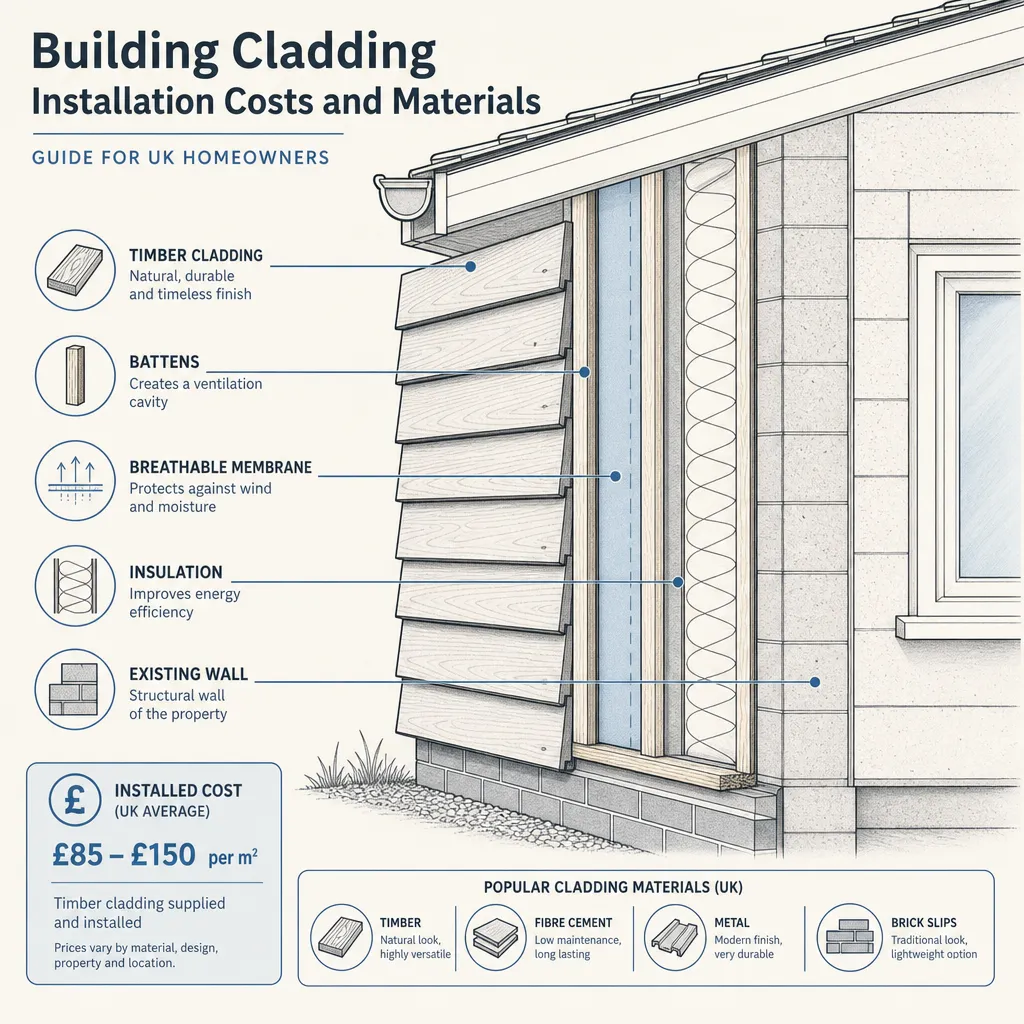
Building Cladding Installation Costs and Materials
External cladding in the UK typically costs £40–£200 per m² installed, depending on material choice, wall preparation, and scaffold requirements.
 Improvement & Build
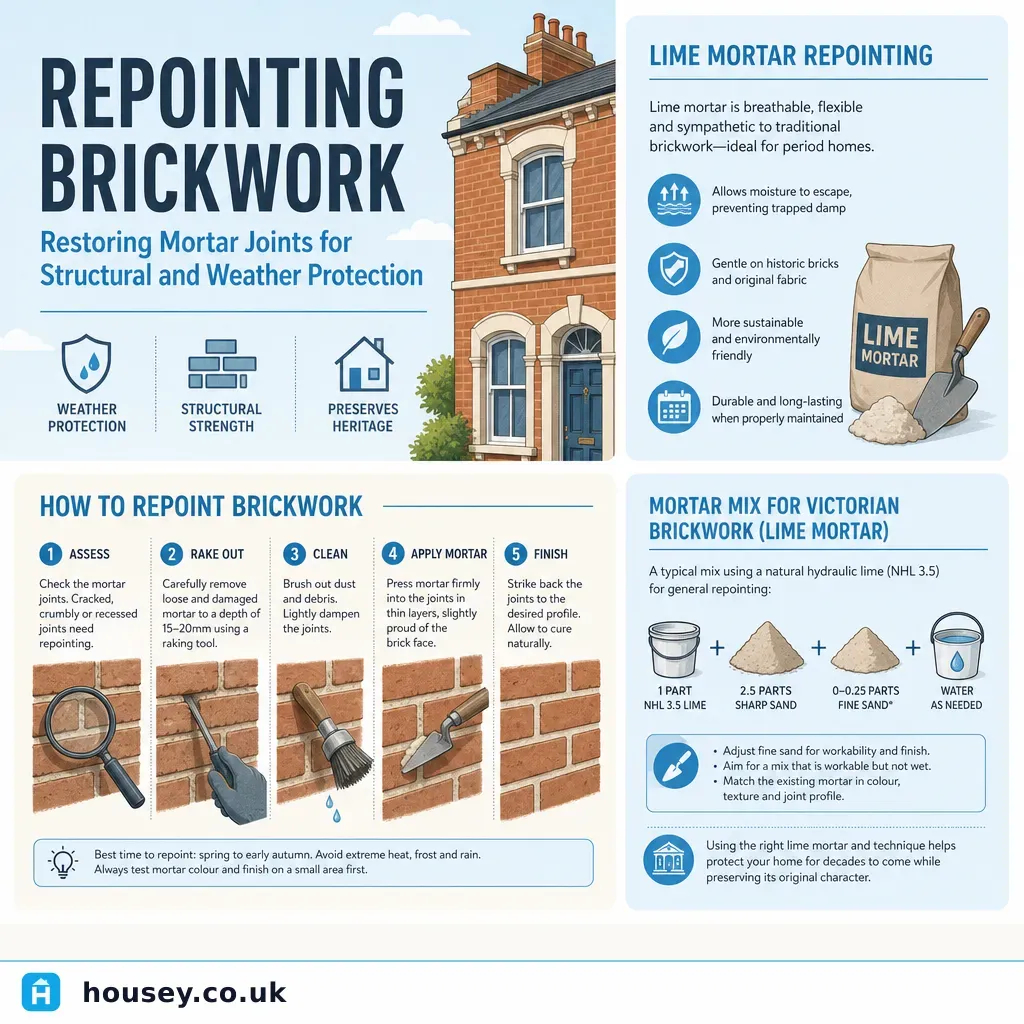
Repointing Brickwork: Restoring Mortar Joints for Structural and Weather Protection
Repointing means raking out deteriorated mortar from brick joints to 15–20mm depth and replacing it with a compatible mix.
 Improvement & Build
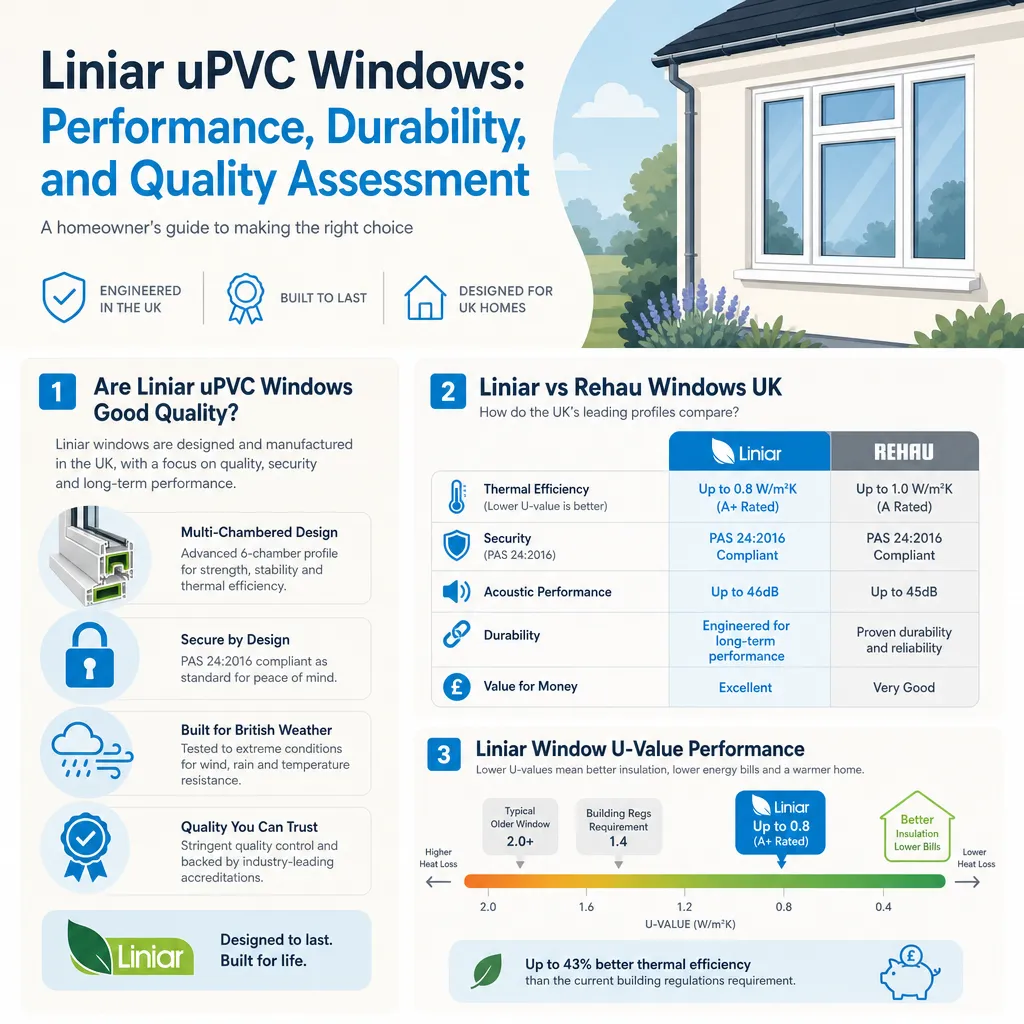
Liniar uPVC Windows: Performance, Durability, and Quality Assessment
Liniar uPVC window profiles are manufactured in the UK using multi-chambered, foamed frames.