Changing Exterior Tiling on Your Property: Planning and Building Regulation Rules
By Housey · Last reviewed 3rd of May 2026
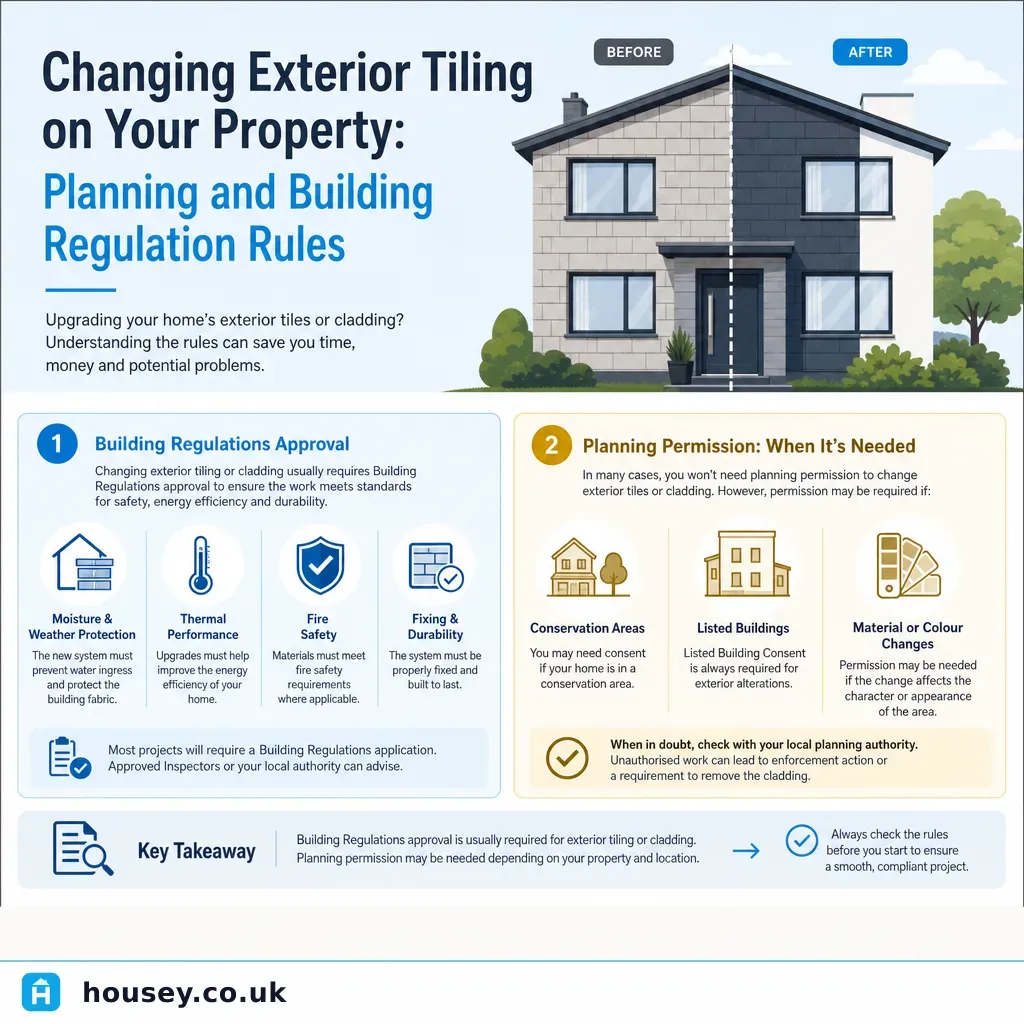
Changing Exterior Tiling on Your Property: Planning and Building Regulation Rules
Most homeowners treat exterior retiling as a straightforward renovation, but the planning and regulatory picture is more nuanced than it first appears. Questions typically arise when owners want to update ageing façades, switch tile materials, or overclad existing surfaces — and the answers differ considerably depending on property type, location, and scale of the change. In England, the General Permitted Development Order 2015 contains specific exclusions that catch many homeowners off guard.
Key points
- Replacing exterior tiles like-for-like is generally treated as maintenance under section 55(2)(a) of the Town and Country Planning Act 1990 and does not require planning permission.
- Cladding the exterior of a dwellinghouse with tiles is explicitly excluded from permitted development under Schedule 2, Part 1, Class A.2(a) of the Town and Country Planning (General Permitted Development) (England) Order 2015 — meaning a change of external tile material or appearance may require a full planning application.
- Listed Building Consent is required for any external works affecting the character of a listed building under the Planning (Listed Buildings and Conservation Areas) Act 1990; this is separate from, and additional to, any planning permission required.
- Article 4 Directions can remove permitted development rights in conservation areas; check with your local planning authority (LPA) before starting any external alteration.
- If the works change the thermal performance of an external wall — for example, by adding external wall insulation — Building Regulations Part L applies, and the wall assembly must meet the U-value requirements set out in Approved Document L1B.
Does like-for-like tile replacement need planning permission?
Replacing existing exterior tiles with an identical or closely matching material is generally classified as maintenance and repair. Under section 55(2)(a) of the Town and Country Planning Act 1990, works that do not materially affect the external appearance of a building fall outside the definition of development — and therefore require no planning permission.
In practice, repointing, repairing, or replacing tiles with the same product or a visually equivalent substitute is unlikely to require consent. However, if you are changing the colour, texture, or material — even on a small area of the façade — it is worth checking with your LPA before committing to any work, particularly if the property is in a sensitive location or has an unusual planning history.
When does changing exterior tiles need planning permission?
The key trigger is whether the works "materially affect" the external appearance of the building. The GPDO 2015, Schedule 2, Part 1, Class A.2(a), explicitly excludes from permitted development any works that consist of or include cladding the exterior of a dwellinghouse with stone, artificial stone, porous concrete render, timber, plastic, or tiles.
This means: if you are applying a new tile layer to previously untiled walls, or making a visible material change to the façade, you will very likely need to apply for householder planning permission.
Key complications to consider:
- Flats and maisonettes: Permitted development rights under Part 1 of the GPDO do not apply to flats or maisonettes. Any material change to the external appearance of a flat will generally require a planning application.
- Conservation areas: LPAs commonly apply Article 4 Directions to remove permitted development rights for external alterations in conservation areas. Approval of the proposed external material is normally required.
- Listed buildings: Listed Building Consent is required for any works affecting the character of a listed building, including external tile changes. Unauthorised works are a criminal offence under the Planning (Listed Buildings and Conservation Areas) Act 1990.
- New-build covenants and conditions: Some housing estates have title conditions or planning conditions restricting changes to the approved external material palette — check your title register and any planning conditions attached to the original consent.
Building Regulations and exterior tiling
Thermal performance: Part L
Approved Document L1B (Conservation of Fuel and Power in Existing Dwellings) sets the minimum thermal standards for alteration work on existing homes. If your retiling project involves upgrading the external wall construction — for example by adding external wall insulation (EWI) behind or around the tiles — the whole wall assembly must achieve the target U-value. The current target for externally insulated walls in existing dwellings is typically 0.30 W/m²K (verify against the current edition of Approved Document L1B, as standards are periodically updated).
If you are simply removing and replacing tiles on an existing substrate without altering the wall build-up, Part L is unlikely to be triggered.
Weathertightness and structural fixings: Parts C and A
Approved Document C (Site Preparation and Resistance to Contaminants and Moisture) is relevant where the tile system forms part of the weatherproof envelope. Mechanically fixed tile systems must be installed in accordance with the tile manufacturer's specification and applicable British Standards. Where tiles are significantly heavier than the original surface material, a structural engineer should confirm that the fixings and substrate can carry the additional load before installation begins.
Decision tree: do you need consent?
- Replacing like-for-like tiles on a standard house, outside a conservation area, with no listed building designation? → Planning permission is probably not required. Check with your LPA if in any doubt.
- Changing the tile material, colour, or texture significantly on an external wall? → A householder planning application is likely required under the GPDO 2015 cladding exclusion. Consult your LPA or a planning consultant.
- Property in a conservation area or subject to an Article 4 Direction? → Permitted development rights may have been removed. Planning permission is very likely needed.
- Property is a listed building? → Listed Building Consent is required in addition to any planning permission. Speak to a conservation officer before proceeding.
- Property is a flat, maisonette, or apartment? → Part 1 PD rights do not apply. Planning permission is needed for material external changes.
- Work involves adding insulation behind the tiles? → Building Regulations Part L applies. A building control application or building notice must be submitted before works start.
Red flags before you start
Pause and take further advice if any of the following apply:
- Your title register or lease includes a restrictive covenant or planning condition referencing approved external materials.
- The property sits on a managed estate where the freeholder or management company controls the external appearance.
- You have received any correspondence from the LPA about external alterations or conservation area controls.
- The proposed tiles are significantly heavier than the original surface — for example, replacing lightweight render with large-format natural stone tiles — requiring assessment of fixings and structural loading.
- The existing wall shows signs of dampness, cracking, or previous cladding failures. Retiling without addressing the underlying cause will not resolve moisture ingress and may trap the problem behind the new surface.
Important limitations
This article provides general information about planning permission and building regulations in England. Planning rules vary significantly depending on your LPA, the planning history of the property, local development plan policies, and any conditions on existing consents. Nothing here constitutes planning advice or replaces consultation with a qualified planning professional or your LPA. Rules for Wales, Scotland, and Northern Ireland differ from English provisions and are not covered here.
What to ask a qualified planning professional
Before instructing a planning consultant or submitting an application, ask:
- Does this property have any existing planning conditions restricting the external material palette?
- Is the property in a conservation area, and has an Article 4 Direction been applied?
- Is the proposed tile material likely to be acceptable to the LPA given local design guidance and the character of the surrounding area?
- What pre-application advice service does the LPA offer, and would it be worth using before a formal submission?
- For listed buildings: what level of Listed Building Consent application is required, and what supporting documents — heritage statement, method statement, sample materials — will the LPA need?
- Is there a permitted development argument or prior approval route that could avoid a full application?
When to get professional help
If there is any ambiguity about whether consent is needed, a pre-application enquiry with the LPA is usually low-cost and can prevent costly enforcement action later. For listed buildings and conservation areas, engaging a planning consultant with heritage or conservation experience is strongly advisable — assessment criteria are subjective and local officers' views vary.
If the work involves external wall insulation or heavy-format tiles on an unusual substrate, submit a building control application before starting and ask a structural engineer to review the fixing specification.
How Housey can help
If you are unsure whether your exterior tile project needs planning permission or building regulations approval, Housey can connect you with experienced professionals. Find a planning consultant for your project or request advice from a building control consultant before committing to any works.
Frequently asked questions
Do I need planning permission to retile my house exterior?
Like-for-like replacement is generally classified as maintenance and is unlikely to need planning permission. However, cladding the exterior with new tile materials is excluded from permitted development under the GPDO 2015, so changing the appearance may require a householder planning application. Always check with your local planning authority, especially if the property is in a conservation area or is listed.
Can I tile over existing external cladding without planning permission?
If the visual appearance changes materially — for example, switching from brick to a tiled façade — planning permission is very likely required, as cladding with tiles is excluded from Class A permitted development under the GPDO 2015. A pre-application enquiry with your local planning authority will confirm whether consent is needed before you commit to any expenditure.
Does exterior retiling need building regulations approval?
Not usually, if you are replacing tiles on a like-for-like basis without altering the wall build-up. However, if you add external wall insulation behind the tiles, Building Regulations Part L applies and a building control application is required. Large-format or unusually heavy tile systems may also need checking under Part A of the Building Regulations for structural fixings.
What rules apply to listed buildings?
Any external alteration to a listed building requires Listed Building Consent under the Planning (Listed Buildings and Conservation Areas) Act 1990. This applies regardless of how minor the change appears. Failure to obtain consent is a criminal offence. You should engage a conservation officer or specialist planning consultant before proceeding with any external work on a listed building.
How do I find out if my property is in a conservation area?
Check your local planning authority's website, which usually maintains an interactive map of conservation areas. You can also enter your postcode on the Planning Portal or contact your LPA directly. If an Article 4 Direction removing permitted development rights has been applied in your area, the LPA should be able to confirm this in writing on request.
Sources and further reading
- Town and Country Planning (General Permitted Development) (England) Order 2015 — legislation.gov.uk
- Planning Portal: Cladding and other exterior works — Planning Portal
- Planning (Listed Buildings and Conservation Areas) Act 1990 — legislation.gov.uk
- Approved Document L1B: Conservation of fuel and power in existing dwellings — GOV.UK
- Historic England: Listed Building Consent guidance — Historic England
Useful next reads
 Planning & Pre-Build
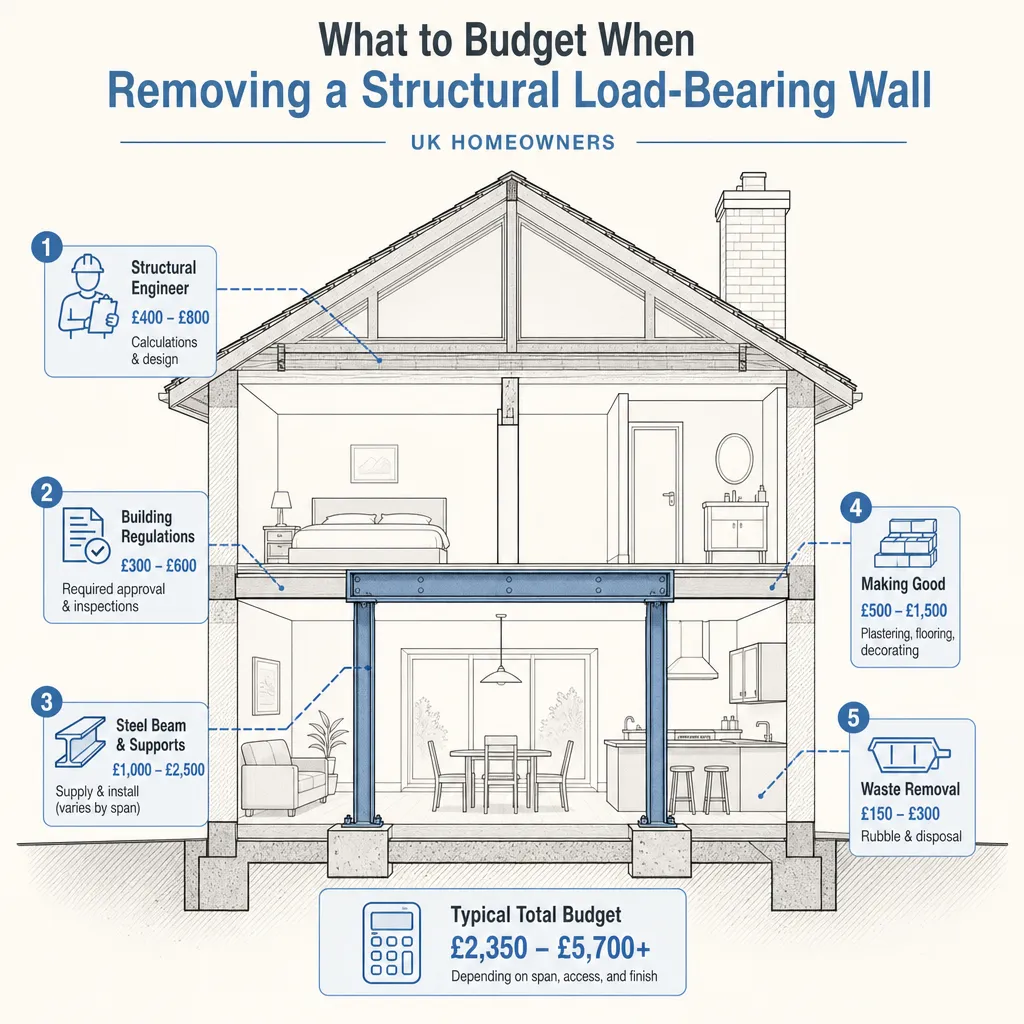
What to Budget When Removing a Structural Load-Bearing Wall
Removing a load-bearing wall in a typical UK home costs £2,500–£8,000 or more in total, covering a structural engineer's calculations, Building Regulations approval, the steel beam, builder's labour, and replastering.
 Planning & Pre-Build
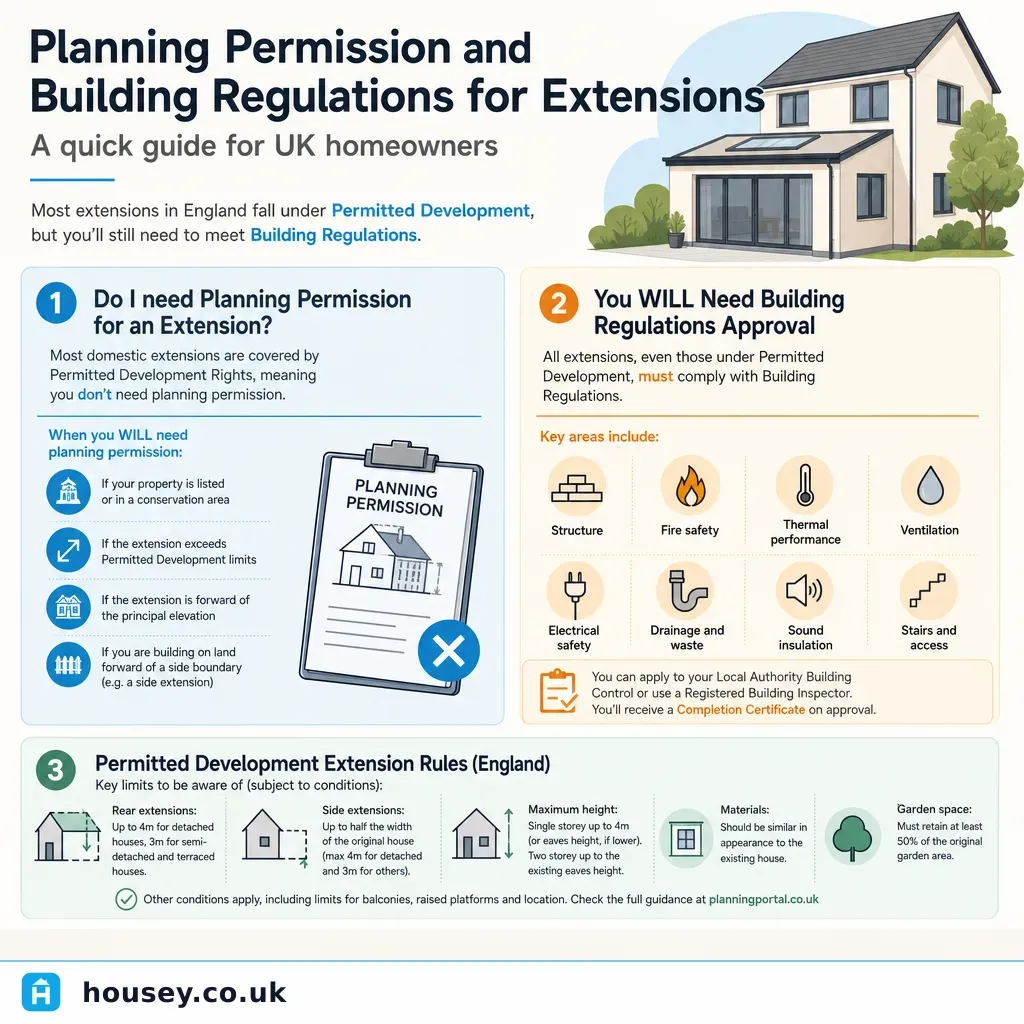
Planning Permission and Building Regulations for Extensions
UK home extensions usually require both planning permission and Building Regulations approval, though most smaller rear extensions qualify as Permitted Development under the GPDO 2015 and need no planning application.
 Planning & Pre-Build
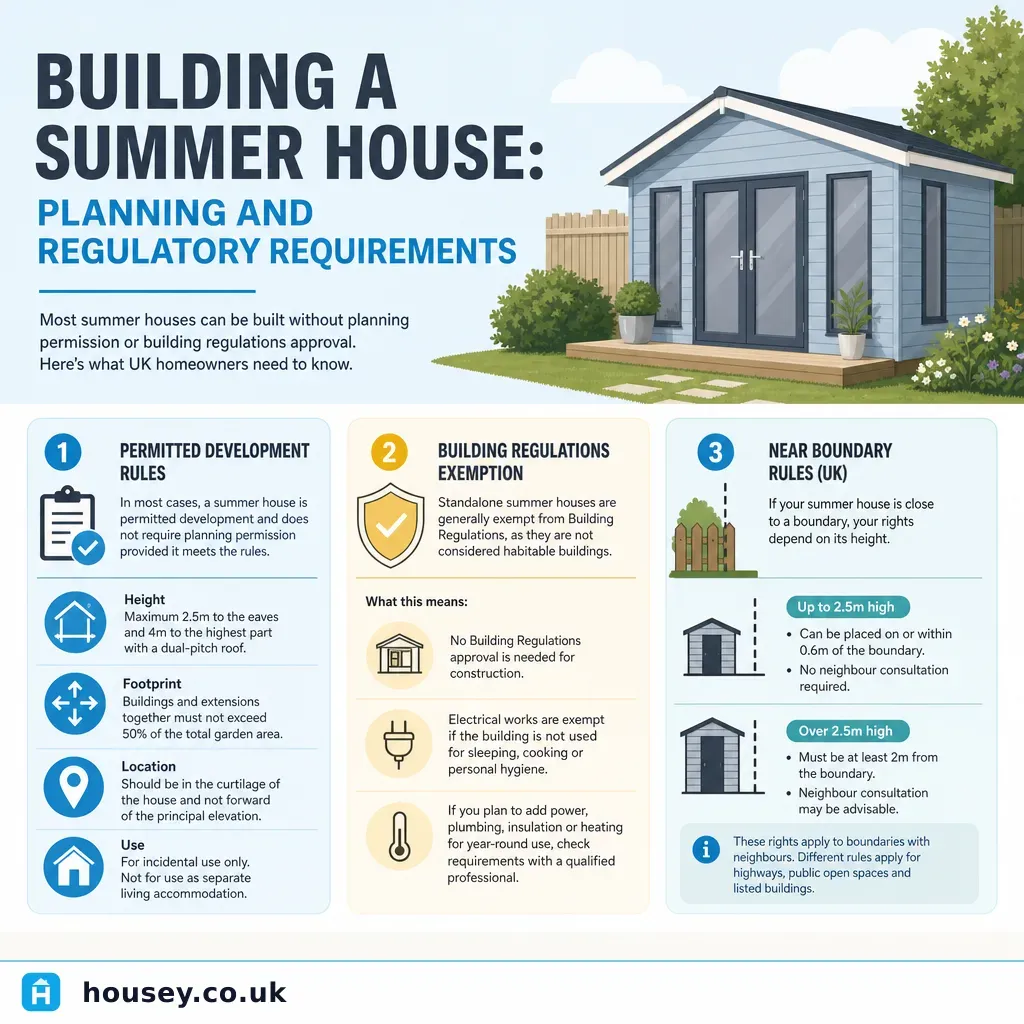
Building a Summer House: Planning and Regulatory Requirements
Most garden summer houses in England fall under Class E permitted development and need no planning permission, provided they are single-storey, within height limits, and not used for sleeping.
 Planning & Pre-Build
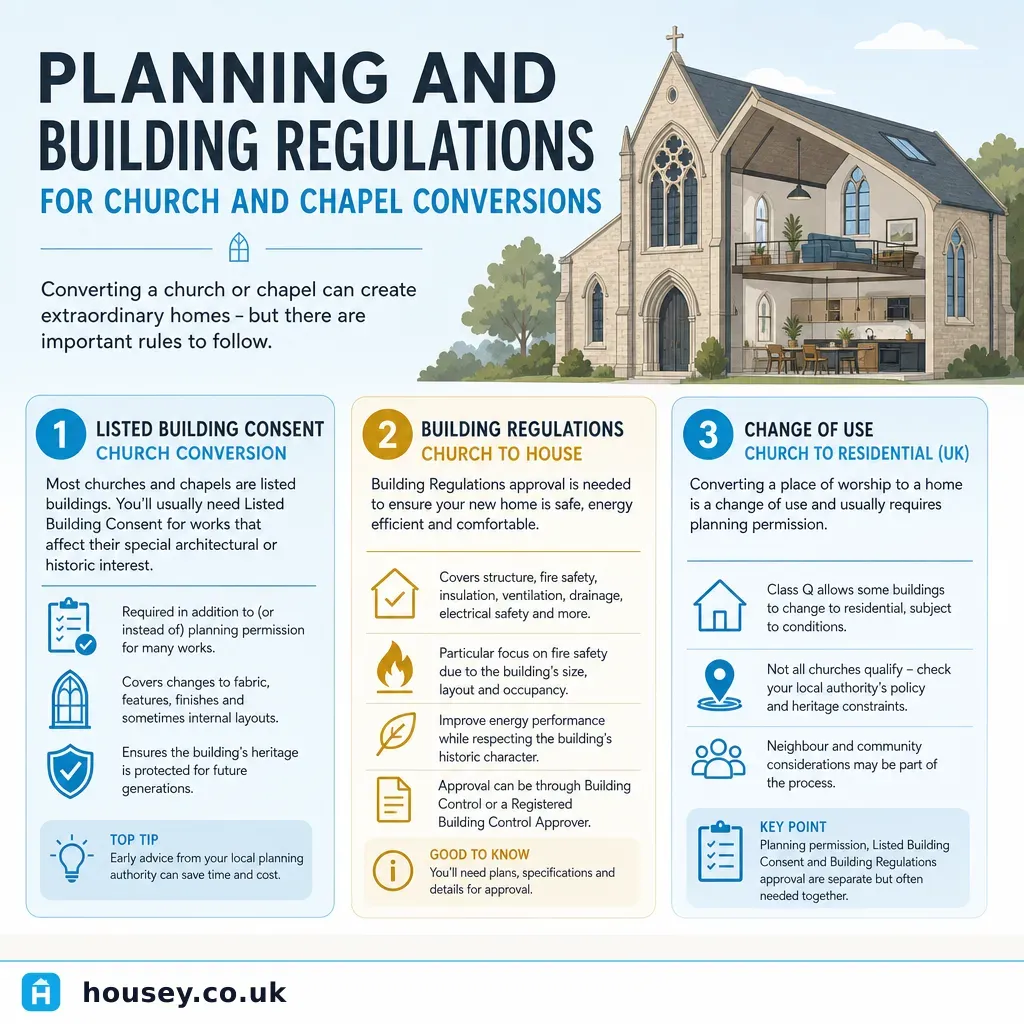
Planning and Building Regulations for Church and Chapel Conversions
Converting a church or chapel to residential use requires planning permission for change of use from Class F1 to Class C3, and listed building consent if the building is listed.
 Planning & Pre-Build
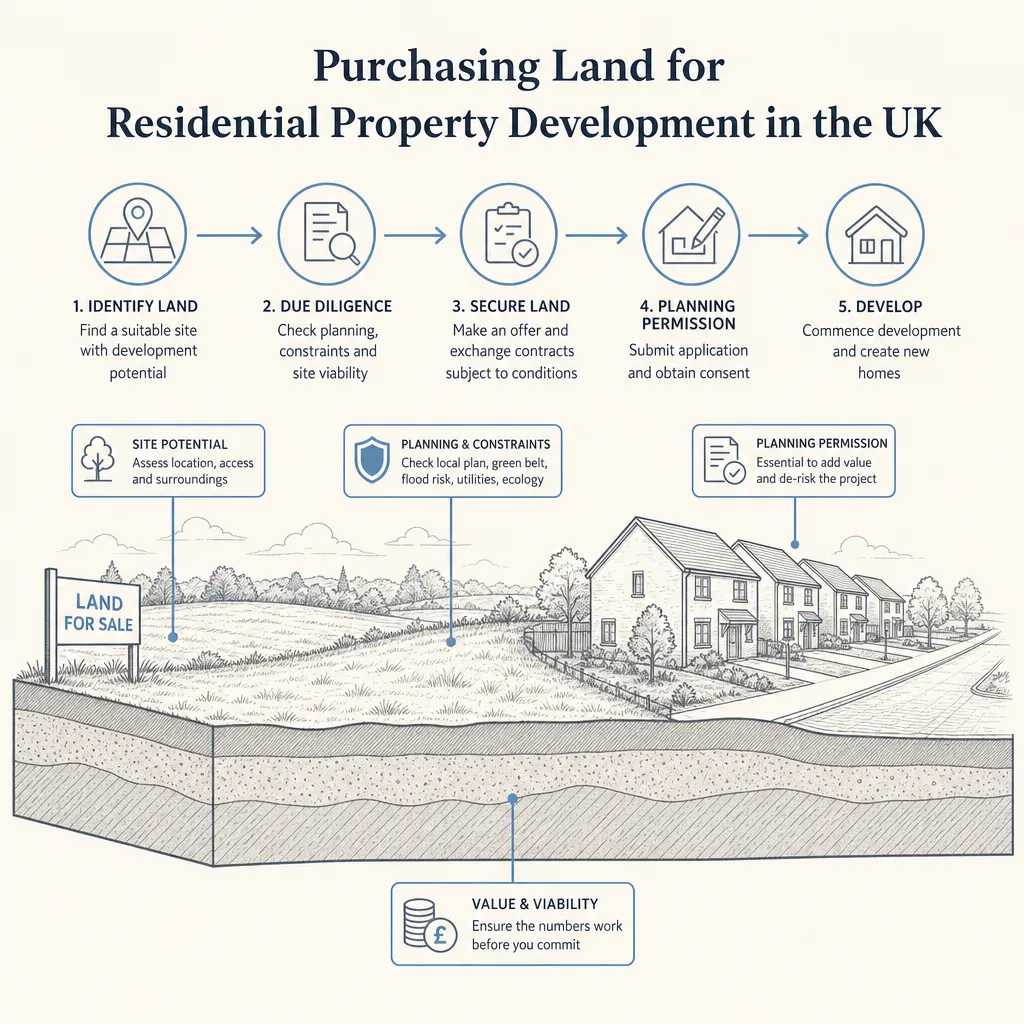
Purchasing Land for Residential Property Development in the UK
Buying development land in the UK involves due diligence on planning status, ground conditions, legal title, and utilities access before exchange.