Understanding Door Types: Materials, Styles and Functional Options
By Housey · Last reviewed 26th of May 2026
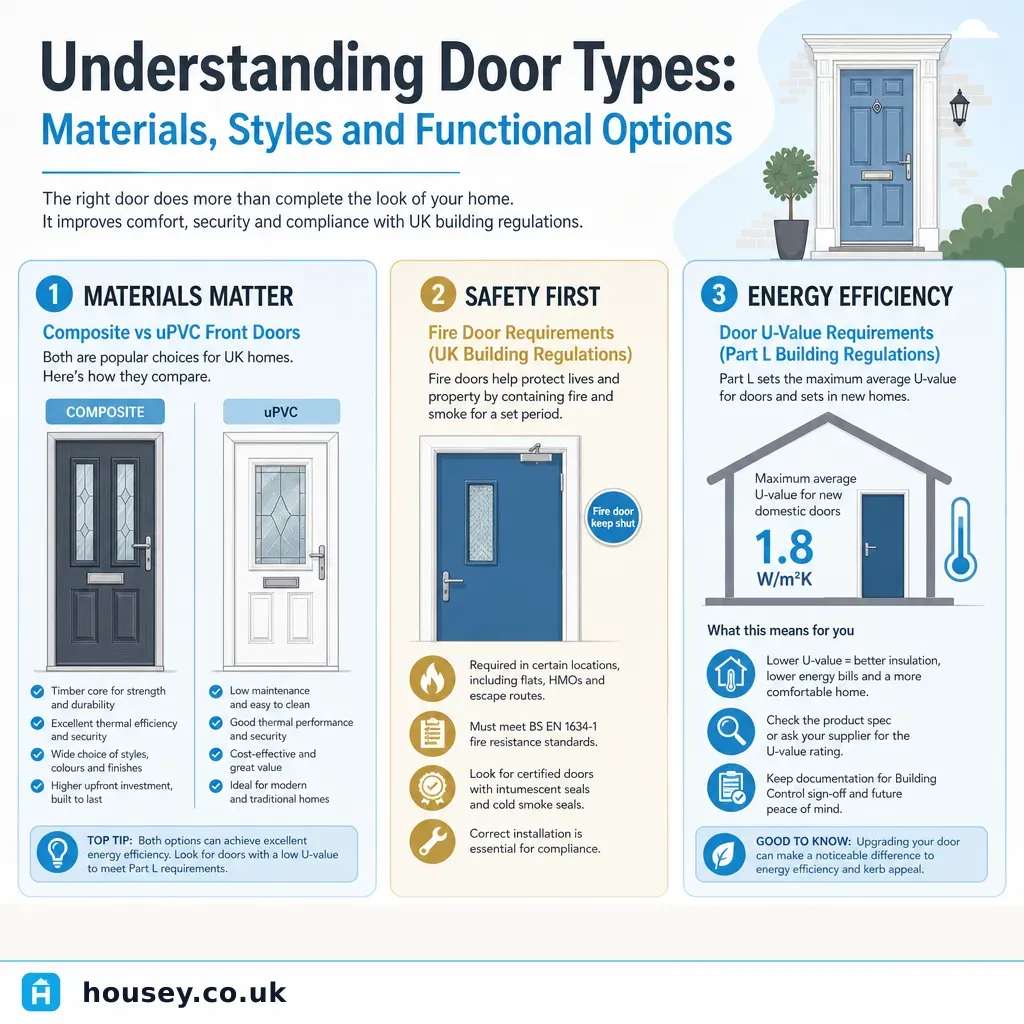
Understanding Door Types: Materials, Styles and Functional Options
Choosing a door — whether replacing an ageing front entrance or specifying internal doors throughout a renovation — involves decisions that affect security, thermal efficiency, acoustic performance, maintenance, and in some cases planning compliance. UK homeowners face a wider range of materials, styles, and certifications than ever before, yet the regulatory context is often overlooked until a problem surfaces at building control, during a sale, or following an insurance claim.
Key points
- Replacement external doors on existing dwellings are usually permitted development but require either FENSA or CERTASS certification, or local authority building control sign-off, to satisfy Building Regulations.
- Approved Document Q (Security) applies to new dwellings and certain change-of-use projects; external doors must achieve PAS 24:2022 or Secured by Design Silver accreditation as a minimum.
- Composite doors typically achieve doorset U-values of 1.0–1.4 W/m²K; uPVC and aluminium doorsets with double or triple glazing can reach 0.8–1.2 W/m²K depending on the glass unit specification.
- Fire doors (FD30 or FD60-rated) are required in specific positions under Approved Document B — including all new loft conversions, doors between an integral garage and the dwelling, and HMO conversions.
- In conservation areas and listed buildings, replacing an original door with a different material or style may require planning permission or listed building consent, even for a like-for-like replacement in appearance.
External vs internal doors: key differences
External and internal doors serve fundamentally different purposes and are governed by different regulatory requirements.
External doors must address weather resistance, thermal performance, security, and — in certain positions — fire separation. Internal doors primarily address privacy, sound separation, and in some locations, fire containment. The distinction matters most when specifying fire doors. An internal door on a habitable room does not usually require a fire rating, but a door between an integral garage and the dwelling must be FD30 under Approved Document B, and any flat above a commercial premises requires FD60 separation to the stairwell.
For replacement external doors in existing dwellings, the relevant compliance route is either a competent persons scheme (FENSA for windows and doors, or CERTASS), which self-certifies compliance, or a full local authority building control application. Failing to use either route leaves the homeowner without the documentation needed to satisfy solicitors on sale.
Door materials compared
Material | Indicative doorset U-value | Typical lifespan | Maintenance level | Best for | Not ideal for |
|---|---|---|---|---|---|
Solid timber | 1.0–2.0 W/m²K (unglazed) | 30–60+ years | Regular — painting or oiling every 3–5 years | Character properties, conservation areas, bespoke designs | Low-maintenance preference, exposed elevations |
uPVC | 1.2–1.8 W/m²K | 20–35 years | Minimal — occasional lubrication | Cost-effective replacements, rental properties | Listed buildings, premium new builds |
Composite (GRP/timber core) | 1.0–1.4 W/m²K | 25–35 years | Very low — wipe-clean face | High security, modern or traditional aesthetics | Conservation areas requiring exact timber match |
Aluminium (thermally broken) | 1.2–2.0 W/m²K | 30–45 years | Low — occasional cleaning | Contemporary new builds, large-span openings | Cost-sensitive projects, listed buildings |
Steel | 1.0–1.5 W/m²K | 30–50 years | Moderate — painting required | High-security applications, industrial-aesthetic renovations | Most standard domestic settings |
U-values are indicative for the doorset; actual performance varies by product, frame proportion, and glass specification. Indicative UK costs, last reviewed 2026-05-26.
Security, fire ratings, and energy performance
Security: Approved Document Q requires external doors in new dwellings to achieve PAS 24:2022 as a minimum, or Secured by Design Silver accreditation. For replacement doors, PAS 24 is not a legal requirement under building regulations, but many insurers and mortgage lenders now expect it. Ask for the specific PAS 24 test certificate from the manufacturer, not just a general security claim.
Fire doors: An FD30 door provides 30 minutes of fire resistance; FD60 provides 60 minutes. Both ratings require a compatible certified frame, intumescent and smoke seals, a self-closing device, and no gaps greater than 3mm around the leaf. A fire door fitted without its certified hardware assembly is not a compliant fire door regardless of the leaf's own certification.
Energy performance: The 2021 edition of Approved Document L (effective June 2023) sets a maximum U-value of 1.4 W/m²K for replacement doors in existing dwellings. For new extensions, the notional building specification is more demanding. Always request a doorset U-value — covering leaf, frame, threshold, and any glazing unit — rather than a frame or glass U-value in isolation.
Styles and glazing options
Doors are available in panel, flush, part-glazed, and full-glazed configurations. Each combination involves trade-offs between thermal performance, natural light, and security:
- Solid panel doors offer maximum thermal resistance and security.
- Part-glazed doors with laminated or toughened safety glass (BS EN 12150) balance light transmission and safety requirements.
- Full-glazed doors in aluminium or thermally broken frames suit contemporary rear openings but require high-performance glass units to meet U-value targets.
- Bi-fold and sliding doors at rear extensions introduce larger frame areas, which can reduce overall opening performance; specify thermally broken frames and triple glazing where thermal performance is a priority.
Approved Document N requires safety glazing in critical locations, including any glazed area within 1,500mm of floor level in a door or adjacent panel.
Which door type should you choose?
Use this decision tree to narrow your options before requesting quotes.
- Choose composite or uPVC if your priority is low maintenance, you are replacing a standard external door, and the property is not listed or in a conservation area.
- Choose solid or engineered timber if the property is in a conservation area, is listed, or requires a specific traditional style, and you are comfortable with periodic maintenance.
- Choose aluminium (thermally broken) if the opening is large (bi-fold or sliding), the design is contemporary, and thermal performance is a priority.
- Choose an FD30 or FD60 fire-rated doorset if the position is between a habitable space and an integral garage, at a flat entrance, in a new loft conversion escape route, or in any HMO.
- Check with your local planning authority or conservation officer if the property is listed or in a conservation area — even a like-for-like material replacement may require consent.
What to ask before accepting a quote
- What is the full doorset U-value (leaf, frame, threshold, and glazing unit combined)?
- Is the door PAS 24:2022-tested, and can you provide the manufacturer's test certificate?
- For fire doors: what frame, seals, and closer are included, and are they part of a certified assembly from a single tested doorset?
- Is FENSA or CERTASS certification included, or will you be applying to local authority building control separately?
- What is the installation timeline, and does the quote include removal of the existing door and frame?
- Does the price include making good the surrounding reveal (plasterwork, decoration)?
- Is VAT included?
When to get professional help
Most door installations are straightforward, but seek specialist advice when:
- The opening requires structural alteration — widening, lowering the head, or removing a lintel.
- The property is listed or the planning history is unclear.
- The door position requires a fire rating and you are unsure whether FD30 or FD60 applies.
- Persistent draught, condensation, or water ingress after installation suggests incorrect installation or a thermal bridge in the frame — a competent installer should return to inspect and rectify.
How Housey can help
Housey helps homeowners find qualified window and door installers who can specify, supply, and fit compliant doorsets — including FENSA registration for external replacements and fire door installations where building control sign-off is required.
Frequently asked questions
Does replacing a front door need planning permission?
For most homes, replacing a front door is permitted development and does not need planning permission. However, if your home is in a conservation area or is a listed building, you may need planning permission or listed building consent even for a like-for-like replacement. Always check with your local planning authority before replacing a door that may be considered original or historically significant.
What is the difference between a fire door and a standard door?
A fire door is a certified doorset assembly — leaf, frame, intumescent seals, and self-closing device — tested to resist fire and smoke for a defined period (FD30 = 30 minutes, FD60 = 60 minutes). A standard door has no tested fire resistance. Fitting intumescent strips to a standard door does not make it compliant; the entire certified assembly must be installed and maintained intact.
Do I need building regulations approval to replace an internal door?
Replacing a like-for-like internal door does not generally require building regulations approval. Adding a new opening in a load-bearing wall is notifiable under building regulations and requires structural assessment. If the door is in a fire-compartmentation position — such as between an integral garage and living space — the replacement must be FD30-rated, and this may also be notifiable work.
Sources and further reading
- Approved Document Q — Security: dwellings — GOV.UK
- Approved Document B — Fire safety: volume 1 — GOV.UK
- Approved Document L — Conservation of fuel and power — GOV.UK
- FENSA — competent persons scheme for windows and doors — FENSA
- Secured by Design — police-preferred specification — Police Crime Prevention Initiatives
- Planning Portal — permitted development for doors — Planning Portal
Useful next reads
 Improvement & Build
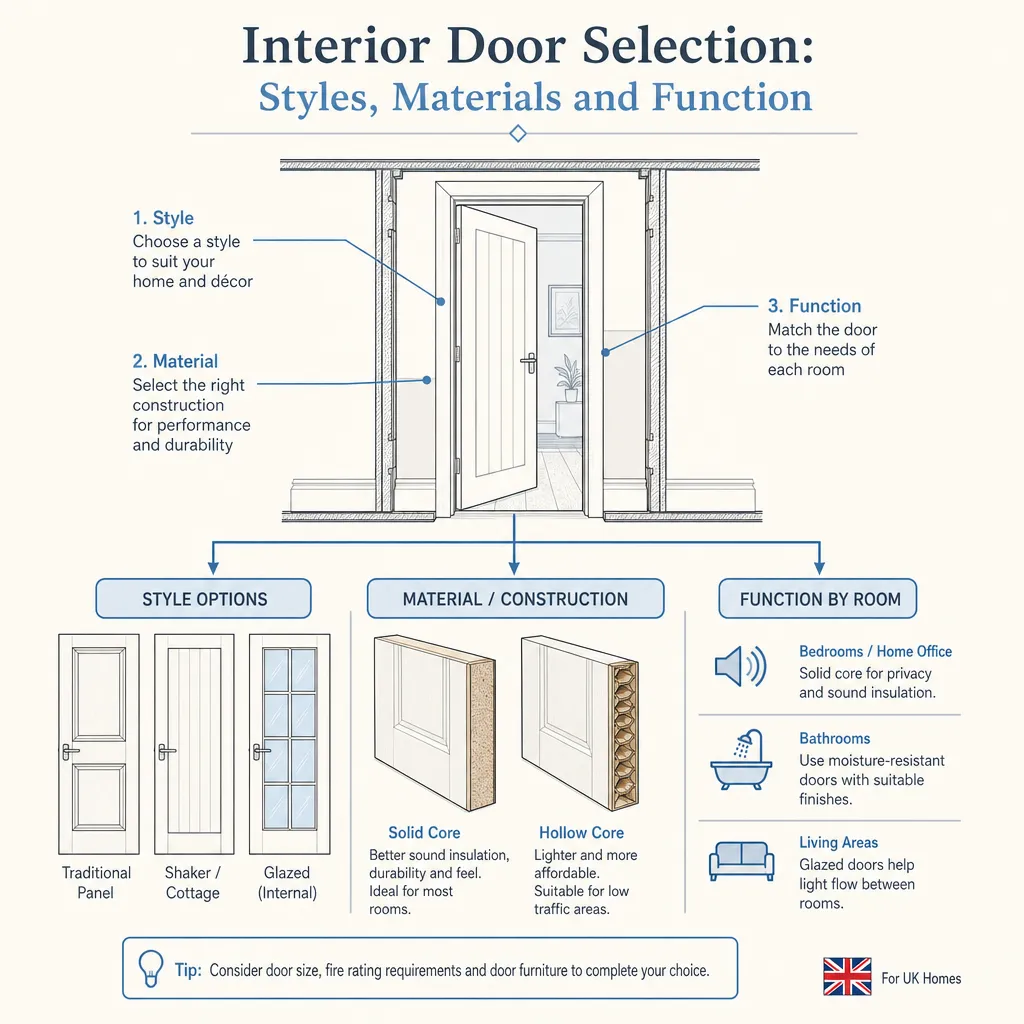
Interior Door Selection: Styles, Materials and Function
Interior doors in UK homes come in solid core, hollow core, and glazed varieties, with styles from flush and panelled to bifold and pocket.
 Improvement & Build
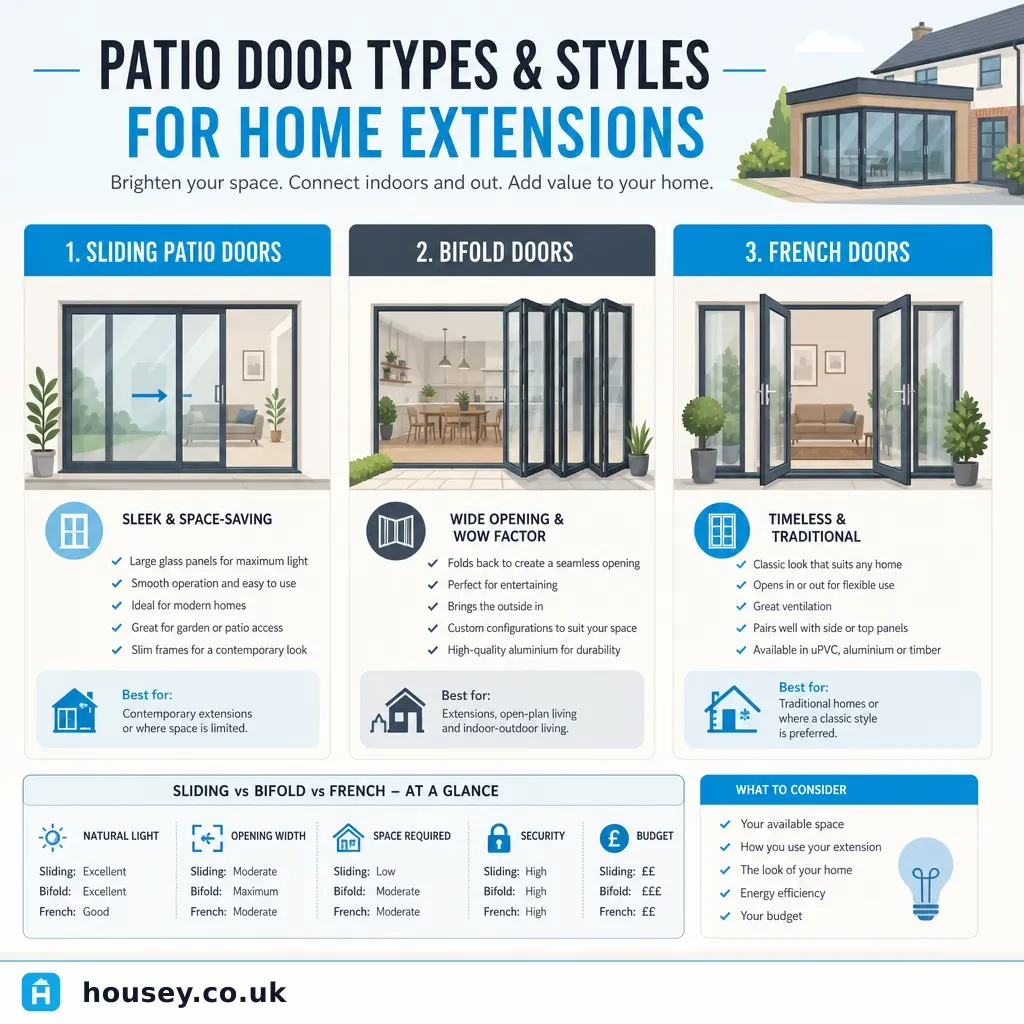
Patio Door Types and Styles for Home Extensions
For most UK home extensions, sliding doors suit openings up to 3.
 Improvement & Build
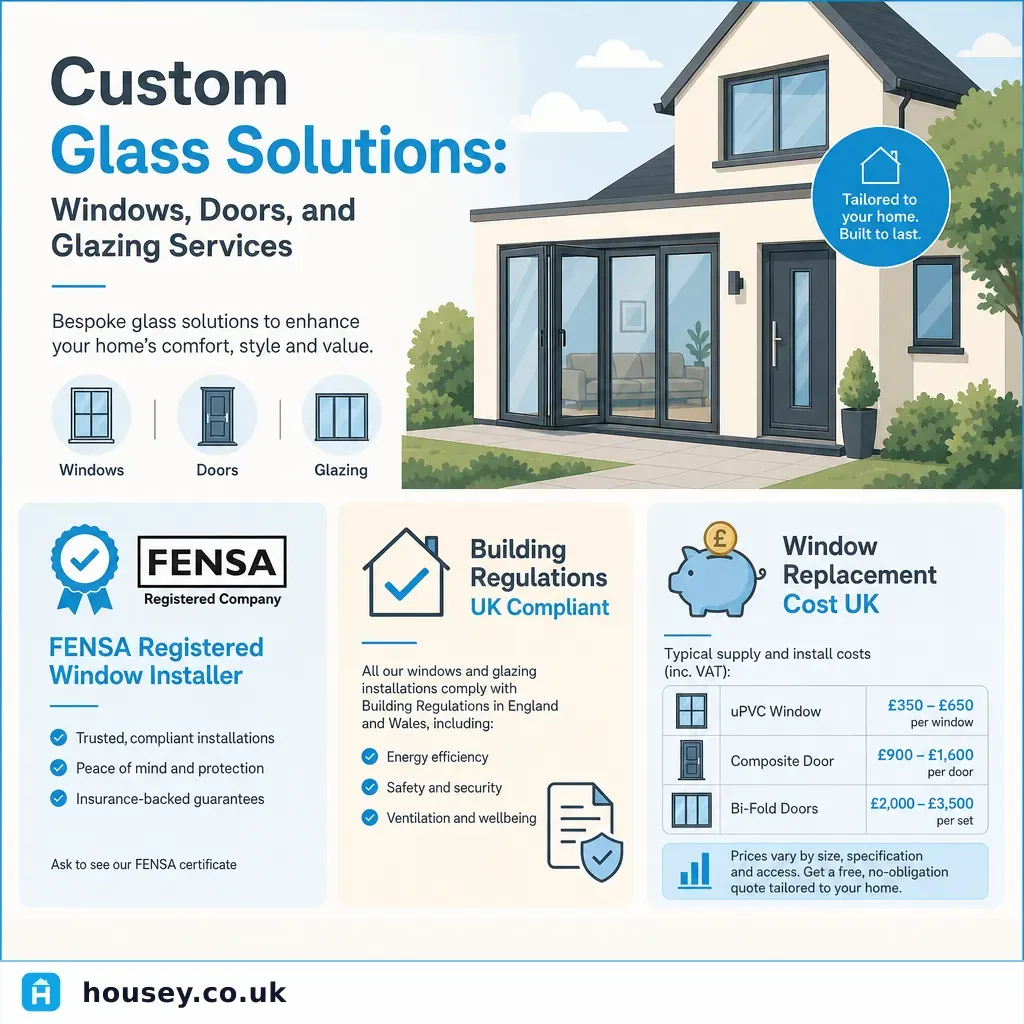
Custom Glass Solutions: Windows, Doors, and Glazing Services
Replacement windows and doors in England and Wales must comply with Building Regulations Approved Document L (2022), requiring a whole-window U-value of 1.
 Improvement & Build
How to Replace Internal Doors in Your Home
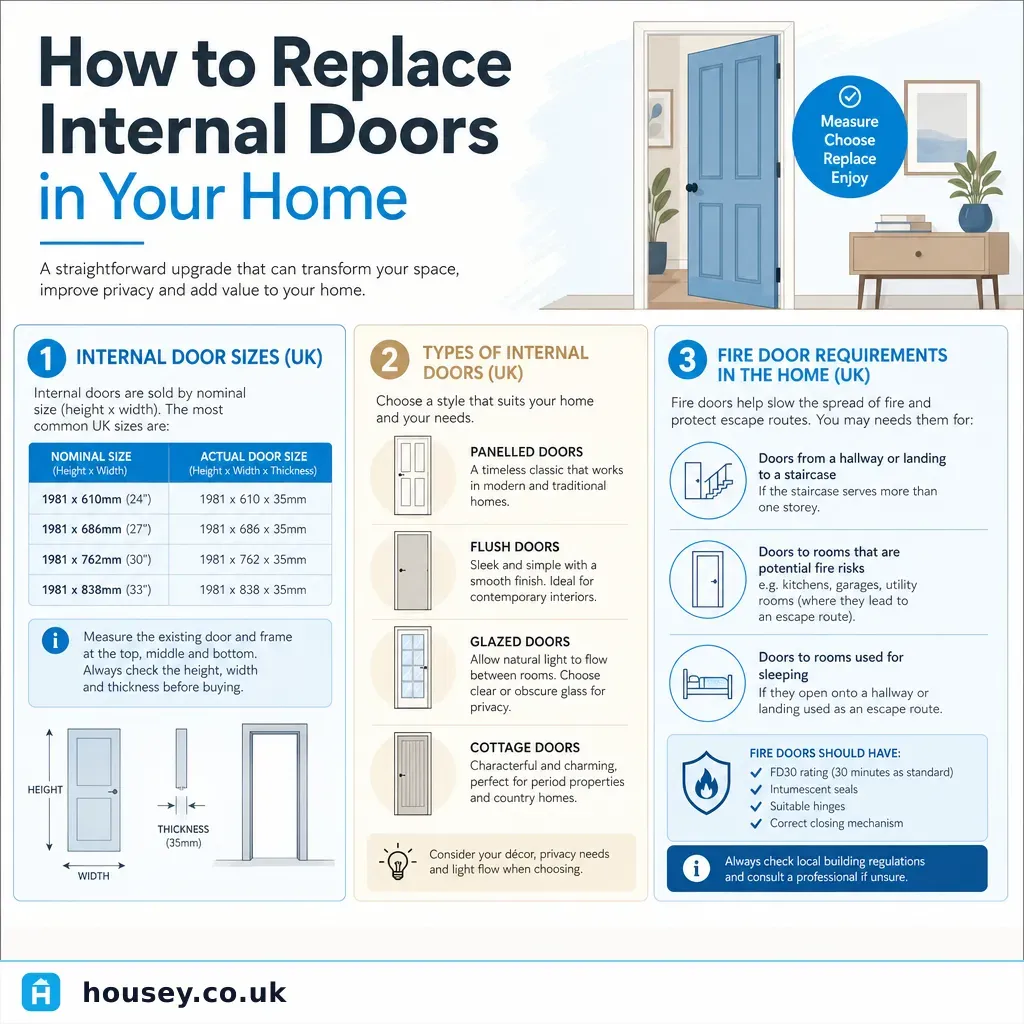
Replacing internal doors is a straightforward home improvement that most competent DIYers or a joiner can complete.
 Improvement & Build
Storm Doors versus Screen Doors: Seasonal Purpose and Protection Compared
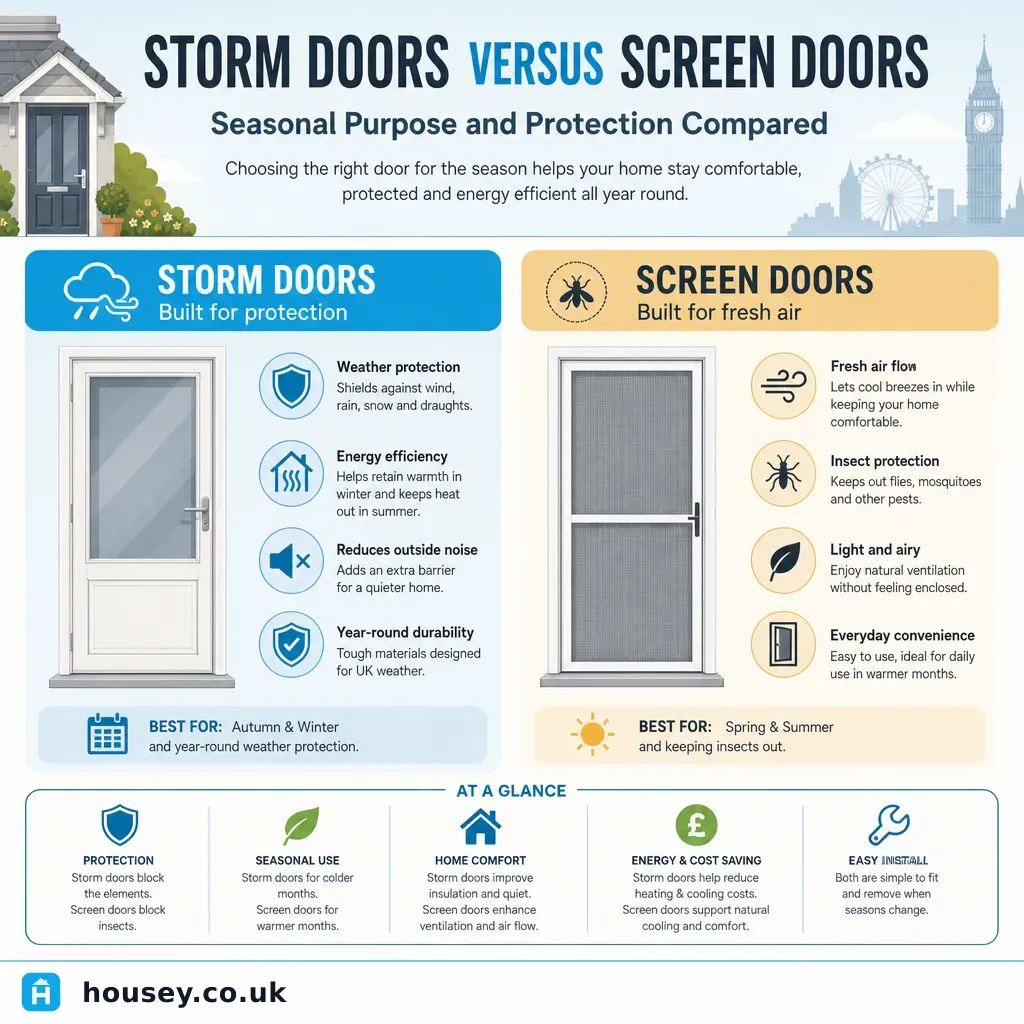
Storm doors are secondary outer doors that reduce draughts, rain ingress, and heat loss year-round, while screen doors are lightweight mesh panels that block insects during warm-weather ventilation.