Storm Door Buying Guide: Types and Installation Considerations
By Housey · Last reviewed 30th of May 2026
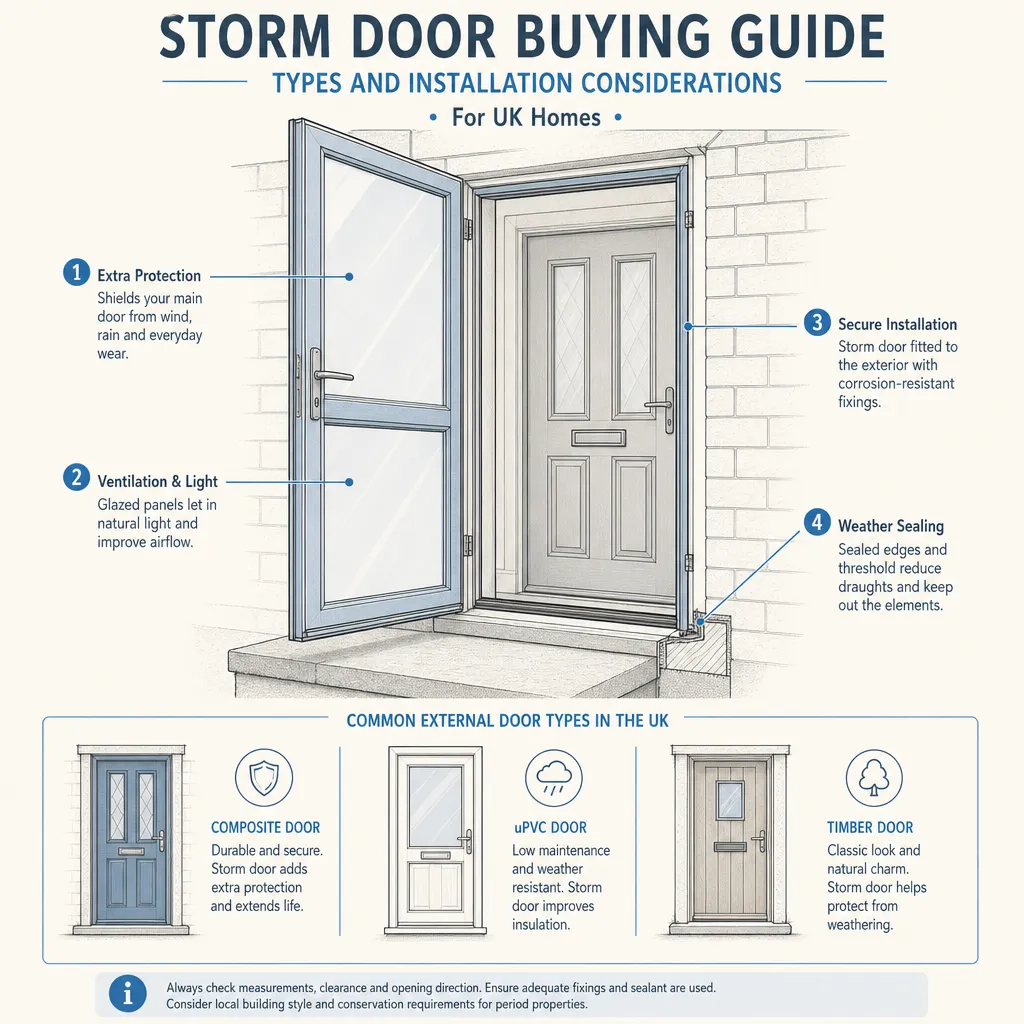
Storm Door Buying Guide: Types and Installation Considerations
Storm doors — secondary outer doors fitted in front of a main entrance, or robust weather-resistant external doors — come up for homeowners planning a front door upgrade, adding a draught porch, or simply wanting better insulation and security. In the UK, the choice is shaped by climate, building regulations, and the wide range of materials now available. Getting it wrong can mean poor weather performance, failed building control sign-off, or a door that does not meet current security standards.
Key points
- Replacement external doors must meet minimum energy performance requirements under Approved Document L, Volume 1: Dwellings (2021 edition, England); always confirm the current limiting U-value with your installer or local building control, as requirements differ across England, Wales, Scotland, and Northern Ireland.
- Installers registered with FENSA or CERTASS can self-certify building regulations compliance, avoiding a separate local authority building control application and providing a certificate needed on sale.
- External door sets must meet the security requirements of Approved Document Q, most commonly by conforming to PAS 24:2022 or STS 201 enhanced security standards.
- Planning permission is not usually required for a like-for-like replacement door, but conservation area or listed building status may change this — always check with your local planning authority first.
- In the UK, the North American-style secondary storm door is less common than composite, uPVC, or timber doors that achieve equivalent weather and thermal performance as a single high-performance door set.
What is a storm door in the UK context?
In North America, a storm door is a secondary glazed or screen door hung outside the main entry door, primarily for weather protection and ventilation. In the UK, the term is used loosely to describe either:
- A secondary outer door — fitted as part of a draught lobby or enclosed porch, adding an extra layer of thermal and weather protection ahead of the main door.
- A high-performance external door — a composite, uPVC, or timber door chosen for robust weather sealing, thermal efficiency, and impact resistance.
Most UK homeowners achieve equivalent performance by selecting a quality composite or uPVC door with multi-point locking and compression seals, rather than fitting a separate secondary door. That said, secondary outer doors do appear in traditional Victorian and Edwardian terraces with enclosed porches, and in some contemporary new-build designs.
Types of external door available in the UK
Door type | Best for | Not ideal for | Typical U-value range | Security standard |
|---|---|---|---|---|
Composite (GRP + foam core) | Most UK homes; best all-round performance | Period properties where a genuine timber appearance is critical | 0.9–1.3 W/m²K | Usually PAS 24-compliant |
uPVC | Budget-conscious buyers; low maintenance | Some conservation areas; period aesthetics | 1.2–1.6 W/m²K | Available in PAS 24 options |
Timber (engineered or solid) | Listed buildings, conservation areas, period properties | High-maintenance aversion; exposed coastal sites | 1.2–1.8 W/m²K (varies) | PAS 24-compliant options available |
Aluminium | Contemporary new-builds; slim sightlines | Budget buyers | 1.0–1.4 W/m²K | Usually PAS 24-compliant |
Secondary outer door (porch) | Draughty Victorian/Edwardian entrances; thermal buffer | Limited porch space; modern properties | N/A (paired with main door) | Depends on specification |
Indicative U-values, last reviewed 2026-05-30. Actual performance varies by manufacturer and glazing specification. Always request certified performance data from your supplier.
Which door material suits your home?
Composite doors are currently the most popular choice for UK domestic installations. The glass-reinforced plastic (GRP) skin sits over a polyurethane foam core, giving excellent insulation, low maintenance, and a realistic timber appearance. Most composite doors from reputable manufacturers are supplied pre-certified to PAS 24, satisfying Approved Document Q requirements without additional testing.
uPVC doors remain the most affordable option and suit the majority of post-1960s UK properties. They are virtually maintenance-free but some local planning authorities restrict their use in conservation areas or where Article 4 directions apply.
Timber doors — including engineered timber options — are often required or preferred for listed buildings and conservation areas. They typically need more regular maintenance (painting or staining every few years) but closely match period aesthetics. Check with your local planning authority or Historic England if your property is listed or within a conservation area.
Aluminium doors use thermal breaks to prevent cold bridging and are popular on new-build and architect-designed homes. They offer slim profiles and a strong contemporary appearance but tend to cost more than composite or uPVC equivalents.
Building regulations: what applies to replacement external doors?
Replacing an external door in England triggers two key sets of building regulations:
- Part L (Energy efficiency): Replacement doors must meet minimum energy performance requirements set out in Approved Document L, Volume 1: Dwellings (2021 edition). Note that Wales, Scotland, and Northern Ireland maintain their own building regulations with separate requirements.
- Part Q (Security): External doors in new and replacement situations in dwellings must meet the security requirements of Approved Document Q. The most common compliance route is a door set tested to PAS 24:2022 or STS 201.
- Part M (Accessibility): If you are undertaking wider renovation works, check whether minimum doorway width and threshold accessibility requirements apply to your project.
Installers registered with FENSA or CERTASS can self-certify compliance and issue a certificate on completion. This certificate is required when you sell the property. If your installer is not registered, you must notify local authority building control before work begins.
Secondary outer doors and porch enclosures
A secondary outer door fitted as part of a porch enclosure creates a thermal lobby, reducing draughts and heat loss in older, less airtight homes. For Victorian and Edwardian terraces with existing tiled porch floors and canopy roofs, this can be a practical and cost-effective upgrade.
Planning note: Enclosing an existing open porch may require planning permission if the resulting structure exceeds the volume threshold under permitted development rights (currently 3 m³ in England; the door must not face a classified road). Always confirm with your local planning authority before starting work, as limits can vary.
Homeowner installation checklist
Before proceeding with a door installation or replacement:
When to get professional help
Most external door replacements are straightforward jobs for a competent, registered installer. Seek additional professional input if:
- The door opening shows signs of lintel failure, settlement, or significant damp around the frame — a structural issue may need addressing before a new door is installed.
- The property is listed or in a conservation area and you are uncertain which materials or styles are permissible.
- You want to enlarge the door opening, which typically requires building control approval and may need structural engineering input.
- You are enclosing an open porch and are uncertain whether permitted development rights apply to the size and location of the proposed structure.
How Housey can help
Housey connects you with vetted FENSA-registered window and door installers who can advise on door types, specification, and compliance with building regulations. Submit a single brief and receive quotes from local professionals before committing to a supplier.
Frequently asked questions
Do I need planning permission to replace my front door in the UK?
Like-for-like front door replacements do not usually require planning permission under permitted development rights. However, if your property is listed, in a conservation area, or if the replacement significantly changes the external appearance, you may need consent. Always check with your local planning authority before proceeding, particularly in conservation areas or Article 4 direction areas.
What is the difference between PAS 24 and Secured by Design?
PAS 24 is the British Standard for enhanced security performance of door and window sets, covering mechanical resistance to physical attack. Secured by Design is a police-backed certification scheme that requires PAS 24-compliant products as part of a broader security package. Most Secured by Design-certified doors are PAS 24-tested, but not all PAS 24 doors carry Secured by Design certification.
Can a secondary outer door help reduce draughts in an older property?
Yes. A secondary outer door creating a draught lobby or enclosed porch can meaningfully reduce heat loss in Victorian and Edwardian terraces with open porches. Whether the work requires planning permission depends on the resulting structure's size and position. Seek advice from a registered installer or your local planning authority before committing to the work.
How long does a composite external door typically last?
Most composite doors from reputable manufacturers carry a 10-year guarantee, and many last 25–35 years with normal use. The glass-reinforced plastic skin resists warping, cracking, and peeling. Hardware — hinges, locks, and handles — may need adjustment or replacement sooner, particularly in coastal or high-exposure locations.
Sources and further reading
- Approved Document L, Volume 1: Dwellings (2021 edition) — GOV.UK
- Approved Document Q: Security — GOV.UK
- FENSA — Glazing Registration and Certification — FENSA
- Permitted development rights for householders — GOV.UK Planning Practice Guidance
Useful next reads
 Improvement & Build
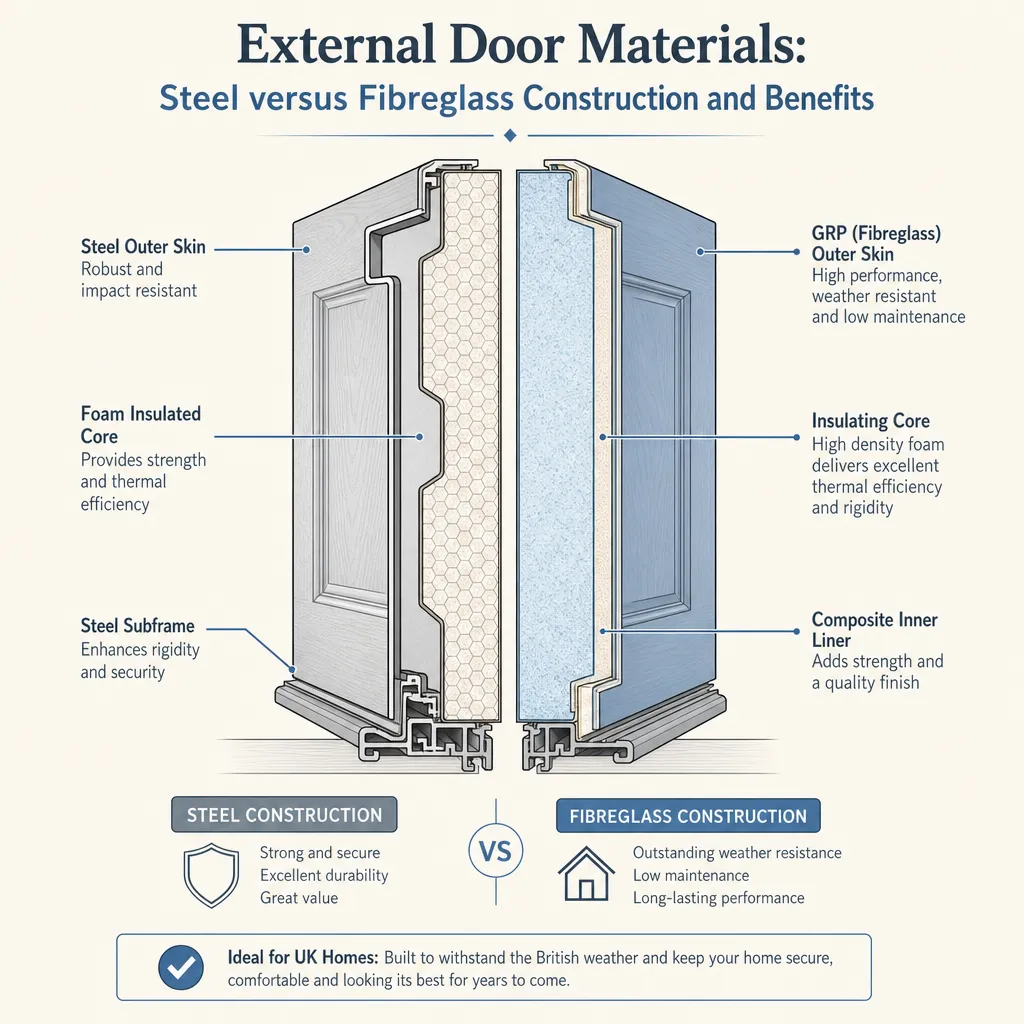
External Door Materials: Steel versus Fibreglass Construction and Benefits
Steel external doors use a cold-rolled steel skin over a foam-filled frame and offer high rigidity and security.
 Improvement & Build
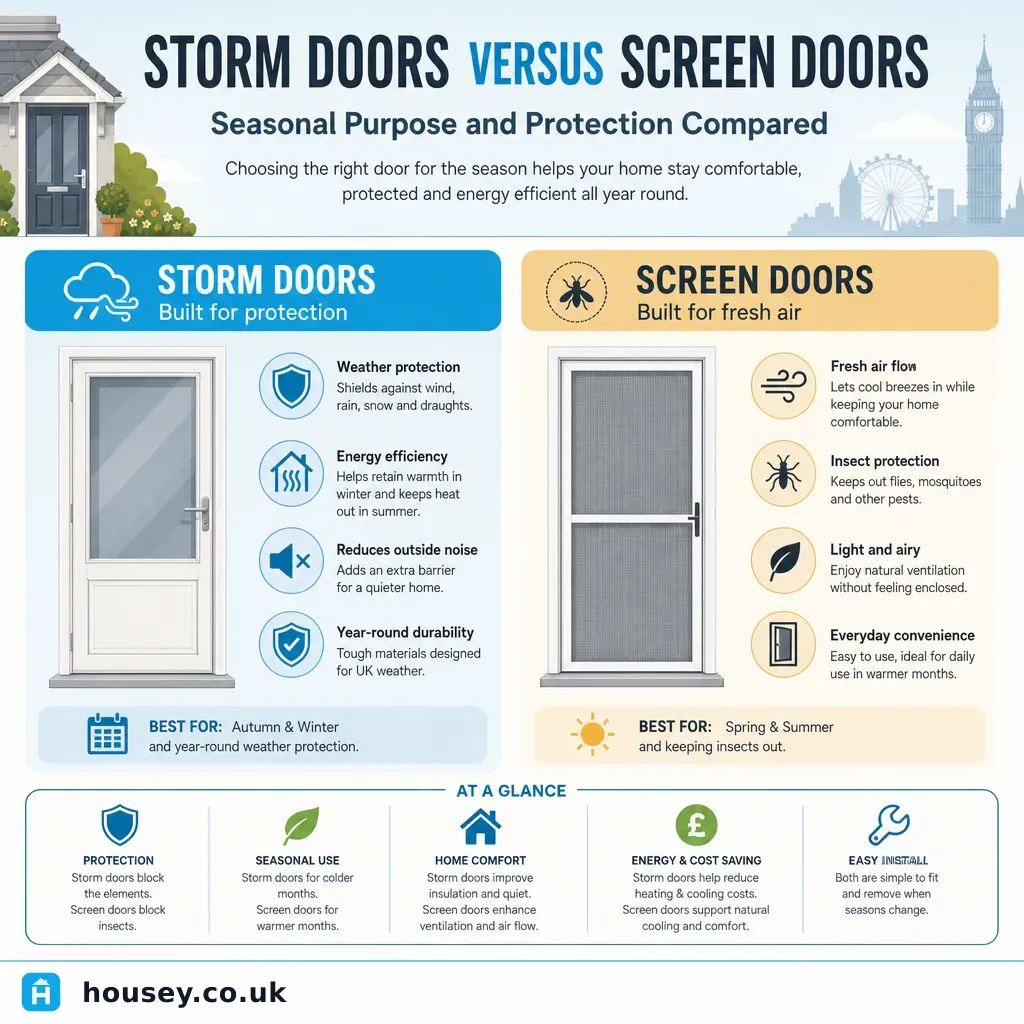
Storm Doors versus Screen Doors: Seasonal Purpose and Protection Compared
Storm doors are secondary outer doors that reduce draughts, rain ingress, and heat loss year-round, while screen doors are lightweight mesh panels that block insects during warm-weather ventilation.
 Improvement & Build
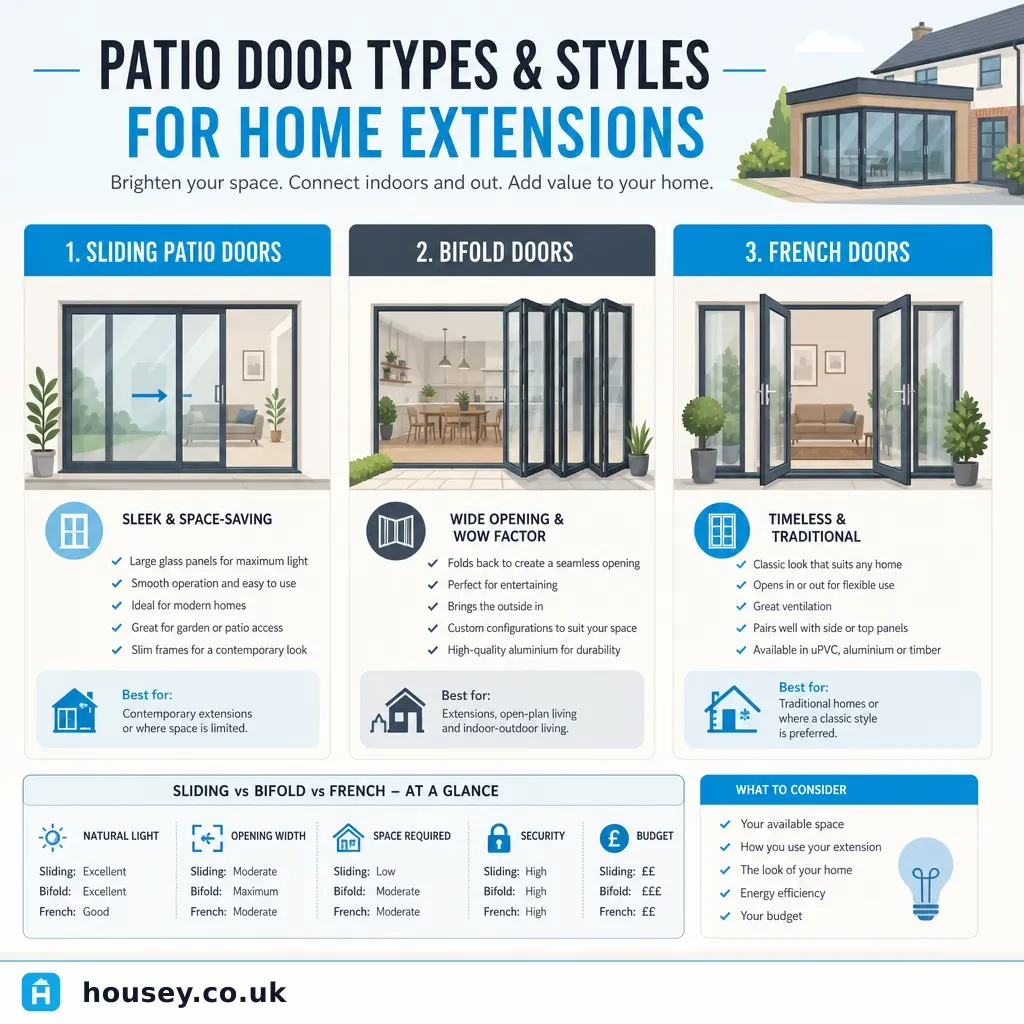
Patio Door Types and Styles for Home Extensions
For most UK home extensions, sliding doors suit openings up to 3.
 Improvement & Build
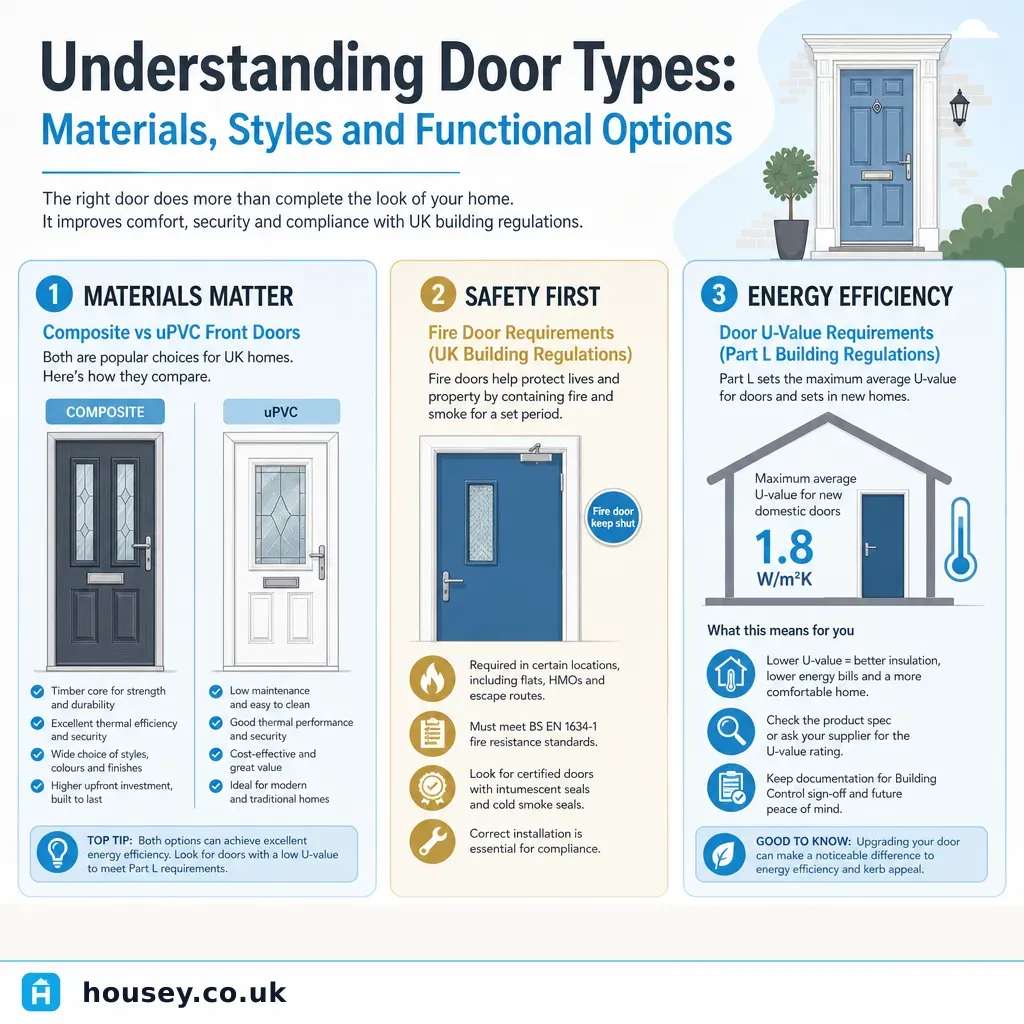
Understanding Door Types: Materials, Styles and Functional Options
Doors are available in timber, uPVC, aluminium, steel, and composite materials, each suited to different budgets, locations, and performance requirements.
 Improvement & Build
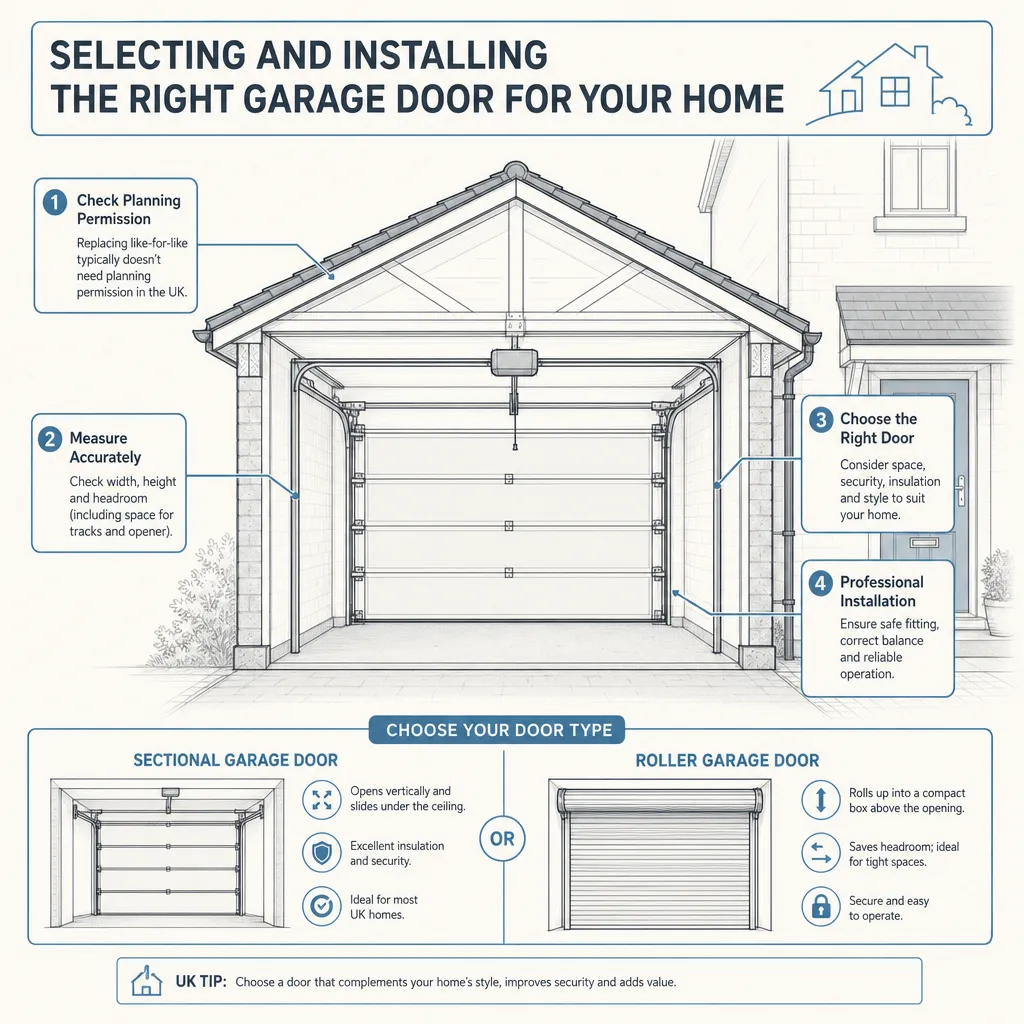
Selecting and Installing the Right Garage Door for Your Home
Choosing the right garage door depends on available headroom, opening width, security needs, and budget.