External Wall Insulation Installation and Retrofit Costs
By Housey · Last reviewed 7th of May 2026
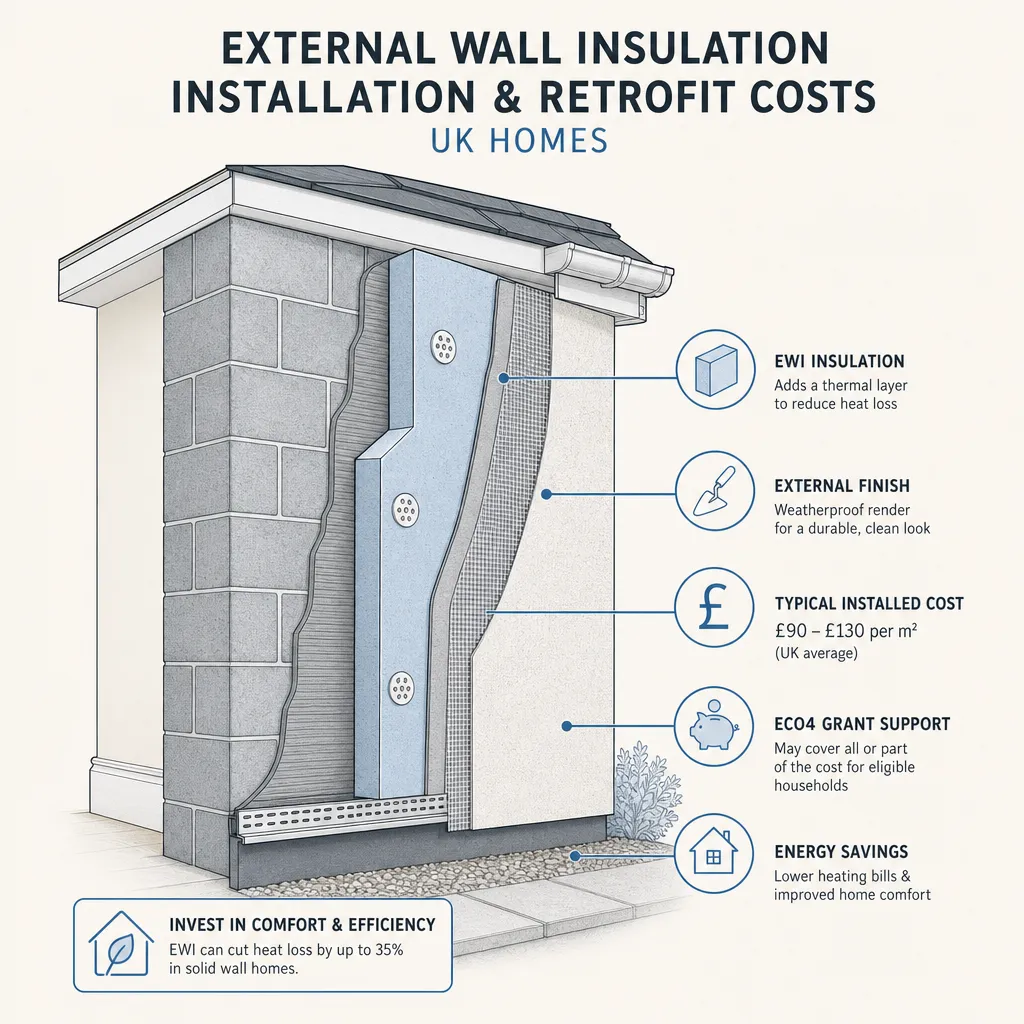
External Wall Insulation Installation and Retrofit Costs
External wall insulation (EWI) is among the most impactful thermal upgrades available for older solid-wall homes — particularly the pre-1920 Victorian and Edwardian properties built with solid brick or stone that cannot easily receive cavity wall insulation. Homeowners typically begin researching EWI after receiving a retrofit assessment, when energy bills are persistently high, or when applying for grant funding under ECO4 or the Great British Insulation Scheme. Because EWI involves a significant change to the building envelope, the costs, specification, and risks all require careful consideration before work begins.
Key points
- Indicative UK costs for EWI on a semi-detached home range from £8,000 to £22,000, depending on wall area, insulation material, render finish, and building complexity. (Indicative UK costs, last reviewed 2026-05-07.)
- ECO4 and the Great British Insulation Scheme (GBIS) can fund EWI for eligible low-income or fuel-poor households; eligibility is typically means-tested or based on EPC rating.
- Grant-funded EWI must be installed by PAS 2030-certified, TrustMark-registered contractors and coordinated under PAS 2035 by a qualified retrofit coordinator.
- EWI on solid-wall properties carries a real risk of interstitial condensation if vapour control, ventilation, and detailing are not correctly managed — a retrofit assessor should evaluate the building before any specification is agreed.
- Planning permission is not normally required under permitted development rights, but listed buildings, conservation areas, and Article 4 Direction areas are exceptions.
How much does external wall insulation cost in the UK?
EWI is typically priced per square metre of treated wall area. Supply-and-install costs generally range from £80 to £180 per m², with the variation driven by insulation board type, render or cladding finish, and building complexity — including bay windows, service penetrations, and the amount of scaffolding required.
Property type | Indicative total cost |
|---|---|
One-bedroom flat (ground floor, two external walls) | £3,500–£8,000 |
Two-bedroom mid-terrace (front and rear) | £6,000–£14,000 |
Three-bedroom semi-detached | £8,000–£18,000 |
Four-bedroom detached | £14,000–£22,000+ |
Indicative UK costs, last reviewed 2026-05-07. Costs vary significantly by region, building complexity, and chosen system. Always obtain at least three itemised quotes from accredited installers.
These figures typically include insulation boards and fixings, render base coat and mesh reinforcement, decorative render or cladding finish, window and door reveals, scaffolding, and making good around rainwater pipes and meters.
They do not always include: replacement of guttering, soffits, or fascias displaced by the added wall thickness; internal ventilation upgrades (often needed alongside EWI); building control fees; or any structural repairs identified before installation begins.
What affects the cost of external wall insulation?
Insulation material: EPS (expanded polystyrene) boards are the most common and cost-effective; mineral wool is preferred for fire performance or where vapour permeability matters; phenolic foam delivers a thinner board for the same thermal performance but costs more; wood fibre is a vapour-open natural option suited to traditionally constructed walls.
Render or cladding finish: Standard silicone render is the most economical finish; brick-slip cladding or through-colour renders are more expensive but can better match the local street character — which may be relevant in areas where planning guidance influences aesthetics.
Building complexity: Bay windows, external meters, downpipes, complex reveals, and properties over three storeys all add time and therefore cost. Access for upper floors requires scaffolding that can add several thousand pounds to the project total.
Existing wall condition: Walls with cracking, damp penetration, or loose pointing need remedial work before EWI is applied. This adds cost but is essential — EWI applied over defective masonry will not perform correctly and may trap moisture.
Grants and funding for external wall insulation
Two main government schemes can fund or subsidise EWI for eligible UK households.
ECO4 (Energy Company Obligation 4): Funded by energy suppliers and targeted at low-income households and those in fuel poverty. EWI is a core measure under ECO4. Eligibility is typically based on receipt of means-tested benefits or having a low EPC rating (D to G). Apply through a TrustMark-registered installer or an energy charity such as National Energy Action or Citizens Advice.
Great British Insulation Scheme (GBIS): Targets households with EPC ratings of D or below. There are two tracks: a means-tested track for households receiving qualifying benefits, and a general track for properties in Council Tax bands A to D with an EPC rating of D or below. Check the GOV.UK guidance for current eligibility criteria, as the scheme has been updated since launch.
Eligible households may receive the full cost of EWI with no contribution required. For partly eligible households, a grant may cover a proportion of the cost. Confirm the exact scope of funding in writing before any work begins.
EWI material comparison
Material | Thermal performance | Vapour permeability | Fire performance | Relative cost |
|---|---|---|---|---|
EPS (expanded polystyrene) | Good | Low — vapour barrier needed | Requires intumescent fire barriers at compartment lines | Lowest |
Mineral wool (rock or glass) | Good | High — vapour open | Excellent — non-combustible | Mid-range |
Phenolic foam | Excellent (thinner boards) | Low | Varies by product | Higher |
Wood fibre | Moderate | High — fully vapour open | Moderate | Higher |
For traditional solid-wall properties built before 1920 in solid brick or stone, vapour-open systems such as mineral wool or wood fibre are often recommended to reduce the risk of interstitial condensation. A retrofit assessor should confirm the appropriate specification for your property's wall construction and exposure.
PAS 2035 and installer accreditation: what you need to know
If your EWI project is grant-funded, or if you simply want assurance of quality and protection against future liability, look for the following:
- PAS 2030 certification: The British Standard for retrofit installer competence. Any installer claiming to carry out grant-funded work must hold this certification.
- TrustMark registration: A Government-endorsed quality scheme required for all publicly funded retrofit work in Great Britain. Verify registration at trustmark.org.uk.
- PAS 2035 coordination: For funded projects, a qualified retrofit assessor must assess the property first, and a retrofit coordinator must design, manage, and sign off the works. You should receive a medium-term improvement plan (MTIP) as part of this process.
Ask for written evidence of these accreditations before signing any contract.
Moisture and ventilation risks with EWI
EWI changes how a building manages moisture at the wall surface. Solid brick walls that previously allowed some moisture to migrate and dry towards the external face behave differently once covered with an insulation and render system. Risks include:
- Interstitial condensation: If vapour control is incorrectly specified, moisture can condense within the wall structure, potentially damaging the fabric or contributing to indoor mould.
- Reduced background ventilation: A better-sealed building may experience less natural air exchange, raising indoor humidity and pollutant levels. MVHR or background trickle ventilation upgrades are often recommended alongside EWI.
- Detailing failures: Incorrect sealing at window reveals, door frames, or service penetrations can allow water to track behind the system, causing insulation failure and localised damp.
These risks are manageable with correct specification and installation, but they require professional assessment — which is precisely why PAS 2035 makes a retrofit assessor's involvement mandatory for funded projects.
Does EWI need planning permission?
In most cases, EWI on a standard house falls within permitted development rights in England and does not require planning permission. You are likely to need consent if:
- The property is a listed building or within its curtilage.
- The property is in a conservation area and the EWI would alter the external appearance significantly.
- An Article 4 Direction has removed permitted development rights in your area.
- The property is a flat or leasehold — consent from the freeholder or management company is typically required, and some leases prohibit external alterations.
A brief pre-application enquiry with your local planning authority (LPA) is usually free or low-cost and provides written confirmation of whether consent is needed.
Important limitations
This article provides general information about EWI costs, materials, grants, and process as of May 2026. Rules, eligibility criteria, grant amounts, planning requirements, and technical specifications vary by property type, wall construction, location, tenure, and local authority. Moisture risk, vapour control, and ventilation requirements must be assessed for your specific building by a qualified professional. Nothing in this article constitutes a design specification or a substitute for professional advice. Always instruct accredited professionals, verify their credentials independently, and obtain written itemised quotes before committing to works.
What to ask a qualified professional
Before instructing a retrofit assessor, retrofit coordinator, or EWI installer, ask:
- Are you PAS 2030-certified and TrustMark-registered? Can I verify your registration number on the TrustMark website?
- Will this project be designed and signed off under PAS 2035, and will I receive a medium-term improvement plan?
- What insulation system and finish do you recommend for my wall construction, and what is your reasoning?
- How will moisture, vapour control, and interstitial condensation risk be managed for my specific property?
- Does the quote include scaffolding, window and door reveals, making good around pipes and meters, and all other associated works — or are any of those charged separately?
- Will I need to upgrade ventilation as part of this project, and if so, is that included?
- What product and workmanship warranty does the EWI system carry, and is it backed by an EWIA-member manufacturer?
- Do I need planning permission, listed building consent, or freeholder approval for this work?
When to get professional help
EWI is a significant building envelope intervention. Seek qualified professional input before committing to any specification if:
- Your property is pre-1920 solid brick or stone construction — moisture management is critical and must be professionally assessed.
- You have existing damp, cracking, or evidence of structural movement — these must be resolved before EWI is applied.
- You are in a conservation area, a listed building, or unsure about permitted development rights in your area.
- You hold a leasehold or flat — consent from the freeholder or management company is likely required.
- You are applying for ECO4 or GBIS grant funding — PAS 2035 mandates a retrofit assessor and coordinator regardless of project size.
How Housey can help
Housey can connect you with PAS 2030-certified insulation installers, qualified retrofit assessors who can evaluate your property under PAS 2035 before any works are agreed, and energy-efficiency consultants who can advise on the right package of measures for your home and help you navigate grant eligibility.
Frequently asked questions
How much does external wall insulation cost for a typical UK house?
For a three-bedroom semi-detached home, indicative costs range from £8,000 to £18,000 depending on wall area, insulation type, and render finish. Some households are eligible for full funding under ECO4 or the Great British Insulation Scheme — check eligibility before accepting a quote. Always obtain at least three itemised quotes from PAS 2030-certified installers. (Indicative UK costs, last reviewed 2026-05-07.)
Do I need planning permission for external wall insulation?
Not usually — EWI typically falls within permitted development rights for standard houses in England. However, listed buildings, properties in conservation areas, and those subject to an Article 4 Direction require planning consent. Flats and leasehold properties also require freeholder or management company approval. Always check with your local planning authority before committing to works.
What is PAS 2035, and why does it matter for EWI?
PAS 2035 is the UK standard for domestic retrofit. It requires a qualified retrofit assessor to evaluate the property and a retrofit coordinator to design, manage, and sign off the works. For any grant-funded EWI project, PAS 2035 compliance is mandatory. It protects against poorly specified work that could cause interstitial condensation, moisture damage, or underperformance.
How long does external wall insulation last?
A well-installed EWI system from an EWIA-member installer should last 25 years or more with normal maintenance. Most systems carry a manufacturer product warranty, and some installers offer an extended workmanship guarantee. Check the warranty terms carefully — including what is and is not covered — before signing the contract.
Can I get external wall insulation if I live in a flat?
Possibly, but it is more complex. EWI on a block of flats is most cost-effective as a whole-building project. You will need consent from the freeholder or management company, and potentially from all leaseholders. Some housing associations and local authorities fund whole-block EWI — it is worth enquiring with yours before pursuing a single-flat approach.
Sources and further reading
- Solid wall insulation — Energy Saving Trust
- Great British Insulation Scheme — GOV.UK — HM Government
- ECO4: Energy Company Obligation — GOV.UK — HM Government
- PAS 2035:2023 — Retrofitting dwellings for improved energy efficiency — BSI Group
- TrustMark — find a registered retrofit installer — TrustMark
Useful next reads
 Energy & Retrofit
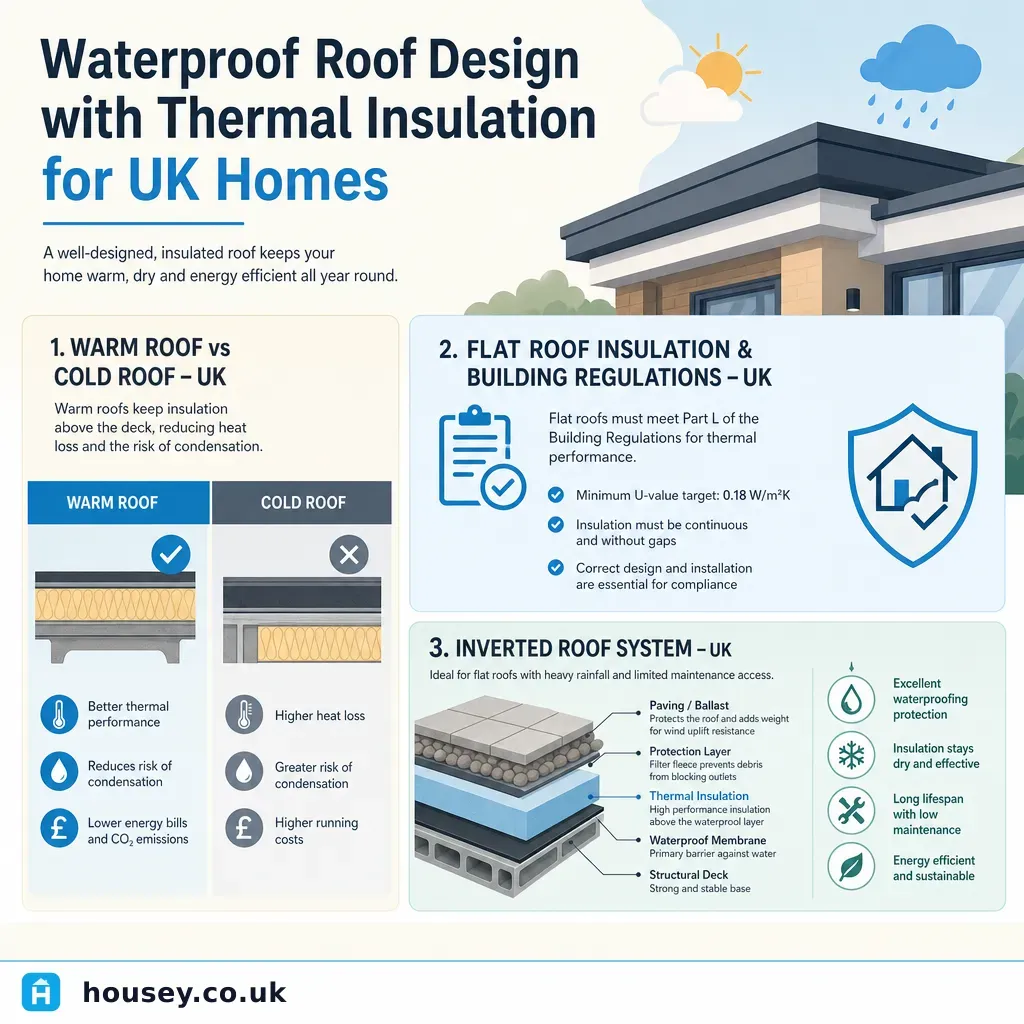
Waterproof Roof Design with Thermal Insulation for UK Homes
The two main approaches to combining waterproofing and thermal insulation in a roof are warm roof and cold roof construction.
 Energy & Retrofit
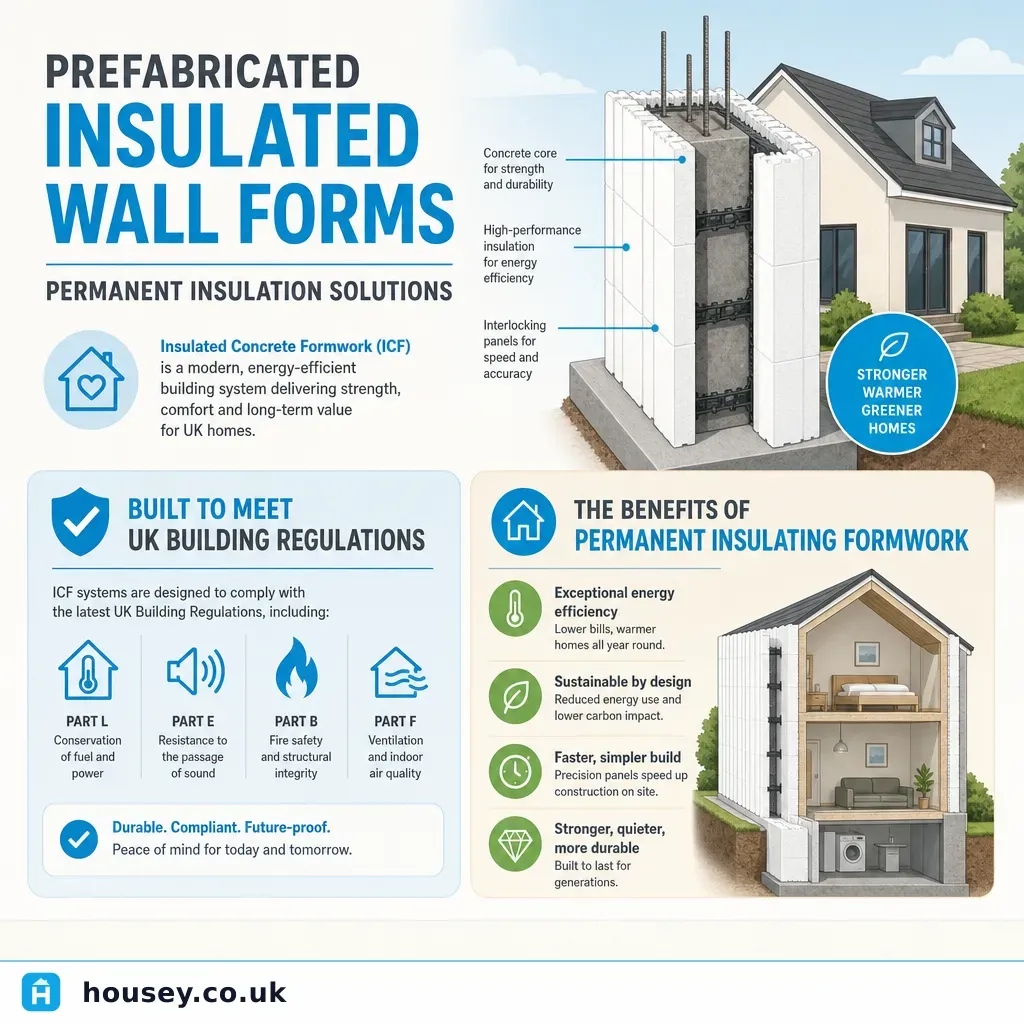
Prefabricated Insulated Wall Forms: Permanent Insulation Solutions
Prefabricated insulated wall forms — including ICF and SIPs systems — deliver high thermal performance by combining permanent insulation with structural concrete or timber in a single wall assembly.
 Energy & Retrofit
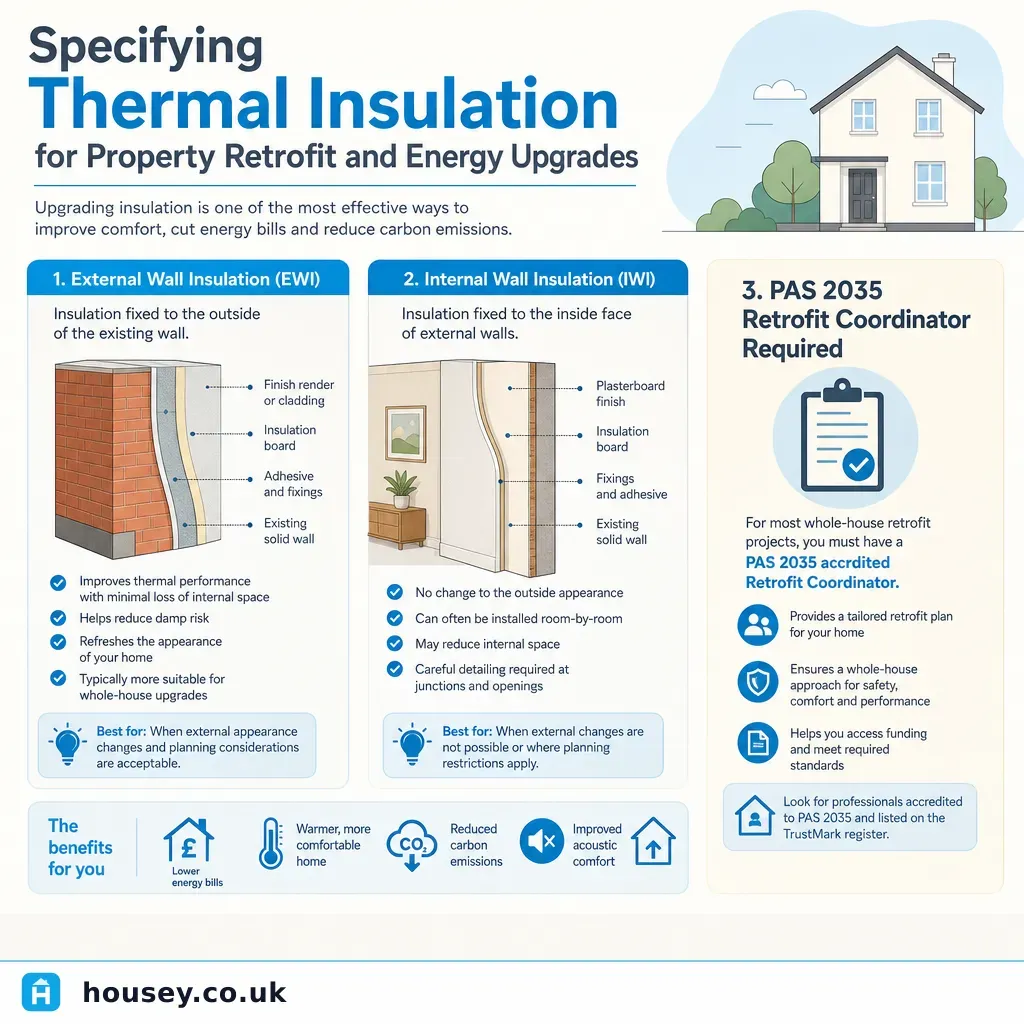
Specifying Thermal Insulation for Property Retrofit and Energy Upgrades
Specifying thermal insulation for UK retrofit requires matching the product to your property's construction, moisture conditions, and heating system.
 Energy & Retrofit
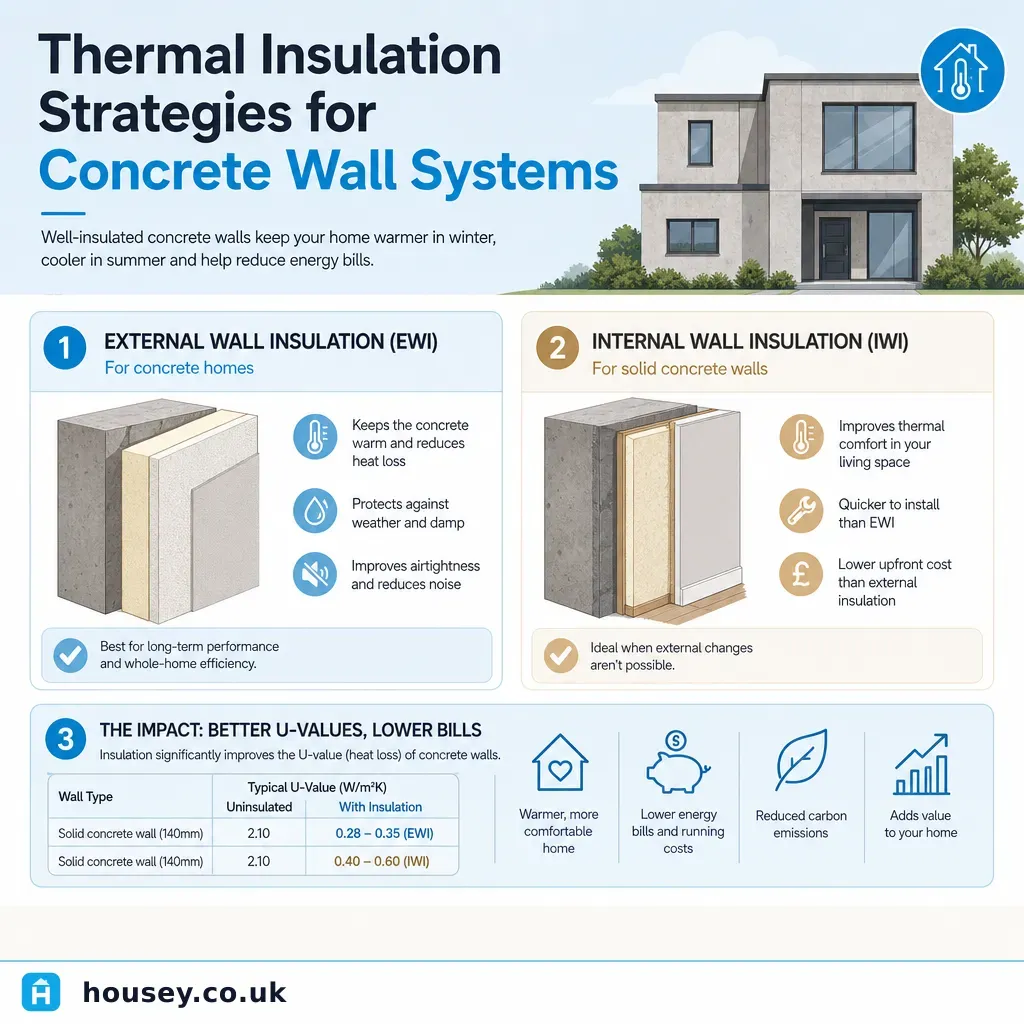
Thermal Insulation Strategies for Concrete Wall Systems
Concrete walls can be insulated using three main approaches: external wall insulation (EWI), internal wall insulation (IWI), or — where a cavity exists — cavity fill.
 Energy & Retrofit
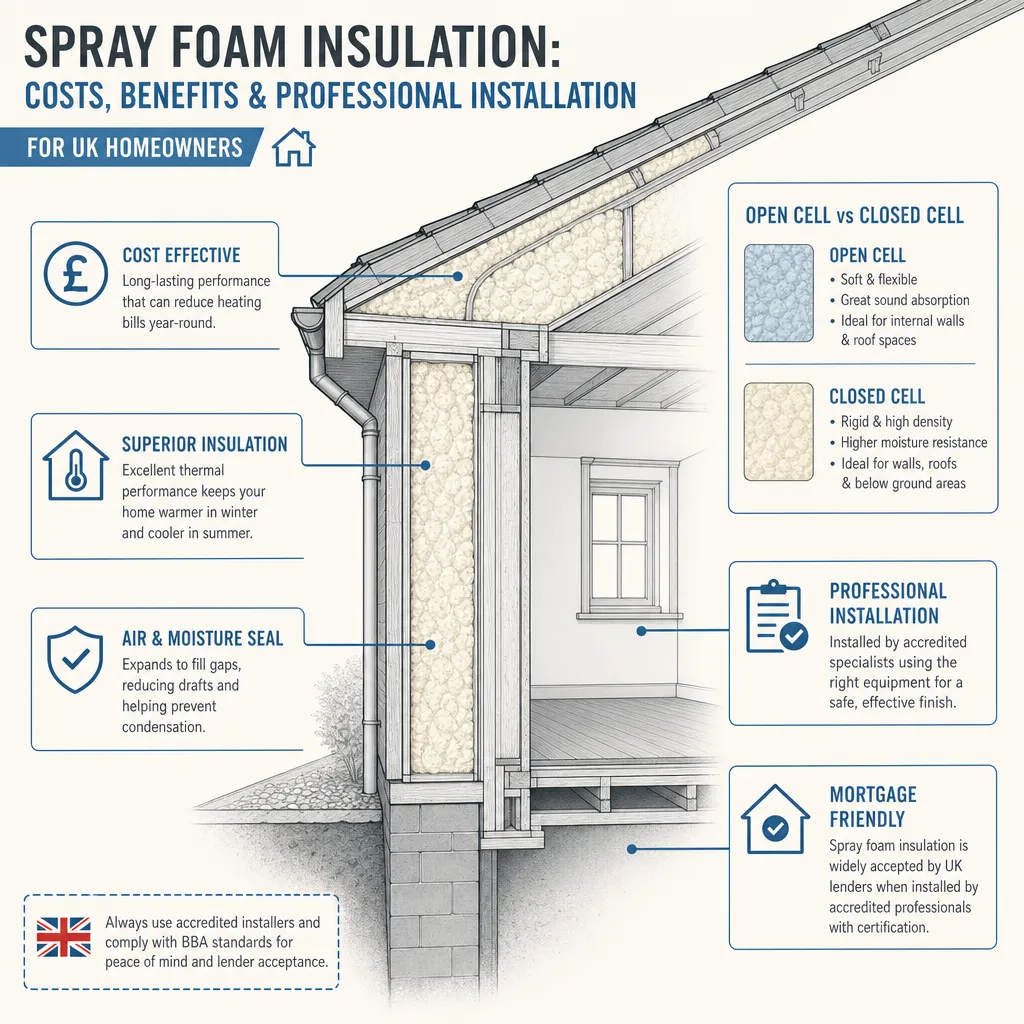
Spray foam insulation: costs, benefits and professional installation
Spray foam insulation costs between £15 and £60 per square metre installed in the UK, depending on whether open-cell or closed-cell foam is used.