Waterproof Roof Design with Thermal Insulation for UK Homes
By Housey · Last reviewed 25th of May 2026
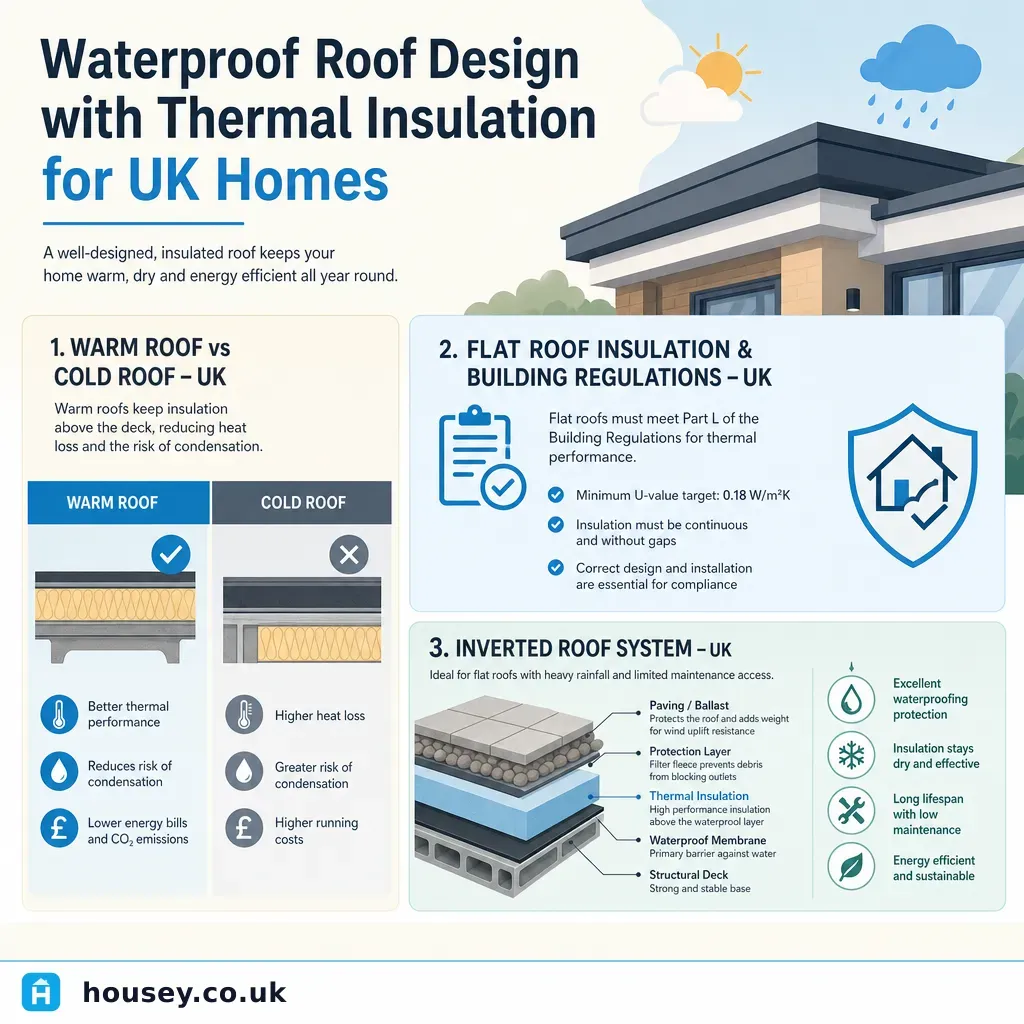
Waterproof Roof Design with Thermal Insulation for UK Homes
Roof construction accounts for around 25% of heat loss in an uninsulated home, making the integration of waterproofing and thermal insulation a critical design decision for new-build projects and retrofit upgrades alike. Questions about roof insulation strategy most commonly arise when a flat roof needs replacing, when a loft conversion is being specified, or when a homeowner is pursuing a whole-house retrofit under PAS 2035. The consequences of a poorly specified roof system — interstitial condensation, structural timber decay, and waterproofing failure — can be expensive and highly disruptive to remedy.
Key points
- Building Regulations Approved Document L1B (England) requires existing roofs being upgraded to achieve a U-value of 0.16 W/m²K or better, where technically and practically feasible.
- Warm roof construction — insulation above the structural deck, below the waterproof membrane — is the standard approach for flat roofs because it keeps the deck above the dew point, dramatically reducing condensation and timber decay risk.
- Cold roof construction requires a minimum 50 mm ventilated air gap above the insulation; omitting this void is one of the most common causes of flat roof timber decay in UK homes.
- Inverted roofs place extruded polystyrene (XPS) insulation above the waterproof membrane, extending membrane service life by protecting it from UV and thermal cycling; standard PIR and mineral wool are not suitable in this position.
- PAS 2035:2023 requires a whole-house Retrofit Assessment before roof insulation is upgraded in funded schemes; the assessor must consider moisture risk alongside thermal performance.
Warm roof, cold roof, and inverted roof: what is the difference?
The position of insulation relative to the structural deck and waterproof membrane defines the thermal strategy and moisture behaviour of any flat or low-pitch roof.
Warm roof
In a warm roof, the insulation layer sits directly above the structural deck, beneath the waterproof membrane. This keeps the structural deck above the dew point throughout the year, preventing condensation and protecting timber or concrete from moisture damage. Warm roof construction is the standard approach for new flat-roof construction and replacement in the UK.
Common insulation materials for warm roofs include:
- PIR (polyisocyanurate) boards — high thermal resistance, relatively thin for a given U-value.
- EPS (expanded polystyrene) boards — lower cost, widely available, slightly lower performance per mm.
- Mineral wool slabs — used where fire performance is a design priority, particularly in multi-occupancy or taller buildings.
Cold roof
A cold roof places insulation between the rafters or joists, with the structural deck and waterproofing above and a ventilated void of at least 50 mm between the insulation and the underside of the deck. Cold roofs were common in UK domestic construction before the 1990s and remain appropriate for pitched roofs with rafter-level insulation.
The critical risk with a cold roof is inadequate or blocked ventilation. Without a clear ventilated void, moisture-laden air from the building condenses on the cold underside of the deck, leading to timber decay that may not be visible until it is advanced.
Inverted roof (protected membrane roof)
The inverted or protected membrane roof reverses the warm roof layer order: the waterproof membrane is applied to the structural deck first, and XPS insulation boards are placed above it, held in place by ballast such as gravel, paving slabs, or a planted substrate for a green roof. The insulation must be non-absorbent; PIR and mineral wool are not suitable for this position.
Inverted roofs are popular for accessible roof terraces and green roofs because the ballast layer can serve as a wearing surface or growing medium, while the membrane beneath is protected from physical damage and temperature extremes.
Comparison: flat roof thermal systems
System | Best for | Insulation position | Condensation risk | Key constraint |
|---|---|---|---|---|
Warm roof | New-build; replacement flat roofs; retrofit upgrades | Above deck, below membrane | Low | Insulation must be continuous; all penetrations fully detailed |
Cold roof | Pitched roofs with rafter-level insulation | Between rafters or joists | Moderate to high if ventilation is inadequate | 50 mm ventilated void essential; cross-ventilation must be confirmed |
Inverted roof | Roof terraces; green roofs; long-term membrane protection | Above membrane, held by ballast | Very low | Must use XPS insulation only; allow for increased structural dead load |
Hybrid warm-cold (pitched) | Loft conversions; maximising habitable loft space | Both between rafters and at ceiling level | Low if detailed correctly | Requires careful vapour control layer at ceiling level |
Which roof system should you choose?
- Choose a warm roof if you are replacing or constructing a flat or low-pitch roof and can achieve the required U-value within the available upstand height.
- Choose an inverted roof if the roof will be used as a terrace or planted roof, or where long-term membrane protection is a priority and the structure can carry the additional ballast load.
- Use cold roof construction only for pitched roofs where rafter depth and cross-ventilation can be confirmed; this approach is not recommended for flat roofs.
- Ask a Retrofit Coordinator if your project is funded by ECO4 or GBIS, or if you are uncertain whether existing ventilation is adequate for the proposed system.
- Check Building Regulations Part L and Part C before finalising the specification — Part C governs resistance to moisture, which is equally important to thermal performance.
- Consult a chartered surveyor or structural engineer if the structural deck or roof timbers show signs of existing decay before any new insulation is added.
Pitched roofs: loft and rafter-level insulation
For pitched roofs, UK homeowners generally have two options depending on whether the loft space is habitable.
Loft floor insulation (cold loft): Mineral wool rolls laid between and across the joists at ceiling level. This is the lowest-cost approach and widely used in UK homes. Recommended installed depth is 270 mm (100 mm between joists plus 170 mm across). Average installed cost for a typical semi-detached house is £300–£600 (indicative UK costs, last reviewed 2026-05-25; source: Energy Saving Trust). The loft void remains unheated; cold-water tanks and pipes must be insulated separately.
Rafter-level (warm loft) insulation: Used when the loft is converted or used as habitable space. Insulation is placed between and below the rafters, making the roof slope part of the thermal envelope. Pre-1980s homes often have insufficient rafter depth for a fully compliant warm roof at rafter level alone; counter-battens or additional framing are commonly needed.
Red flags: when roof insulation has gone wrong
Watch for these signs that a roof insulation system may be underperforming or failing:
- Damp patches or staining on ceilings — may indicate condensation within a cold roof void, or waterproof membrane failure above a warm roof.
- Soft or springy areas on a flat roof surface — may indicate waterlogged or degraded insulation beneath the membrane.
- Mould or discolouration on rafters visible in an unboarded loft — indicates insufficient ventilation in a cold roof construction.
- Blistering or bubbling of a flat roof membrane — often caused by moisture trapped between layers during construction or a previous repair.
- Very cold rooms directly below the roof slope or flat ceiling — suggests insulation gaps, thermal bridges, or incomplete coverage.
- Condensation on roof windows or skylights worsening after insulation works — may indicate reduced ventilation following changes to the roof void.
Important limitations
This article provides general guidance only. The thermal and moisture performance of a roof system depends on the specific construction, materials, building geometry, occupancy pattern, and local climate. A competent professional — a Retrofit Coordinator for funded works, or a chartered surveyor or building engineer for defect diagnosis — should assess the specific situation before work is specified or commenced. Building Regulations requirements differ in Scotland, Wales, and Northern Ireland; always check with your local authority building control.
When this becomes urgent
Seek immediate professional advice if:
- You observe rapid or worsening water ingress after any roof insulation or waterproofing work.
- Roof timbers are visibly decayed, soft, discoloured, or structurally compromised.
- Mould or condensation is worsening after new insulation is installed, which may indicate a ventilation or vapour control failure.
- A contractor proposes installing insulation on a flat roof without a warm-roof or inverted-roof approach.
What to ask a qualified professional
- What system — warm, cold, or inverted — are you specifying, and why is it appropriate for this roof?
- Have you assessed the condition of the existing structural deck and roofing timbers before specifying?
- What U-value will the finished system achieve, and does this meet Building Regulations Part L?
- How are junctions, upstands, penetrations, and abutments detailed to prevent cold bridges?
- What waterproof membrane system are you using, and what warranty does it carry?
- Where is the vapour control layer in the specification, and why?
- Is the installation covered by a manufacturer-backed insurance guarantee?
When to get professional help
A roof survey should precede any insulation work on a flat roof, particularly when the existing membrane and deck condition are unknown. If roof timbers show any sign of decay, a chartered surveyor should assess the cause before insulation is added — covering over existing defects can accelerate deterioration significantly. Any flat roof replacement covering more than 25% of the total roof area is notifiable under Building Regulations Part L; confirm the position with your local authority building control before work starts.
How Housey can help
Housey can connect you with qualified roofers experienced in warm-roof and inverted-roof construction, and with insulation installers for loft and rafter-level insulation work. If you need an independent assessment of your roof's condition or thermal performance, our roof surveys service matches you with local professionals. For funded whole-house projects, our retrofit assessments connects you with PAS 2035-qualified Retrofit Coordinators.
Frequently asked questions
Does replacing a flat roof require building regulations approval?
In most cases, replacing a flat roof covering more than 25% of the total roof area of a house requires building control notification in England, as the work must comply with Building Regulations Part L (thermal performance) and Part C (moisture resistance). Always check with your local authority building control before proceeding.
Can I lay insulation directly on top of an existing flat roof membrane?
This is only appropriate for certain inverted-roof conversions using XPS insulation and ballast. In most cases, flat roof replacement involves stripping back to the structural deck, addressing any decay or defects, and building up a new warm roof system. Laying insulation over a failed membrane risks trapping moisture and accelerating structural decay.
What insulation depth is needed for a warm flat roof under Part L?
The required depth depends on the material's thermal conductivity. To achieve a U-value of 0.16 W/m²K using PIR boards (lambda approximately 0.022 W/mK), you typically need around 140–150 mm of insulation, depending on the deck and finish layers. Your specifier should confirm the precise calculation for your project.
Is flat roof insulation eligible for ECO4 funding?
Flat roof insulation can be included in an ECO4 package where it forms part of a whole-house retrofit under PAS 2035. However, standalone flat roof upgrades are less commonly funded than loft or wall insulation. Check current eligibility with an approved ECO4 installer or the Energy Saving Trust.
Sources and further reading
- Building Regulations Approved Document L — GOV.UK
- Building Regulations Approved Document C — GOV.UK
- PAS 2035:2023 Retrofitting dwellings — BSI / TrustMark
- Roof and loft insulation advice — Energy Saving Trust
- NHBC Standards Chapter 7: Roofs — NHBC
Useful next reads
 Energy & Retrofit
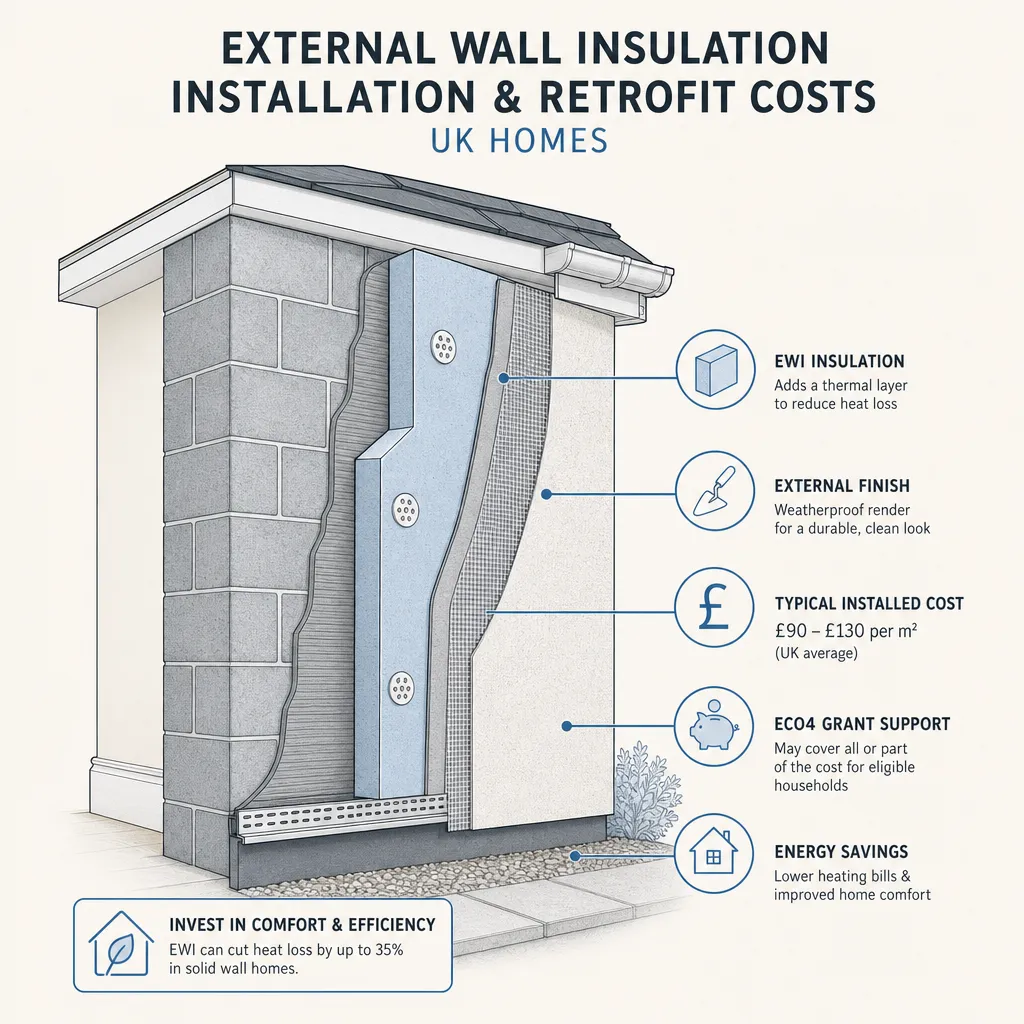
External Wall Insulation Installation and Retrofit Costs
External wall insulation (EWI) in the UK typically costs £8,000–£22,000 for a semi-detached home, depending on wall area, insulation type, and render finish.
 Energy & Retrofit
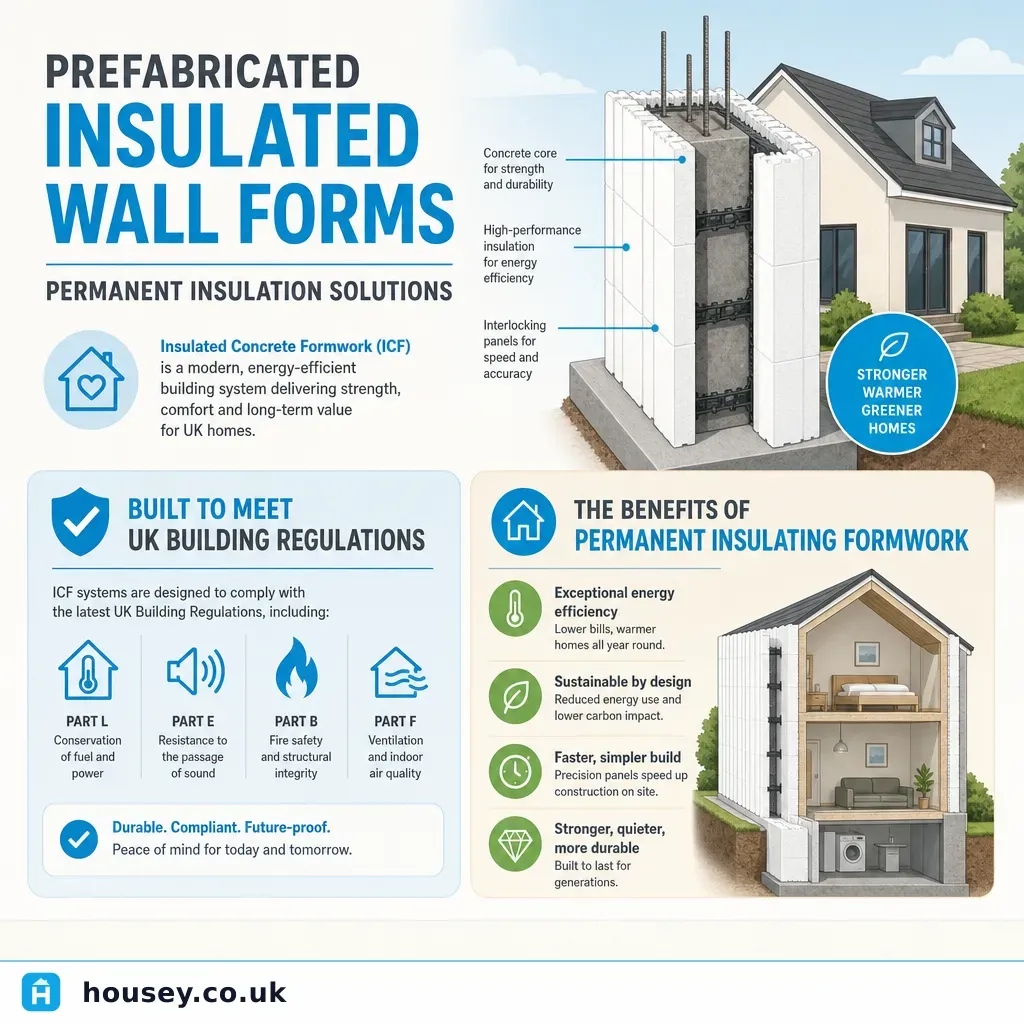
Prefabricated Insulated Wall Forms: Permanent Insulation Solutions
Prefabricated insulated wall forms — including ICF and SIPs systems — deliver high thermal performance by combining permanent insulation with structural concrete or timber in a single wall assembly.
 Energy & Retrofit
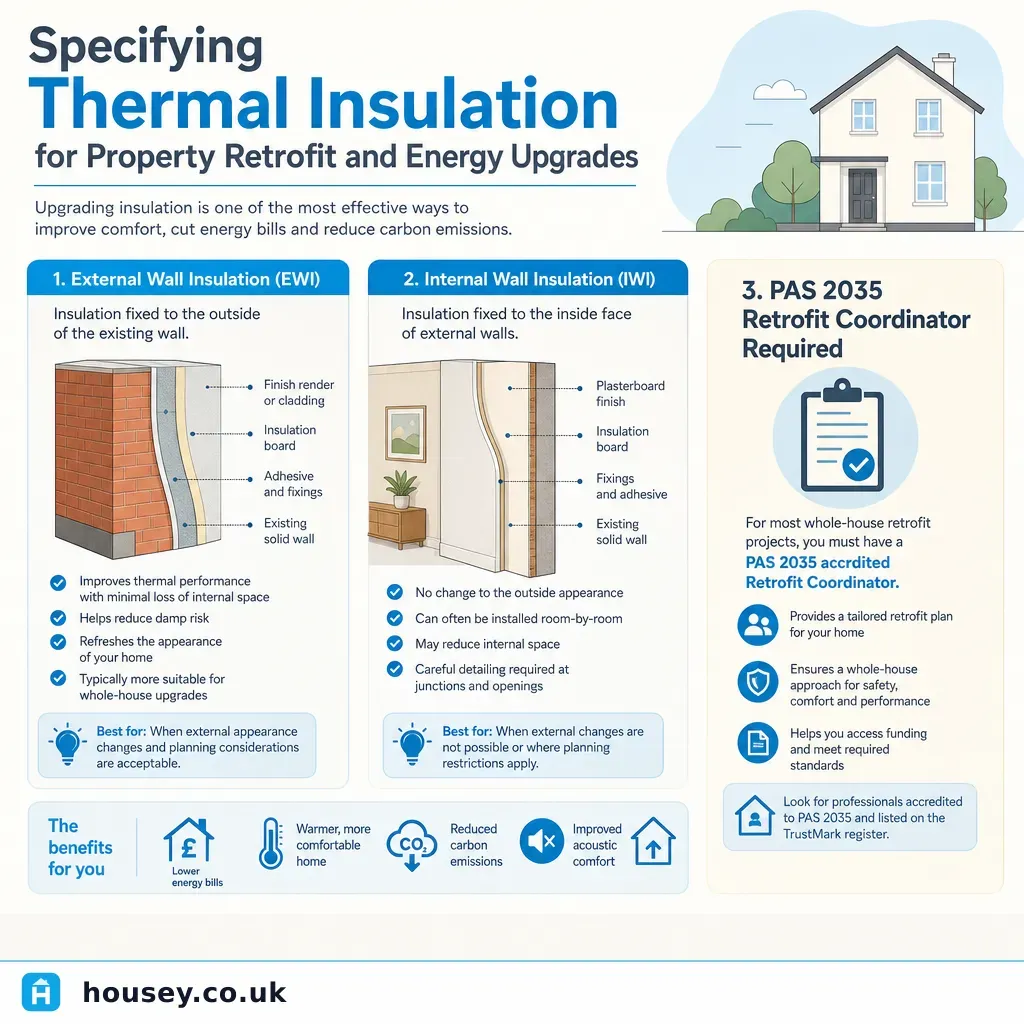
Specifying Thermal Insulation for Property Retrofit and Energy Upgrades
Specifying thermal insulation for UK retrofit requires matching the product to your property's construction, moisture conditions, and heating system.
 Energy & Retrofit
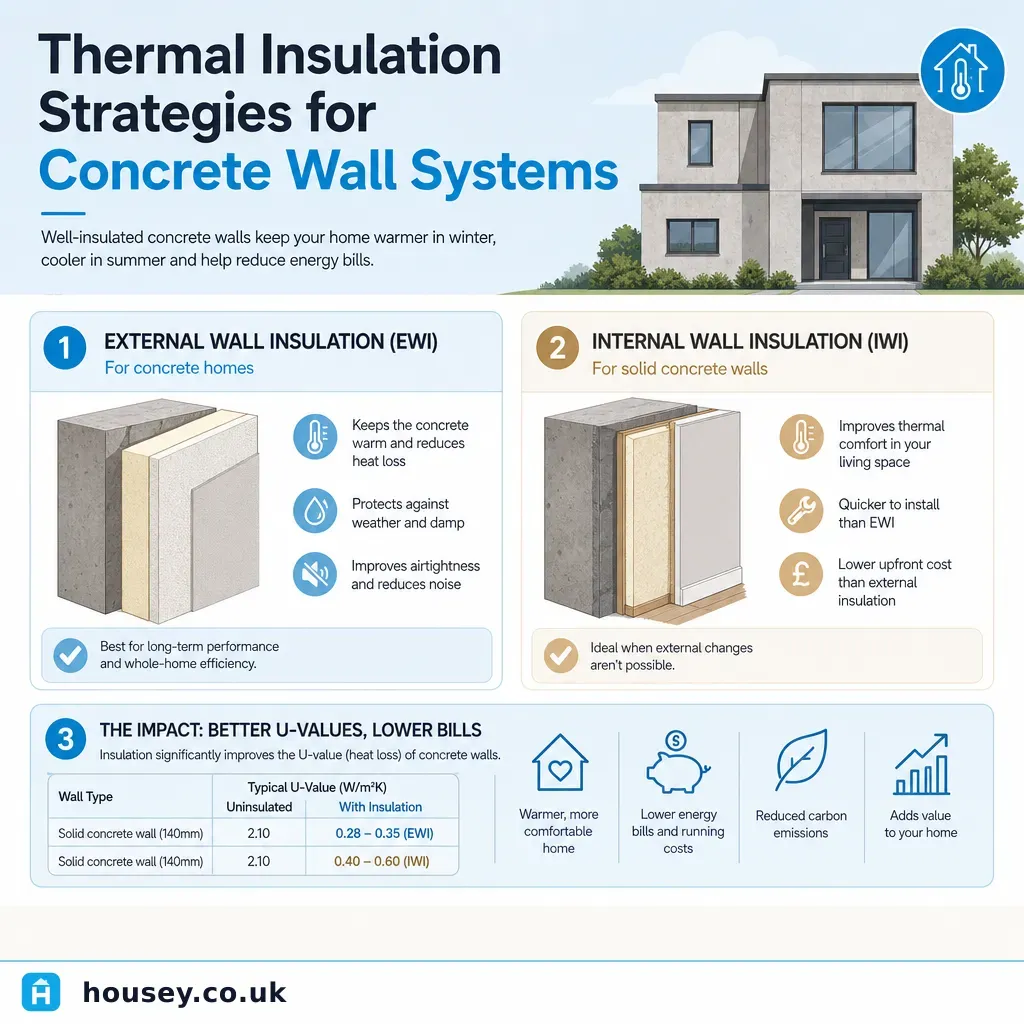
Thermal Insulation Strategies for Concrete Wall Systems
Concrete walls can be insulated using three main approaches: external wall insulation (EWI), internal wall insulation (IWI), or — where a cavity exists — cavity fill.
 Energy & Retrofit
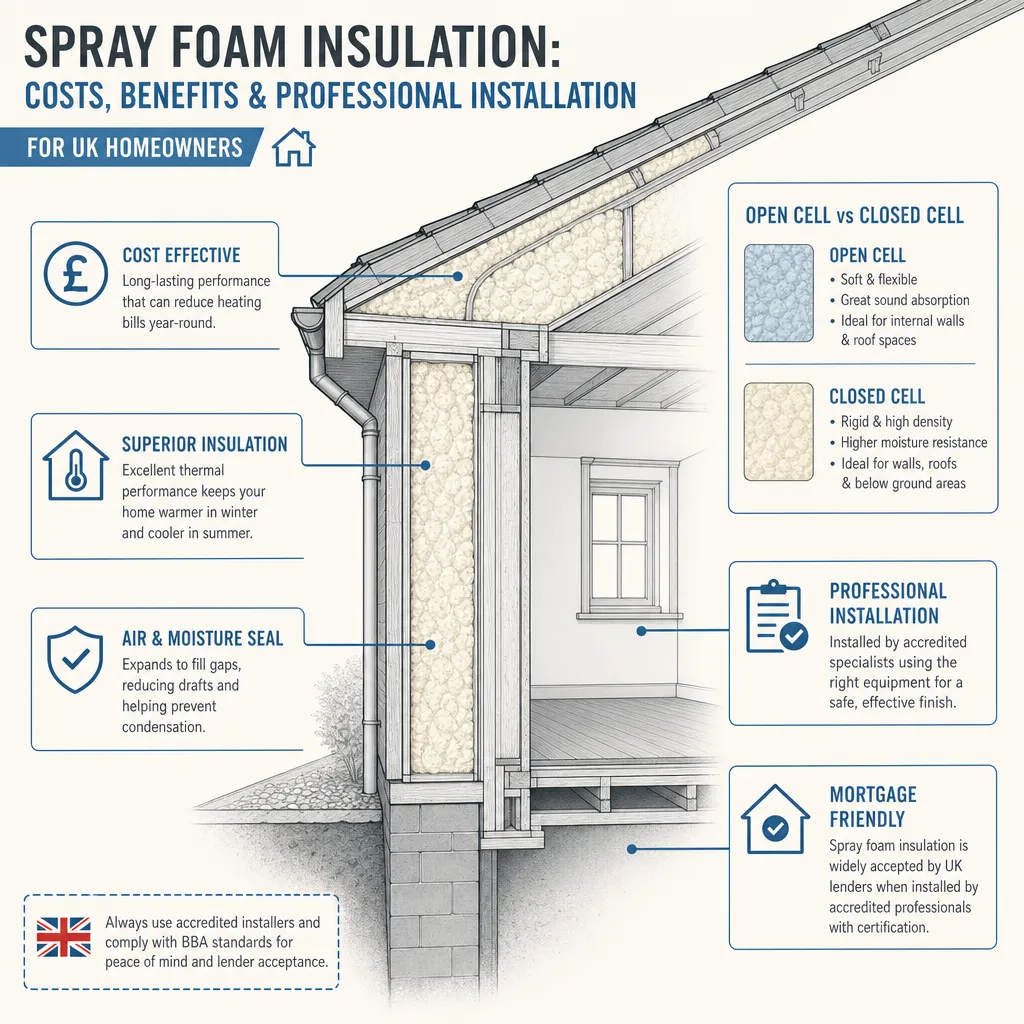
Spray foam insulation: costs, benefits and professional installation
Spray foam insulation costs between £15 and £60 per square metre installed in the UK, depending on whether open-cell or closed-cell foam is used.