Thermal Insulation Strategies for Concrete Wall Systems
By Housey · Last reviewed 25th of May 2026
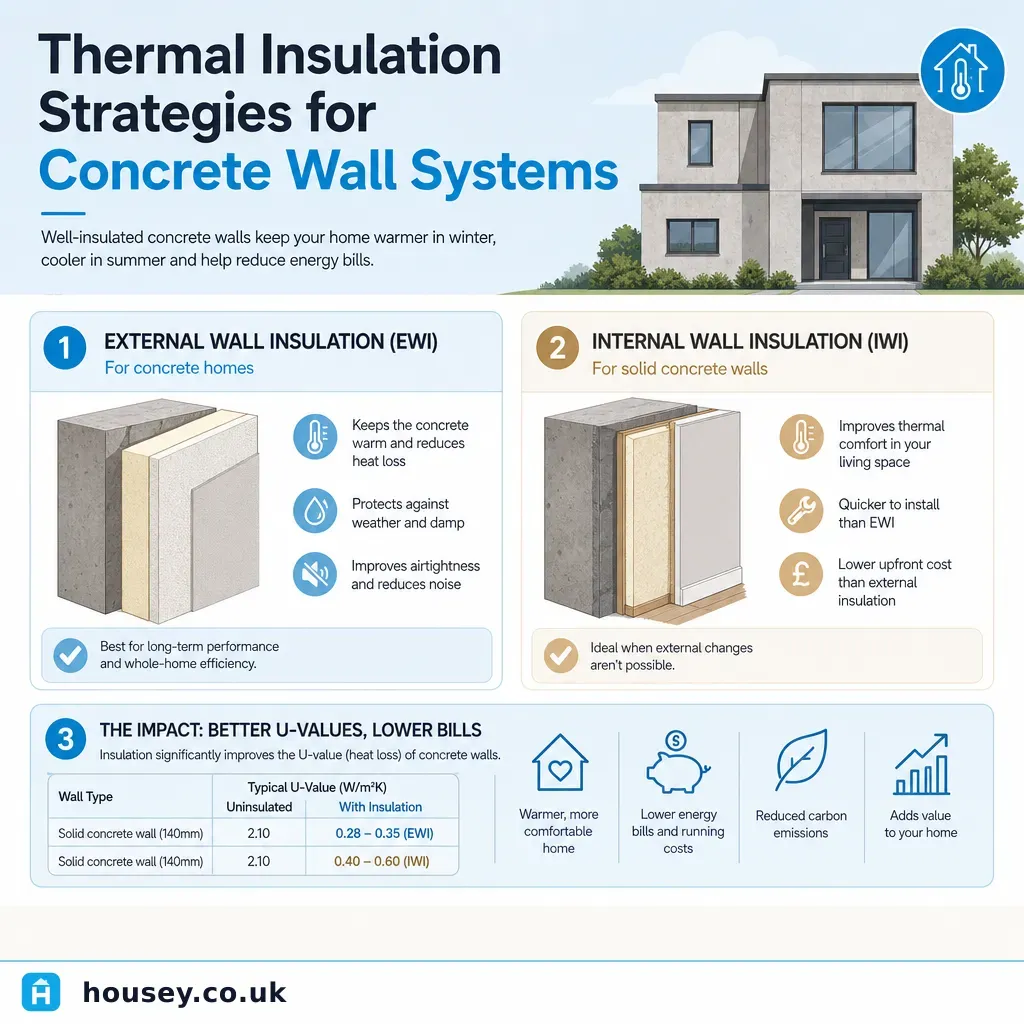
Thermal Insulation Strategies for Concrete Wall Systems
Concrete walls — whether in-situ cast, precast panel, or solid dense-concrete construction — present specific challenges when it comes to meeting the thermal performance requirements that modern energy legislation demands. In the UK, millions of homes built with concrete wall systems before the 1980s fall well short of the U-value standards that now apply to upgraded and extended elements. Choosing the wrong insulation strategy for a concrete wall can introduce moisture problems, interstitial condensation, or planning complications that are harder and more costly to resolve than the original heat-loss problem.
Key points
- Building Regulations Approved Document L (2021, England) sets a target U-value of 0.18 W/m²·K for new external walls and a threshold of 0.30 W/m²·K for existing walls being significantly upgraded, subject to cost-effectiveness assessment.
- External Wall Insulation (EWI) is generally preferred for solid concrete walls because it places insulation on the cold face, reducing thermal bridging and condensation risk on the inner wall surface.
- Internal Wall Insulation (IWI) on solid concrete must be accompanied by a condensation risk analysis — using the Glaser method to BS EN 15026 or dynamic WUFI modelling — due to the risk of interstitial condensation forming behind the insulation layer.
- PAS 2035:2023 — the UK standard for domestic retrofit — requires a TrustMark-registered Retrofit Coordinator to assess moisture risk and ventilation strategy before any insulation system is specified for solid-wall or non-traditional construction.
- EWI on a property in a conservation area, or on a listed building, may require planning consent or listed building consent from the local planning authority before any work starts.
Important limitations
This article provides a general overview of insulation options for concrete wall construction. The right approach for any specific property depends on its exact construction type, exposure zone, existing moisture conditions, ventilation provision, and local planning constraints. A qualified professional — typically a Retrofit Coordinator registered with TrustMark and working to PAS 2035 — should inspect and assess your property before any insulation system is specified or installed. Nothing in this article constitutes structural, moisture-risk, or energy-performance advice for any specific building.
Understanding concrete wall construction types in UK homes
Not all concrete wall systems are the same, and the appropriate insulation strategy differs by construction type. Confirming the exact type before specifying insulation is essential.
Construction type | UK examples and period | Wall structure | Key insulation challenge |
|---|---|---|---|
In-situ cast concrete | 1950s–70s social housing, some self-builds | Monolithic solid concrete | High thermal mass; cold bridging at floor and ceiling junctions |
Precast concrete panels | Laing Easiform, Wimpey No-Fines, Bison (1950s–80s) | Solid or ribbed precast elements | Panel joints, mortar beds, condensation at junctions |
No-fines concrete | Common 1950s–60s council housing | Permeable coarse aggregate matrix | Internal surface moisture; specialist breathable EWI render required |
Concrete-framed with infill | 1960s–80s flats and low-rise | In-situ frame, lightweight infill panels | Frame thermal bridging, complex interfaces at junctions |
Insulating Concrete Formwork (ICF) | Self-builds from c.2000 onwards | EPS formwork retained permanently as insulation | Better-performing; junction detailing and airtightness still critical |
The three main insulation strategies for concrete walls
External Wall Insulation (EWI)
EWI involves fixing insulation boards — typically EPS, mineral wool, or phenolic — to the outside of the concrete wall and finishing with a reinforced render or cladding system. For solid concrete walls, EWI is generally preferred because:
- It places the insulation on the cold side of the structure, minimising the risk of interstitial condensation within or on the inner wall face.
- It treats structural cold bridges at floor slab edges, lintels, and joist ends that internal insulation leaves unaddressed.
- It preserves internal floor area and avoids relocating sockets, switches, and internal pipework.
- It can improve the external appearance of an older concrete building, though this requires planning consideration in conservation areas.
To upgrade an existing solid concrete wall to 0.30 W/m²·K, typically 60–100 mm of EPS or mineral wool is required depending on baseline wall performance. Achieving 0.18 W/m²·K for a new-build standard may require 150–200 mm. EWI fixings must be engineered to carry the load through the insulation layer into the concrete substrate. In some precast systems, panel joints must be treated separately before cladding.
Internal Wall Insulation (IWI)
IWI attaches insulation to the inside face of the concrete wall — typically using insulated plasterboard bonded directly or a stud-frame system with mineral wool fill. For solid concrete walls, IWI carries a higher moisture risk than EWI because:
- The concrete wall remains cold behind the insulation, creating a condensation risk at that cold face.
- Structural cold bridges at floor-edge junctions remain unaddressed, limiting the overall thermal benefit.
- Usable floor area is permanently reduced — typically by 80–120 mm per wall treated.
- Services (sockets, switches, radiators, pipework) on affected walls must be relocated.
IWI may be the only viable option where EWI is restricted by planning constraints, site boundaries, or adjoining structures. If IWI is specified for a solid concrete wall, a vapour control layer and a full condensation risk analysis are essential requirements, not optional extras.
Cavity fill
Some concrete-framed buildings with an identifiable cavity — including certain 1970s–80s system-built types — can have cavity fill insulation retrofitted. This is less common for concrete construction than for traditional masonry cavity walls. A specialist surveyor should confirm that any cavity is clear, dry, and structurally suitable before cavity fill is specified.
When this becomes urgent
Seek professional advice without delay if any of the following apply to your property:
- Visible damp patches, mould, or persistent condensation on internal concrete wall faces — insulating without addressing the moisture source first can trap moisture and cause structural deterioration.
- Evidence of carbonation, spalling concrete, or rust staining from reinforcing steel — common in buildings over 50 years old and a signal that structural assessment should precede insulation work.
- You are planning IWI on a solid concrete wall without a condensation risk analysis having been carried out.
- You have been offered ECO4 or Great British Insulation Scheme funding and need to confirm the proposed system is appropriate for your specific construction type.
- The property is listed or in a conservation area and you have not yet confirmed planning requirements with your local planning authority.
What to ask a qualified professional
Before instructing a Retrofit Coordinator, energy assessor, or insulation installer for work on concrete walls, ask:
- What is the confirmed construction type of my walls, and how has this been established — by inspection, physical testing, or documentary evidence?
- Which insulation system do you recommend, and why is it appropriate for my wall type, exposure zone, and moisture conditions?
- What condensation or interstitial moisture risk does the proposed system introduce, and how will it be managed?
- Has a condensation risk analysis been carried out, and which method was used — Glaser, BS EN 15026, or WUFI dynamic modelling?
- What ventilation strategy is proposed to manage any increase in airtightness resulting from the work?
- Is planning permission or listed building consent required for this system on my property?
- Which TrustMark-registered installer will carry out the work, and what system warranty is provided?
- Will an updated EPC be produced on completion to reflect the improvement?
Homeowner checklist before insulating concrete walls
Use this checklist to confirm you are prepared before any insulation work starts:
When to get professional help
Insulating concrete walls is a technically demanding retrofit intervention — not a suitable DIY project. The consequences of poor specification include trapped moisture, interstitial condensation, structural damage, and planning enforcement action. The cost of remediation consistently exceeds the energy savings the insulation was intended to deliver.
Always appoint a TrustMark-registered Retrofit Coordinator working to PAS 2035 for whole-house retrofits, and a TrustMark-registered installer for any EWI or IWI system on concrete construction. Where structural concerns are present — spalling, cracking, or reinforcement corrosion — engage a chartered structural engineer before specifying any insulation system.
How Housey can help
Housey connects you with vetted insulation installers experienced in EWI and IWI on concrete construction, and energy-efficiency consultants who can advise on the correct system for your property and model the expected U-value improvement. A retrofit assessment will confirm your wall construction type, existing thermal performance, and the most suitable insulation strategy — and will identify moisture or planning considerations before you commit to a specification. Where structural concerns need addressing first, Housey's structural engineering service can arrange a preliminary inspection.
Frequently asked questions
Do I need building regulations approval to insulate my concrete walls?
In most cases, yes. Adding insulation to an existing external wall — whether EWI, IWI, or cavity fill — is notifiable under Building Regulations in England and Wales if it materially affects the thermal performance of the element. You will need to demonstrate the upgraded wall achieves the required U-value (typically 0.30 W/m²·K for existing elements) and that moisture risk has been addressed. Engage a building control body — local authority building control or a registered building control approver — early in the project.
What is the most appropriate insulation for a 1960s no-fines concrete house?
No-fines concrete is porous and susceptible to moisture retention, making internal insulation particularly risky without specialist detailing. External Wall Insulation using a breathable, vapour-open render system designed specifically for no-fines substrates is generally the preferred approach. Fixings must be anchored into the structural frame rather than the no-fines surface alone. A contractor with specific no-fines experience should be appointed; a PAS 2035 Retrofit Coordinator can help identify suitable specialists.
Will insulating concrete walls affect my mortgage or property value?
EWI changes the external dimensions and appearance of a property, which may require notification to your mortgage lender. Some lenders have specific conditions for non-standard construction types — if your property is already classified as non-traditional concrete construction, check with your lender before any insulation work begins. A well-specified and certificated EWI system that improves the EPC rating generally has a neutral to positive effect on value, though outcomes vary by location and market conditions.
How much does external wall insulation on a concrete house cost?
Indicative UK costs, last reviewed 2026-05-25. EWI installed by a TrustMark-registered contractor typically costs £80–£150 per m² for a standard EPS or mineral wool system including render finish, depending on insulation thickness, access requirements, and chosen finish. For a three-bedroom semi-detached house with approximately 80 m² of treated wall area, total costs are broadly in the range of £7,000–£14,000. Funding may be available through ECO4 or the Great British Insulation Scheme for eligible households. Always obtain at least three written quotes. Source: Energy Saving Trust cost guidance.
Sources and further reading
- Approved Document L: Conservation of fuel and power (2021) — GOV.UK
- PAS 2035:2023 — Retrofitting dwellings for improved energy efficiency — BSI Group
- TrustMark: Find a registered retrofit installer — TrustMark
- Solid wall insulation guidance — Energy Saving Trust
- ECO4 guidance for installers — GOV.UK
- Thermal insulation: avoiding risks (BR 262) — Building Research Establishment
Useful next reads
 Energy & Retrofit
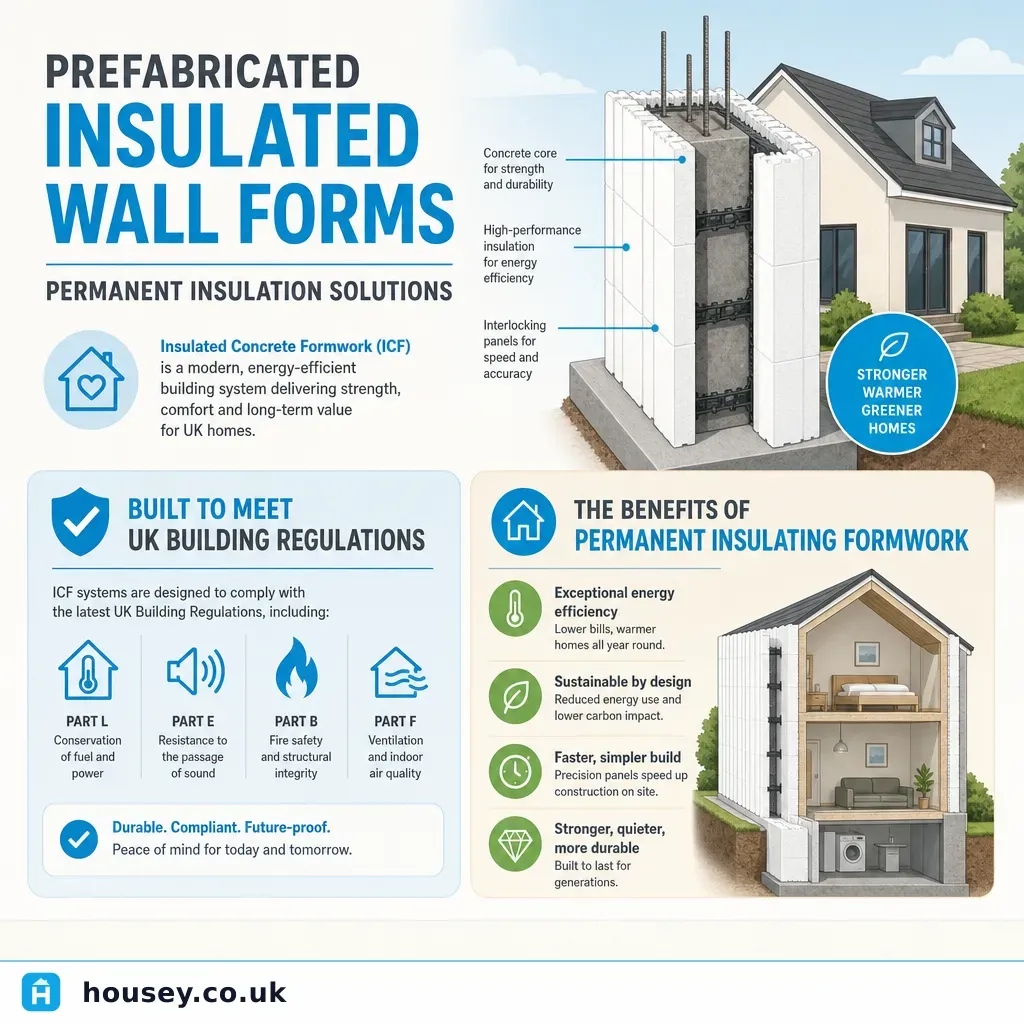
Prefabricated Insulated Wall Forms: Permanent Insulation Solutions
Prefabricated insulated wall forms — including ICF and SIPs systems — deliver high thermal performance by combining permanent insulation with structural concrete or timber in a single wall assembly.
 Energy & Retrofit
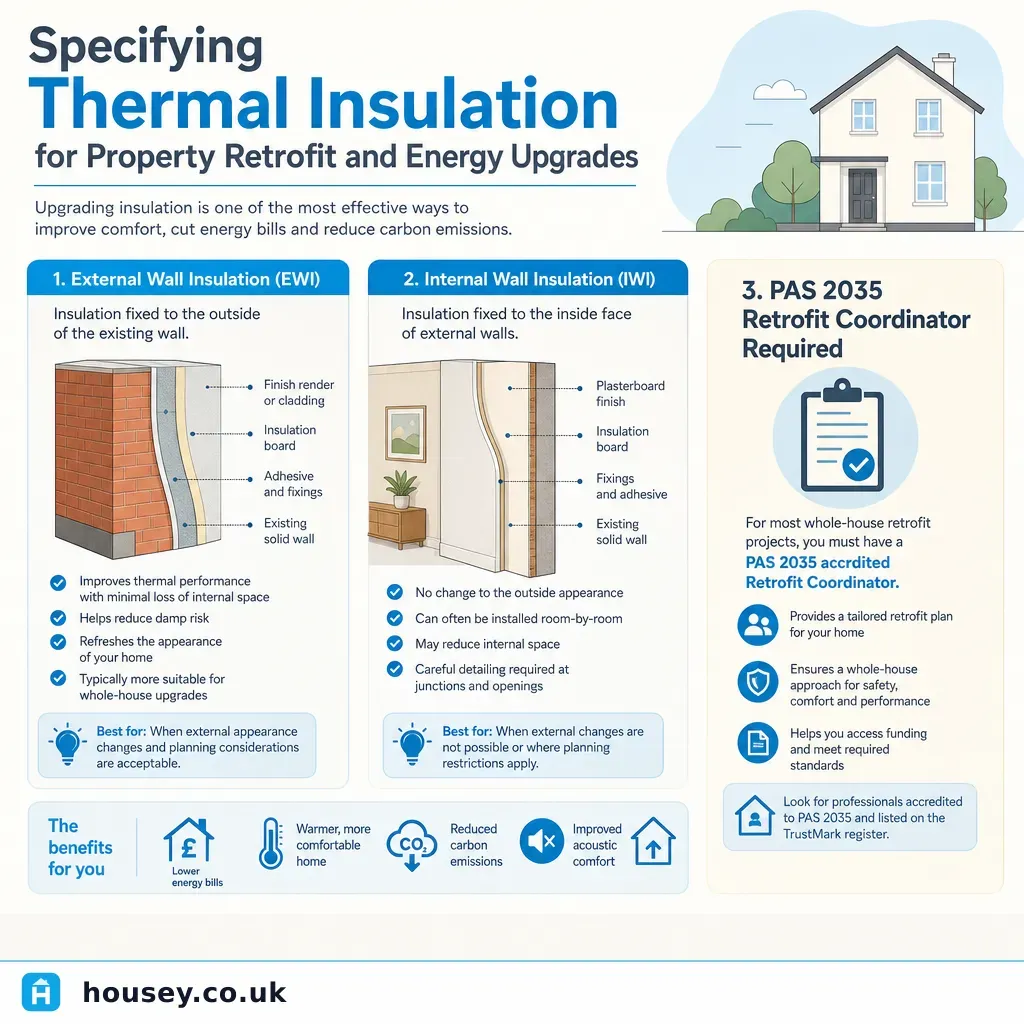
Specifying Thermal Insulation for Property Retrofit and Energy Upgrades
Specifying thermal insulation for UK retrofit requires matching the product to your property's construction, moisture conditions, and heating system.
 Energy & Retrofit
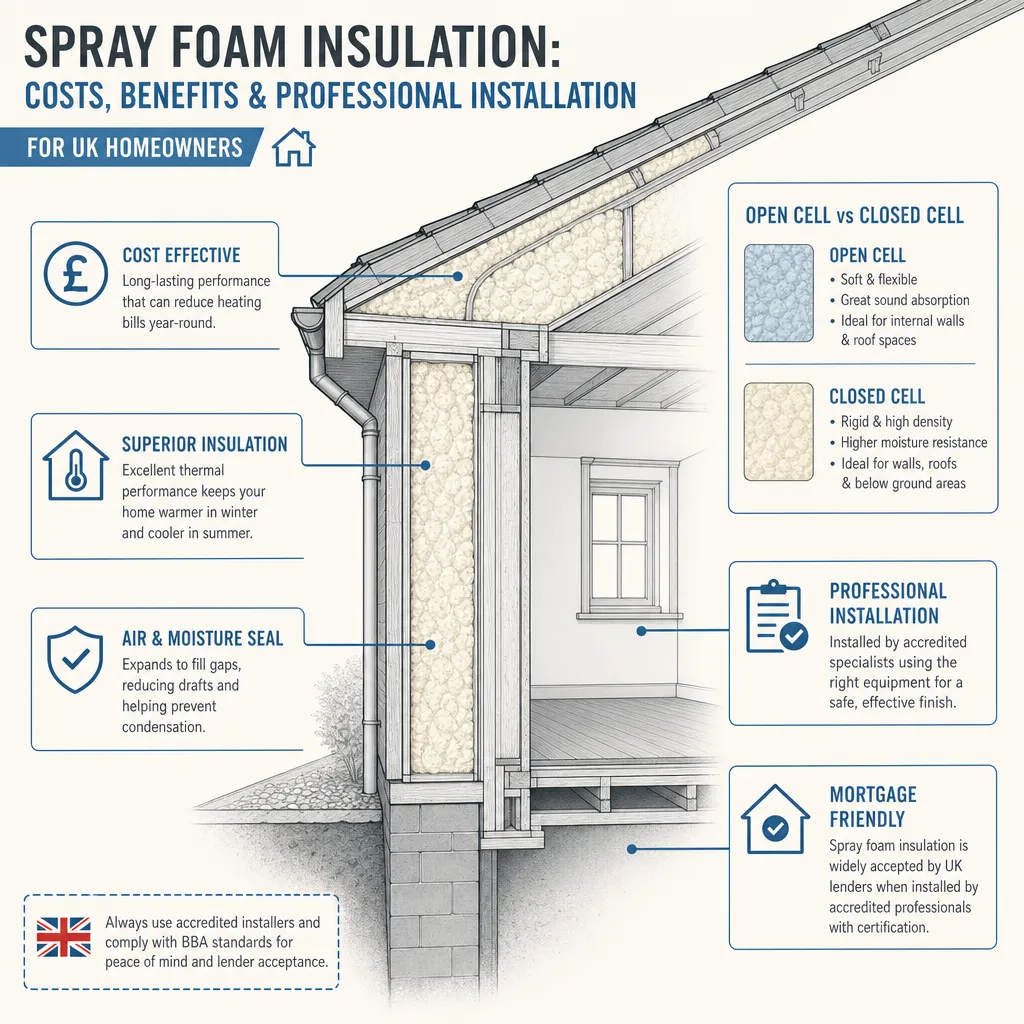
Spray foam insulation: costs, benefits and professional installation
Spray foam insulation costs between £15 and £60 per square metre installed in the UK, depending on whether open-cell or closed-cell foam is used.
 Energy & Retrofit
Insulating Original Plaster Walls: Methods and Considerations
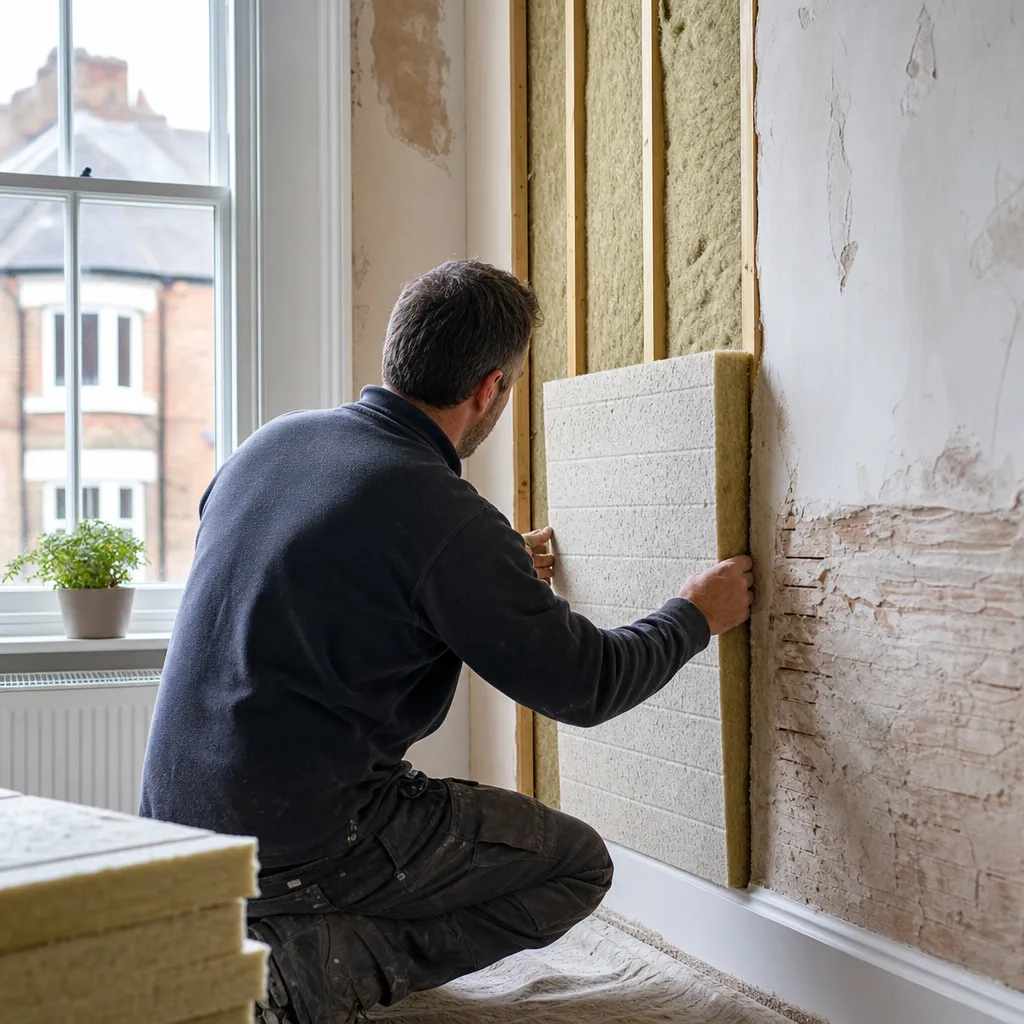
Original plaster walls — particularly lime-based finishes in pre-1919 homes — require breathable insulation systems to avoid trapping moisture.
 Energy & Retrofit
Wall Insulation: Cost, Methods, and Energy Efficiency Gains
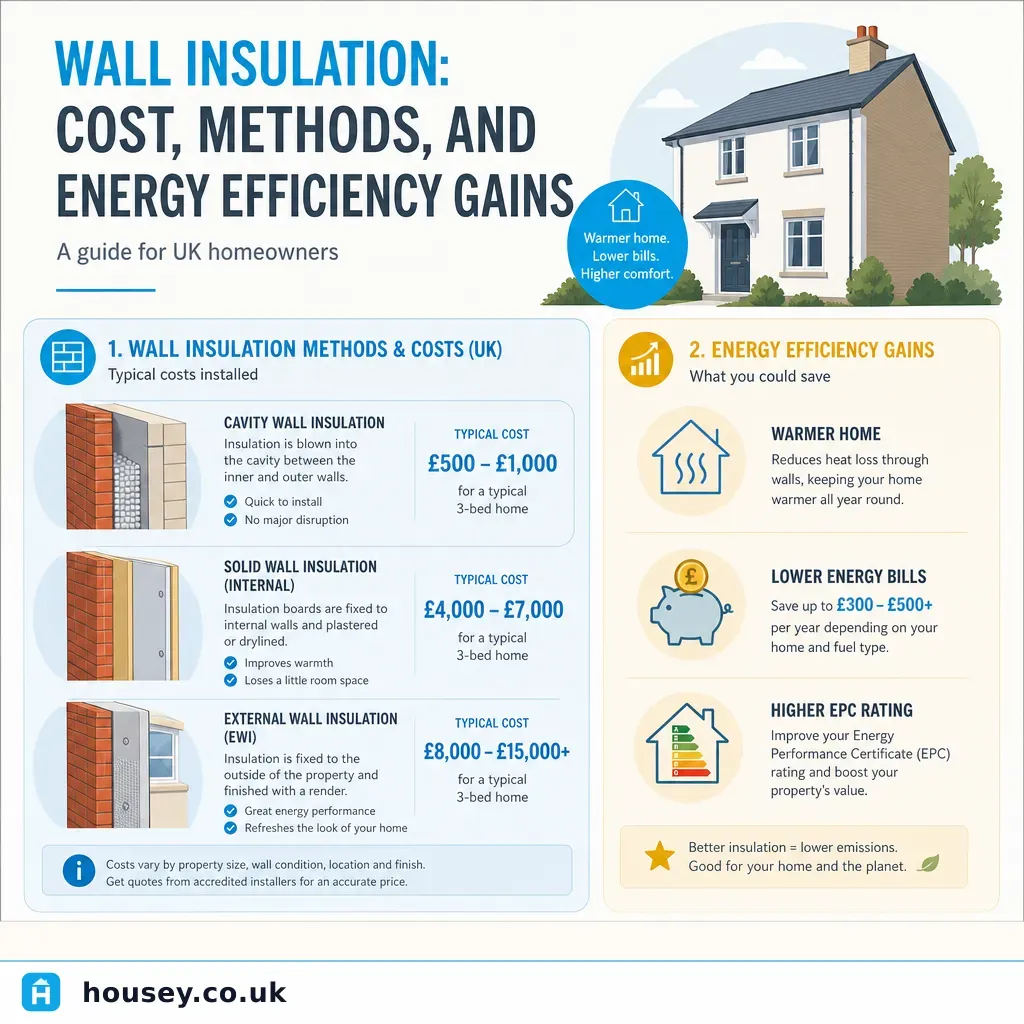
Wall insulation in UK homes uses one of three main methods: cavity wall insulation for post-1920 homes with an unfilled cavity, external wall insulation for solid-walled properties, and internal wall insulation where external changes are not permitted.