Extractor Fan Installation and Ventilation Costs
By Housey · Last reviewed 6th of May 2026
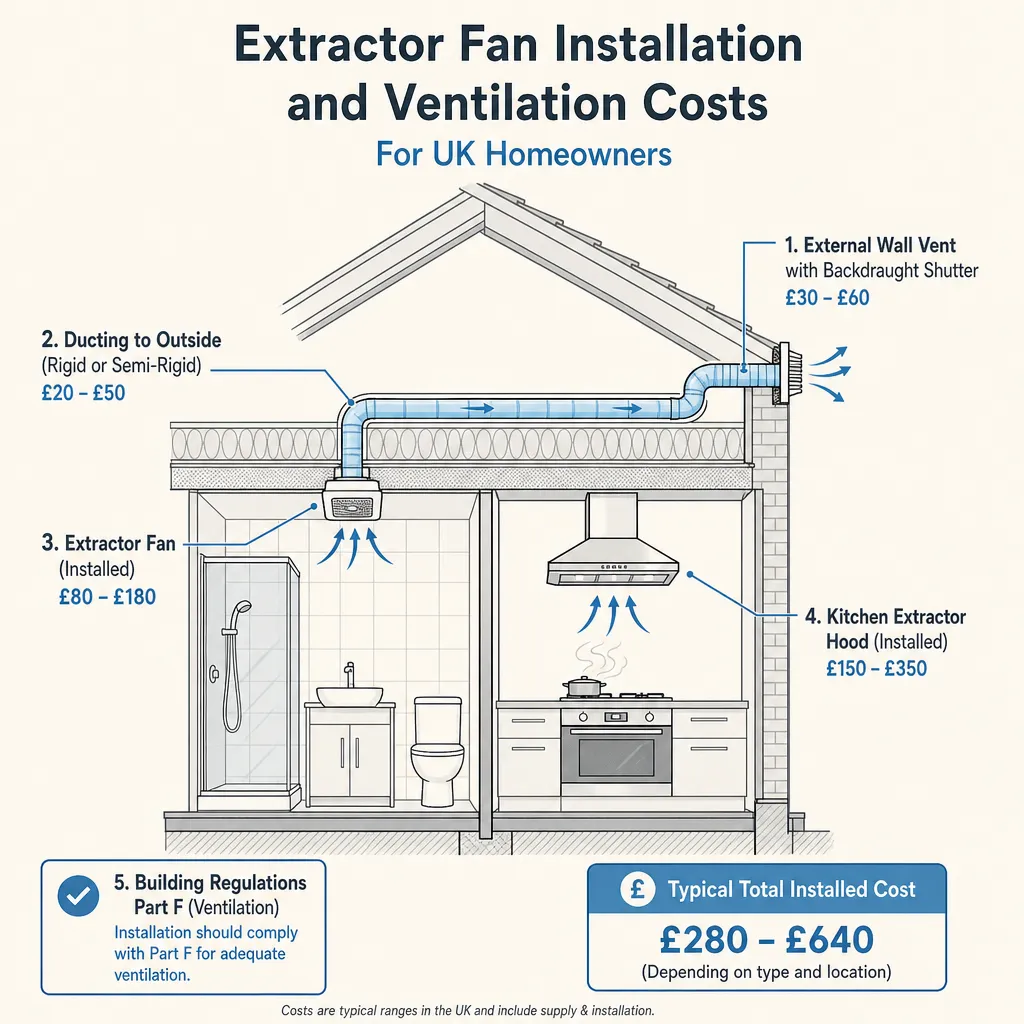
Extractor Fan Installation and Ventilation Costs
Inadequate ventilation is one of the most common causes of condensation damp in UK homes, and many properties — particularly those built before modern airtightness standards — still rely on original units that no longer meet current performance requirements. Extractor fans are a legal requirement in new or substantially renovated bathrooms and kitchens under Building Regulations, and getting the specification and installation right affects both regulatory compliance and indoor air quality. Whether you are replacing a failed unit, upgrading before a sale, or fitting ventilation for the first time following a loft conversion or extension, understanding costs and obligations helps avoid expensive mistakes.
Key points
- Building Regulations Approved Document F requires bathrooms to have a minimum extract rate of 15 litres per second (l/s) and kitchens 30 l/s (60 l/s adjacent to the hob) for intermittent mechanical extract.
- New fan wiring in bathroom zones defined by BS 7671 is a notifiable activity under Part P; a NICEIC- or NAPIT-registered electrician should carry out or certify the work.
- Extracted air must discharge to the external face of the building — not into a roof void or wall cavity — under Approved Document F requirements.
- Indicative UK supply-and-install costs range from £150–£350 for a standard axial bathroom fan to £500–£1,500+ for a centrifugal or whole-room system (Indicative UK costs, last reviewed 2026-05-06).
What Building Regulations require
Approved Document F (Volume 1: Dwellings, 2021 edition) sets minimum extract rates for dwellings. Like-for-like replacements do not always trigger a full compliance assessment, but the new unit should meet or exceed the original specification. If a renovation is substantial enough to constitute a material change of use, full Part F compliance applies.
Room type | Minimum intermittent extract rate | Notes |
|---|---|---|
Bathroom (with or without WC) | 15 l/s | Overrun timer recommended |
Separate WC / sanitary accommodation | 6 l/s | — |
Utility room | 30 l/s | — |
Kitchen — general | 30 l/s | — |
Kitchen — adjacent to hob | 60 l/s | Intermittent extract rate |
Overrun timers (minimum 15 minutes post-occupancy) and humidity sensors are recommended under Part F for bathrooms without an openable window.
Types of extractor fan and typical installed costs
Fan type | Best for | Not ideal for | Typical installed cost |
|---|---|---|---|
Axial (wall or ceiling) | Short duct runs ≤1.5 m, standard bathrooms | Long or complex duct runs | £150–£350 |
Centrifugal (inline or ceiling) | Long runs, kitchens, larger wet rooms | Very restricted ceiling voids | £300–£700 |
Positive Input Ventilation (PIV) | Whole-house condensation, homes with a usable loft | No-loft properties, listed buildings | £400–£900 |
Mechanical Ventilation with Heat Recovery (MVHR) | New builds, deep retrofits, airtight homes | Leaky older properties | £2,000–£6,000+ |
Recirculating kitchen canopy | No external duct route available | Moisture or combustion gas removal | £200–£600 |
Indicative UK costs, last reviewed 2026-05-06. Prices vary by property type, duct run length, and region.
What drives installation costs
Duct run and route: Each additional metre of duct adds material and labour cost. A fan exiting directly through an adjacent external wall costs far less than one requiring a ceiling run to a roof tile or soffit vent.
Controls: Humidistat and timer-delay fans add £20–£80 to unit cost but improve moisture removal and reduce energy waste compared with basic on/off models.
Electrical work: A new fused spur adds £100–£250 to the total. Any wiring in bathroom zones under BS 7671 must be certified under Part P by a registered electrician.
Making good: Cutting vent penetrations, repairing tiling, and making good plasterwork around new wiring typically adds £50–£150 to the overall project cost.
Which type of fan does your home need?
- Choose an axial fan if the bathroom adjoins an external wall, the duct run is under 1.5 m, and it is a like-for-like replacement.
- Choose a centrifugal or inline fan if the duct run is 3 m or longer, has bends, or serves a kitchen or large wet room requiring higher static pressure.
- Consider PIV if you have persistent whole-house condensation and a usable loft — it avoids room-by-room ductwork and suits many 1930s to 1980s UK homes.
- Consider MVHR if you are carrying out a deep energy retrofit or building an airtight extension and want heat recovery specified as part of a PAS 2035 plan.
- Book a ventilation and condensation assessment if mould returns quickly after treatment, or if you are unsure what specification your property needs.
What to ask before accepting a quote
- What extract rate (l/s) does the specified fan deliver, and does it meet Part F minimums for this room type?
- How will the duct be routed, and where will the external termination be positioned?
- Is any electrical work notifiable under Part P, and are you registered with NICEIC, NAPIT, or an equivalent competent person scheme?
- Does the price include making good around the duct penetration — tiling, plasterwork, and external vent cover?
- What product warranty applies, and can I see the data sheet confirming performance figures?
- Is VAT included in the quoted price?
When to get professional help
A Part P-registered electrician must carry out or certify new wiring in bathroom zones (within 0.6 m horizontally of a bath or shower, as defined by BS 7671). Attempting this without appropriate competence creates an electric shock risk and will not satisfy Building Regulations.
Consider a specialist assessment if:
- Mould returns within weeks of treatment — root causes can include thermal bridges, background ventilation deficiencies, or plumbing leaks rather than inadequate extract alone.
- You are a landlord and need to demonstrate compliance with the Homes (Fitness for Human Habitation) Act 2018, which lists adequate ventilation as a fitness criterion.
- Your property is listed or in a conservation area, where external duct terminations visible from the street may require consent from the local planning authority.
- You are planning a substantial retrofit, loft conversion, or extension where whole-dwelling ventilation needs coordinating rather than addressing room by room.
How Housey can help
If a single fan replacement may not be enough, a ventilation and condensation assessment can identify the root cause and recommend the right solution — whether that is a higher-specification fan, PIV, or a coordinated whole-house ventilation strategy. Housey connects you with qualified assessors across the UK.
Frequently asked questions
Does a bathroom extractor fan need to be on its own circuit?
Not necessarily — a bathroom fan can often run from an existing lighting circuit via a fused connection unit. However, new wiring within Zones 1 and 2 around a bath or shower is notifiable under Part P and must be certified by a registered electrician. Confirm which zone applies and the correct certification route before work begins.
How long should an extractor fan run after I leave the bathroom?
Approved Document F guidance recommends a minimum overrun of around 15 minutes for intermittent extract fans, to clear residual moisture after the room is vacated. Fans with a built-in timer or humidistat achieve this automatically. A fan that cuts out with the light switch will rarely extract enough moisture to prevent condensation forming on cold surfaces such as tiles and mirrors.
Does my extractor fan need to vent to the outside?
Yes. Approved Document F requires extract air to discharge to the external face of the building. Ducting into a roof void or wall cavity concentrates moisture that can cause timber rot and mould in the building fabric. Recirculating kitchen canopies filter odours but do not remove moisture or combustion by-products and should not be the sole ventilation provision in a kitchen.
What is the difference between an axial and a centrifugal extractor fan?
Axial fans move air straight along the duct axis and suit short, low-resistance runs. Centrifugal fans pressurise air using a rotating impeller and maintain flow over longer or more complex duct runs. For most standard bathrooms with a short external-wall route, an axial fan is sufficient; for kitchens or bathrooms with longer runs and bends, a centrifugal fan typically performs more reliably.
Sources and further reading
- Approved Document F: Ventilation — Ministry of Housing, Communities and Local Government
- Approved Document P: Electrical Safety in Dwellings — Ministry of Housing, Communities and Local Government
- Homes (Fitness for Human Habitation) Act 2018 — legislation.gov.uk
- Energy Saving Trust: Ventilation — Energy Saving Trust
- CIBSE Guide F: Energy Efficiency in Buildings — Chartered Institution of Building Services Engineers
Useful next reads
 Energy & Retrofit
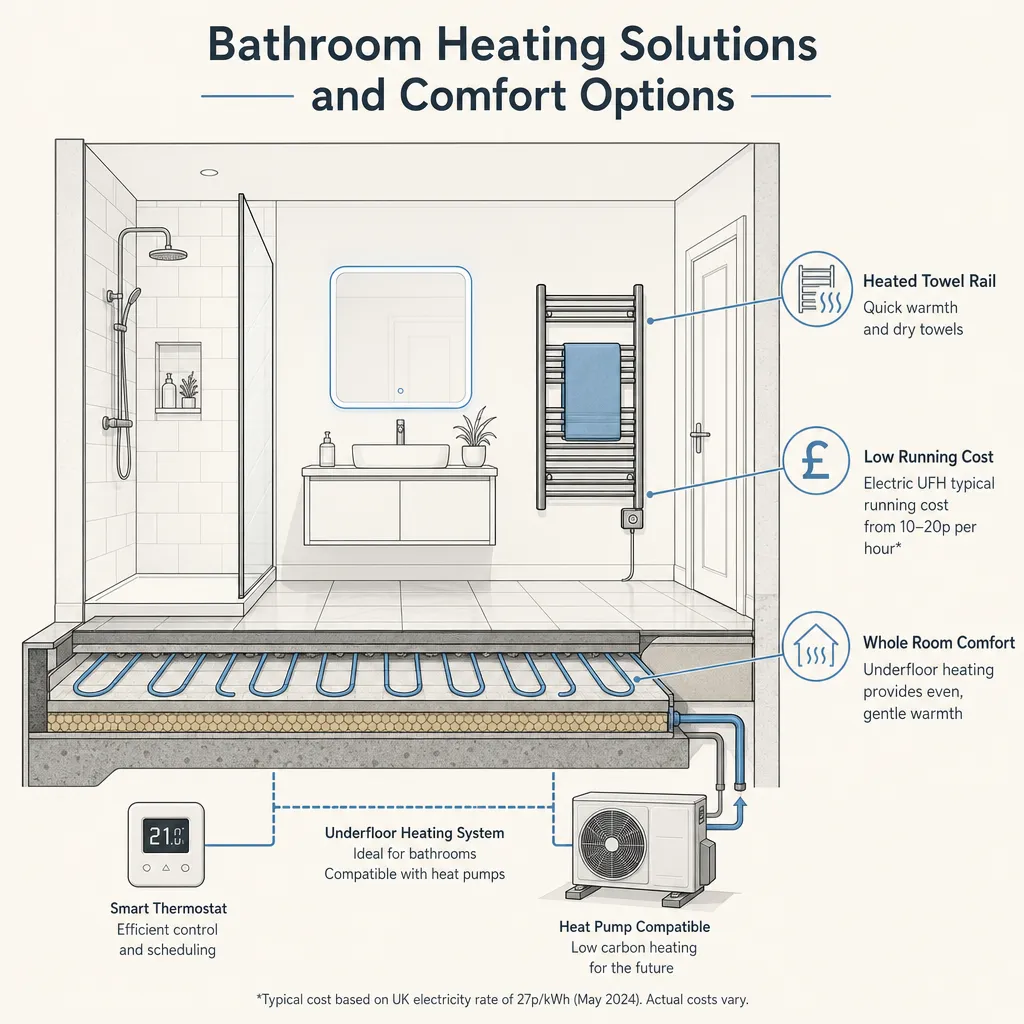
Bathroom Heating Solutions and Comfort Options
UK bathrooms can be heated using electric towel rails, wet radiators on the central heating circuit, electric or wet underfloor heating, or infrared panels.
 Energy & Retrofit
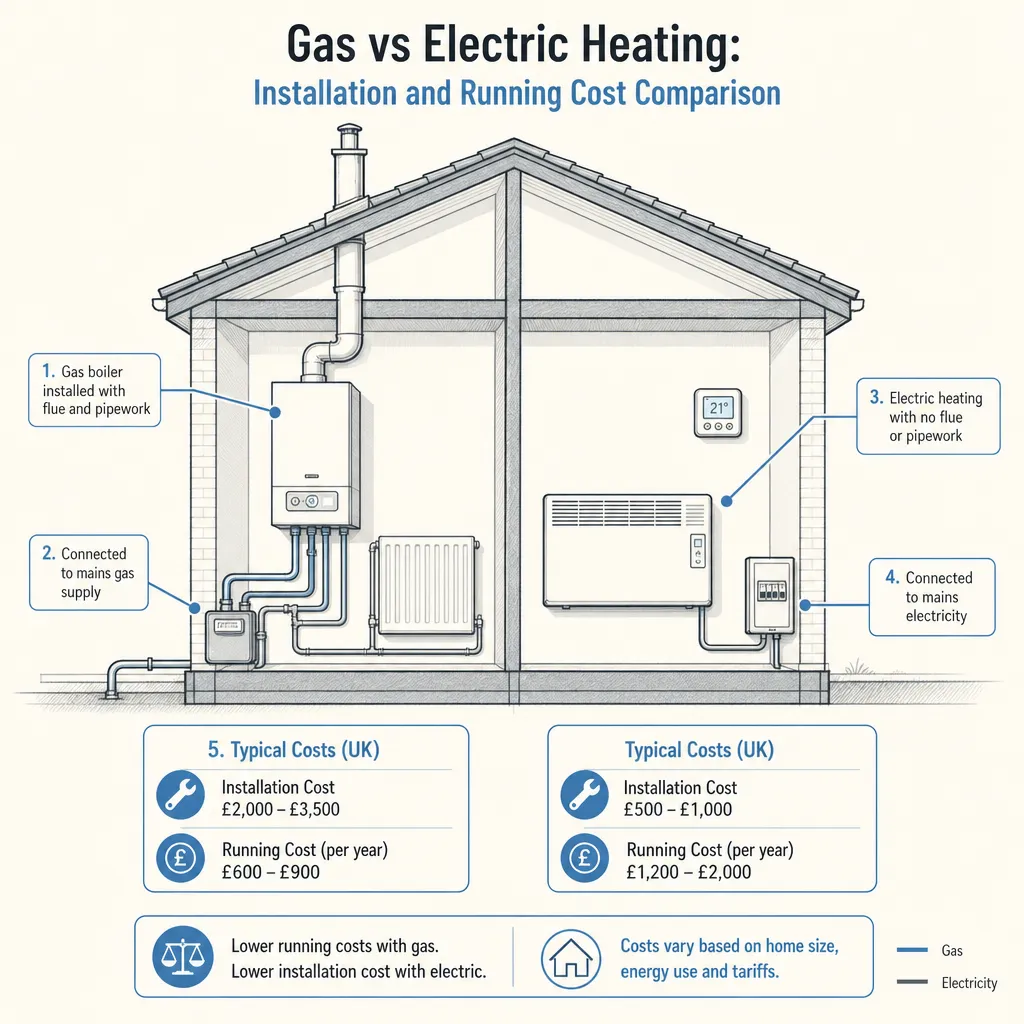
Gas vs Electric Heating: Installation and Running Cost Comparison
Gas central heating usually has lower running costs per kWh than direct electric heating in the UK, though heat pumps can change that equation.
 Energy & Retrofit
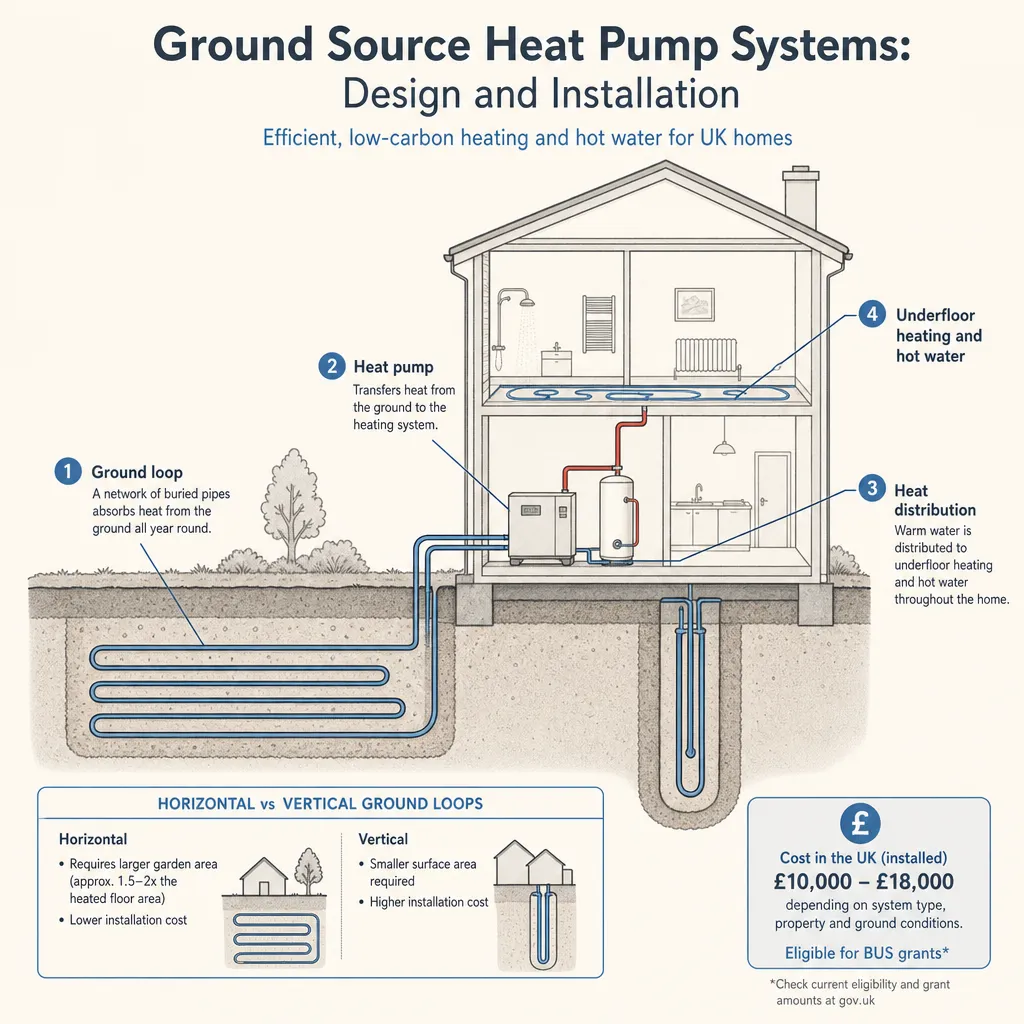
Ground Source Heat Pump Systems: Design and Installation
Ground source heat pumps extract heat from the earth through buried loops or boreholes, then upgrade it for space heating and hot water.
 Energy & Retrofit
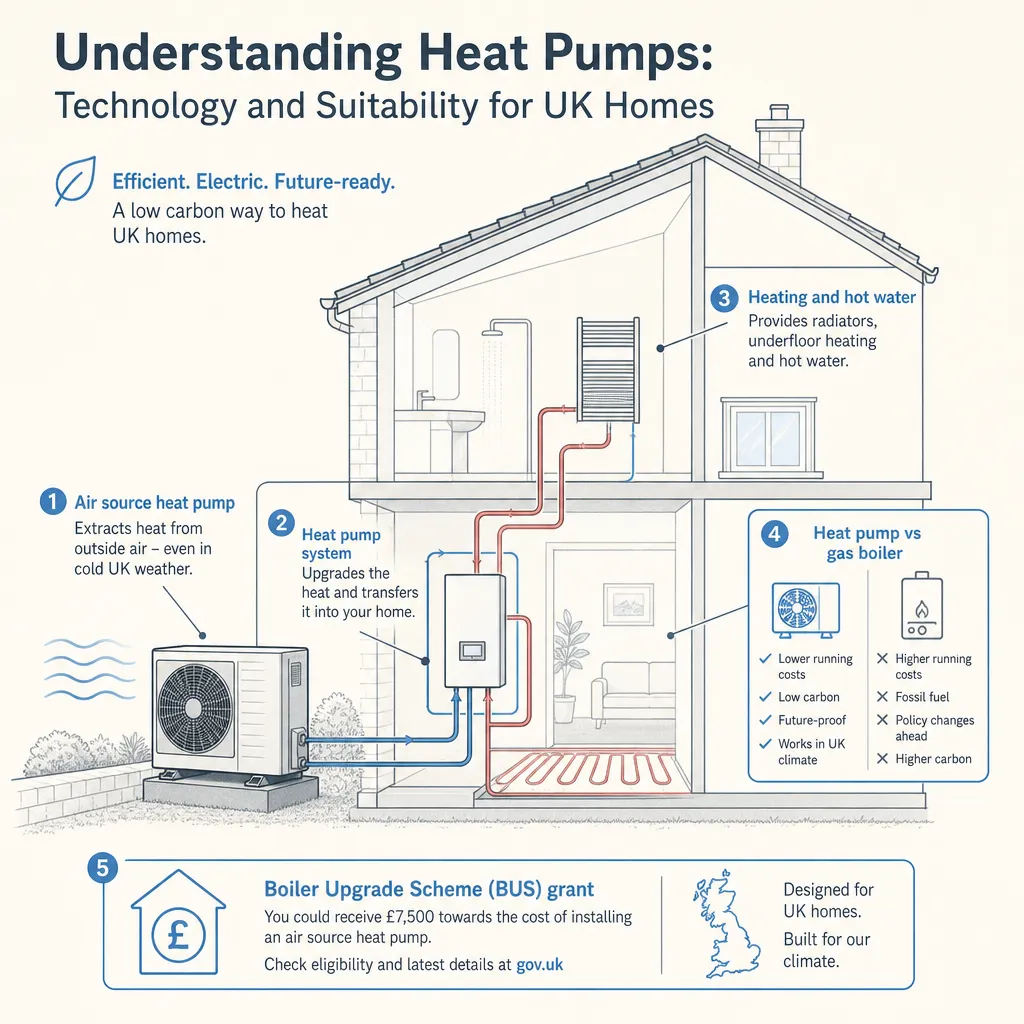
Understanding Heat Pumps: Technology and Suitability for UK Homes
Heat pumps extract heat from the air or ground and transfer it indoors, typically achieving efficiencies of 250–400% compared to a conventional boiler's near 100%.
 Energy & Retrofit
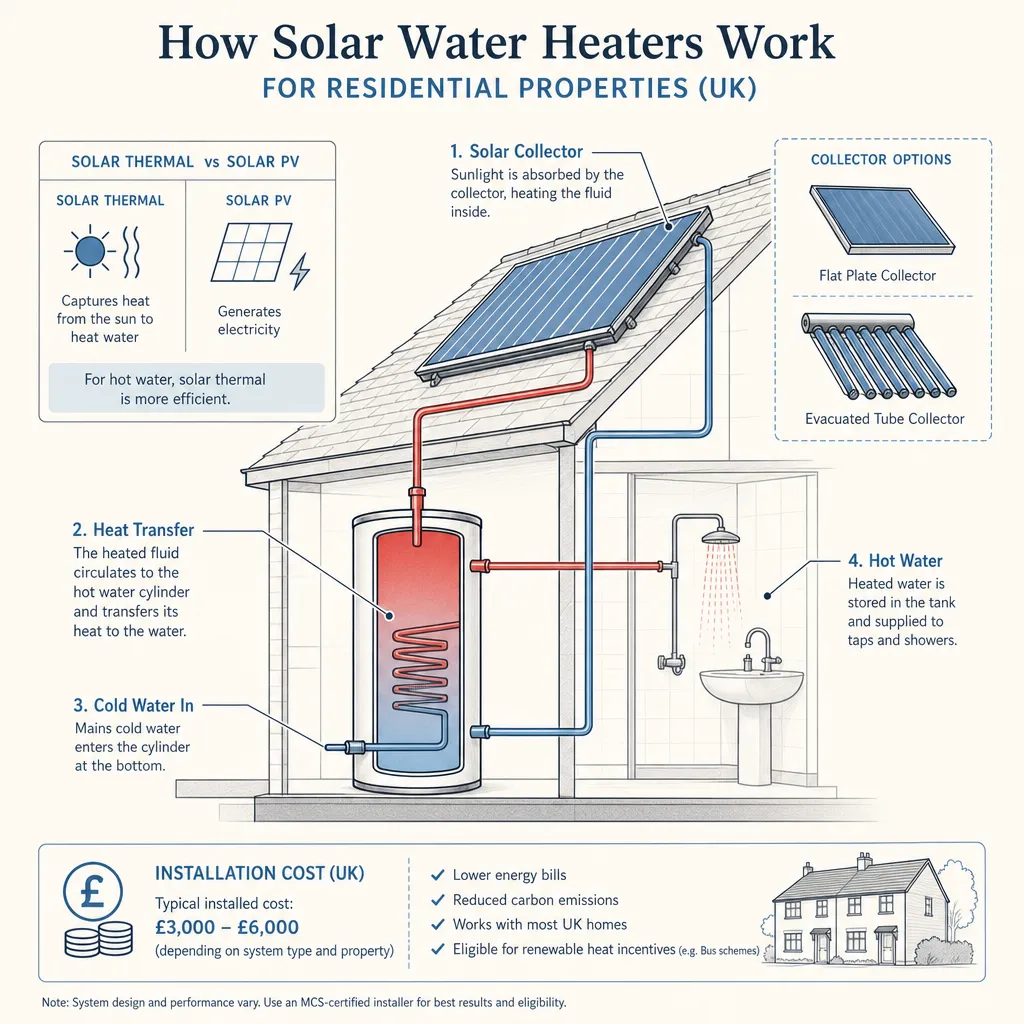
How Solar Water Heaters Work for Residential Properties
Solar water heaters use roof-mounted collectors to capture heat from sunlight and transfer it to a hot water cylinder via a fluid circuit.