How Solar Water Heaters Work for Residential Properties
By Housey · Last reviewed 31st of May 2026
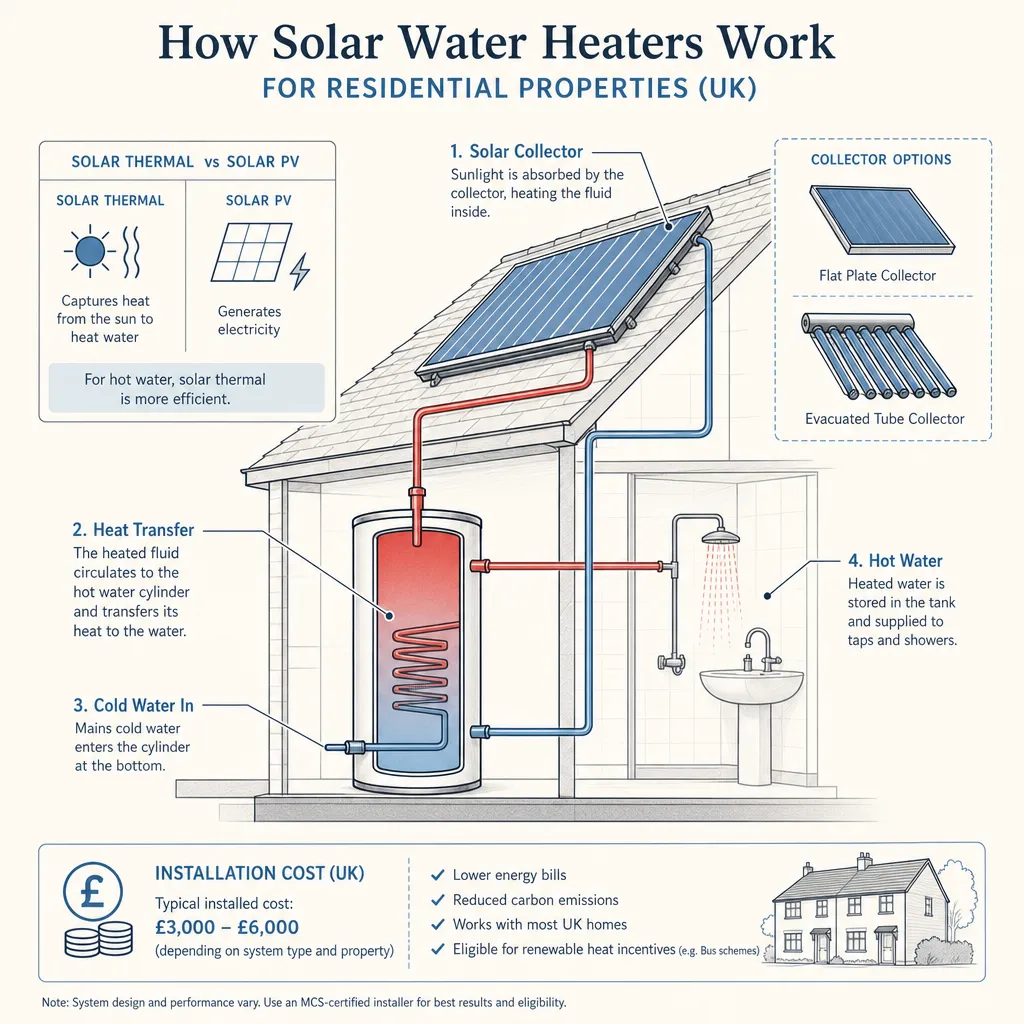
How Solar Water Heaters Work for Residential Properties
Hot water typically accounts for around 25–30% of a UK home's annual energy use, making it one of the most impactful areas to address in any energy retrofit. Solar water heating — also called solar thermal — uses roof-mounted collectors to capture heat from sunlight directly, rather than converting it to electricity first, and the technology has been deployed on UK homes for decades. Homeowners weighing up their options often compare it against a solar PV diverter, which uses surplus electricity from solar panels to heat water, or against a heat pump; understanding how each system actually works is the most useful starting point before comparing quotes or commissioning a survey.
Key points
- Solar thermal systems use dedicated roof collectors and a separate fluid circuit to transfer heat to a hot water cylinder — they do not generate electricity and are entirely distinct from solar PV systems.
- A domestic solar thermal system typically covers 40–60% of annual hot water demand in the UK, with output highest in spring and summer.
- MCS certification of both the product and the installer is required for installations to be counted towards Building Regulations compliance and to access current VAT relief.
- PAS 2035:2023, the UK framework for domestic energy retrofit, applies when solar thermal is installed as part of a broader whole-house retrofit — requiring oversight by a qualified Retrofit Coordinator.
- Two main collector types exist — flat plate and evacuated tube — with different thermal performance characteristics, particularly under the diffuse light conditions common across much of the UK.
How the system works
A solar thermal system has four main components working together:
- Collectors. Panels fixed to the roof absorb solar radiation. Inside the collectors, a heat-transfer fluid — usually a glycol-water antifreeze mixture — is heated by the sun.
- Pipework and pump. The heated fluid circulates through insulated pipes from the collectors down to the hot water cylinder. A small electric pump moves the fluid around the closed circuit; an electronic controller starts the pump when the collector temperature is sufficiently above the stored water temperature.
- Twin-coil cylinder. A purpose-designed hot water cylinder with two heat exchangers (coils): one for the solar circuit (connected to the lower portion of the cylinder) and one for the backup heating source — boiler, heat pump, or immersion heater. Solar preheats the water in the lower zone; backup heating brings it up to temperature when solar input is insufficient.
- Expansion vessel and safety valve. Solar systems operate under pressure and can reach high temperatures in summer. An expansion vessel, pressure relief valve, and overheat protection device prevent damage to pipework and eliminate scalding risk.
The controller monitors temperature sensors at the collector and at the base of the cylinder. When the collector is sufficiently warmer than the stored water — typically a 5–8°C differential — the pump runs and heat is transferred. The system is passive during the night and in cold conditions when the collector cannot generate useful heat.
Flat plate vs evacuated tube collectors
Feature | Flat plate collector | Evacuated tube collector |
|---|---|---|
How it works | Absorber plate inside a glazed, thermally insulated box | Each glass tube is a vacuum-insulated envelope containing an absorber fin or heat pipe |
Performance in diffuse light | Good | Better — vacuum insulation reduces heat loss in overcast, cold, or low-angle winter sun |
Performance in direct sun | Very good | Very good |
Typical UK annual output | 350–500 kWh/m² | 400–600 kWh/m² |
Roof profile | Flush-mount or low-frame; lower visual profile | Tubular; higher profile, more visible from street level |
Durability | Robust sealed unit with no moving parts | Individual glass tubes can be replaced separately if broken |
Relative upfront cost | Lower | Higher |
Best for | South or south-west facing roofs; consistent temperate conditions | Colder or cloudier regions; east/west-facing or lower-pitch roofs |
Indicative UK costs, last reviewed 2026-05-31: a typical 2–4 m² domestic solar thermal installation (supply and fit, including cylinder if required) ranges from approximately £3,000 to £6,000 depending on system type, collector specification, and location. Always obtain at least three quotes from MCS-certified installers. (Source: Energy Saving Trust solar water heating guidance.)
Solar thermal vs solar PV diverter: which is right for you?
- Choose solar thermal if you do not yet have solar PV panels, want a dedicated high-efficiency hot water solution, and your roof has sufficient south-facing area for collectors.
- Choose a solar PV diverter if you already have solar PV and want to reduce wasted export to the grid without additional roof equipment — a diverter routes surplus generation to your existing immersion heater.
- Consider neither in isolation if your home does not have suitable hot water storage — both solar thermal and PV diverters require a compatible hot water cylinder with an immersion heater or solar coil.
- Consult a retrofit assessor if solar thermal is part of a broader energy upgrade — PAS 2035 requires whole-house assessment to identify sequencing risks, including moisture and ventilation implications of changing heating systems.
What to ask before accepting a quote
Before instructing a solar thermal installer, ask the following:
- Is the system and installation MCS-certified? Will you provide the MCS certificate on completion?
- Which collector type and brand are you proposing, and what is the manufacturer's rated output for my roof orientation and location?
- What cylinder will you install, and is it compatible with my existing boiler or heat pump?
- Has Legionella risk been considered — will the system reliably maintain stored water at 60°C with backup heating?
- What maintenance does the system require, and is a periodic service contract available?
- Is VAT included? MCS-certified solar thermal installations currently attract 0% VAT under HMRC energy-saving materials relief — confirm this applies to your project.
- What is the estimated annual yield for my property, and what calculation method or tool was used to arrive at this figure?
- What are the terms of the installation warranty and the manufacturer's product warranty?
When to get professional help
Solar thermal installation involves pressurised plumbing, roof-mounted equipment, and connection to the home's hot water system. It must be carried out by a competent, ideally MCS-certified, installer. Self-installation will not achieve MCS certification and forfeits the associated regulatory recognition and financial benefits.
Seek professional advice before proceeding if:
- Your roof faces north or has a pitch below 20° — output will be significantly reduced and alternatives may be more cost-effective.
- Your property is listed or in a conservation area — permitted development rights for solar thermal collectors may be restricted, and planning permission may be required before any installation work starts.
- Your existing cylinder is not a twin-coil design — cylinder replacement will add to the project cost and should be factored into any quotes you receive.
- You are considering solar thermal as part of a whole-house retrofit — PAS 2035 requires a qualified Retrofit Coordinator to oversee project sequencing and risk management.
How Housey can help
Housey connects you with MCS-certified solar thermal installers and retrofit professionals across the UK. A solar survey will assess your roof's suitability and estimate likely output for your location, while a retrofit assessment can position solar thermal within a whole-house energy improvement plan — making sure new systems complement your existing heating and ventilation rather than working against them.
Frequently asked questions
How much hot water can solar thermal provide in the UK?
A well-designed system typically provides 40–60% of annual hot water demand in the UK. Output is highest in spring and summer, when on sunny days the system may cover close to 100% of demand. In winter, output drops significantly and a backup boiler or heat pump is needed to maintain water at a Legionella-safe storage temperature of at least 60°C.
Do I need planning permission for solar thermal panels?
In most cases, solar thermal panels on a residential property in England fall under permitted development rights and do not require a planning application. Restrictions apply to listed buildings and conservation areas, and panels must not protrude more than 200mm beyond the roof plane. Check current rules via the Planning Portal or your local planning authority before any installation work starts.
Is there any grant funding available for solar water heaters in the UK?
As of 2026, the main financial support for MCS-certified solar thermal installations in Great Britain is the 0% VAT rate under HMRC's energy-saving materials relief. The Renewable Heat Incentive closed to new applications in March 2022. Check GOV.UK and the Energy Saving Trust for the latest information, as government schemes and eligibility criteria can change.
How often does a solar thermal system need servicing?
Most manufacturers and installers recommend a service every 3–5 years. Key checks include antifreeze concentration, pump and controller operation, system pressure, pipe insulation condition, and roof fixings. Some installers offer periodic maintenance contracts — ask for terms and costs when you request installation quotes, so ongoing servicing is factored into the total cost.
Sources and further reading
- Solar water heating — Energy Saving Trust
- MCS standards for solar thermal — Microgeneration Certification Scheme
- Solar panels and planning permission — Planning Portal
- PAS 2035:2023 — Retrofitting dwellings for improved energy efficiency — British Standards Institution / TrustMark
- VAT on energy-saving materials — HMRC
Useful next reads
 Energy & Retrofit
Do Solar Panels Increase Property Value?
Solar panels generally add value to UK properties, with research suggesting an uplift of 0.
 Energy & Retrofit
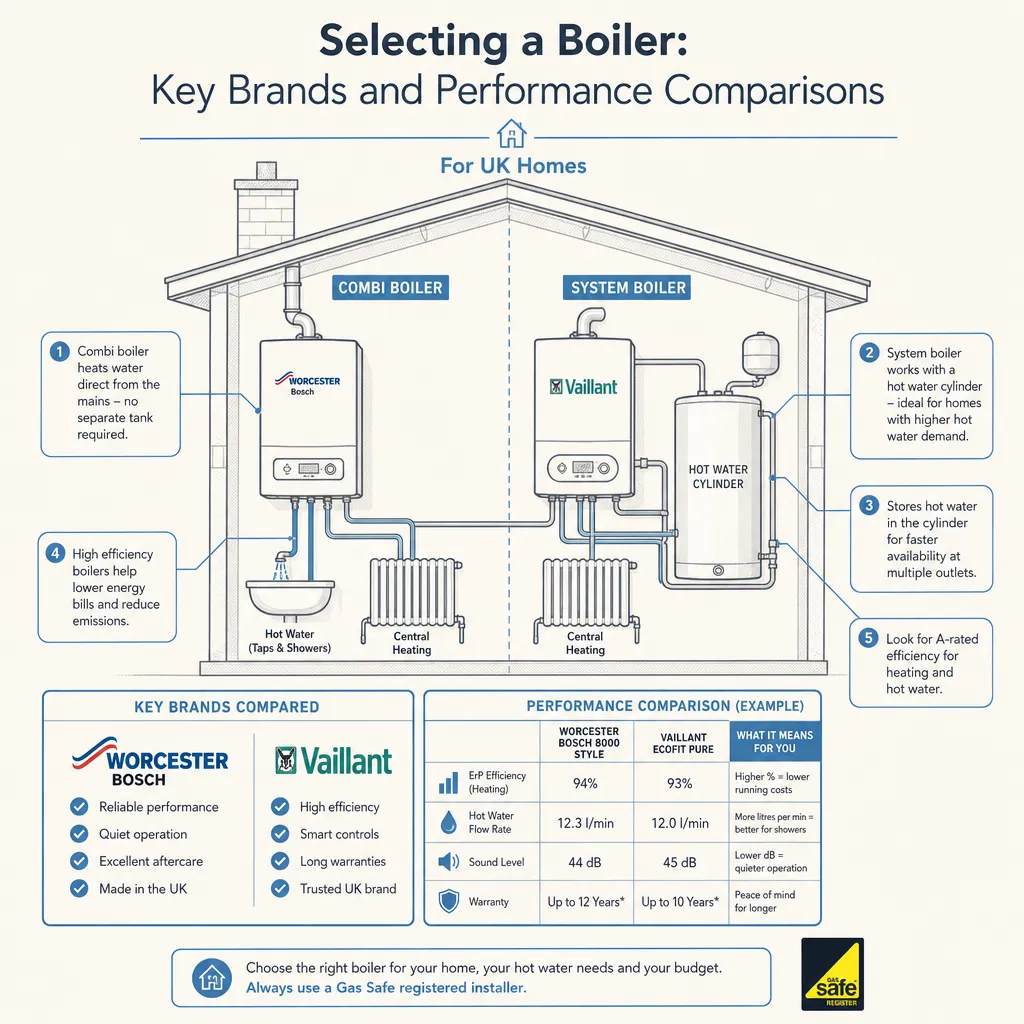
Selecting a Boiler: Key Brands and Performance Comparisons
Most UK homes are heated by a combi, system, or heat-only boiler.
 Energy & Retrofit
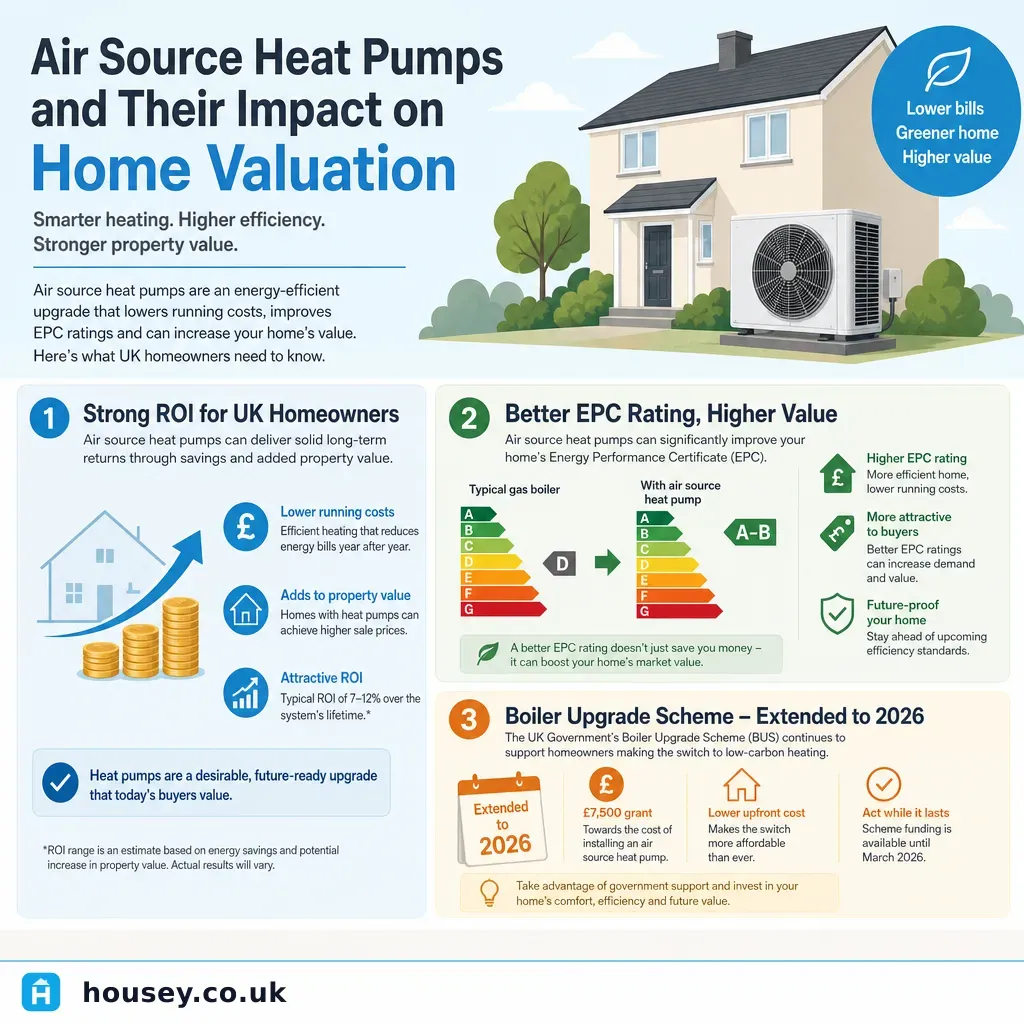
Air Source Heat Pumps and Their Impact on Home Valuation
An air source heat pump can improve your home's EPC rating, which may positively influence its market value — particularly as mortgage lenders and buyers increasingly factor in energy performance.
 Energy & Retrofit
Electric Heating Systems: Options and Comparisons
Electric heating in the UK ranges from direct-acting radiators and storage heaters to heat pumps and electric boilers.
 Energy & Retrofit
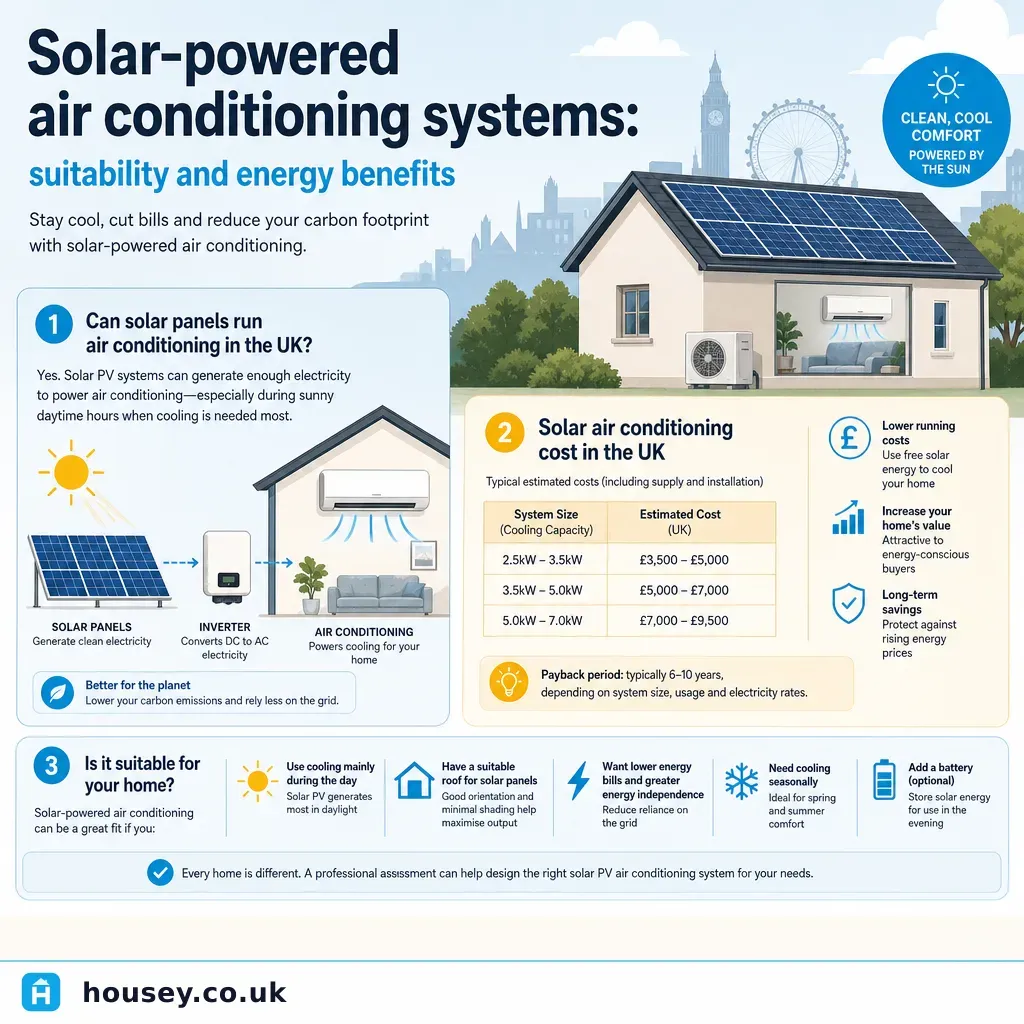
Solar-powered air conditioning systems: suitability and energy benefits
Solar-powered air conditioning pairs photovoltaic panels with an inverter-driven air conditioning unit to cool a home using renewable electricity.